General Chemistry, 11e (Petrucci)
Chapter 28 Chemistry of the Living State
1) The cell is the fundamental unit of all life.
2) All of the known elements occur in measurable amounts in the human body.
3) Lipids are those constituents of plant and animal tissue that are soluble in very polar solvents.
4) Fats and oils differ in the nature of the acid components in the triglycerides.
5) Diastereomers have the same chemical and physical properties.
6) Enantiomers have the same chemical and physical properties.
7) Enantiomers are non-superimposable mirror images.
8) Proteins are made up of 40 amino acids.
9) Metabolic reactions in which substances are broken down are referred to as anabolism.
10) The fundamental agents involved in energy transfer are adenosine diphosphate (ADP) and adenosine
triphosphate(ATP).
11) DNA contains the sugar ribose.
12) In DNA, guanine always pairs with cytosine.
13) Choose the INCORRECT statement.
A) About 50 elements occur in measurable concentrations in living matter.
B) About 25 elements have functions that are definitely known.
C) Oxygen, carbon, hydrogen and nitrogen account for 96% of human body mass.
D) Water is the most abundant compound in most living organisms.
E) Mitochondria make up the nucleus of a cell.
14) Choose the INCORRECT statement.
A) Tissues are the fundamental unit of all life.
B) Tissues group into organs.
C) Organs combine into organ systems.
D) A nucleus, mitochondria, and chloroplasts are components of cells.
E) Living tissue is synthesized from simple precursors: N2, H2O, CO2.
15) Triglycerides are composed of which two compounds linked through an ester functionality?
A) glycerol and long chain monoalcohols
B) glycine and carboxylic acids
C) glycerol and long-chain monocarboxylic acids
D) lauric acid and glucose
E) ethylene glycol and dicarboxylic acids
16) Choose the INCORRECT statement.
A) Fats become rancid when they hydrolyze and cleave at the double bonds by oxidation.
B) Antioxidants retard oxidative rancidity of fats.
C) Medical studies correlate a high intake of saturated fats and coronary heart disease.
D) Healthy diets call for the substitution of saturated fatty acids with unsaturated fatty acids in foods.
E) In general, mammal fats are unsaturated.
17) Choose the INCORRECT statement.
A) Lipids are hydrocarbons with basic properties.
B) The acyl groups of triglycerides are fatty acids.
C) A mixed triglyceride has different acyl groups.
D) Lipids are constituents of plant and animal tissues that are soluble in solvents of low polarity.
E) Triglycerides are esters of glycerol with long-chain monocarboxylic acids.
18) Choose the INCORRECT statement.
A) When the long chain monocarboxylic acids are removed from a triglyceride they are called fatty acids.
B) Saturated fatty acids have multiple double bonds.
C) Triglycerides can be hydrolyzed in alkaline solution to glycerol and salts of fatty acids.
D) Salts of fatty acids are called soaps.
E) The hydrolysis of triglycerides is called saponification.
19) Choose the INCORRECT statement.
A) Triglycerides are glyceryl esters.
B) Fats and oils are glyceryl esters.
C) Oils have predominately saturated acid components.
D) Oils are liquid at room temperature.
E) Pure fats and oils are colorless, odorless and tasteless.
20) A glycerol ester of unsaturated fatty acids best describes a(n):
A) vegetable oil
B) vegetable starch
C) animal fat
D) lipid
E) wax
21) Which of the following readily dissolve in nonpolar solvents?
A) proteins
B) nucleic acids
C) glycine
D) lipids
E) enzymes
22) Which of the following fatty acids is unsaturated?
A) palmitic acid
B) oleic acid
C) myristic acid
D) stearic acid
23) Saponification of 1 mole of glyceryl dibutyrooleate with excess potassium hydroxide would yield
which of the following products?
A) 2 moles of potassium butyrate, 1 mole of potassium oleate
B) 1 mole of glycerol, 1 mole of potassium oleate, 2 moles of potassium butyrate
C) 2 moles of potassium butyrate
D) 1 mole of glycerol, 2 moles of butyraldehyde, 1 mole of olealdehyde
E) 1 mole of glycerol, 1 mole of potassium decanoate, 2 moles of potassium butyrate
24) A typical E. coli bacterium is a cylindrical cell about 2 μm long and 1 μm in diameter, weighing about
1.8 × 10⁻¹² g and containing 80% water by volume. Calculate the number of lipid molecules present,
assuming their average molecular weight is 688 g/mol and the lipid content is 1.9%.
A) 8.3 × 10¹⁰
B) 2.1 × 10¹⁰
C) 2.4 × 10⁷
D) 1.6 × 10⁹
E) 3.0 × 10⁷
25) Enantiomers ALWAYS:
A) have an asymmetric carbon
B) have different physical properties
C) change the color of light
D) rotate polarized light
E) have different chemical properties
26) Which of the following is a polysaccharide?
A) ribose
B) fructose
C) glucose
D) glycogen
E) pentose
27) Compounds which are optical isomers of one another but differ in physical and chemical properties
are known as what?
A) geometric isomers
B) enantiomers
C) racemic compounds
D) allotropes
E) diastereomers
28) Choose the INCORRECT statement.
A) Unsaturation in a fat or oil can be removed by hydrogenation.
B) Unsaturation can be removed by the catalytic addition of hydrogen.
C) Removing unsaturation raises the melting point of the fat or oil.
D) Margarines are oils, fortified with color.
E) Fats and oils become rancid when exposed to heat, air, and light.
29) Choose the INCORRECT statement.
A) The simplest carbohydrates are the oligosaccharides.
B) Mono- and oligosaccharides are called sugars.
C) Polysaccharides contain more than 10 monosaccharide units.
D) Starch and cellulose are polysaccharides.
E) The general term for all carbohydrates is glycoses.
30) Choose the INCORRECT statement.
A) Two molecules that are nonsuperimposable mirror images of one another are optical isomers.
B) Enantiomers are molecules that are mirror images of one another which are superimposable.
C) A dextrorotatory isomer rotates plane polarized light to the right.
D) Optical isomers generally have one carbon with 4 different groups attached to it.
E) A carbon atom with 4 different groups attached to it is called a chiral center.
31) Choose the INCORRECT statement.
A) A levorotatory isomer rotates plane polarized light to the left.
B) A chiral atom is said to be asymmetric.
C) The absolute configuration is the arrangement of atoms as determined by X-ray studies.
D) Molecules that are optically active isomers but not mirror images are diastereomers.
E) Enantiomer properties differ only in the direction they rotate plane polarized light.
32) Choose the INCORRECT statement.
A) A 50/50 mixture of two enantiomers is a racemic mixture.
B) A racemic mixture will not rotate plane polarized light.
C) Separating the optical isomers is called resolution.
D) Dextrorotatory optical isomers are designated as (-).
E) Molecules that will rotate plane polarized light are optically active.
33) Choose the INCORRECT statement.
A) Glucose, galactose and mannose exist in straight-chain and in ring structures.
B) Two monosaccharides combine by losing a water molecule to form a disaccharide.
C) The important natural disaccharides are maltose, cellobiose, lactose and sucrose.
D) Glycogen is the reserve carbohydrate of animals.
E) Glycogen cannot be broken down by human digestion.
34) Choose the INCORRECT statement.
A) Glycogen is the main structural material of plants.
B) Carbohydrates are produced in plants by the photosynthesis reaction.
C) Oligosaccharides contain 2 to 10 monosaccharide units.
D) Polysaccharides contain more than 10 monosaccharide units.
E) Monosaccharides contain one saccharide unit.
35) Which of the following do humans have difficulty digesting?
A) cellulose
B) proteins
C) vegetable oils
D) vegetable starch
E) animal fats
36) Choose the correct statement.
A) Fructose is a pentose.
B) All sugars have oxygen and are good oxidizing agents.
C) Reducing sugars don’t open into the straight chain form.
D) Sucrose is a disaccharide.
E) Ribose and deoxyribose are hexoses.
37) Which of the following is a monosaccharide?
A) glycogen
B) animal fat
C) cellulose
D) starch
E) sucrose
38) Choose the molecule which may display optical isomerism.
A) CH2OH-CH(OH)-CH2OH
B) CH3CH2CH(OH)CH3
C) NH3CH2COOH
D) O
CH3(CH2)16COH
E) O
HOCH2CH2CH
39) Which molecule is optically active?
A) 2-chlorobutane
B) 1-chlorobutane
C) trans-propene
D) cis-propene
40) Which of the following contains less than six carbon atoms?
A) deoxyribose
B) glucose
C) aldohexose
D) methylcyclopentane
E) benzene
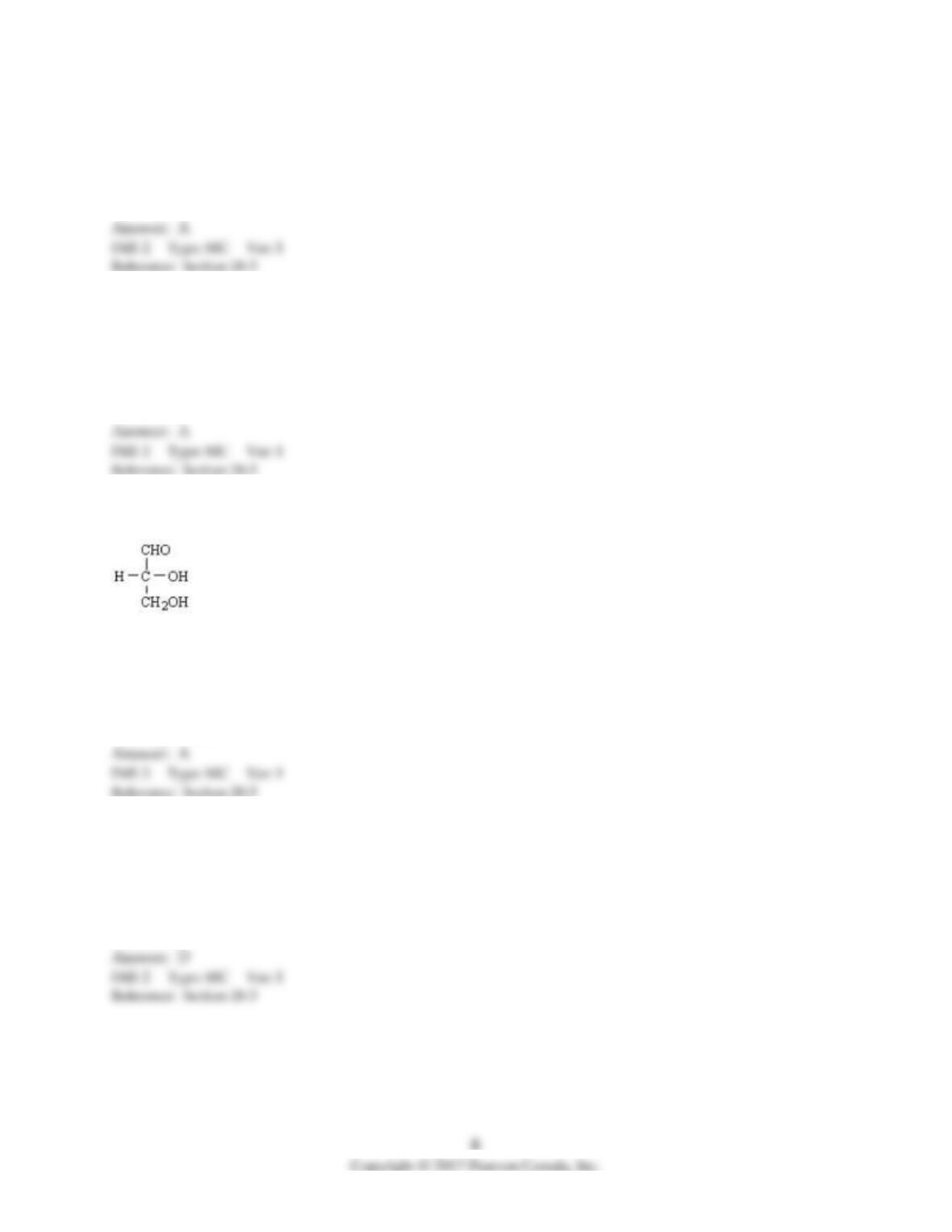
41) What is the common name of the following glycose shown in Fischer notation?
A) D-glyceraldehyde
B) L-glyceraldehyde
C) S-glyceraldehyde
D) (-)-glyceraldehyde
E) D-erythrose
42) Which of the following compounds may display the property of optical isomerism?
A) 3-pentanol
B) 2-pentene
C) 2-bromopropane
D) 2-bromobutane
E) acetone
43) Choose the INCORRECT prediction. By careful inspection of the formula of lactic acid,
CH3CH(OH)COOH, one would predict:
A) Molecules should have two forms. These forms are mirror images of one another.
B) Molecule should show cis and trans isomerism.
C) Molecule should have a chiral carbon atom.
D) Molecule should show optical isomerism.
E) Molecule should show acidic properties.
44) Cellulose and starch are both polymers of glucose units, but most animals can only use starch as a
source of carbohydrate in their diets. Why are most animals incapable of digesting cellulose?
A) Starch contains α linkages between carbons 1 and 4, where as cellulose contains β linkages between
carbons 1 and 2.
B) The glucose units of cellulose are in the open chain form and cannot be hydrolyzed by the cyclic-sugar
specific enzymes of animals.
C) The polymer of cellulose is simply too long to be completely digested by animals.
D) Most animals do not produce enzymes which are capable of hydrolyzing β linkages between cellulose.
E) This statement is incorrect. Most animals can digest cellulose.
45) Which of the following is unimportant for tertiary structure of the proteins?
A) peptide bonds
B) salt linkages
C) hydrogen bonding
D) disulfide linkages
46) Choose the INCORRECT statement.
A) Peptides are amino acids joined by a peptide bond.
B) A tripeptide has three peptide bonds.
C) A protein is hydrolyzed to a mixture of α-amino acids.
D) An α–amino acid is a carboxylic acid with an amine group on the α carbon atom.
E) Proteins are a polymer of amino acid units.
47) Choose the INCORRECT statement.
A) Proteins make up the bulk of the body’s nonskeletal structure.
B) Enzymes are carbohydrates which speed up reactions.
C) Except glycine, naturally occurring amino acids are optically active.
D) Essential amino acids are necessary for proper health and growth.
E) Essential amino acids must be ingested through foods because the body is unable to synthesize them.
48) Choose the INCORRECT statement.
A) Amino acids can exist as dipolar ions.
B) Dipolar ions are also called zwitterion.
C) Isoelectric point is the pH at which an amino acid becomes a cation.
D) Two amino acids joined by the elimination of a water molecule is a dipeptide.
E) A large polypeptide of more than 10,000 u is called a protein.
49) Choose the INCORRECT statement.
A) The bond between amino acids is called a peptide bond.
B) There are four levels of structure in a protein.
C) Primary structure is the linear sequence of amino acids in the polypeptide chain.
D) Secondary structure is the bonding of more than one protein together.
E) Enzymes are biological catalysts that contain protein.
50) Which of the following examples of protein structure would be classified as the tertiary structure of a
protein?
A) β-pleated sheet
B) gly-leu-trp-lys-lys-arg-met
C) three identical subunits
D) an elongated α-helix between two β-pleated sheets
E) amorphous, globular peptide
51) Which of the following is an aromatic amino acid?
A) leucine
B) tryptophan
C) arginine
D) cysteine
E) alanine
52) Which of the following is a basic amino acid?
A) alanine
B) cysteine
C) lysine
D) aspartic acid
E) glycine
53) Glycine is a(n):
A) nucleic acid
B) optically active compound
C) carbohydrate
D) amino acid
E) lipid
54) Which of the following are unimportant for tertiary structure of the proteins?
A) salt linkage
B) disulfide bonds
C) hydrophobic interactions
D) van der Waals forces
E) hydrogen bonding
55) Amino acids are joined into proteins by:
A) a 3′-5′ linkage
B) a beta 1-4 linkage
C) DNA
D) an ester
E) peptide bonds
56) The R group CH2C6H5 belongs to which amino acid?
A) aspartic acid
B) phenylalanine
C) cysteine
D) tyrosine
E) arginine
57) The R group CH2SH belongs to which amino acid?
A) aspartic acid
B) phenylalanine
C) cysteine
D) tyrosine
E) arginine
58) At the isoelectric point, an amino acid has what charges?
A) + and –
B) none
C) + only
D) – only
E) multiple charges
59) The R group –CH3 belongs to which amino acid?
A) glycine
B) lysine
C) proline
D) alanine
E) histidine
60) Salt linkages:
A) occur between acidic and basic R groups
B) join two halves of cysteine
C) occur between purine and pyrimidine bases
D) occur in sugars
E) connect the cell with the environment
61) The molecule on which an enzyme acts is commonly referred to as:
A) reactant
B) substrate
C) metabolites
D) active site
E) coenzyme
62) Choose the INCORRECT statement about metabolism.
A) Catabolism is when substances are broken down.
B) Anabolism is the derivation of energy from substances.
C) Metabolites are substances involved in metabolism.
D) Endergonic reactions are nonspontaneous.
E) Metabolism is the totality of an organism deriving energy from matter and excreting excess.
63) Find a mismatch enzyme – substrate pair.
A) amylases – starch
B) amylase – polysaccharides
C) lipase – fats and oils
D) pepsin – diglycerides
E) trypsin and chymotrypsin – polypeptides
64) Living cells are unable to convert glucose-6P into which of the following?
A) glycogen
B) glucose
C) coenzyme A
D) polysaccharide stored in liver
E) it may be metabolized
65) By definition, exergonic reaction has:
A) ΔG= positive value
B) ΔG= negative value
C) ΔH= positive value
D) ΔH= negative value
E) ΔS= positive value
66) Find a mismatch in the following body part – food metabolism pairs:
A) mouth – starch
B) small intestine – polysaccharides
C) small intestine – fats and oils
D) stomach – proteins
E) stomach – small peptides