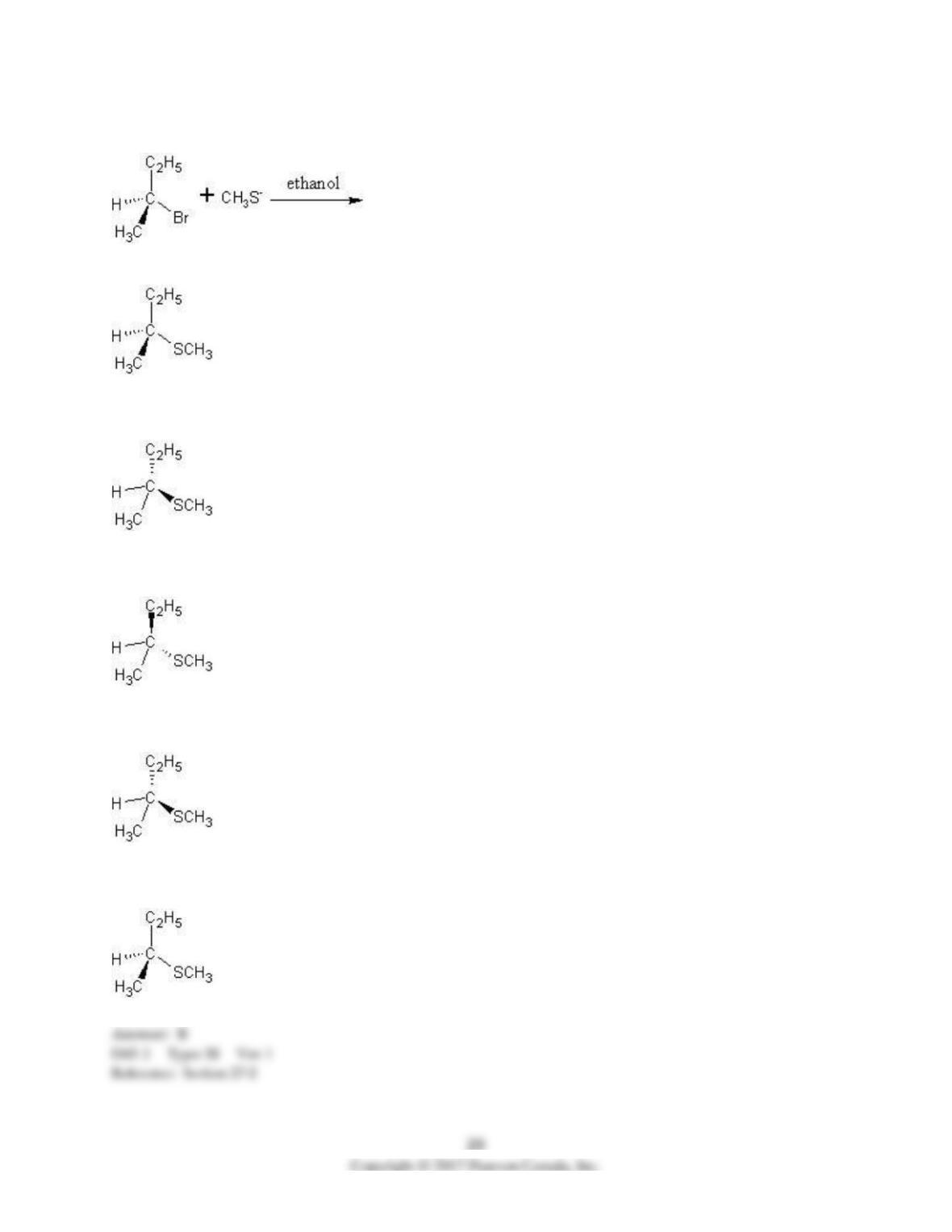
59) Predict the product and mechanism type for the following reaction:
A)
SN2 mechanism
B)
SN2 mechanism
C)
SN1 mechanism
D)
SN1 mechanism
E)
SN1 mechanism
21
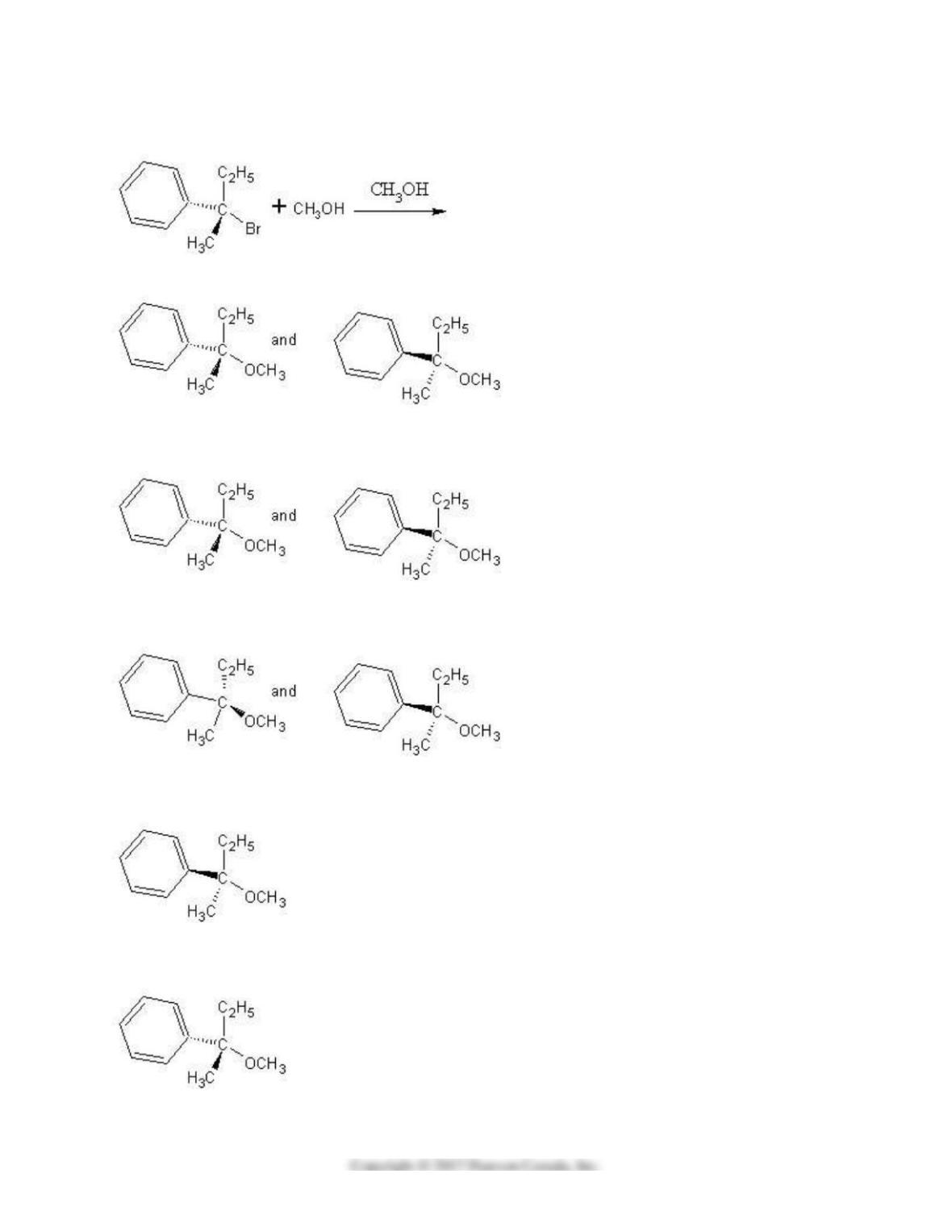
60) Identify the product(s) and mechanism for the following reaction:
A)
SN1 mechanism
B)
SN2 mechanism
C)
SN1 mechanism
D)
SN2 mechanism
E)
SN2 mechanism
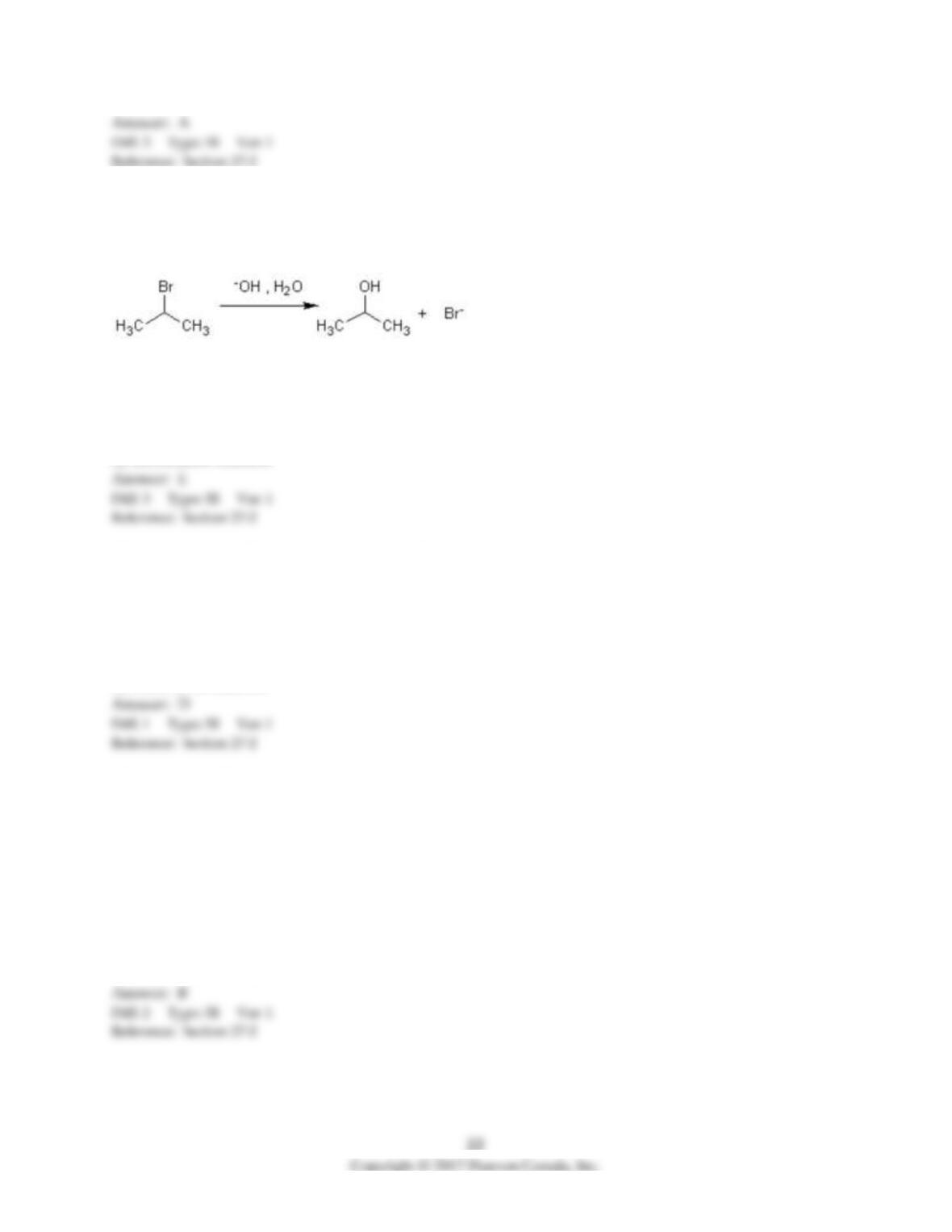
61) The formation of isopropanol (rubbing alcohol) through the following hydrolysis is known as what
type of general reaction?
A) oxidation
B) aromatic substitution
C) addition reaction
D) elimination
E) substitution reaction
62) Complete the following reaction: NH3 + CH3Br →
A) CH4 + NH2Br
B) CH2=NH + H2 + HBr
C) CH3NH2 + NH4+Br–
D) CH3NH3+Br–
E) There is no reaction.
63) Order the following substrates according to the increase in SN2 reaction rate:
(CH3)2CHBr, (CH3)3CBr, CH3CH2Br, CH3Br
A) (CH3)2CHBr < (CH3)3CBr < CH3CH2Br < CH3Br
B) (CH3)3CBr < (CH3)2CHBr < CH3CH2Br < CH3Br
C) (CH3)3CBr < (CH3)2CHBr < CH3Br < CH3CH2Br
D) (CH3)3CBr < CH3CH2Br < (CH3)2CHBr < CH3Br
E) CH3CH2Br < (CH3)3CBr < (CH3)2CHBr < CH3Br
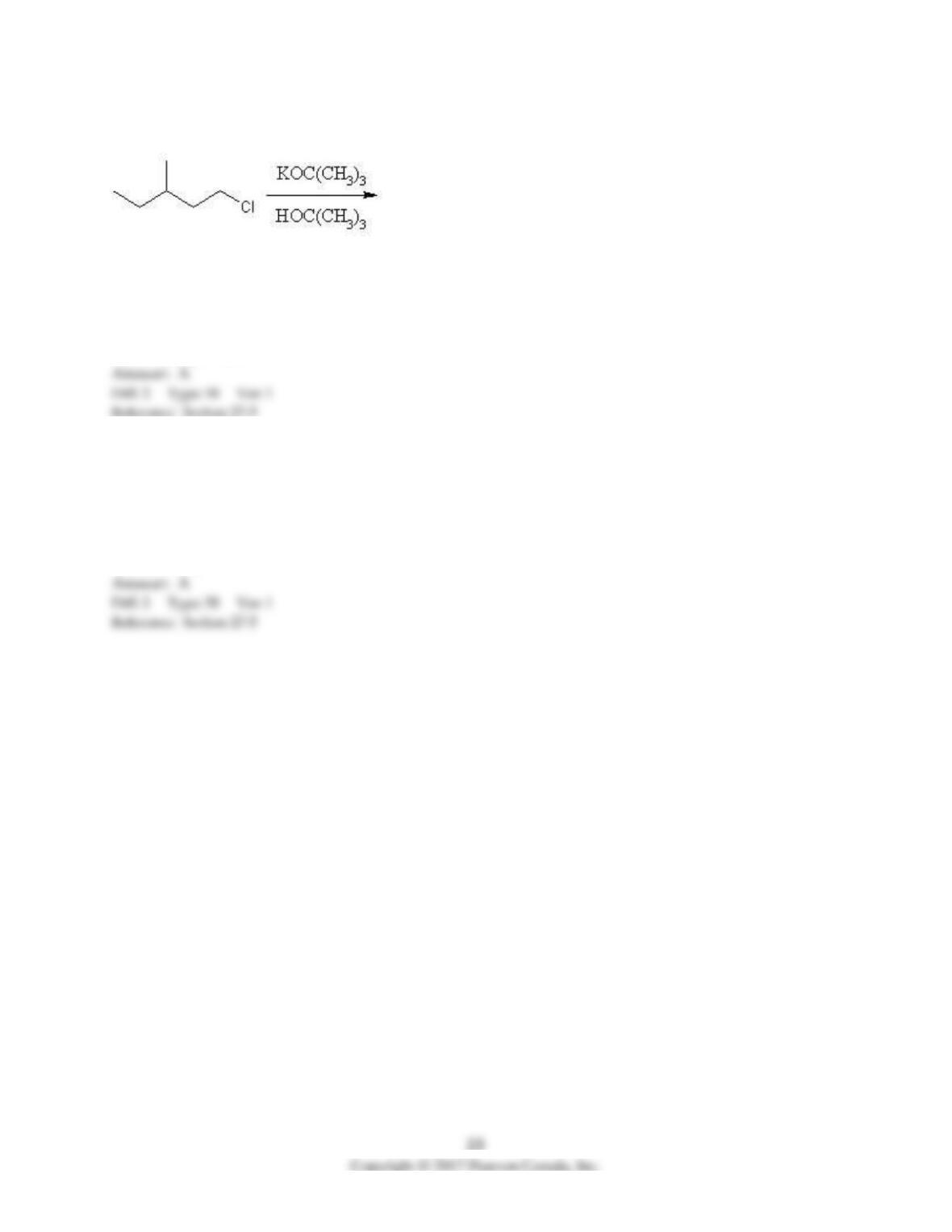
64) Identify the product for the following reaction:
A) 3-methyl-1-pentene
B) 3-methyl-2-pentene
C) 3-methyl-1-pentane
D) 3-methyl-1-tert-butylpentante
E) 3-methylpentane
65) Write down the rate law for E1 reactions (S is a substrate and B is a base).
A) rate = k[S]
B) rate = k[S][B]
C) rate = k[B]
D) rate = k[S]2
E) rate = k[S]1/2
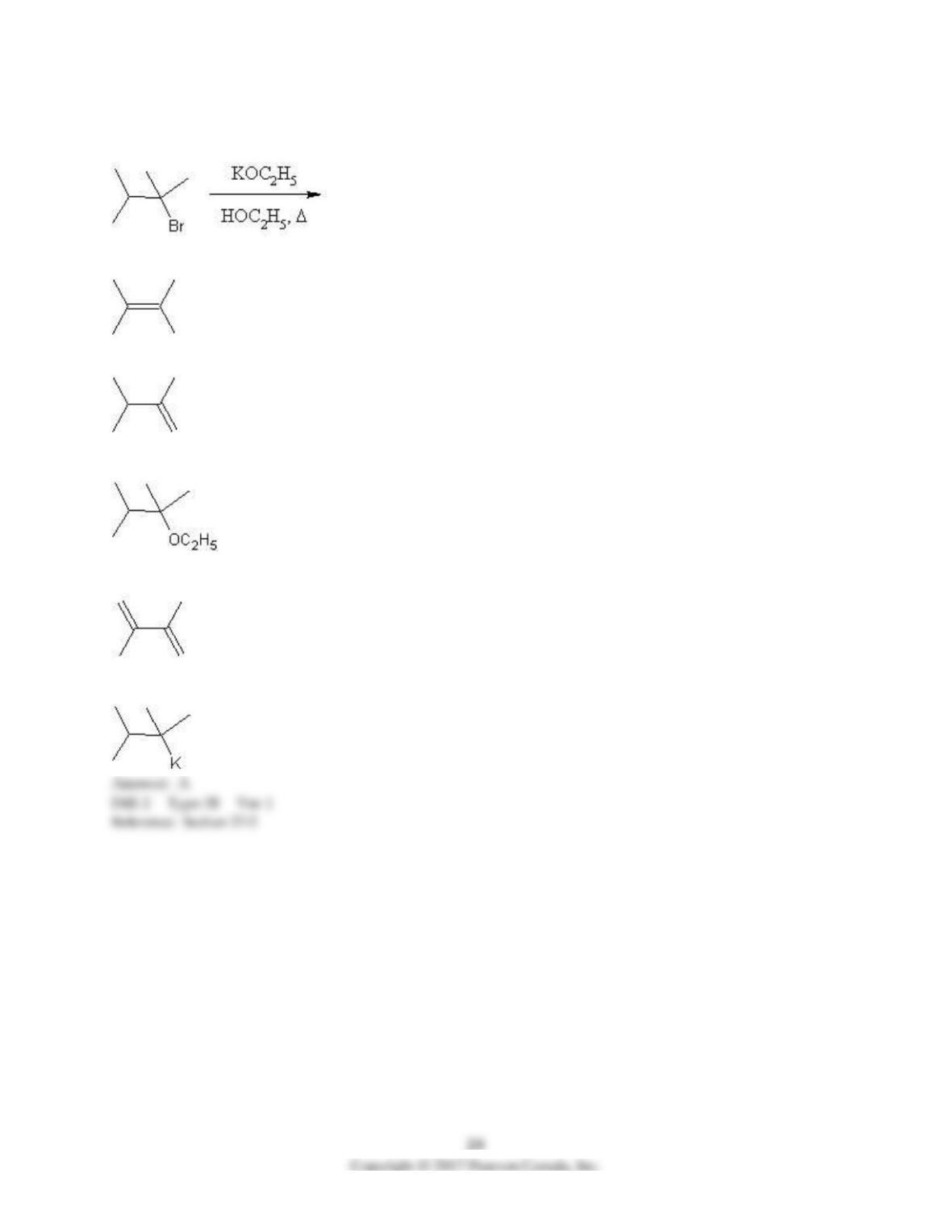
66) What is the major product in the following transformation?
A)
B)
C)
D)
E)
67) Which are the most probable reactions and mechanisms in which tertiary haloalkanes participate?
I) Substitution, SN1
II) Substitution SN2
III) Elimination E1
IV) Elimination E2
V) Addition
A) II), III) and IV)
B) I), IV) and V)
C) II), III) and V)
D) I), III) and IV)
E) III), IV), V)
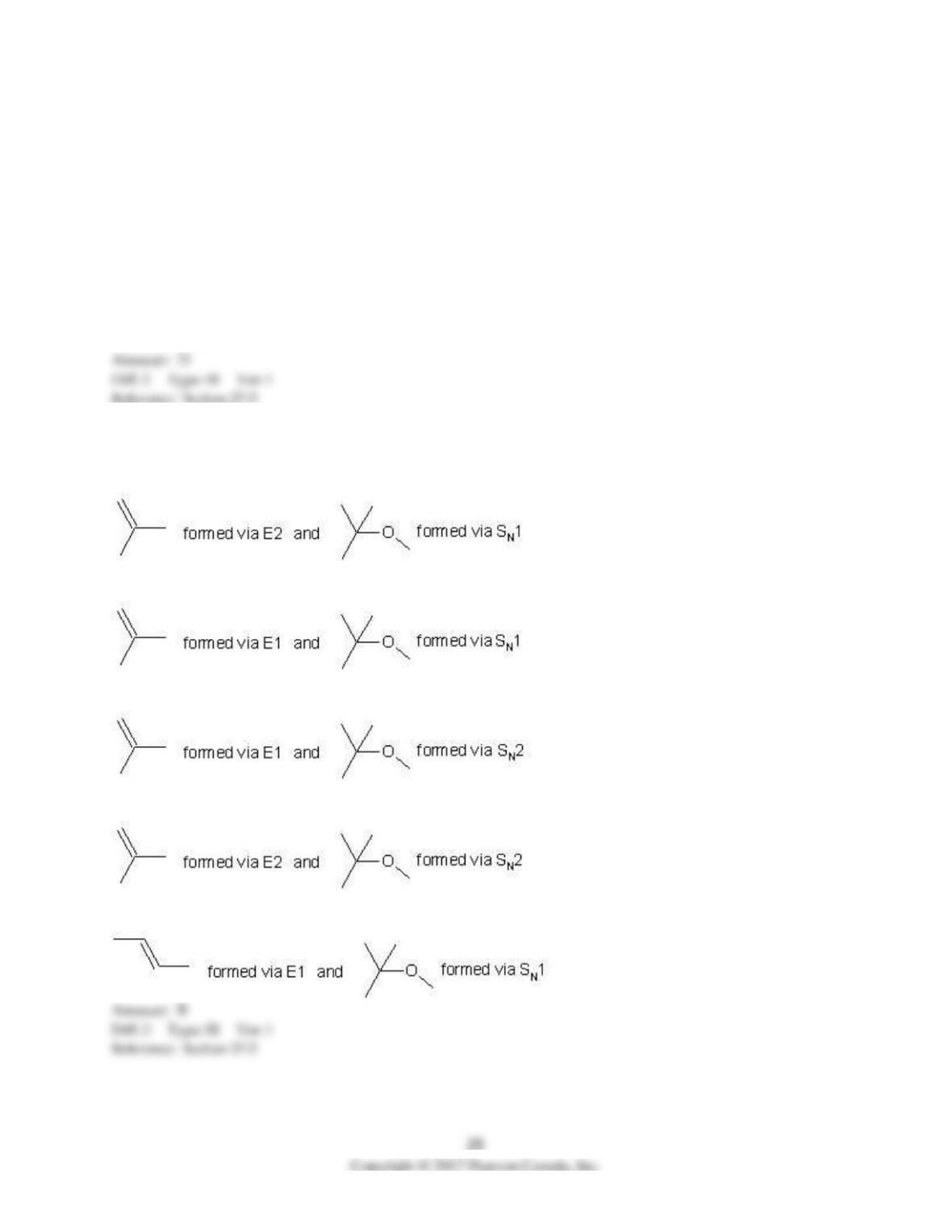
68) When (CH3)3CBr reacts with CH3ONa in methanol, two products are formed: a major one is an
alkene and minor one is an ether. Identify the two products and by what mechanism(s) they are formed?
A)
B)
C)
D)
E)
69) Give the correct mathematical expression for the rate law for E2 reactions (S is a substrate and B is a
base).
A) rate = k[S]
B) rate = k[B]
C) rate = k[S][B]
D) rate = k[S]1/2
E) rate = k[S]2
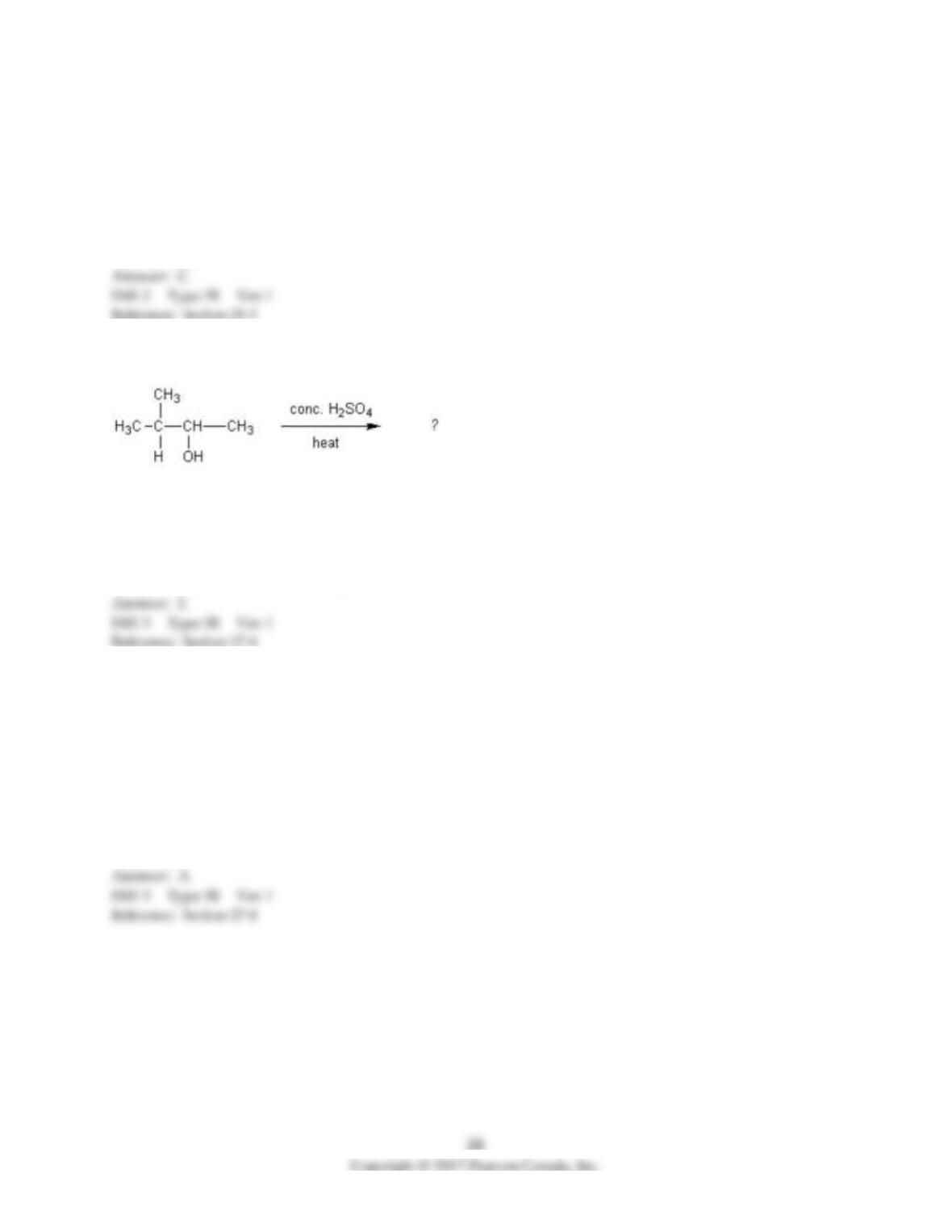
70) What alkene(s) would be produced in the following reaction?
A) 3-methyl-2-pentene
B) 2-methyl-2-butene
C) 3-methylbutene
D) pentene and 1-methylpentene
E) 2-methyl-2-butene and 3-methylbutene
71) Which of the following alcohols can eliminate water to produce alkene?
I) phenol
II) HOC(CH3)3
III) HOCH(CH3)2
A) II) and III)
B) I), II) and III)
C) III) only
D) I) and II)
E) II) only
27
72) The common general anesthetic neothyl can be produced by the following dehydration reaction. What
is the systematic name of neothyl?
CH3CH2CH2OH + CH3OH ?
A) propanone
B) propanal
C) methyl propanoate
D) methyl propyl ether
E) ethyl methyl ether
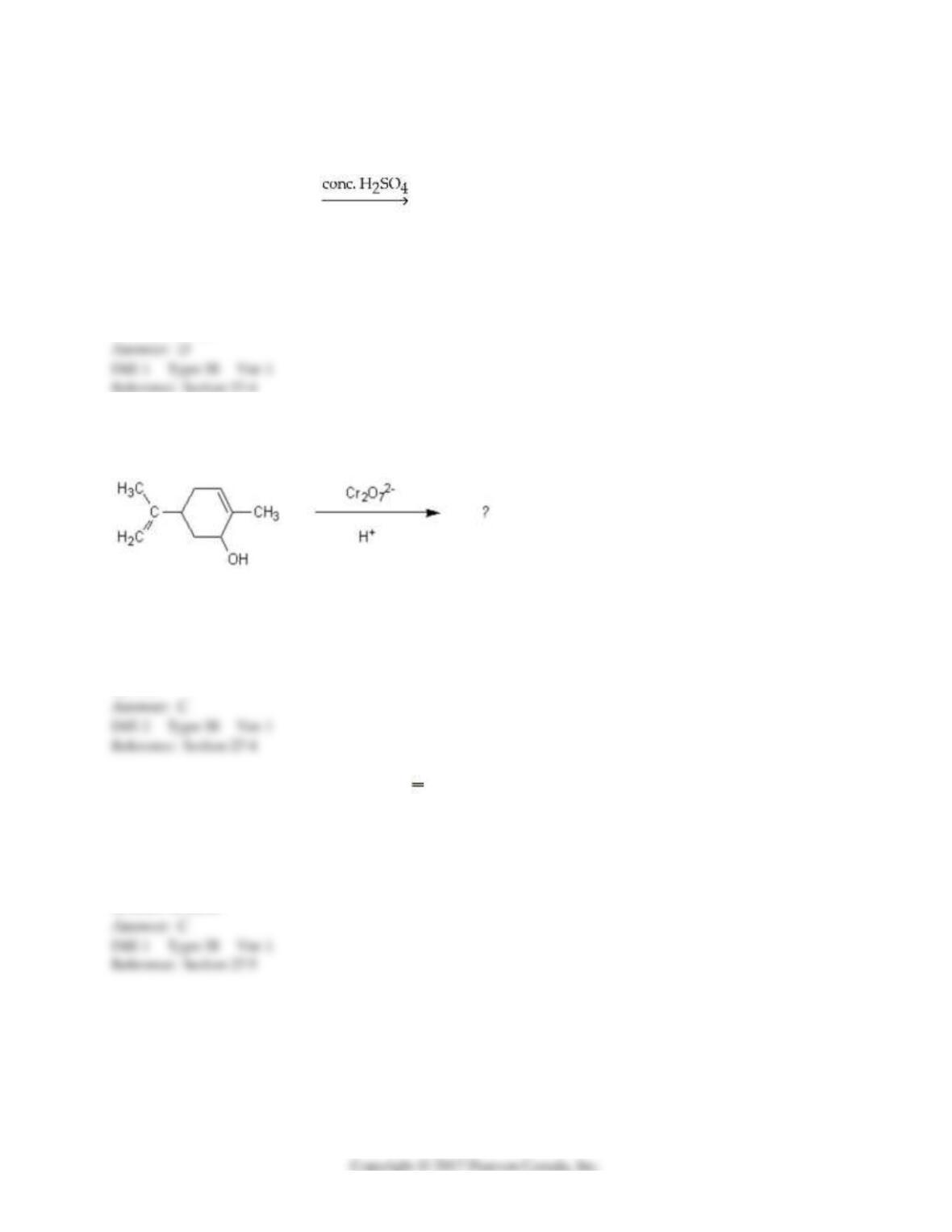
73) Oxidation of the following alcohol via the conditions below yields spearmint oil. What new functional
group is formed in the reaction to yield spearmint?
A) aldehyde
B) carboxylic acid
C) ketone
D) amine
E) ester
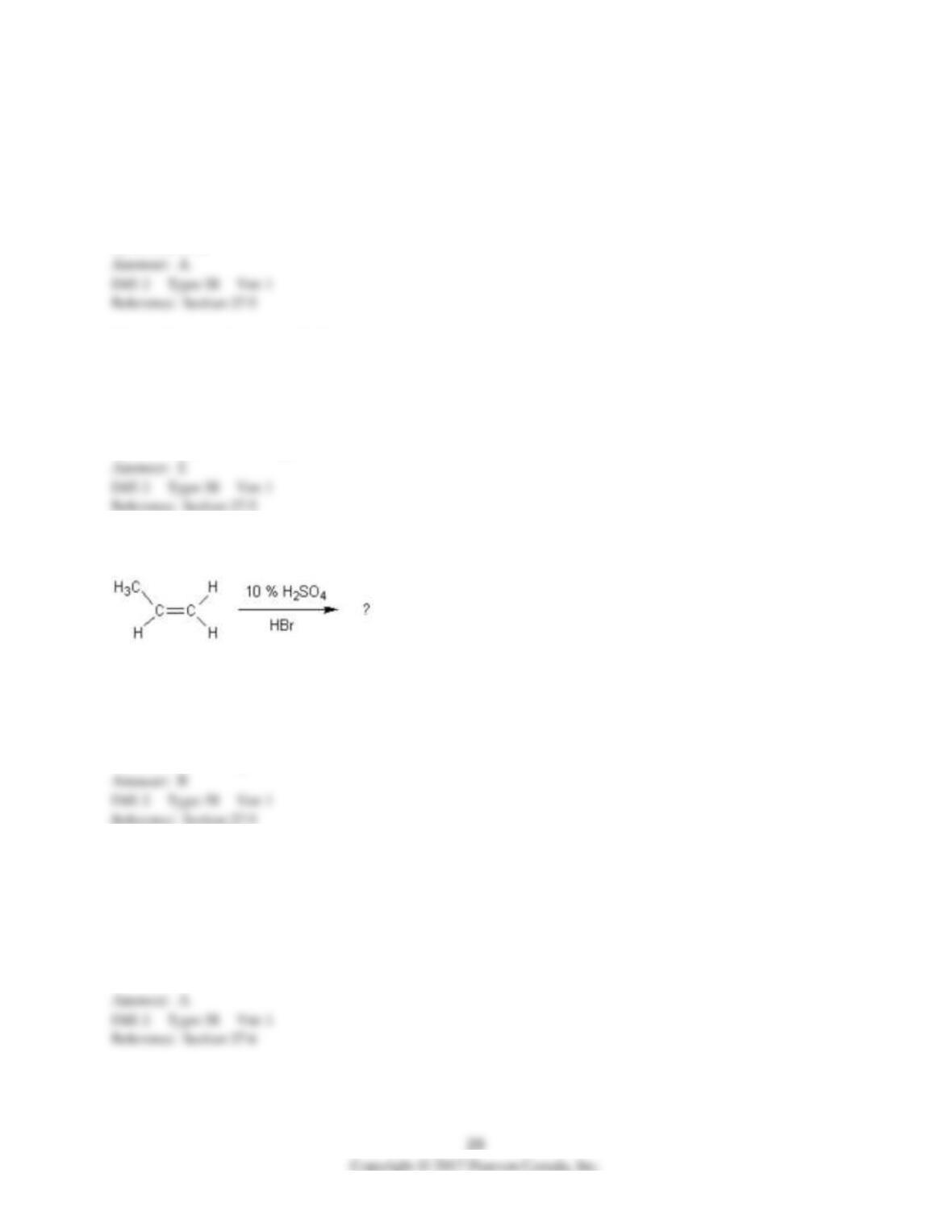
74) Give the product(s) of the reaction: CH2CHCH3 + HCl → product(s)
A) CH3CH2CH3 + H2
B) CH2ClCHClCH3 + H2
C) CH3CHClCH3
D) CH2ClCH2CH3
E) none of these
28
75) Give the product(s) of the reaction (in H2SO4) : CH2CHCH3 + H2O → product(s)
A) CH2OHCH(OH)CH3
B) CH2OHCH2CH3
C) CH2OHCHOHCH3 + H2
D) CH3CH2CH3 + H2O2
E) CH3CH(OH)CH3
76) Predict the major product for the reaction: 1-butene + HI →
A) CH2ICH2CH2CH3
B) CH2ICH=CHCH3
C) CH2=CICH2CH3
D) CH3CHICH2CH3
E) CH3CI2CH2CH3
77) Predict the major product for the reaction: 2-methyl-2-pentene + HCl →
A) (CH3)2CHCHClCH2CH3
B) CH2=C(CH3)CHClCH2CH3
C) (CH3)2CClCCl=CHCH3
D) (CH3)2CClCH2CH2CH3
E) no reaction
78) Predict the major product for the reaction: 2-methyl-2-butene + HBr →
A) (CH3)2CBrCH2CH3
B) (CH3)2CBrCH=CH2
C) (CH3)2CHCHBrCH3
D) CH2=C(CH3)CH2CH3
E) no reaction
79) Predict the major product for the reaction: CH3C≡CH + 2 HBr →
A) CH3CBr2CH3
B) CH3CH2CHBr2
C) CH3CHBrCH2Br
D) CH2=CBrCH2Br
E) no reaction
80) Lindlar’s catalyst is used when ________.
A) we want to reduce alkynes to alkanes
B) we want to speed up HX addition reactions
C) we have to promote elimination reactions over substitution reactions
D) we need to activate Pd hydrogenation catalyst
E) we want to reduce alkynes to Z alkenes
81) What is the main product of the following reaction?
A) 1-bromopropane
B) 2-bromopropane
C) propyl alcohol
D) 2-bromopropene
E) 1-bromo-2-methylethane
82) Suggest reagents for the synthesis of meta-chloronitrobenzene from nitrobenzene.
A) Cl2 and AlCl3
B) HCl and AlCl3
C) Cl2 and H2SO4
D) HCl and HNO3
E) Cl2 and FeBr3
83) Which of the following groups would be ortho, para directors in electrophilic aromatic substitution?
I) –CN
II) –SO3H
III) –NH2
IV) –OH
V) –Br
A) III), IV), and V)
B) II), III),and V)
C) I), III), and IV)
D) I), II) and IV)
E) II), IV) and V)
84) Identify substituents that are meta directors in electrophilic aromatic substitution.
I) –OR
II) –NO2
III) –OCOCH3
IV) -CHO
V) –COOH
A) I), II) and V)
B) III), IV), and V)
C) I), IV), and V)
D) II), IV), and V)
E) I), III), and V)
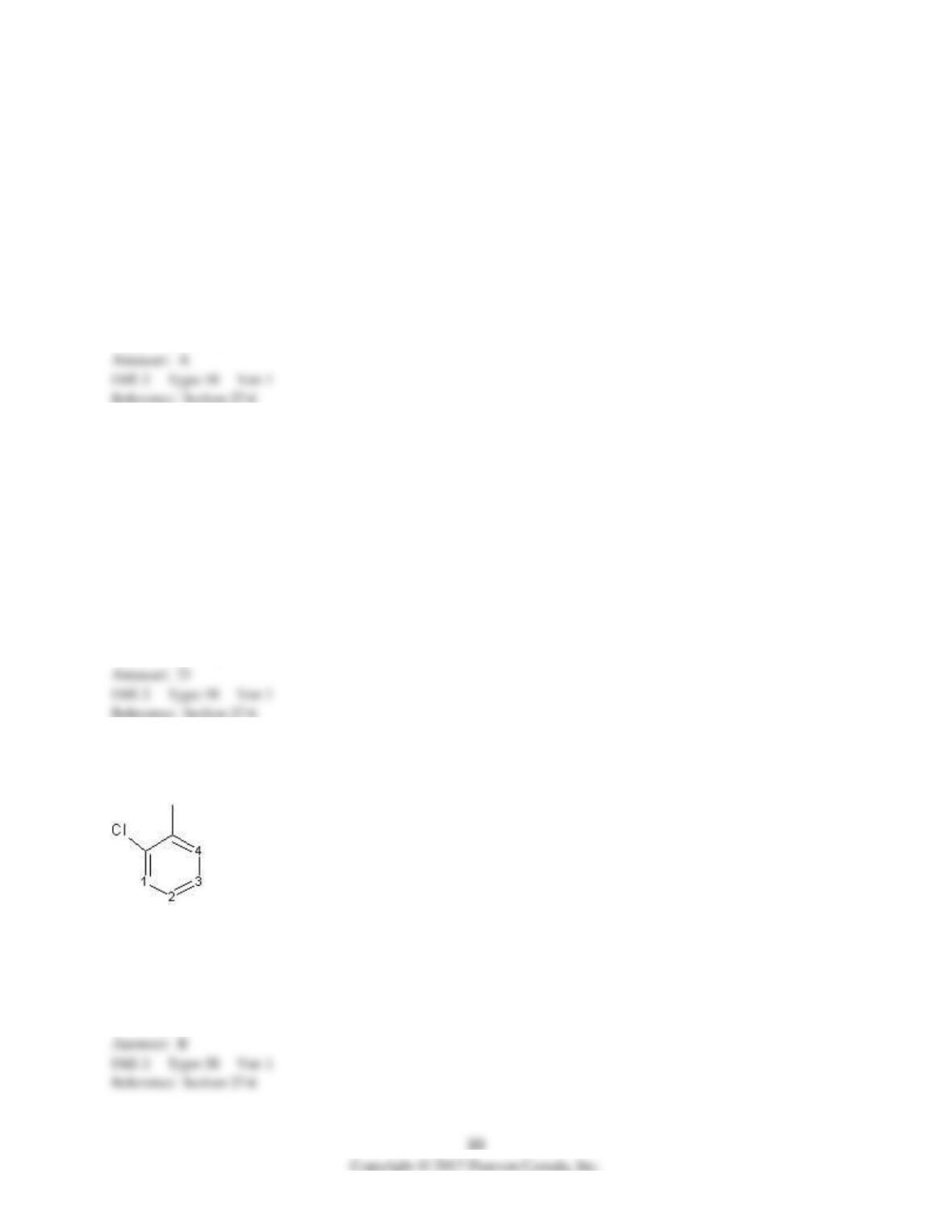
85) Which of the four positions 1-4 marked on the structure of aromatic compound shown below would
be preferentially substituted in an electrophilic aromatic substitution reaction?
A) 4 only
B) 2 and 4
C) 2 only
D) 1 and 3
E) 3 only
31
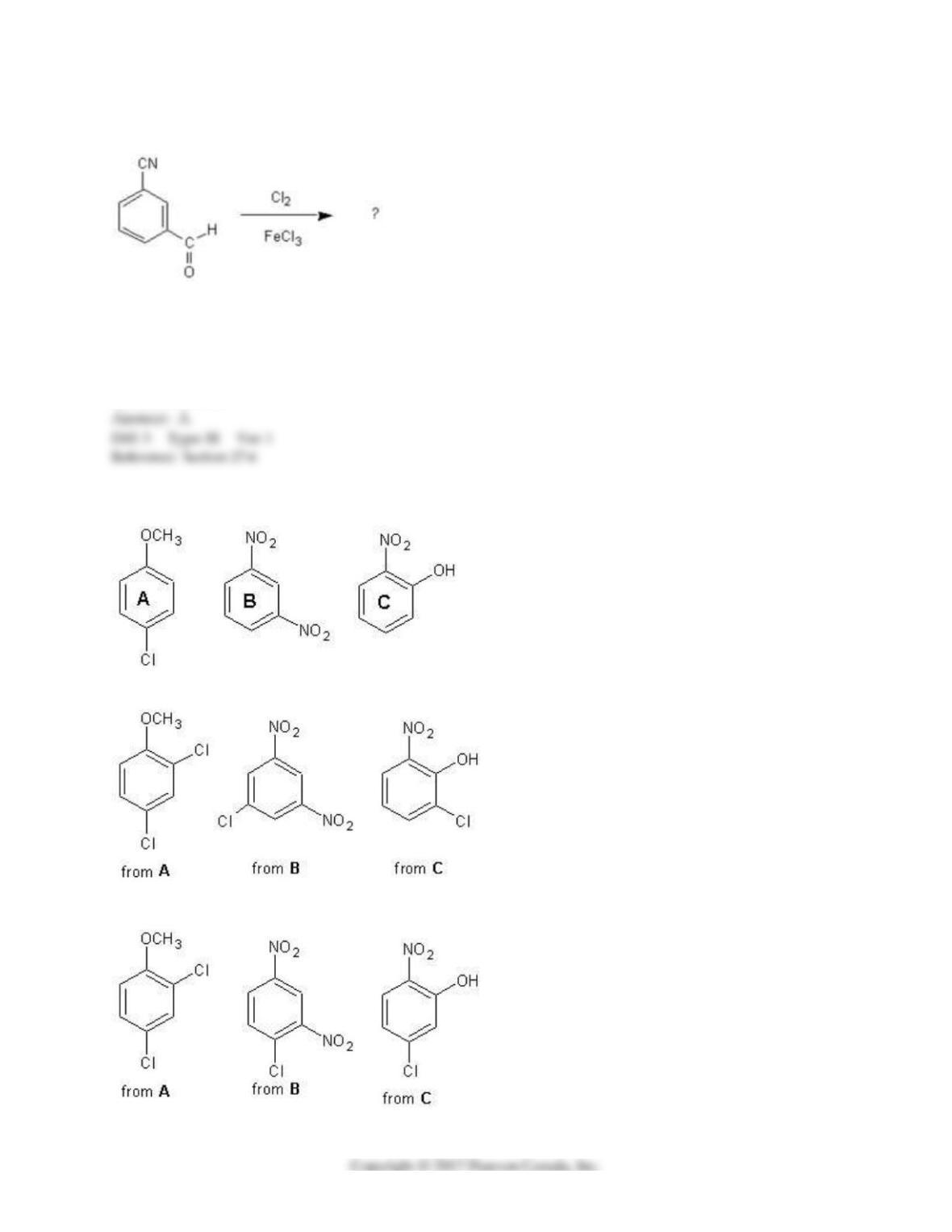
86) What is(are) the main product(s) of the following chlorination reaction?
A) 3-chloro-5-cyanobenzaldehyde
B) 2, 6-dichloro-3-cyanobenzaldehyde
C) 2-chloro-3-cyanobenzaldehyde
D) 2-chloro-3-cyanobenzaldehyde and 2-chloro-5-cyanobenzaldehyde
E) None of these
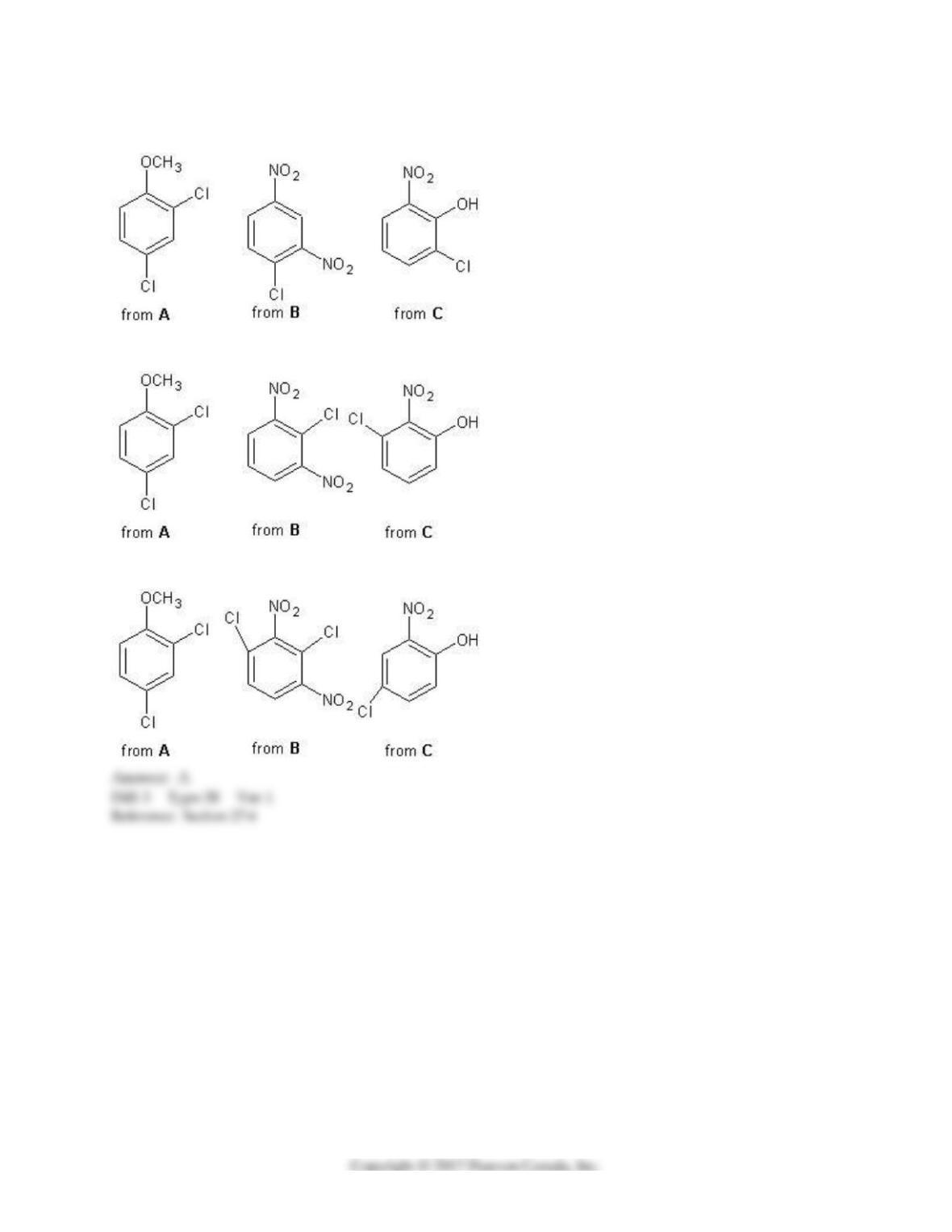
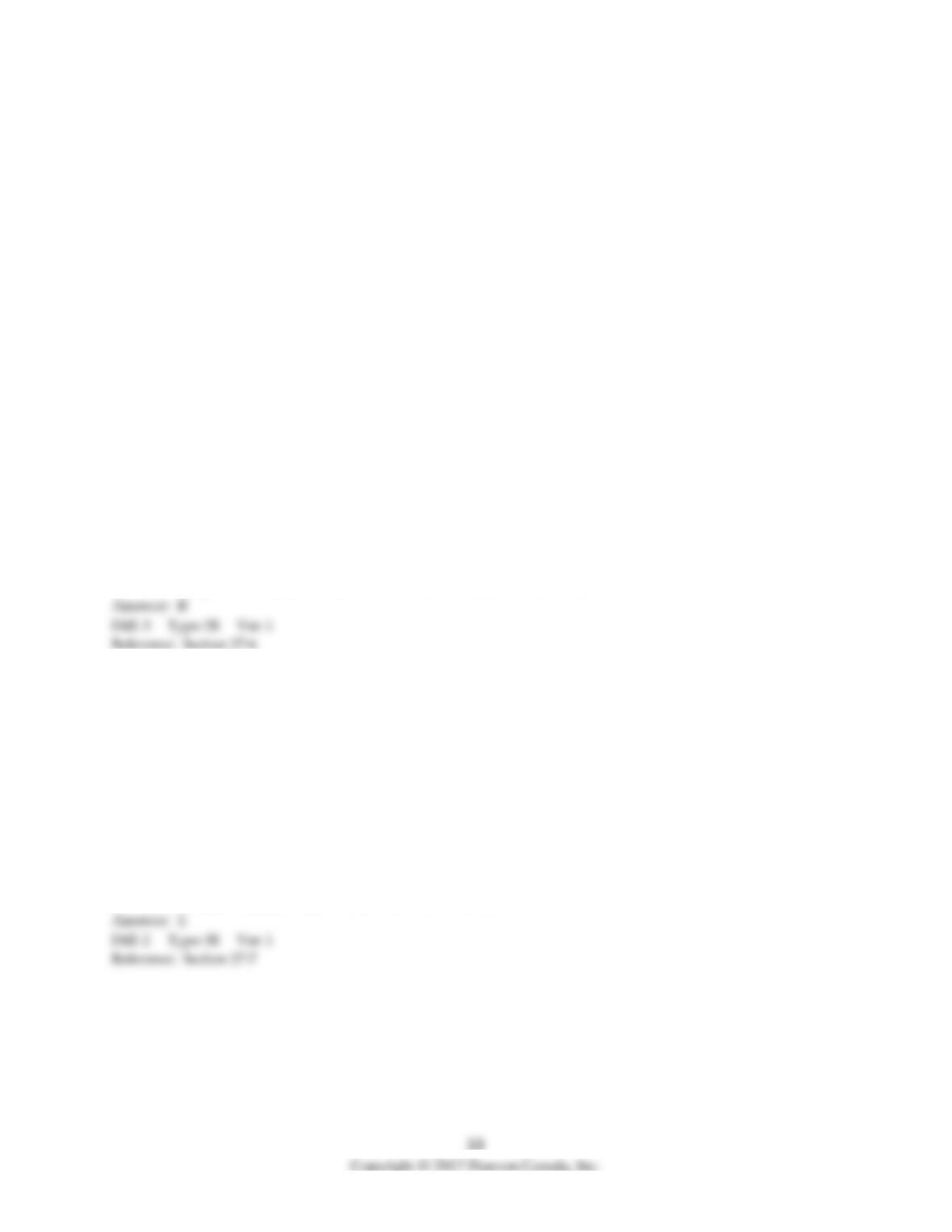
87) Predict major products for chlorination of the following three aromatic compounds:
A)
B)
32
C)
D)
E)
88) Predict major products for the following three reactions:
I) nitration of bromobenzene
II) bromination of nitrobenzene
III) bromination of aniline (aminobenzene)
A) Reaction I) gives ortho-bromonitrobenzene
Reaction II) gives meta-bromonitrobenzene
Reaction III) gives para-bromoaniline (para-aminobromobenzene)
B) Reaction I) gives ortho-bromonitrobenzene and para-bromonitrobenzene
Reaction II) gives meta-bromonitrobenzene
Reaction III) gives ortho-bromoaniline (ortho-aminobromobenzene) and para-bromoaniline (para–
aminobromobenzene)
C) Reaction I) gives meta-bromonitrobenzene
Reaction II) gives ortho-bromonitrobenzene and para-bromonitrobenzene
Reaction III) gives ortho-bromoaniline (ortho-aminobromobenzene) and para-bromoaniline (para–
aminobromobenzene)
D) Reaction I) gives meta-bromonitrobenzene
Reaction II) gives ortho-bromonitrobenzene and para-bromonitrobenzene
Reaction III) gives meta-bromoaniline (meta-aminobromobenzene)
E) Reaction I) gives 1,3-bromonitrobenzene
Reaction II) gives 1,2-bromonitrobenzene and 1,4-bromonitrobenzene
Reaction III) gives 1,2-aminobromobenzene and 1,4-aminobromobenzene
89) Classify the following reaction steps as initiation, propagation or termination.
A: Br-Br → 2 Br∙
B: H3CH2C∙ + Br∙ → CH3CH2Br
C: 2 H3CH2C∙ → CH3CH2CH2CH3
A) Step A is initiation and steps B and C are propagation
B) Steps A and B are initiation and step C is termination
C) Step A is initiation, step B is termination and step C is propagation
D) Step A is initiation, step B is propagation and step C is termination
E) Step A is initiation and steps B and C are termination
90) How many monobromo derivatives can be obtained from A) CH3CH3 and B) (CH3)3CH?
A) Alkane A) gives one and alkane B) gives two.
B) Alkane A) gives two and alkane B) gives two.
C) Alkane A) gives one and alkane B) gives three.
D) Alkane A) gives two and alkane B) gives three.
E) Both alkane A) and B) give one.
91) Which of the following steps can be found in any of the polymerization mechanisms you learned?
I) initiation
II) condensation
III) propagation
IV) dehydrohalogenation
V) rearrangement
A) I), III), V)
B) II), III) and IV)
C) III), IV), and V)
D) I), II), and III)
E) II), III), and V)
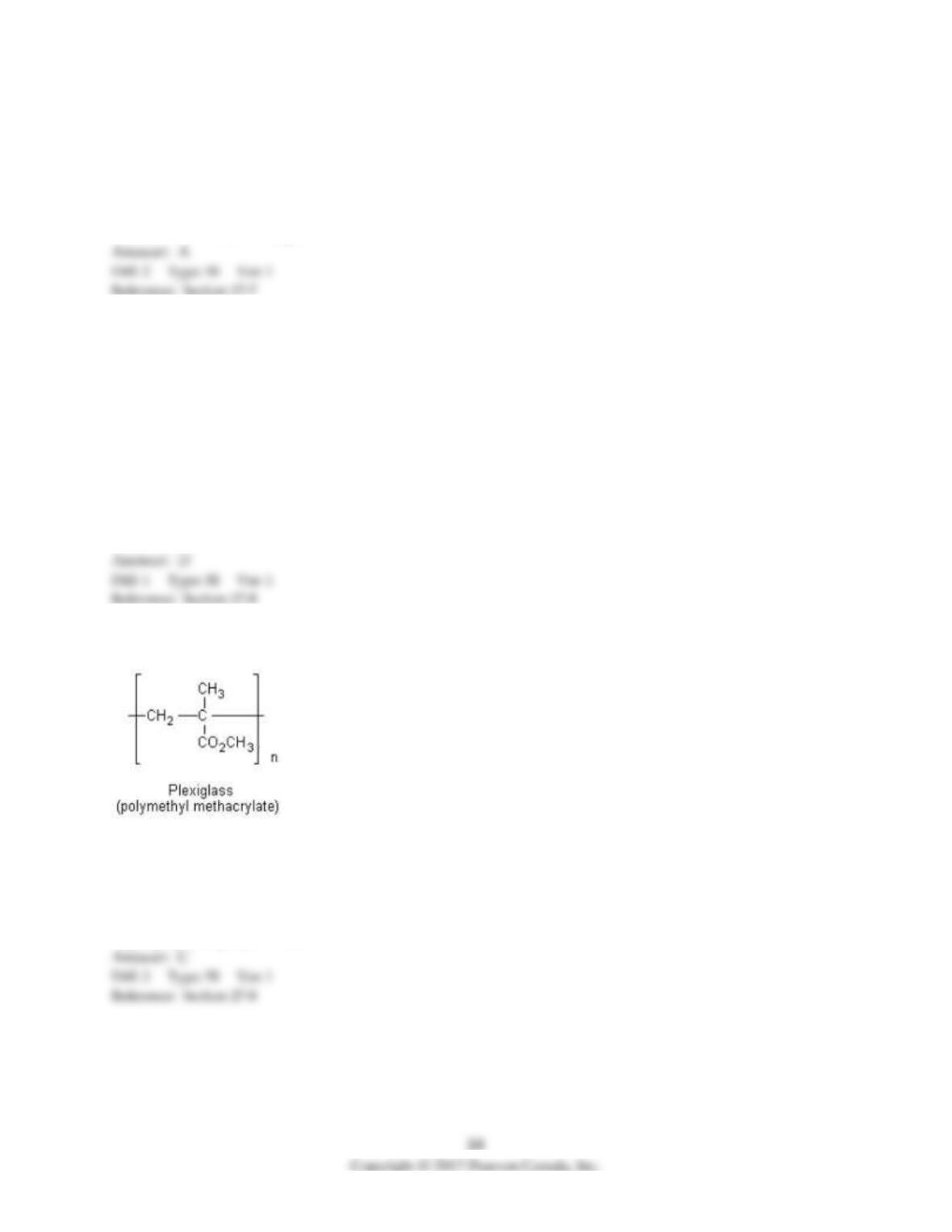
92) What type of polymerization reaction occurred to produce the following polymer?
A) step-reaction polymerization
B) elimination reaction
C) chain-reaction polymerization
D) condensation polymerization
E) propagation polymerization
35
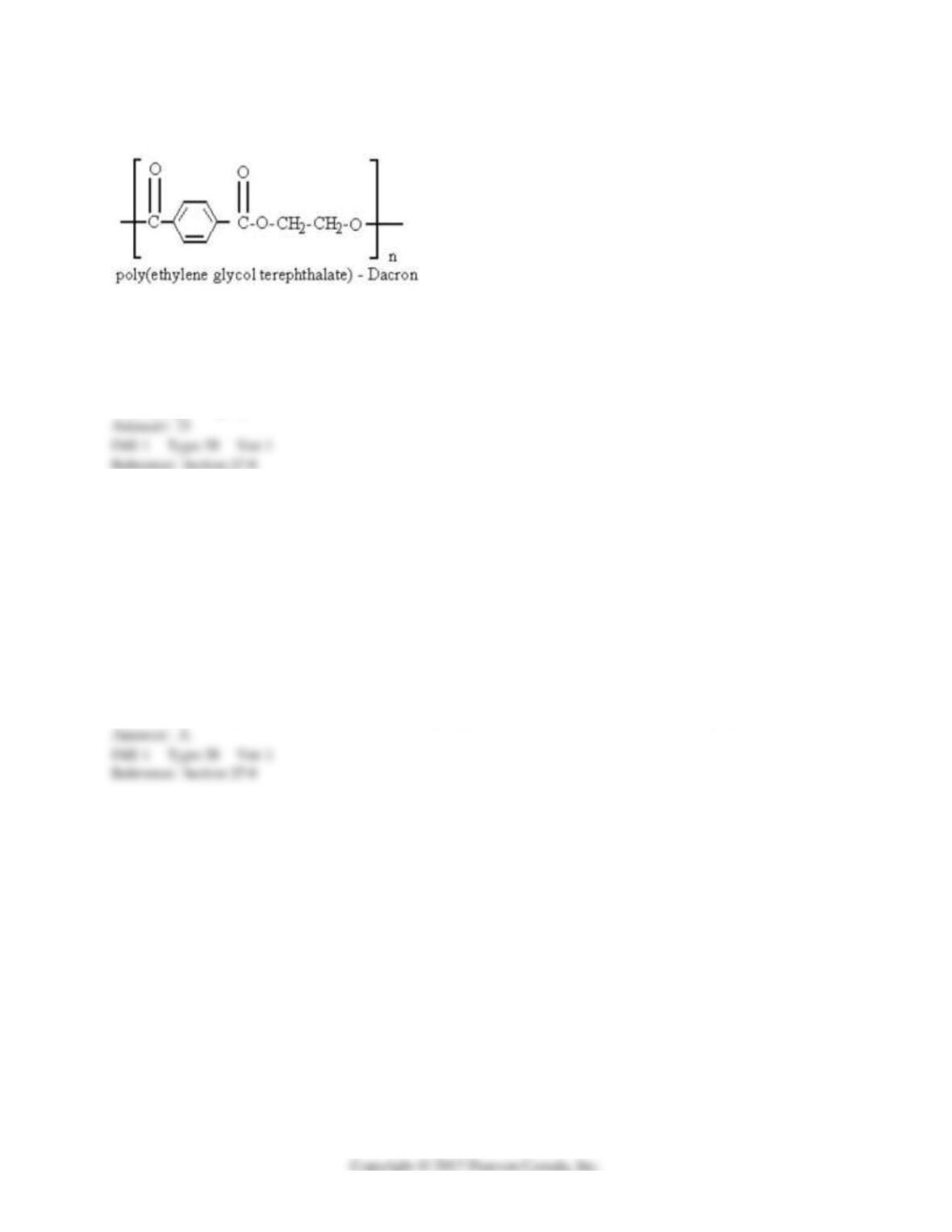
93) What type of polymerization reaction occurred to produce the following polymer?
A) addition polymerization
B) elimination reaction
C) chain-reaction polymerization
D) condensation polymerization
E) propagation polymerization
94) What is the difference between atactic polymer and isotactic polymer?
A) Atactic polymer has an irregular structure while in isotactic polymer identical functional groups have
the same orientation on the polymer chain.
B) Atactic polymer has a regular zig-zag structure while in isotactic polymer identical functional groups
have the same orientation on the polymer chain.
C) Atactic polymer has the same functional groups on one side of the polymer structure while in isotactic
polymer has random distribution of functional groups in its structure.
D) Atactic polymer has an irregular structure while in isotactic polymer identical functional alternate
back and forth along the polymer chain.
E) Atactic polymer has identical functional groups alternating back and forth along the polymer chain
while in isotactic polymer identical functional groups have the same orientation on the polymer chain.
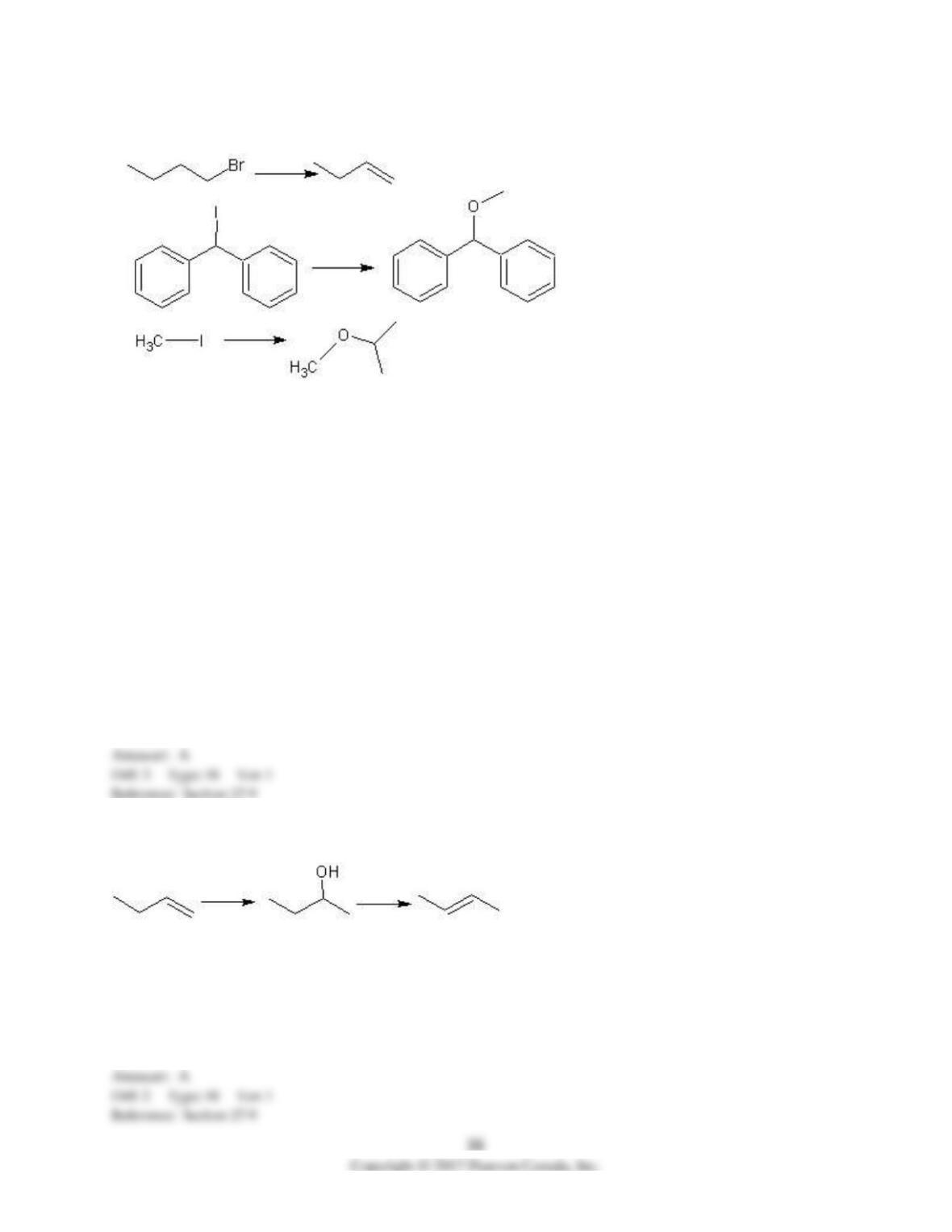
95) Which reagents would you choose to carry out the following transformations?
I)
II)
III)
A) Reaction I use KOtBu
Reaction II use MeOH
Reaction III use NaOCH(CH3)2
B) Reaction I use NaOMe
Reaction II use MeOH
Reaction III use NaOC(CH3)3
C) Reaction I use NaOMe
Reaction II use MeOH
Reaction III use NaOMe
D) Reaction I use KOtBu
Reaction II use HC(=O)H
Reaction III use NaOCH(CH3)2
E) Reaction I use KOtBu
Reaction II use Na2Cr2O7 or K2Cr2O7
Reaction III use NaOCH(CH3)2
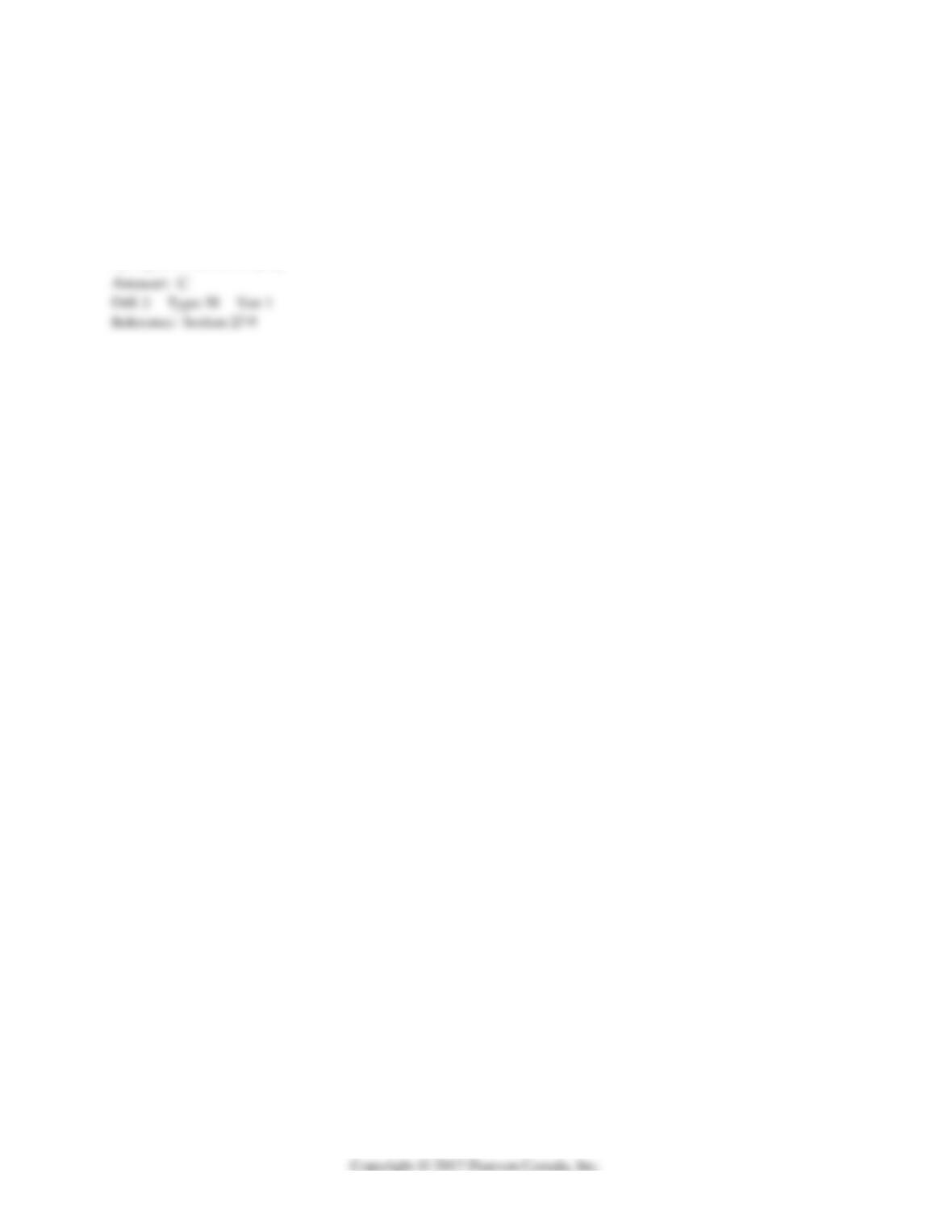
96) Which reagents would you use for the following transformations?
A) First H2O/H3O+ then conc. H2SO4
B) First H2O/H3O+ then conc. HCl
C) First OH– then conc. H2SO4
D) First OH– then conc. HCl
E) First H2O/H3O+ then dilute H2SO4
37
97) You need to substitute one hydrogen with bromine on an aromatic ring. What reagents do you use?
A) HBr and FeBr3 as catalyst
B) Br2 and heat
C) Br2 and FeBr3 as catalyst
D) a mixture of HBr and conc. H2SO4
E) Br2 and radiation (hυ)