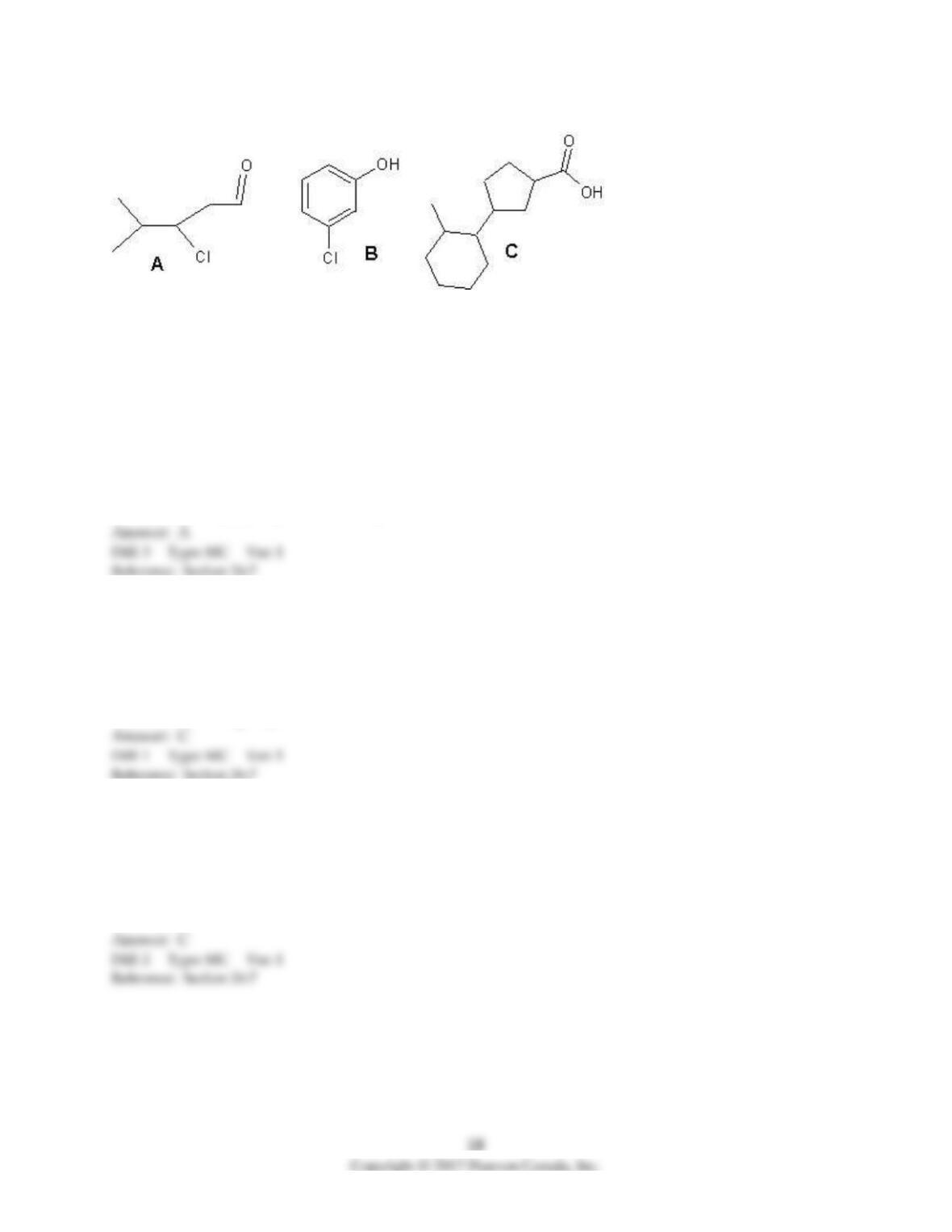
50) Provide names for compounds A, B and C:
A) A is 3-chloro-4-methylpentanal, B is meta-chlorophenol and C is 3-(2–
methylcyclohexyl)cyclopentanecarboxylic acid
B) A is 3-chloro-4-methylpentanol, B is meta-chlorophenol and C is 3-(2–
methylcyclohexyl)cyclopentanecarboxylic acid
C) A is 3-chloro-4-methylpentanal, B is ortho-chlorophenol and C is 3-(3–
methylcyclohexyl)cyclopentanecarboxylic acid
D) A is 3-chloro-4-methylpentanone, B is meta-chlorophenol and C is 3-(2–
methylcyclohexyl)cyclopentanal
E) A is 4-chloro-3-methylpentanal, B is para-chlorophenol and C is 3-(2–
methylcyclohexyl)cyclopentanecarboxylic acid
51) Which two simple functional groups make carboxyl group?
A) aldehyde and keto groups
B) aldehyde and hydroxyl groups
C) keto and hydroxyl groups
D) ester and hydroxyl groups
E) ester and ether groups
52) Which class of compounds is most oxidized?
A) alkanes
B) alcohols
C) carboxylic acids
D) aldehydes
E) ketones
53) What are heterocyclic compounds?
A) They are cyclic compounds in which carbon has one or more substituents that are neither hydrogen or
another carbon atom.
B) They are cyclic compounds in which two or more carbon rings are connected by C-C bonds (for
example biphenyl).
C) They are cyclic compounds in which carbon ring is connected to another ring not containing carbon
atoms.
D) They are cyclic compounds in which one or more atoms are not carbon atoms.
E) They are cyclic compounds that can have more than one stable conformation.
54) Which of the following synthetic procedures are plausible?
I) synthesis of esters from alcohols and acids
II) synthesis of ethers from acids and alcohols
III) synthesis of amides from acids and amines
IV) synthesis of alcohols from alkanes and water
V) synthesis of aldehydes from alcohols and oxidizing agents
A) I), III), and IV)
B) I), III), and V)
C) II), III), and V)
D) II), III), and IV)
E) III), IV), and V)
55) Compound A easily reacts with water to give compound B. Compound B can be oxidized to produce
compound C. Both B and C can be further oxidized to produce D. To which classes of organic
compounds A, B, C and D most likely belong to, respectively?
A) A is an alkane, B is an alcohol, C is an aldehyde and D is a carboxylic acid
B) A is an alkene, B is an ether, C is an aldehyde and D is a carboxylic acid
C) A is an alkene, B is an alcohol, C is a ketone and D is a carboxylic acid
D) A is an alkene, B is an alcohol, C is an aldehyde and D is an ester
E) A is an alkene, B is an alcohol, C is an aldehyde and D is a carboxylic acid
56) Calculate the degree of unsaturation for the following molecules:
Molecule I: C3H4
Molecule II: C5H10
Molecule III: C4H6
A) For molecule I the degree of unsaturation is 2, for molecule II the degree of unsaturation is 1 and for
molecule III the degree of unsaturation is 1.
B) For molecule I the degree of unsaturation is 2, for molecule II the degree of unsaturation is 0 and for
molecule III the degree of unsaturation is 2.
C) For molecule I the degree of unsaturation is 2, for molecule II the degree of unsaturation is 1 and for
molecule III the degree of unsaturation is 2.
D) For molecule I the degree of unsaturation is 2, for molecule II the degree of unsaturation is 2 and for
molecule III the degree of unsaturation is 2.
E) For molecule I the degree of unsaturation is 1, for molecule II the degree of unsaturation is 2 and for
molecule III the degree of unsaturation is 1.
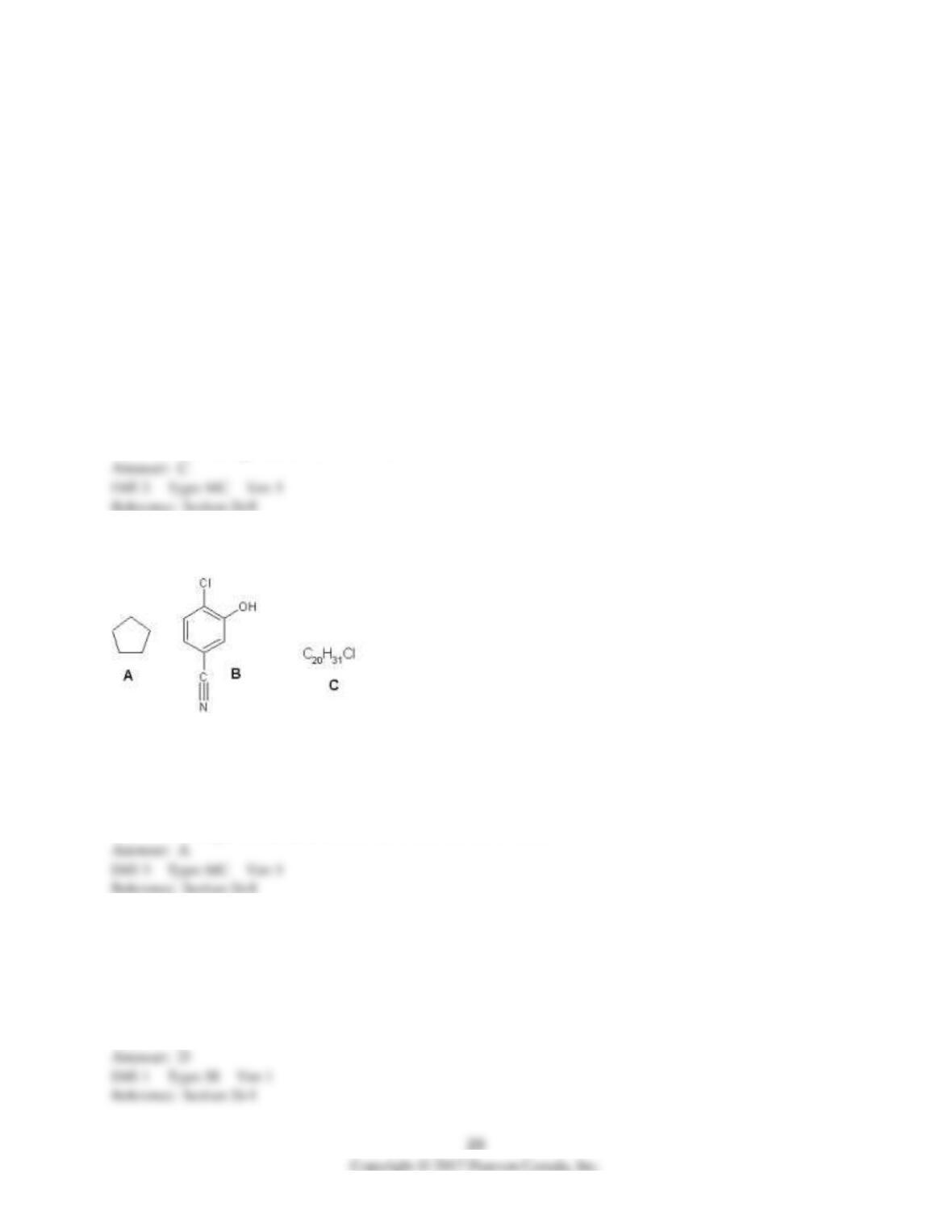
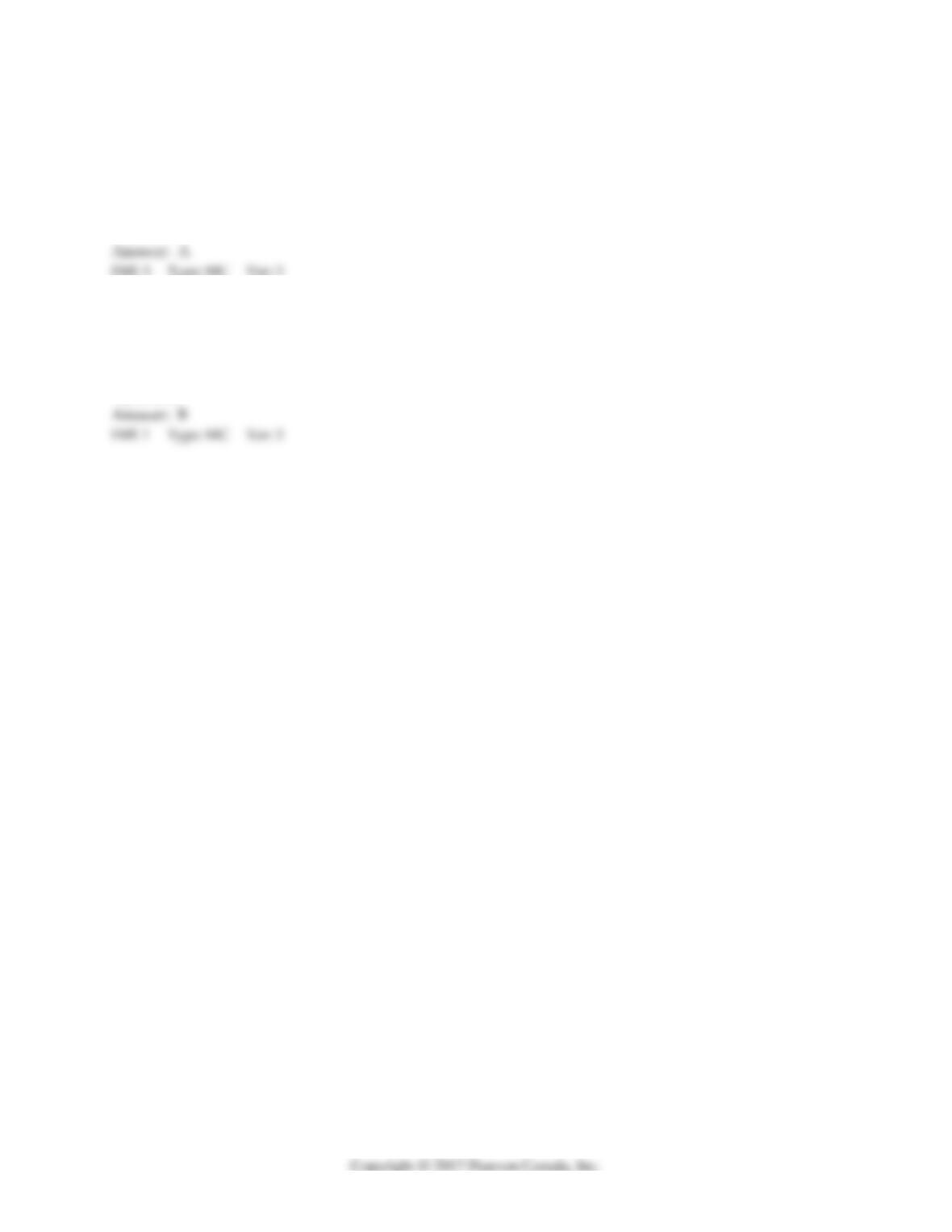
57) What is the degree of unsaturation for the following compounds?
A) For A the degree of unsaturation is 1, for B is 6 and for C is 5.
B) For A the degree of unsaturation is 1, for B is 5 and for C is 6.
C) For A the degree of unsaturation is 0, for B is 6 and for C is 5.
D) For A the degree of unsaturation is 1, for B is 6 and for C is 4.
E) For A the degree of unsaturation is 1, for B is 4 and for C is 5.
58) How many skeletal isomers for C6H14 can be drawn?
A) 6
B) 3
C) 8
D) 5
E) 2
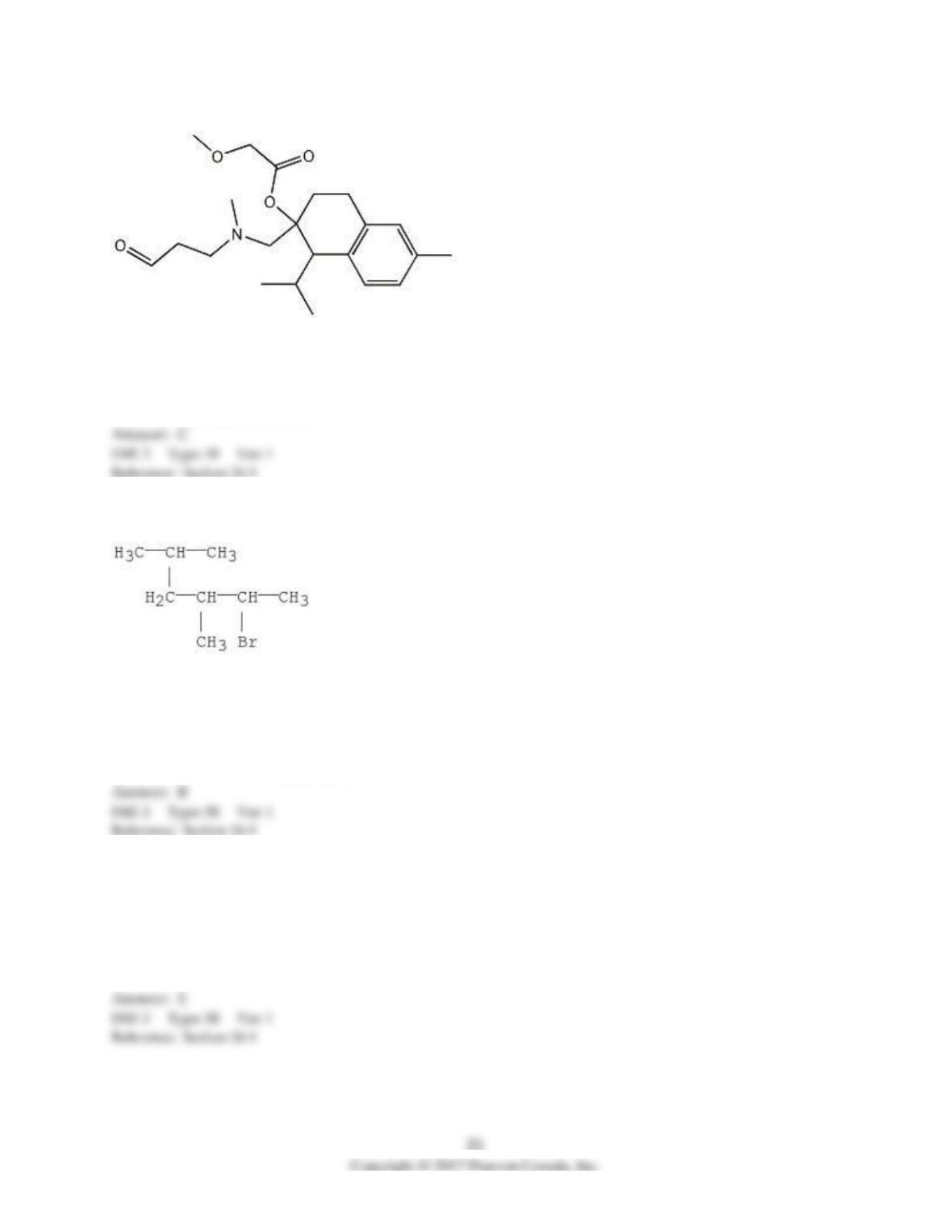
59) Name the functional groups in the molecule below:
A) ester, ether, amine, keto
B) carboxyl, ether, amine, keto
C) ester, ether, amine, aldehyde
D) ester, ether, amide, aldehyde
E) ester, carboxyl, amine, keto
60) What is the IUPAC name for the following molecule?
A) 2-bromo-4-isopropyl-3-methylbutane
B) 2-bromo-3,5-dimethylhexane
C) 3,5-dimethyl-2-bromohexane
D) 2-bromo-3-methyl-4-propylbutane
E) 2-bromo-5,5,3-trimethylpentane
61) C3H8O has how many skeletal isomers?
A) 2
B) 4
C) 5
D) 6
E) 3
62) C4H10O has how many skeletal isomers?
A) 11
B) 12
C) 8
D) 7
E) 6
63) How many different structural isomers are there of the compound dichlorobutane?
A) 6
B) 8
C) 9
D) 5
E) 7
64) Give the name for CH3CH2CHBrCH3.
A) 2-bromobutane
B) 3-bromobutane
C) 2-bromopropane
D) 3-bromopropane
E) 3-bromylpentane
65) What are the possible positions for hydrogen on the chair conformation of cyclohexane?
A) staggered and eclipsed
B) axial and equatorial
C) equatorial and apical
D) longitudinal and latitudinal
E) chair and boat
66) The burning of alkanes to produce carbon dioxide and water is known as what type of reaction?
A) thermal cracking
B) reforming
C) radical substitution
D) oxidation
E) alkylation
67) Combustion of 493 mg of a hydrocarbon gave 1549 mg CO2 and 633.9 mg H2O. What is the molecular
formula if the molecular weight is subsequently found to be 42?
A) CO2
B) CH2
C) C6H12
D) C2H2O
E) C3H6
68) Which of the following has the lowest melting point: cyclohexane, hexane, benzene?
A) cyclohexane
B) hexane
C) benzene
D) They have approximately the same melting point.
E) There is not enough information to determine.
69) Give the condensed structural formula for 3-bromopentane.
A) CH3CH2CHBrCH2CH2CH3
B) CH3CHBrCH2CH2CH3
C) (CH3)3CHBrCH2CH3
D) CH3CH2CHBrCH2CH3
E) CH3CH2CBr3CH2CH3
70) If an ethyl group is substituted for one hydrogen of cyclohexane, what would be the preferred
position of that ethyl substituent on the ring?
A) axial position
B) equatorial position
C) chair position
D) boat position
E) twist boat conformation
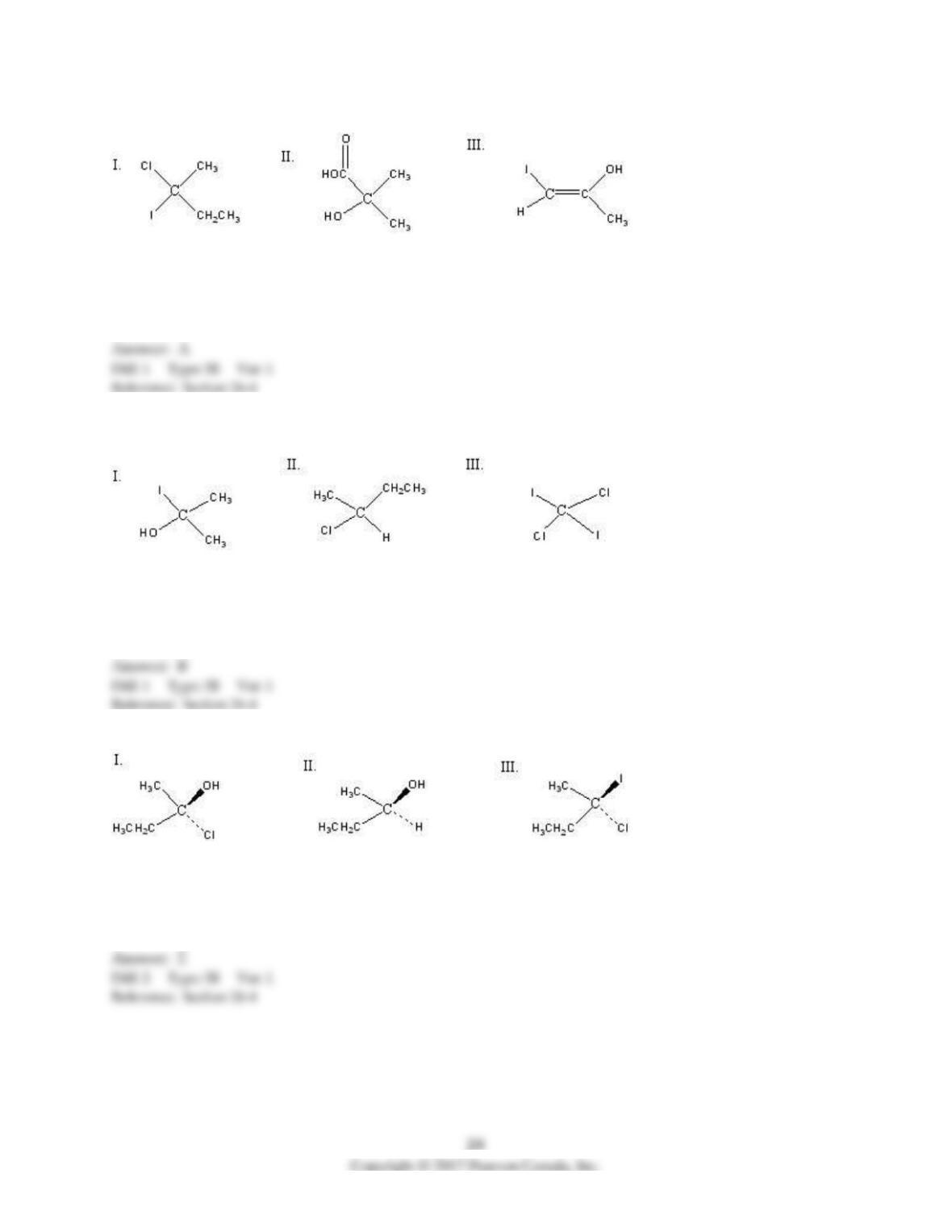
71) Which of the following compounds is(are) chiral?
A) I
B) II
C) III
D) I and II
E) II and III
72) Which of the following compounds is(are) chiral?
A) I
B) II
C) III
D) I and II
E) II and III
73) Which of the following chiral compounds is(are) S enantiomer(s)?
A) I
B) II
C) III
D) I and II
E) I and III
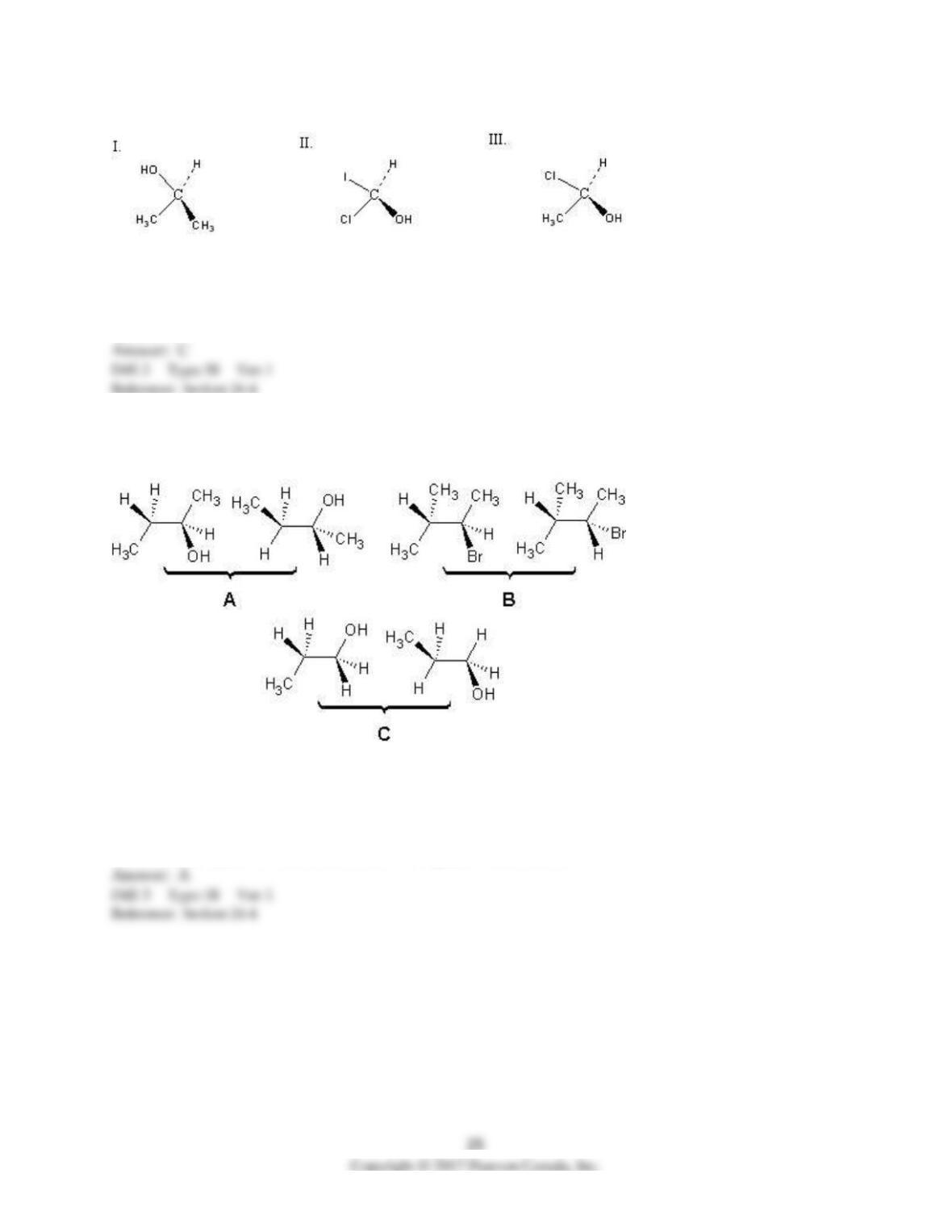
74) Which of the following chiral compounds is(are) R enantiomer(s)?
A) I
B) II
C) III
D) II and III
E) I and II
75) Are the following three pairs of structural formulas (pairs A, B, and C) representing identical
molecules, conformers of the same molecule, or enantiomers?
A) A is a pair of identical molecules, B is a pair of diastereomers and C is a pair of conformers
B) A and C are pairs of conformers, and B is a pair of enantiomers
C) A is a pair of conformers, B is a pair of enantiomers and C is a pair of identical molecules
D) A is a pair of identical molecules, B and C are pairs of enantiomers
E) A and B are pairs of enantiomers, and C is a pair of conformers
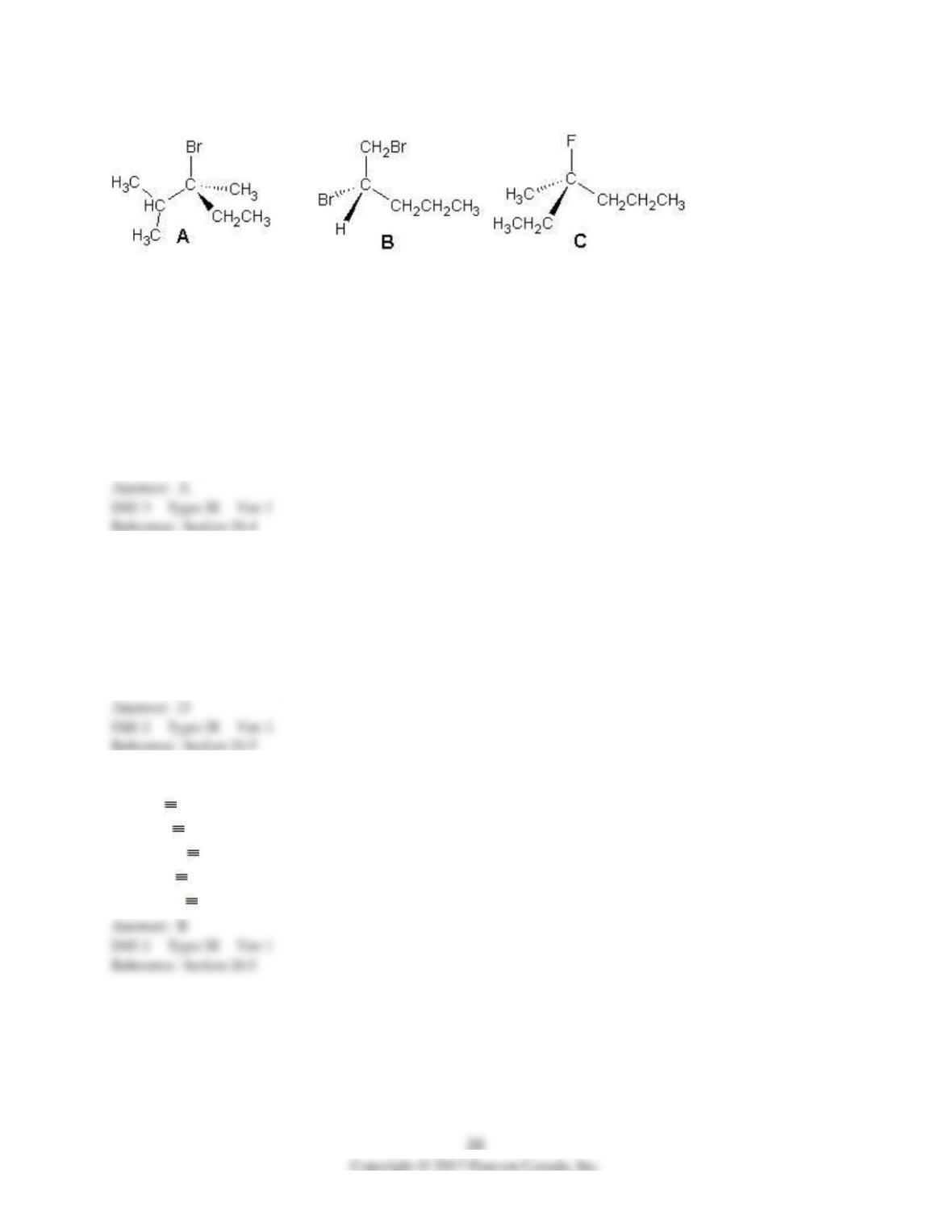
76) Provide IUPAC names for the following compounds:
A) A is (3S)-3-bromo-2,3-dimethylpentane, B is (2S)-1,2-dibromopentane and C is (3R)-3-fluoro-3-
methylhexane
B) A is (3R)-3-bromo-2,3-dimethylpentane, B is (2S)-1,2-dibromopentane and C is (3R)-3-fluoro-3-
methylhexane
C) A is (3S)-3-bromo-2,3-dimethylpentane, B is (2R)-1,2-dibromopentane and C is (3R)-3-fluoro-3-
methylhexane
D) A is (3S)-3-bromo-2,3-dimethylpentane, B is (2S)-1,2-dibromopentane and C is (3S)-3-fluoro-3-
methylhexane
E) A is (3R)-3-bromo-2,3-dimethylpentane, B is (2S)-1,2-dibromopentane and C is (3S)-3-fluoro-3-
methylhexane
77) Give the condensed structural formula for 3-methyl-3-hexene.
A) CH3CH2CH(CH3)CH=CHCH3
B) CH3CH2C(CH3)2CH=CHCH3
C) (CH3)3CCH=CHCH3
D) CH3CH2C(CH3)=CHCH2CH3
E) (CH3)6CCH2CH=CH2
78) What is the condensed structural formula for 2-pentyne?
A) CH2CHCH2CH2CH3
B) CH3CCCH2CH3
C) CH3CH CHCH2CH3
D) CH3CCCH3
E) CH3CH CCH2CH2CH3
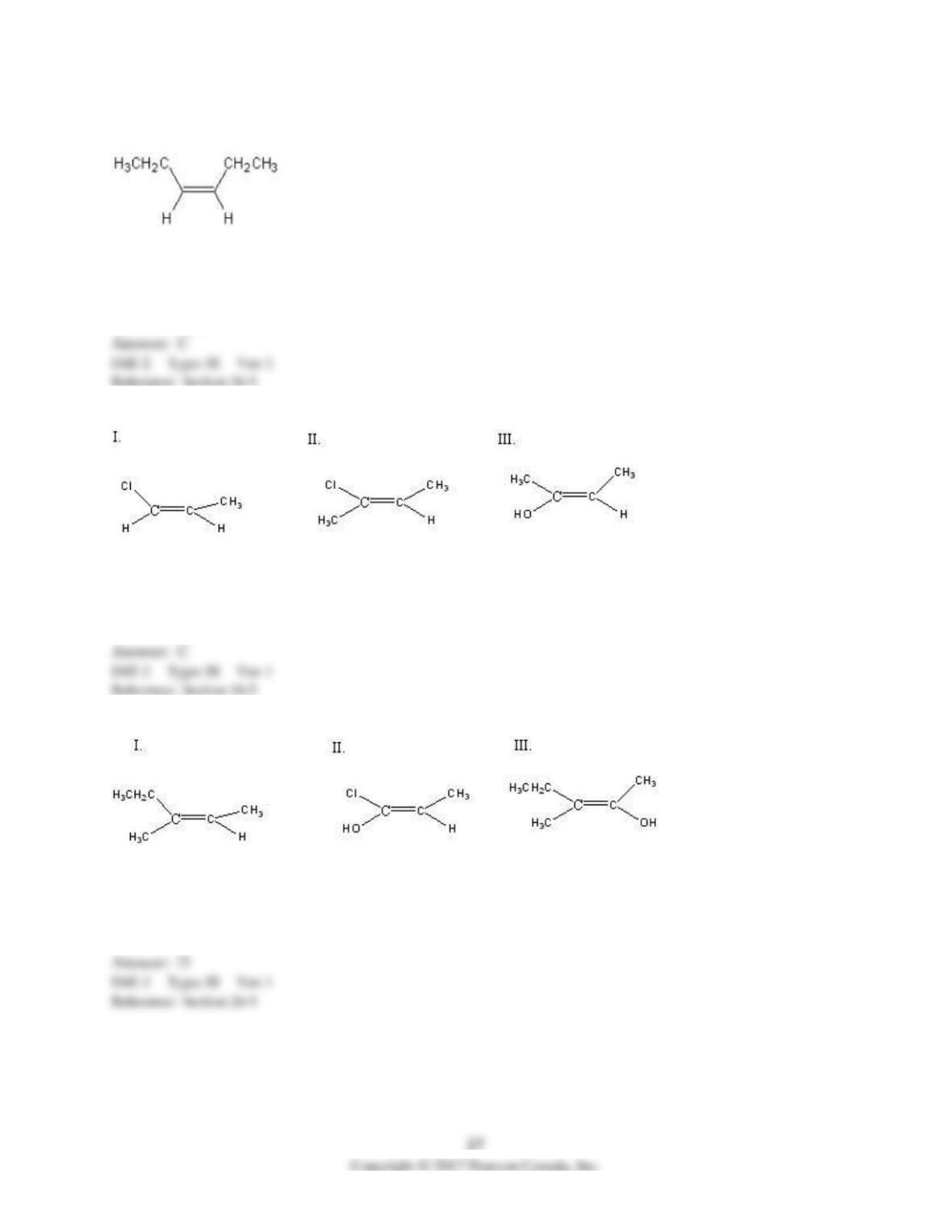
79) What is the complete systematic name for the following molecule?
A) 3-pentene
B) 3-hexene
C) cis-3-hexene
D) trans-3-hexene
E) cis-3-hexyne
80) Which of the following compounds is(are) E configuration(s)?
A) I
B) II
C) III
D) I + II
E) II + III
81) Which of the following compounds is(are) Z configuration(s)?
A) I
B) II
C) III
D) I + II
E) I + II + III
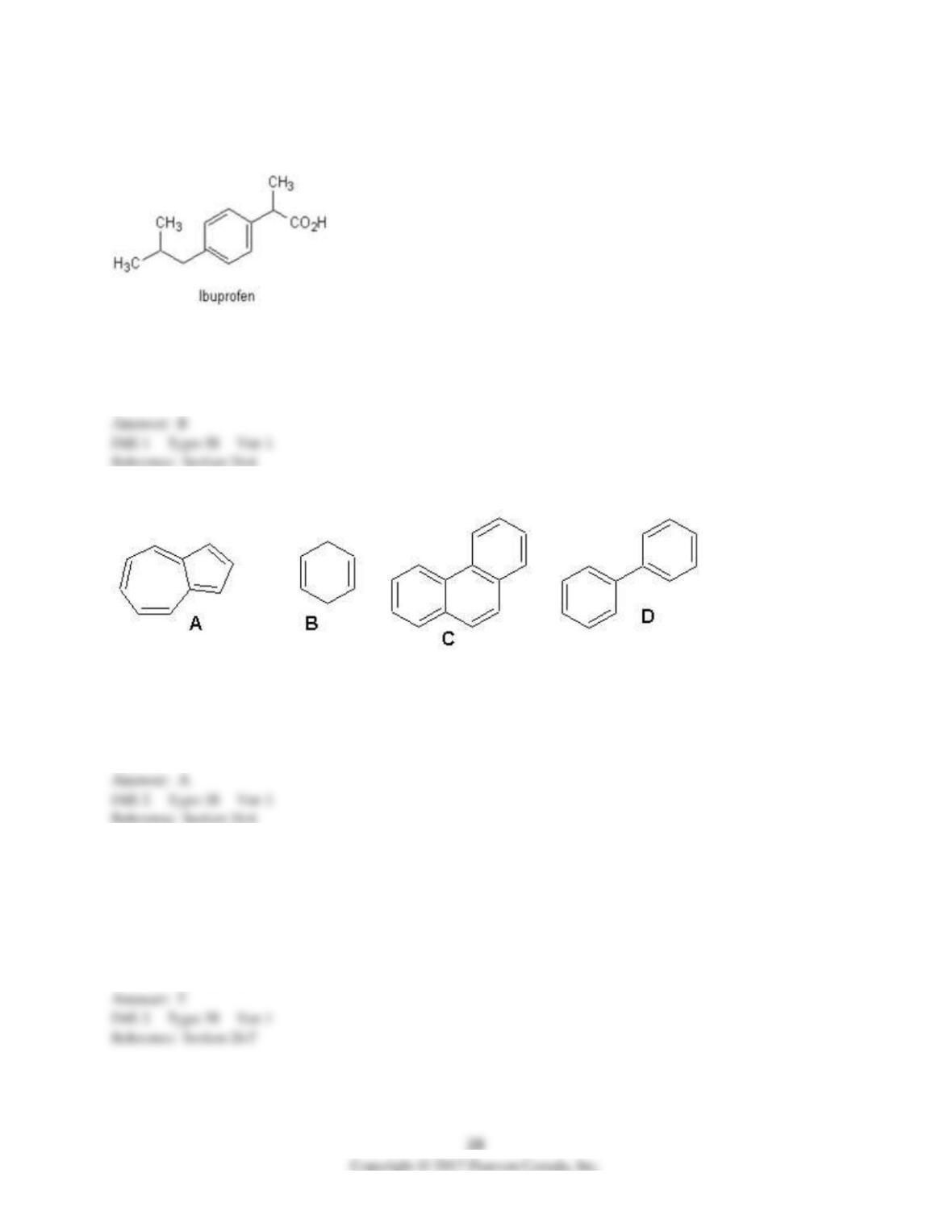
82) The two benzene substituents of the common analgesic shown below are considered in what relation
to one another?
A) ortho
B) para
C) meta
D) trans
E) 1,3
83) Which of the following four molecules are aromatic?
A) A, C, D
B) A, B, D
C) B, D
D) A, D
E) B, C
84) Give the condensed structural formula for 2-butanone.
A) HCOCH2CH2CH3
B) CH3CH2CH2CHO
C) HCOCH2CH2CHO
D) CH3CH2COCH2CH3
E) CH3COCH2CH3
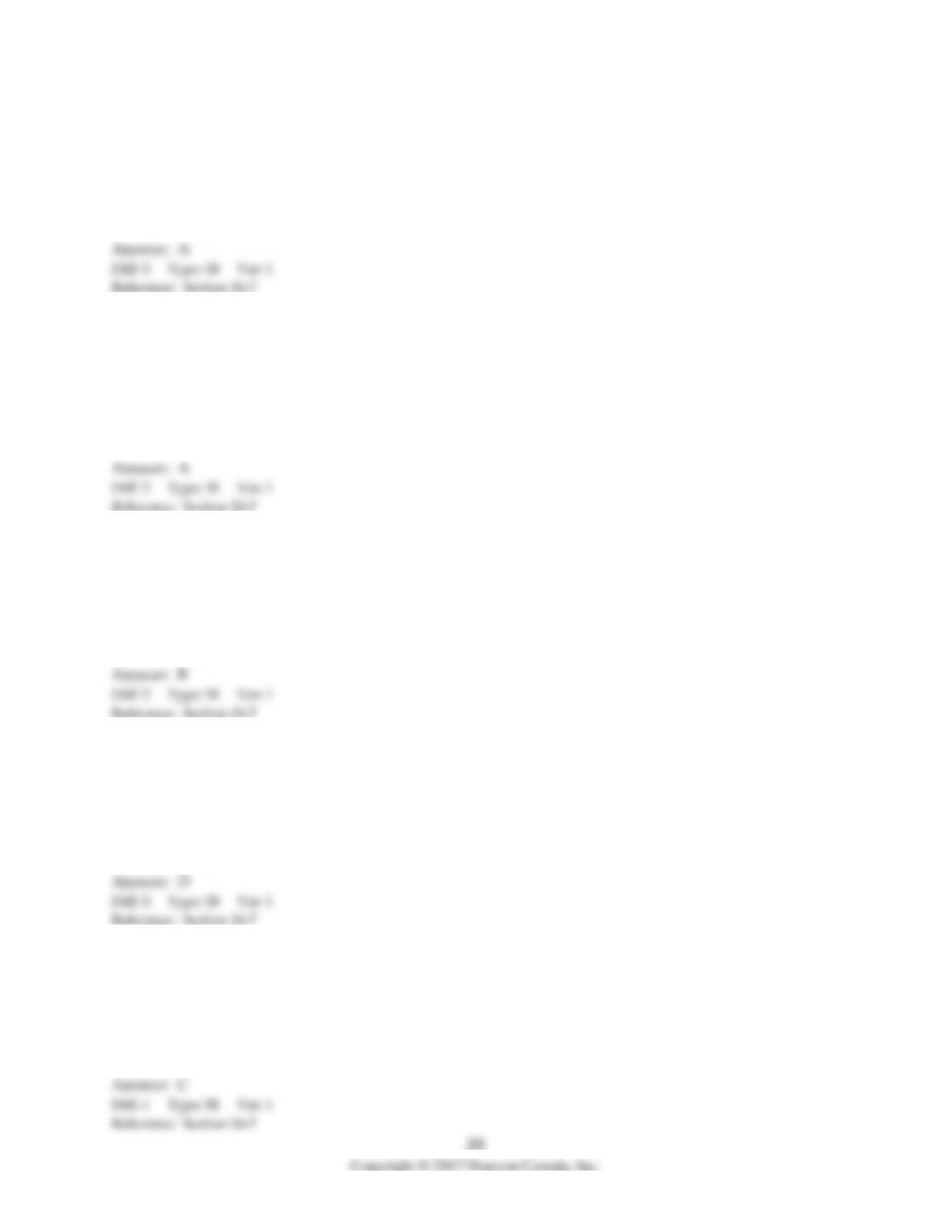
85) The common ether used in anesthesia has the IUPAC name ________.
A) diethyl ether
B) methyl ethyl ether
C) methyl ether
D) 2-butyl ether
E) none of these
86) Give the condensed structural formula for propanone.
A) CH3COCH3
B) CH3CH2CHO
C) CH3OCH2CH3
D) CH3OCH3
E) CH3CH2CO
87) Give the name for CH3CH2CH2COCH2CH3.
A) 4-hexanone
B) 3-hexanone
C) 3-butanone
D) 3-hexanol
E) 4-hexanoic acid
88) Give the name for (CH3)3CCHO.
A) 2,2-dimethylpropanone
B) 2-methylbutanol
C) 1,1,1-trimethylethanol
D) 2,2-dimethylpropanal
E) ethylethanol
89) To produce an organic ester, one uses a carboxylic acid and a(n) ________.
A) alkyl halide
B) alkane
C) alcohol
D) aldehyde
E) ketone
90) Give the name for HCOOH.
A) methanone
B) methanal
C) ethanoic or acetic acid
D) methanaldehyde
E) methanoic or formic acid
91) Give the condensed structural formula for 2-methylpropanoic acid.
A) (CH3)2CHCOOH
B) (CH3)2CHCHO
C) (CH3)2CHCH2COOH
D) (CH3)2COOH
E) CH3CH2COOH
92) Give the condensed structural formula for methyl butanoate.
A) CH3COOCH2CH2CH2CH3
B) HCOOCH2CH2CH2CH3
C) CH3CH2CH2COOCH3
D) CH3CH2CH2CH2COOCH3
E) CH3CH2CH2COOH
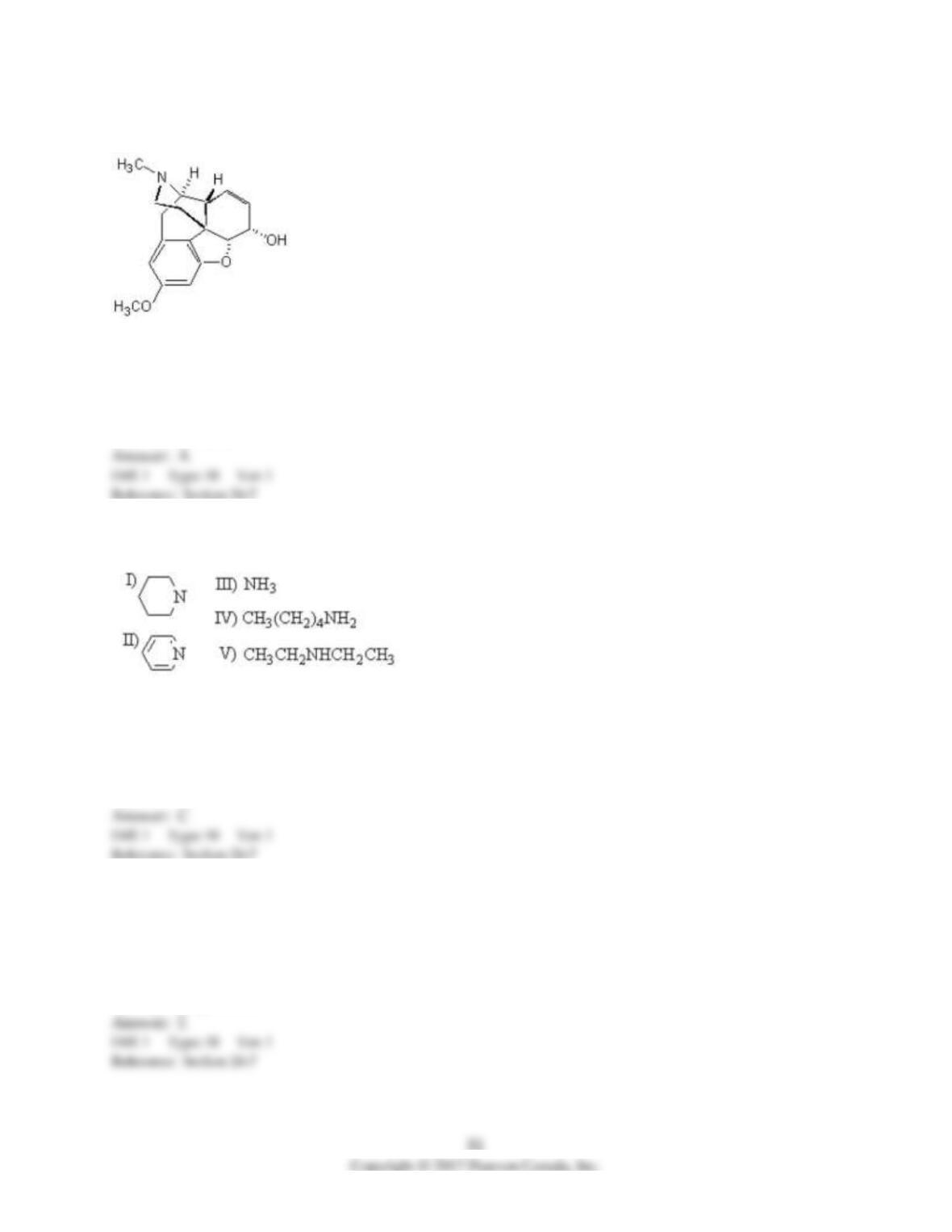
93) What class of amine is found in the analgesic codeine (shown below)?
A) tertiary amine
B) secondary amine
C) aromatic amine
D) quaternary amine
E) dimethylamine
94) Which of the following is the most soluble in water?
A) I
B) II
C) III
D) IV
E) V
95) Name the following compound: CH3CH2NHCH3.
A) aminopropane
B) aminomethylethane
C) methylaminoethane
D) propylamine
E) ethylmethylamine
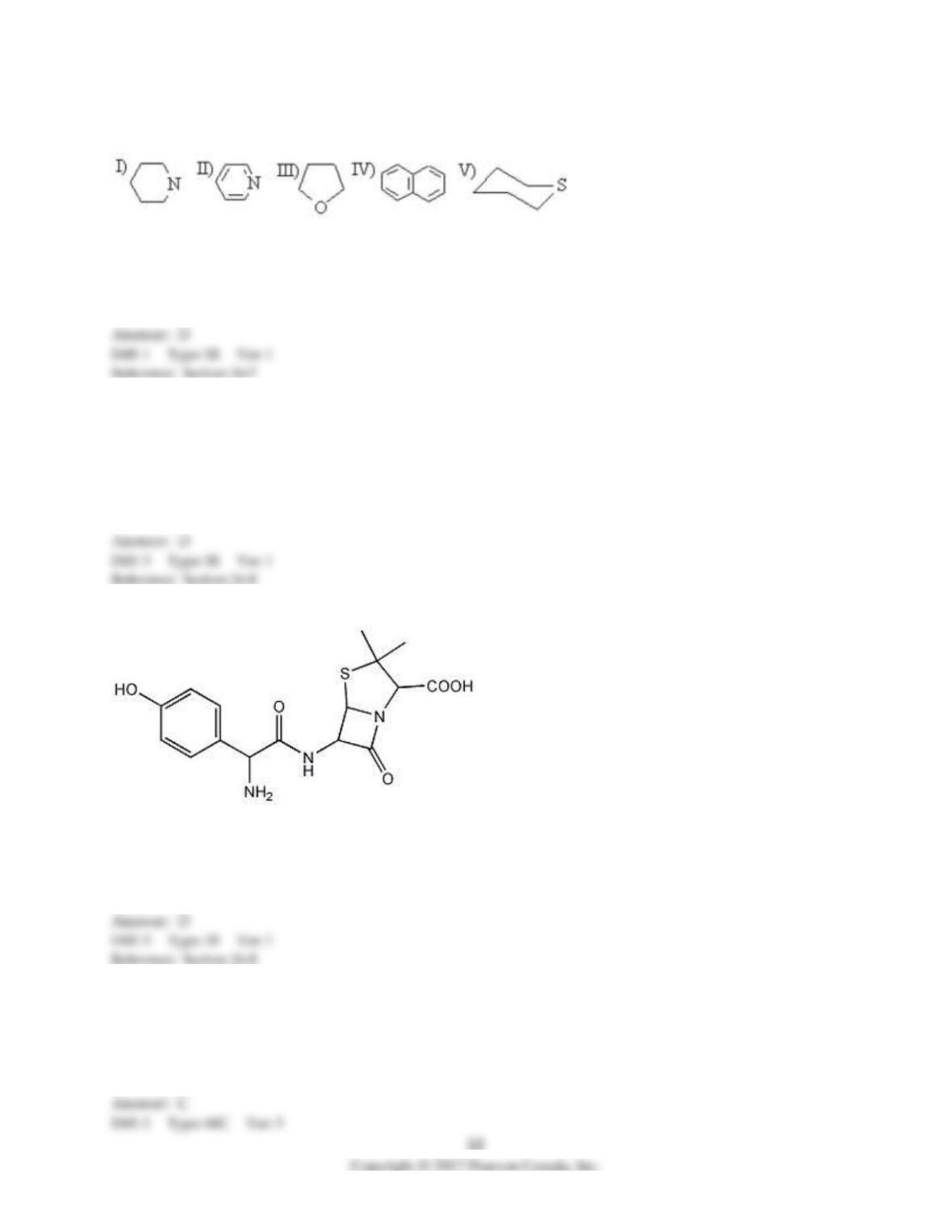
96) Compounds I) to V) are all cyclic compounds. How many heterocyclic compounds are among them?
A) 1
B) 2
C) 3
D) 4
E) 5
97) How many noncyclic isomers including geometric isomers of C4H8 exist?
A) 1
B) 2
C) 3
D) 4
E) 5
98) Calculate the degree of unsaturation for the molecule below:
A) 3
B) 5
C) 7
D) 9
E) 11
99) Which compound is a saturated hydrocarbon?
A) 1-butyne
B) cycloheptene
C) 3-methylheptane
D) 2-heptyne
33
100) How many isomers are there for C5H12?
A) 3
B) 4
C) 5
D) 6
101) Which one of the following molecules is the most polar?
A) butane
B) butanoic acid
C) cyclohexane
D) ethanol