General Chemistry, 11e (Petrucci)
Chapter 26 Structures of Organic Compounds
1) A solid wedge line denotes a bond that sticks back behind the plane of the paper.
2) Constitutional isomers have different bond connectivities, and as a consequence they have different
skeletal structures.
3) Replacing the acidic hydrogen of a carboxylic acid with an organic group produces an amide.
4) A conformation is a set of all possible optical isomers of an organic compound of a given molecular
formula.
5) Torsional or rotational energy is the difference in energy between the eclipsed and staggered
conformations in alkane structure.
6) Cis-trans isomerism is a type of isomerism generally known as stereoisomerism.
7) Different forms of isomerism in organic compounds can be summarized as follows:
“Isomers can be constitutional or stereoisomers. Constitutional isomers are further divided in
enantiomers and diastereomers.”
8) When determining the priority of substituents is “A substituent atom of higher atomic number has
higher priority over a substituent atom with lower atomic number.”
9) In alkene nomenclature “trans” stands for “on the same side” while “cis” means “across.”
10) Two structural features shared among all aromatic organic compounds are:
1) They all are flat, cyclic or linear molecules
2) They have a conjugated bonding system.
11) In the rings of heterocyclic compounds we can find one or more atoms that are not carbon atoms.
12) The compound with formula C4H9N has two degrees of unsaturation.
13) Choose the INCORRECT statement.
A) Hydrocarbons are compounds of carbon and hydrogen.
B) Skeletal isomerism is also called chain isomerism.
C) Isomers have the same chemical formula but differ with respect to the arrangement of atoms.
D) Saturated hydrocarbons have only single bonds connecting each atom.
E) Organic compounds can be obtained only from living tissue.
14) Choose the INCORRECT statement.
A) Latin prefixes provide information on the numbers of C atoms in a chain.
B) An alkane group used as a side chain group is called an alkyl group.
C) Di, tri, and tetra can be used to designate the number of side chain groups.
D) Positional isomers differ in the position on the main chain of the side chain group.
E) Functional groups are distinctive groupings of one or more atoms.
3
15) The IUPAC name of tert-butyl group is:
A) 1,1-dimethylethyl
B) 1,1-dimethylethane
C) 1,2-dimethylethyl
D) 1-methylpropyl
E) 2-methylpropyl
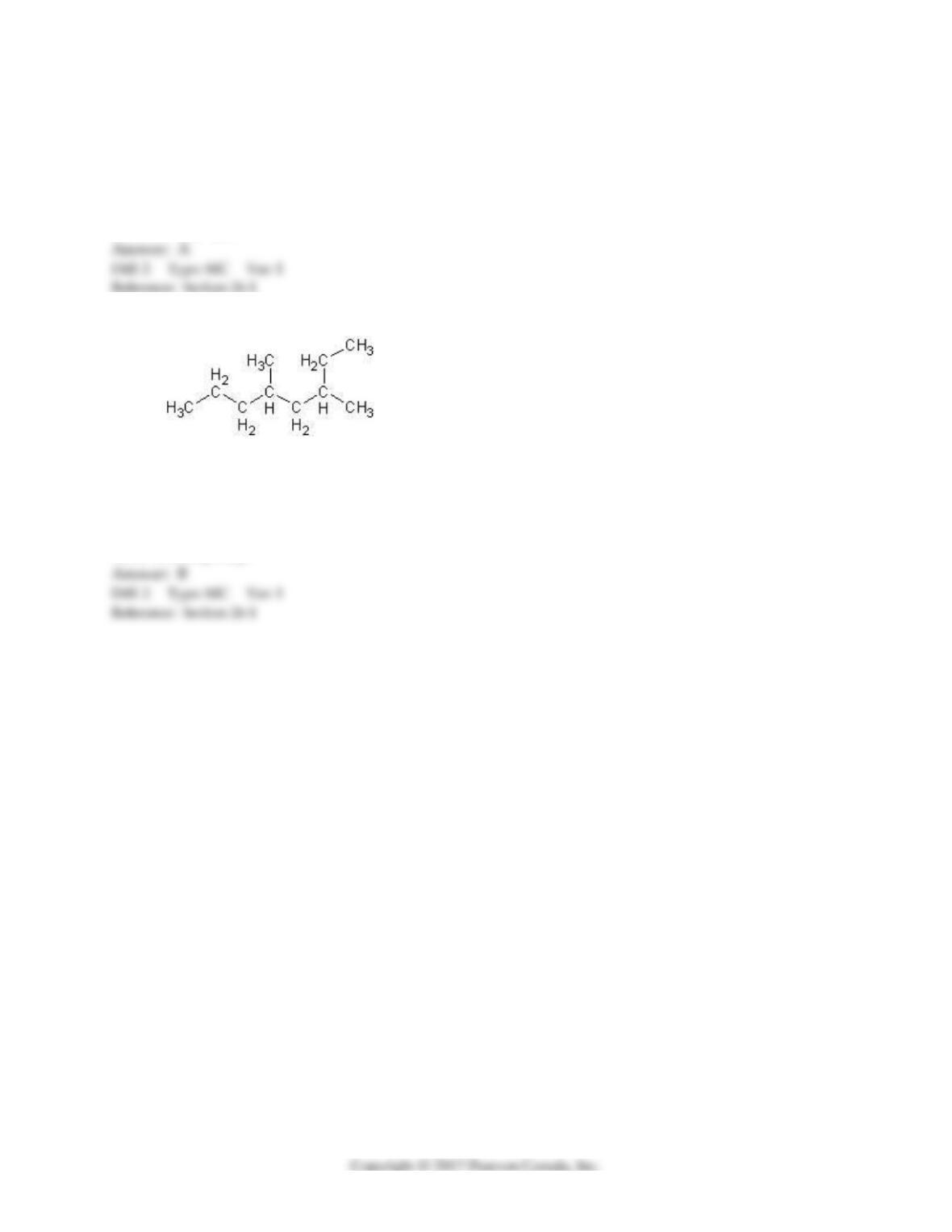
16) What is the correct IUPAC name for the following structure?
A) 2-ethyl-3-methylheptane
B) 3,5-dimethyloctane
C) 4-methyl-6-ethylheptane
D) 4,6-dimethyloctane
E) 3,5-dimethyloctyl
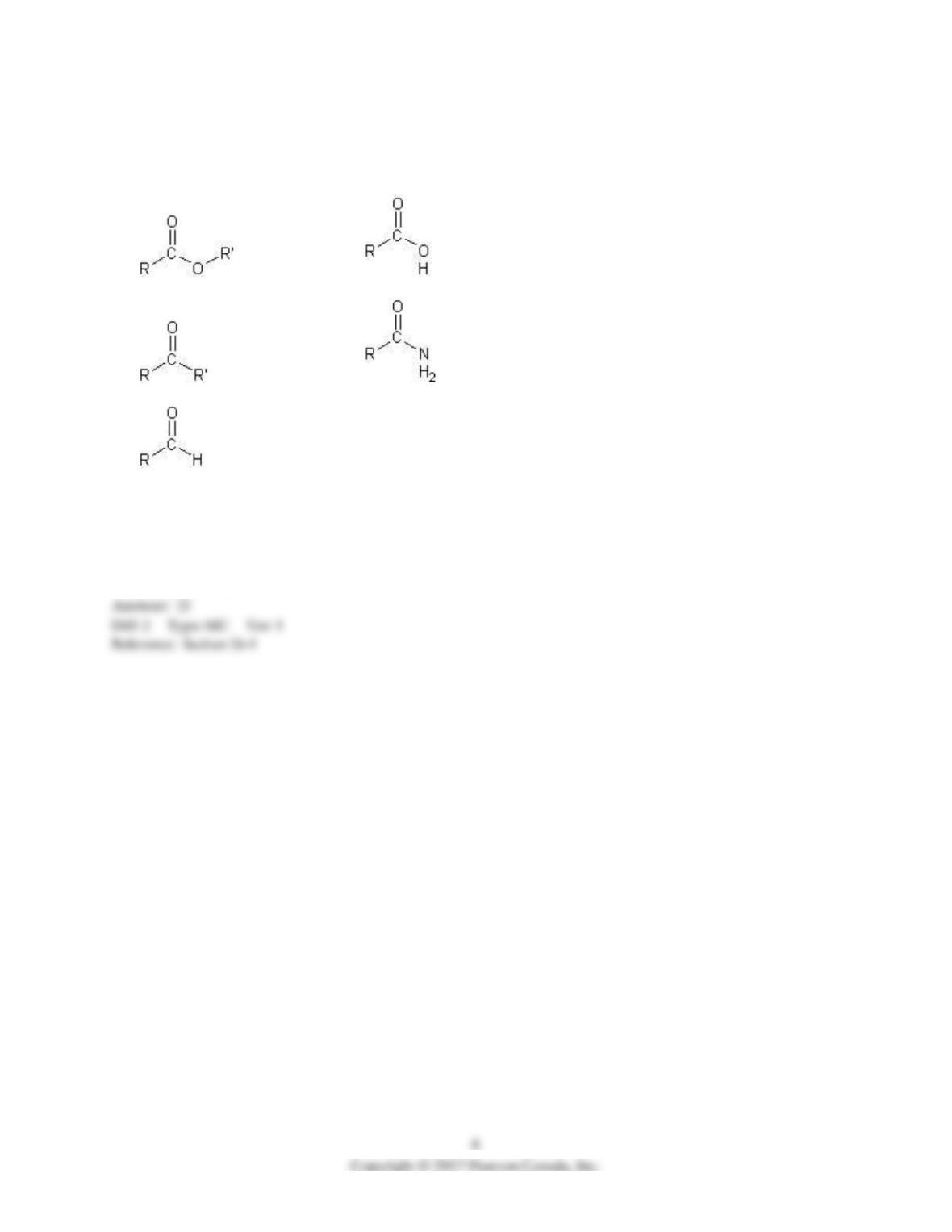
17) Which of the following classes of organic compounds and their general structural formulas have been
correctly matched?
I) ester: IV) carboxylic acid:
II) aldehyde: V) amide:
III) ketone:
A) I), II), and V)
B) II), III), and V)
C) III), IV), and V)
D) I), IV), and V)
E) II), IV), and V)
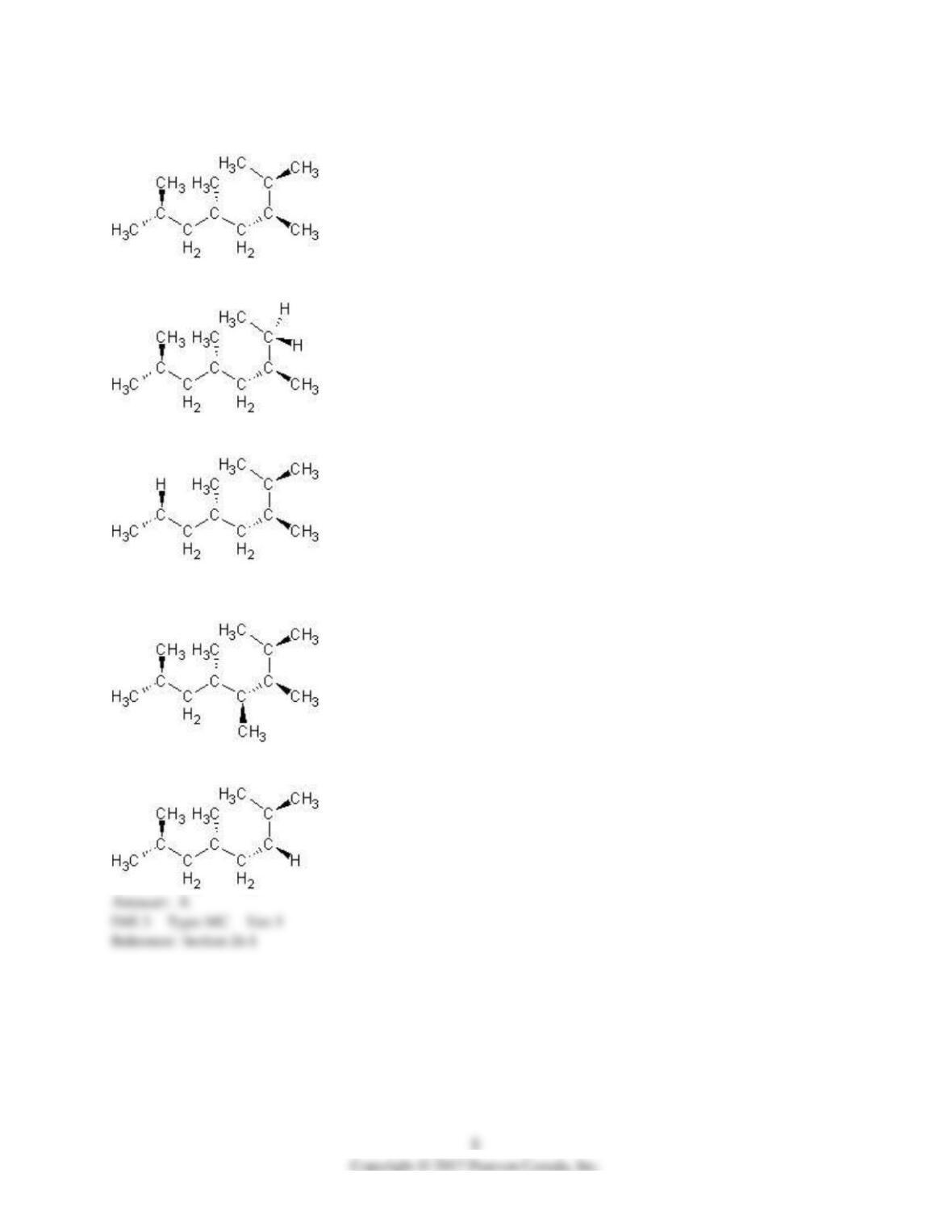
18) Find the structure for 2,3,5,7-tetramethyloctane
A)
B)
C)
D)
E)
19) How many primary, secondary, tertiary and quaternary carbon atoms are there in the structure of
2,4,6-trimetylheptane?
A) 5 primary, 2 secondary, 2 tertiary and 1 quaternary carbon atoms
B) 5 primary, 3 secondary, 2 tertiary and 0 quaternary carbon atoms
C) 4 primary, 4 secondary, 2 tertiary and 0 quaternary carbon atoms
D) 4 primary, 2 secondary, 2 tertiary and 2 quaternary carbon atoms
E) 5 primary, 2 secondary, 3 tertiary and 0 quaternary carbon atoms
20) Which compound is the lowest boiling?
A) methane
B) ethene
C) ethane
D) cyclopropane
E) ethyne
21) Choose the INCORRECT statement.
A) In thermal cracking large hydrocarbon molecules are broken down into smaller molecules, ideally,
molecules in the gasoline range.
B) Reforming converts straight-chain hydrocarbons into branched-chain hydrocarbons.
C) Branched-chain hydrocarbons have higher octane numbers.
D) Alkylation is the joining of small hydrocarbon fragments to larger molecules.
E) Engine knocking is caused by the smooth firing of gasoline.
22) Define “conformation.”
A) Conformations are different arrangements of bonds in space.
B) Conformations are different structural representations of the same molecule.
C) Conformations are different spatial arrangements one structure can have.
D) Conformations are two enantiomers.
E) Conformations are all possible structural isomers for a given molecular formula.
23) What are skew conformations?
A) Skew conformations all possible conformations between the eclipsed and staggered extremes.
B) Skew conformations in which linear molecules get twisted.
C) Skew conformations are conformations that have the greatest energy.
D) Skew conformations are conformations that have the lowest energy.
E) Skew conformations are conformations that have the greatest energy barrier.
24) Which of the following methods are used for the laboratory alkane synthesis?
I) catalytic addition of hydrogen to multiple carbon – carbon bonds
II) catalytic hydrogenation of aldehydes
III) from halogenated hydrocarbons and sodium
IV) from alkali metal salts of organic acids and alkali metal hydroxides
V) dehydrohalogenation of organic halogen compounds
A) I), II), and V)
B) II), III), and V)
C) I), III), and IV)
D) II), III), and IV)
E) III), IV) and V)
25) Reforming is:
A) a process that joins low molecular mass hydrocarbons into higher molecular mass hydrocarbons
B) a process that converts straight chain hydrocarbons to branched hydrocarbons
C) a process that converts unsaturated organic compounds to saturated ones
D) a process that breaks down high molecular mass hydrocarbons into low molecular mass hydrocarbons
E) a process that converts branched hydrocarbons to straight chain hydrocarbons
26) Which of the following positions would result in the most stable molecule for a large group like t–
butyl, -C(CH3)3?
A) equatorial position in boat cyclohexane
B) axial position in boat cyclohexane
C) two or more of these answers are equally stable
D) axial position in chair cyclohexane
E) equatorial position in chair cyclohexane
F) two or more of these answers are equally stable
27) Choose the INCORRECT statement.
A) Axial H atoms are directed above and below the cyclohexane ring.
B) A substitution reaction typically involves a functional group replacing a hydrogen atom on a chain or
ring containing molecule.
C) A free radical is a compound with an unpaired electron.
D) LPG is linear polymerized gas.
E) Unsaturated usually means a double, triple or delocalized electron system is present in the molecule.
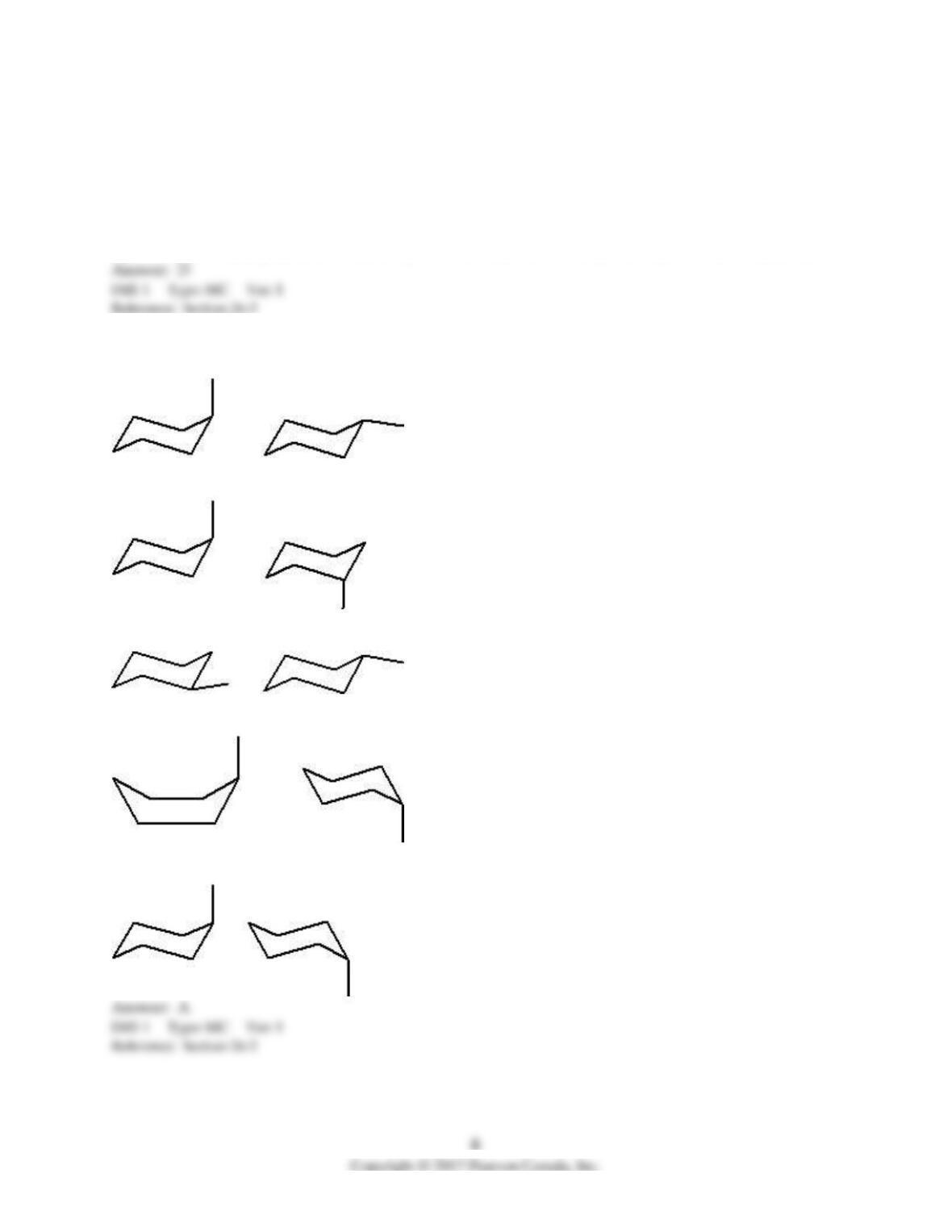
28) Which of the following represent two different chair forms of methylcyclohexane?
A)
B)
C)
D)
E)
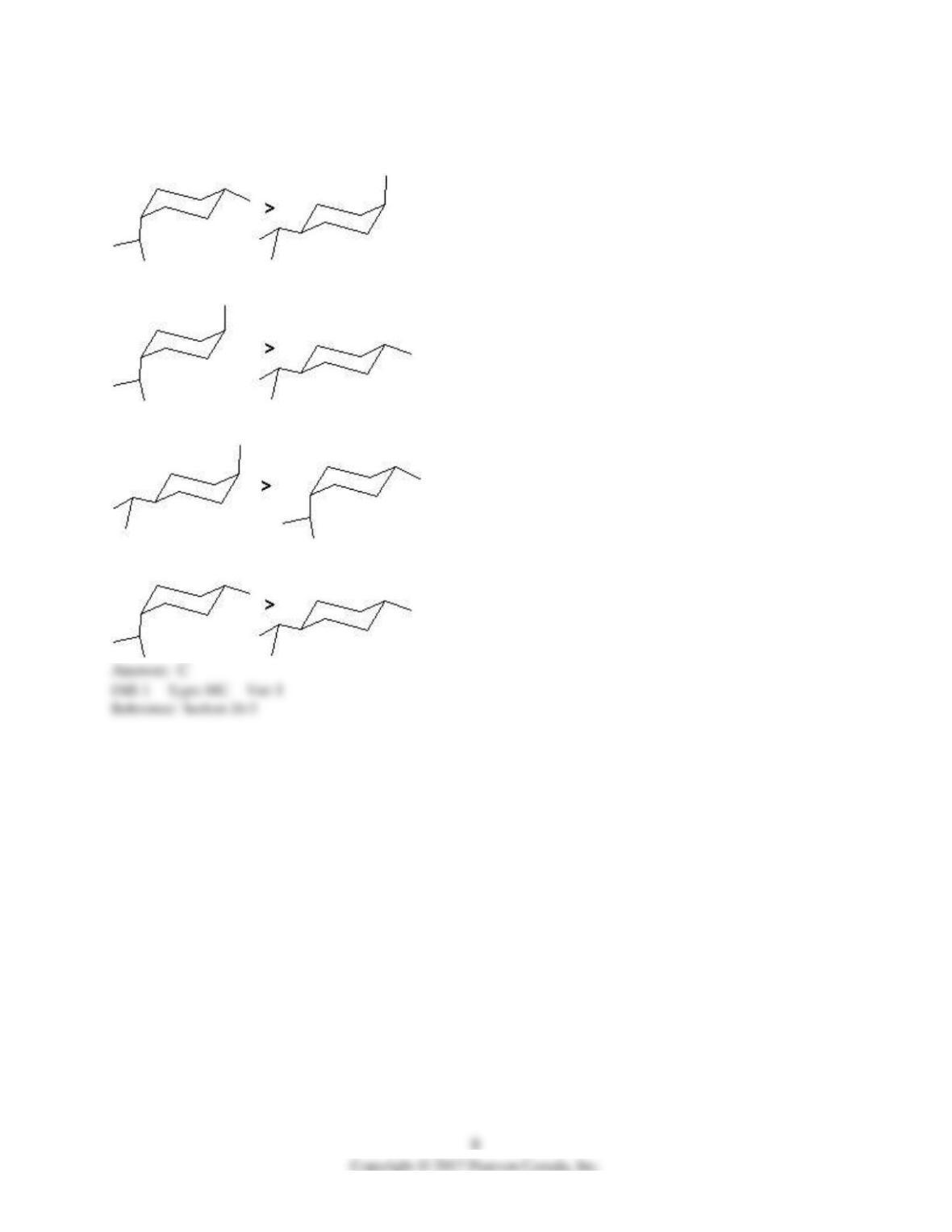
29) Find the answer that has correct both the two structures of cis-1-isopropyl-4-methylcyclohexane and
their relative stability (stability is indicated with “>” meaning “more stable than”).
A)
B)
C)
D)
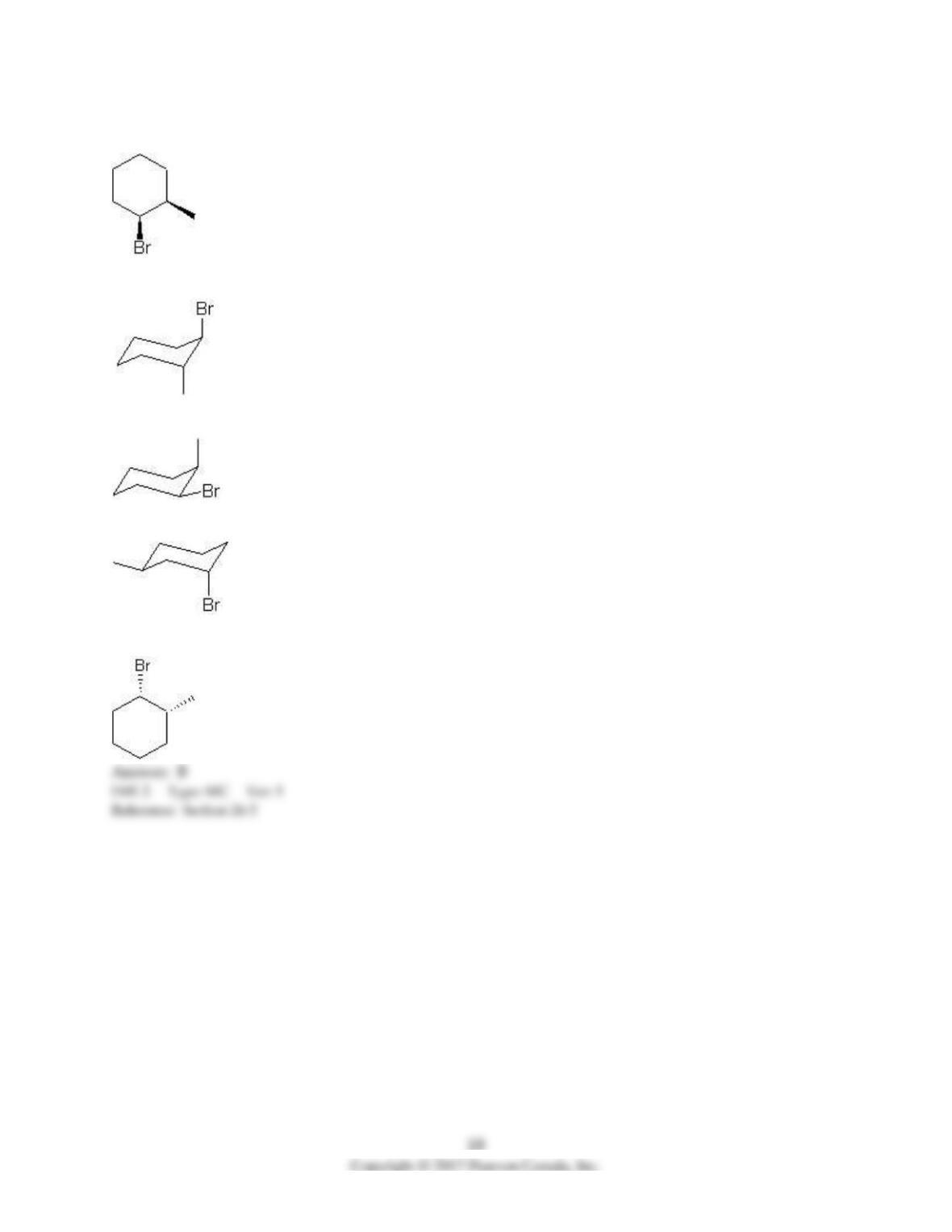
30) Which of the following structures represent the structure of trans-1-bromo-2-methylcyclohexane?
A)
B)
C)
D)
E)
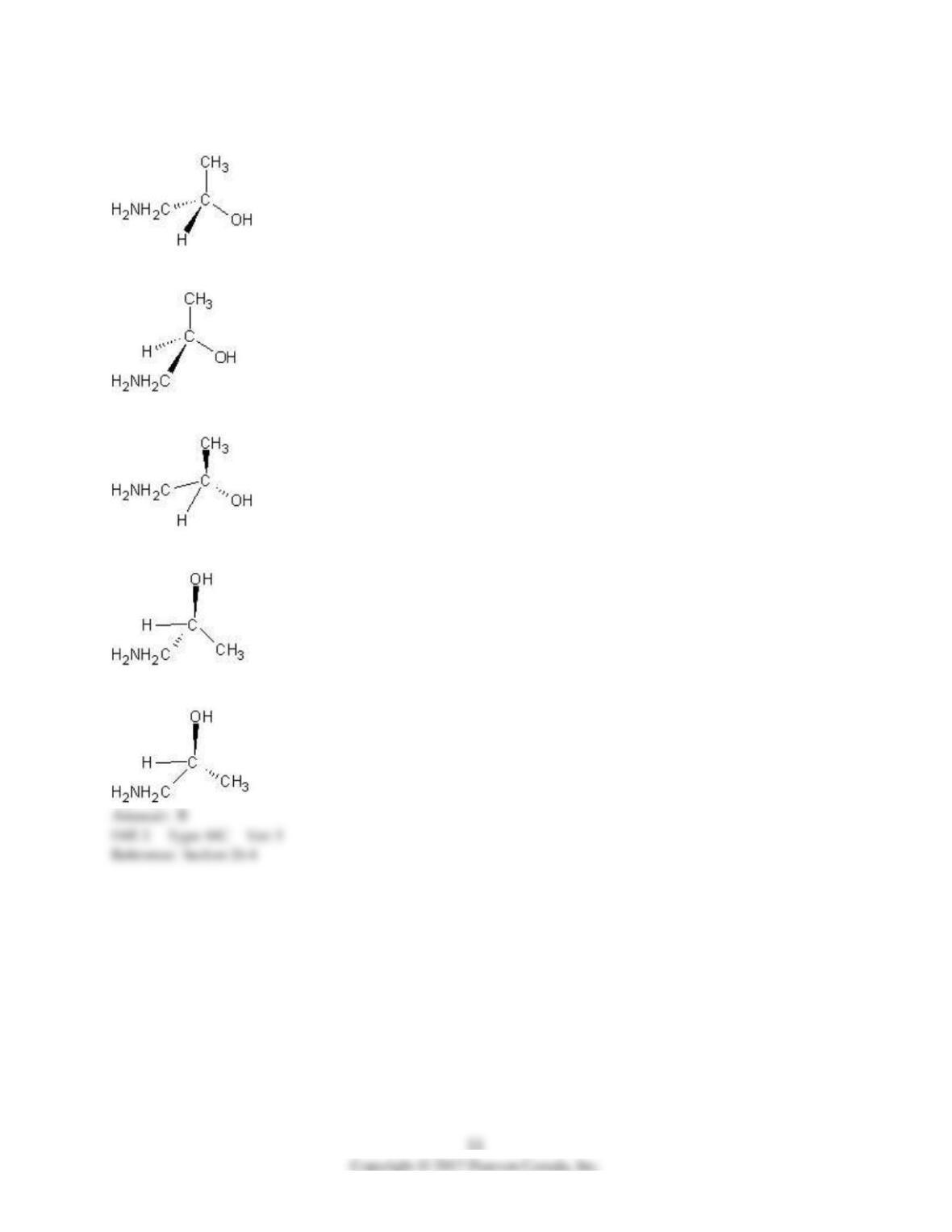
31) Which of the following structures represents a structure of R isomer of 1-amino-2-propanol?
A)
B)
C)
D)
E)
32) Which statements regarding chiral compounds are correct?
I) “Chiral carbon” is synonymous with “asymmetric carbon.”
II) The presence of one chiral carbon in a structure results in two possible enantiomers.
III) Two enantiomers can be interconverted without breaking any bonds.
IV) Two chiral molecules are mirror images of each other.
V) Two chiral molecules have significantly different chemical properties.
A) II), III), and V)
B) I), II), and IV)
C) I), III), and IV)
D) II), IV) and V)
E) III), and V)
33) There are three rules for assigning priorities:
Rule 1: A substituent atom of higher atomic number takes precedence over one of lower atomic number.
Rule 2: If two substituent atoms attached to the stereocenter have the same priority, the atom on the right
of a hydrogen atom bonded to chiral carbon is a substituent of higher priority.
Rule 3: Double and triple bonds are treated as if they were single, and the atoms in them are duplicated
or triplicated at each end by the particular atoms at the other end of the multiple bond.
Which rule(s) is/are stated incorrectly?
A) rule 2
B) rules 1 and 3
C) rule 3
D) rules 2 and 3
E) rules 1 and 2
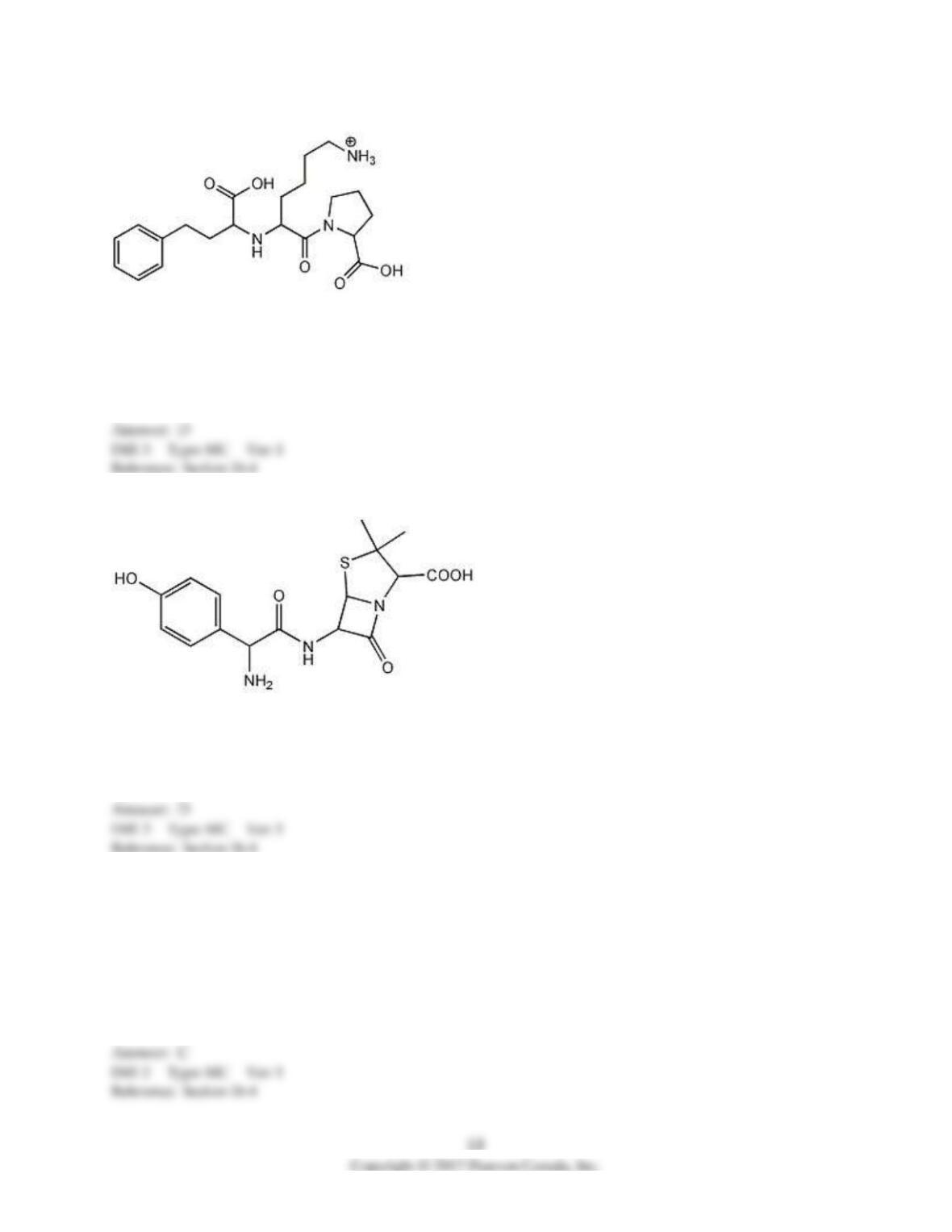
34) How many chiral carbon atoms can you find in the molecule below?
A) 0
B) 1
C) 2
D) 3
E) 4
35) How many chiral carbon atoms can you find in the molecule below?
A) 1
B) 2
C) 3
D) 4
E) 5
36) You found an organic compound containing chiral carbon atom with the following four substituents:
HC≡C-, Cl-, O=C- and H2C=CH-. What would be the correct order of their priorities?
A) HC≡C– > O=C- > Cl- > H2C=CH-
B) Cl- > HC≡C– > O=C- > H2C=CH-
C) Cl- > O=C- > HC≡C– > H2C=CH–
D) Cl- > O=C-> H2C=CH- > HC≡C–
E) O=C- > Cl- > HC≡C– > H2C=CH–
37) Give the name for CH3CH CHCH3.
A) 3-butene
B) 2-butene
C) 2-propene
D) 2-pentene
E) 2-butane
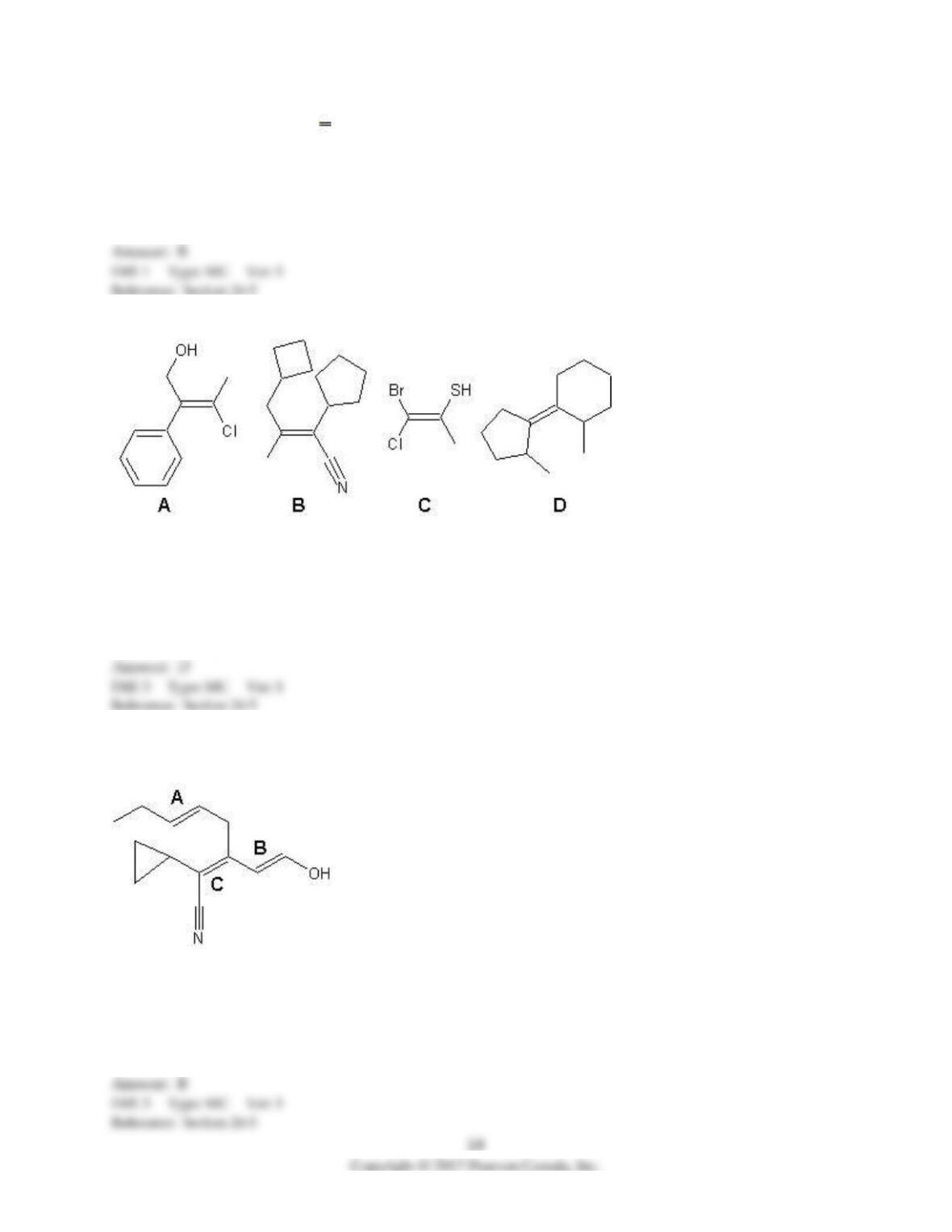
38) Find the correct stereochemistries for the following four alkenes:
A) A is Z, B is Z, C is E, D is E
B) A is Z, B is E, C is Z, D is E
C) A is E, B is E, C is Z, D is E
D) A is E, B is E, C is Z, D is Z
E) A is Z, B is Z, C is E, D is Z
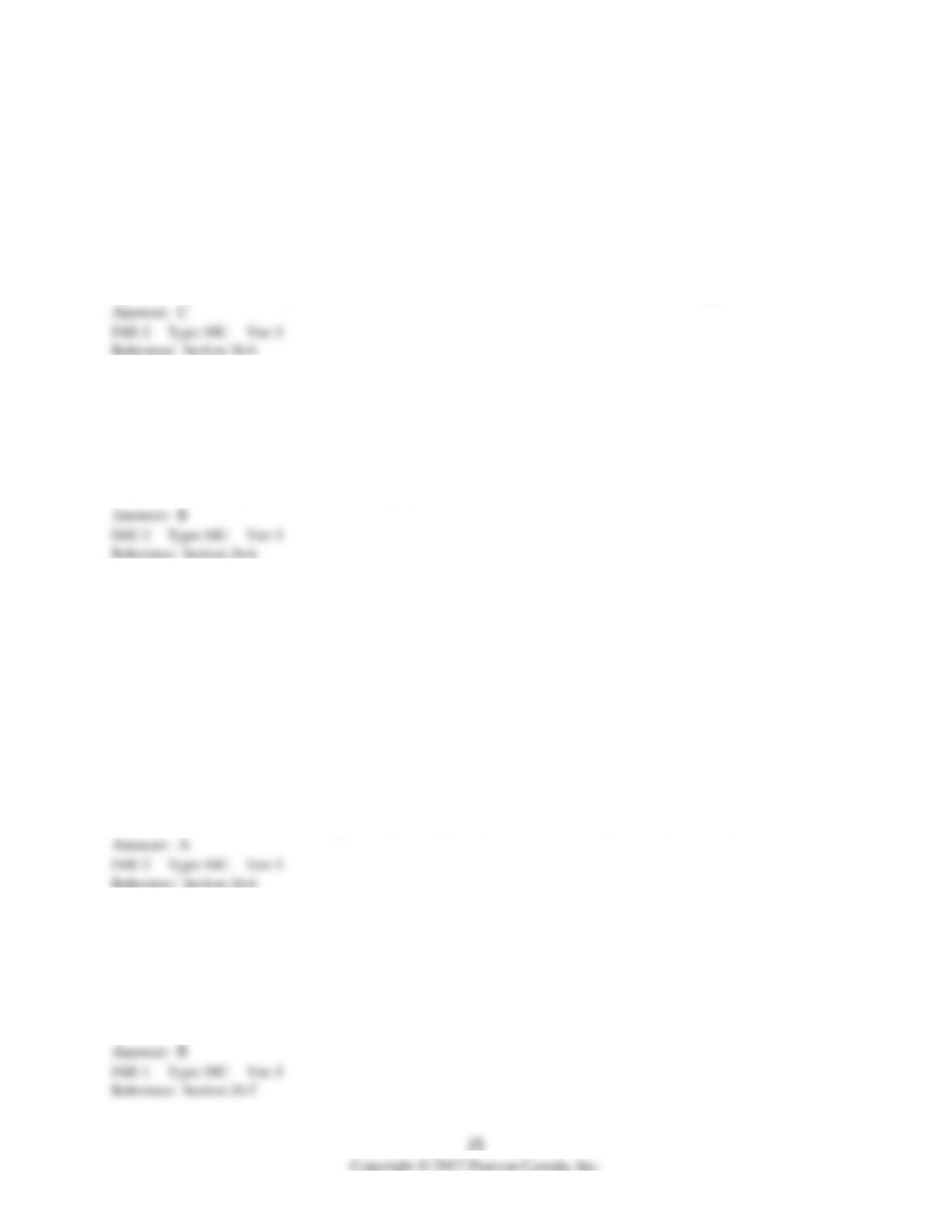
39) Choose the best configuration assignments for the three double bonds, labeled A, B and C, in the
following compound:
A) A is E, B is E, and C is E
B) A is E, B is E, and C is Z
C) A is Z, B is Z, and C is E
D) A is E, B is Z, and C is E
E) A is Z, B is E, and C is Z
40) Why does benzene have a much higher boiling point (80 °C) than hexane (69 °C), even though they
have the same number of carbons?
A) Benzene has fewer hydrogens than hexane.
B) Benzene is much more polar than hexane which enhances the attractive forces between molecules and
raises the boiling point.
C) Benzene is planar and has delocalized electron density which increases the attractive forces between
molecules and raises the boiling point.
D) Hexane has more Kekulé structures than benzene.
E) Benzene can covalently bond to another benzene molecule which increases its boiling point.
41) Can 1,3,5-hexatriene be considered an aromatic compound? Why do you think so?
A) Yes, because it contains alternating double and single bonds.
B) No, because the molecule is not a flat ring.
C) Yes, because its double bonds contain 4n+2 electrons (n = 1).
D) No, because the structure is not based on benzene ring.
E) Yes, because the molecule has a delocalized π electron cloud.
42) The terms ortho, meta and para are used to describe the substitution on benzene ring. What do they
stand for?
A) Ortho stands for two adjacent substituents, meta for two substituents with one carbon between them
and para for two substituents with two carbon atoms between them.
B) Ortho stands for two cis substituents, meta for two trans substituents and para for two opposite
substituents.
C) Ortho stands for two adjacent substituents, meta for two different adjacent substituents and para for
two substituents with one carbon atoms between them.
D) Ortho stands for two substituents with one carbon atom between them, meta for two substituents with
two carbons between them and para for two substituents with three carbon atoms between them.
E) Ortho stands for two substituents with two carbon atoms between them, meta for two substituents with
three carbons between them and para for two substituents with four carbon atoms between them.
43) CH3(C=O)CH3 is a(n):
A) ether
B) ketone
C) ester
D) aldehyde
E) carboxylic acid
44) To produce an ether from methanol, one can use:
A) reacting alkene with water in a presence of a strong mineral acid
B) alcohol and concentrated H2SO4
C) KOH in alcohol
D) Cu, heat
E) reacting alcohol with sodium
45) The diol, ethylene glycol, is used extensively as an antifreeze additive in automobile radiators. What
properties of ethylene glycol make it a good antifreeze?
A) Ethylene glycol coats the radiator to prevent crystallization of ice at low temperatures.
B) Ethylene glycol has a higher boiling point than water and is soluble in water.
C) Ethylene glycol has a lower boiling point than water and is soluble in water.
D) Ethylene glycol forms a film on the surface of the water to prevent ice formation in the radiator.
E) Ethylene glycol will remain in the radiator after the water evaporates. This prevents freezing in cold
climates.
46) Which class of compounds is the least reactive?
A) ethers
B) alcohols
C) ketones
D) alkyl halides
E) aldehydes
47) An alcohol of formula C3H8O in which there are only three different kinds of hydrogens is:
A) 2-propanol
B) 1-propanol
C) cyclopropanol
D) ethanol
E) None of the above
48) Which methods can be used to prepare alcohols?
I) addition of H2O to alkenes in the presence of H2SO4
II) reacting alkanes with a concentrated solution of CH3OH
III) hydrolysis of alkyl halides
IV) methanol can be prepared from CO(g) and H2(g) in the presence of a heterogeneous catalyst
V) removing one oxygen atom from a carboxylic acid
A) I), II) and IV)
B) I), III), and IV)
C) II), III), and V)
D) I), II), and V)
E) II), IV) and V)
49) Choose the INCORRECT statement.
A) CH3CH2CH2CH2CH2NH2 is an amine.
B) CH3CH2OCH2CH2CH3 is an ether.
C) CH3CH2CH2CH2CH2OH is an alcohol.
D) O
CH3CH2CH2CH2CH is a ketone.
E) CH3CH2CH2CH=CH2 is an alkene.