General Chemistry, 11e (Petrucci)
Chapter 24 Complex Ions and Coordination Compounds
1) A complex is any species involving coordination of ligands to a metal center.
2) A monodentate ligand can have only one lone pair of electrons.
3) Enantiomers are isomers which are not chiral.
4) High spin refers to the maximum number of ligands attached to the metal ion.
5) Unpaired electrons cause a complex ion to be diamagnetic.
6) Some wavelengths of light are the correct energy to be used to promote electrons to higher energy
levels and are thus lost from white light. The loss of these wavelengths causes solutions of transition
elements to be colored.
7) The overall formation constant can be calculated by multiplying the constant for each step of the
formation.
8) Complex-ion formation can be described in terms of Br∅nsted-Lowry acid-base reactions.
9) Complex-ions in which ligands are interchanged very slowly are called labile.
10) Sequestering is using a chelating agents to reduce a free cation concentration to the point that the
cation will not react to form objectionable products.
11) Which combination of central species and net charge is FALSE for complex ions or coordination
compounds?
A) neutral metal atom, positive net charge
B) neutral metal atom, zero net charge
C) metal cation, zero net charge
D) metal cation, positive net charge
E) metal cation, negative net charge
12) Which of the following metal ions can have coordination numbers of either 4 or 6?
A) Ag+
B) Ca2+
C) Cu+
D) Ni2+
E) Au+
13) Which of the following metal ions has coordination numbers of 2 or 4?
A) Fe3+
B) Co3+
C) Cu+
D) Pt2+
E) Cr3+
14) The [Fe(CN)6]3- complex ion:
A) exhibits square planar geometry
B) is diamagnetic
C) exhibits octahedral geometry
D) has two unpaired electrons
E) has four unpaired electrons
15) Choose the INCORRECT statement.
A) The coordination number is the number of ligands which can attach to a metal center.
B) A ligand supplies one or more electron pairs to bond to the metal ion.
C) The ligand-metal ion bond is a coordinate covalent bond.
D) A ligand is a Lewis base.
E) A ligand that donates a pair of electrons is multidentate.
16) Choose the INCORRECT statement.
A) A ligand that bonds to the metal ion with more than one atom is unidentate.
B) A chelate is produced by a ligand bonding to the metal ion with two or more donor atoms.
C) In coordination nomenclature, the cations are named before the anions.
D) In coordination nomenclature, the names of the ligands are followed by the name of the central metal
ion.
E) Anionic ligands end in –o in coordination nomenclature.
17) Choose the INCORRECT formula/name combination for ligands.
A) H2O / aqua
B) NH3 / ammine
C) CO / carbonyl
D) NO / nitrito-N–
E) CH3NH2 / methylamine
18) Choose the INCORRECT formula/name combination for ligands.
A) C5H5N / pyridine
B) F– / fluoro
C) Cl– / chloro
D) OH– / hydroxo
E) I– / iodino
19) Choose the INCORRECT formula/name combination for ligands.
A) O2- / hydroxo
B) NO / nitrosyl
C) I– / iodo
D) CN– / cyano
E) SO42- / sulfato
20) Choose the INCORRECT formula/name combination for ligands.
A) Br– / bromo
B) S2O32- / sulfato
C) NO2– bonded to N / nitrito-N–
D) NO2– bonded to O / nitrito-O–
E) en (ethylenediamine) / N2NCH2CH2NH2
21) Choose the INCORRECT formula/name combination for ligands.
A) –O2C-CO2– / oxalato (ox)
B) S2O32- / thiosulfato
C) CH3NH2 / ammino
D) SCN– bonded to S / thiocyanato-S–
E) NCS– bonded to N / thiocyanato-N–
22) It is known that the sulfhydryl group, –SH, forms strong coordinate bonds to certain heavy metal ions.
Which of the following do you expect to be the best chelating agent for heavy metal ions?
A) HS-CH2-CH(SH)-CH2-OH
B) H-SH
C) CH3-SH
D) CH3-S-S-CH3
E) SO42-
23) Which one of the following could be a chelating ligand?
A) NH3
B) CH3-CH2–NH2
C) NH2–CH2–CH2–NH2
D) CN–
E) any metal ion
24) Which of the following is a bidentate ligand?
A) H2O
B) NO2–
C) NH3
D) H2NCH2CH2NH2
E) [(O2C)2NCH2CH2N(CO2)2]4-
25) Which of the following ligand names is INCORRECT?
A) F–/fluoro
B) OH–/hydroxo
C) NH3/ammino
D) NO2–/nitrito
E) SO42-/sulfato
26) Which of the following ligands cannot act as a chelating agent?
A) nitrite ion
B) ethylenediamine
C) ethylenediaminetetracetate ion
D) hydrazine
E) oxalate ion
27) Choose the INCORRECT statement about coordination nomenclature.
A) Molecular ligands carry the molecule’s name.
B) The number of ligands is specified by a superscript.
C) Ligands are named in alphabetical order.
D) A Roman numeral designates the oxidation state of the metal ion.
E) Complex anions have an ate ending on the central metal’s name.
28) Coordination isomerism could be shown by:
A) Li[AlH4]
B) [Ag(NH3)2][CuCl2]
C) [Co(NH3)4Cl2]Br
D) [Pt(H2O)4Cl2]
E) [Fe(CN)6](NH3)3
29) Choose the INCORRECT statement about isomers.
A) Structural isomers differ in structure or bond type.
B) stereoisomers differ in the spatial arrangements among the ligands.
C) Ionization isomers differ in the charge on the central ion.
D) Linkage isomers differ in which atom is bonded to the central atom.
E) Geometric isomerism is cis-trans isomerism.
30) Choose the INCORRECT statement.
A) Structures that are nonsuperimposable mirror images are enantiomers.
B) Enantiomers are chiral.
C) Enantiomers are optical isomers.
D) Hydrates are molecules which do not react with water.
E) Coordination complexes add the ligands one at a time.
31) Choose the INCORRECT statement.
A) One popular chelating agent is EDTA.
B) [Cr(NH3)4Br]Cl and [Cr(NH3)4Cl]Br are examples of ionization isomerism.
C) Linkage isomers differ in the spatial arrangements among the ligands.
D) A tetrahedral complex cannot have a geometric isomer.
E) Enantiomers are optical isomers.
7
32) The compound PtCl2(en)2 [en = H2NCH2NH2] is octahedral; therefore we know that:
A) en must be a monodentate ligand
B) two moles of Cl– per mole of PtCl2(en)2 can be precipitated rapidly by the addition of Ag+
C) the molecule is nonpolar
D) the compound can have cis and trans isomers
E) Pt always has a coordination of 4
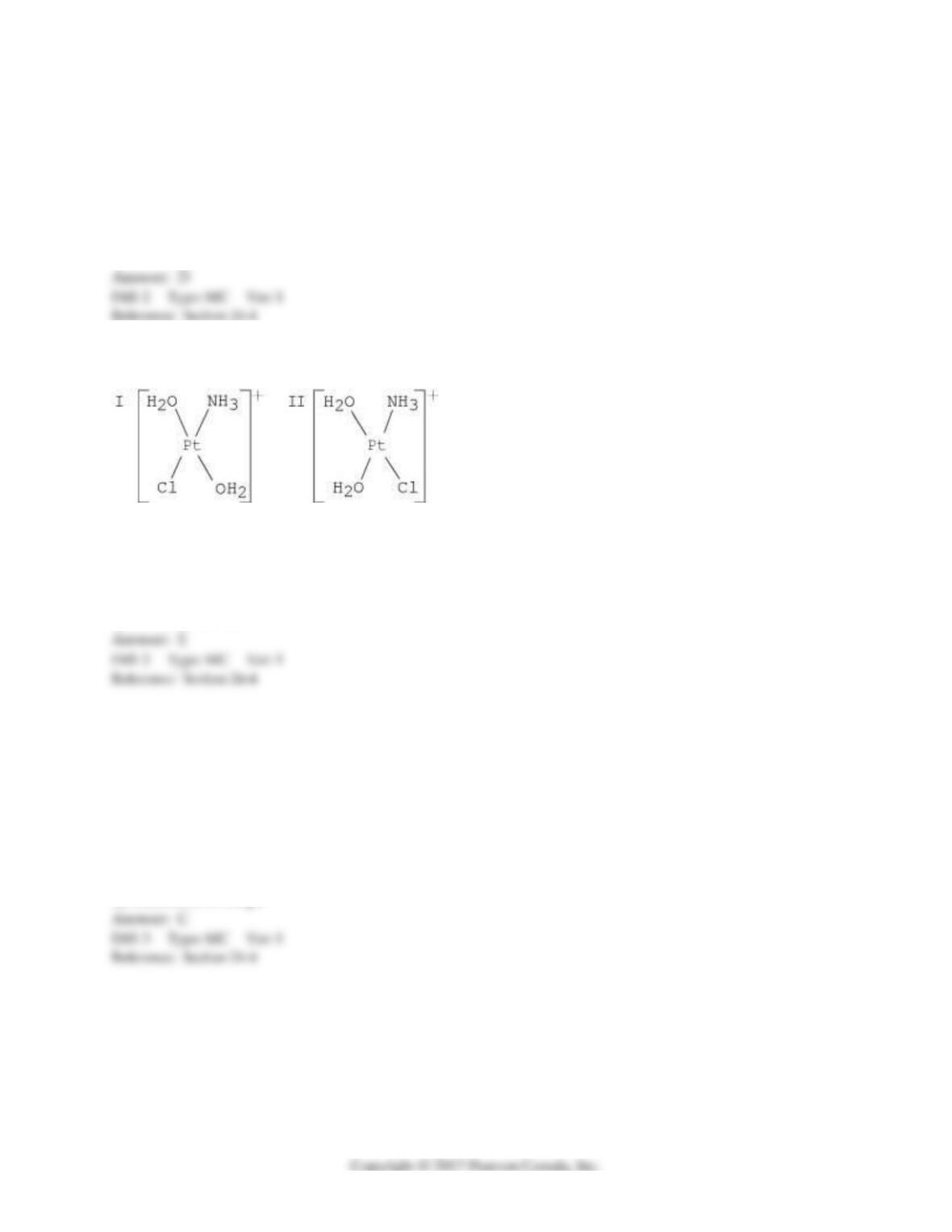
33) Choose the correct statement about isomers of [Pt(H2O)2(NH3)Cl]Br.
A) I is cis, II is trans.
B) The two molecules are the same.
C) The two molecules are the same but one is turned over.
D) They are not isomers.
E) I is trans, II is cis.
34) When [Ni(NH3)4]2+ is treated with concentrated HCl(aq), two compounds having the same formula,
[Ni(NH3)4Cl2], designated I and II, are formed. Compound I can be converted to compound II by boiling
it in dilute HCl(aq). A solution of I reacts with oxalic acid, H2C2O4, to form [Ni(NH3)4(C2O4)].
Compound II does not react with oxalic acid. Compound II is:
A) the cis isomer
B) tetrahedral in shape
C) the trans isomer
D) the same as compound I
E) octahedral in shape
8
35) Which of the following ligands exerts the strongest field?
A) I–
B) H2O
C) ONO–
D) NH3
E) Br–
36) Which complex ion possesses the largest number of unpaired electrons?
A) [CoCl4]2-
B) [Cr(NH3)6]2+
C) [Cu(NH3)4]2+
D) [Mn(CN)6]4-
E) [Fe(H2O)6]3+
37) Which element possesses the smallest number of unpaired electrons?
A) Co
B) Cr
C) Cu
D) Mn
E) Fe
38) Choose the correct shape, weak or strong field, and number of unpaired electrons for [Co(NH3)6]3+.
A) square planar, strong, 6
B) square planar, weak, 0
C) tetrahedral, strong, 0
D) octahedral, strong, 0
E) octahedral, weak, 6
9
39) Choose the correct shape, weak or strong field, and number of unpaired electrons for [PtCl6]2-.
A) square planar, weak, 0
B) square planar, strong, 4
C) tetrahedral, weak, 0
D) octahedral, weak, 1
E) octahedral, weak, 4
40) Choose the correct shape, weak or strong field, and number of unpaired electrons for [CoCl4]2-.
A) square planar, strong, 3
B) square planar, strong, 0
C) tetrahedral, strong, 1
D) tetrahedral, weak, 3
E) square planar, weak, 0
41) Choose the correct shape, weak or strong field, and number of unpaired electrons for [Ni(C2O4)3]4-.
A) square planar, strong, 4
B) octahedral, weak, 2
C) square planar, weak, 0
D) tetrahedral, weak, 0
E) octahedral, weak, 3
42) Choose the correct shape, weak or strong field, and number of unpaired electrons for [Co(NH3)4]2+.
A) octahedral, weak, 3
B) octahedral, strong, 3
C) square planar, strong, 1
D) tetrahedral, weak, 1
E) tetrahedral, strong, 1
43) Choose the correct shape, weak or strong field, and number of unpaired electrons for [Co(ox)3]4-.
A) tetrahedral, weak, 3
B) tetrahedral, strong, 3
C) square planar, strong, 3
D) octahedral, weak, 3
E) octahedral, strong, 5
44) Choose the correct shape, weak or strong field, and number of unpaired electrons for [CoI6]3-.
A) tetrahedral, strong, 2
B) tetrahedral, weak, 4
C) square planar, strong, 0
D) octahedral, strong, 5
E) octahedral, weak, 4
45) The hexaaquachromium(III) ion absorbs light in the green part of the visible spectrum, thereby
appearing to have the color:
A) blue
B) cyan
C) green
D) purple
E) yellow
46) Of the following complex ions, two appear violet in aqueous solution, one appears purple, one
appears blue-green, and one appears yellow. Which is yellow?
A) [Cr(H2O)6]3+
B) [CrCl(H2O)5]2+
C) [CrCl(NH3)5]2+
D) [CrCl2(NH3)4]+
E) [Cr(NH3)6]3+
11
47) Using the stepwise formation constants given, calculate the net formation constant for the
[Cu(H2NCH2CH2NH2)2]2+ complex.
Cu2+ + en → [Cu(en)]2+ K1 = 5.2 × 10¹⁰
[Cu(en)]2+ + en → [Cu(en)2]2+ K2 = 2.0 × 10⁹
A) 2.6 × 101
B) 2.5 × 10⁹
C) 5.4 × 10¹⁰
D) 7.9 × 10¹⁹
E) 1.0 × 10²⁰
48) What is the approximate concentration of free Ni2+(aq) remaining at equilibrium in a solution
prepared by mixing 5.0 mL of 0.10 M NiCl(aq)2 with 5.0 mL of 2.0 M NH3(aq)? [The net formation
constant for the hexamminenickel(II) ion is 5.5 × 10⁸.]
A) 1.8 × 10⁻⁹ M
B) 7.7 × 10⁻¹⁰ M
C) 1.3 × 10⁻¹⁰ M
D) 2.4 × 10⁻¹⁰ M
E) 0.050 M
49) What is the approximate concentration of free Cu2+(aq) remaining at equilibrium in a solution
prepared by mixing 5.0 mL of 0.10 M CuCl2(aq) with 5.0 mL of 2.0 M aqueous ethylenediamine? [The net
formation constant for the bis(ethylenediaminecopper(II) ion is 1 × 10²⁰.]
A) 9 × 10–22 M
B) 7 × 10–22 M
C) 2 × 10–22 M
D) 1 × 10–21 M
E) 6 × 10–22 M
12
50) What is the approximate concentration of free Ni2+(aq) remaining at equilibrium in a solution
prepared by mixing 5.0 mL of 0.10 M NiCl2(aq) with 5.0 mL of 2.00 M aqeous ethylenediamine? [The net
formation constant for the tris(ethylenediaminenickel(II) ion is 2.1 × 10¹⁸.]
A) 0.050 M
B) 1.4 × 10⁻¹⁹ M
C) 4.8 × 10⁻¹⁹ M
D) 3.9 × 10⁻²⁰ M
E) 2.8 × 10⁻²⁰ M
51) What is the concentration of Ag+(aq) if 0.125 g of AgC2H3O2(s) is placed in 100.0 mL of 1.00 M
NH3(aq)?
Kf = 1.6 × 10⁷ for [Ag(NH3)2]+
A) 4.8 × 10⁻¹⁰ M
B) 5.6 × 10⁻¹⁰ M
C) 8.0 × 10⁻⁸ M
D) 8.3 × 10⁻⁶ M
E) 7.5 × 10⁻³ M
52) What is the concentration of Zn2+(aq) if 0.254 g of ZnCl2(s) is dissolved in 200.0 mL of 2.00 M
NH3(aq)?
Kf ([Zn(NH3)4]2+) = 4.1 × 10⁸
A) 0.0093 M
B) 1.5 × 10⁻¹² M
C) 2.4 × 10⁻⁹ M
D) 2.3 × 10⁻¹² M
E) 0.0019 M
13
53) What is the concentration of Cu2+(aq) if 0.235 g of CuCl2(s) is dissolved in 300.0 mL of 0.550 M
NH3(aq)?
Kf ([Cu(NH3)4]2+) = 1.1 × 10¹³
A) 5.8 × 10⁻¹⁵ M
B) 1.0 × 10⁻¹⁵ M
C) 6.9 × 10⁻¹⁵ M
D) 5.8 × 10⁻³ M
E) 1.2 × 10⁻¹² M
54) What is the concentration of Ni2+(aq) if 0.223 g of NiCl2(s) is dissolved in 250.0 mL of 0.760 M
NH3(aq)?
Kf ([Ni(NH3)6]2+) = 5.5 × 10⁸
A) 6.9 × 10⁻³ M
B) 7.6 × 10⁻¹¹ M
C) 1.3 × 10⁻¹¹ M
D) 9.7 × 10⁻¹¹ M
E) 1.4 × 10⁻¹¹ M
55) What is the approximate concentration of free Fe2+(aq) remaining at equilibrium in a solution
prepared by mixing 5.0 mL of 0.10 M FeSO4(aq) with 5.0 mL of 2.0 M KCN(aq)? [The net formation
constant for the hexacyanoferrate(II) ion is 1 × 1037.]
A) 3 × 10–22 M
B) 7 × 10–30 M
C) 4 × 10–38 M
D) 5 × 10–37 M
E) 4 × 10–40 M