62) Choose the INCORRECT statement.
A) The electron configuration of Fe2+ is [Ar]3d6.
B) The electron configuration of Co2+ is [Ar]3d7.
C) The electron configuration of Fe3+ is [Ar]3d5.
D) The electron configuration of Ni2+ is [Ar]3d5.
E) A metal carbonyl is a compound formed from a metal and carbon monoxide.
63) Which element has the largest number of unpaired electrons?
A) Cu2+
B) Fe3+
C) V3+
D) Ni2+
E) Zn2+
64) Choose the INCORRECT statement.
A) The coinage metals are used for coins because of durability and resistance to corrosion.
B) Bronze is an alloy of copper and tin.
C) Coinage metals are excellent electrical conductors.
D) Coinage metals have poor malleability and ductility.
E) Gold does not react with any acid but aqua regia.
65) Choose the INCORRECT statement.
A) Aqua regia is a combination of HCl and HNO3.
B) Malleable means that a metal can be beaten into a thin sheet.
C) One of the most important property of Cu, Ag, and Au is resistance to corrosion.
D) Because the ions of Cu, Ag, and Au are easy to reduce means that the metals are easy to oxidize.
E) The coinage metals are Cu, Ag, and Au.
66) Choose the INCORRECT statement.
A) Cu, Ag, and Au are the preferred metals for coins because they are durable and resistant to corrosion.
B) Cu, Ag, and Au are used in the electronics industry because of their conductivity.
C) Cu, Ag, and Au do not readily react with HCl although most metals do.
D) Tarnish is black Ag2S.
E) Silver is the basis for the world’s monetary reserve.
67) Estimate the net formation constant for diamminesilver(I) ion from the following data:
Ag+(aq) + e– → Ag(s) E° = 0.80 V
Ag(NH3)2+(aq) + e– → Ag(s) + 2 NH3(aq) E° = 0.37 V
A) 6 × 10¹¹
B) 5 × 10¹⁰
C) 4 × 10⁹
D) 3 × 10⁸
E) 2 × 10⁷
68) Choose the INCORRECT statement.
A) Cu, Ag, and Au do not react with oxygen in the air.
B) Cu will corrode in moist air.
C) Ag will react with sulfur in the air to form tarnish.
D) Copper is used as copper halide in photography.
E) Copper is essential to life in trace amounts.
69) Which of the following represents a disproportionation reaction?
A) 2 Cu+(aq) + H2O(l) → Cu(s) + CuO(s) + 2 H+(aq)
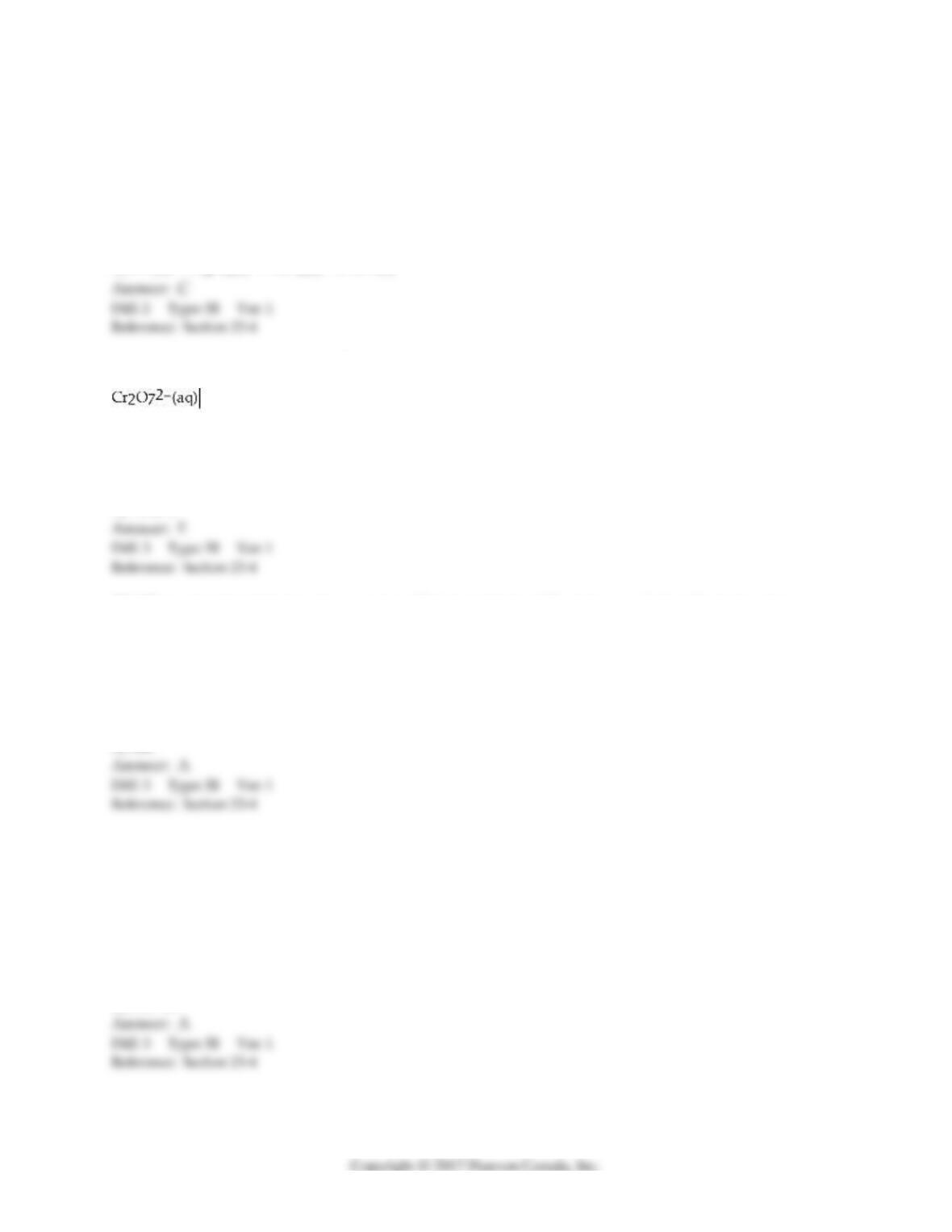
B) 2 CrO42-(aq) + 2 H+(aq) → Cr2O72-(aq) + H2O(aq)
C) TiCl4(l) + 2 H2O(l) → TiO2(s) + 4 HCl(g)
D) MnO4–(aq) + 5 VO2+(aq) + H2O(l) → Mn2+(aq) + 5 VO2+(aq) + 2 H+(aq)
E) 3MnO2(s) + 6 KOH(aq) + KClO3(aq) 3 K2MnO4(aq) + KCl(aq) + 3 H2O(l)
16
70) Choose the INCORRECT statement.
A) Galvanized iron is iron coated with zinc.
B) Mercury is the only metal that is liquid at 25 °C.
C) Hatter’s disease is a form of mercury poisoning, i.e., the Mad Hatter, the friend of Alice.
D) Brass is an alloy of mostly copper and zinc.
E) Amalgams are zinc alloys.
71) Choose the INCORRECT statement.
A) Zn, Cd, and Hg all have electron configurations of (n–1)d10ns2.
B) Because in Zn, Cd, and Hg only s electrons are participating, metallic bonding is strong.
C) The low melting and boiling points of Zn, Cd, and Hg are due to the metallic bonding.
D) Galvanized iron is iron coated with zinc.
E) Cadmium and mercury compounds are poisonous.
72) Choose the INCORRECT statement.
A) Zinc is poisonous in trace amounts.
B) ZnO, CdS and HgS are used as artist’s pigments.
C) The band gap is the energy difference between the conduction band and the valence band.
D) The color of Zn, Cd, and Hg compounds depends on the width of the band gap.
E) One proposed mechanism of mercury poisoning is that mercury compounds react with sulfur in
enzymes.
73) Consider two metals, metal M and metal N. The reaction M + N2+ → M2+ + N will proceed if:
A) M is Zn and N2+ is Pb2+
B) M is Cu and N2+ is Fe2+
C) M is Sn and N2+ is Ca2+
D) M is Ni and N2+ is Mg2+
E) M is Fe and N2+ is Ca2+
17
74) Choose the INCORRECT statement.
A) The inner transition elements include the lanthanides.
B) The lanthanides are sometimes called rare earth elements.
C) The lanthanides feature the filling of the 5f orbitals.
D) The lanthanides have very similar chemical properties.
E) Lanthanides are difficult to separate from each other.
75) Choose the INCORRECT statement.
A) The lanthanides often occur naturally as oxides.
B) The most common oxidation state of lanthanides is +4.
C) Most of the lanthanides are paramagnetic.
D) Like the transition elements, aqueous solutions of the lanthanides are colored.
E) Fractionated means to alter slightly the ratio of the concentration of one element to another.
76) Choose the INCORRECT statement.
A) Among the methods to separate the lanthanides are fractional precipitation and solvent extraction.
B) Because the properties of the lanthanides are so similar, separation must be done in a series of
repetitive steps.
C) Lanthanides are reactive metals, that is they liberate H2(g) from acids.
D) The 4f electrons play a major role in chemical bonding.
E) The pure lanthanide metals can be produced by electrolytic reduction from the +3 oxidation state.
77) Write the probable electron configuration for Ti2+.
A) 3d2
B) 4s2
C) 4s13d5
D) 4s24d4
E) 5s2
78) List the following in order of increasing number of unpaired electrons: Fe, V, Sc, Mn
A) Mn < Fe < V < Sc
B) Sc < V < Fe < Mn
C) Fe < V < Sc < Mn
D) V < Sc < Mn < Fe
E) Sc < Mn < Fe < V
79) In the group of elements Cr, Ni, Sn, Pt, Ti, the one which is a main group element is ________.
A) Ni
B) Sn
C) Ti
D) Pt
E) Cr
80) List the following in order of increasing atomic radius: Ti, Cr, V, Ca.
A) V < Ti < Ca < Cr
B) Ca < V < Cr < Ti
C) Ca < Ti < Cr < V
D) Cr < V < Ti < Ca
E) Cr < V < Ca < Ti
81) List the following in order of increasing atomic radius: V, Sc, Fe, Ti.
A) Fe < V < Ti < Sc
B) Sc < Ti < V < Fe
C) Ti < V < Fe < Sc
D) V < Fe < Sc < Ti
E) Fe < Sc < Ti < V
82) List the following in order of increasing density: Ti, Pd, Nb, Pt.
A) Ti < Pt < Pd < Nb
B) Nb < Ti < Pt < Pd
C) Pd < Nb < Ti < Pt
D) Pt < Pd < Nb < Ti
E) Ti < Nb < Pd < Pt
83) The metallurgical method for obtaining a metal from its ore by roasting the ore and then reducing the
resulting metal oxide is called ________.
A) zone melting
B) pyrometallurgy
C) leaching
D) hydrometallurgy
E) flotation
84) Zinc oxide, a useful fungicide, can be prepared from zinc blende ore by roasting the ore in air and
then purifying the resulting oxide. What mass of zinc oxide could be obtained from 5.00 kg of a zinc
blende ore that analyzed at 48.6% zinc sulfide, if the net conversion is 66.7% efficient?
A) 0.98 kg
B) 1.35 kg
C) 1.51 kg
D) 1.89 kg
E) 2.07 kg
85) What average current must be maintained to electroplate 6.5 g of chromium per hour from a solution
of chromium(III) complex?
A) 3.4 A
B) 6.9 A
C) 10 A
D) 12 A
E) 15 A
86) What mass of manganese dioxide, from pyrolusite ore, is required for production of 25 kg of
potassium permanganate by a process which is 78% efficient?
A) 18 kg
B) 14 kg
C) 25 kg
D) 29 kg
E) 32 kg
20
87) Write the equation for treatment of Ag(s) with CN–(aq).
A) 4 Ag(s) + 2 CN–(aq) + O2(g) + 2 H2O(l) → 4 AgO(s) + 4 CO(g) + 4 NH–(aq)
B) 4 Ag(s) + 8 CN–(aq) + O2(g) + 2 H2O(l) → 4 [AgCN]– + 4 CO(g) + 4 NH+(aq)
C) 4 Ag(s) + 8 CN–(aq) + O2(g) + 2 H2O(l) → Ag3N(s) + 4 OH–(aq) + AgC8(s)
D) 4 Ag(s) + 8 CN–(aq) + O2(g) + 2 H2O(l) → 4 [Ag(CN)2]–(aq) + 4 OH–(aq)
E) 4 Ag(s) + 8 CN–(aq) + O2(g) + 2 H2O(l) → 4 AgO(s) + 2 H2(g) + 2 CO(g) + 6 CN–(aq)
88) What volume of 18 M sulfuric acid could be prepared from the sulfur dioxide formed by the smelting
of 5.00 metric tons of copper(I) sulfide, assuming that only 50% of the sulfur dioxide can actually be
converted to the acid?
A) 790 L
B) 870 L
C) 940 L
D) 1,200 L
E) 1,600 L
89) Write the overall equation for reducing Cu2S to metallic copper.
A) Cu2S(l) + C(s) → 2 Cu(l) + CS(g)
B) Cu2S(l) + CO(g) → 2 Cu(l) + CO(g) + S(s)
C) Cu2S(l) + 2 CO(g) + O2(g) → 2 Cu(l) + 2 CO2(g) + S(s)
D) Cu2S(l) + 3 O2(g) → 2 Cu(l) + S(s) + 2 O3(g)
E) Cu2S(l) + O2(g) → 2 Cu(l) + SO2(g)
90) A 0.535 g sample of pyrolusite ore (impure MnO2) is treated with 1.42 g oxalic acid (H2C2O4 ∙ 2H2O)
in an acidic medium. Following this reaction, the excess oxalic acid is titrated with 0.1000 M KMnO4, 36.6
mL being required. What is the % MnO2 in the ore? The reactions are:
H2C2O4 ∙ 2 H2O(aq) + MnO2(s) + 2 H+(aq) → Mn2+(aq) + 4 H2O(l) + 2 CO2(g)
5 H2C2O4 ∙ 2H2O(aq)+ 2 MnO4–(aq) + 6 H+(aq) → 2 Mn2+(aq) + 18 H2O(l) + 10 CO2(g)
A) 34.4%
B) 61.1%
C) 2.33%
D) 1.22%
E) 38.9%
91) The simplified equation for the reduction of iron ore is:
Fe2O3(s) + CO(g) → Fe(l) + CO2(g)
When it is balanced, the coefficients are ________.
A) 1, 3, 2, 3
B) 1, 3, 1, 3
C) 1, 1, 1, 2
D) 2, 6, 3, 3
E) 1, 1, 2, 1
92) How much carbon monoxide is required to reduce 2.00 metric tons (2000 kg) of iron ore if the ore is
5.03% iron?
Fe2O3(s) + 3 CO(g) → 2 Fe(l) + 3 CO2(g)
A) 151 kg
B) 75.7 kg
C) 25.2 kg
D) 40.7 kg
E) 50.5 kg
22
93) Write the chemical equation for the reduction of Cr2O3 to chromium with silicon as the reducing
agent.
A) Si(s) + Cr2O3(s) → SiO3(s) + Cr(l)
B) Si(s) + Cr2O3(s) → SiO2(s) + 2 CrO(s)
C) 3 Si(s) + 2 Cr2O3(s) → 3 SiO2(s) + 4 Cr(l)
D) 3 Si(s) + Cr2O3(s) → 3 SiO(s) + 2 Cr(l)
E) 4 Si(s) + Cr2O3(s) → SiO3(s) + 2 CrO(s)
94) Use the couples Cr2+(aq) | Cr3+(aq), -0.424 V and Cr3+(aq) | Cr2O72-(aq), -1.33 V to determine E° of
Cr2+(aq).
A) -0.02 V
B) 1.75 V
C) -1.75 V
D) 0.81 V
E) -1.10 V
95) When permanganate ion serves as an oxidizing agent in acidic aqueous solution the manganese-
containing product most likely to be formed is ________.
A) Mn2+
B) MnO2
C) MnO4–
D) MnO
E) Mn
96) A 25.0 mL aliquot of a solution containing Fe2+(aq), prepared during an assay of a pyrite ore, was
titrated to a faint purple endpoint by 32.2 mL of 0.020 M KMnO4(aq). What was the molarity of the Fe2+
solution? [The permanganate was reduced to Mn2+(aq).]
A) 0.13 M
B) 0.19 M
C) 0.26 M
D) 0.31 M
E) 0.47 M
23
97) Write the electron configuration for Fe2+.
A) [Ar]3d6
B) [Ar]4s23d4
C) [Ar]4s24p4
D) [Ar]4s14p1
E) [Ar]5s2
98) Write the electron configuration for Co3+.
A) [Ar]3d6
B) [Ar]4s23d4
C) [Ar]4s24p4
D) [Ar]4s14p1
E) [Ar]5s2
99) Which is most probably the ground state electron configuration for the iron(III) ion?
A) [Ar]4s23d3
B) [Ar]4s13d4
C) [Ar]4s03d33p3
D) [Ar]4s04p5
E) [Ar]4s03d5
100) What is the approximate pH of the H+(aq)/H2(g) electrode compartment through which H2 gas is
bubbled at a pressure of 1.00 atm if this electrode, when coupled with a Ni(s)/(0.10 M) Ni2+(aq) electrode,
forms a galvanic cell having an initial potential of 0.10 V? [The discharge reaction involves oxidation of
nickel to Ni2+(aq).]
A) 2.15
B) 4.65
C) 6.15
D) 3.15
E) 3.65
24
101) Gold does not react with either nitric acid nor hydrochloric acid alone, but can be dissolved by aqua
regia to form the tetrachloroaurate(III) ion, water and nitric oxide. What is the sum of the coefficients
when the net equation for this process is balanced?
A) 17
B) 14
C) 11
D) 9
E) 7
102) The net formation constant for tetraamminezinc(II) is 4.1 × 10⁸. What would be the approximate
potential of the galvanic cell symbolized below?
Zn(s)/Zn(NH3)42+ (aq, 1.0 M), NH3(aq, 1.0 M)//Zn2+(aq, 1.0 M)/Zn(s)
A) 0.76 V
B) 0.00 V
C) 0.51 V
D) 0.25 V
E) 1.02 V
103) Which substance is the best conductor of electricity?
A) arsenic
B) boron
C) silver
D) tellurium
104) What is the highest possible oxidation state for manganese?
A) +2
B) +5
C) +6
D) +7
25
105) What is the ground-state electron configuration for the element chromium (Z = 24)?
A) [Ne] 4s23d4
B) [Ar] 4s23d4
C) [Ar] 4s13d5
D) [Ar] 3d6
106) What is the ground-state electron configuration for Cr3+ (Z = 24)?
A) [Ar] 4s23d7
B) [Ar] 4s23d1
C) [Ar] 3d3
D) [Ar] 4s13d2
107) Which of the following species has the electron configuration [Ar]3d6?
A) Cr
B) Fe3+
C) Co3+
D) Ni3+
108) How many d electrons are there in CrO72-?
A) 0
B) 1
C) 2
D) 3