56) Choose the INCORRECT statement.
A) Hydrogen occurs in more compounds than any other element.
B) The “water gas” reactions produce combustible gases (CO and H2) from steam and C(s).
C) Metallic hydrides are always in fixed ratios of hydrogen to other elements.
D) Binary compounds of hydrogen are called hydrides.
E) Hydrogenation reactions are hydrogen added to double or triple bonds in presence of a catalyst.
57) Choose the INCORRECT name/formula combination.
A) hydrogen chloride HClO
B) sodium hydride NaH
C) sodium hydrogen carbonate NaHCO3
D) calcium hydride CaH2
E) dihydrogen H2
58) Define “hydrogenation reaction.”
A) Hydrogen is produced chemically.
B) Double bonds are formed by removing hydrogen.
C) Hydrogen is removed from water.
D) Hydrogen is separated from other gases in air.
E) Hydrogen is added to carbon-carbon multiple bonds such that the bond order is reduced in the final
product.
59) What is the molecular shape for XeF2?
A) trigonal planar
B) tetrahedral
C) bent
D) linear
E) trigonal pyramidal
14
60) What is the molecular shape for XeOF2?
A) trigonal planar
B) tetrahedral
C) trigonal bipyramid
D) T-shape
E) trigonal pyramidal
61) The electron group geometry for XeF2 is ________.
A) trigonal planar
B) trigonal bipyramid
C) bent
D) linear
E) trigonal pyramidal
62) On the average, air contains about 9.3 mL of argon per liter. What would be the partial pressure of
argon in air when the barometric pressure is 780 Torr?
A) 84 Torr
B) 7.3 Torr
C) 780 Torr
D) 770 Torr
E) 790 Torr
63) In a reaction between XeO3(aq) and Mn2+(aq) that occurred in 324 mL of aqueous solution, the
gaseous Xe produced occupied a volume of 595 mL at STP. What is the molarity of the MnO4–(aq)
solution resulting from the reaction?
9 H2O(l) + 6 Mn2+(aq) + 5 XeO3(aq) → 6 MnO4–(aq) + 5 Xe(g) + 18 H+(aq)
A) 0.0983 M
B) 0.0683 M
C) 0.00292 M
D) 0.0820 M
E) 0.00203 M
64) Write an equation for the oxidation in aqueous acidic solution of Mn2+(aq) to MnO4–(aq) by
XeO3(aq), which is reduced to Xe(g).
A) 6 Mn2(aq)+ + 5 XeO3(aq) → 6 MnO4–(aq) + 5 Xe(g)
B) 24 H2O(l) + 6 Mn2+(aq) + 5 XeO3(aq) → 6 MnO4–(aq) + 5 Xe(g) + 18 H+(aq)
C) H2O(l) + Mn2+(aq) + XeO3(aq) → MnO4–(aq) + Xe(g) + 2 H+(aq)
D) 24 H2O(l) + 6 Mn2+(aq) + 5 XeO3(aq) + 30 H+(aq) → 6 MnO4–(aq) + 5 Xe(g) + 15 H2O + 48 H+(aq)
E) 9 H2O(l) + 6 Mn2+(aq) + 5 XeO3(aq) → 6 MnO4–(aq) + 5 Xe(g) + 18 H+(aq)
65) If a certain natural gas supply contains 2.13% helium by mass, what amount of the natural gas must
be processed, at 96.2% efficiency of helium recovery, to produce sufficient helium to inflate 24 party
balloons to a volume of 5.3 L each at an internal gas pressure of 1.25 atm and a temperature of 23.7 °C?
A) 1.28 kg
B) 1.18 kg
C) 1.09 kg
D) 0.82 kg
E) 0.75 kg
66) The most reactive of the nonmetallic elements is ________.
A) xenon
B) nitrogen
C) iodine
D) helium
E) fluorine
67) “Chlorine-type” laundry bleaches are in reality aqueous solutions of ________.
A) NaOCl
B) NaClO3
C) HOCl
D) HOClO3
E) NaClO2
68) What is the formula for chloric acid?
A) HClO
B) HCl
C) HClO3
D) HClO2
E) HClO4
69) What is the skeletal structure for chloric acid?
A)
H-O-Cl-O-O
B)
H-Cl-O-O
∣
O
C)
H-O-O-Cl–O
D)
H-O-Cl-O
∣
O
E)
O
∣
H-Cl-O
∣
O
70) Write the equation for commercially extracting bromine from seawater.
A) Br2(l) + 2 Cl(aq) → Cl2(g) + 2 Br–(aq)
B) 2 Br–(aq) + I2(s) → Br2(l) + 2 I–(aq)
C) 4 Br–(aq) + Cl2(g) → Br2(l) + 2 BrCl(aq)
D) 2 Br–(aq) + F2(g) → Br2(l) + 2 F–(aq)
E) 2 Br–(aq) + Cl2(g) → Br2(l) + 2 Cl–(aq)
17
71) What is the correct completion of the reaction: IO3–(aq) + HSO3–(aq) →
A) IO3–(aq) + 3 HSO3–(aq) → I–(aq) + 3 SO42-(aq)+ 3 H+(aq)
B) IO3–(aq) + HSO3–(aq) → IO2–(aq) + HSO4–(aq)
C) 2 IO3–(aq) + 3 HSO3–(aq) → I2(s) + HSO4–(aq)+ O3–(aq)
D) IO3–(aq) + HSO3–(aq) → IO4–(aq) + HSO2–(aq)
E) IO3–(aq) + 2 HSO3–(aq) → S2I(aq) + H2O(l) + 4 O2(g)
72) What is the correct completion of the reaction: NaF + HC2H3O2 →
A) NaF + HC2H3O2 → NaC2H3 + HFO2
B) NaF + HC2H3O2 ⇌ HF + NaC2H3O2
C) NaF + HC2H3O2 ⇌ NaC2O2 + H4F
D) NaF + HC2H3O2 → NaH3O2 + HFC2
E) NaF + HC2H3O2 → no reaction
73) What is the correct completion of the reaction: H2 + X2 → where X is a halogen
A) 2 H2 + X2 → 2 H2X
B) H2 + 2 X2 → 2 HX2
C) H2 + X2 → 2 HX
D) H2 + X2 → H2X2
E) H2 + X2 → no reaction
74) What is the correct completion of the reaction: X2 + OH– → where X is a halogen
A) X2 + 2 OH– → 2 XOH
B) X2 + 4 OH– → 2 X(OH)2
C) X2 + 2 OH– → XO2 + XH2
D) X2 + 2 OH– → OX– + X– + H2O
E) X2 + OH– → no reaction
75) Give the molecular shape of BrO3–.
A) trigonal pyramidal
B) trigonal planar
C) tetrahedral
D) linear
E) octahedral
76) Write a balanced half equation for the following couple: ClO2–(aq)| Cl–(aq) (basic)
A) ClO2–(aq) + 2 H2O(l) + 4 e– → Cl–(aq) + 4 OH–(aq)
B) ClO2–(aq) + 4 H+(aq) + 4 e– → Cl–(aq) + 2 H2O(l)
C) ClO2–(aq) + H2O(l) + e– → Cl–(aq) + OH–(aq)
D) ClO2–(aq) + H+(aq) + e– → Cl–(aq) + H2O(l)
E) ClO2–(aq) + 4 H2O(l) + 8 e– → Cl–(aq) + 4 OH–(aq)
77) Arrange the following in order of decreasing acid strength:
HClO2, HClO3, HClO, HClO4
A) HClO3 > HClO2 > HClO > HClO4
B) HClO > HClO2 > HClO3 > HClO4
C) HClO4 > HClO3 > HClO2 > HClO
D) HClO2 > HClO > HClO4 > HClO3
E) HClO3 > HClO > HClO4 > HClO2
78) Write a balanced half equation for the following couple: HClO2(aq) | Cl–(aq) (acidic)
A) HClO2(aq) + 2 H2O(l) → Cl–(aq) + 3 H+(aq) + 4 e–
B) HClO2(aq) + 2 H+(aq) + 2 e– → Cl–(aq) + H2O(l)
C) HClO2(aq) + 3 H+(aq) + 4 e– → Cl–(aq) + 2 H2O(l)
D) HClO2(aq) + 3 H+(aq) → Cl–(aq) + H2O(l) + 4 e–
E) HClO2(aq) + e– → Cl–(aq) + H+(aq) + O2(g)
79) A bleaching solution can be prepared by bubbling chlorine gas through dilute sodium hydroxide:
Cl2(g) + 2 OH–(aq) → Cl–(aq) + OCl–(aq) + H2O(l)
The chlorine required may be generated by the electrolysis of molten sodium chloride. What volume of
0.30 M hypochlorite solution could be prepared from the chlorine generated by such electrolysis using a
current of 3.0 A for 25 minutes? Assume 100% efficiency.
A) 78 mL
B) 63 mL
C) 40 mL
D) 31 mL
E) 26 mL
80) Given E°red = 1.05 V for XO4–/XO3–, E°red = 1.13 V for XO3–/X2 and E°red = 1.30 V for X2/X–,
determine E°red for XO4–/X–.
A) 0.435 V
B) 1.13 V
C) 3.48 V
D) 2.05 V
E) 1.16 V
81) Which element is used as antiseptic and in medication for thyroid gland?
A) Cl2
B) Br2
C) F2
D) H2
E) I2
82) Pyrosulfuric is also called disulfuric H2S2O7. Pyrosulfuric acid may be synthesized by dissolving SO3
in ________.
A) H2SO4
B) H2S2O8
C) H2SO3
D) H2O
E) H2S2O7
83) Give the molecular shape of SO2.
A) trigonal pyramidal
B) trigonal planar
C) tetrahedral
D) linear
E) bent
84) Give the molecular shape of SO42-.
A) trigonal pyramidal
B) trigonal planar
C) tetrahedral
D) linear
E) octahedral
85) Write a balanced half equation for the following couple: O2(g) | OH–(aq) (basic)
A) O2(g) + OH–(aq) + 4 e– → 2 H2O(l)
B) O2(g) + 2 H2O(l) + 4 e– → 4 OH–(aq)
C) O2(g) + H2O(l) + e– → 2 OH–(aq)
D) O2(g) + 2 H2O(l) → 4 OH–(aq) + 4 e–
E) O2(g) + 2 H2O(l) + 4 e– → 8 OH–(aq)
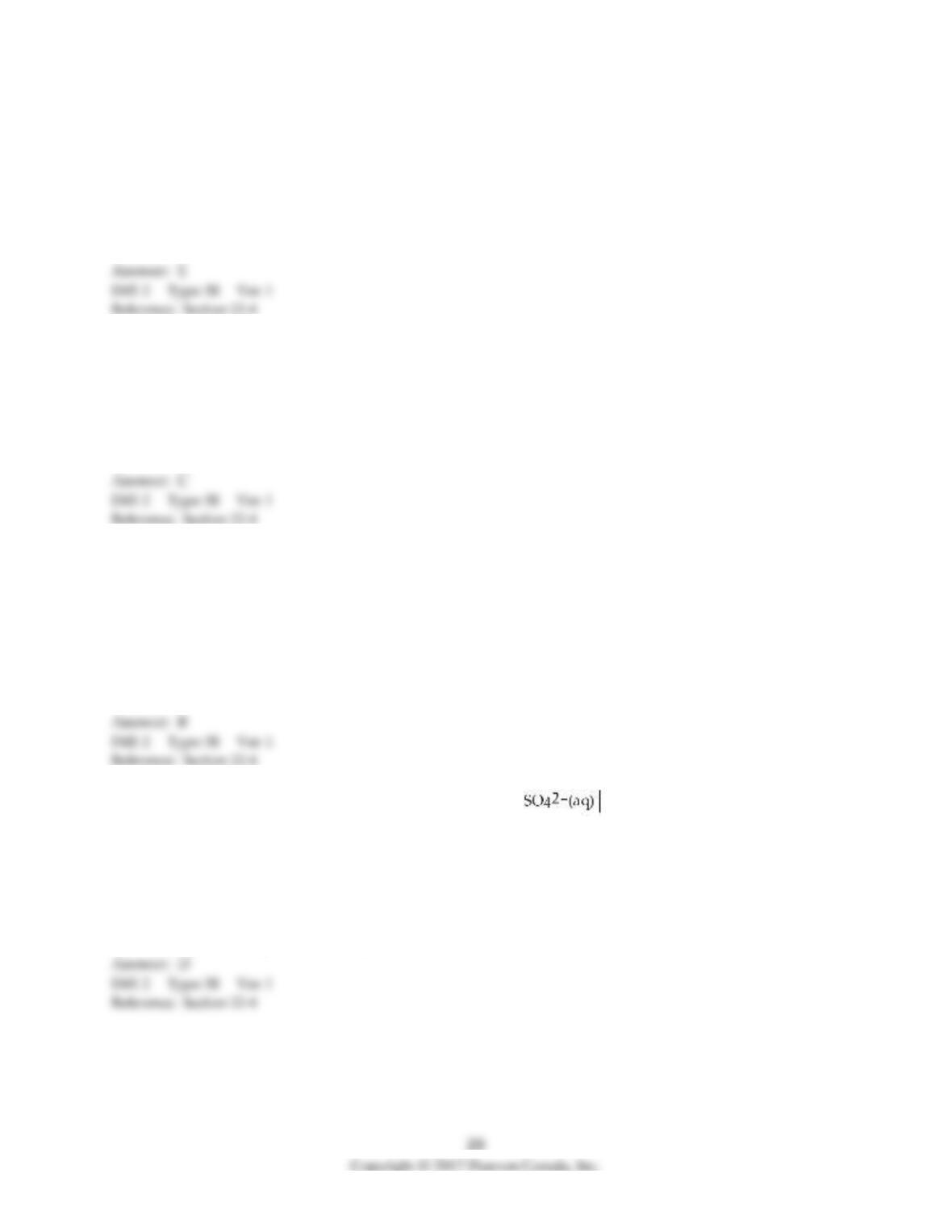
86) Write a balanced half equation for the following couple: S(s) (acidic)
A) SO42-(aq) + 2 H+(aq) + 2 e– → S(s) + H2O(l)
B) SO42-(aq) + H2O(l) + 4e– → S(s) + 2 H+(aq)
C) SO42-(aq) + 2 H+(aq) + 2 e– → S(s) + H2SO4(aq)
D) SO42-(aq) + 8 H+(aq) + 6 e– → S(s) + 4 H2O(l)
E) SO42-(aq) + 8 H+(aq) → S(s) + 4 H2O(l) + 6 e–
87) One of the natural processes that destroys ozone in the atmosphere is postulated to consist of two
steps:
O3(g) + UV radiation → O2(g) + O(g)
O3(g) + O(g) → 2 O2(g)
The standard enthalpies of formation for ozone and for atomic oxygen are +142.7 kJ/mol and +249.2
kJ/mol, respectively. What would be the standard energy change associated with the combination of
ozone and atomic oxygen to form 50.0 L of molecular oxygen, measured at -75 °C and 0.12 atm?
A) -38 kJ
B) -72 kJ
C) -150 kJ
D) -196 kJ
E) -600 kJ
88) The compound of which P4O6 is the anhydride is ________.
A) HPO3
B) H3PO4
C) H3PO3
D) H4P2O7
E) H2P2O7
89) What is the main commercial source of nitrogen?
A) fractional distillation of liquid air
B) chemical reaction from NH3
C) chemical reaction from HNO3
D) from lightning or electrical motors
E) separated from air by chemical traps
90) In certain automotive catalytic converters, one step involves the catalyzed reduction by carbon
monoxide of nitric oxide (nitrogen monoxide) to nitrogen gas, with the carbon monoxide being converted
to carbon dioxide. When the equation for this process is balanced, the sum of the coefficients is ________.
A) 4
B) 5
C) 7
D) 9
E) 11
91) Write a balanced half equation for the following couple: NH4+(aq)(acidic)
A) NO3–(aq) + 3 H2O(l) → NH4+(aq) + 10 H+(aq) + 8 e–
B) NO3–(aq) + 4 H+(aq) + 3 e– → NH4+(aq) + 3 H2O(l)
C) NO3–(aq) + 4 H+(aq) → NH4+(aq) + 3 H2O(l) + e–
D) NO3–(aq) + 8 H+(aq) + 8 e– → NH4+(aq) + 3 H2O(l)
E) NO3–(aq) + 10 H+(aq) + 8 e– → NH4+(aq) + 3 H2O(l)
92) Write a balanced half equation for the following couple: NO2–(aq) (basic)
A) NO3–(aq) + 2 H+(aq) + 2 e– → NO2–(aq) + H2O(l)
B) NO3–(aq) + 2 H2O(l) + 2 e– → NO2–(aq) + 2 OH–(aq) + 2 H2O(l)
C) NO3–(aq) + H2O(l) + 2 e– → NO2–(aq) + 2 OH–(aq)
D) NO3–(aq) + H2O(l) + e– → NO2–(aq) + OH–(aq)
E) NO3-v + H2(g) + e– → NO2–(aq) + OH–(aq)
93) Give the molecular shape of NO3–.
A) trigonal pyramidal
B) trigonal planar
C) tetrahedral
D) linear
E) octahedral
94) The pollution process in which oxygen depletion of natural waters by increased algae growth occurs
because of contaminants such as excess phosphates is referred to as ________.
A) anoxia
B) biodegradation
C) eutrophication
D) phosphorylation
E) saponification
95) What is the pH of a solution labeled “0.30 M Hydroxylamine”? [Kb is 9.1 × 10⁻⁹]
A) 4.38
B) 6.60
C) 7.38
D) 8.23
E) 9.72
96) What volume of 17 M nitric acid is required to dissolve 15 g of copper by a reaction for which the
products are aqueous copper(II) nitrate, nitric oxide gas, and water? Assume 100% reaction.
A) 93 mL
B) 79 mL
C) 53 mL
D) 37 mL
E) 21 mL
97) In the compound dinitrogen monoxide, sometimes used as a dental anesthetic, the oxidation state of
nitrogen is ________.
A) +1
B) –1
C) +2
D) –2
E) 0
98) How much H2 (in liters) is produced at 65 °C and 670. torr by the reaction of 75.7 g of zinc?
Zn(s) + 2 H+(aq) → Zn2+(aq) + H2(g)
A) 188 L
B) 2.33 L
C) 9.22 L
D) 36.4 L
E) 95.8 L
99) How much hydrogen (in liters at STP) is required to change 857 kg of diisobutylene to isooctane?
Molar mass of diisobutylene is 112.2 grams.
CH3C(CH3)2CH=C(CH3)2 + H2 → CH3C(CH3)2CH2CH(CH3)2
A) 15.4 L
B) 1.71 × 10⁵ L
C) 8.55 × 10⁴ L
D) 3.42 × 10⁵ L
E) 30.8 L
100) How much H2 (in liters) is produced at 45 °C and 770. torr by the reaction of 45.7 g of zinc?
Zn(s) + 2 H+(aq) → Zn2+(aq) + H2(g)
A) 139 L
B) 15.7 L
C) 18.0 L
D) 31.4 L
E) 11.8 L