Chapter Twenty one
1.
What is the IUPAC name for the following compound?
OH
O
A)
−methylpentanoic acid
B)
3-methylpentanoic acid
C)
2-methylhexanoic acid
D)
3-methylhexanoic acid
E)
None of these
Ans:
D
2.
What is the common name for the following compound?
OH
OF
A)
–fluorobutanoic acid
B)
β–fluorobutanoic acid
C)
β-fluorobutyric acid
D)
–fluorobutyric acid
E)
3-fluorobutyric acid
Ans:
C
3.
What is the IUPAC name for the following compound?
OH
O
HO
O
A)
−dimethylheptanedioic acid
B)
−dimethylheptanedioic acid
C)
−dimethylpentanedioic acid
D)
−dimethylpentanedioic acid
E)
−dimethylheptanoyl acid
Ans:
B
4.
What is the correct structure for trichloroacetic acid?
OH
O
Cl Cl
OH
O
Cl
Cl Cl
Cl
OH
O
Cl
Cl
OH
O
Cl Cl
Cl Cl
III III IV
A)
B)
C)
D)
V
E)
none of these
Ans:
B
5.
What is the correct structure for succinic acid
HO OH
OO
HO
O
OH
O
HO
OO
OH
O
OH
I II III
IV
A)
B)
C)
D)
V
E)
none of these
Ans:
C
6.
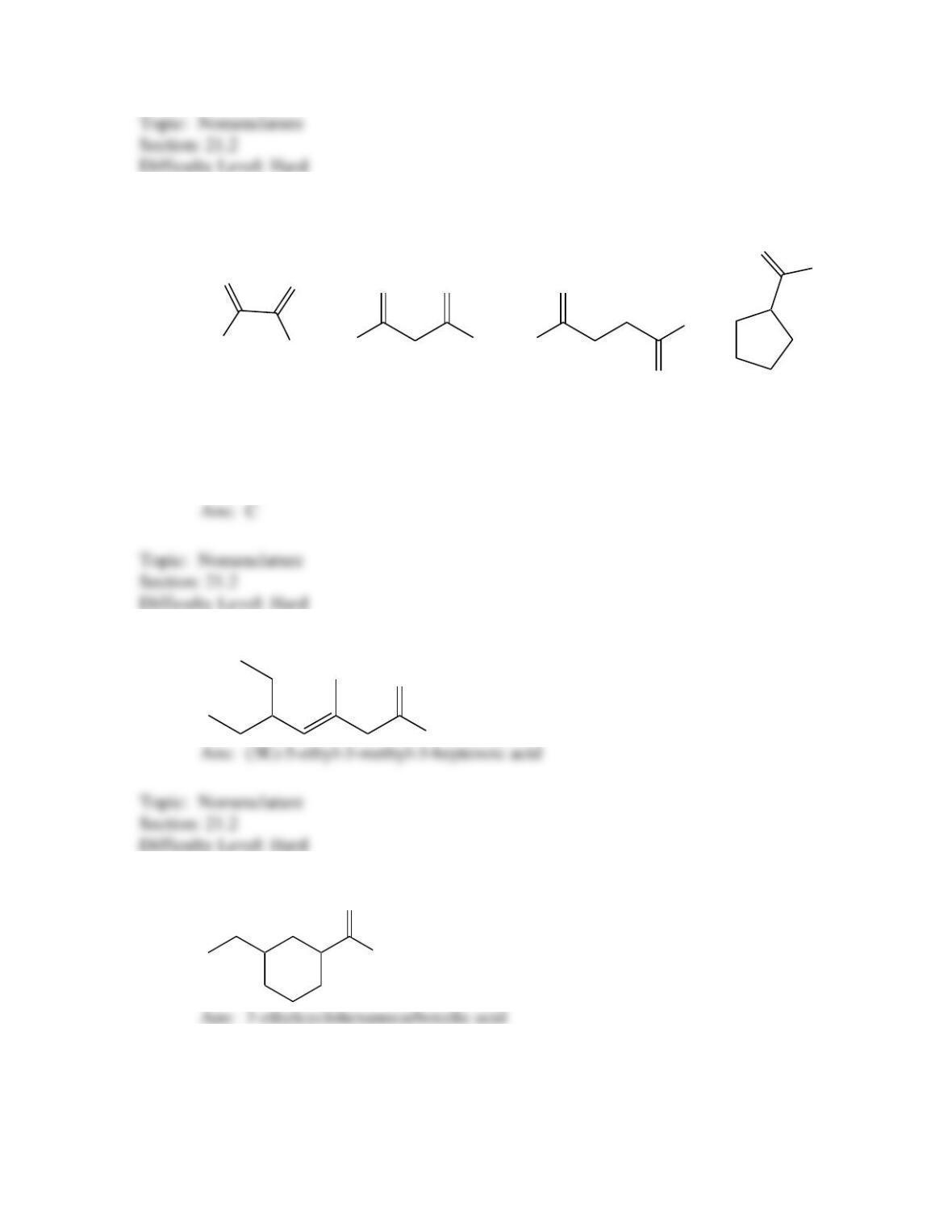
What is the IUPAC name for the following compound?
OH
O
Ans:
(3E)-5-ethyl-3-methyl-3-heptenoic acid
7.
What is the IUPAC name for the following compound?
OH
O
Ans:
3-ethylcyclohexanecarboxylic acid
8.
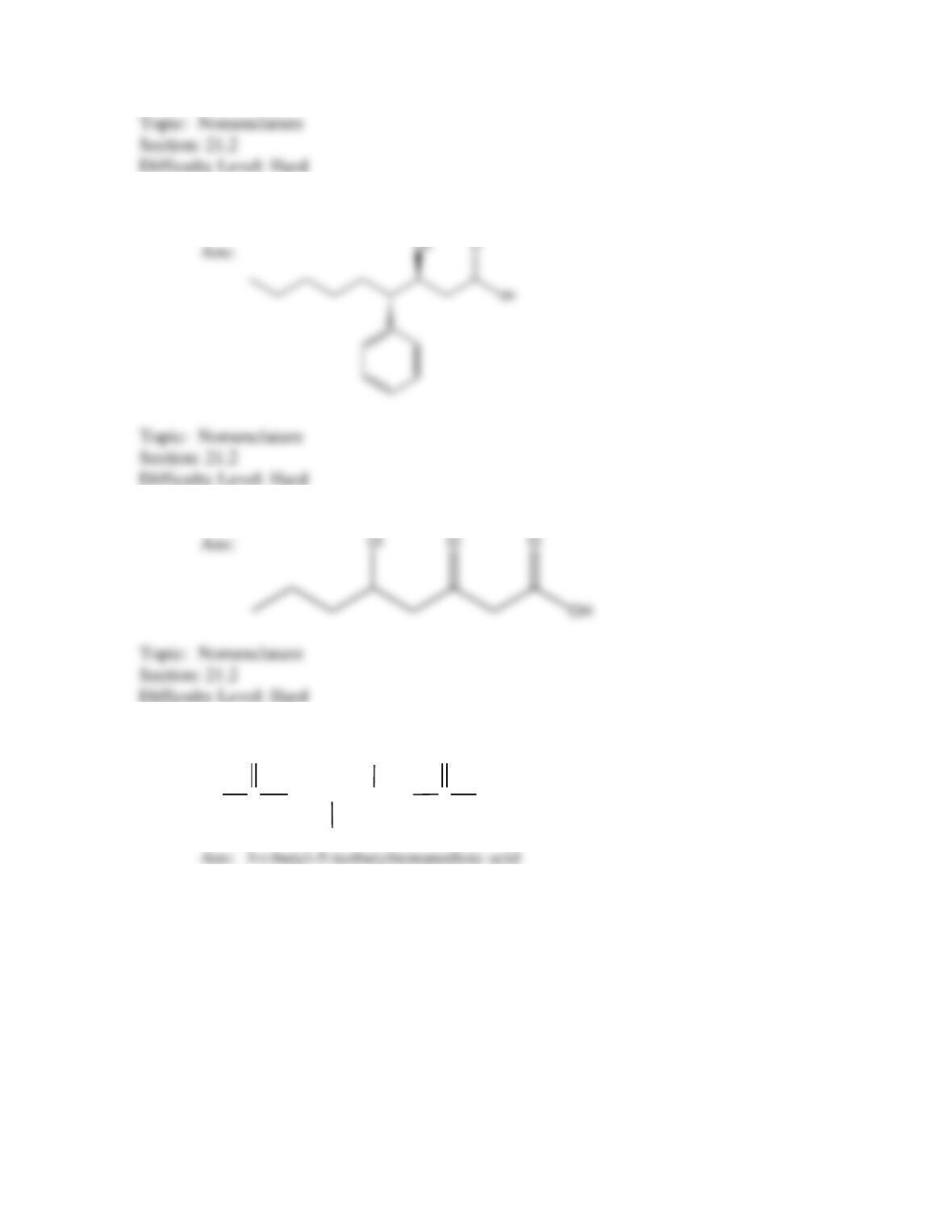
Provide the structure for (3S,4S)-3-hydroxy-4-phenylnonanoic acid
9.
Provide the structure for 5-chloro-3-oxo-octanoic acid
10.
What is the IUPAC name for the following compound?
HO C
O
(CH2)3CHCH2CHCH2C
O
OH
C(CH3)3
CH2CH(CH3)2
Ans:
3-t-butyl-5-isobutylnonanedioic acid
11.
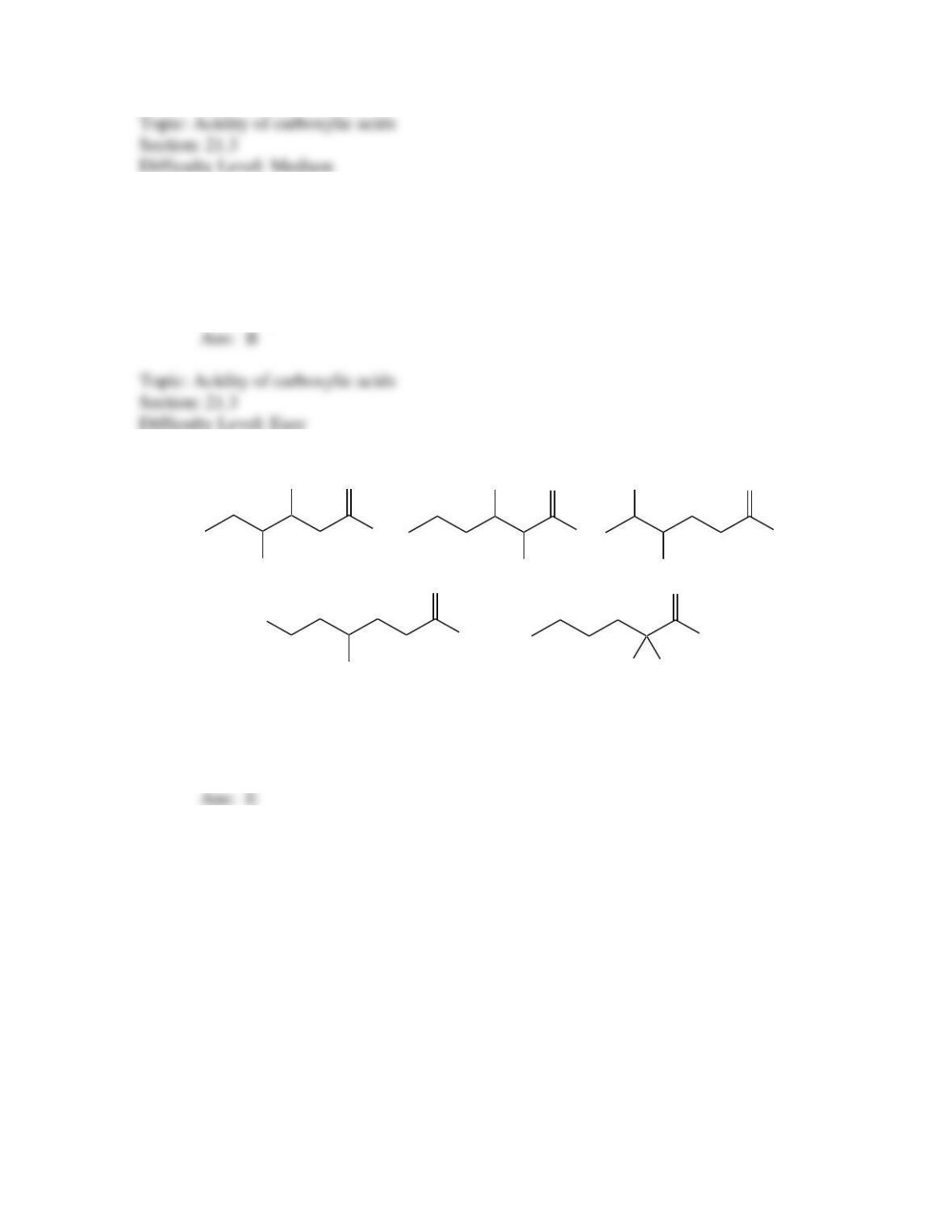
Which one of the following is the strongest acid?
A)
benzoic acid
B)
4-nitrobenzoic acid
C)
4-ethylbenzoic acid
D)
4-chlorobenzoic acid
E)
4-hydroxybenzoic acid
Ans:
B
12.
Which one of the following compound is the strongest acid?
OH
OF
F
OH
OF
F
OH
O
F
F
OH
O
F
F
OH
O
F F
III III
IV V
A)
B)
C)
D)
V
E)
V
Ans:
E
13.
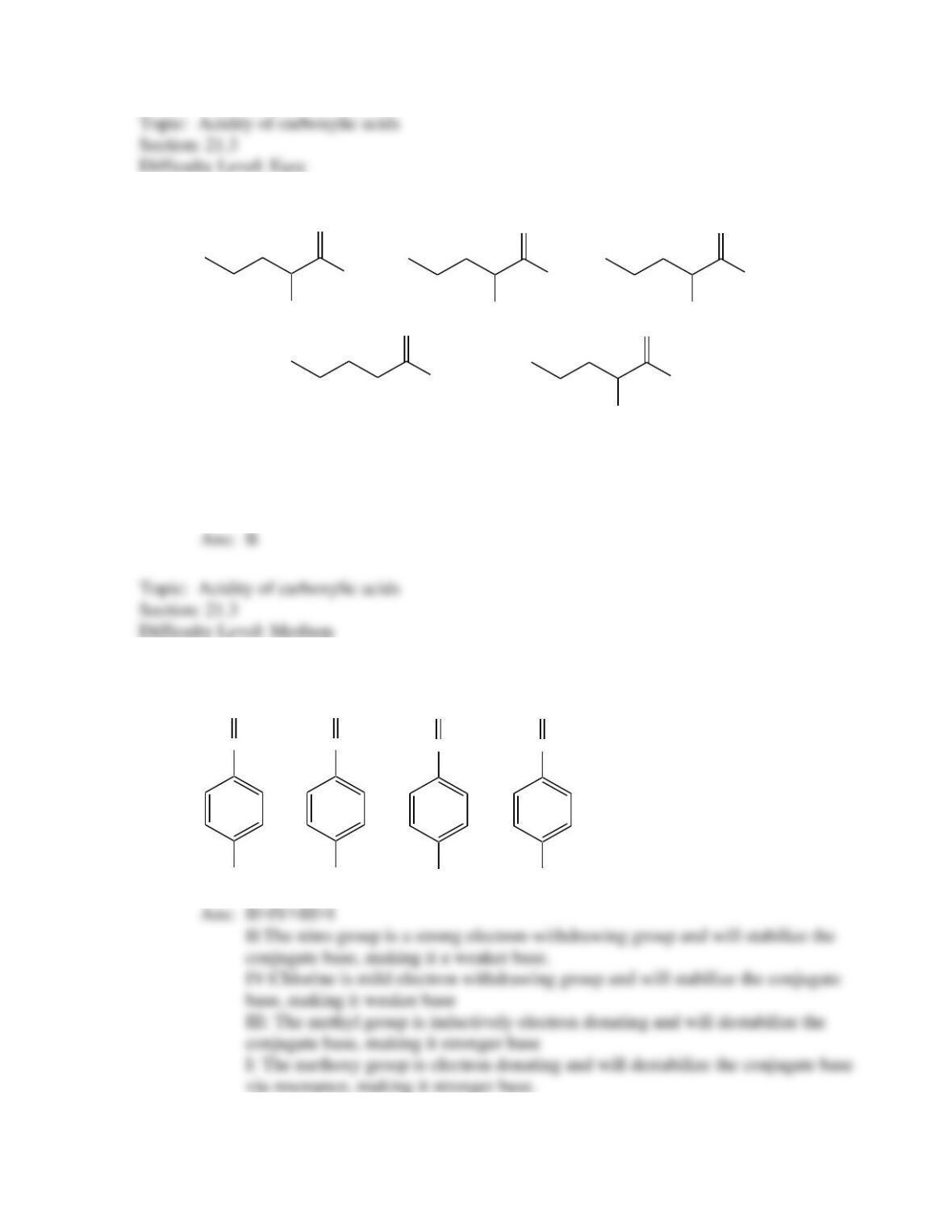
Rank the following acids in decreasing (strongest to weakest) order of acidity.
OH
O
OH
O
F
OH
O
OH
O
OH
O
III III
IV VI
Br
Cl
A)
V>III>I>II>IV
B)
>I>III>V>IV
C)
IV>III>I>II>V
D)
V>V>III>I>II
E)
V>I>III>II>IV
Ans:
B
14.
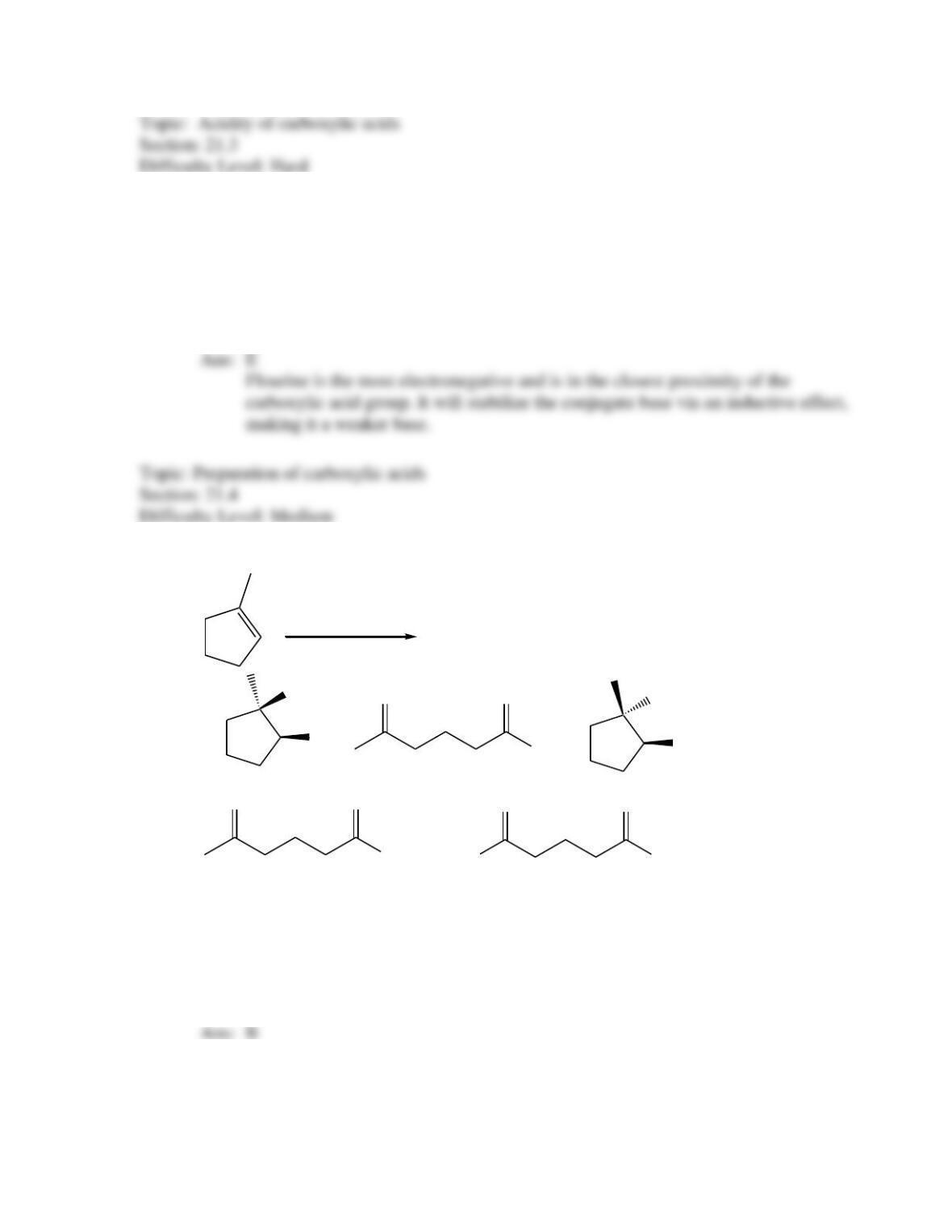
Rank the following acids in decreasing (strongest to weakest) order of acidity.
Explain your choice.
COH
O
OCH3
COH
O
NO2
COH
O
CH3
COH
O
Cl
III III IV
15.
Which one of the following is the strongest acid? Explain your choice.
A)
2,3-dimethylheptanoic acid
B)
3,3-dichlorohexanoic acid
C)
3-iodo-4-bromo-hexanoic acid
D)
3-chloro-4-bromoheptanoic acid
E)
2-fluoro-4-bromohexanoic acid
making it a weaker base.
16.
Predict the product for the following reaction.
1. O3
2.H2O2/NaOH/H2O
3. H3O+
III III
IV V
OH
OH
OH
OH
O
OH
O
O
H
O
HO
O
OH
O
A)
I
B)
II
C)
III
D)
IV
E)
V
Ans:
B
17.
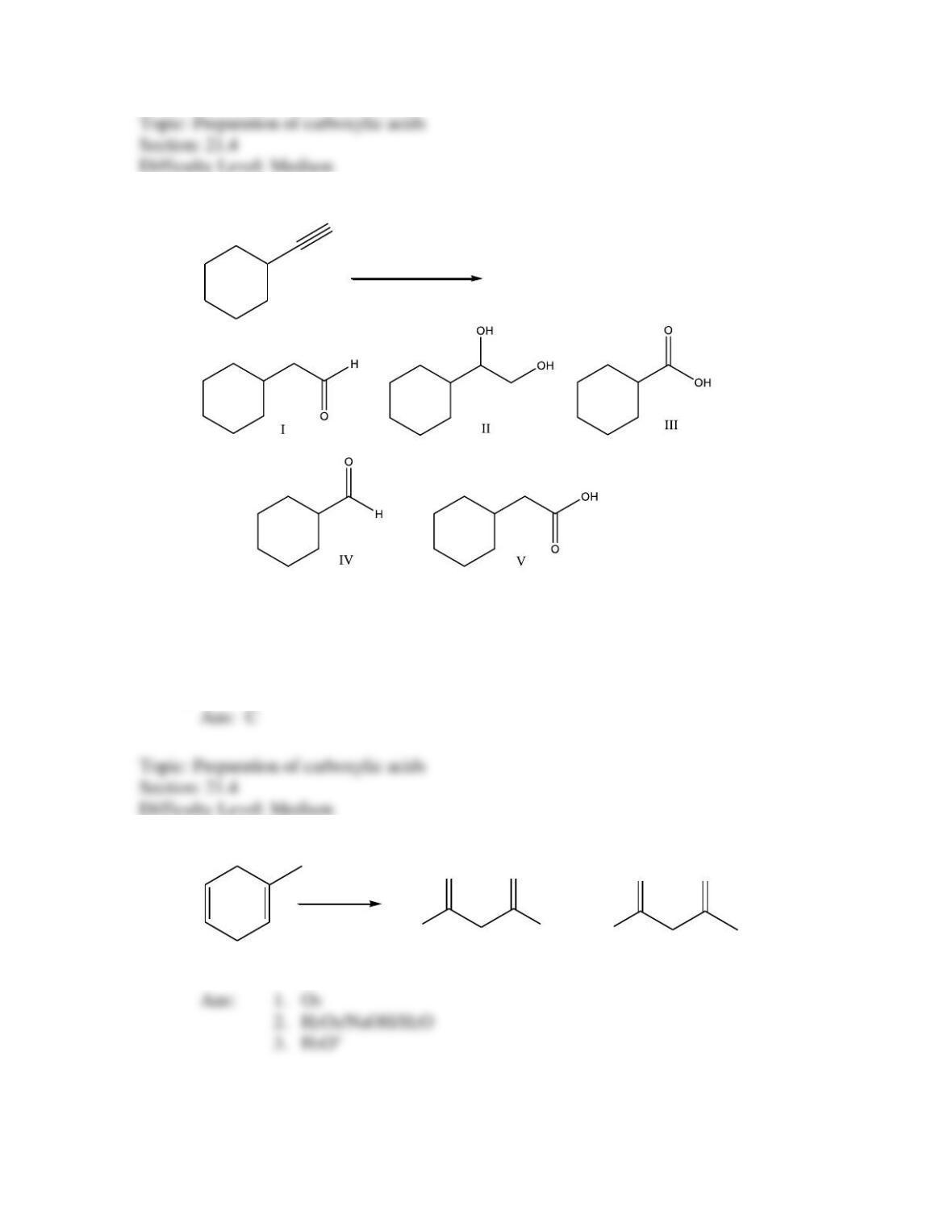
Predict the product for the following reaction.
1. O3
2. H2O
A)
I
B)
II
C)
III
D)
IV
E)
V
Ans:
C
18.
Provide the reagents necessary to carry out the following conversion.
HO OH
O O
HO
O O
+
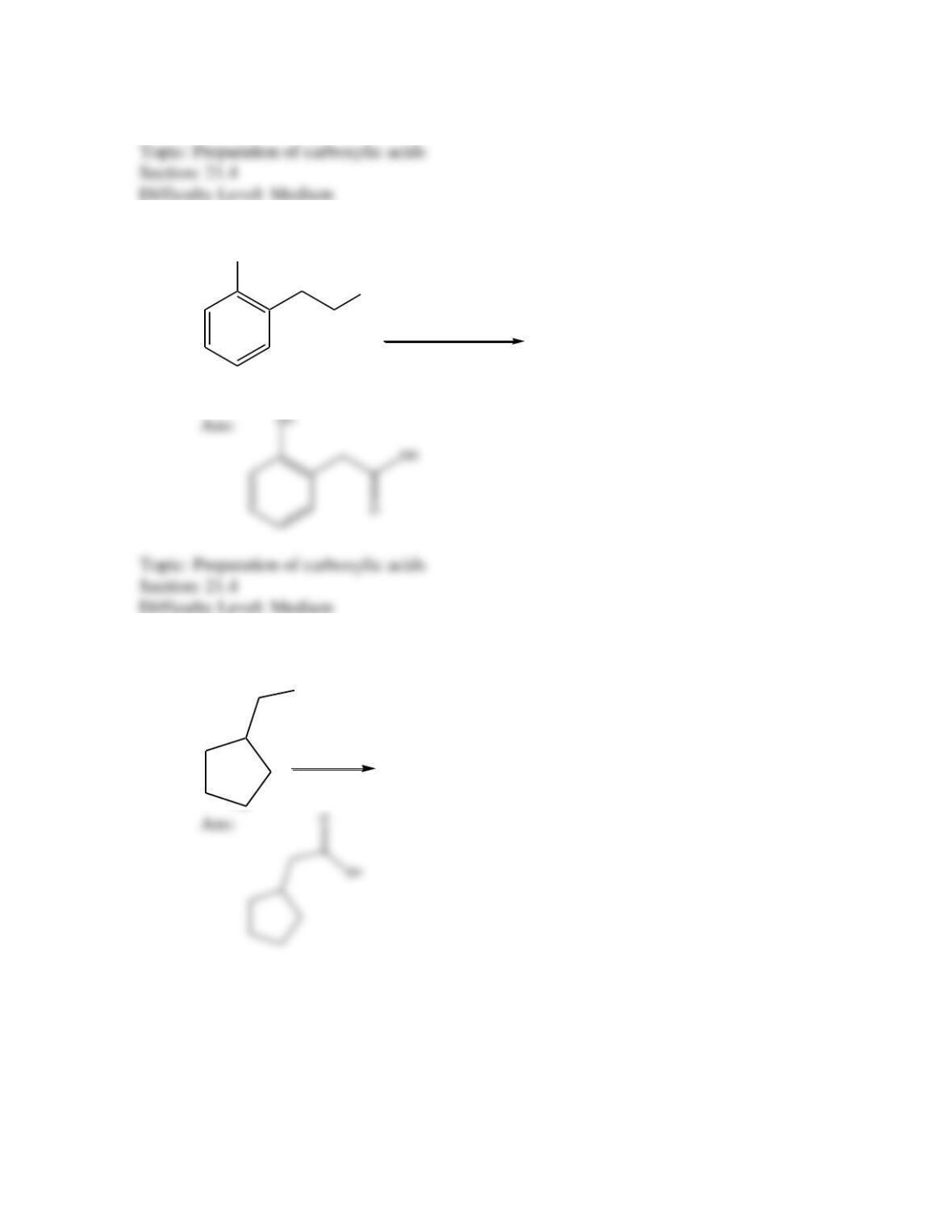
19.
Predict the product for the following reaction.
OH
OH
K2Cr2O7/H2SO4/H2O
excess
20.
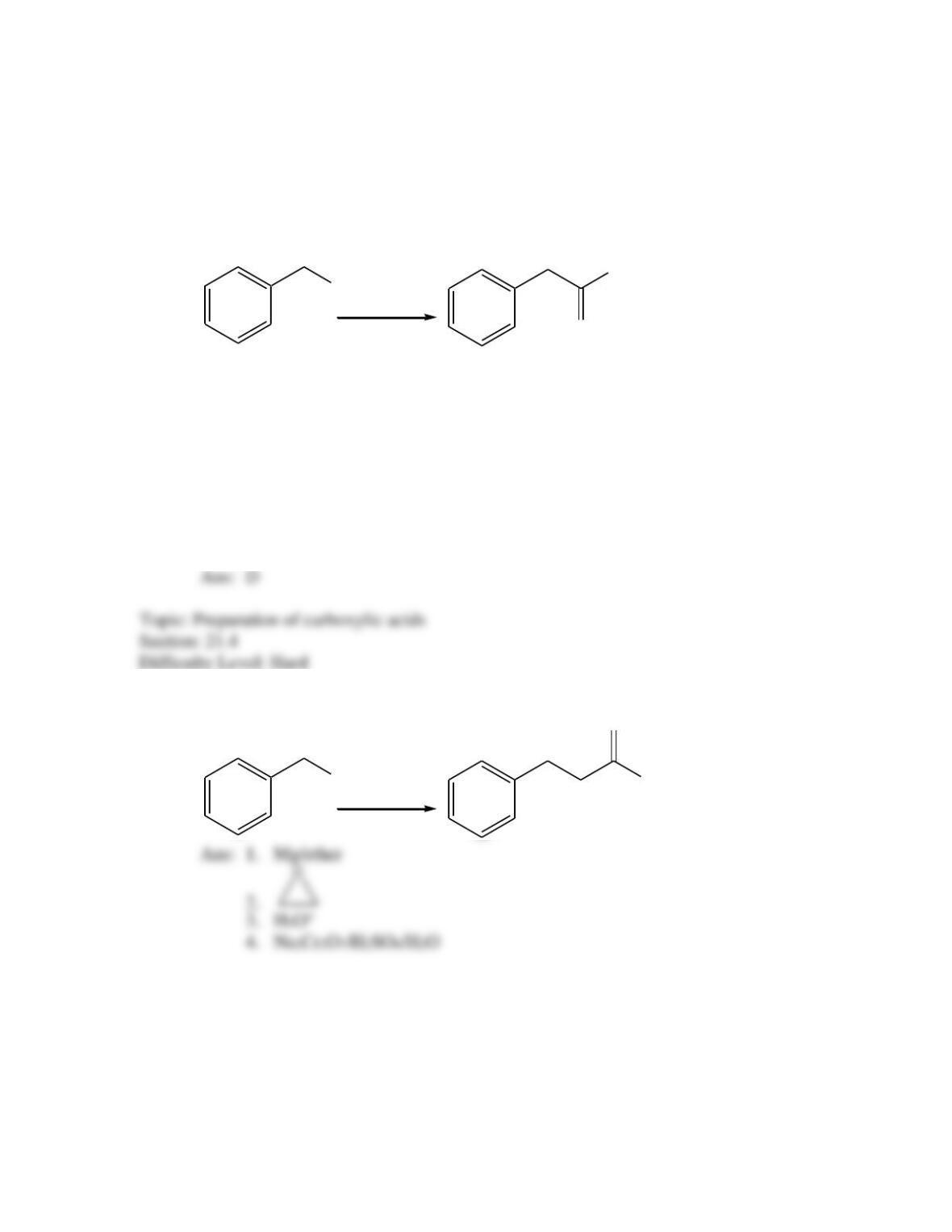
Predict the product for the following reaction.
1. NaCN
2. H3O+, heat
Br
Topic: Preparation of carboxylic acids
Section: 21.4
Difficulty Level: Medium
21.
Provide the reagents necessary to carry out the following conversion.
Br
OH
O
A)
1. Mg/ether
2. CO2
3. H3O+
B)
1. NaOH
2. KMnO4/NaOH/H2O
3. H3O+
C)
1. NaCN
2. H3O+, heat
D)
A & C
E)
all of these
22.
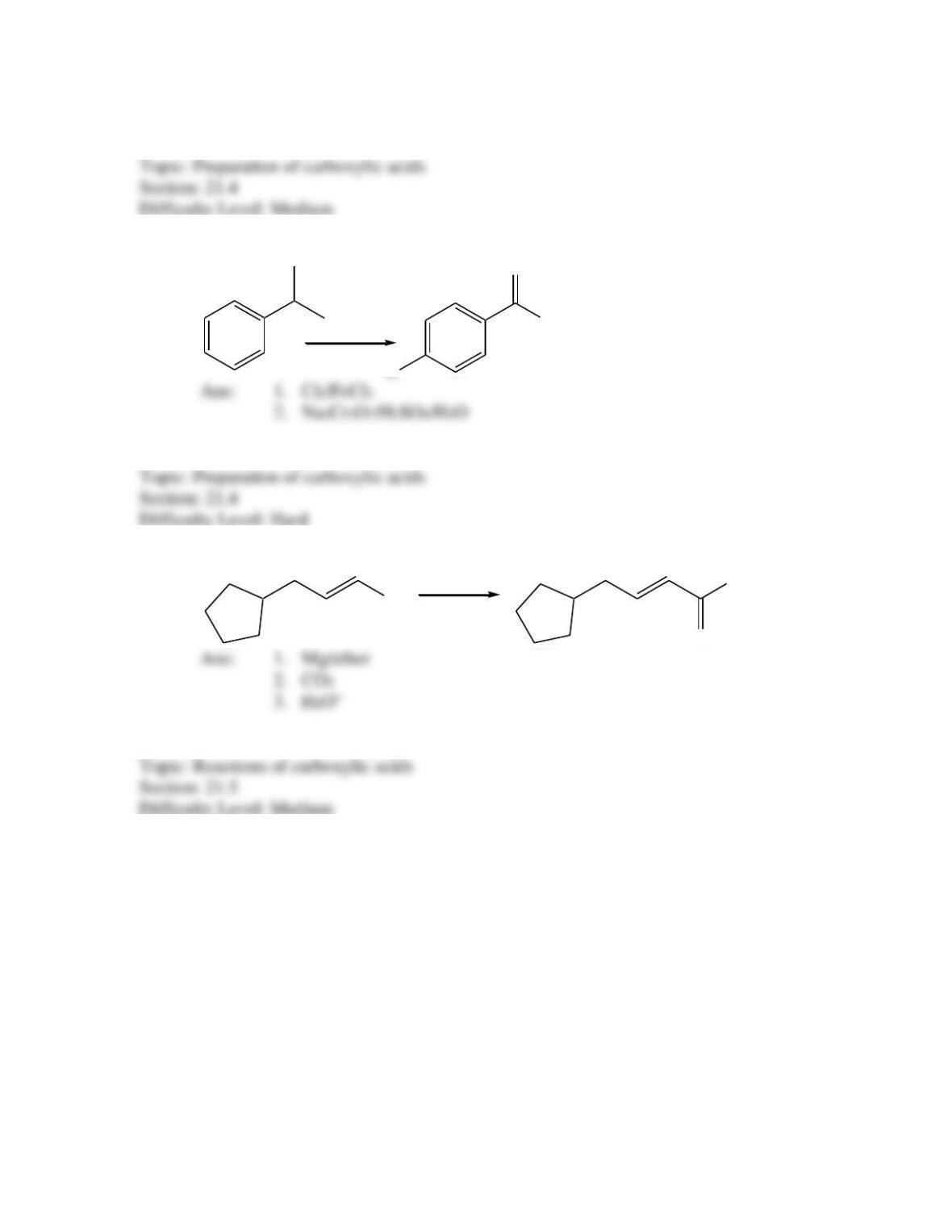
Provide the reagents necessary to carry out the following conversion.
Br OH
O
Ans:
D
23.
Provide the reagents necessary to carry out the following conversion.
OH
O
24.
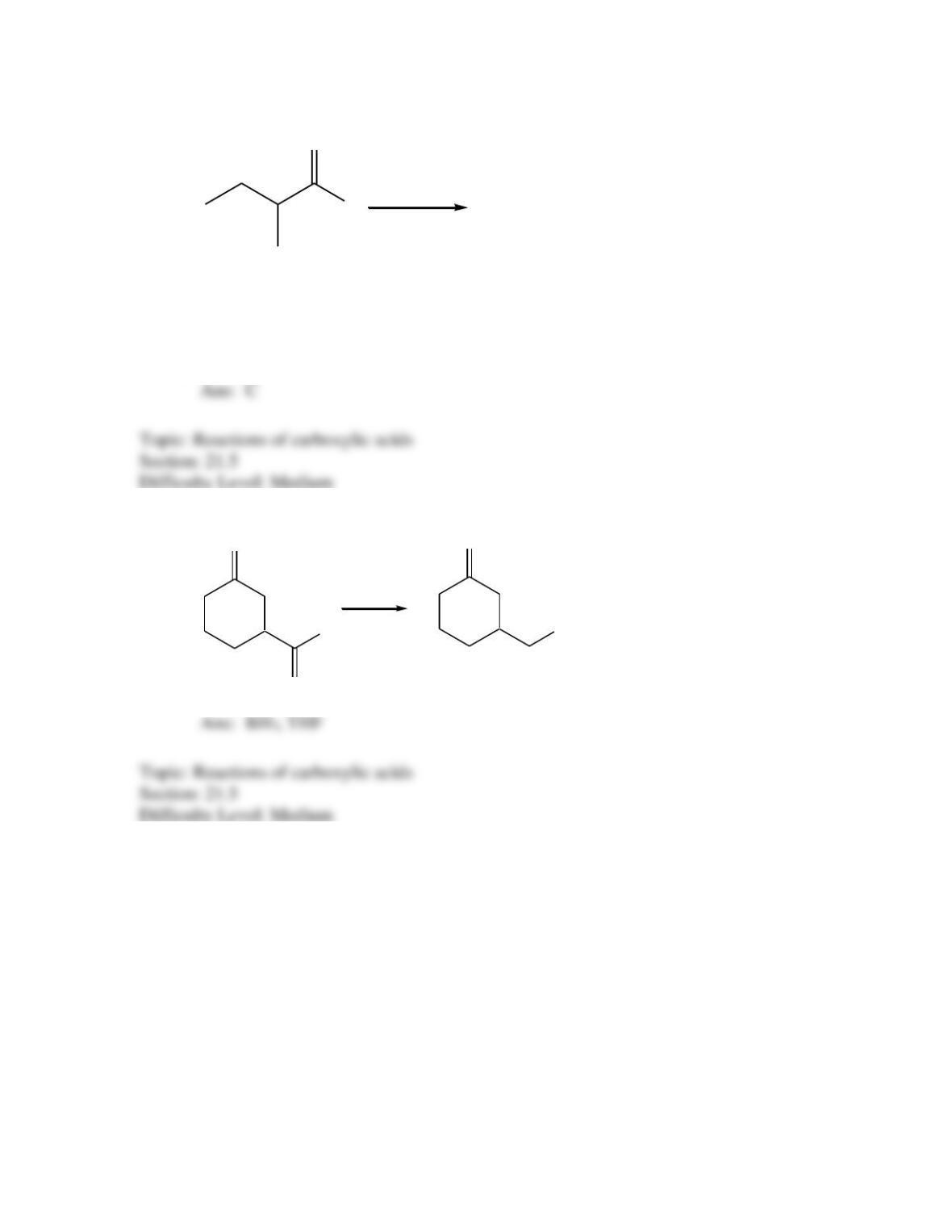
Provide the reagents necessary to carry out the following conversion.
Br
O
OH
25.
Predict the product for the following reaction.
OH 1. LiAlH4
2. H2O
O
A)
3-methyl-2-pentanone
B)
3-methyl -1-propanol
C)
2-methyl-1-butanol
D)
3-methyl-2-pentanol
E)
none of these
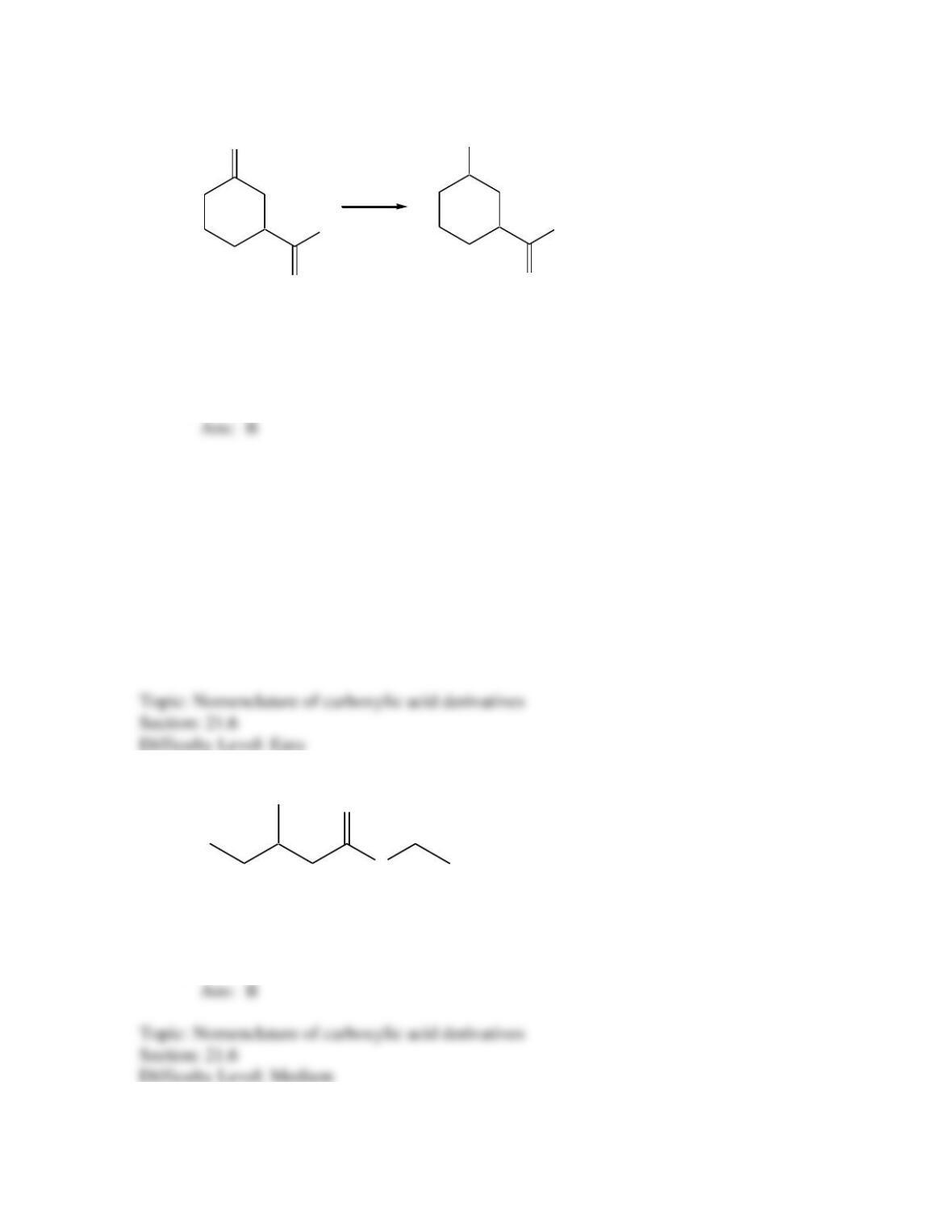
26.
Provide the reagents necessary to carry out the following conversion.
O
OH
O
O
OH
Ans:
Ans:
C
27.
Provide the reagents necessary to carry out the following conversion.
O
OH
O
OH
OH
O
A)
1. LiAlH4 2. H2O
B)
NaBH4/CH3OH
C)
LiAl[OC(CH3)3]H
D)
BH3, THF
E)
C & D
28.
What is the IUPAC name for the following compound?
O
O
A)
sec-butyl ethanoate
B)
ethyl-3-methylpentanoate
C)
3-methylbutyl ethanoate
D)
ethyl 3-methylbutanoate
E)
none of these
Ans:
B
Ans:
B
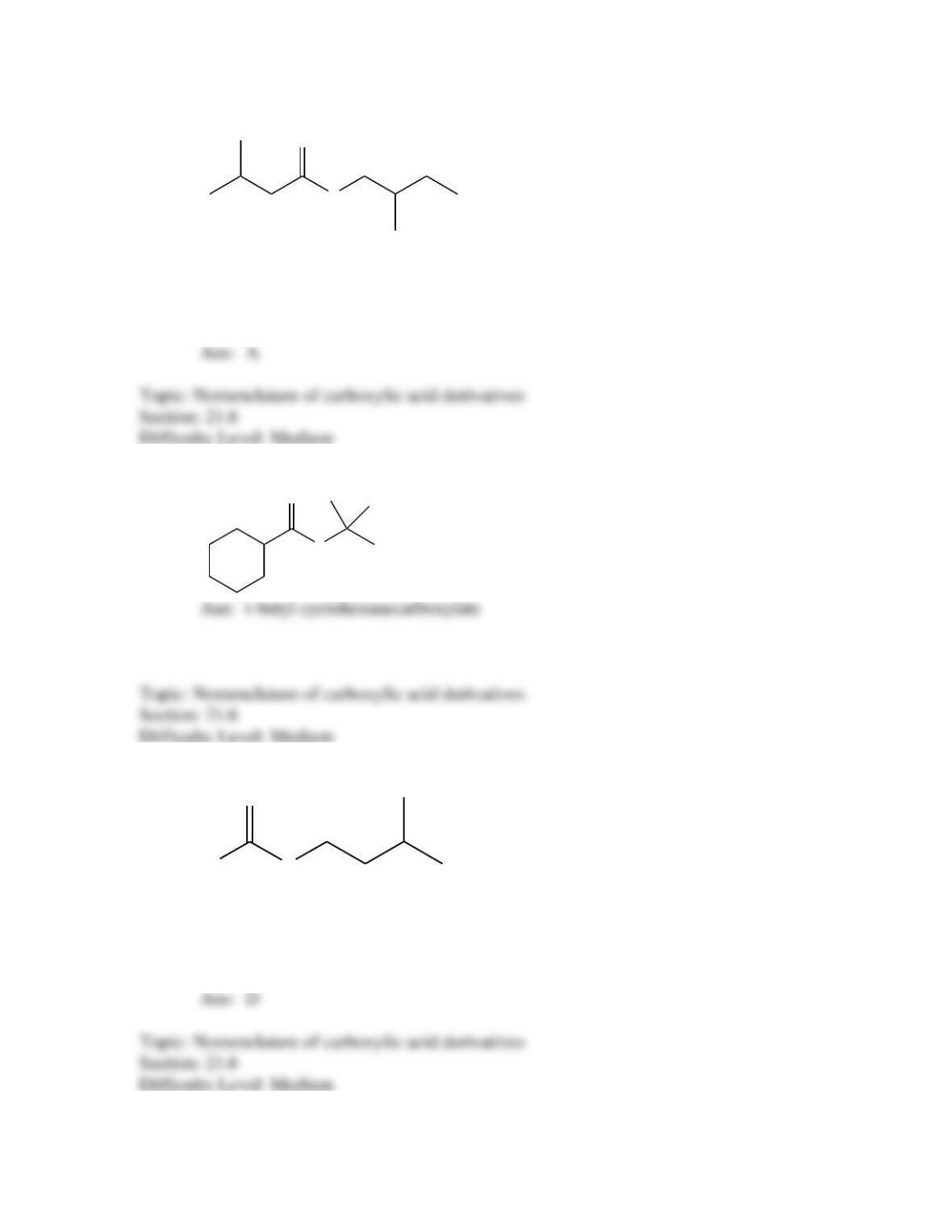
29.
What is the IUPAC name for the following compound?
O
O
A)
2-methylbutyl-3-methylbutanoate
B)
3-methylbutyl-3-methylbutanoate
C)
2-methylbutyl isovalerate
D)
2-methylbutyl-2-methylbutanoate
E)
none of these
30.
What is the IUPAC name for the following compound?
O
O
Ans:
t-butyl cyclohexanecarboxylate
31.
What is the IUPAC name for the following compound?
H O
O
A)
−methylbutyl acetate
B)
−methylbutyl acetate
C)
−methylbutyl methanoate
D)
−methylbutyl methanoate
E)
−methylbutyl formate
Ans:
D
Ans:
A
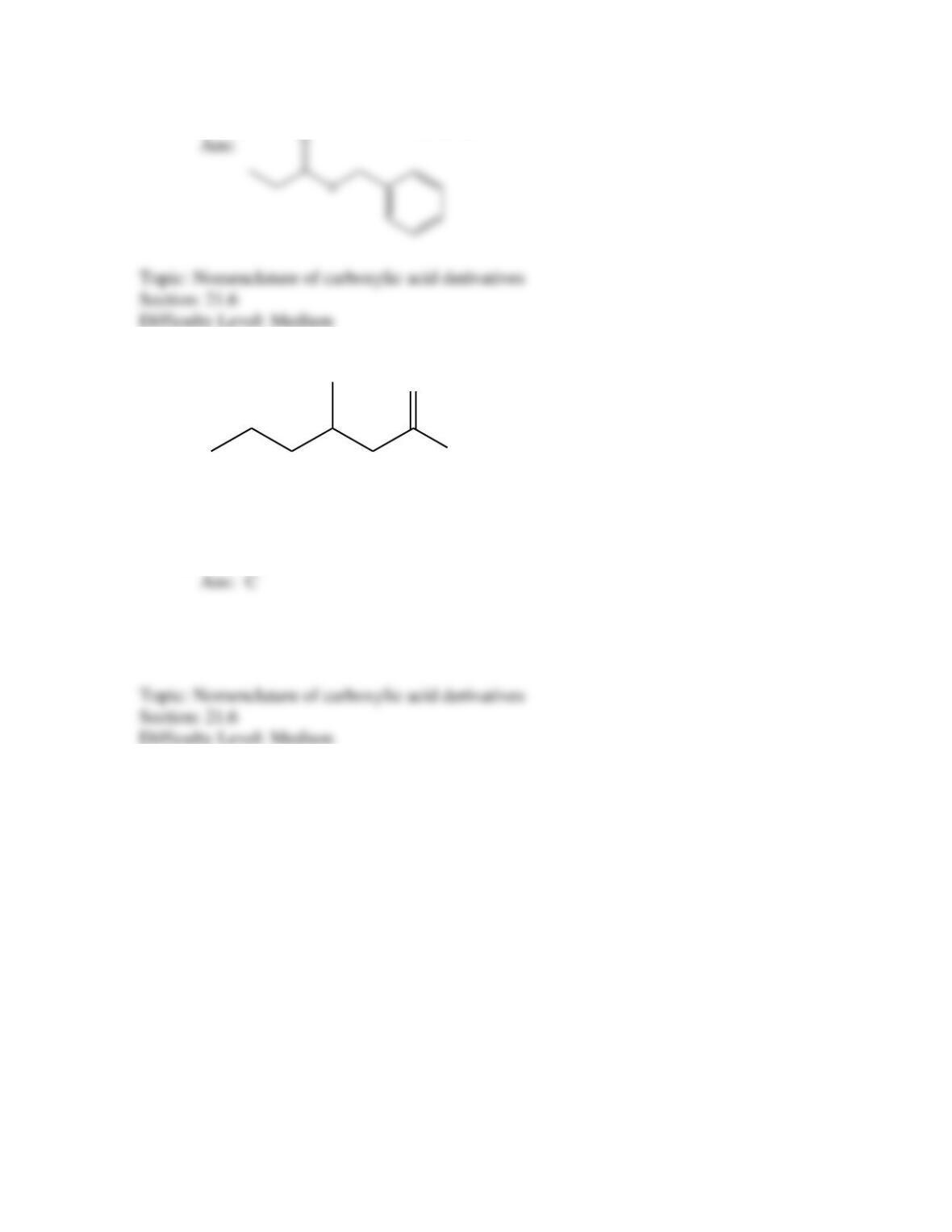
32.
Provide the structure for benzyl propionate.
33.
What is the IUPAC name for the following compound?
O
Cl
A)
-methylvaleryl chloride
B)
2-methylpentanoyl chloride
C)
3-methylhexanoyl chloride
D)
3-methylpentanoyl chloride
E)
none of these
Ans:
C
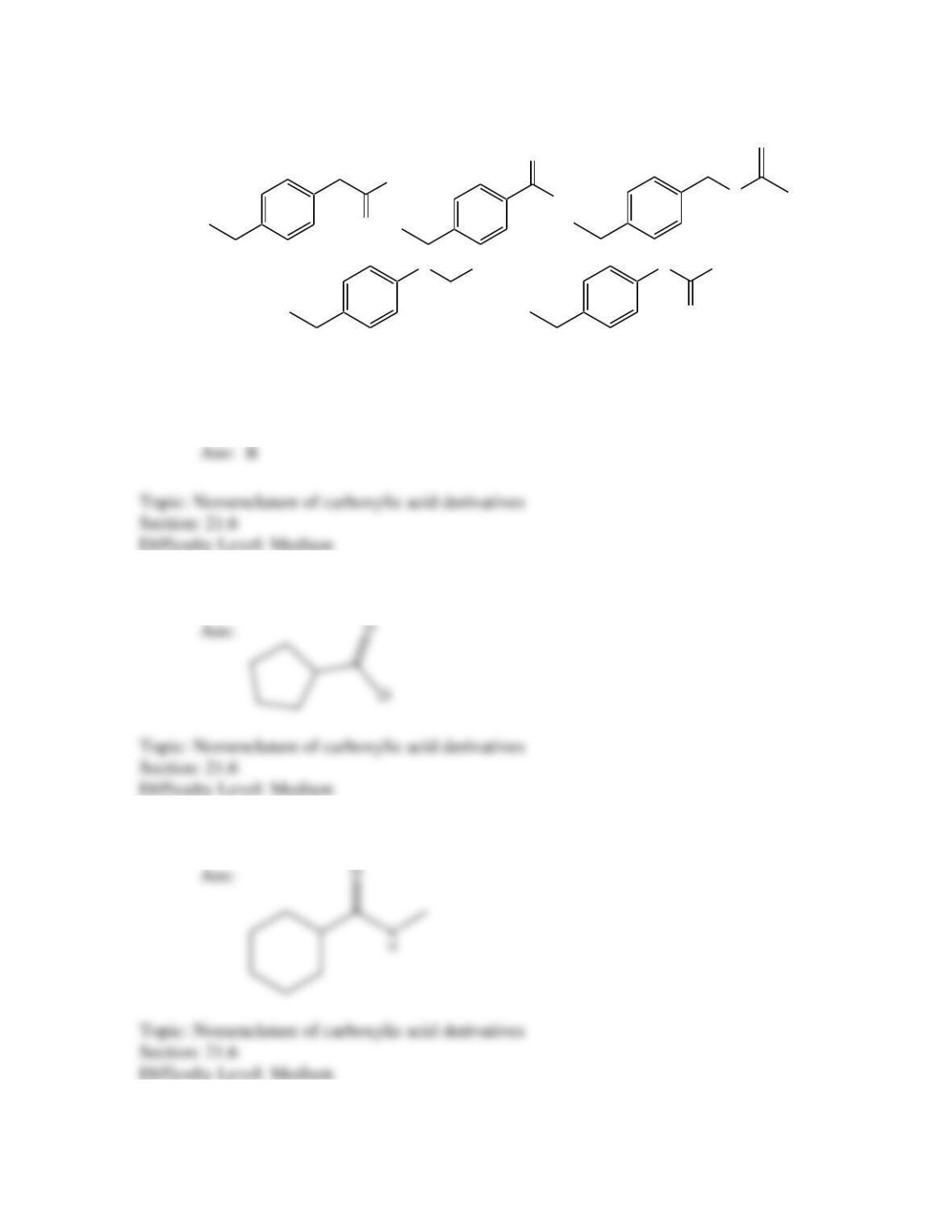
34.
Provide the structure for 4-ethylbenzoyl chloride
O Cl
O
O Cl
Cl
O
Cl
O
OCl
O
III III
IV V
A)
B)
II
C)
III
D)
IV
E)
V
35.
Provide the structure for cyclopentanecarbonyl chloride
36.
Provide the structure for N-methylcyclohexanecarboxamide
Ans:
B
37.
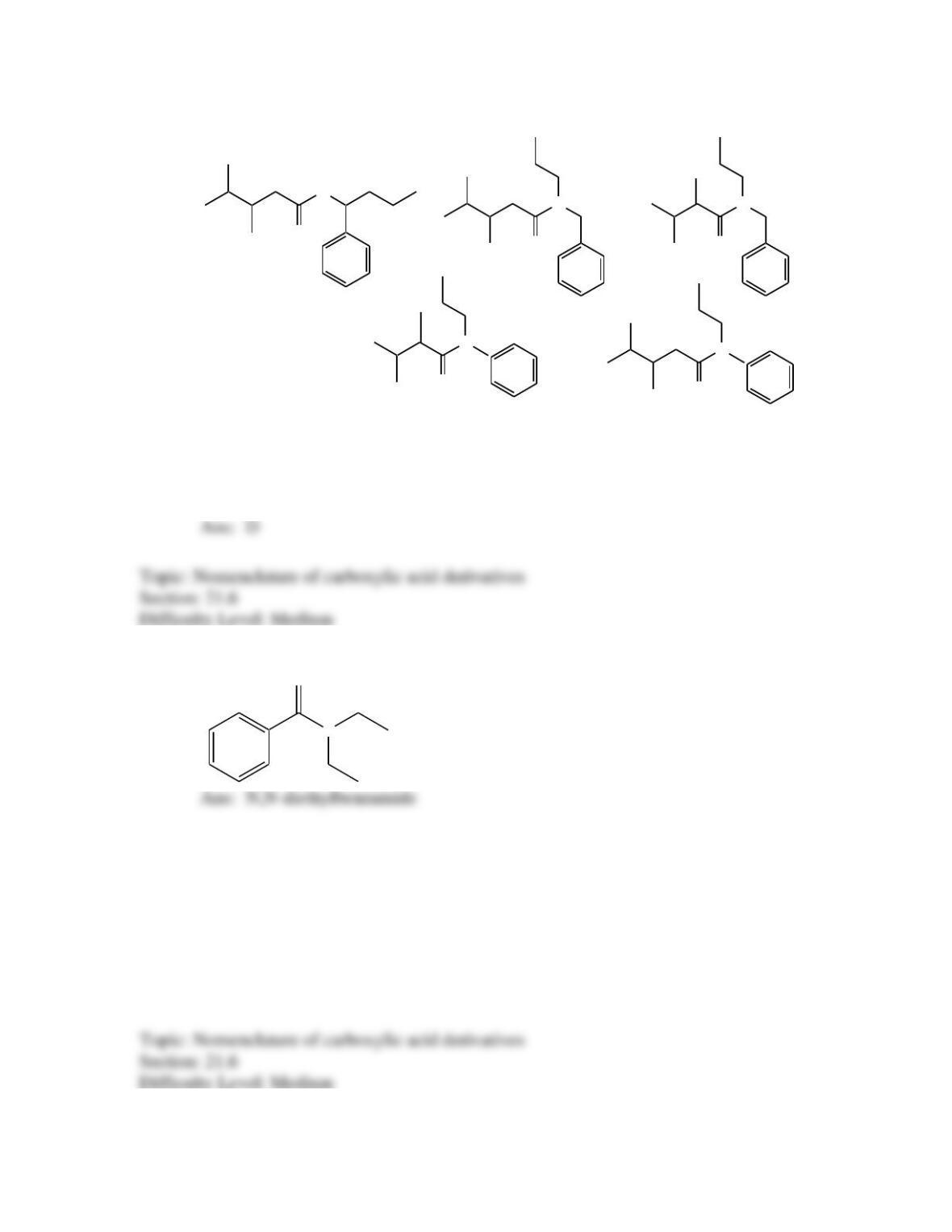
Provide the structure for N-phenyl-N-propyl-2,3-dimethylbutanamide?
H
N
O
N
O
N
O
N
O
N
O
III III
IV V
A)
I
B)
II
C)
III
D)
IV
E)
V
38.
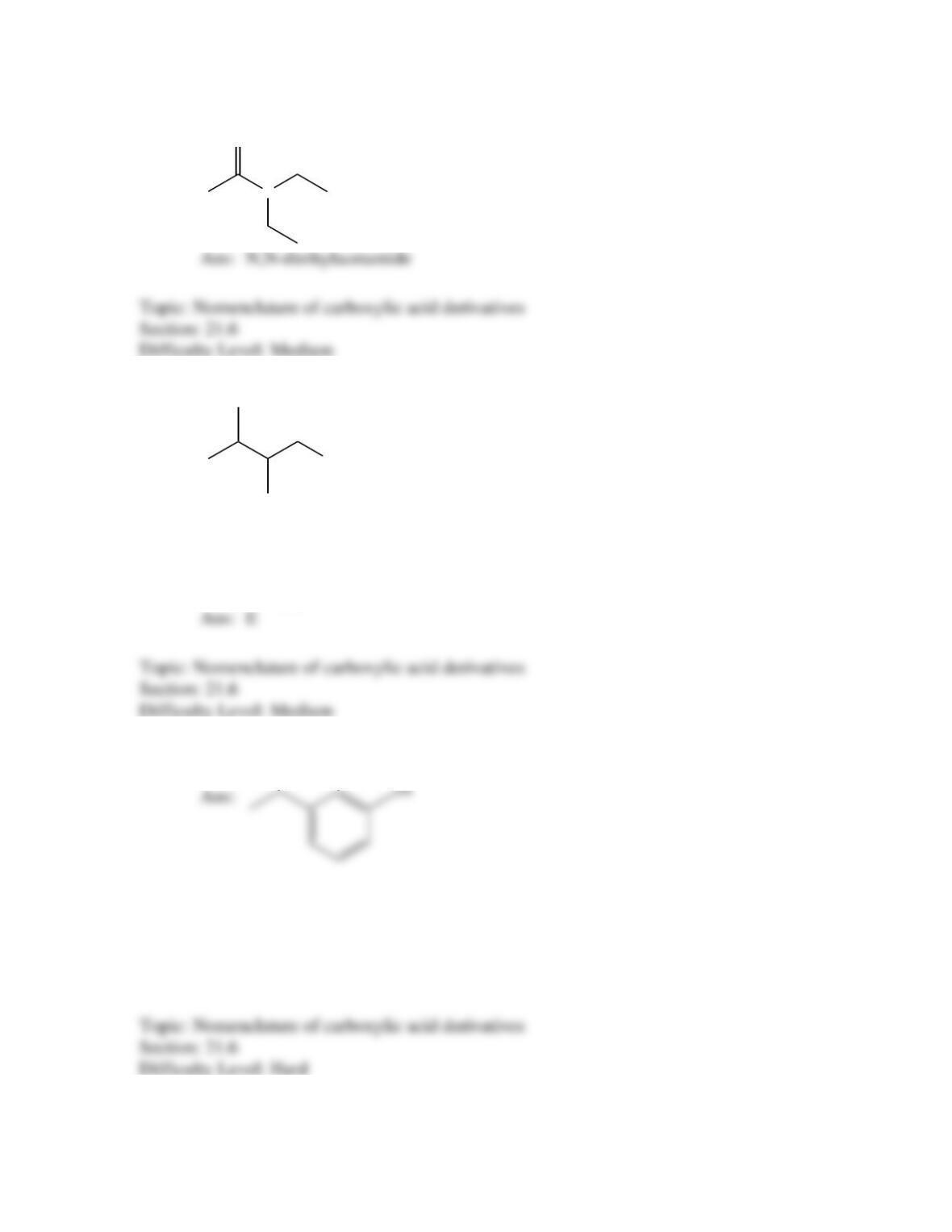
What is the IUPAC name for the following compound?
N
O
Ans:
N,N-diethylbenzamide
Ans:
D
39.
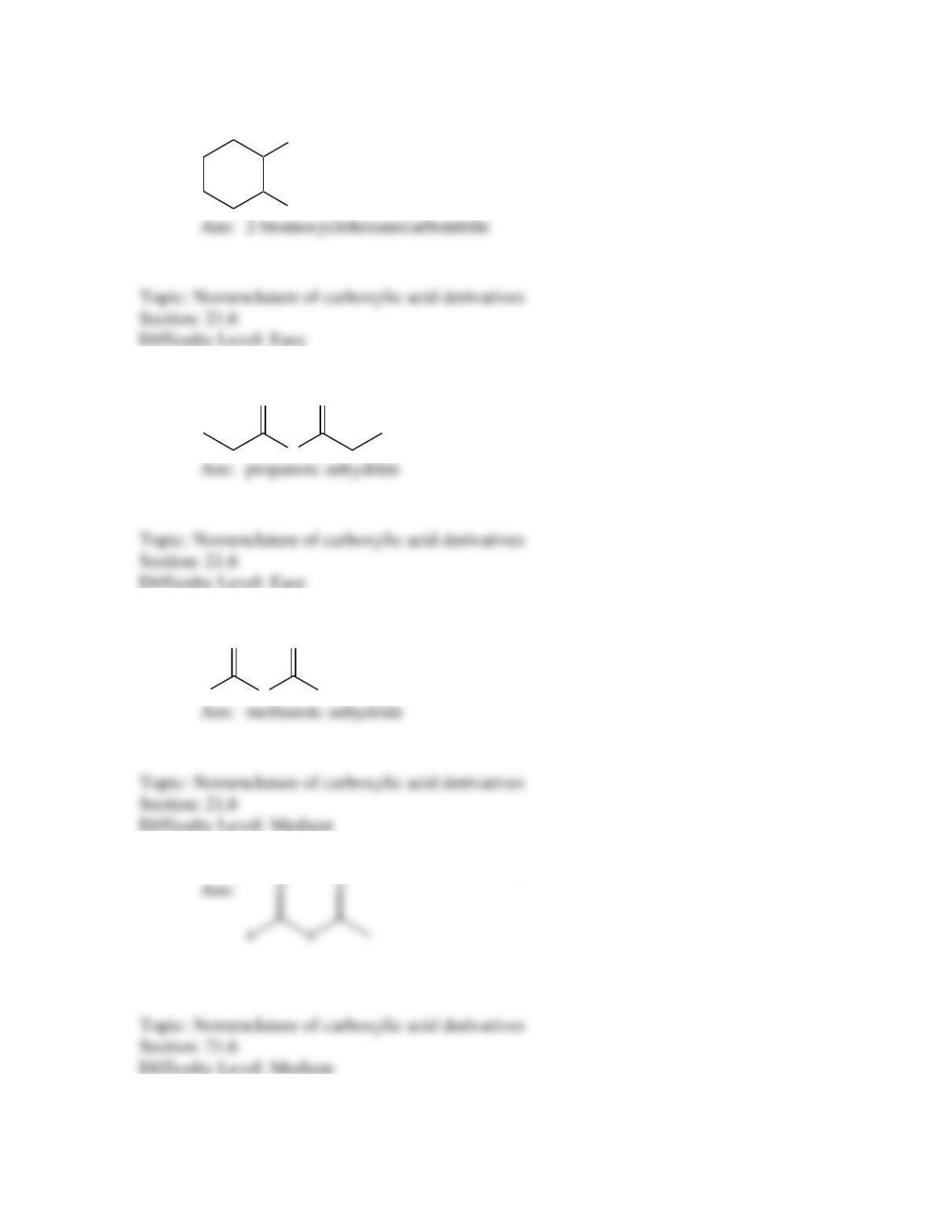
What is the common name for the following compound?
N
O
40.
What is the IUPAC name for the following compound?
CN
A)
2,3-dimethylbutanenitrile
B)
-dimethylbutyrnitrile
C)
-dimethylbutyrnitrile
D)
3,4-dimethylbutanenitrile
E)
3,4-dimethylpentanenitrile
Ans:
E
41.
Provide the structure for 3-ethylbenzonitrile.
Ans:
N,N-diethylacetamide
42.
What is the IUPAC name for the following compound?
CN
Br
43.
What is the IUPAC name for the following compound?
O
O O
44.
What is the IUPAC name for the following compound?
H O H
O O
45.
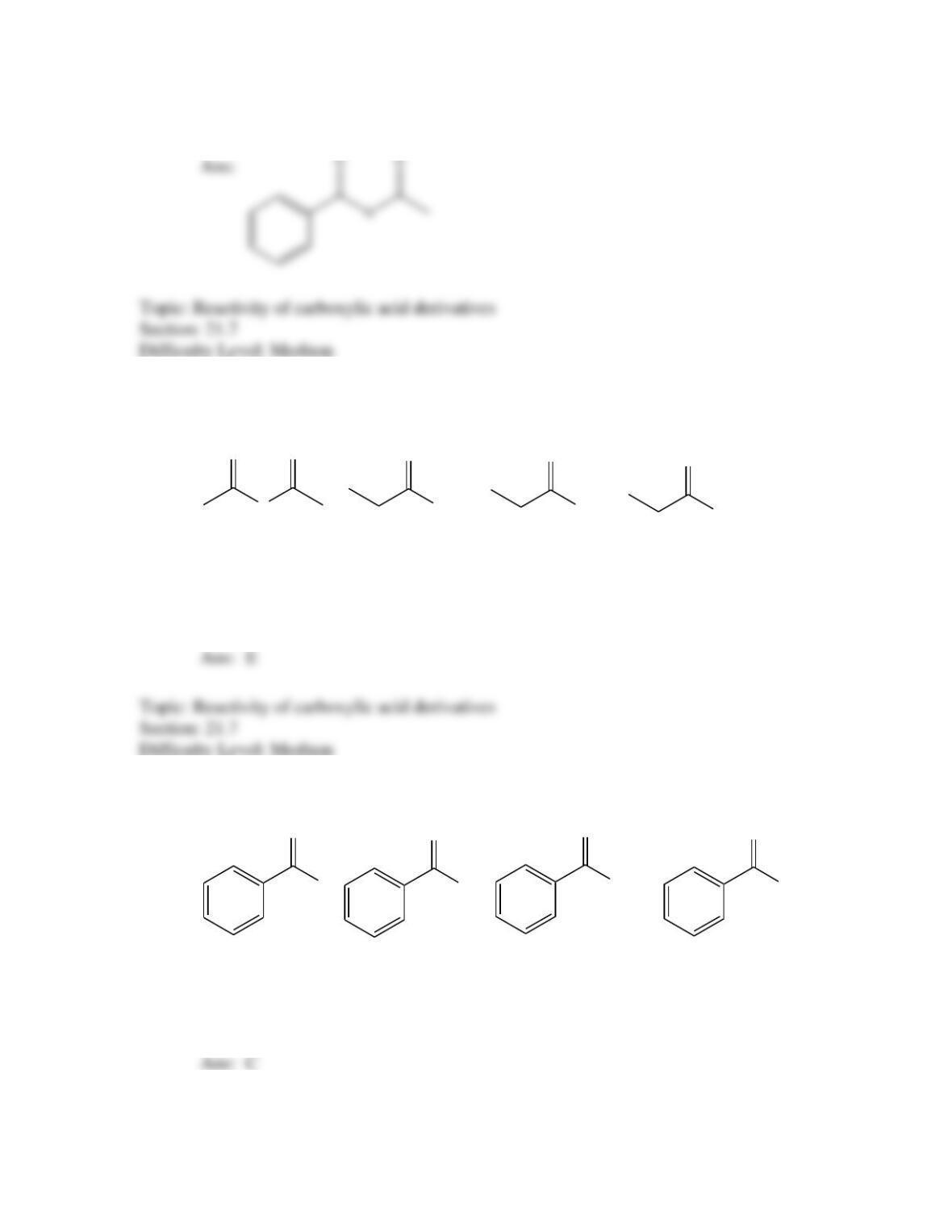
Provide the structure for acetic formic anhydride.
46.
Provide the structure for benzoic ethanoic anhydride
47.
Rank the following carboxylic acid derivatives in decreasing order (most to least) of
reactivity towards nucleophilic substitution.
III III IV
O
O O
NH2
O
OH
O
Cl
O
A)
I>IV>III>II
B)
II>III>IV>I
C)
I>III>II>IV
D)
III>IV>II>I
E)
IV>I>III>II
Ans:
E
48.
Rank the following carboxylic acid derivatives in decreasing order (most to least) of
reactivity towards nucleophilic substitution.
O Na
O
Cl
O
NH2
O
OCH3
O
III III IV
A)
I>IV>III>II
B)
II>III>IV>I
C)
I>III>II>IV
D)
III>IV>II>I
E)
IV>I>III>II
Ans:
C