General Chemistry, 11e (Petrucci)
Chapter 20 Chemical Kinetics
1) If increasing the concentration of A in a chemical reaction causes no increase in the rate of the reaction,
then we may say the reaction rate is first order in [A].
2) If the rate of a specific chemical reaction is independent of the concentrations of the reactants, the
reaction is zero order.
3) If the half-life of a reactant is independent of its initial concentration, the reaction order is 0.
4) For a reaction with a second order rate constant, the correct unit is M ∙ time-1.
5) Energy of activation has no effect on reaction rate.
6) Temperature has no effect on reaction rate.
7) In the Arrhenius equation, ln k = –Ea/RT + ln A, the symbol A denotes the initial concentration of A.
8) In the Arrhenius equation, ln k = –Ea/RT + ln A, the symbol A is a constant that represents the frequency
of collisions with the proper orientation and other steric conditions favorable for a reaction.
9) Adding a catalyst lowers the activation energy of a reaction.
2
10) A heterogeneous catalyst is a catalyst that is in two phases of matter.
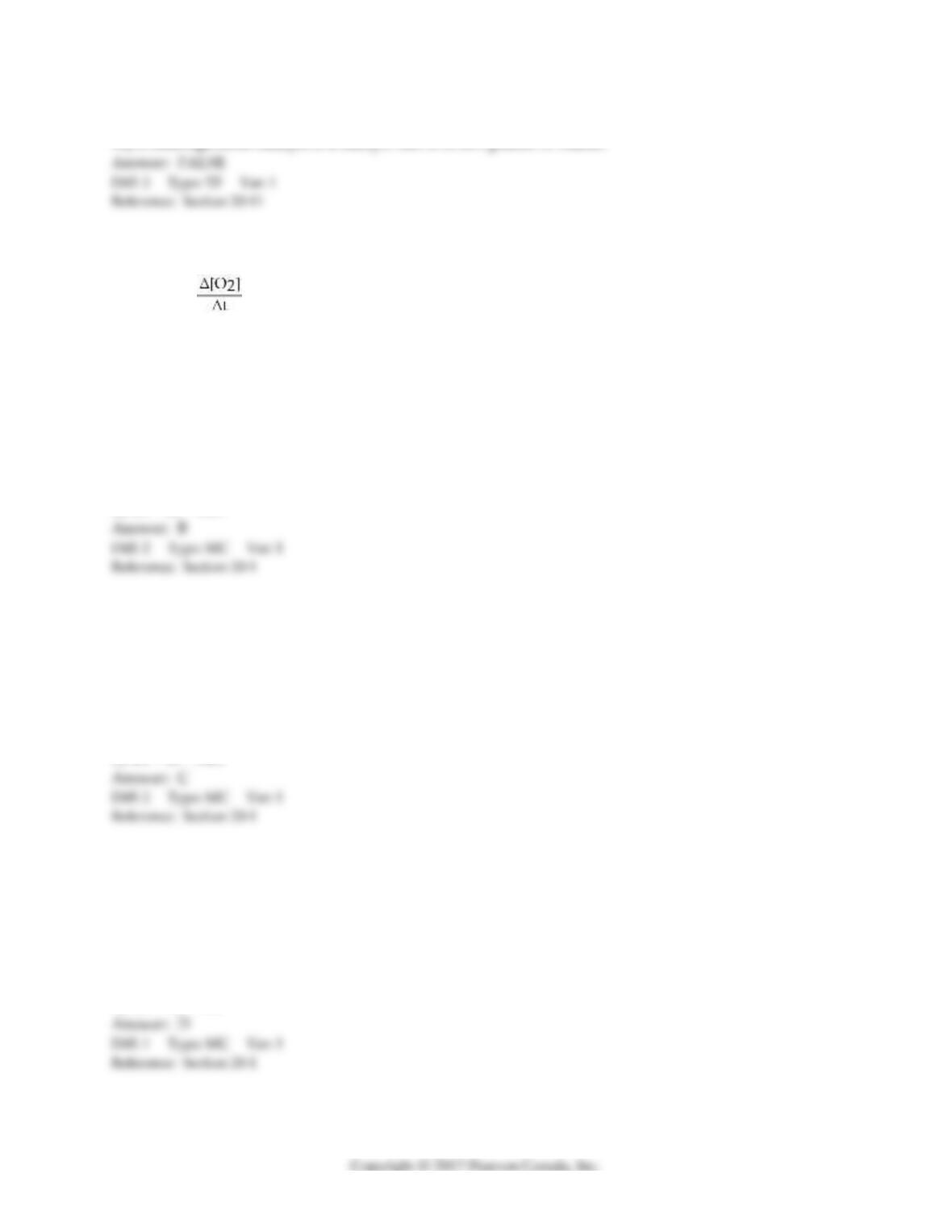
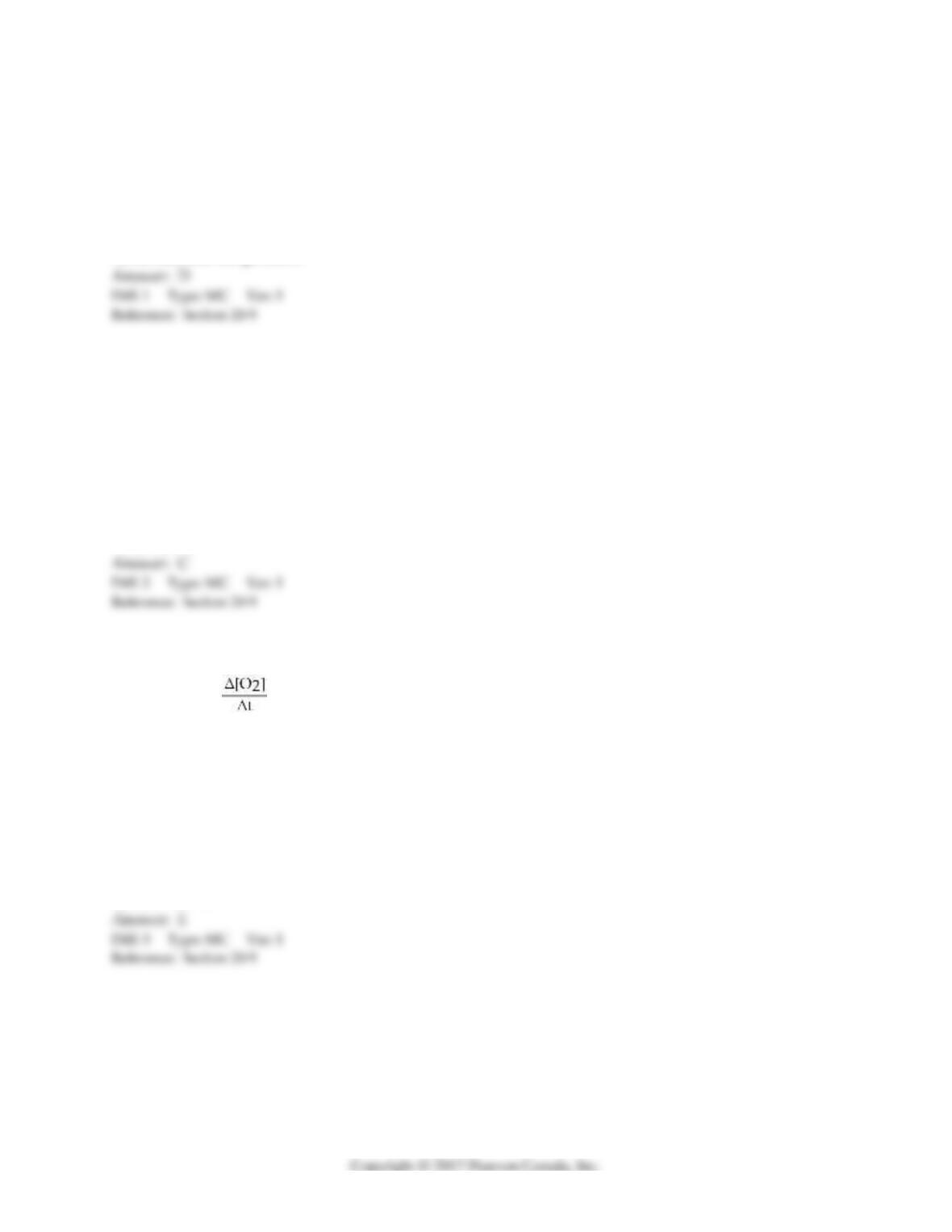
11) For the reaction: 2 N2O5(g) → 4 NO2(g) + O2(g) the rate law is:
= k[N2O5]
At 300 K, the half-life is 2.50 × 10⁴ seconds and the activation energy is 103.3 kJ/mol O2. At the time when
N2O5 is being consumed at a rate of 1.2 × 10⁻⁴ M/s, what is the rate at which NO2 is being formed?
A) 1.2 × 10⁻⁴ M/s
B) 2.4 × 10⁻⁴ M/s
C) 6.0 × 10⁻⁵ M/s
D) 3.0 × 10⁻⁵ M/s
E) 4.8 × 10⁻⁴ M/s
12) For the reaction: 2 N2O5(g) → 4 NO2(g) + O2(g) at the time when N2O5 is being consumed at a rate of
1.2 × 10⁻⁴ M/s, what is the rate at which O2 is being formed?
A) 1.2 × 10⁻⁴ M/s
B) 2.4 × 10⁻⁴ M/s
C) 6.0 × 10⁻⁵ M/s
D) 3.0 × 10⁻⁵ M/s
E) 4.8 × 10⁻⁴ M/s
13) For the reaction: C2H4Br2 + 3 KI → C2H4 + 2 KBr + KI3, when the rate of disappearance of C2H4Br2 is
2.0 × 10⁻⁵ M/s, what is the rate of disappearance of KI?
A) 0.67 × 10⁻⁵ M/s
B) 2.0 × 10⁻⁵ M/s
C) 4.0 × 10⁻⁵ M/s
D) 6.0 × 10⁻⁵ M/s
E) 1.0 × 10⁻⁵ M/s
3
14) For the reaction: C2H4Br2 + 3 KI → C2H4 + 2 KBr + KI3, when the rate of appearance of C2H4 is 2.0 ×
10-5 M/s, what is the rate of disappearance of C2H4Br2?
A) 0.67 × 10⁻⁵ M/s
B) 2.0 × 10⁻⁵ M/s
C) 4.0 × 10⁻⁵ M/s
D) 6.0 × 10⁻⁵ M/s
E) 1.0 × 10⁻⁵ M/s
15) For the reaction: C2H4Br2 + 3 KI → C2H4 + 2 KBr + KI3, when the rate of disappearance of C2H4Br2 is
2.0 × 10⁻⁵ M/s, what is the rate of appearance of C2H4?
A) 0.67 × 10⁻⁵ M/s
B) 2.0 × 10⁻⁵ M/s
C) 4.0 × 10⁻⁵ M/s
D) 6.0 × 10⁻⁵ M/s
E) 1.0 × 10⁻⁵ M/s
16) For the reaction: C2H4Br2 + 3 KI → C2H4 + 2 KBr + KI3, when the rate of disappearance of C2H4Br2 is
2.0 × 10⁻⁵ M/s, what is the rate of appearance of KBr?
A) 0.67 × 10⁻⁵ M/s
B) 2.0 × 10⁻⁵ M/s
C) 4.0 × 10⁻⁵ M/s
D) 6.0 × 10⁻⁵ M/s
E) 1.0 × 10⁻⁵ M/s
17) In the reaction C4H9Cl(aq) + H2O(l) → C4H9OH(aq) + HCl(aq) the concentration of the reactant
changes from 0.0562 M to 0.0431 M in 85 sec. What is the average rate of decomposition over this
interval?
A) 1.54 × 10⁻⁴ M/s
B) 1.54 × 10⁻⁴ moles
C) 1.54 × 10⁻⁴ moles/s
D) 0.0154 M
E) 0.0154 M/s
4
18) Define rate law.
A) A theoretical equation that describes how the rate of reaction depends on the concentration of
reactants.
B) An experimentally determined equation that describes how the rate of reaction depends on the
concentration of reactants.
C) A theoretical equation that describes how the rate of reaction depends on temperature, orientation and
number of collisions.
D) An experimentally determined equation that describes how the rate of reaction depends on
temperature, orientation and number of collisions.
E) A statement that describes how the ratio of reaction depends on concentration of reactants developed
from the balanced equation.
19) If a reaction has a rate equation of rate = k[A][B][C] then it is:
A) overall second order
B) overall first order
C) overall third order
D) zero order in A
E) second order in B
20) The reaction has the rate law Rate = k[A][B]2. Which will cause the rate to increase the most?
A) doubling [A]
B) lowering temperature
C) tripling [B]
D) quadrupling [A]
E) doubling [B]
21) If increasing the concentration of A in a chemical reaction 2 A → B + C causes no increase in the rate of
the reaction, then we may say:
A) A is a catalyst
B) the reaction rate is zero order in A
C) the reaction rate is zero order in [A]
D) the reaction rate is first order in [A]
E) A is not involved in the reaction
5
22) Which of the following statements is true about the reaction 2 A → B + C which is first order in A and
first order overall?
A) The rate of the reaction will decrease at higher concentrations of B and C.
B) The time required for one half of A to react is directly proportional to the quantity of A.
C) The rate of formation of C is twice the rate of reaction of A.
D) The rate of formation of B is the same as the rate of reaction of A.
E) The initial rate doubles with doubling of initial concentration of A.
23) The reaction A + B → C + D is second order in A and zero order in B. The value of k is 0.012 M-1 min–
1. What is the rate of this reaction when [A] = 0.125 M and [B] = 0.435 M?
A) 5 × 10⁻⁴ M min–1
B) 3.4 × 10⁻³ M min–1
C) 1.3 M min–1
D) 1.9 × 10⁻⁴ M min–1
E) 1.5 × 10⁻³ M min–1
24) For the reaction 2 HgCl2 + C2O42- → products, data are:
[HgCl2]0 (in M) 0.0836 0.0836 0.0418
[C2O42-]0 (in M) 0.202 0.404 0.404
rate (M/hr) 0.26 1.04 0.53
The rate law is Rate = k[HgCl2]x[C2O42-]y. Thus:
A) x = 2, y = 1
B) x = 2, y = 2
C) x = 1, y = 2
D) x = 1, y = 1
E) x = 0, y = 2
25) For 2 NO + O2 → 2 NO2, initial rate data are:
[NO]0 (in M) 0.010 0.010 0.030
[O2]0 (in M) 0.010 0.020 0.020
rate (mM/sec) 2.5 5.0 45.0
The rate law is Rate = k[NO][O2]y:
A) x = 1, y = 2
B) x = 2, y = 1
C) x = 1, y = 1
D) x = 2, y = 2
E) x = 0, y = 2
26) Data for the reaction A + B → C are given below. Find the rate constant for this system.
1 0.030 0.060 2.5 × 10⁻⁵
2 0.030 0.020 2.5 × 10⁻⁵
3 0.060 0.060 10.0 × 10⁻⁵
A) 2.8 × 10⁻² M-1s–1
B) 2.8 × 10⁻² Ms–1
C) 2.8 × 10⁻² M2s–1
D) 1.7 × 10⁻³ M-1s–1
E) 1.7 × 10⁻³ Ms–1
27) The rate of a specific chemical reaction is independent of the concentrations of the reactants. Thus the
reaction is:
A) first order in A
B) second order
C) first order in the product
D) catalyzed
E) overall zero order
28) Calculate rate constant k for a first order reaction with a half-life of 75.0 min.
A) 52.0 min–1
B) 1.54 × 10⁻⁴ min–1
C) 1.33 × 10⁻² min–1
D) 9.24 × 10⁻³ min–1
E) 2.67 × 10⁻² min–1
29) Which of the following statements is INCORRECT?
A) Radioactive decay is a first order reaction.
B) Half-life in a first order reaction is constant.
C) For a first order reaction ln [A]t/[A]o = kt.
D) In gaseous reactions [A] can be expressed as concentration or as pressure.
E) In a zero order reaction the rate remains constant throughout the reaction.
30) In the first order reaction A → products, [A] = 0.400 M initially and 0.250 M after 15.0 min, what will
[A] be after 175 min?
A) 1.67 × 10⁻³ M
B) 1.04 × 10⁻³ M
C) 3.70 × 10⁻² M
D) 6.024 × 10⁻³ M
E) 2.31 × 10⁻¹ M
31) For a reaction Rate = k[A][B]2, what factor will keep k unchanged?
A) raising temperature
B) adding inhibitor
C) increasing [A]
D) adding catalyst
32) In a second order reaction:
I) the sum of the exponents in the rate law is equal to two.
II) at least one of the exponents in the rate law is a two.
III) the half-life is dependent on the initial concentration of the reactant species.
IV) the half-life is independent of the initial concentration of the reactant species.
V) k can be expressed as M-2s-1 or M-2min-1.
A) I and IV
B) II and IV
C) I, III, and V
D) I and III
E) II and III
33) Which of the following is FALSE for a second order reaction?
A) 1/[A]t – 1/[A]o = kt.
B) t1/2 = 1/k[A]o.
C) If 1/[A] versus time is a straight line, the reaction is second order.
D) Each successive half-life is 4 times as long as the previous.
E) The slope of 1/[A]t versus time is k.
34) For the second order reaction A → products, the following data are obtained:
[A] = 3.024 M, t = 0 min
[A] = 2.935 M, t = 1.0 min
[A] = 2.852 M, t = 2.0 min
What is the rate constant, k?
A) 3.6 × 10⁻³ M-1 min–1
B) 1.4 × 10⁻² M-1 min–1
C) 2.2 × 10⁻² M-1 min–1
D) 9.7 × 10⁻³ M-1 min–1
E) 1.0 × 10⁻² M-1 min–1
35) For the second order reaction A → products, the following data are obtained:
[A] = 1.512 M, t = 0 min
[A] = 1.490 M, t = 1.0 min
[A] = 1.469 M, t = 2.0 min
What is the rate constant, k, for the reaction?
A) 3.6 × 10⁻³ M-1 min–1
B) 1.4 × 10⁻² M-1 min–1
C) 2.2 × 10⁻² M-1 min–1
D) 1.0 × 10⁻² M-1 min–1
E) 9.7 × 10⁻³ M-1 min–1
36) Activation energy is:
A) energy at the bottom of the reaction curve
B) the heat energy in joules required to break the bonds in one reactant
C) an energy that a catalyst brings to the system to activate one of the reactants
D) the kinetic energy of solution stirring that brings the reaction to start
E) minimum kinetic energy that molecules must bring to their collisions for a chemical reaction to occur
37) Choose the INCORRECT answer. The rate of a chemical reaction:
A) usually is increased when the concentration of one of the reactants is increased
B) is dependent on temperature
C) may be increased by certain catalytic agents
D) will be very rapid if the activation energy is large
E) describes the rate of change in concentration of a reactant or product with time
38) Which of the following has no effect on the rate of a reaction?
A) value of ΔH°
B) activation energy
C) presence of a catalyst
D) temperature of reactants
E) concentrations of reactants
39) Which of the following statements is correct?
A) A zero order reaction depends on the concentration of reactants.
B) A reaction rate cannot be calculated from the collision frequency alone.
C) The activated complex is a chemical species that can be isolated and analysed.
D) The number of collisions has no effect on the rate constant.
E) The orientation of a collision does not affect the rate constant.
40) Choose the INCORRECT statement.
A) A reaction intermediate is produced and used up during the reaction.
B) A transition state and a reaction intermediate are the same.
C) An activated complex has partially formed bonds.
D) A reaction intermediates have fully formed bonds.
E) The rate-determining step is the slow-step.
41) Define activation energy.
A) the difference between the energy of the products and reactants
B) the energy difference between the maximum energy of reaction and the energy of the products
C) the minimum total kinetic energy that molecules must bring to their collisions for a chemical reaction
to occur
D) the total kinetic energy of molecules in collisions
E) the total kinetic energy of molecules in a system
42) According to the collision theory in gaseous molecules, collision frequency is ________ and the rate of
reaction is ________ because ________.
A) low, low, molecules are so far apart
B) high, high, each collision results in a reaction
C) low, low, molecules must collide before they can react
D) high, relatively low, only a fraction of the collisions lead to a reaction
E) low, high, molecules are moving so fast that each reaction causes many others
43) Which statement is INCORRECT?
A) Activation energy is always the same for forward and reverse reaction.
B) If the forward reaction is endothermic, the reverse will be exothermic.
C) In an endothermic reaction, activation energy is usually greater than the enthalpy.
D) An activated complex has higher energy than any molecule contributing to it.
E) The activated complex will be the highest on the energy profile.
44) A factor that decreases the activation energy for a reaction:
I) decreases the rate constant
II) increases the rate constant
III) has no effect on the rate constant
IV) increases the product yield
V) might be a catalyst
A) I and IV
B) II and IV
C) I, IV, and V
D) IV and III
E) II and V
45) What is the rate constant at 305 K for the reaction:
2 N2O5 → 2 N2O4 + O2,
if k = 3.46 × 10⁻⁵ s-1 at 298 K and Ea = 106 kJ/mol?
A) 2.4 × 10⁻⁵ s–1
B) 4.8 × 10⁻⁵ s–1
C) 6.0 × 10⁻⁵ s–1
D) 1.2 × 10⁻⁵ s–1
E) 9.2 × 10⁻⁵ s–1
12
46) In the Arrhenius equation, ln k = –Ea/RT + ln A, the symbol A denotes:
A) the initial concentration of A
B) the activation energy
C) the rate constant
D) a constant that represents the frequency of collisions with the proper orientation and other steric
conditions favorable for a reaction
E) the absolute temperature
47) Activation energy is:
I) the minimum kinetic energy required for each molecule in a collision to produce a reaction.
II) the minimum total kinetic energy required for the molecules in a collision to produce a reaction.
III) a factor in determining the rate of a reaction.
IV) high for fast reactions.
A) I and III
B) I, III, and IV
C) II, III
D) II and IV
E) II, III, and IV
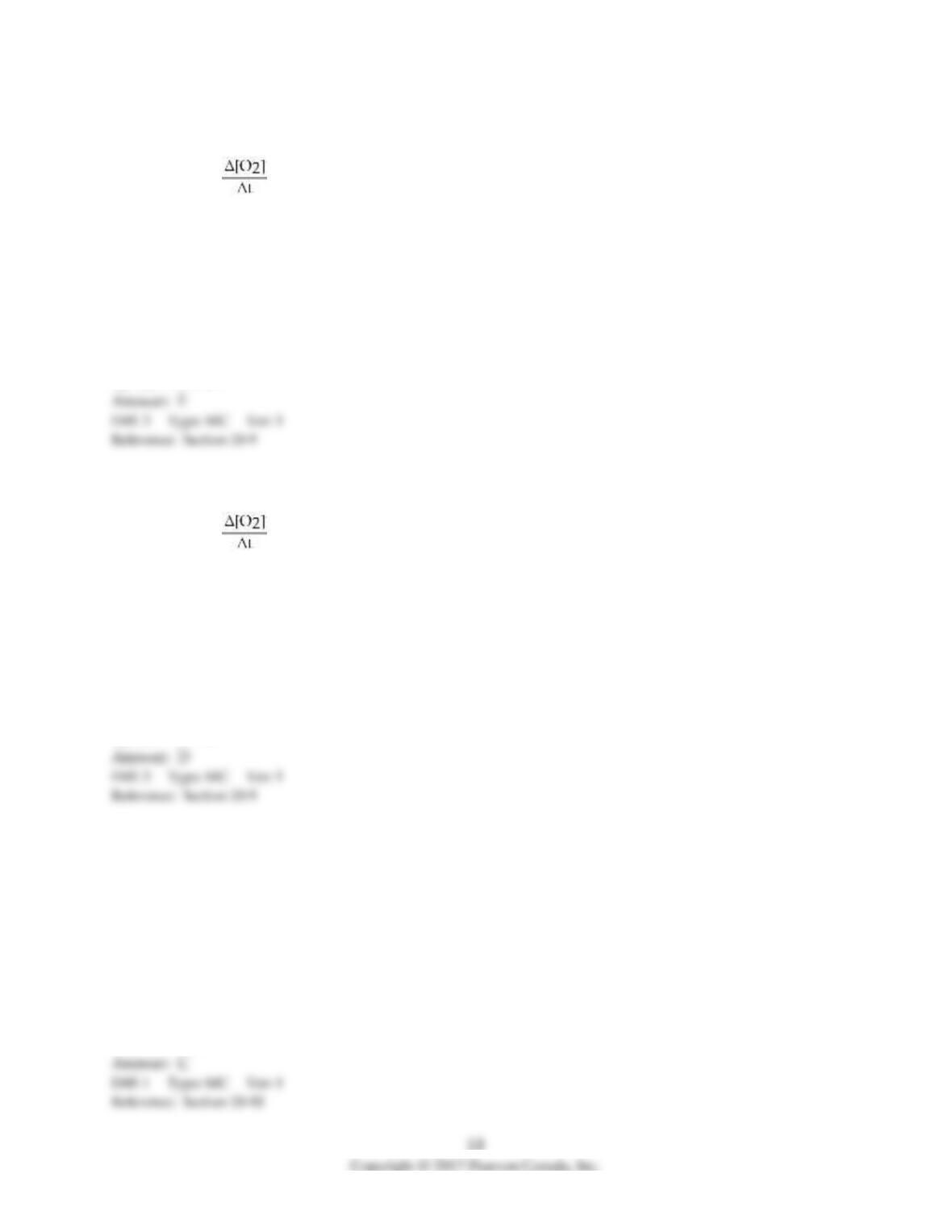
48) For the reaction: 2 N2O5(g) → 4 NO2(g) + O2(g) the rate law is:
= k[N2O5]
At 300 K, the half-life is 2.50 × 10⁴ seconds and the activation energy is 103.3 kJ/mol. What is the rate
constant at 310 K?
A) 2.78 × 10⁻⁵ s-1
B) 7.29 × 10⁻⁶ s-1
C) 7.29 × 10⁻⁸ s-1
D) 3.70 × 10⁻⁵ s-1
E) 1.05 × 10⁻⁴ s-1
49) For the reaction: 2 N2O5(g) → 4 NO2(g) + O2(g) the rate law is:
= k[N2O5]
At 300 K, the half-life is 2.50 × 10⁴ seconds and the activation energy is 103.3 kJ/mol. What is the rate
constant at 350 K?
A) 4.78 s-1
B) 2.79 × 10⁻⁵ s-1
C) 6.38 × 10¹⁶ s-1
D) 7.47 × 10⁻⁸ s-1
E) 1.03 × 10⁻² s-1
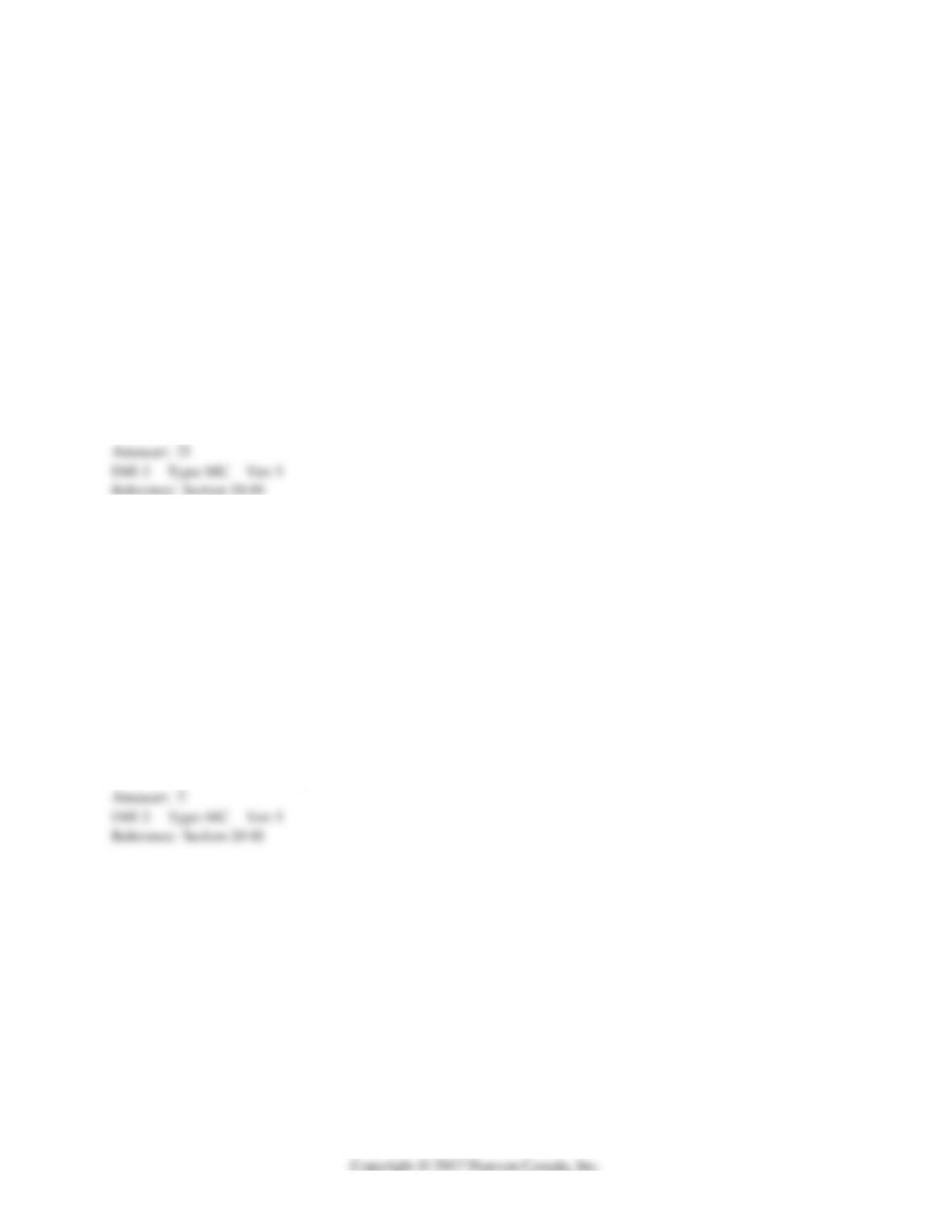
50) For the reaction: 2 N2O5(g) → 4 NO2(g) + O2(g) the rate law is:
= k[N2O5]
At 300 K, the half-life is 2.50 × 10⁴ seconds and the activation energy is 103.3 kJ/mol. What is the half-life
at 310 K?
A) 2.49 × 10⁴ s
B) 9.51 × 10⁴ s
C) 9.51 × 10⁶ s
D) 6.57 × 10³ s
E) 1.87 × 10⁻¹ s
51) What is the rate law for the following mechanism?
N2O + NO → N2ONO (Slow)
N2ONO → N2 + NO2 (Fast)
A) Rate = k[N2O]
B) Rate = k[NO]
C) Rate = k[N2O][NO]
D) Rate = k[N2][NO2]
E) Rate = k[N2ONO]
14
52) What is the rate law for the following reaction and its mechanism?
2 HgCl2 + C2O42- → 2 Cl– + 2 CO2 + Hg2Cl2 (overall reaction)
HgCl2 + C2O42- ⇌ HgCl2C2O42- (fast)
HgCl2C2O42- + C2O42- → Hg + 2 C2O4Cl2- (slow)
Hg + HgCl2 → Hg2Cl2 (fast)
2 C2O4Cl2- → C2O42- + 2Cl– + 2 CO2 (fast)
A) Rate = k[HgCl2][C2O42-]
B) Rate = k[HgCl2]2[C2O42-]
C) Rate = k[Hg2Cl2]
D) Rate = k[HgCl2][C2O42-]2
E) Rate = k[HgCl2]2[C2O42-]2
53) What is the rate law for the following mechanism?
CH3COOC2H5 + H2O → CH3COOC2H6+ + OH– (slow)
CH3COOC2H6+ → CH3COOH + C2H5+ (fast)
C2H5+ + OH– → C2H5OH (fast)
A) Rate = k[CH3COOC2H5][H2O]2
B) Rate = k[C2H5OH]
C) Rate = k[CH3COOH]
D) Rate = k[CH3COOC2H5]
E) Rate = k[CH3COOC2H5][H2O]
54) What is the rate law for the following reaction and its mechanism?
2 O3 → 3 O2 (overall reaction)
O3 → O2 + O∙ (slow)
O∙ + O3 → 2 O2 (fast)
A) Rate = k[O3]
B) Rate = k[O3]2
C) Rate = k[O3]2/[O2]
D) Rate = k[O3]/[O2]
E) Rate = k[O3][O2]
55) Choose the INCORRECT statement.
A) The rate-determining step is always the first step.
B) A unimolecular process is one in which a single molecule dissociates.
C) A bimolecular process is one involving a collision of two molecules.
D) A reaction mechanism is a step-by-step detailed description of a chemical reaction.
E) An elementary process is a step in the mechanism.
56) Why is rate = k[HgCl2] 2[C2O42-] not the rate law for the following mechanism?
2 HgCl2 + C2O42- → 2 Cl– + 2 CO2 + Hg2Cl2 (overall reaction)
HgCl2 + C2O42- ⇌ HgCl2C2O42- (fast)
HgCl2C2O42- + C2O42- → Hg + 2 C2O4Cl2- (slow)
Hg + HgCl2 → Hg2Cl2 (fast)
2 C2O4Cl2- → C2O42- + 2 Cl– + 2 CO2 (fast)
A) The rate law is not based on the slow step of the proposed mechanism.
B) The steps do not add to the overall reaction.
C) The rate law does not agree with the overall reaction.
D) The exponents of HgCl2 and C2O42- are not equal.
E) The first step is not the slow step.
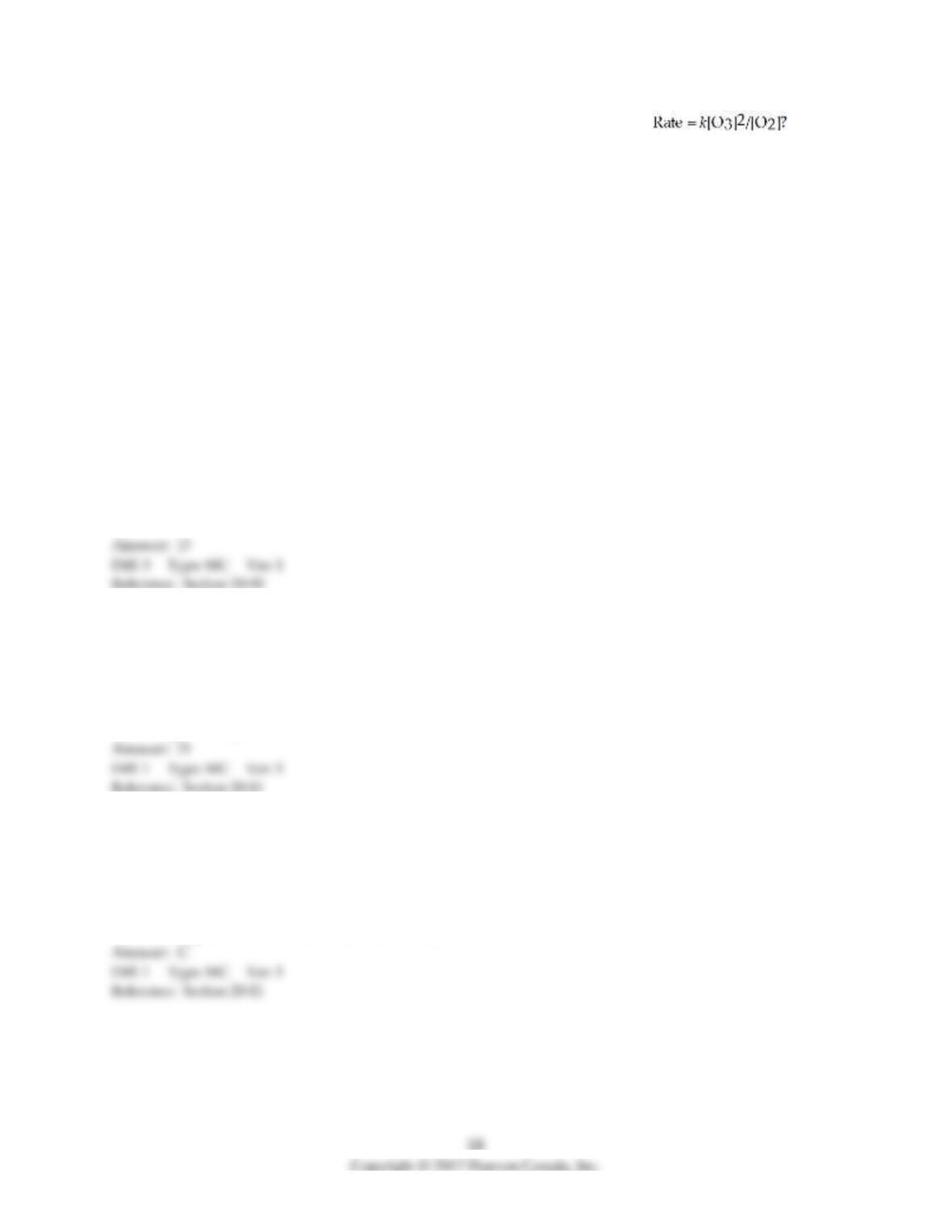
57) Which is a plausible mechanism for the following reaction if the rate law is
2 O3 → 3 O2
A) 2 O3 → O2 + O4 (slow)
O4 → 2 O2 (fast)
B) 2 O3 → O6 (slow)
O6 → O4 + O2 (fast)
O4 → 2 O2 (slow)
C) 2 O3 → O4– + O2+ (slow)
O4– → O2 + O2– (fast)
O2– + O2+ → 2 O2 (slow)
D) O3 ⇌ O2 + O∙ (fast)
O∙ + O3 → 2 O2 (slow)
E) O3 ⇌ O2+ + O– (fast)
O– + O3 → O2 + O2– (slow)
O2– + O2+ → 2 O2 (fast)
58) Which of the following lowers the activation energy of a reaction?
A) adding reactants
B) lowering the temperature
C) removing products
D) adding a catalyst
E) raising the temperature
59) A catalyst alters the rate of a chemical reaction by:
A) always providing a surface on which molecules react
B) changing the products formed in the reaction
C) inducing an alternate pathway for the reaction with generally lower activation energy
D) changing the frequency of collisions between molecules
E) increasing the number of collisions of molecules
60) What is the main difference between a Pt catalyst and an enzyme catalyst?
A) An enzyme has greater substrate specificity.
B) The Pt catalyst causes a faster reaction.
C) The enzyme causes a faster reaction.
D) A Pt catalyst is always a homogeneous catalyst.
E) A Pt catalyst is an enzyme.
61) A catalyst:
I) lowers activation energy
II) provides an alternate reaction pathway
III) is consumed in the reaction and therefore does not appear in the chemical equation of each
mechanism
IV) speeds a reaction
V) is heterogeneous if it is in a different phase than the reactants
A) I, III, and IV
B) I, IV, and V
C) II, III, and IV
D) II and IV
E) I, II, IV, and V
62) If a catalyst is added to a reaction:
I) the value of k is increased
II) the value of k is decreased
III) the rate is increased
IV) the rate is decreased
V) neither rate nor the constant are changed, only the order
A) I and IV
B) II and IV
C) II and III
D) I and III
E) V only
63) Which of the following situations involves a heterogeneous catalysis?
A) The catalyst is present in a different phase of matter than are the reactants and products.
B) The catalyst is in two different phases of matter.
C) The reactants and products are different phases of matter in a catalyzed reaction.
D) The catalyst, reactants, and products are all different phases of matter.
E) The catalyst changes phases during the reaction.
64) The reaction 2 H2 + NO → H2O + 1/2N2 is first order in H2 and second order in NO. The rate law is
________.
A) k[H2]2[NO]
B) k[H2][NO]2
C) k[H2]
D) k[H2][NO]
E) k[H2][NO]–2
65) The rate data from a chemical reaction shows that doubling the concentration of A with the
concentration of B remaining constant causes the rate to increase by a factor of four. What is the reaction
order for [A]?
A) 0
B) 0.5
C) 1
D) 2
E) 3