19
66) For the reaction: C2H4Br2 + 3 KI → C2H4 + 2 KBr + KI3
Initial rate data at 60 °C are:
[C2H4Br2]0, M [KI]0, M Δ[KI3]/Δt (M min-1)
0.500 1.80 0.269
0.500 7.20 1.08
1.50 1.80 0.807
The rate law is ________.
A) rate = k[KI]
B) rate = k[C2H4Br2]
C) rate = k[KI]2
D) rate = k[KI][C2H4Br2]
E) rate = k[KI][C2H4Br2]2
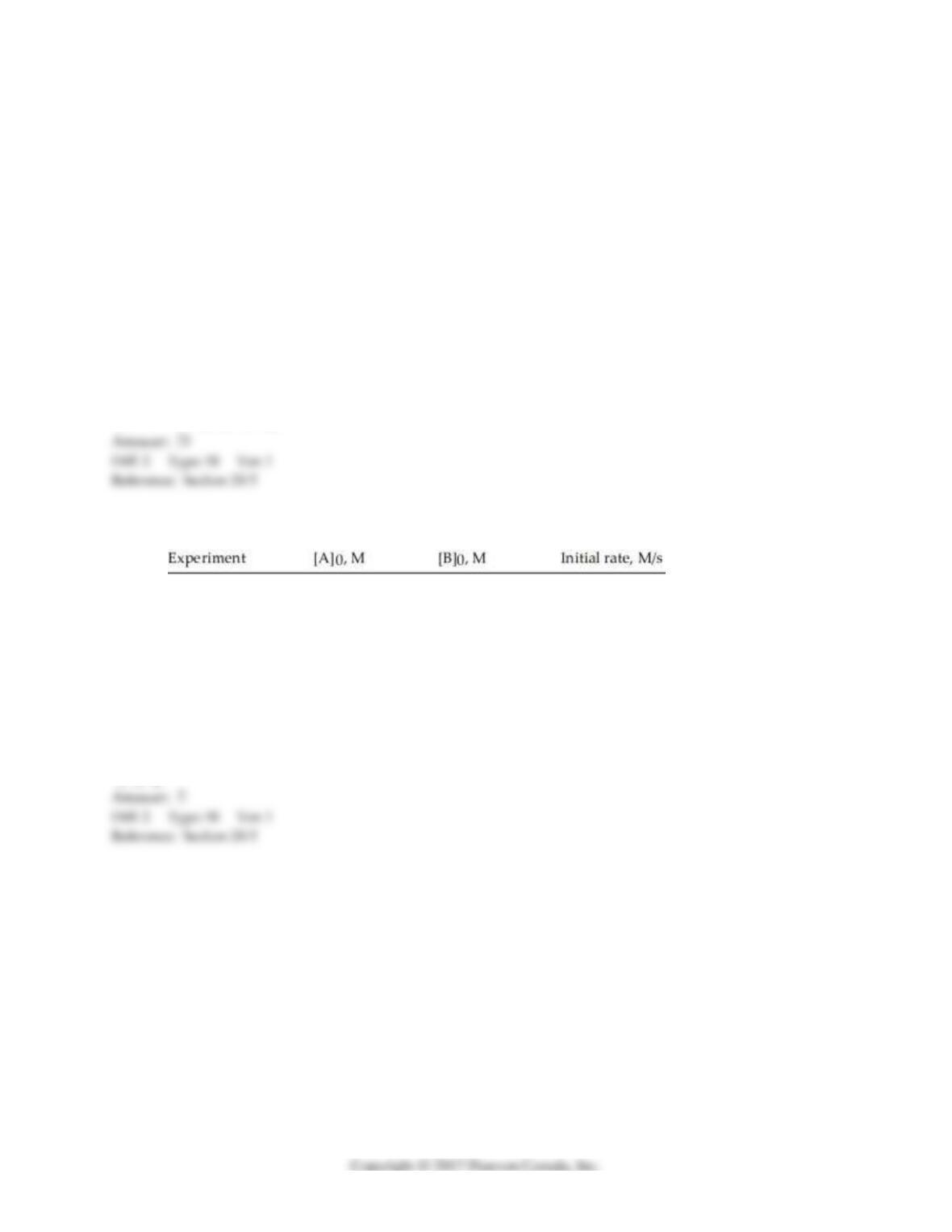
67) Data for the reaction A + B → C are given below. What is the correct rate law?
1 0.030 0.060 2.5 × 10⁻⁵
2 0.030 0.020 2.5 × 10⁻⁵
3 0.060 0.060 10.0 × 10⁻⁵
A) k [A] [B]
B) k [A]2 [B]
C) k [A]2 [B]2
D) k [B]2
E) k[A]2
20
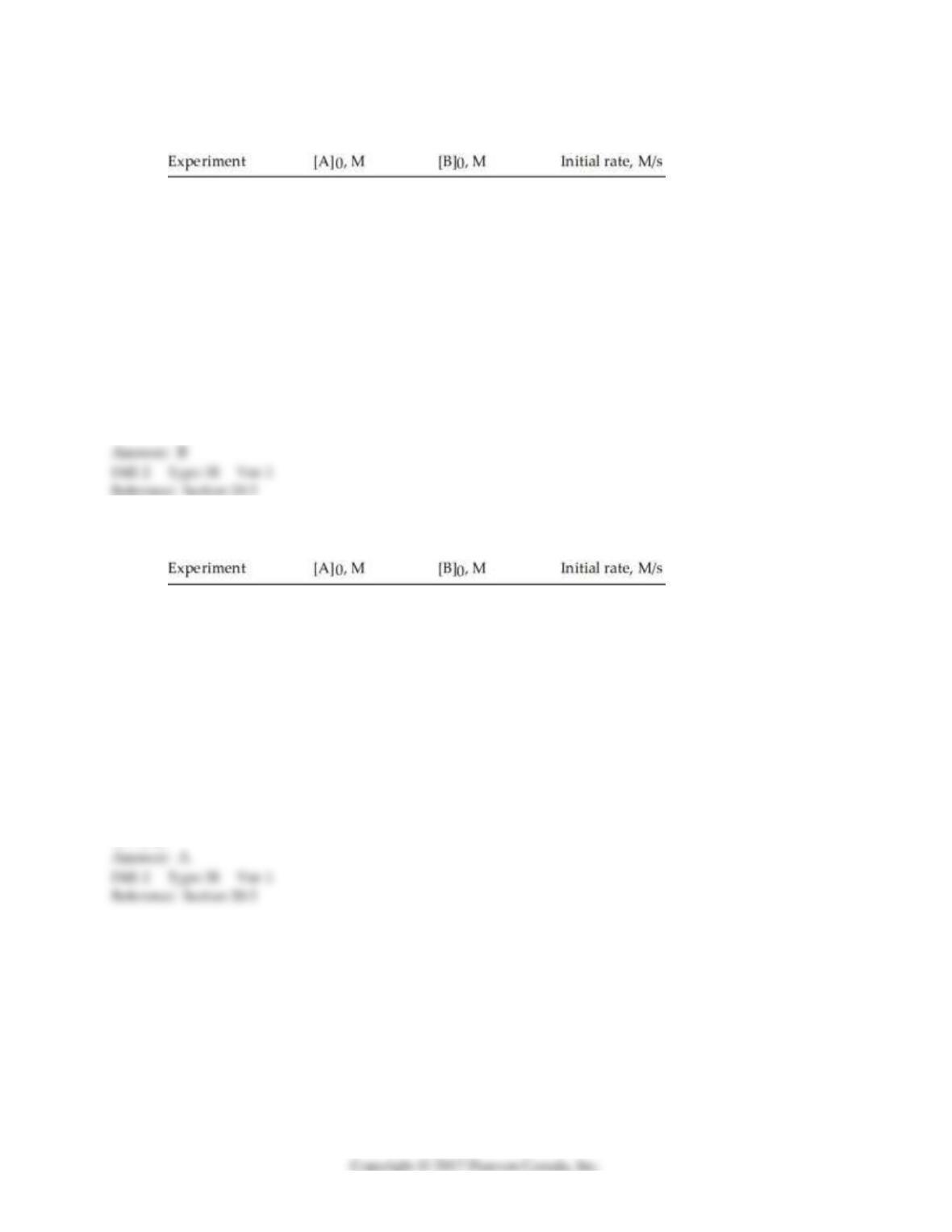
68) Given the following initial rate data, calculate the specific rate constant.
1 5.1 × 10⁻⁴ 0.35 × 10⁻⁴ 3.4 × 10⁻⁸
2 5.1 × 10⁻⁴ 0.70 × 10⁻⁴ 6.8 × 10⁻⁸
3 5.1 × 10⁻⁴ 0.18 × 10⁻⁴ 1.7 × 10⁻⁸
4 1.0 × 10⁻³ 0.35 × 10⁻⁴ 6.8 × 10⁻⁸
5 1.5 × 10⁻³ 0.35 × 10⁻⁴ 10.2 × 10⁻⁸
A) 1.9 M2/s2
B) 1.9 M-1 s–1
C) 3.6 M s–1
D) 1.1 × 10⁸ M2/s2
E) 3.6 M2 s–1
69) Given the following initial rate data, write the rate law expression.
1 5.1 × 10⁻⁴ 0.35 × 10⁻⁴ 3.4 × 10⁻⁸
2 5.1 × 10⁻⁴ 0.70 × 10⁻⁴ 6.8 × 10⁻⁸
3 5.1 × 10⁻⁴ 0.18 × 10⁻⁴ 1.7 × 10⁻⁸
4 1.0 × 10⁻³ 0.35 × 10⁻⁴ 6.8 × 10⁻⁸
5 1.5 × 10⁻³ 0.35 × 10⁻⁴ 10.2 × 10⁻⁸
A) k [A] [B]
B) k [A]2 [B]2
C) k [A]2 [B]
D) k [B]2
E) k [A]2
70) What is the order of reaction for the following reaction: Rate = k[A]-1/2 [B]1/2?
A) first order
B) zero order
C) 1/2 order
D) -1/2 order
E) second order
71) The correct units of the specific rate constant for a zero order reaction are ________.
A) L/mol s
B) s–1
C) s
D) L2/mol2 s
E) rate is a constant, so it has no units
72) The first order reaction A → products has = 150 s. What percent of the sample remains unreacted
after 300 s?
A) 25%
B) 50%
C) 12.5%
D) 0.0%
E) 100%
73) If the half-life of a reaction depends on the concentration of the reactant, then the reaction cannot be
________ order.
A) second
B) zero
C) first
D) third
74) Substance A decomposes by a first-order reaction. Starting initially with [A] = 2.00 M, after 150 min
[A] = 0.50 M. For this reaction what is ?
A) 150 min
B) 37.5 min
C) 75.0 min
D) 15.0 min
E) 300 min
75) If the half-life of a reactant is independent of its initial concentration, the reaction order is ________.
A) 0
B) 0.5
C) 1
D) 2
E) 3
76) If a reaction is first order with a rate constant of 5.48 × 10⁻²/s, how long is required for 3/4 of the initial
concentration of reactant to be used up?
A) 25.3 s
B) 36.5 s
C) 6.3 s
D) 18.2 s
E) 50.6 s
77) The rate constant at 160 °C for the first order decomposition of ore is 0.032/min. The half-life of the
reaction is ________.
A) 62.5 s
B) 31.25 s
C) 5000 s
D) 111 s
E) 1300 s
78) A reaction is first order. If its initial rate is 0.0200 M/s and 25.0 days later its rate is 6.25 × 10⁻⁴ M/s,
then its half-life is ________.
A) 12.5 days
B) 5.0 days
C) 25.0 days
D) 50.0 days
E) 2.5 days
79) The rate constant for a first-order reaction is k = 0.00073 s-1. Determine the percent of reactant that has
decomposed after 500 s.
A) 69%
B) 57%
C) 37%
D) 31%
E) 43%
80) In the first-order, reaction A → products, [A] = 0.400 M initially and 0.250 M after 15.0 min, what is the
value of the rate constant, k?
A) 3.06 min–1
B) 0.0136 min–1
C) 0.470 min–1
D) 7.05 min–1
E) 0.0313 min–1
81) In the first-order, reaction A → products, [A] = 0.400 M initially and 0.250 M after 15.0 min, what is the
half-life of the reaction?
A) 22.1 min
B) 63.9 min
C) 9.62 min
D) 51.0 min
E) 15.0 min
24
82) In the first-order, reaction A → products, [A] = 0.400 M initially and 0.250 M after 15.0 min, at what
time will [A] = 0.200 M?
A) 63.9 min
B) 22.1 min
C) 9.62 min
D) 51.0 min
E) 15.0 min
83) For a reaction with a second order rate constant, what is the correct unit?
A) M time–1
B) M-1 time–1
C) time-1
D) M-2 time
E) M time–2
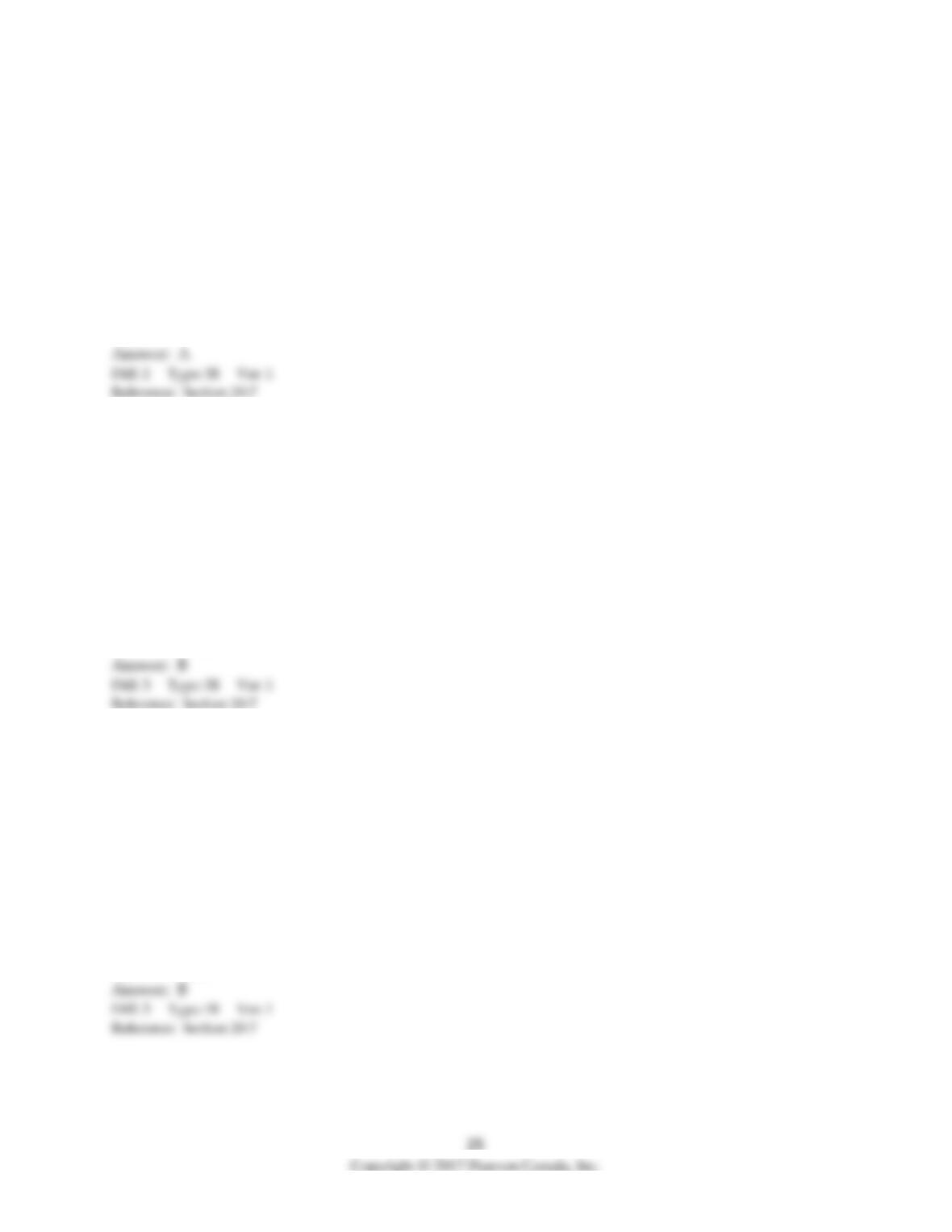
84) For the reaction: 2 NO2(g) → 2 NO(g) + O2(g) concentration-time data are:
t(s) [NO2] log[NO2]
0.00 2.000 0.300 0.500
0.40 1.467 0.166 0.682
0.80 1.076 0.032 0.929
1.20 0.789 -0.103 1.267
1.60 0.579 -0.237 1.727
2.00 0.424 -0.373 2.358
What is the order of the reaction with respect to [NO2]?
A) zero
B) first
C) second
D) third
E) 2 + 2
85) For the second order reaction A → products, the following data are obtained:
[A] = 1.512 M, t = 0 min
[A] = 1.490 M, t = 1.0 min
[A] = 1.469 M, t = 2.0 min
What is the concentration of [A] in the experiment after 4.0 min for the reaction?
A) 1.43 M
B) 1.35 M
C) 1.61 M
D) 1.39 M
E) 1.37 M
86) For the second-order reaction A → products, the following data are obtained:
[A] = 1.512 M, t = 0 min
[A] = 1.490 M, t = 1.0 min
[A] = 1.469 M, t = 2.0 min
What is the initial rate of the reaction in the experiment?
A) 0.40 M/min
B) 0.022 M/min
C) 0.089 M/min
D) 9.8 × 10⁻³ M/min
E) 0.046 M/min
87) For the second-order reaction A → products, the following data are obtained:
[A] = 3.024 M, t = 0 min
[A] = 2.935 M, t = 1.0 min
[A] = 2.852 M, t = 2.0 min
What is the initial rate of the reaction?
A) 1.0 × 10⁻⁴ M min–1
B) 0.091 M min–1
C) 11.2 M min–1
D) 0.010 M min–1
E) 0.030 M min–1
26
88) For the second-order reaction A → products, the following data are obtained:
[A] = 3.024 M, t = 0 min
[A] = 2.935 M, t = 1.0 min
[A] = 2.852 M, t = 2.0 min
What is the concentration of [A] after 4 min?
A) 2.70 M
B) 2.66 M
C) 0.76 M
D) 2.76 M
E) 2.62 M
89) For the reaction: A → Products concentration-time data are:
[A]t 0.2000 0.1486 0.1182 0.0981 0.0839 M
t 0 1 2 3 4 h
[A]t 0.0733 0.0650 0.0584 0.0531 0.0486 M
t 5 6 7 8 9 h
What is the order of this reaction with respect to [A]?
A) zero
B) first
C) second
D) third
E) none of these
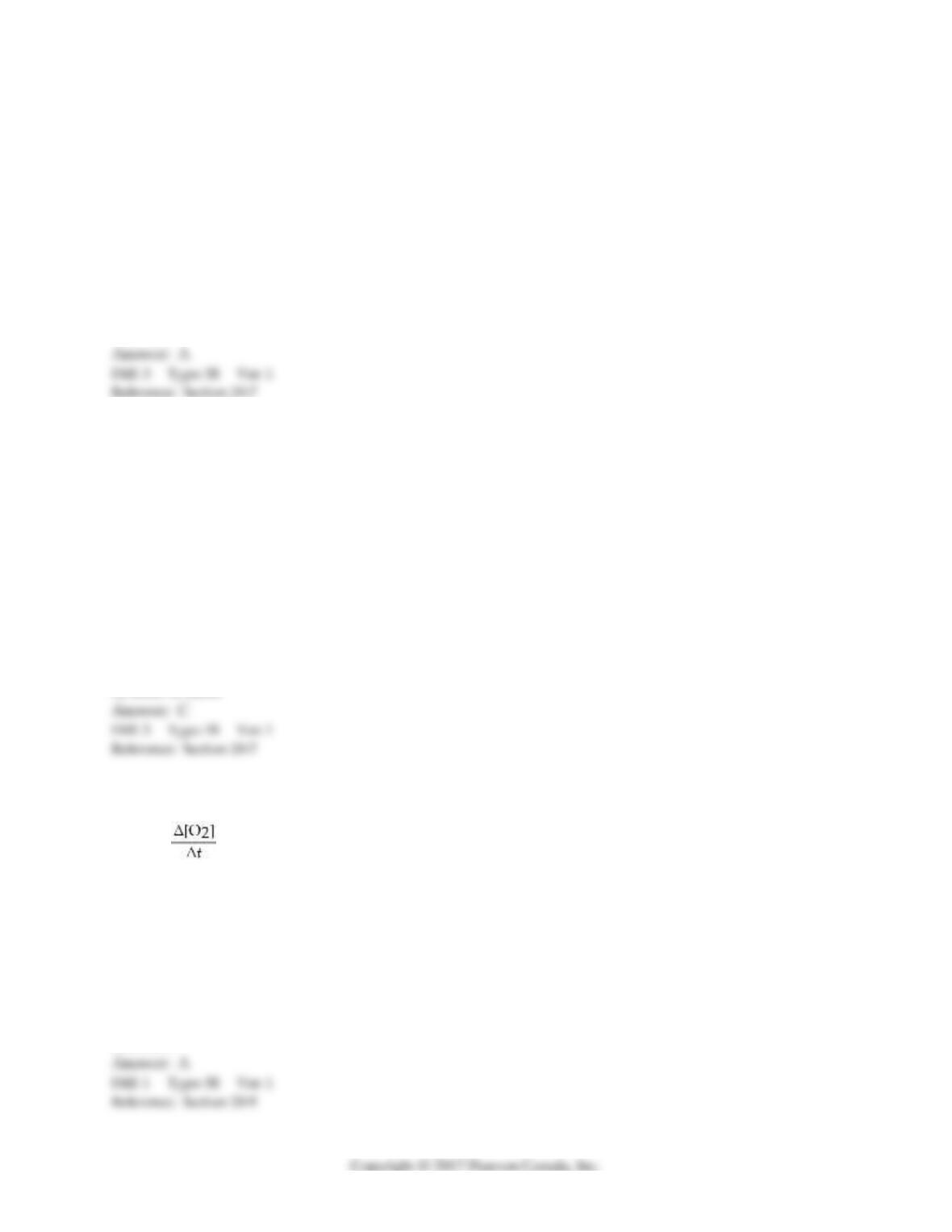
90) For the reaction: 2 N2O5(g) → 4 NO2(g) + O2(g) the rate law is:
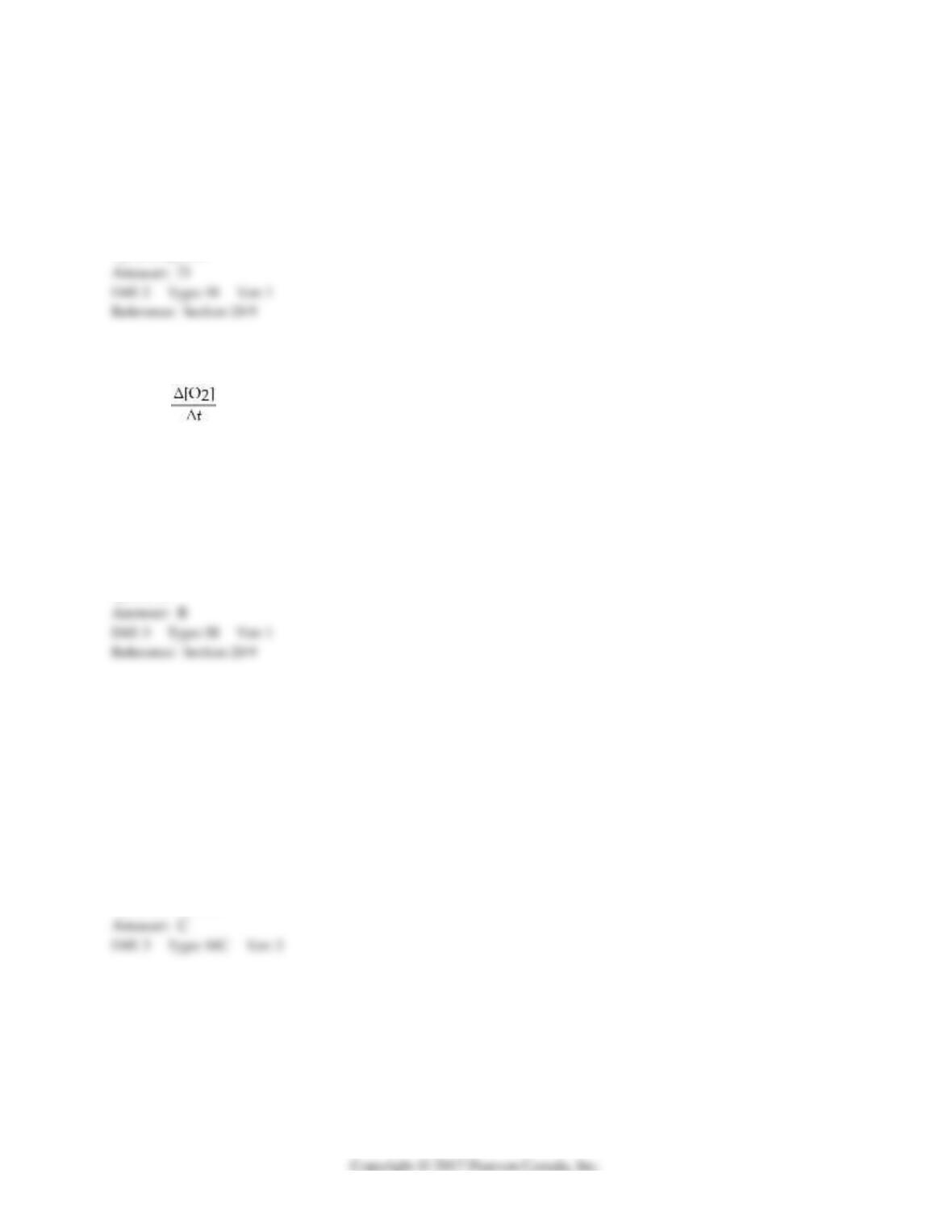
= k[N2O5]
At 300 K, the half-life is 2.50 × 10⁴ seconds and the activation energy is 103.3 kJ/mol O2. What is the half-
life at 350 K?
A) 67.3 s
B) 9.3 × 10⁶ s
C) 1.09 × 10⁻¹⁷ s
D) 2.48 × 10⁴ s
E) 0.145 s
27
91) The first-order reaction A → Products has a half-life, t1/2, of 55.0 min at 25 °C and 6.8 min at 100 °C.
What is the activation energy for this reaction?
A) -25.8 kJ/mol
B) -38.8 kJ/mol
C) 347 kJ/mol
D) 25.8 kJ/mol
E) 38.8 kJ/mol
92) For the reaction: 2 N2O5(g) → 4 NO2(g) + O2(g) the rate law is:
= k[N2O5]
At 300 K, the half-life is 2.50 × 10⁴ seconds and the activation energy is 103.3 kJ/mol. At what
temperature is the half-life 400. seconds?
A) 273 K
B) 333 K
C) 3.04 K
D) 304 K
E) 296 K
93) The decomposition of dinitrogen pentoxide is described by the chemical equation
2 N2O5(g) → 4 NO2(g) + O2(g).
If the rate of disappearance of N2O5 is equal to 1.60 mol min-1 at a particular moment, what is the rate of
appearance of NO2 at that moment?
A) 0.800 mol min-1
B) 1.60 mol min-1
C) 3.20 mol min-1
D) 6.40 mol min-1
94) The decomposition of dinitrogen pentoxide is described by the chemical equation
2 N2O5(g) → 4 NO2(g) + O2(g).
If the rate of appearance of NO2 is equal to 0.560 mol min-1 at a particular moment, what is the rate of
appearance of O2 at that moment?
A) 0.140 mol min-1
B) 0.280 mol min-1
C) 1.12 mol min-1
D) 2.24 mol min-1
95) The decomposition of dinitrogen pentoxide is described by the chemical equation
2 N2O5(g) → 4 NO2(g) + O2(g).
If the rate of appearance of O2 is equal to 3.00 mol min-1 at a particular moment, what is the rate of
disappearance of N2O5 at that moment?
A) 0.750 mol min-1
B) 1.50 mol min-1
C) 6.00 mol min-1
D) 12.0 mol min-1
96) For a reaction that follows the general rate law, Rate = k[A][B]2, what will happen to the rate of
reaction if the concentration of A is increased by a factor of 5.00?
A) The rate will decrease by a factor of 1/25.0.
B) The rate will decrease by a factor of 1/5.00.
C) The rate will increase by a factor of 5.00.
D) The rate will increase by a factor of 25.0.
97) For a reaction that follows the general rate law, Rate = k[A][B]2, what will happen to the rate of
reaction if the concentration of B is increased by a factor of 3.00?
A) The rate will decrease by a factor of 1/9.00.
B) The rate will decrease by a factor of 1/3.00.
C) The rate will increase by a factor of 3.00.
D) The rate will increase by a factor of 9.00.
98) What is the overall reaction order for the reaction that has the rate law Rate = k[Cl ][N]2?
A) zero order
B) first order
C) second order
D) third order
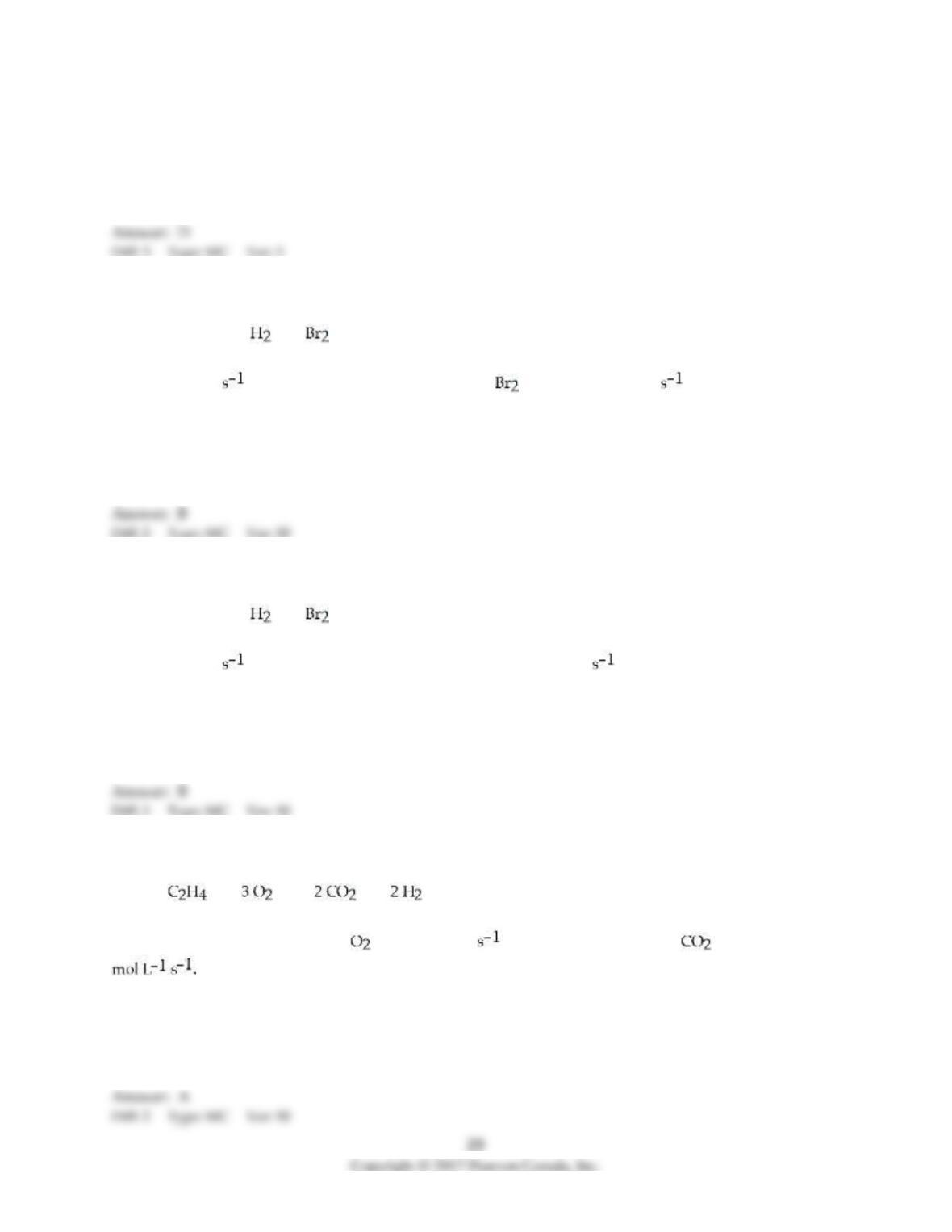
99) The rate of disappearance of HBr in the gas phase reaction
2 HBr(g) → (g) + (g)
is 0.301 mol L-1 at 150 °C. The rate of appearance of is ________ mol L-1 .
A) 1.66
B) 0.151
C) 0.0906
D) 0.602
E) 0.549
100) The rate of disappearance of HBr in the gas phase reaction
2 HBr(g) → (g) + (g)
is 0.130 mol L-1 at 150 °C. The rate of reaction is ________ mol L-1 .
A) 3.85
B) 0.0650
C) 0.0169
D) 0.260
E) 0.0860
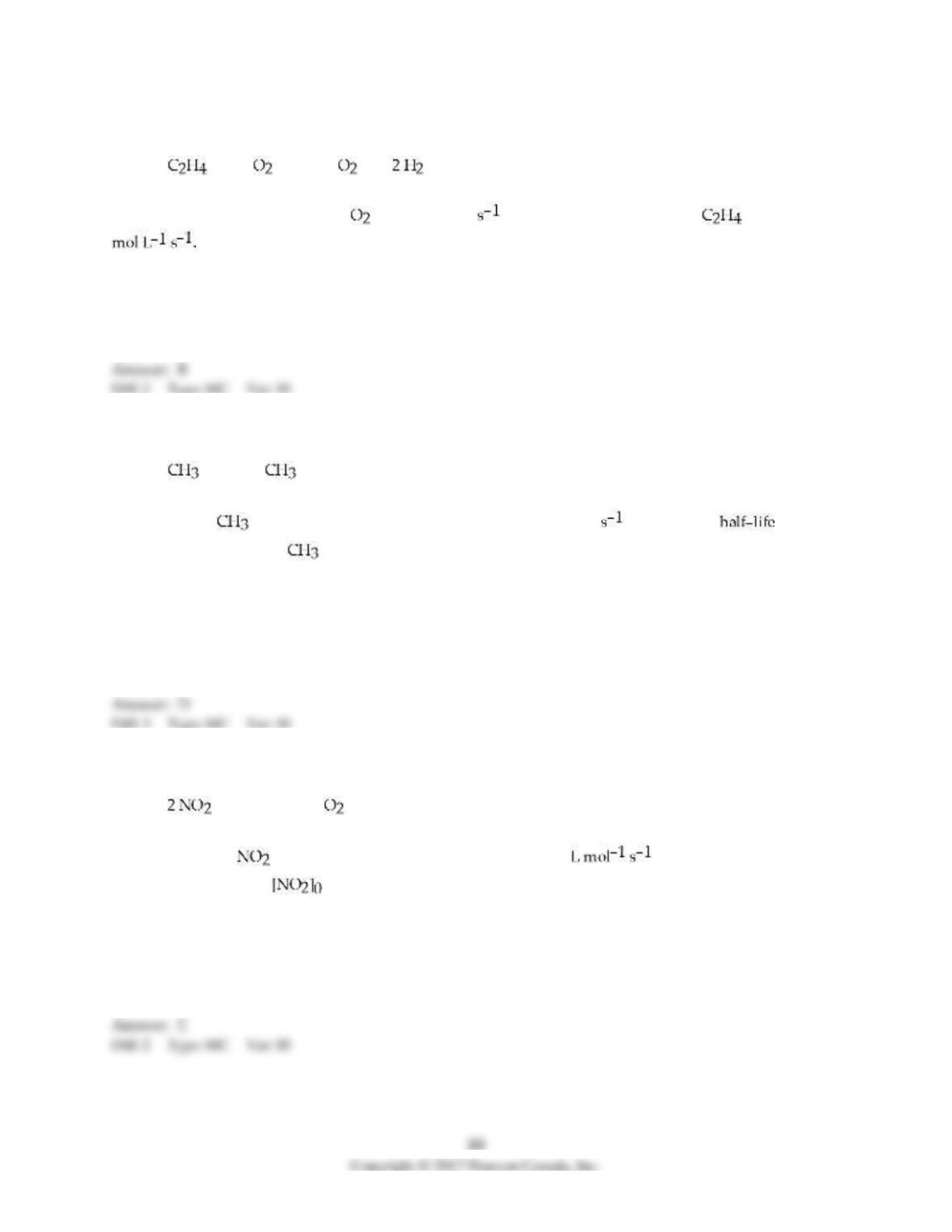
101) The combustion of ethylene proceeds by the reaction
(g) + (g) → (g) + O(g)
When the rate of disappearance of is 0.28 mol L-1 , the rate of appearance of is ________
A) 0.19
B) 0.093
C) 0.84
D) 0.42
E) 0.56
102) The combustion of ethylene proceeds by the reaction
(g) + 3 (g) → 2 C (g) + O(g)
When the rate of disappearance of is 0.23 mol L-1 , the rate of disappearance of is ________
A) 0.15
B) 0.077
C) 0.69
D) 0.35
E) 0.46
103) The isomerization of methylisonitrile to acetonitrile
NC(g) → CN(g)
is first order in NC. The rate constant for the reaction is 9.45 × 10⁻⁵ at 478 K. The of the
reaction when the initial [ NC] is 0.030 mol L-1 is ________ s.
A) 1.06 × 10⁴
B) 5.29 × 10³
C) 3.53E × 105
D) 7.33 × 10³
E) 1.36 × 10⁻⁴
104) The elementary reaction
(g) → 2 NO(g) + (g)
is second order in and the rate constant at 501 K is 7.93 × 10⁻³ . The reaction half-life at
this temperature when = 0.45 mol L-1 is ________ s.
A) 3.6 × 10⁻³
B) 0.011
C) 126
D) 87
E) 280

105) The isomerization of methylisonitrile to acetonitrile
NC(g) → CN(g)
is first order in NC. The half-life of the reaction is 5.20 × 101 s at 545 K. The rate constant when the
initial [ NC] is 0.030 mol L-1 is ________ .
A) 75.1
B) 0.641
C) 0.0133
D) 1.56
E) 2.84 × 10⁴
106) The decomposition of in solution in carbon tetrachloride proceeds via the reaction
2 (soln) → (soln) + (soln)
The reaction is first order and has a rate constant of 4.82 × at 64 °C. If the reaction is initiated
with 0.058 mol in a 1.00 L vessel, how many moles remain after 151 s?
A) 0.055 mol L-1
B) 0.060 mol L-1
C) 0.028 mol L-1
D) 12 mol L-1
E) 2.0 × mol L-1
107) decomposes in the gas phase by the reaction
(g) → (g) + (g)
The reaction is first order in and the rate constant is 3.0 × at 600 K. A vessel is charged
with 2.4 atm of at 600 K. The partial pressure of at is ________ atm.
A) 0.76
B) 2.2
C) 0.98
D) 0.29
E) 1.4 × 10⁵
32
108) The reaction that occurs in a Breathalyzer, a device used to determine the alcohol level in a person’s
bloodstream, is given below. If the rate of appearance of Cr2(SO4)3 is 1.64 mol min-1 at a particular
moment, what is the rate of disappearance of C2H6O at that moment?
2 K2Cr2O7(aq) + 8 H2SO4(aq) + 3 C2H6O(aq) → 2 Cr2(SO4)3(aq) + 2 K2SO4(aq) + 11 H2O(l)
A) 0.547 mol min-1
B) 1.09 mol min-1
C) 2.46 mol min-1
D) 4.92 mol min-1
109) For a particular first-order reaction, it takes 24 minutes for the concentration of the reactant to
decrease to 25% of its initial value. What is the value for rate constant (in s-1) for the reaction?
A) 2.0 × 10⁻⁴ s-1
B) 9.6 × 10⁻⁴ s-1
C) 1.2 × 10⁻² s-1
D) 5.8 × 10⁻² s-1
110) The first-order reaction, SO2Cl2 → SO2 + Cl2, has a rate constant equal to 2.20 × 10⁻⁵ s-1 at 593 K.
What percentage of the initial amount of SO2Cl2 will remain after 6.00 hours?
A) 1.00%
B) 37.8%
C) 40.2%
D) 62.2%
111) The first-order reaction, 2 N2O(g) → 2 N2(g) + O2(g), has a rate constant equal to 0.76 s-1 at 1000 K.
How long will it take for the concentration of N2O to decrease to 12% of its initial concentration?
A) 0.62 s
B) 2.8 s
C) 6.3 s
D) 8.4 s
33
112) The isomerization reaction, CH3NC → CH3CN, is first order and the rate constant is equal to 0.46 s-1
at 600 K. What is the concentration of CH3NC after 0.20 minutes if the initial concentration is 0.30 mol L–
1?
A) 1.2 × 10⁻³ mol L-1
B) 2.7 × 10⁻³ mol L-1
C) 1.2 × 10⁻¹ mol L-1
D) 2.7 × 10⁻¹ mol L-1
113) The following reaction is first order, C2H6 → 2 CH3. If the rate constant is equal to 5.5 × 10⁻⁴ s-1 at
1000 K, how long will it take for 0.35 mol of C2H6 in a 1.00 L container to decrease to 0.20 mol in the same
container?
A) 4.5 min
B) 17 min
C) 53 min
D) 65 min
114) The rate constant, k, for a first-order reaction is equal to 4.2 × 10⁻⁴ s-1. What is the half-life for the
reaction?
A) 2.9 × 10⁻⁴ s
B) 1.2 × 10³ s
C) 1.7 × 10³ s
D) 2.4 × 10³ s
115) The first-order reaction, SO2Cl2 → SO2 + Cl2, has a half-life of 8.75 hours at 593 K. How long will it
take for the concentration of SO2Cl2 to fall to 16.5% of its initial value?
A) 0.143 hr
B) 2.28 hr
C) 6.99 hr
D) 22.7 hr
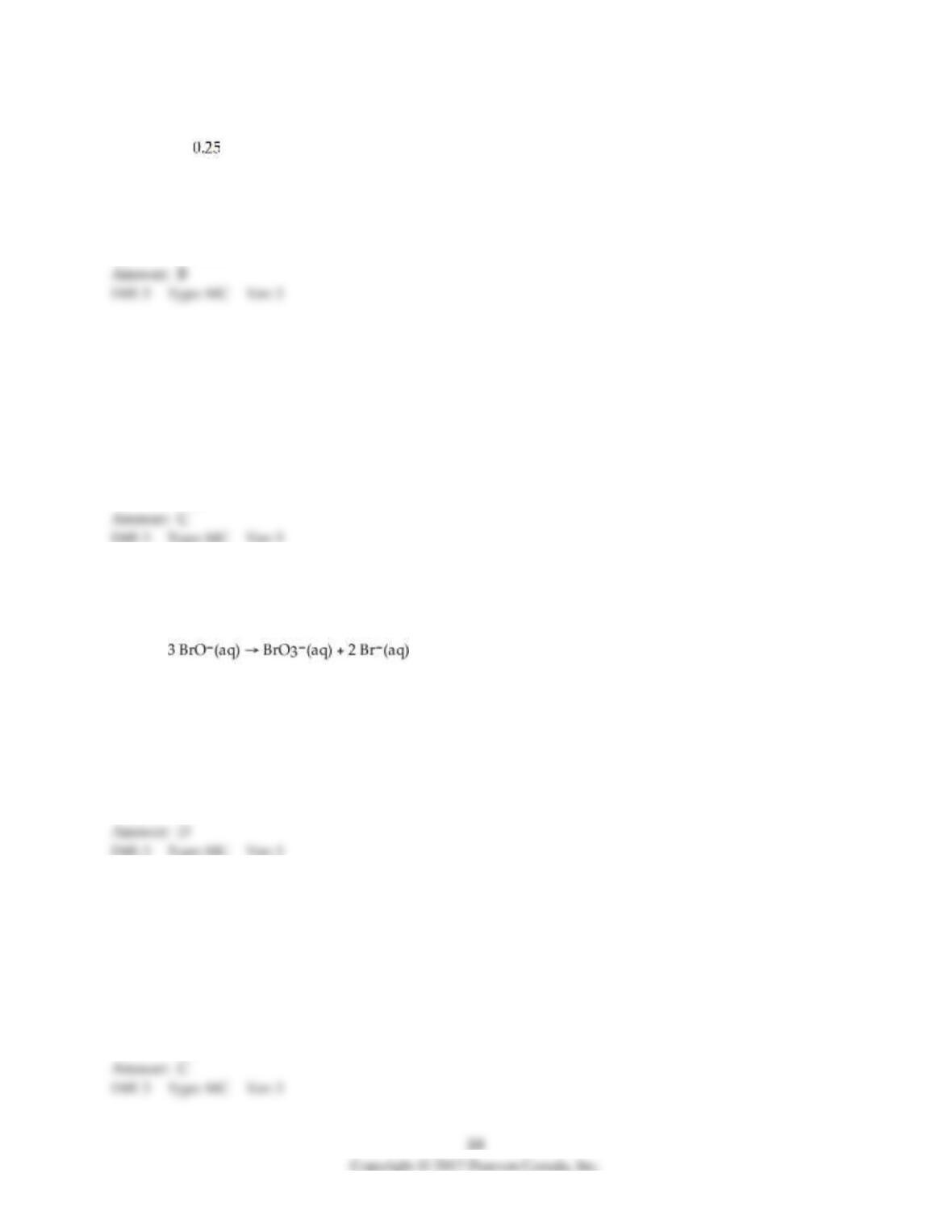
116) For the first-order reaction, 2 N2O(g) → 2 N2(g) + O2(g), what is the concentration of N2O after 3
half-lives if mol of N2O is initially placed into a 1.00 L reaction vessel?
A) 1.6 × 10⁻² mol L-1
B) 3.1 × 10⁻² mol L-1
C) 6.2 × 10⁻² mol L-1
D) 1.2 × 10⁻¹ mol L-1
117) Carbon-14, which is present in all living tissue, radioactively decays via a first-order process. A one-
gram sample of wood taken from a living tree gives a rate for carbon-14 decay of 13.6 counts per minute.
If the half-life for carbon-14 is 5720 years, how old is a wood sample that gives a rate for carbon-14 decay
of 11.9 counts per minute?
A) 5.3 × 10² yr
B) 7.6 × 10² yr
C) 1.1 × 10³ yr
D) 9.4 × 10³ yr
118) In aqueous solution, hypobromite ion, BrO–, reacts to produce bromate ion, BrO3–, and bromide ion,
Br–, according to the following chemical equation:
A plot of 1/[BrO–] vs. time is linear and the slope is equal to 0.056 L mol–1 s-1. If the initial concentration
of BrO– is 0.80 mol L-1, how long will it take one-half of the BrO– ion to react?
A) 4.5 × 10⁻² s
B) 7.1 s
C) 12 s
D) 22 s
119) The second-order reaction 2 Mn(CO)5 → Mn2(CO)10 has a rate constant equal to 3.0 × 10⁹ L mol-1 s–
1 at 25 °C. If the initial concentration of Mn(CO)5 is 2.0 × 10⁻⁵ mol L-1, how long will it take for 90.% of
the reactant to disappear?
A) 6.7 × 10⁻¹⁶ s
B) 7.4 × 10⁻¹⁵ s
C) 1.5 × 10⁻⁴ s
D) 6.0 × 10³ s
120) Nitrogen dioxide decomposes at 300 °C via a second-order process to produce nitrogen monoxide
and oxygen according to the following chemical equation:
2 NO2(g) → 2 NO(g) + O2(g).
A sample of NO2(g) is initially placed in a 2.50 L reaction vessel at 300 °C. If the half-life and the rate
constant at 300 °C are 11 seconds and 0.54 L mol-1 s-1, respectively, how many moles of NO2 were in the
original sample?
A) 0.17 mol
B) 0.42 mol
C) 5.9 mol
D) 15 mol
121) Hydrogen iodide decomposes at 800 K via a second-order process to produce hydrogen and iodine
according to the following chemical equation:
2 HI(g) → H2(g) + I2(g)
At 800 K it takes 142 seconds for the initial concentration of HI to decrease from 6.75 × 10⁻² mol L-1 to 3.50
× 10-2 mol L-1. What is the rate constant for the reaction at this temperature?
A) 5.12 × 10⁻⁴ L mol–1 s-1
B) 9.69 × 10⁻² L mol–1 s–1
C) 10.3 L mol–1 s-1
D) 1.95 × 10³ L mol–1 s-1
122) The aquation of tris (1,10-phenanthroline)iron(II) in acid solution takes place according to the
equation:
Fe(phen)32+ + 3 H3O+ + 3 H2O → Fe(H2O)62+ + 3 phenH+.
If the activation energy, Ea, is 126 kJ mol-1 and the rate constant at 30 °C is 9.8 × 10⁻³ min-1, what is the
rate constant at 35 °C?
A) 4.4 × 10⁻³ min-1
B) 2.2 × 10⁻² min-1
C) 4.5 × 101 min-1
D) 2.3 × 10² min-1
36
123) A particular first-order reaction has a rate constant of 1.35 × at 25.0 °C. What is the magnitude
of k at
A) 9.56 × 10³ s-1
B) 2.85 × 10⁴ s-1
C) 576 s-1
D) 4.33 × 1087 s-1
E) 1.36 × s-1
124) A particular first-order reaction has a rate constant of 1.35 × at 25.0 °C. What is the magnitude
of k at 75.0 °C if
A) 3.47 × s-1
B) 1.92 × 10⁴ s-1
C) 670 s-1
D) 3.85 × s-1
E) 1.36 × s-1