General Chemistry, 11e (Petrucci)
Chapter 2 Atoms and the Atomic Theory
1) Atoms retain their identity during a chemical reaction.
2) All matter is composed of atoms.
3) Atoms combine in small, whole-numbered ratios.
4) All atoms of a given element are identical.
5) Different ratios of atoms produce different compounds.
6) J. J. Thomson suggested the “plum pudding” model of the atom.
7) Robert Millikan determined the charge on an electron.
8) The number of protons and neutrons in the nucleus of a given atom is called the atomic number.
9) Isotopes have different atomic number (Z) but the same mass number (A).
10) The vertical columns in the periodic table of the elements are called groups.
11) A 25 g sample of sugar is found to contain 51.4% oxygen by mass. Another 250 g sample of the same
sugar is also 51.4% oxygen by mass. This is consistent with the:
A) law of conservation of mass
B) law of constant composition
C) law of multiple proportions
D) first assumption of Dalton’s atomic theory
E) second assumption of Dalton’s theory
12) When a chemical reaction is carried out in a sealed container, the substances may change in color,
temperature, or state, but no change in mass is detected. This is evidence of the:
A) law of conservation of mass
B) law of constant composition
C) law of definite proportions
D) existence of electrons
E) existence of protons
13) When decomposed chemically, 73.0 grams of a sample of HCl produce 71.0 g of Cl2 and 2.0 g of H2,
while 34.0 g of a sample of H2S produce 32.0 g of S and 2.0 g of H2. This is an example of the law:
A) of conservation of mass
B) of multiple proportions
C) of definite proportions
D) of constant composition
E) of simple whole numbers
14) Choose the INCORRECT statement from those given below.
A) Atoms retain their identity during a chemical reaction.
B) All matter is composed of atoms.
C) Atoms combine in small, whole-numbered ratios.
D) All atoms of a given element have same mass.
E) Different ratios of atoms produce different compounds.
15) A 0.920-gram sample of magnesium is allowed to burn in 0.321 g of oxygen gas. The sole product is
magnesium oxide. After the reaction, no oxygen remains and 0.809 g of magnesium oxide has been
formed. What mass of magnesium is left unreacted?
A) 0.210 g
B) 0.432 g
C) 1.408 g
D) 0.111 g
E) 0.488 g
16) Dalton’s atomic theory is based on several assumptions, which are listed below. Which of these
assumptions is strictly correct?
I) All atoms of the same element are identical.
II) Atoms are indivisible and unchangeable.
III) Chemical changes are the result of the combination, separation, and rearrangement of atoms.
A) I, II, and III are correct.
B) I and III are correct.
C) II and III are correct.
D) I and II are correct.
E) III is correct.
17) Choose the INCORRECT statement.
A) The law of constant composition is the law of definite proportions.
B) Objects of like charge repel each other.
C) Electrons were once known as cathode rays.
D) Alpha particles are the same mass as a helium nucleus.
E) Gamma rays are the same as electrons.
18) Which of the following statements is FALSE?
A) Michael Faraday discovered cathode rays.
B) J .J. Thomson suggested the “plum pudding” model of the atom.
C) Robert Millikan determined the charge on an electron.
D) J. J. Thomson determined the mass-to-charge ratio for electrons.
E) Michael Faraday determined that cathode rays were the fundamental negatively charged particles and
called them electrons.
19) Which of the following would be unaffected by an electric field?
A) alpha particles
B) beta particles
C) gamma rays
D) protons
E) electrons
20) Choose the correct statement.
A) Neutrons have no charge and no mass.
B) An electron has 1/1837 the mass of a proton.
C) The atomic number is the total number of protons and neutrons in the nucleus.
D) The charge of a proton is 1837 times the charge of an electron.
E) Electrons and protons have about the same mass.
21) Which of the following is a correct feature of the nuclear atom proposed by Rutherford?
A) All atoms of an element have the same mass.
B) The atom is mostly empty space.
C) The number of neutrons and electrons in the atom are equal.
D) The majority of alpha particles to strike the foil “bounced back.”
E) It is like the “plum pudding” model.
22) Beta particles:
A) have a mass of 4 and a charge of +2
B) are like X-rays
C) are repelled by a positively charged plate
D) can be electrons
E) have the same mass as a neutron
23) Ernest Rutherford is credited with:
I) the nuclear model of the atom
II) the identification of alpha and beta particles
III) the discovery of protons
IV) the prediction of a third, neutral, subatomic particle
A) I and II
B) I and III
C) I, II, III
D) II, III, IV
E) I, II, III, IV
24) Choose the INCORRECT statement.
A) Gamma rays are bent by magnetic fields as a ray of positive charges.
B) Protons and neutrons are found in the nucleus.
C) Protons and neutrons are close to the same mass.
D) The atomic number is the proton number.
E) The mass number is the number of protons plus neutrons.
25) What is the mass number of the most abundant form of oxygen atom?
A) 15.9994
B) 8
C) 16
D) 24
E) 32
26) Which of these atoms has the greatest number of neutrons in its nucleus?
A) Mn
B) Co
C) Fe
D) Ni
E) Si
27) Choose the information a mass spectrometer is unable to provide.
A) the relative abundance of two isotopes of potassium
B) the number of protons in potassium
C) the atomic mass of a single isotope of potassium
D) the mass of a proton
E) the number of stable isotopes of potassium
28) A species that differs in charge from another atom of the same element:
I) is called an isotope
II) has more or less neutrons
III) has lost or gained electrons
IV) is called an ion
V) has the same number of protons
A) I and II
B) I and III
C) II and IV
D) III and IV
E) III, IV, V
29) Which of the following statements is true concerning the masses of individual Cl atoms?
A) All atoms have a mass of 35.45 u.
B) Most of the atoms have a mass of 35.45 u.
C) Some of the atoms have a mass of 35.45 u.
D) None of the atoms have a mass of 35.45 u.
E) All atoms have a mass of 17 u.
30) A hypothetical element, E, has two stable isotopes:
E-46 = 46.046 u 64.08%
E-51 = 50.826 u 35.92%
What is the average atom weight of the element?
A) 47.76 u
B) 48.44 u
C) 49.11 u
D) 48.50 u
E) 47.44 u
31) A hypothetical element, E, has two stable isotopes.
E-38 = 38.012 u 75.68%
E-46 = 45.981 u 24.32%
The element’s atomic mass would be closest to which of the elements?
A) K
B) Ar
C) Ca
D) Sc
E) Cl
32) The atomic weight of chlorine is very close to 35.5. This means that:
A) chlorine occurs with a variable number of protons
B) a variable number of electrons gives the fractional weight
C) on the average, an atom of chlorine weighs almost 3 times as much as carbon
D) the actual weight of a chlorine atom is not known very precisely
E) chlorine atoms contain half of a proton
33) An element has 5 stable isotopes. The mass and percentage of each are:
69.9243 20.52%
71.9217 27.43%
72.9234 7.76%
73.9219 36.54%
75.9214 7.76%
The element is which of the following?
A) As
B) Se
C) Ge
D) Ga
E) Zn
34) An element has 5 stable isotopes. The mass and percentage of each are:
89.9043 51.46%
90.9053 11.23%
91.9046 17.11%
93.9061 17.40%
95.9082 2.80%
The element is which of the following?
A) Nb
B) Y
C) Sr
D) Zr
E) Rb
35) The atomic mass interval for carbon is given as [ 12.0096; 12.0116 ]. Which of the below statements is
correct regarding this atomic mass interval?
A) 12.0106 represents the most likely value of the atomic mass of carbon
B) 0.00207 represents the uncertainty in the value of atomic mass of carbon
C) The upper and lower bound of the atomic weight interval are based on the periodic table
D) This interval indicates that the atomic mass of carbon would not be lower than 12.0096 and it would
not be higher than 12.0116
36) Which statement below is true?
A) Metals gain electrons to have a positive charge.
B) Metals gain electrons to have a negative charge.
C) Metals lose electrons to have a positive charge.
D) Nonmetals are more likely to lose than to gain electrons.
E) Transition metals can gain 2 or more electrons to become metal ions.
37) Groups, or families, on the periodic table are:
A) vertical columns of elements with similar properties
B) horizontal rows of elements with increasing atomic numbers
C) named for the first elements in the series; such as “actinides”
D) extremely reactive with each other
E) elements that all occur naturally in the same state
38) Which of the following is a metalloid?
A) mercury
B) selenium
C) bismuth
D) radium
E) calcium
39) What is the mass in grams of 1 atom of sulfur
A) 1.661 × 10⁻²⁴ g
B) 1.931 × 10⁻²⁵ g
C) 5.325 × 10⁻²³ g
D) 5.179 × 10⁻²⁶ g
E) 5.989 × 10⁻²³ g
40) 31.0 grams of the element phosphorus contain:
A) 6.02 × 10²³ P4 molecules
B) 31.0 × (6.02 × 1023) P atoms
C) 6.02 × 10²³ P atoms
D) 31.0 P atoms
E) 31.0 moles of P
41) How many arsenic atoms are in 5.21 g of arsenic?
A) 0.0695 atoms
B) 9.51 × 10²² atoms
C) 3.14 × 1024 atoms
D) 2.10 × 10²² atoms
E) 4.19 × 10²² atoms
42) A cubic centimeter of lead weighs 11.35 g. How many atoms are in the block?
A) 6.8 × 1024 atoms
B) 2.4 × 10²³ atoms
C) 3.3 × 10²² atoms
D) 5.3 × 10²² atoms
E) 1.1 × 1025 atoms
43) How many moles are represented by 2.5 × 10¹⁵ Na atoms?
A) 3.8 × 10⁻¹⁰ mol
B) 1.8 × 10⁻¹⁰ mol
C) 1.5 × 1039 mol
D) 4.2 × 10⁻⁹ mol
E) 1.1 × 10¹⁴ mol
44) The natural abundance of calcium in the earth’s crust is 3.4% by mass. How many calcium atoms are
present in a 1.50 g sample of the earth’s crust?
A) 6.6 × 10²³ atoms
B) 3.1 × 10²² atoms
C) 7.7 × 10²⁰ atoms
D) 7.7 × 10²² atoms
E) 5.1 × 10²⁰ atoms
45) 57.7 g Ni contains how many atoms?
A) 6.13 × 10²³ atoms
B) 3.47 × 10²³ atoms
C) 5.92 × 10²³ atoms
D) 1.24 × 1024 atoms
E) 0.983 atoms
46) How many atoms of silicon are contained in 8.50 × 10⁻⁵ grams?
A) 1.44 × 10²³ atoms
B) 1.82 × 10¹⁸ atoms
C) 5.02 × 1030 atoms
D) 5.02 × 10¹⁸ atoms
E) 1.82 × 10²⁰ atoms
47) If the density of lead is 11.34 g/cm3, how many atoms are in a piece of lead that is 2.00 cm wide, 1.00
m long, and 2.00 mm thick?
A) 1.32 × 1024 atoms
B) 1.16 × 10²³ atoms
C) 1.32 × 10²³ atoms
D) 1.16 × 10²² atoms
E) 6.60 × 10²³ atoms
48) How many atoms of rubidium-85 are in 87.2 g of rubidium? Rubidium-85 is 72.2 % abundant.
A) 5.16 × 1046 atoms
B) 4.46 × 10²³ atoms
C) 8.51 × 10²³ atoms
D) 6.14 × 10²² atoms
E) 1.02 × 1024 atoms
49) How many atoms of hydrogen are present in 1.5 lb of hydrogen peroxide, which is 5.93% hydrogen?
A) 2.4 × 1025 atoms
B) 1.21 × 1025 atoms
C) 1.2 × 1025 atoms
D) 2.41 × 1025 atoms
E) 1.2 × 10²⁰ atoms
50) How many atoms of sulfur are in 280 g of a 50% by mass H2SO4 solution?
A) 8.6 × 1025 atoms
B) 8.6 × 10²³ atoms
C) 8.0 × 1025 atoms
D) 8.0 × 10²³ atoms
E) 2.8 × 1029 atoms
51) How many Cu atoms are present in a 75.0 cm length of 20-gauge copper wire? A 20-gauge wire has a
diameter of 0.03196 in. Copper’s density is 8.92 g/cm3.
A) 1.31 × 10²¹
B) 3.28 × 10²²
C) 8.08 × 10²¹
D) 1.04 × 10²²
E) 2.08 × 10²²
52) How many atoms of lead are required to cover a 33.0 cm by 45.0 cm area with a sheet of lead that is
0.140 mm thick? The density of lead is 11.35 g/cm3.
A) 6.86 × 10²³
B) 2.29 × 1026
C) 2.29 × 1025
D) 6.86 × 10²²
E) 1.42 × 1026
53) A 3.214 g sample of magnesium reacts with 8.416 g of bromine. The only product is magnesium
bromide. If 1.934 g of magnesium is left unreacted, how much magnesium bromide is formed?
A) 1.280 g
B) 5.202 g
C) 9.696 g
D) 7.136 g
E) 3.268 g
54) What mass of magnesium is necessary to make 10.5 g of magnesium bromide if 1.04 g of magnesium
makes 7.88 g of magnesium bromide?
A) 1.39 g
B) 79.9 g
C) 1.58 g
D) 3.66 g
E) 7.89 g
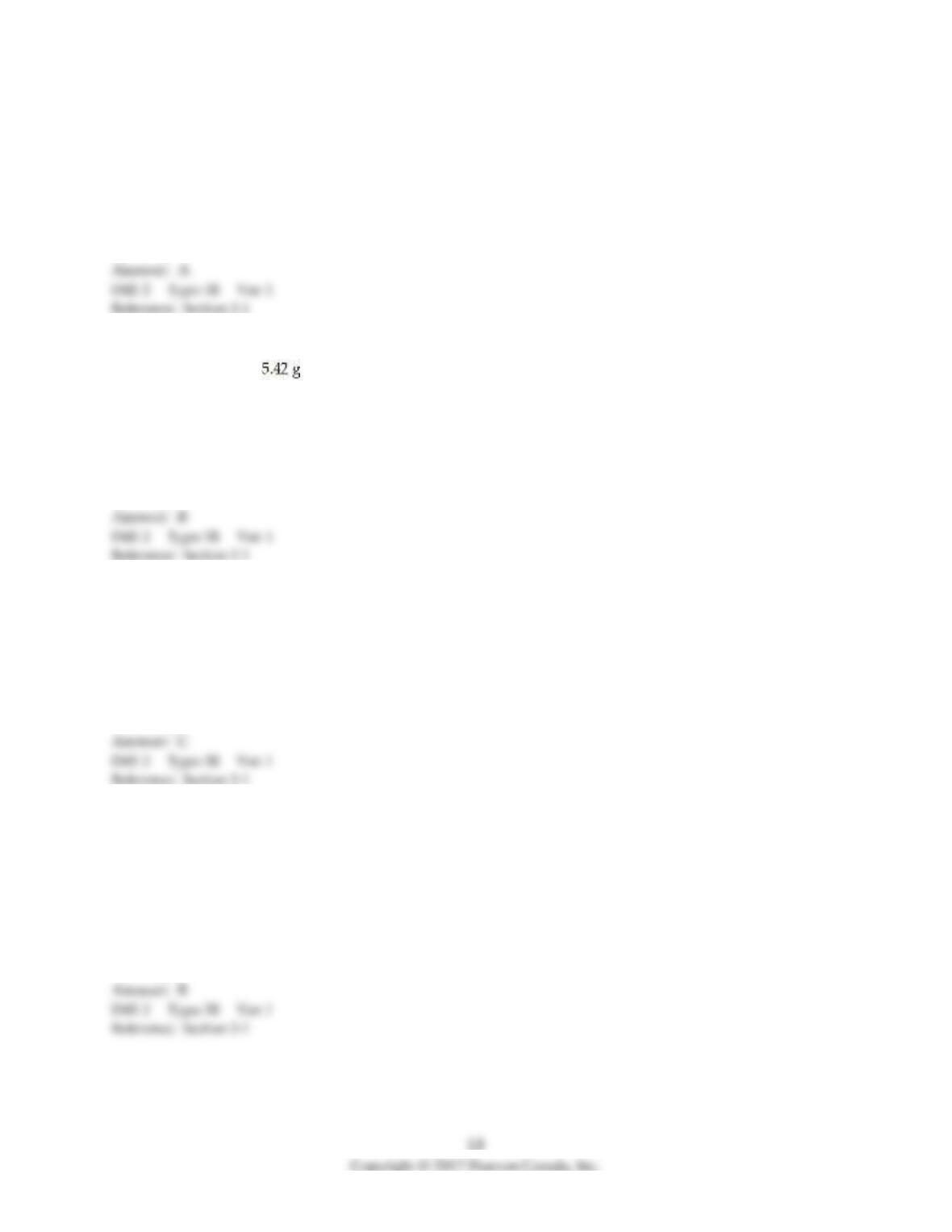
55) A sample of pure carbon weighing 1.48 g was burned in an excess of air. The mass of carbon dioxide,
the sole product, was . In a second experiment, 11.62 g of carbon dioxide was obtained. What mass
of carbon was burned in the second experiment?
A) 42.6 g
B) 3.17 g
C) 3.54 g
D) 0.866 g
E) 11.6 g
56) A 1.4 g sample of calcium is reacted with 3.2 g of oxygen. The only product after the reaction is 1.96 g
of CaO. How many grams of oxygen remains unreacted?
A) 0.56 g
B) 0.224 g
C) 2.64 g
D) 0.264 g
E) 0.203 g
57) A certain mass of nickel reacts with sulphur to produce 2.83 g of NiS. The same mass of nickel reacts
completely with 0.5 g of oxygen to produce 2.33 g of NiO. How many grams of sulfur reacted in the first
reaction?
A) 0.5 g
B) 1 g
C) 1.5 g
D) 10-1 g
E) 1.25 g
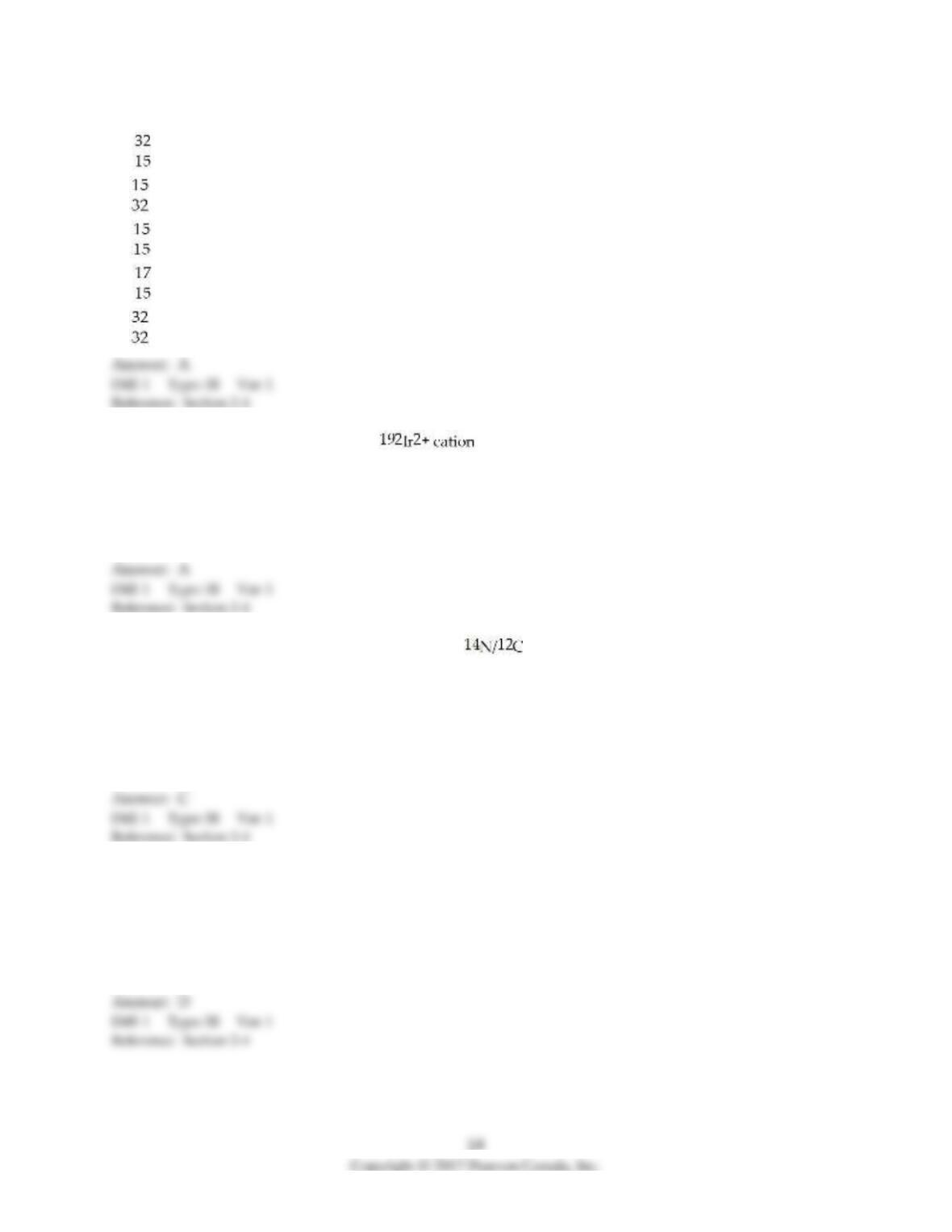
58) Write the symbol for the radioactive isotope phosphorus-32.
A) P
B) Ge
C) P
D) P
E) Ge
59) The total number of neutrons in an is ________.
A) 115
B) 77
C) 192
D) 75
E) 269
60) With mass spectral data the ratio of the mass of was found to be 1.167. What is the mass of
the 14N atom?
A) 14.017 u
B) 10.292 u
C) 14.004 u
D) 17.000 u
E) 14.007 u
61) Which is the proper chemical symbol for tungsten?
A) Te
B) Ti
C) Tm
D) W
E) Tc