
20
69) The net reaction in a voltaic cell with E°cell = +0.726 V is,
2 Fe3+(aq) + 3 Zn(s) → 2 Fe(s) + 3 Zn2+(aq)
What is ΔG° for this reaction at 25 °C?
A) -210 kJ
B) -140 kJ
C) -700 kJ
D) -463 kJ
E) -420 kJ
70) The standard Gibbs energy change for the following voltaic cell is ΔG° = -89.3 kJ at 25 °C. What is
E°cell? Ag(s)
A) +0.463 V
B) -0.926 V
C) -0.463 V
D) +0.926 V
E) +0.231 V
71) What is Keq at 25 °C of the spontaneous cell made from Ag+(aq)/Ag(s) (0.80 V) and Cl2(g)/Cl–(aq)
(1.36 V) half cells?
A) 9 × 10-74
B) 1 × 10-19
C) 1 × 1073
D) 9 × 10¹⁸
E) 1 × 1027
72) What is Keq at 25 °C of the spontaneous cell made from the Zn2+(aq)/Zn(s) (-0.76 V) and Br2(l)/2Br–
(aq) (1.07 V) half cells?
A) 3 × 10¹⁰
B) 3 × 10-11
C) 8 × 1061
D) 2 × 1036
E) 5 × 1025

21
73) Determine Keq at 25 °C for the following reaction:
Pb2+(aq) + Cu(s) ⇌ Cu2+(aq) + Pb(s)
The half-reactions are:
Pb2+(aq) + 2 e– ⇌ Pb(s) E° = -0.125 V
Cu2+(aq) + 2 e– ⇌ Cu(s) E° = +0.337 V
A) 2 × 1069
B) 3 × 10–16
C) 2 × 10¹⁶
D) 2 × 10⁻⁸
E) 6 × 10⁷
74) For the reaction: Mg(s) + AgNO3(aq) → Ag(s) + Mg(NO3)2(aq)
Ag+(aq) + e– → Ag(s) E° = 0.800 V
Mg2+(aq) + 2 e– → Mg(s) E° = -2.356 V
Determine ΔG°.
A) -300.3 kJ/mol
B) 304.5 kJ/mol
C) 609.0 kJ/mol
D) -304.5 kJ/mol
E) -609.0 kJ/mol
75) What is ΔG° at 25 °C for the reaction (not balanced): C3H8(g) + O2(g) → CO2(g) + H2O(l) if the
standard cell potential is 1.092 V?
A) -105 kJ
B) -211 kJ
C) 105 kJ
D) -2107 kJ
E) 211 kJ

76) What is the standard cell potential if the Gibbs energy is -2108 kJ in the reaction:
C3H8(g) + O2(g) → CO2(g) + H2O(l) (not balanced)?
A) -10.92 V
B) 10.92 V
C) 21.85 V
D) -1.092 V
E) 1.092 V
77) Calculate Ecell at 25 °C for the following voltaic cell. Ksp for NiCO3(s) is 1.42 × 10⁻⁷.
Ni(s) ∣ Ni2+(aq) [sat’d NiCO3(s)] Ni2+(aq) (0.010M) ∣ Ni(s)
The half-reaction is: Ni2+(aq) + 2 e– → Ni(s) E° = -0.257 V
A) +0.257 V
B) -0.257 V
C) 0.000 V
D) +0.0844 V
E) +0.0422 V
78) Find Ecell for the following voltaic cell at 25 °C:
Ti(s) ∣ Ti2+(aq) (0.550M) Sn2+(aq) (0.005 M) ∣ Sn(s)
The half-reactions are:
Ti2+(aq) + 2 e– ⇔ Ti(s) E° = -1.630 V
Sn2+(aq) + 2 e– ⇔ Sn(s) E° = -0.137 V
A) 1.372 V
B) 1.707 V
C) 1.646 V
D) 1.433 V
E) -1.646 V

79) Determine Ecell at 25 °C for the following reaction at 25 °C:
Al(s) ∣ Al3+(0.435 M) Sn2+(2.12 × 10⁻³ M) ∣ Sn(s)
3 Sn2+(aq) + 2 Al(s) → 2 Al3+(aq) + 3 Sn(s)
Al3+(aq) + 3 e– → Al(s) E° = -1.676 V
Sn2+(aq) + 2 e– → Sn(s) E° = -0.137 V
A) 1.227 V
B) 1.611 V
C) 1.562 V
D) 1.487 V
E) 1.467 V
80) What is Ecell at 25 °C of the spontaneous cell made from Ag+(aq)/Ag(s) (0.80 V) and Cl2(g)/Cl–(aq)
(1.36 V) half cells if [Ag+] = 1 × 10⁻² M and [Cl–] = 1 × 10⁻⁴ M with P(Cl2) = 1.1 atm?
A) 0.65 V
B) 0.38 V
C) 0.74 V
D) 0.92 V
E) 0.20 V
81) Find Ecell at 25 °C for the following voltaic cell:
Cu(s) ∣ Cu2+(aq) (0.10 M) Cu2+(aq) (0.85 M) ∣ Cu(s)
The half-reaction is:
Cu2+(aq) + 2 e– → Cu(s) E° = +0.377 volts
A) +0.0209 V
B) +0.0550 V
C) +0.0275 V
D) -0.0209 V
E) +0.310 V
24
82) Consider the following reaction:
2 Al(s) + 3 Ni2+(aq) → 2 Al3+(aq) + 3 Ni(s) E° = 1.410 V
What would be the cell potential at 25 °C as calculated from the Nernst equation if [Ni2+] = 0.020 M,
[Al3+] = 3.60 M?
A) 1.388 volts
B) 1.034 volts
C) 1.471 volts
D) 1.349 volts
E) 1.410 volts
83) What is the cell potential for the following cell at 25 °C?
Al(s) ∣ Al3+(0.00212 M) Sn2+(0.435 M) ∣ Sn(s)
Al3+(aq) + 3 e– → Al(s) E° = -1.676 V
Sn2+(aq) + 2 e– → Sn(s E° = -0.137 V
A) 1.517 V
B) 1.668 V
C) 1.410 V
D) 1.497 V
E) 1.581 V
84) What is the cell potential for the following cell at 25 °C?
Zn(s) ∣ Zn2+ (0.0456 M) Cu2+(0.120 M) ∣ Cu(s)
Cu2+(aq) + 2 e– → Cu(s) E° = 0.340 V
Zn2+(aq) + 2 e– → Zn(s) E° = -0.763 V
A) 1.088 V
B) 1.114 V
C) 1.106 V
D) 1.094 V
E) 1.129 V
25
85) What is the Ecell for the following cell at 25 °C?
Pt(s) ∣ Fe2+ (aq, 0.0562 M), Fe3+ (aq, 0.253 M) Ag+ (aq, 0.334 M) ∣ Ag(s)
Ag+(aq) + e– → Ag(s) E° = 0.800 V
Fe3+(aq) + e– → Fe2+ E° = –0.771 V
A) -0.038 V
B) 1.500 V
C) -0.004 V
D) 0.096 V
E) 0.039 V
86) What is the [H+] in a concentration cell at 25 °C if the cell potential is 0.0451 V and cell diagram:
Pt(s) ∣ H2 (g, 1 atm) ∣ H+(?) H+ (aq, 1 M) ∣ H2(g, 1 atm)
2 H+(aq) + 2 e– → H2(g) E° = 0. V
A) 0.51 M
B) 0.42 M
C) 0.030 M
D) 0.17 M
E) 5.7 M
87) What is Ecell at 25 °C of the spontaneous cell made from the Zn2+(aq)/Zn(s) (0.76 V) and Br2(l)/Br–(aq)
(1.07 V) half cells if [Zn2+] = 1 × 10⁻² M and [Br–] = 1 × 10⁻⁴ M?
A) 0.40 V
B) 0.13 V
C) 0.61 V
D) 0.01 V
E) 0.49 V

88) For the following voltaic cell, determine the [Cl–] when = 0.500 atm, [Zn2+] = 1.77 × 10⁻² M, and
Ecell = 2.250 V. The half-reactions at 25 °C are:
Cl2(g) + 2 e– → 2 Cl–(aq) E° = +1.358 V
Zn2+(aq) + 2 e– → Zn(s) E° = –0.763 V
Zn(s) ∣ Zn2+(aq) Cl–(aq), Cl2(g) ∣ Pt(s)
A) 5.48 × 10⁻⁶ M
B) 2.32 × 10⁻³ M
C) 0.0296 M
D) 0.0939 M
E) 0.0352 M
89) What is the Ecell for the following concentration cell at 25 °C:
Pt(s) ∣ H2(g, 0.025 atm) ∣ H+ (0.012 M) H+ (aq, 1 M) ∣ H2(g, 1 atm) ∣ Pt(s)
2 H+(aq) + 2 e– → H2(g) E° = 0. V
A) -0.16 V
B) +0.066 V
C) -0.132 V
D) 0.16 V
E) -0.066 V
90) What is the Ecell for the following cell at 25 °C?
Pt(s) ∣ Sn2+ (aq, 0.233 M), Sn4+ (aq, 1.05 M) Ag+ (aq, 2.22 × 10⁻² M) ∣ Ag(s)
Ag+(aq) + e– → Ag(s) E° = 0.800 V
Sn4+(aq) + 2 e– → Sn2+(aq) E° = 0.154 V
A) 0.763 V
B) 0.529 V
C) 0.412 V
D) 0.680 V
E) 0.578 V

91) Given the following half-reactions occurring in the silver-zinc hearing aid battery, calculate the
voltage at 25 °C of this battery.
ZnO(s) + H2O(l) + 2 e– → Zn(s) + 2 OH–(aq) E° = -1.260 V
Ag2O(s) + H2O(l) + 2 e– → 2 Ag(s) + 2 OH–(aq) E° = +0.342 V
A) +1.602 V
B) +1.402 V
C) +0.858 V
D) -0.858 V
E) -1.602 V
92) Calculate the mass of I2(s) produced at the anode if a current of 2.85 A is passed through a solution of
KI(aq) for 56 minutes.
A) 0.42 g
B) 0.13 g
C) 13 g
D) 25 g
E) 4.3 g
93) A constant current of 10.0 A is passed through an electrolytic cell for 90.0 min. How many Coulombs
of charge are passed through the cell?
A) 0.00933
B) 0.560
C) 0.00560
D) 900
E) 15
94) A constant current of 15.0 A is passed through an electrolytic cell for 60.0 min. How many Coulombs
of charge are passed through the cell?
A) 0.00933
B) 0.560
C) 0.00560
D) 900
E) 15

95) A solution of Al(NO3)3(aq) is electrolyzed by passing 144 A of current for 102 min. What mass of
aluminum plates out?
A) 27.4 g
B) 760 g
C) 82.1 g
D) 2.3 g
E) 75.3 g
96) What mass of silver can be deposited by the passage of a constant current of 5.00 A through a
AgNO3(aq) solution for 2.00 hours?
A) 40.3 g
B) 0.0112 g
C) 0.671 g
D) 0.373 g
E) 10.06 g
97) What mass of aluminum can be deposited by the passage of a constant current of 5.00 A through a
Al(NO3)3(aq) solution for 2.00 hours?
A) 3.36 g
B) 1.12 g
C) 0.0559 g
D) 0.672 g
E) 0.125 g
98) A solution of AgNO3(aq) is electrolyzed by passing 144 A of current for 102 min. What mass of silver
plates out?
A) 16.4 g
B) 5.91 × 10⁴ g
C) 985 g
D) 9.13 g
E) 6.84 g

99) Two cells containing solutions of AgNO3(aq) and CuSO4(aq), respectively, were connected in series
and electrolyzed. The cathode in the AgNO3(aq) cell was found to gain 1.078 grams in weight. How
much had the cathode in the other cell gained?
A) 0.127 g
B) 0.6354 g
C) 3.175 g
D) 0.318 g
E) 0.254 g
100) 3.53 L of 0.362 M CuCl2(aq) solution are electrolyzed for 55.6 minutes with a current of 14.0-amperes.
What is [CuCl2] when the electrolysis ends?
A) 0.361 M
B) 0.328 M
C) 0.120 M
D) 0.171 M
E) 0.293 M
101) How long would it take to deposit 15.0 g copper metal at the cathode of an electrolysis cell running
with a current of 150 mA?
A) 42.2 h
B) 4.22 h
C) 12.7 h
D) 84.4 h
E) 19.0 h
102) A copper electrode weighs 35.42 g before the electrolysis of a copper (II) sulfate solution and 36.69 g
after the electrolysis has run for 20.0 s. What was the amperage of the current used?
A) 2.12 A
B) 0.0335 A
C) 48.2 A
D) 96.4 A
E) 193 A
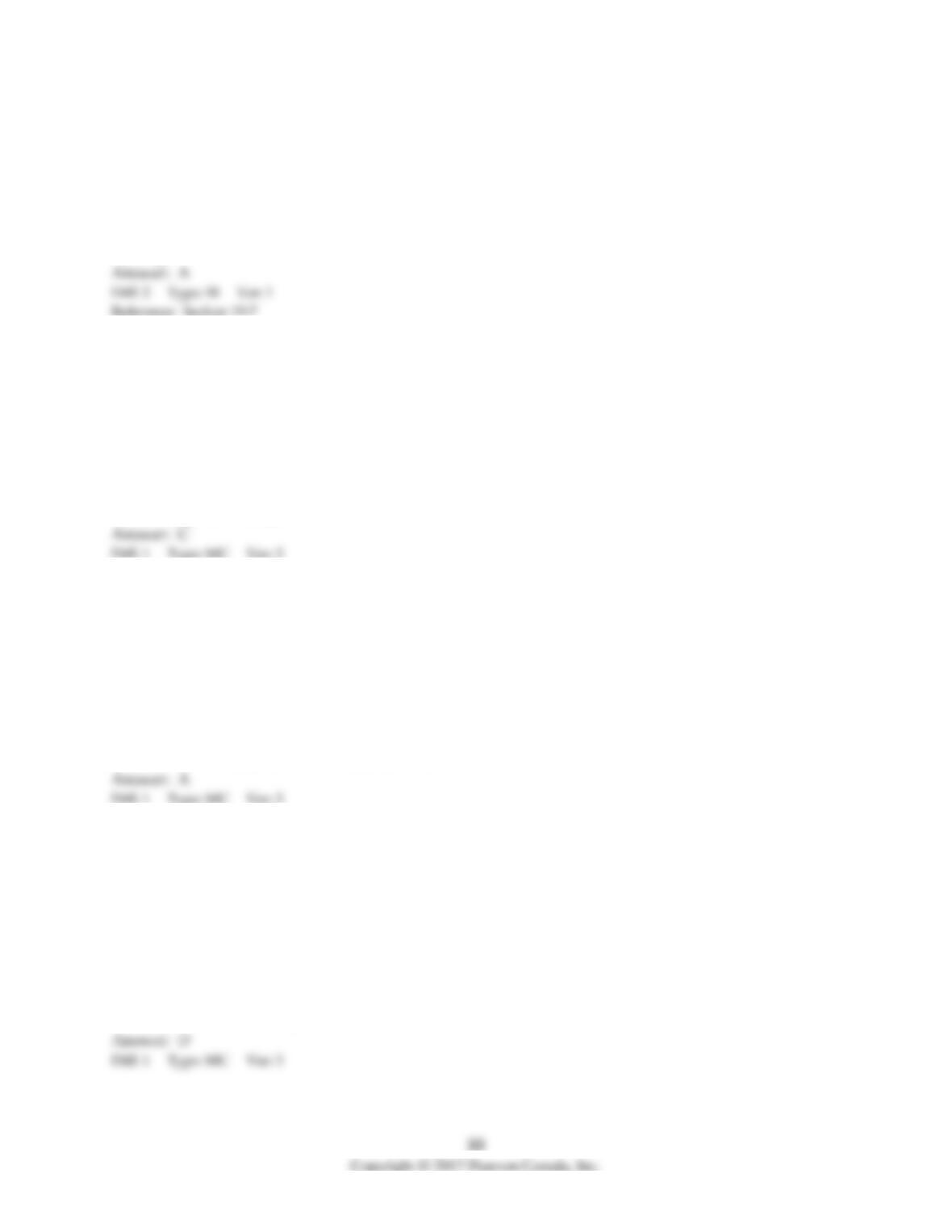
103) A solution of AuCl3(aq) is electrolyzed by passing 85.0 A of current for 17.6 min. What mass of gold
plates out?
A) 61.1 g
B) 1.02 g
C) 183 g
D) 0.483 g
E) 290 g
104) What is the reduction half-reaction for the following overall galvanic cell reaction?
Co2+(aq) + 2Ag(s) → Co(s) + 2 Ag+(aq)
A) Ag(s) + e– → Ag+(aq)
B) Ag+(aq) + e– → Ag(s)
C) Co2+(aq) + 2 e– → Co(s)
D) Co2+(aq) + e– → Co(s)
105) What is the shorthand notation that represents the following galvanic cell reaction?
Pb(s) + Cu(NO3)2(aq) → Pb(NO3)2(aq) + Cu(s)
A) Pb(s) ∣ Pb2+(aq) ∣∣ Cu2+(aq) ∣ Cu(s)
B) Cu(s) ∣ Cu2+(aq) ∣∣ Pb2+(aq) ∣ Pb(s)
C) Pb(s) ∣ NO3–(aq) ∣∣ NO3–(aq) ∣ Cu(s)
D) Cu(s) ∣ Cu(NO3)2(aq) ∣∣ Pb(NO3)2(aq) ∣ Pb(s)
106) What is the shorthand notation that represents the following galvanic cell reaction?
2 Fe2+(aq) + F2(g) → 2 Fe3+(aq) + 2 F–(aq)
A) Fe2+(aq) ∣ Fe3+(aq) ∣∣ F2(g) ∣ F–(aq)
B) Fe(s) ∣ Fe2+(aq) ∣∣ Fe3+(aq) F2(g) ∣ F–(aq) ∣ C(s)
C) Pt(s) ∣ Fe3+(aq), Fe2+(aq), F2(g) ∣∣ F–(aq) ∣ C(s)
D) Pt(s) ∣ Fe2+(aq), Fe3+(aq) ∣∣ F2(g) ∣ F–(aq) ∣ C(s)

31
107) For the galvanic cell reaction, expressed below using shorthand notation, what half-reaction occurs
at the cathode?
Zn(s) ∣ Zn2+(aq) ∣∣ Ni2+(aq) ∣ Ni(s)
A) Zn(s) → Zn2+(aq) + 2 e–
B) Zn2+(aq) + 2 e– → Zn(s)
C) Ni(s) → Ni2+(aq) + 2 e–
D) Ni2+(aq) + 2 e– → Ni(s)
108) What is the balanced chemical equation for the galvanic cell reaction expressed using shorthand
notation below?
Al(s) ∣ Al3+(aq) ∣∣ Fe2+(aq) ∣ Fe(s)
A) 2 Al(s) + 3 Fe2+(aq) → 2 Al3+(aq) + 3Fe(s)
B) 3 Al(s) + 2 Fe2+(aq) → 3 Al3+(aq) + 2 Fe(s)
C) 2 Fe(s) + 3 Al3+(aq) → 2 Fe2+(aq) + 3 Al(s)
D) 3 Fe(s) + 2 Al3+(aq) → 3 Fe2+(aq) + 2 Al(s)
109) What is the balanced equation for the galvanic cell reaction expressed using shorthand notation
below?
Ni(s) ∣ Ni2+(aq) ∣∣ Cl2(g) ∣ Cl–(aq) ∣ C(s)
A) Ni(s) + 2 Cl–(aq) → Ni2+(aq) + Cl2(g)
B) Ni(s) + Cl2(g) → Ni2+(aq) + 2 Cl–(aq)
C) Ni2+(aq) + 2 Cl–(aq) → Ni(s) + Cl2(g)
D) Ni2+(aq) + 2 Cl–(aq) → NiCl2(s)
110) A galvanic cell consists of a Ni2+(aq)/Ni(s) half-cell and a standard hydrogen electrode. If the
Ni2+/Ni half-cell standard cell functions as the anode, and the standard cell potential is 0.26 V, what is the
standard reduction potential for the Ni2+(aq)/Ni(s) half-cell?
A) -0.26 V
B) -0.13 V
C) +0.13 V
D) +0.26 V

32
111) A galvanic cell consists of one half-cell that contains Ag(s) and Ag+(aq), and one half-cell that
contains Cu(s) and Cu2+(aq). What species are produced at the electrodes under standard conditions?
Ag+(aq) + e– → Ag(s) E° = +0.80 V
Cu2+(aq) + 2 e– → Cu(s) E° = +0.34 V
A) Ag(aq) is formed at the cathode, and Cu(s) is formed at the anode.
B) Ag(s) is formed at the cathode, and Cu2+(aq) is formed at the anode.
C) Cu(s) is formed at the cathode, and Ag+(aq) is formed at the anode.
D) Cu2+(aq) is formed at the cathode, and Cu(s) is formed at the anode.
112) Consider the following standard reduction potentials:
Ni2+(aq) + 2 e– → Ni(s) E° = -0.26 V
I2(s) + 2 e– → 2 I–(aq) E° = +0.54 V
Under standard conditions:
A) Ni2+(aq) is a stronger oxidizing agent than I2(s), and I–(aq) is a stronger reducing agent than Ni(s)
B) I2(s) is a stronger oxidizing agent than Ni2+(aq), and Ni(s) is a stronger reducing agent than I–(aq)
C) Ni(s) is a stronger oxidizing agent than I–(aq), and Ni2+(aq) is a stronger reducing agent than I2(s)
D) I–(aq) is a stronger oxidizing agent than Ni(s), and I2(s) is a stronger reducing agent than Ni2+(aq)
113) Consider the galvanic cell, Which one of the following changes to
the cell would cause the cell potential to increase (i.e., become more positive)?
A) increase the [Zn2+] concentration
B) increase the [Pb2+] concentration
C) increase the mass of Zn(s)
D) decrease the mass of Zn(s)

114) Based on the following information,
F2(g) + 2 e– → 2 F–(aq) E° = +2.87 V
Li +(aq) + e– → Li(s) E° = -3.04 V
which of the following chemical species is the strongest reducing agent?
A) F2(g)
B) Li +(aq)
C) F–(aq)
D) Li(s)
115) Using the following standard reduction potentials,
Fe3+(aq) + e– → Fe2+(aq) E° = +0.77 V
Ni2+(aq) + 2 e– → Ni(s) E° = -0.23 V
calculate the standard cell potential for the galvanic cell reaction given below and determine whether or
not this reaction is spontaneous under standard conditions.
Ni2+(aq) + 2 Fe2+(aq) → 2 Fe3+(aq) + Ni(s)
A) E° = -1.00 V, nonspontaneous
B) E° = -1.00 V, spontaneous
C) E° = +1.00 V, nonspontaneous
D) E° = +1.00 V, spontaneous
116) The gas OF2 can be produced from the electrolysis of an aqueous solution of KF, as shown in the
equation below:
OF2(g) + 2 H+(aq) + 4 e– → H2O(l) + 2 F–(aq) E° = +2.15 V
Using the given standard reduction potential, calculate the amount of OF2 that is produced, and the
electrode at which the OF2 is produced, upon the passage of 0.480 faradays through an aqueous KF
solution.
A) 6.48 g of OF2 at the anode
B) 26.0 g of OF2 at the anode
C) 6.48 g of OF2 at the cathode
D) 26.0 g of OF2 at the cathode

117) Given that E°red = -1.66 V for Al3+(aq)/Al(s) at 25 °C, find E° and E for the concentration cell
expressed using shorthand notation below:
Al(s) ∣ Al3+(aq, 1.0 × 10⁻⁵ mol L-1) ∣∣ Al3+(aq, 0.100 mol L-1) ∣ Al(s)
A) E° = 0.00 V and E = +0.24 V
B) E° = 0.00 V and E = +0.0789 V
C) E° = -1.66 V and E = -1.42 V
D) E° = -1.66 V and E = -1.54 V
118) The standard cell potential (E°) of a voltaic cell constructed using the cell reaction below is 0.76 V:
Zn(s) + (aq) → (aq) + (g)
With = 1.0 atm and [ ] = 1.0 mol L-1, the cell potential is 0.66 V. The concentration of (aq) in
the cathode compartment is ________ mol L-1.
A) 2.0 × 10⁻²
B) 4.2 × 10⁻⁴
C) 1.4 × 10⁻¹
D) 4.9 × 101
E) 1.0 × 10⁻¹²
119) A voltaic cell is constructed with two silver-silver chloride electrodes, where the half-reaction is
AgCl(s) + → Ag(s) + (aq) E° = +0.222 V
The concentrations of chloride ion in the two compartments are 0.0222 mol L-1 and 2.22 mol L-1,
respectively. The cell emf is ________ V.
A) 0.212
B) 0.118
C) 0.00222
D) 22.2
E) 0.232

35
120) A voltaic cell is constructed with two -Zn electrodes, where the half-reaction is
(aq) + → Zn(s) E° = -0.763 V
The concentrations of zinc ion in the two compartments are 5.50 mol L-1 and 1.11 × mol L-1,
respectively. The cell emf is ________ V.
A) -1.54 ×
B) –378
C) 0.0798
D) 0.160
E) -0.761
121) The standard emf for the cell using the overall cell reaction below is +2.20 V:
2 Al(s) + (s) → (aq) + (aq)
The emf generated by the cell when [ ] = 5.0 × mol L-1 and [ ] = 0.10 mol L-1 is
A) 2.20
B) 2.30
C) 2.10
D) 2.41
E) 2.23
122) The standard emf for the cell using the overall cell reaction below is +0.48 V:
Zn(s) + (aq) → (aq) + Ni(s)
The emf generated by the cell when [ ] = 2.50 mol L-1 and [ ] = 0.100 mol L-1 is
A) 0.40
B) 0.50
C) 0.52
D) 0.56
E) 0.44
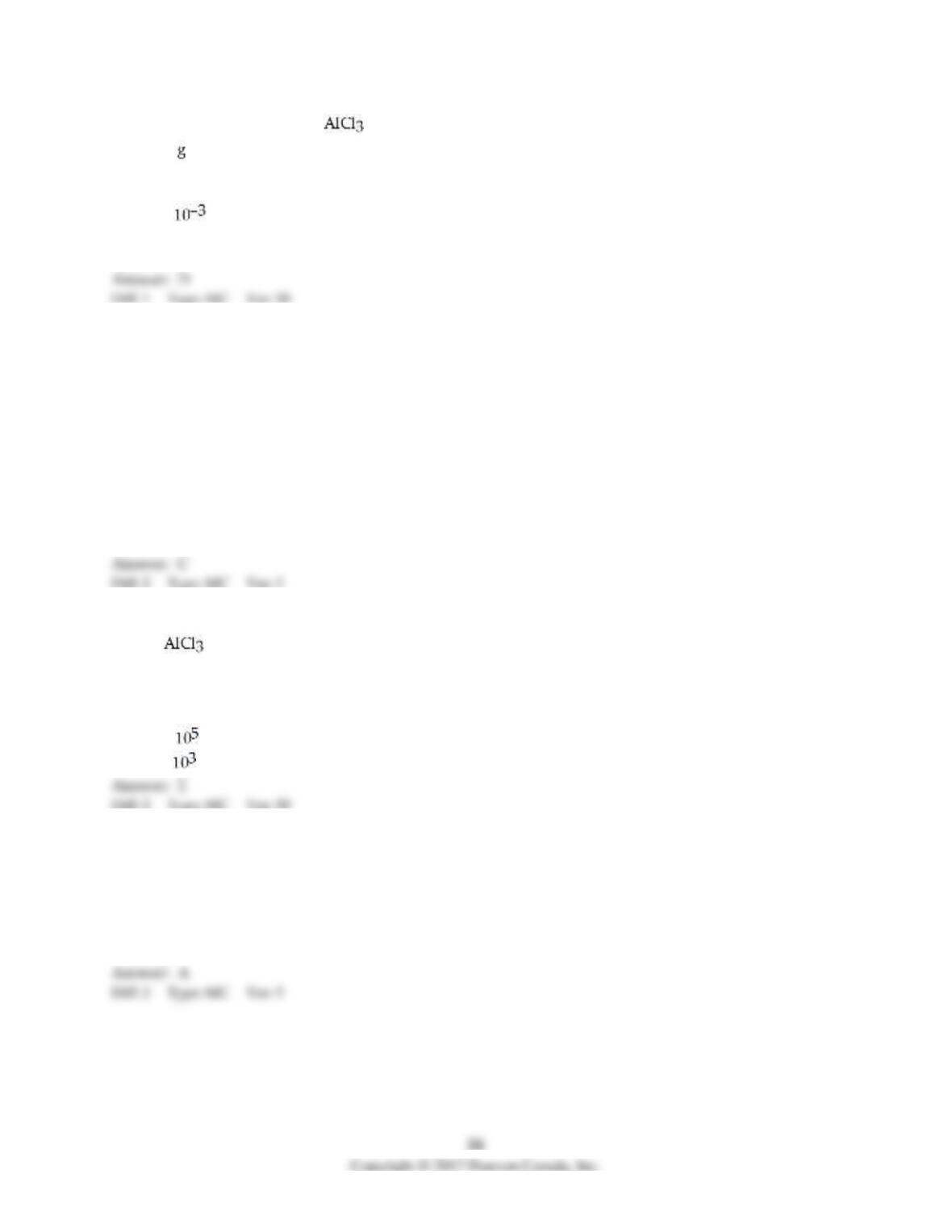
123) The electrolysis of molten (aq) for 3.25 hr with an electrical current of 15.0 A produces
of aluminum metal.
A) 147
B) 0.606
C) 4.55 ×
D) 16.4
E) 49.1
124) For a galvanic cell that uses the following two half-reactions,
Cr2O72-(aq) + 14 H+(aq) + 6 e– → 2 Cr3+(aq) + 7 H2O(l)
Pb(s) → Pb2+(aq) + 2 e–
how many moles of Pb(s) are oxidized by three moles of Cr2O72-(aq)?
A) 3
B) 6
C) 9
D) 18
125) How many seconds are required to produce 4.00 g of aluminum metal from the electrolysis of
molten (l) with an electrical current of 12.0 A?
A) 27.0
B) 9.00
C) 1.19 × 10³
D) 2.90 ×
E) 3.57 ×
126) How many grams of chromium metal are plated out when a constant current of 8.00 A is passed
through an aqueous solution containing Cr3+ ions for 320. minutes?
A) 27.6 g
B) 49.2 g
C) 82.4 g
D) 248 g

127) How many grams of nickel metal are plated out when a constant current of 15.0 A is passed through
aqueous NiCl2 for 60.0 minutes?
A) 10.9 g
B) 16.4 g
C) 32.8 g
D) 36.3 g
128) How long must a constant current of 50.0 A be passed through an electrolytic cell containing
aqueous Cu2+ ions to produce 5.00 moles of copper metal?
A) 0.187 hours
B) 0.373 hours
C) 2.68 hours
D) 5.36 hours