Chapter Nineteen
Topic: Electrophilic Aromatic Substitution
Section: 19.1
Difficulty Level: Medium
1.
Cyclohexene undergoes addition reaction with bromine, but benzene does not. Instead
benzene undergoes a substitution reaction with bromine. Explain.
2.
Which chemical test would you use to distinguish between ethylbenzene and styrene?
Ans:
Styrene will react with Br2/CCl4, whereas ethylbenzene will not react.
3.
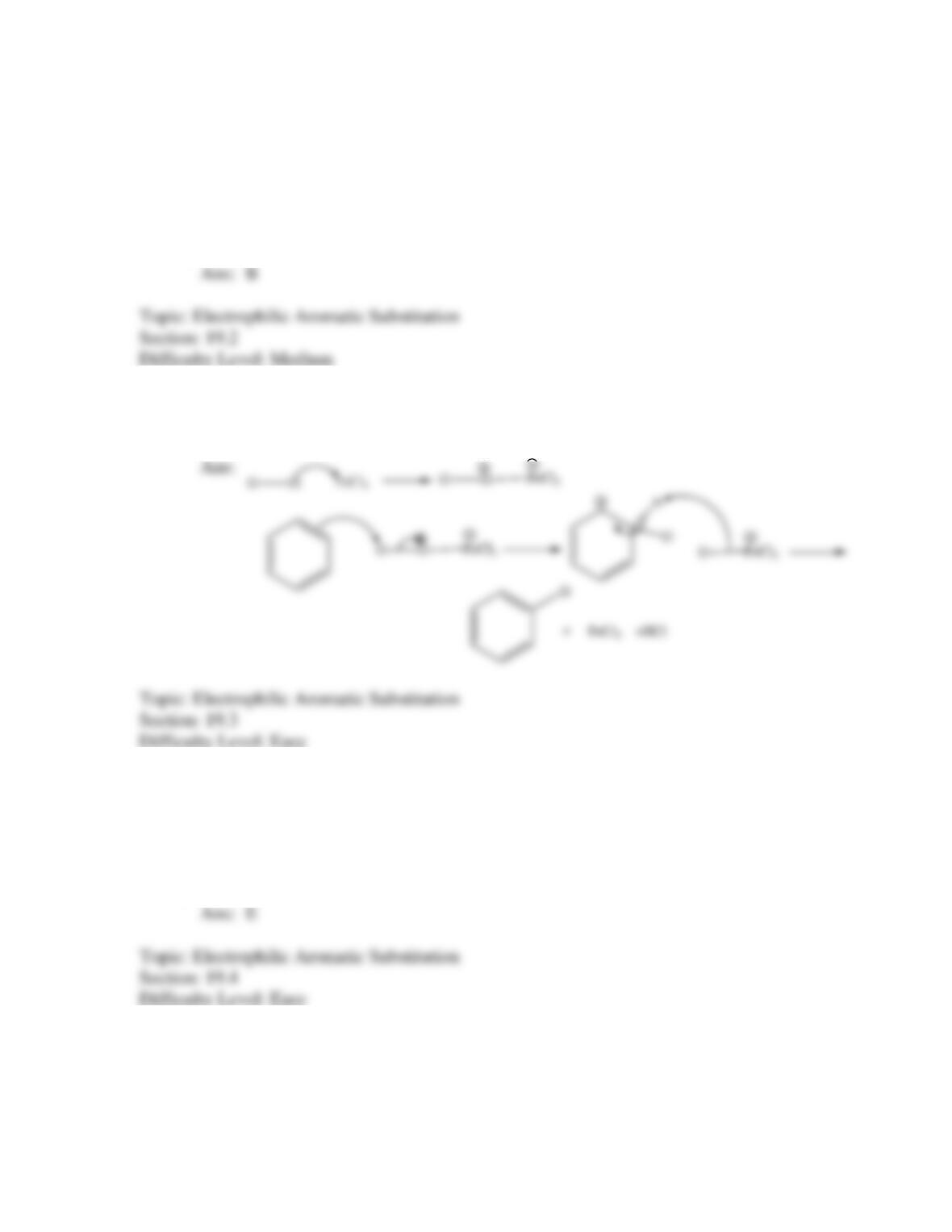
Provide all the resonance structures of the sigma complex, when benzene reacts with an
electrophile (E+).
4.
Which of these is the rate-determining step in the electrophilic aromatic substitution of
benzene?
A)
Formation of an electrophile
B)
Formation of sigma complex.
C)
Loss of proton from sigma complex.
D)
Addition of electrophile & loss of proton
E)
None of these
5.
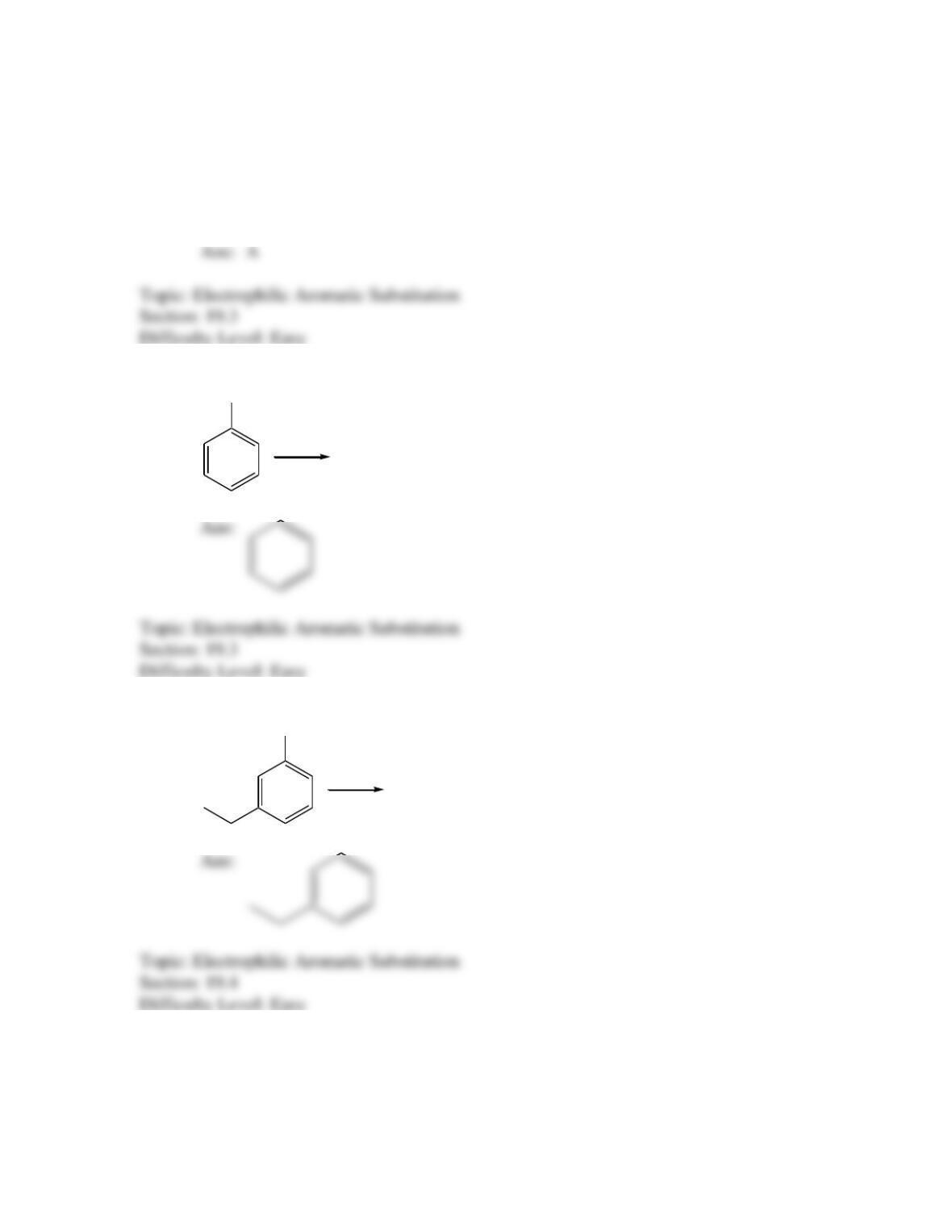
Provide a stepwise curved arrow mechanism for chlorination of benzene in the presence
of FeCl3.
6.
The electrophile in the sulfonation reaction of benzene is:
A)
SO2+
B)
H2SO4
C)
SO3+
D)
H2SO3
E)
SO3
Ans:
E
Ans:
B
7.
The electrophile in the nitration reaction of benzene is:
A)
NO2+
B)
HNO3
C)
NO3+
D)
H2SO4
E)
NO2
8.
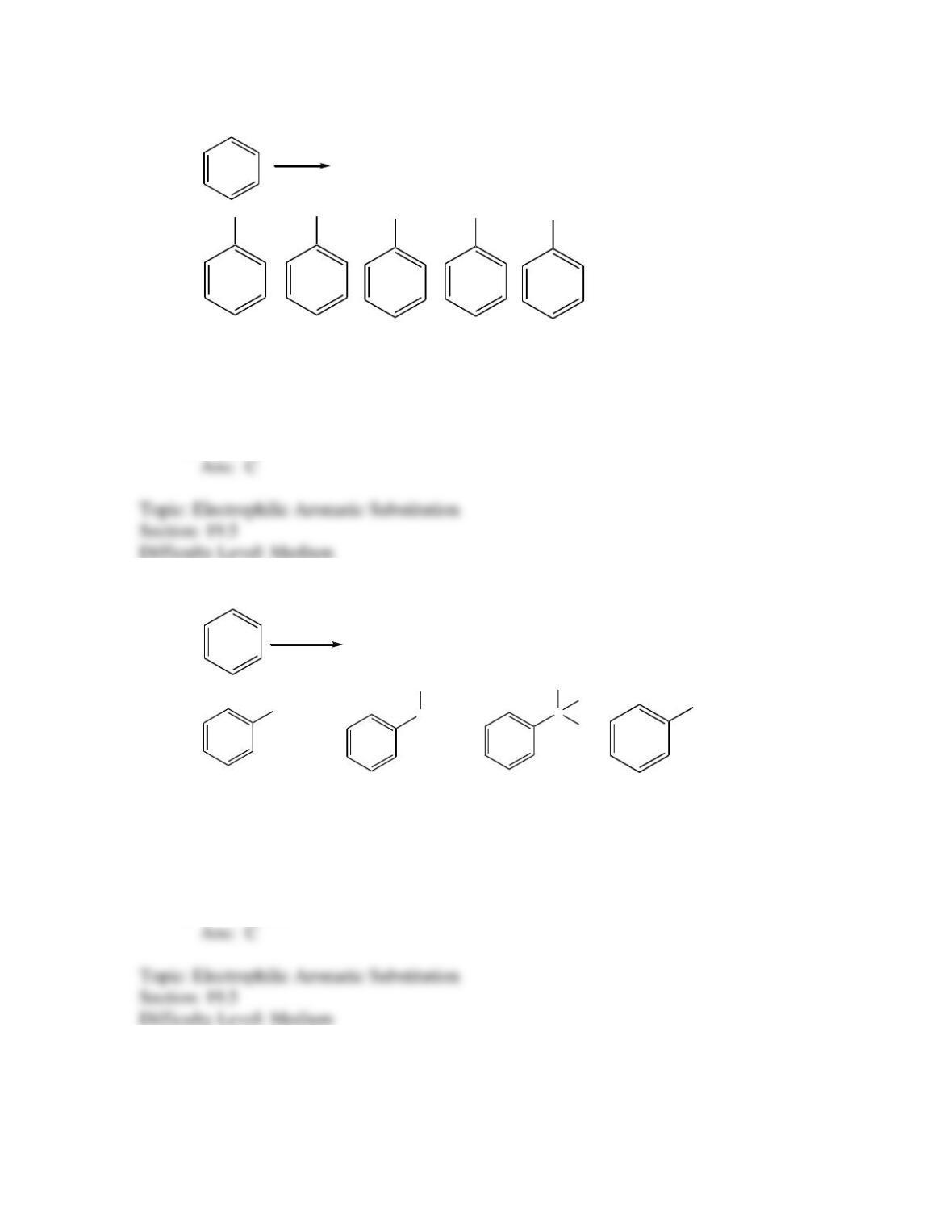
Predict the product for the following reaction.
SO3H
H3O+
9.
Predict the product for the following reaction.
SO3H
H3O+
Ans:
A
10.
Predict the product for the following reaction.
HNO3
SO4
SO3H NO3NO2SO3OH
III III IV V
A)
I
B)
II
C)
III
D)
IV
E)
V
11.
Predict the major product for the following reaction.
(CH3)2CHCH2Cl
AlCl3
CH2CH(CH3)2CHCH2CH3
CH3
C
CH3
CH3
CH3
III III
CH2CH2CH2CH3
IV
A)
I
B)
II
C)
III
D)
IV
E)
none of these
Ans:
C
Ans:
C
12.
Which one of the following reactions is most likely to give a polysubstituted product?
A)
Friedel-Crafts alkylation
B)
Friedel-Crafts acylation
C)
Nitration
D)
Sulfonation
E)
Halogenation
13.
Which one of the following compounds does not undergo Friedel-Crafts reaction?
A)
Benzene
B)
Chlorobenzene
C)
Nitrobenzene
D)
Toluene
E)
tert-Butylbenzene
Ans:
C
14.
Predict the major product for the reaction between benzene and 2-chlorobutane in the
presence of AlCl3.
A)
Chlorobenzene
B)
sec-butylbenzene
C)
ethylbenzene
D)
isopropylbenzene
E)
t-butylbenzene
Ans:
B
Ans:
A
15.
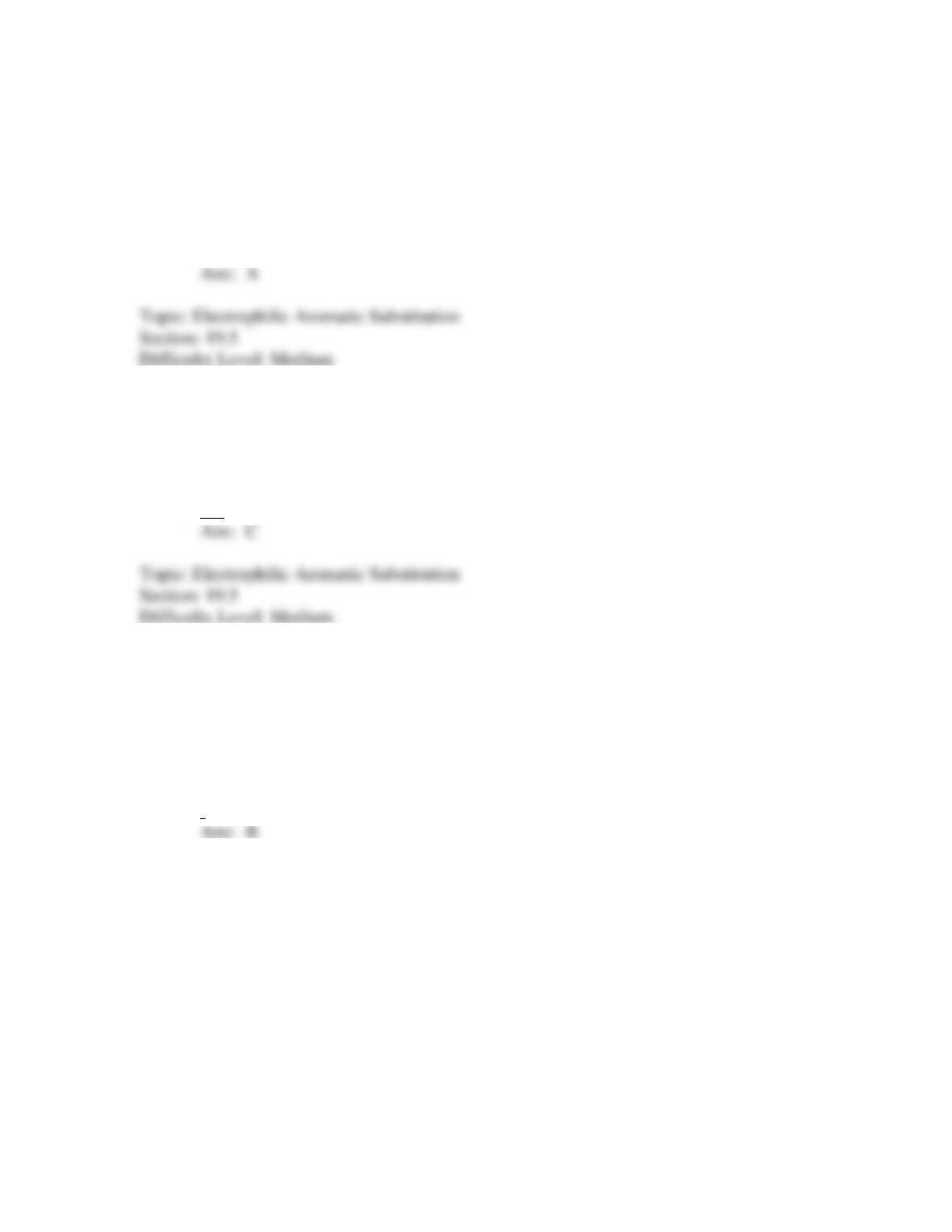
Predict the major product for the following reaction.
AlCl3
Cl
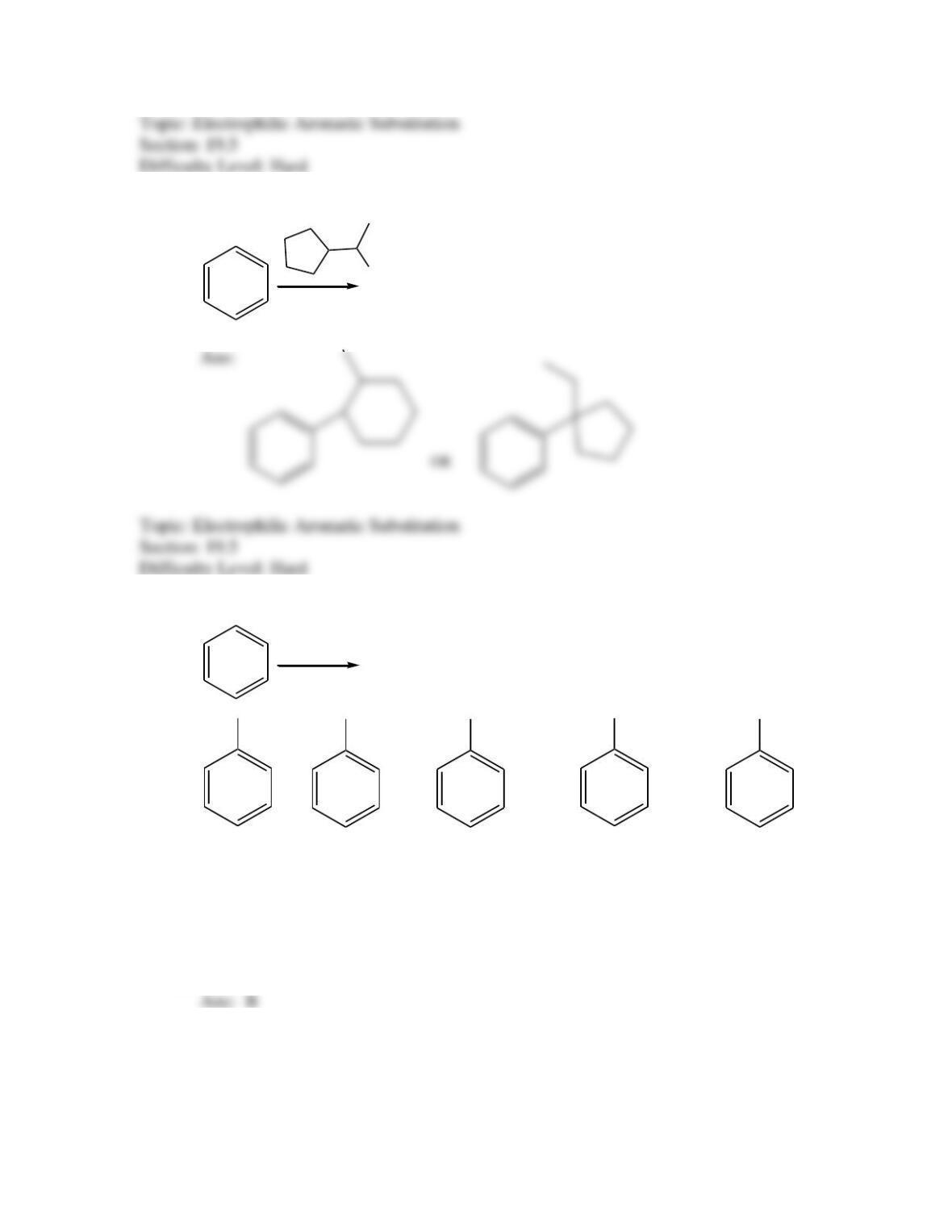
16.
Predict the major product for the following reaction.
(CH3)3CCH2Cl
AlCl3
CH2C(CH3)3C(CH3)2CH2CH3CH(CH3)CH2CH2CH3CH2CH2CH2CH2CH3
III III IV
CH2CH2CH(CH3)2
v
A)
I
B)
II
C)
III
D)
IV
E)
V
Ans:
B
17.
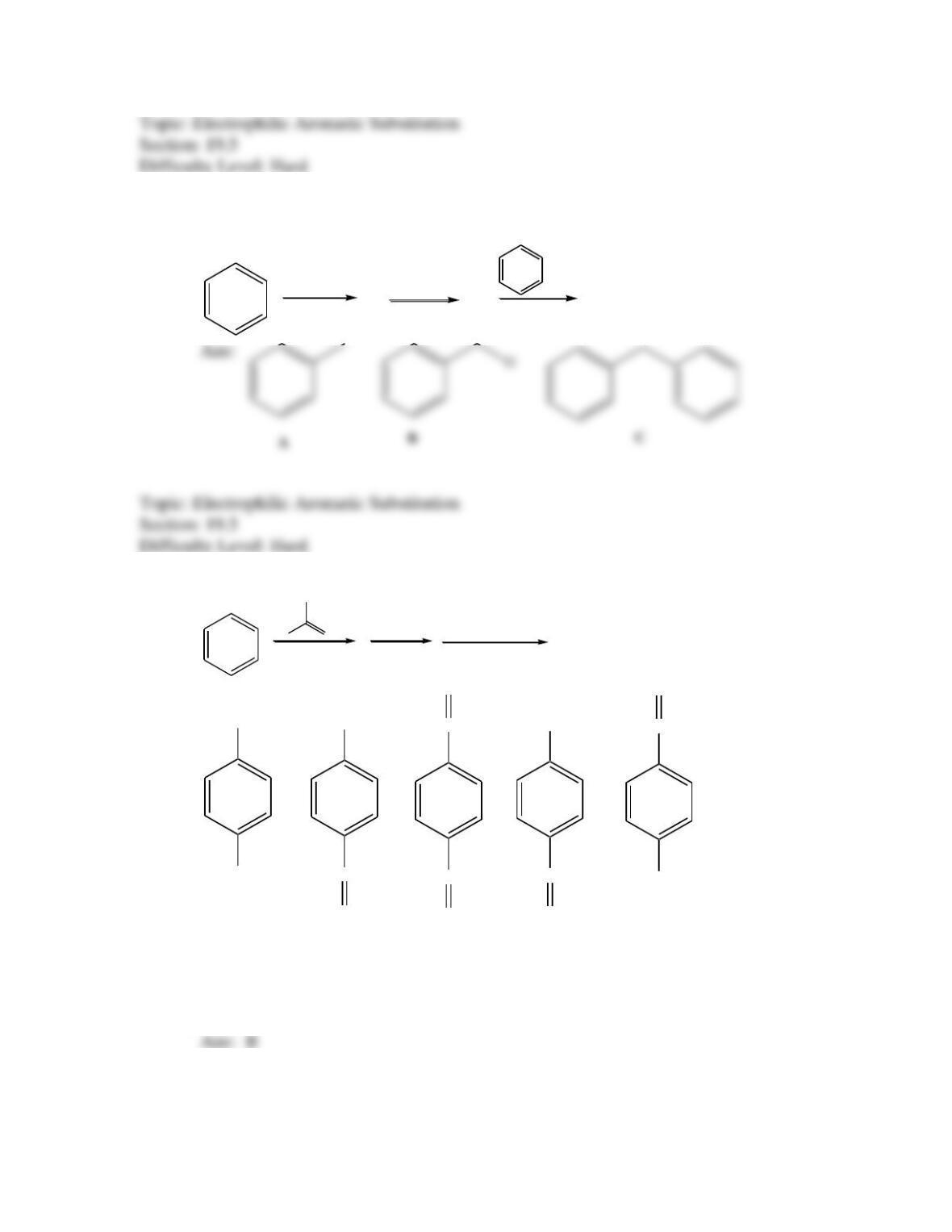
Provide the structure(s) of the intermediate product(s) in the following reaction
sequence
CH3Cl ACl2B
AlCl3AlCl3
C
18.
Predict the major product for the following reaction.
H2SO4
1. KMnO4/NaOH/H2O
2. H3O+
CH2CH2Cl
AlCl3
excess
C(CH3)3
CH2CH3
C(CH3)3
COH
O
COH
COH
O
O
CH2CH(CH3)2
COH
O
COH
CH2CH3
O
III III IV V
A)
I
B)
II
C)
III
D)
IV
E)
V
Ans:
B
19.
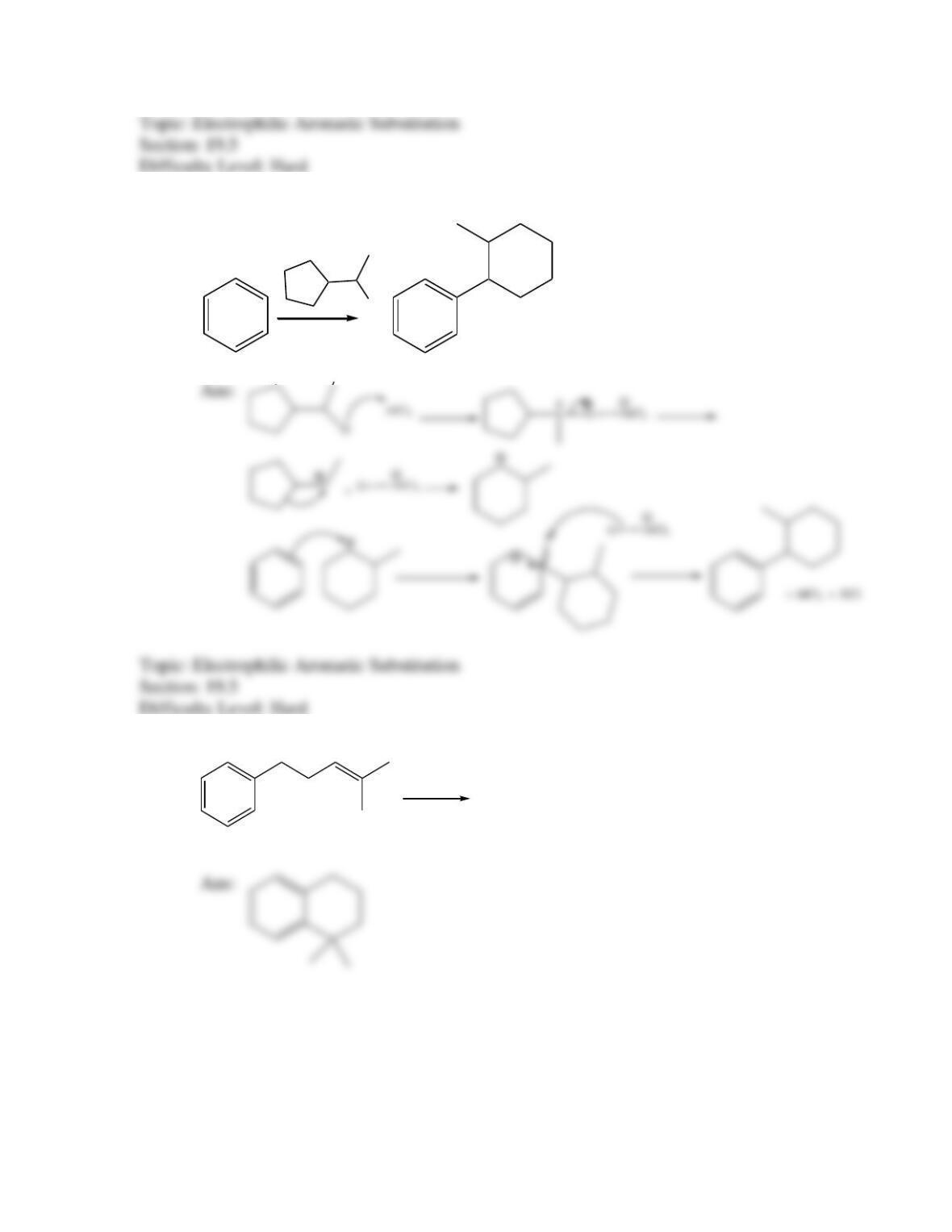
Provide a stepwise curved arrow mechanism for the following reaction.
AlCl3
Cl
20.
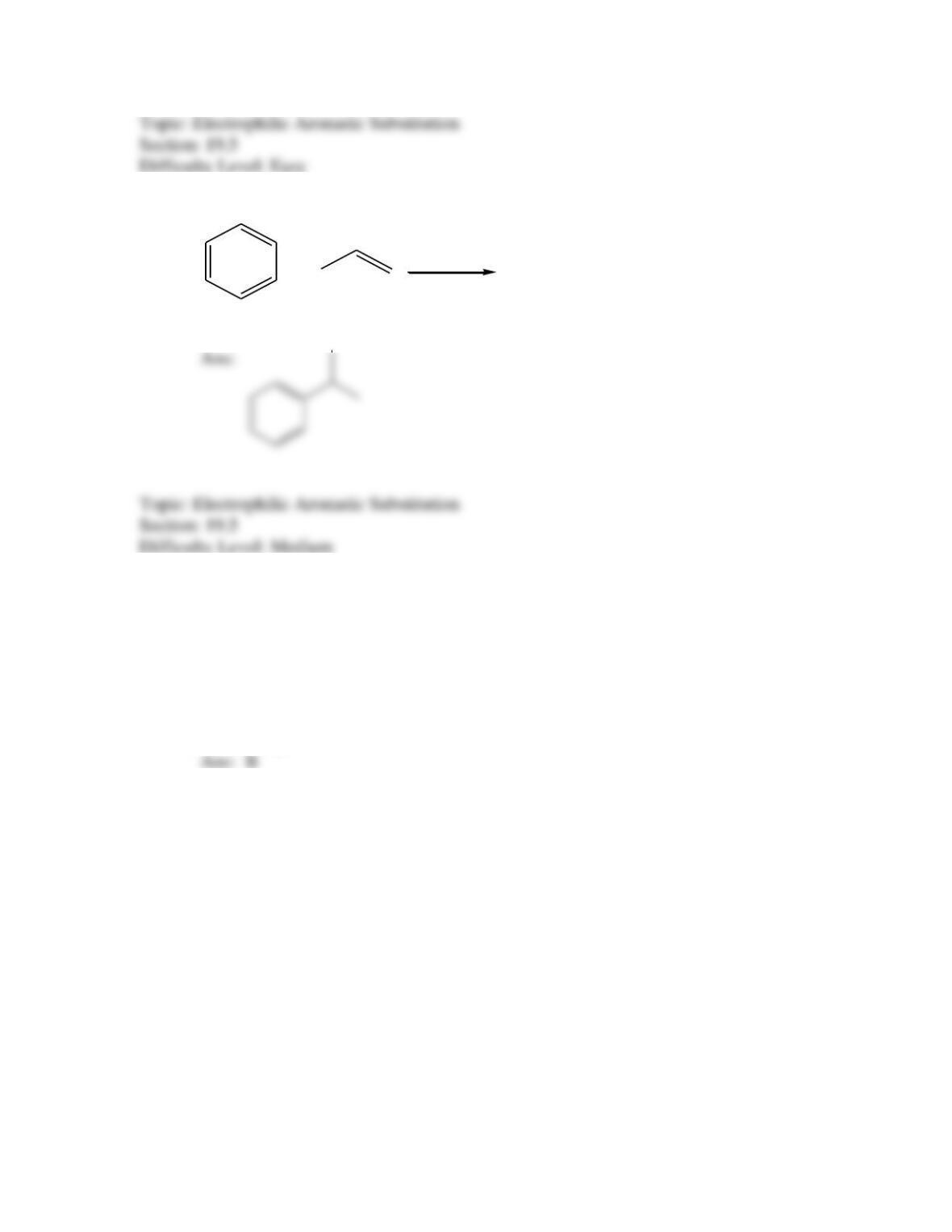
Predict the major product for the following reaction.
H2SO4
21.
Predict the major product for the following reaction.
H2SO4
+
22.
Which one of the following compounds will be most reactive towards bromination
reaction?
A)
nitrobenzene
B)
anisole
C)
acetanilide
D)
benzene
E)
benzaldehyde
Ans:
B
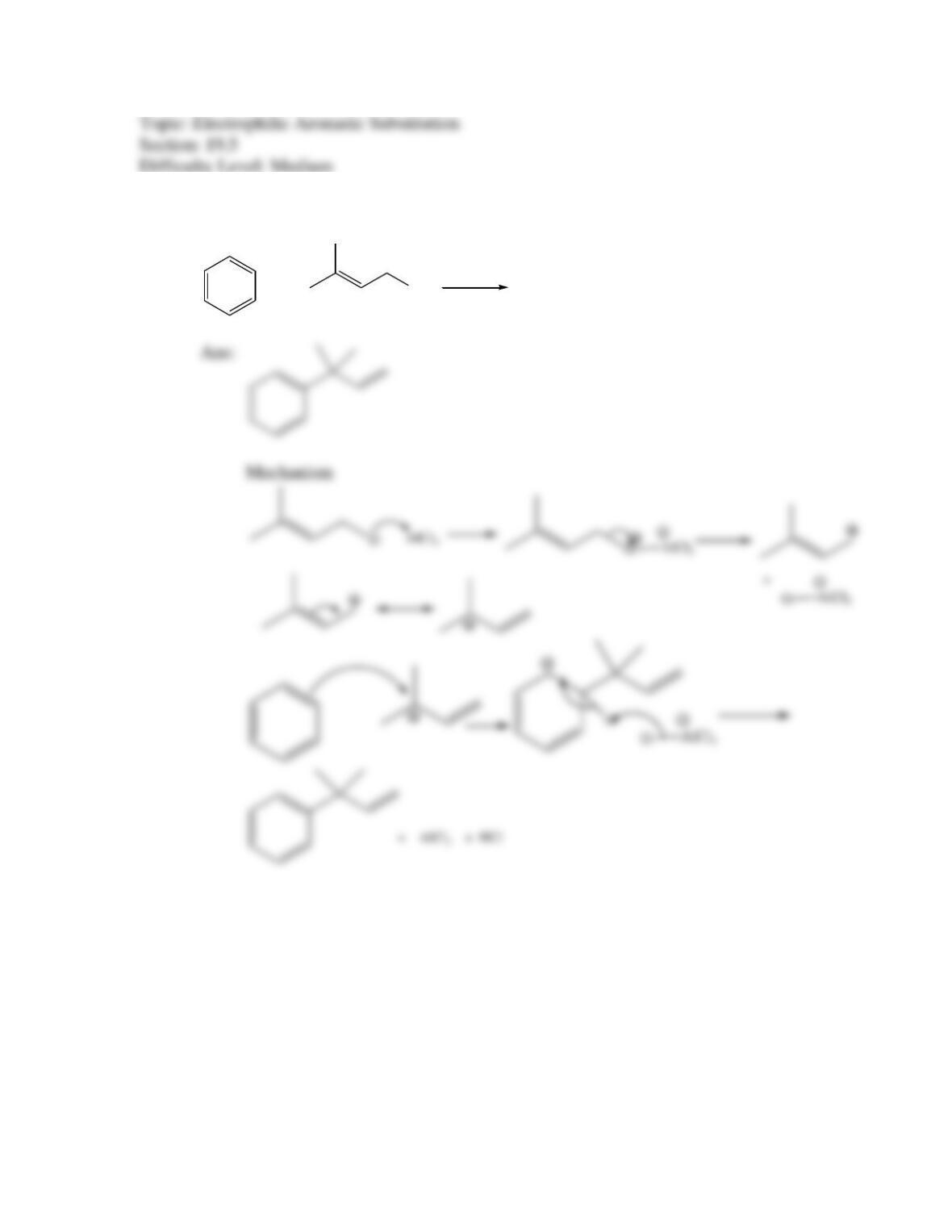
23.
Predict the major product for the following reaction and provide a stepwise curved
arrow mechanism for the formation of the product.
Cl AlCl3
+
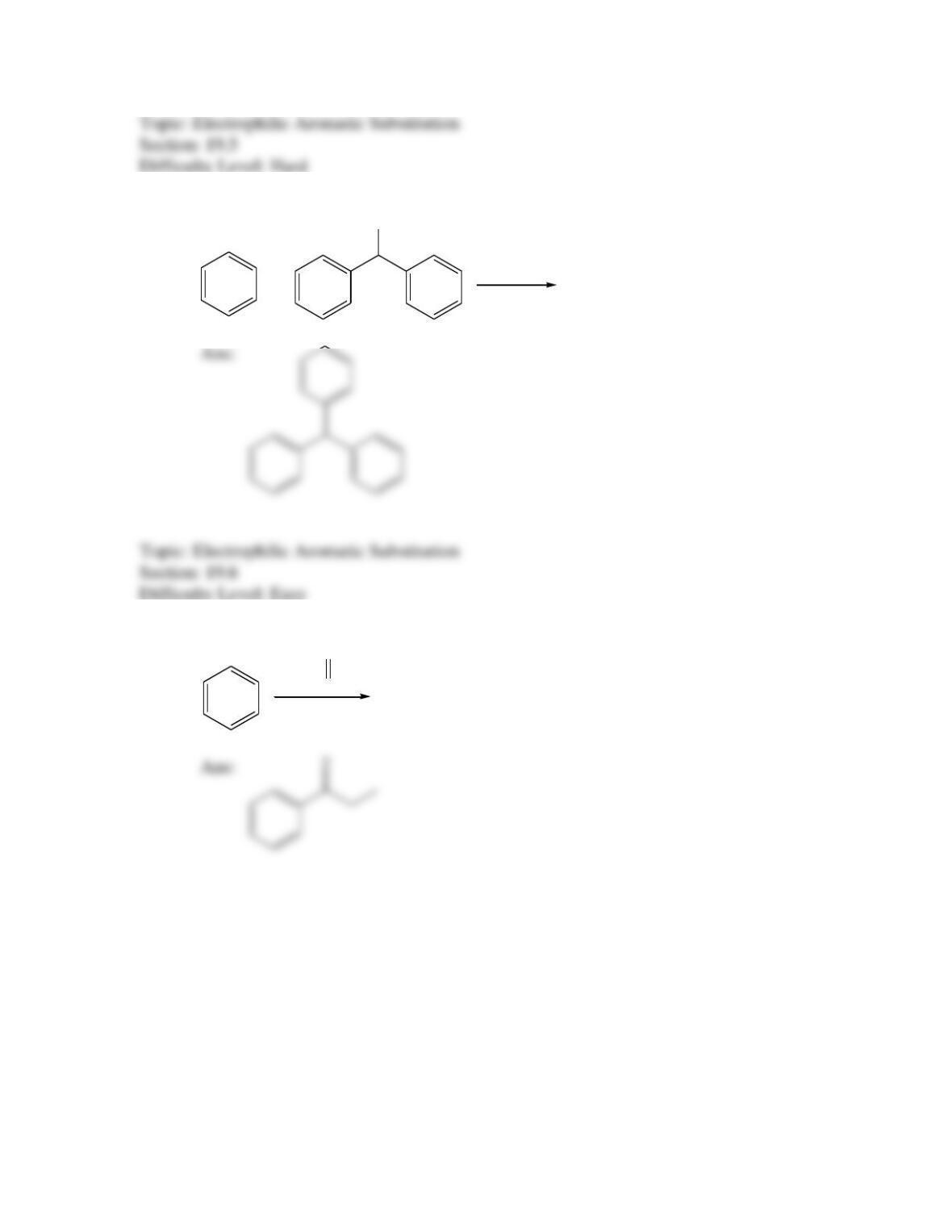
24.
Predict the structure of the major product for the following reaction.
OH
H2SO4
+
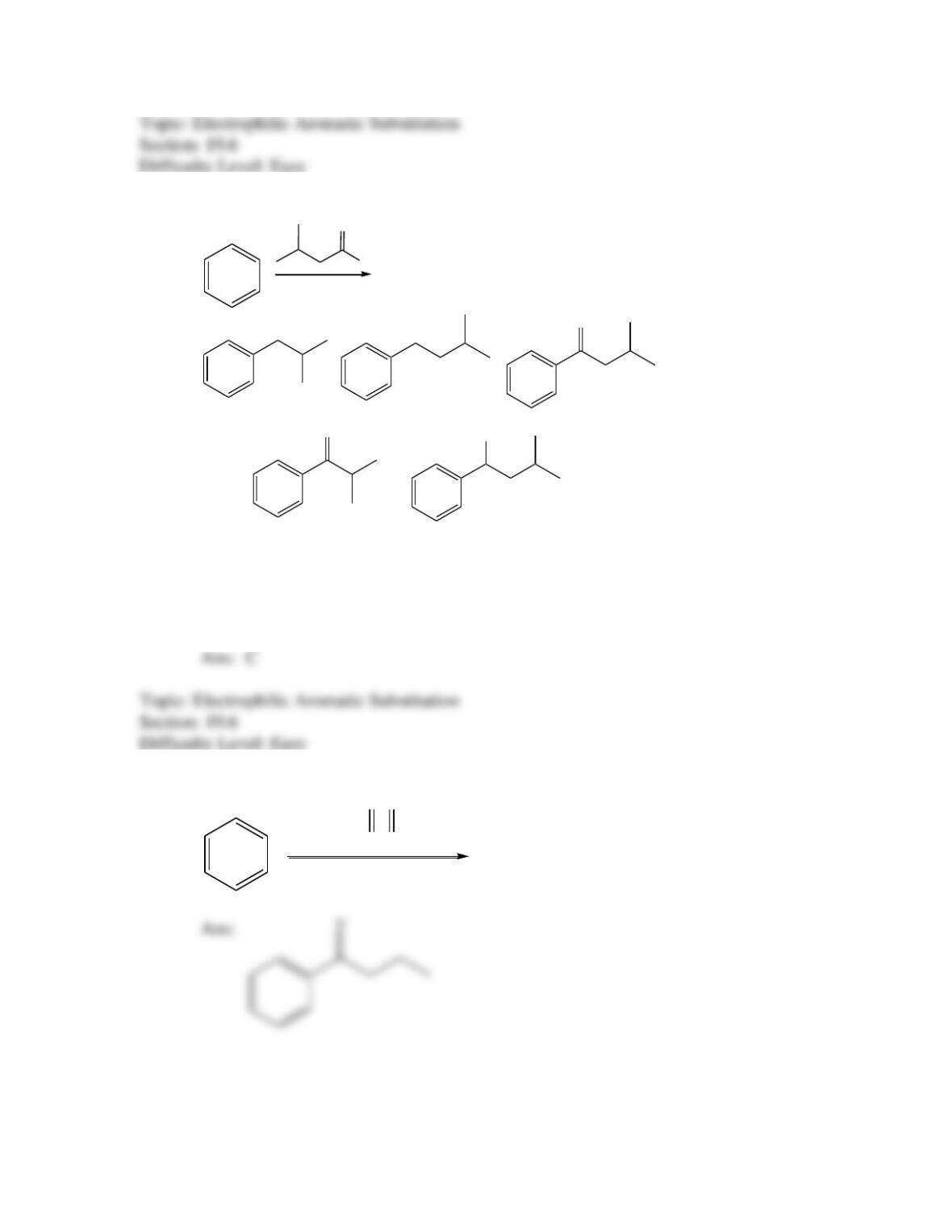
25.
Predict the structure of the major product for the following reaction.
CH3CH2CCl
O
AlCl3
26.
Predict the structure of the major product for the following reaction.
AlCl3
Cl
O
O
OOH
III III
IV V
A)
I
B)
II
C)
III
D)
IV
E)
V
Ans:
C
27.
Predict the structure of the major product for the following reaction.
CH3CH2CH2COCCH2CH2CH3
AlCl3
O O
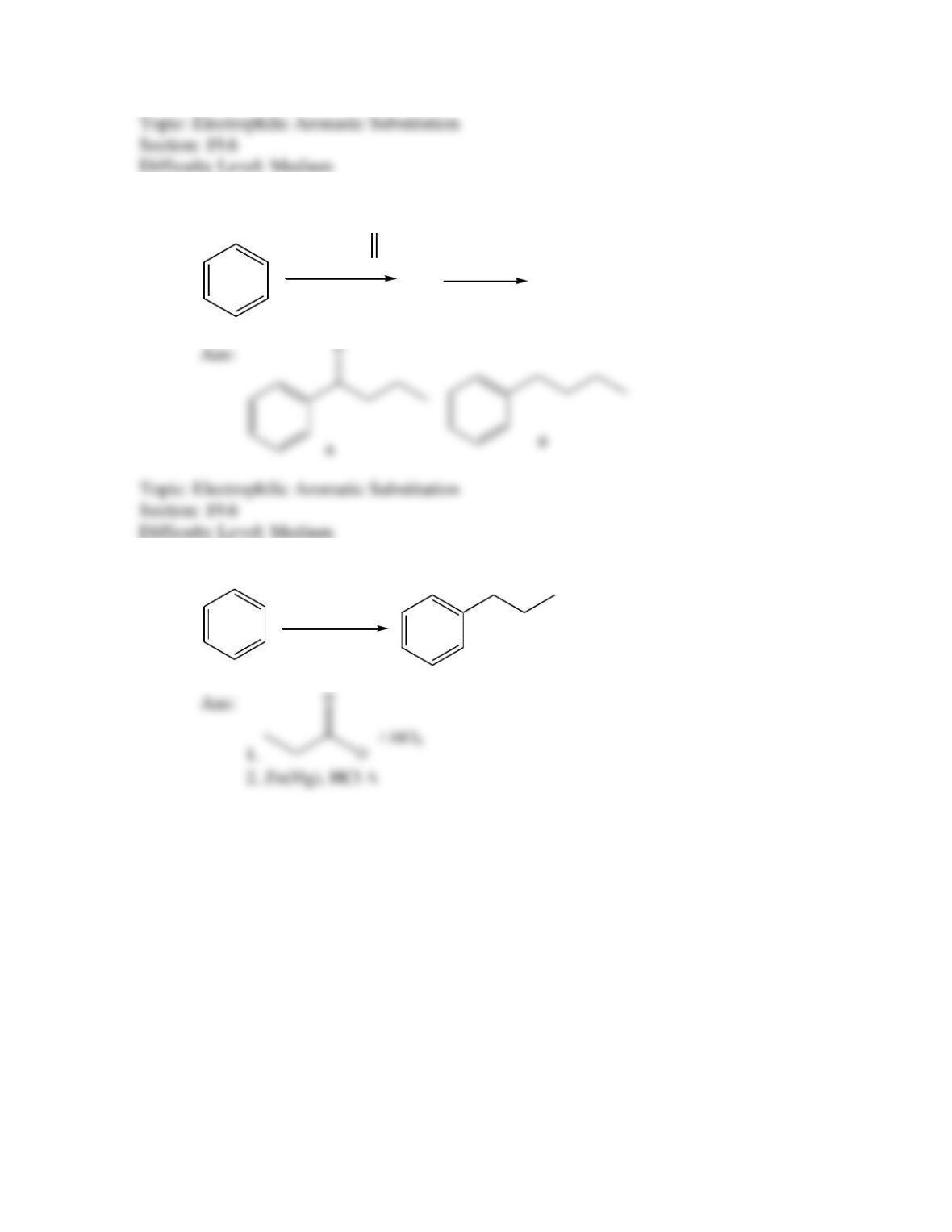
28.
Provide the structure of the major products formed in the following reaction sequence.
CH3CH2CH2CCl
O
AlCl3
A
Zn(Hg)
HCl
B
29.
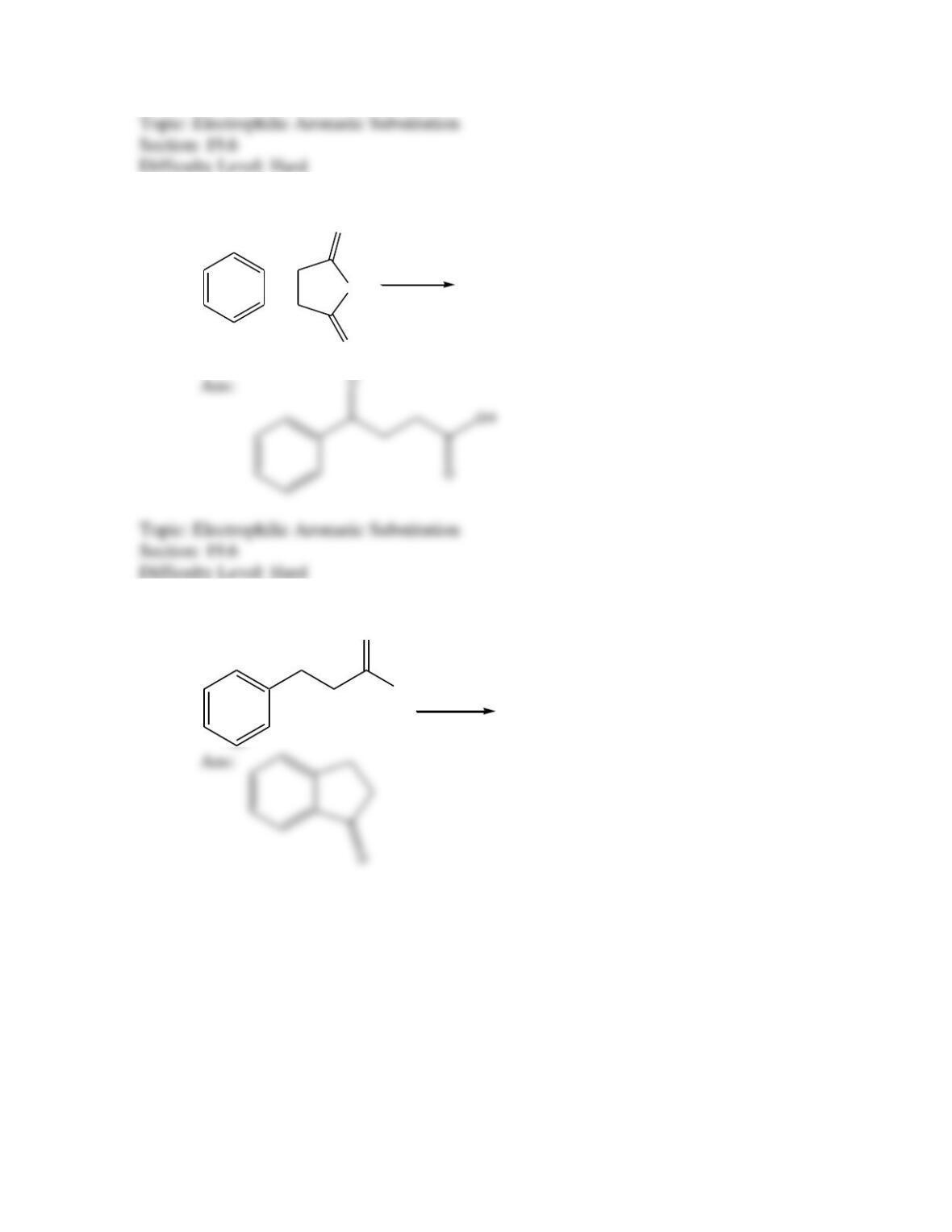
Provide the reagents necessary to carry out the following conversion.
30.
Predict the structure of the product for the following reaction.
O
O
O
1. AlCl3
2. H3O+
+
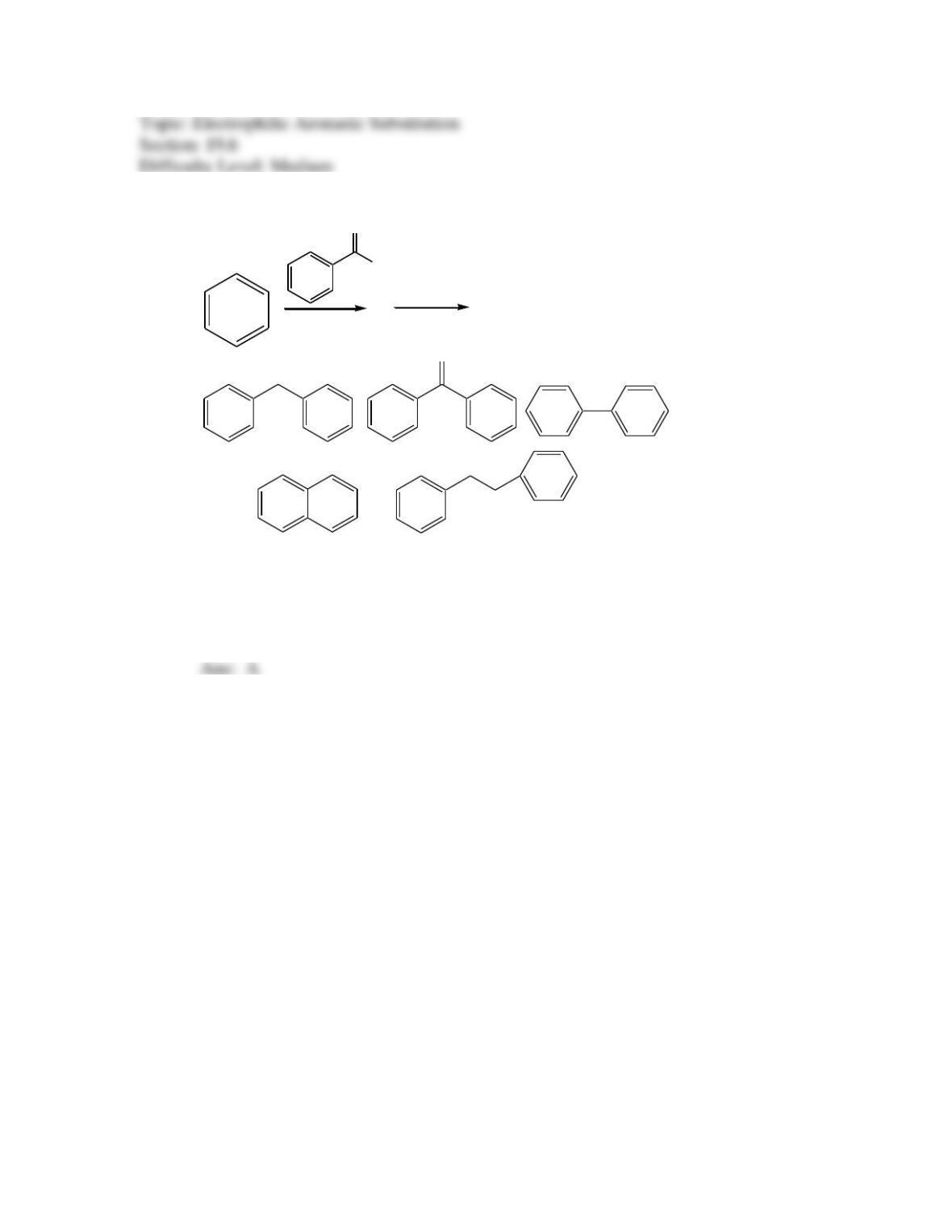
31.
Predict the structure of the product for the following reaction.
AlCl3
Cl
O
32.
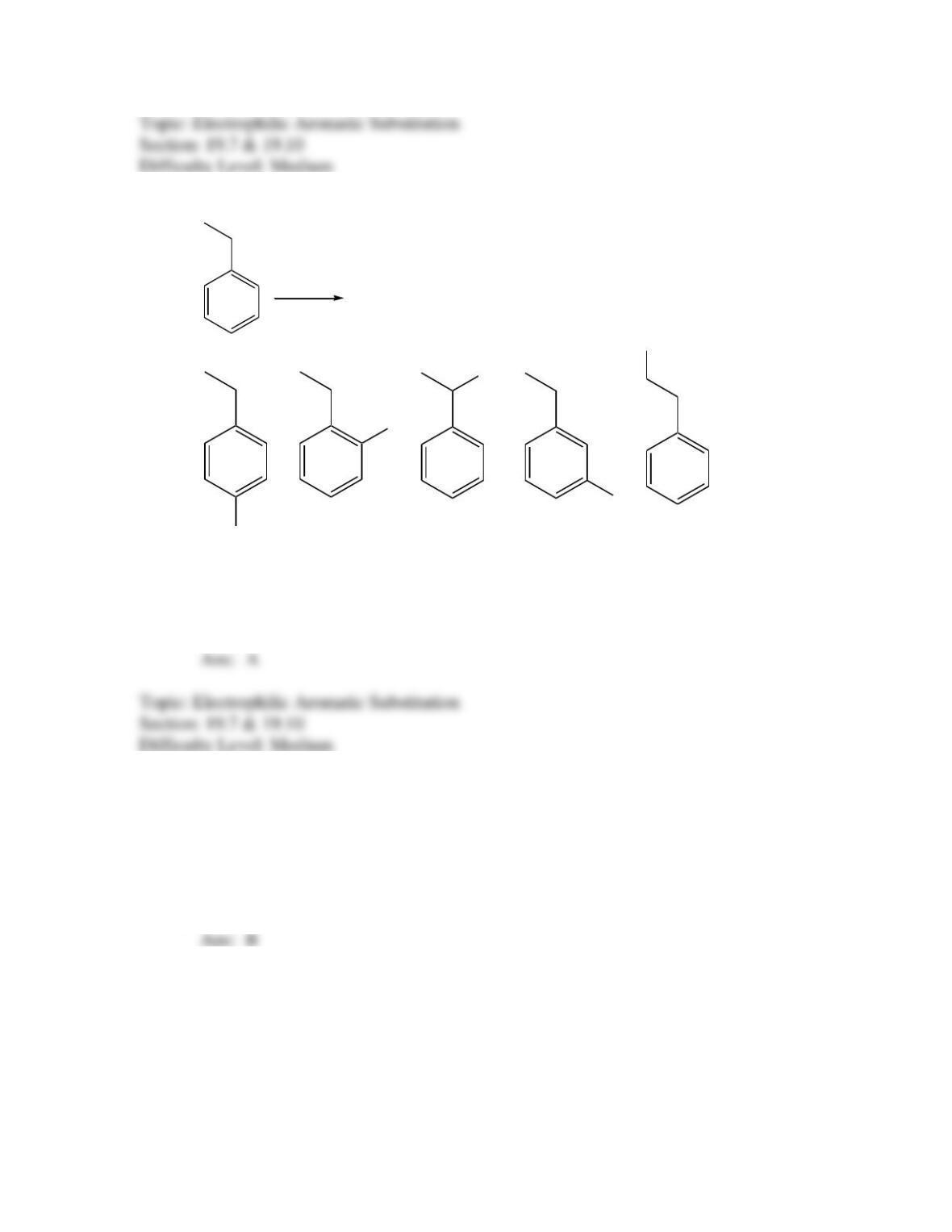
Predict the structure of the product for the following reaction.
Cl
O
AlCl3HCl
Zn(Hg)
O
III III
IV V
A)
I
B)
II
C)
III
D)
IV
E)
V
Ans:
A
33.
Predict the major product for the following reaction.
Cl2/FeCl3
Cl
Cl
Cl
Cl
Cl
III III IV V
A)
I
B)
II
C)
III
D)
IV
E)
V
Ans:
A
34.
Provide the reagent(s) that are necessary to carry out the following conversion.
t-butylbenzene ⎯⎯→ 4-chloro-1-t-butylbenzene
A)
Cl2, heat
B)
Cl2, FeCl3
C)
SOCl2, pyridine
D)
HCl
E)
PCl3
Ans:
B
35.
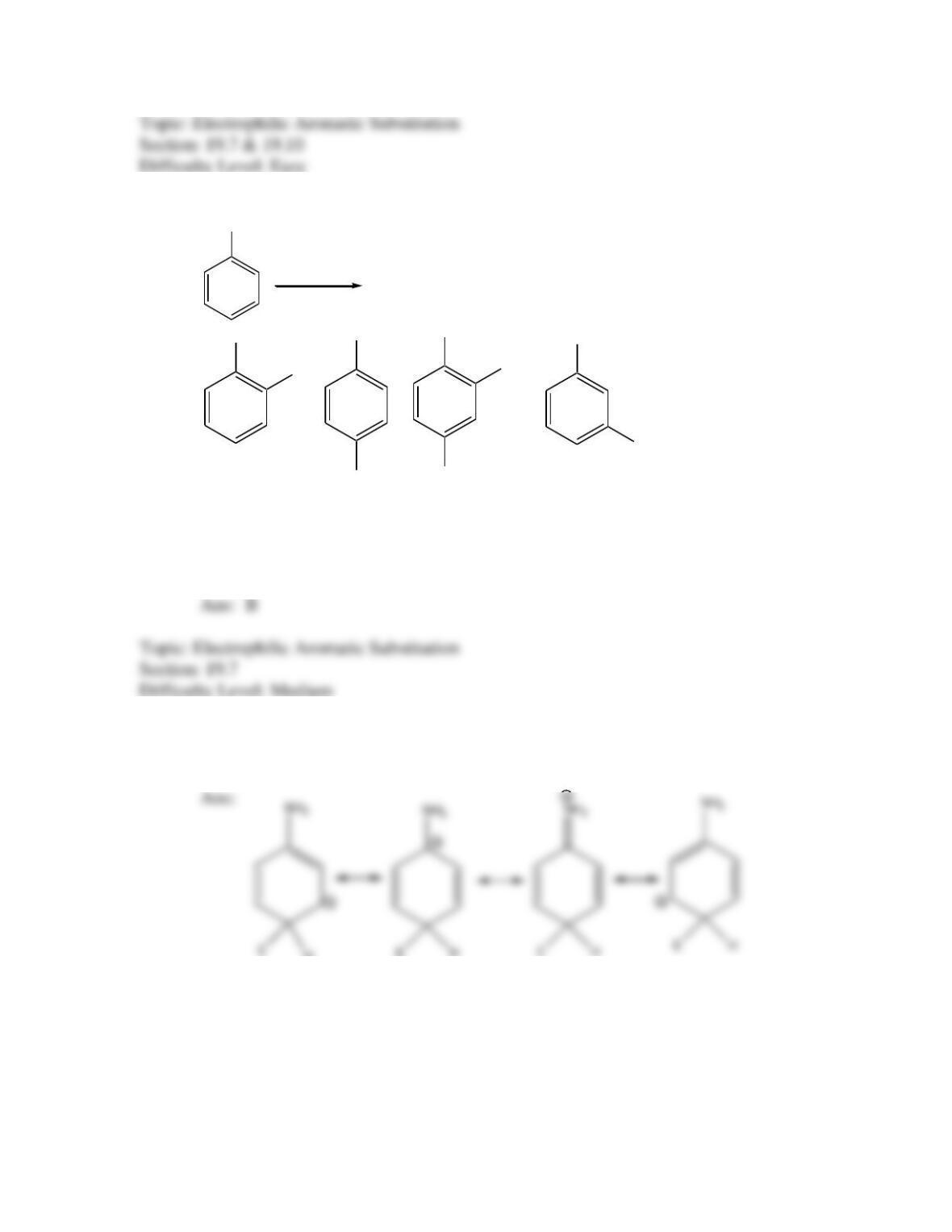
Predict the major product for the following reaction.
OCH3
Fuming H2SO4
OCH3
SO3H
OCH3
SO3H
OCH3
SO3H
OCH3
III III IV
SO3H
SO3H
A)
I
B)
II
C)
III
D)
IV
E)
I & II
Ans:
B
36.
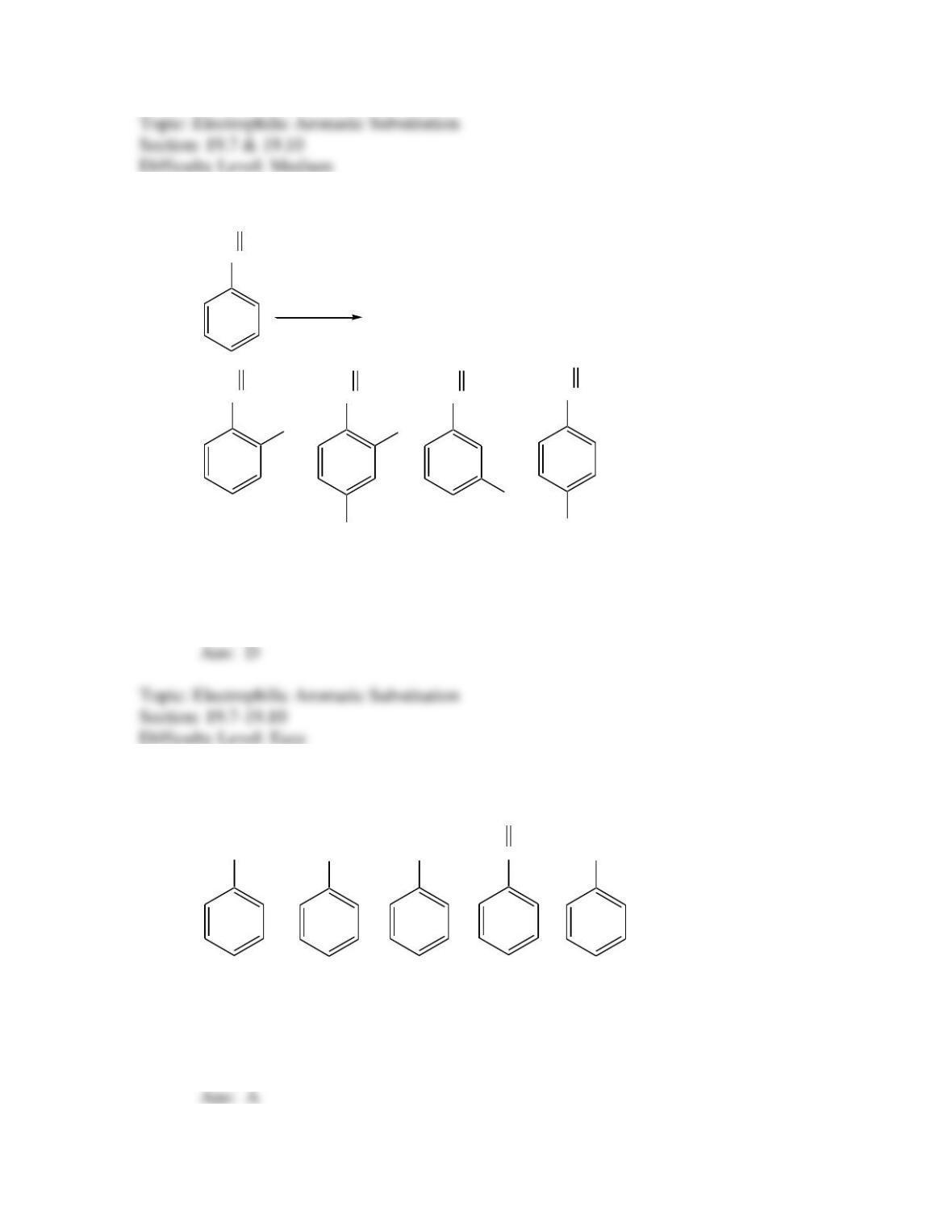
Provide all resonance structures of the sigma complex when aniline reacts with an
electrophile (E+) to yield the para-substituted product.
37.
Predict the major product for the following reaction.
OCCH3
Br2/ FeBr3
O
Br
OCCH3
O
Br
OCCH3
O
OCCH3
O
OCCH3
O
Br
Br
Br
III III IV
A)
I
B)
II
C)
III
D)
IV
E)
I & IV
Ans:
D
38.
Which one of the following compounds would be most reactive toward electrophilic
aromatic substitution?
NH2CH3Cl CCH3CF3
O
III III IV V
A)
I
B)
II
C)
III
D)
IV
E)
V
39.
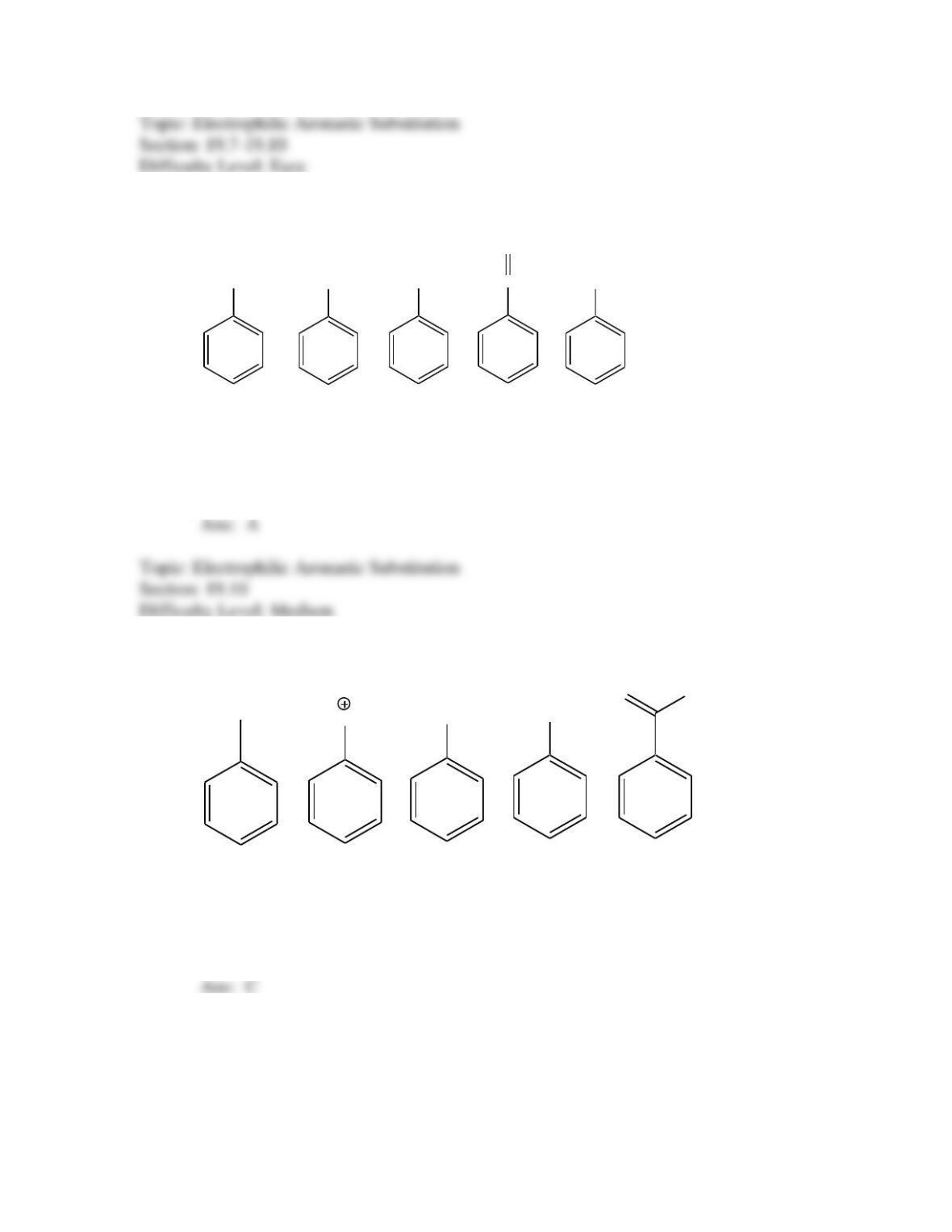
Which one of the following compounds would be least reactive toward electrophilic
aromatic substitution?
NO2OCH3Cl CCH3
O
CF3
III III IV V
A)
I
B)
II
C)
III
D)
IV
E)
V
Ans:
A
40.
Arrange the following compounds in order of decreasing reactivity towards electrophilic
aromatic substitution:
NH3Cl OH
O H
III III IV V
A)
V>II>I>III>IV
B)
II>V>III>I>IV
C)
IV>I>III>V>II
D)
III>II>I>IV>V
E)
IV>V>II>I>III
Ans:
C
41.
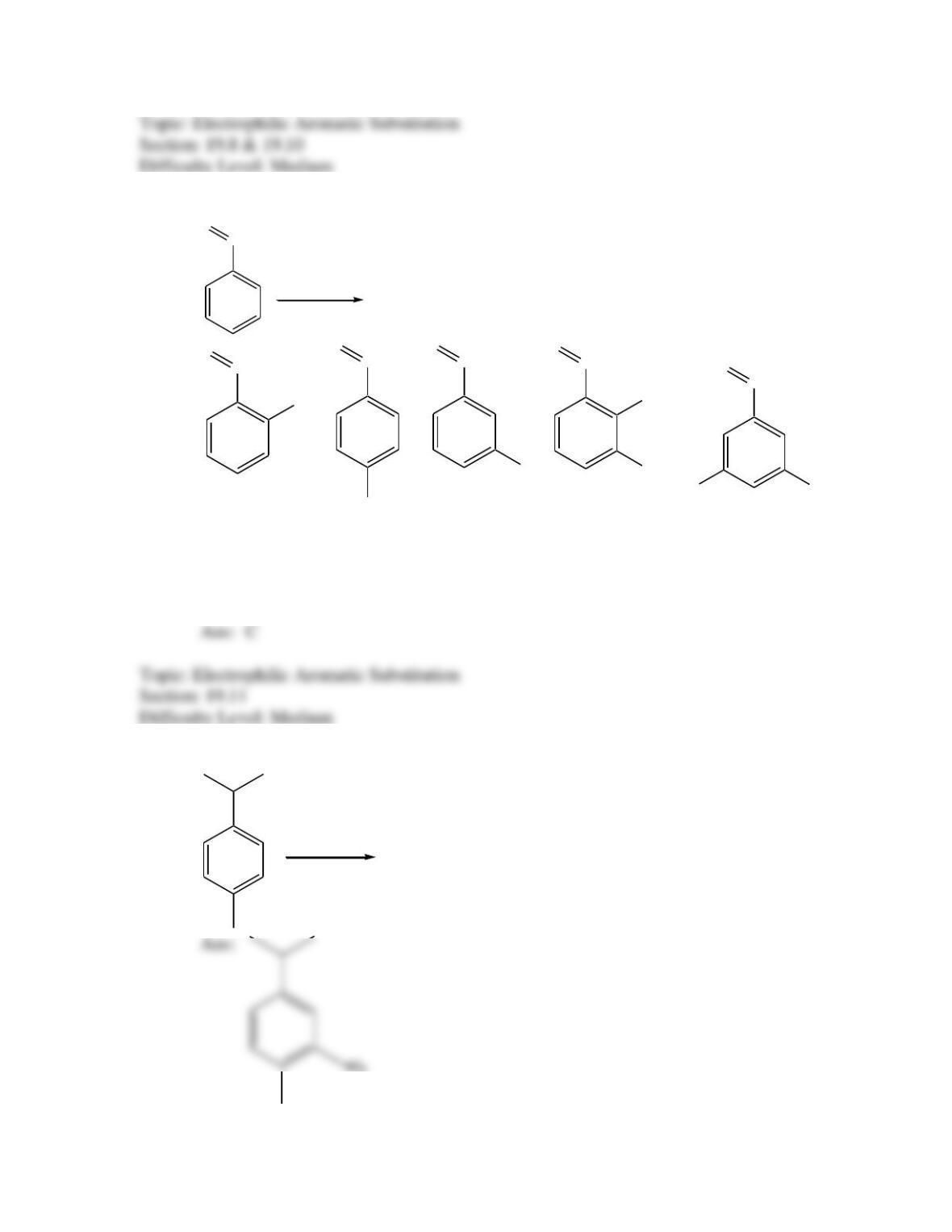
Predict the major product for the following reaction.
COCH3
HNO3/ H2SO4
O
COCH3
NO2
OCOCH3
O
NO2
COCH3
O
NO2
COCH3
NO2
O
NO2
I II III IV
COCH3
O
NO2
O2N
V
A)
I
B)
II
C)
III
D)
IV
E)
V
Ans:
C
42.
Predict the major product for the following reaction.
HNO3/H2SO4