16
56) What is the concentration of free Zn2+(aq) if 0.020 M Zn2+ solution is mixed with an equal volume of
2.0 M NH3(aq)? Kf for [Zn(NH3)4]2+ is 4.1 × 10⁸.
A) 2.5 × 10⁻¹¹ M
B) 2.9 × 10⁻¹¹ M
C) 1.7 × 10⁻¹⁰ M
D) 9.6 × 10⁻¹¹ M
E) 2.4 × 10⁻⁹ M
57) What is the free Cu2+(aq) concentration if 0.020 M Cu2+(aq) solution is mixed with an equal volume
of 4.0 M NH3(aq)? Kf for [Cu(NH3)4]2+ is 1.1 × 10¹³.
A) 5.7 × 10⁻¹⁵ M
B) 2.8 × 10⁻¹⁶ M
C) 6.2 × 10⁻¹⁷ M
D) 4.5 × 10⁻¹⁵ M
E) 1.7 × 10⁻¹⁶ M
58) What is the free Ag+(aq) concentration of 0.020 M Ag+(aq) solution mixed with an equal volume of 2.0
M NH3(aq)? Kf for [Ag(NH3)2]+ is 1.6 × 10⁷.
A) 1.3 × 10⁻¹⁰ M
B) 2.0 × 10⁻¹⁴ M
C) 6.3 × 10⁻⁸ M
D) 6.5 × 10⁻¹⁰ M
E) 3.1 × 10⁻¹⁰ M
59) What is the approximate concentration of free Fe3+(aq) ion in a solution prepared by mixing equal
volumes of 0.06 M Fe3+(aq) and 4.0 M F–(aq) solutions? [The net formation constant for FeF5(H2O)2- is
2.0 × 10¹⁵.]
A) 2.8 × 10⁻²³ M
B) 6.7 × 10⁻²¹ M
C) 6.9 × 10⁻¹⁹ M
D) 4.0 × 10⁻¹⁵ M
E) 8.9 × 10⁻¹⁰ M
17
60) In which of the following solutions will the concentration of dissolved silver species be the highest if
solid AgNO3 is stirred with 1.00 L of solution?
A) 1.00 M NH3(aq)
B) 1.00 M NaOH
C) 1.00 M Na2SO4(aq)
D) 1.00 M NaCl(aq)
E) 1.00 M NaC2H3O2(aq)
61) Equal volumes of a 0.020 M Zn2+(aq) solution and a 2.0 M NH3(aq) solution are mixed. Kf for
[Zn(NH3)4]2+ is 4.1 × 10⁸. If enough sodium oxalate is added to make the solution 0.10 M in oxalate, will
ZnC2O4(s) precipitate? What is Qsp? Ksp ZnC2O4 = 2.7 × 10⁻⁸
A) yes, Qsp = 11
B) yes, Qsp = 2.9 × 10⁻¹²
C) no, Qsp = 2.9 × 10⁻¹²
D) yes, Qsp = 2.4 × 10⁻⁹
E) no, Qsp = 2.4 × 10⁻⁹
62) Equal volumes of 0.020 M Ag+(aq) solution and 2.0 M NH3(aq) solution are mixed. Kf for
[Ag(NH3)2]+ is 1.6 × 10⁷. If trisodium arsenate is added so that the arsenate ion concentration is 0.10 M,
will silver arsenate precipitate? What is Qsp? Ksp for silver arsenate is 1.0 × 10⁻²².
A) no, Qsp = 6.3 × 10⁻⁹
B) no, Qsp = 1.9 × 10⁻²⁹
C) yes, Qsp = 6.5 × 10⁻⁹
D) yes, Qsp = 4.2 × 10⁻²⁰
E) no, Qsp = 2.6 × 10⁻²⁹
63) What is the minimum concentration of CN–(aq) that will prevent the precipitation of AgX(s) from a
solution that is 0.149 M in X–(aq) and 0.0184 M in Ag+(aq)? (Ksp for AgX(s) = 5.2 × 10⁻¹⁷; Kf for Ag(CN)2–
= 5.6 × 10¹⁸)
A) 3.1 × 10⁻³ M
B) 9.4 × 10⁻⁶ M
C) 1.8 × 10⁻¹⁰ M
D) 1.2 × 10⁻³ M
E) 9.6 × 10⁻³ M
64) Choose the compound that is most soluble in water.
A) K2S
B) HgS
C) ZnS
D) SnS
E) PbS
65) What is the composition of the precipitate formed when H2S gas is bubbled through 1.0 litre of a
solution of 0.010 M Zn2+, 0.010 M Pb2+, and 0.010 M Mn2+, buffered at pH 2.0, until 0.10 mol of H2S has
been added? (Ksp values are: ZnS: 1.6 × 10⁻²³; MnS: 7.0 × 10⁻¹⁶; PbS: 7.0 × 10⁻²⁹. For H2S, Ka1 = 1.0 × 10⁻⁷;
Ka2 = 1.3 × 10⁻¹³ ).
A) only ZnS
B) only MnS
C) only PbS
D) only MnS and PbS
E) only ZnS and PbS
66) Write the solubility product constant for KAl(SO4)2(s)?
A) ([K+] × [Al3+] × 2[SO42-]/[KAl(SO4)2])
B) ([K+] × [Al3+] × [SO42-]/[KAl(SO4)2])
C) ([K+] × [Al3+] × [SO42-])
D) ([K+] × [Al3+] × [SO42-]2)
E) none of these
67) Write the solubility product constant expression for the following salt: Na2CO3(s).
A) [Na+][CO32-]
B) [Na+][CO32-]2
C) [Na+]2[CO32-]2
D) [Na+]2[CO32-]
E) 4[Na+]2[CO32-]
68) Write the solubility product constant expression for the following salt: Ca(OH)2(s).
A) [Ca2+][OH–]
B) [Ca2+]2[OH–]
C) [Ca2+]3[OH–]
D) [Ca2+]2[OH–]2
E) [Ca2+][OH–]2
69) Write the solubility product constant expression for the following salt: PbC2O4(s).
A) [Pb2+][C2O42-]
B) [Pb2+]2[C2O42-]
C) [Pb2+]2[C2O42-]2
D) [Pb2+][C2O42-]2
E) 4[Pb2+][C2O42-]
70) Write the solubility product constant expression for the following salt: Ag2SO4(s).
A) [Ag+][SO42-]
B) [Ag+]2[SO42-]
C) 4[Ag+]2[SO42-]
D) [Ag+][SO42-]2
E) [Ag+]2[SO42-]2
20
71) Write the solubility product constant expression for the following salt: Ca3(PO4)2(s).
A) [Ca2+][PO43-]
B) [Ca2+]2[PO43-]3
C) [Ca2+]3[PO43-]2
D) [Ca2+]2[PO43-]
E) [Ca2+][PO43-]2
72) Write the solubility product constant expression for the following salt: CoS(s).
A) [Co2+]2[S2-]2
B) [Co2+]2[S2-]
C) [Co2+][S2-]
D) [Co2+][S2-]2
E) [Co2+]1/2[S2-]
73) At a temperature for which the solubility product constant of calcium carbonate is 4.7 × 10⁻⁹, what
mass of the salt will dissolve in 100 mL of water?
A) 0.69 mg
B) 0.94 mg
C) 1.2 mg
D) 2.4 mg
E) 4.7 mg
21
74) The following table lists five compounds and their Ksp value. Which is least soluble?
ZnS 2 × 10-25
TlBr 3.4 × 10⁻⁶
AgCl 1.8 × 10⁻¹⁰
FeS 6 × 10-19
CuI 1.1 × 10⁻¹²
A) ZnS
B) TlBr
C) AgCl
D) FeS
E) CuI
75) What is the concentration of Ca2+ in ppm (mg/L) in cave water saturated with calcite (calcium
carbonate, Ksp = 4.7 × 10⁻⁹)?
A) 7.5 ppm
B) 6.9 ppm
C) 5.0 ppm
D) 3.8 ppm
E) 2.7 ppm
76) The relationship between the molar concentration of silver ion in a saturated solution of silver
phosphate and the solubility product constant for silver phosphate is ________.
A) Ksp = 9[Ag+]3
B) Ksp = 27[Ag+]4
C) Ksp = [Ag+]1/3
D) Ksp = 0.125[Ag+]
E) Ksp = 0.333[Ag+]4
77) What molar concentration of silver ion could exist in a solution in which the concentration of CrO42-
is 1.0 × 10⁻⁴ M? (Ksp of Ag2CrO4 = 1.1 × 10⁻¹²)
A) 9.0 × 10⁻⁸ M
B) 4.5 × 10⁻³ M
C) 1.0 × 10⁻⁴ M
D) 2.1 × 10⁻⁴ M
E) 7.5 × 10⁻⁵ M
78) When 200 mL of 0.10 M BaCl2(aq) is added to 100 mL of 0.30 M Na2SO4(aq), the number of moles of
BaSO4 (solubility product = 1.1 × 10⁻¹⁰) precipitated is ________.
A) 0.020 mol
B) 0.010 mol
C) 0.20 mol
D) 0.030 mol
E) 0.10 mol
79) The solubility product constant of PbI2(s) is 7.1 × 10⁻⁹. How many moles of PbI2 will precipitate if 250
mL of a 0.200 M solution of NaI(aq) are added to 150 mL of 0.100 M solution of Pb(NO3)2(aq)? You may
neglect hydrolysis.
A) 0.050 mol
B) 1.3 × 10⁻⁵ mol
C) 0.015 mol
D) 5.6 × 10⁻³ mol
E) 0.040 mol
80) A concentrated buffer of pH 8.0 is added to an equal volume of an aqueous solution that is 0.080 M in
each of the ions Zn2+, Ni2+, and Mn2+. The expected precipitate would consist of ________.
salt zinc hydroxide nickel hydroxide manganese hydroxide
Ksp 1.2 × 10⁻¹⁷ 2.0 × 10⁻¹⁵ 1.9 × 10⁻¹³
A) Zn(OH)2, Ni(OH)2 and Mn(OH)2
B) Ni(OH)2 and Mn(OH)2
C) Mn(OH)2
D) Ni(OH)2 and Zn(OH)2
E) Zn(OH)2
81) Consider an aqueous solution which is 0.020 M in Pb2+ and 0.20 M in Ag+. If concentrated aqueous
potassium iodide solution (so that volume changes may be neglected) is added gradually with good
stirring to this solution, which precipitate will form first?
Ksp for PbI2 = 7.1 × 10⁻⁹; for AgI = 8.31 × 10⁻¹⁷
A) PbI2
B) KI
C) AgI
D) PbI2 and AgI precipitate together
E) Ag2[PbI4]
82) To a concentrated buffer of pH 4.0 is added an equal volume of an aqueous solution that is 0.020 M in
Cr3+, Cd2+ and Al3+. The expected precipitate would consist of ________.
salt chromium(III) hydroxide cadmium hydroxide aluminum hydroxide
Ksp 6.3 × 10⁻³¹ 2.5 × 10⁻¹⁴ 1.3 × 10⁻³³
A) Al(OH)3
B) Al(OH)3 and Cr(OH)3
C) Cd(OH)2
D) Cd(OH)2 and Cr(OH)3
E) Cd(OH)2, Cr(OH)3 and Al(OH)3
24
83) A swimming pool was sufficiently alkaline so that the carbon dioxide absorbed from the air produced
a solution in the pool that was 2 × 10⁻⁴ M in carbonate ion. If the pool originally contained 4 × 10⁻³ M
Mg2+, 6 × 10⁻⁴ M Ca2+, and 8 × 10⁻⁷ M Fe2+, then the precipitate that was formed consisted of ________.
(Ksp values are: CaCO3, 4.7 × 10⁻⁹; MgCO3, 4.0 × 10⁻⁵; FeCO3, 2.0 × 10⁻¹¹)
A) only MgCO3
B) only CaCO3
C) only FeCO3
D) only CaCO3 and FeCO3
E) MgCO3, CaCO3, and FeCO3
84) An aqueous solution contains [Ba2+] = 5.0 × 10⁻⁵ M, [Ag+] = 3.0 × 10⁻⁵ M, and [Zn2+] = 2.0 × 10⁻⁷ M.
Sodium oxalate is slowly added so that [C2O42-] increases.
Salt BaC2O4 ZnC2O4 Ag2C2O4
Ksp 1.5 × 10⁻⁸ 1.35 × 10⁻⁹ 1.1 × 10⁻¹¹
Which one of the oxalates precipitates first?
A) BaC2O4
B) Na2C2O4
C) ZnC2O4
D) Ag2C2O4
E) ZnC2O4 and Ag2C2O4 precipitate together
85) What ratio of [NH4+]/[NH3] would provide a buffer of pH low enough to avoid precipitation of
Co(OH)2(s) from a 0.50 M Co2+(aq) solution? (Kb for NH3 = 1.8 × 10⁻⁵ and Ksp for Co(OH)2= 2.0 × 10⁻¹⁴
A) 1/50
B) 1/90
C) 1/1
D) 90/1
E) 50/1
86) What is the minimum pH at which cobalt(II) hydroxide (Ksp = 2.0 × 10⁻¹⁶) will precipitate from an
aqueous solution of 0.020 M in Co2+?
A) 5.8
B) 6.2
C) 7.0
D) 7.8
E) 8.2
87) Concentrated aqueous solutions of sodium sulfate, ammonium carbonate, and nickel (II) nitrate are
mixed together. The precipitate which forms is ________.
A) nickel (II) carbonate
B) nickel (II) sulfate
C) sodium carbonate
D) ammonium sulfate
E) nothing precipitates
88) Concentrated aqueous solutions of iron (III) chloride, sodium hydroxide, and potassium nitrate are
mixed together. The precipitate which forms is ________.
A) potassium hydroxide
B) sodium chloride
C) iron (III) hydroxide
D) iron (III) nitrate
E) nothing precipitates
89) Concentrated aqueous solutions of copper (I) nitrate, sodium sulfate and silver acetate are mixed
together. The precipitate which forms is ________.
A) copper (I) acetate
B) silver nitrate
C) silver sulfate
D) sodium acetate
E) nothing precipitates
90) Saturated aqueous solutions of sodium sulfate, ammonium carbonate, and nickel (II) nitrate are mixed
together. The precipitate that forms is ________.
A) nickel (II) carbonate
B) sodium carbonate
C) nickel (II) sulfate
D) ammonium sulfate
E) sodium nitrate
91) In a qualitative cation analysis, the unknown ion is precipitated by HCl(aq), remains as a chloride
solid in hot water, and the precipitate turns black upon addition of aqueous ammonia. The unknown ion
is ________.
A) Hg22+
B) Pb2+
C) Ag+
D) K+
E) Cd2+
92) In a qualitative cation analysis, the unknown ion is unaffected by HCl(aq), but is precipitated by
aqueous hydrogen sulfide. The unknown ion is ________.
A) NH4+
B) Cu2+
C) Ag+
D) K+
E) Na+
93) In a qualitative cation analysis, the unknown ion is not precipitated by HCl or H2S, but is precipitated
by CO32-. The unknown ion is ________.
A) Ag+
B) Mn2+
C) Ca2+
D) K+
E) Al3+
94) In a qualitative cation analysis, the unknown ion is not precipitated by aqueous solutions of HCl(aq),
H2S(aq), or CO32-(aq). A flame test produced a violet flame. The unknown ion is ________.
A) Ag+
B) Pb2+
C) Fe2+
D) K+
E) NH4+
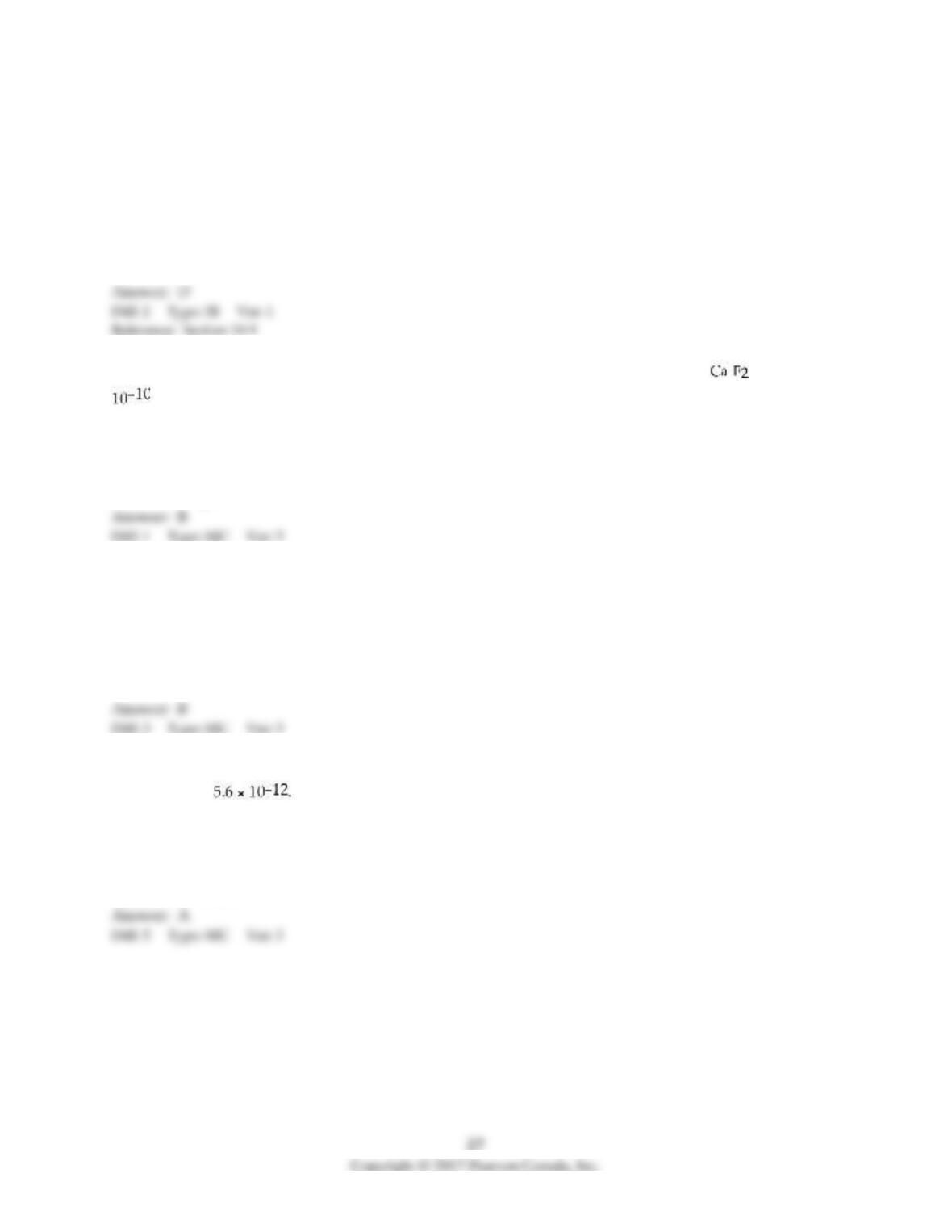
95) Calculate the solubility (in g L-1) of calcium fluoride in water at 25 °C if the Ksp for is 1.5 ×
.
A) 9.6 × 10⁻⁴ g L-1
B) 2.6 × 10⁻² g L-1
C) 3.3 × 10⁻² g L-1
D) 4.1 × 10⁻² g L-1
96) Calculate the Ksp for silver carbonate if the solubility of Ag2CO3(s) in pure water is 3.5 × 10⁻² g L-1.
A) 1.3 × 10⁻⁴
B) 8.4 × 10⁻¹²
C) 4.6 × 10⁻⁷
D) 5.8 × 10⁻¹⁰
97) What is the molar solubility of Mg(OH)2(s) in a basic aqueous solution with a pH of 12.50? Ksp for
Mg(OH)2(s) is
A) 1.8 × 10⁻¹⁰ mol L-1
B) 5.6 × 10⁻⁹ mol L-1
C) 2.4 × 10⁻⁶ mol L-1
D) 1.1 × 10⁻⁴ mol L-1
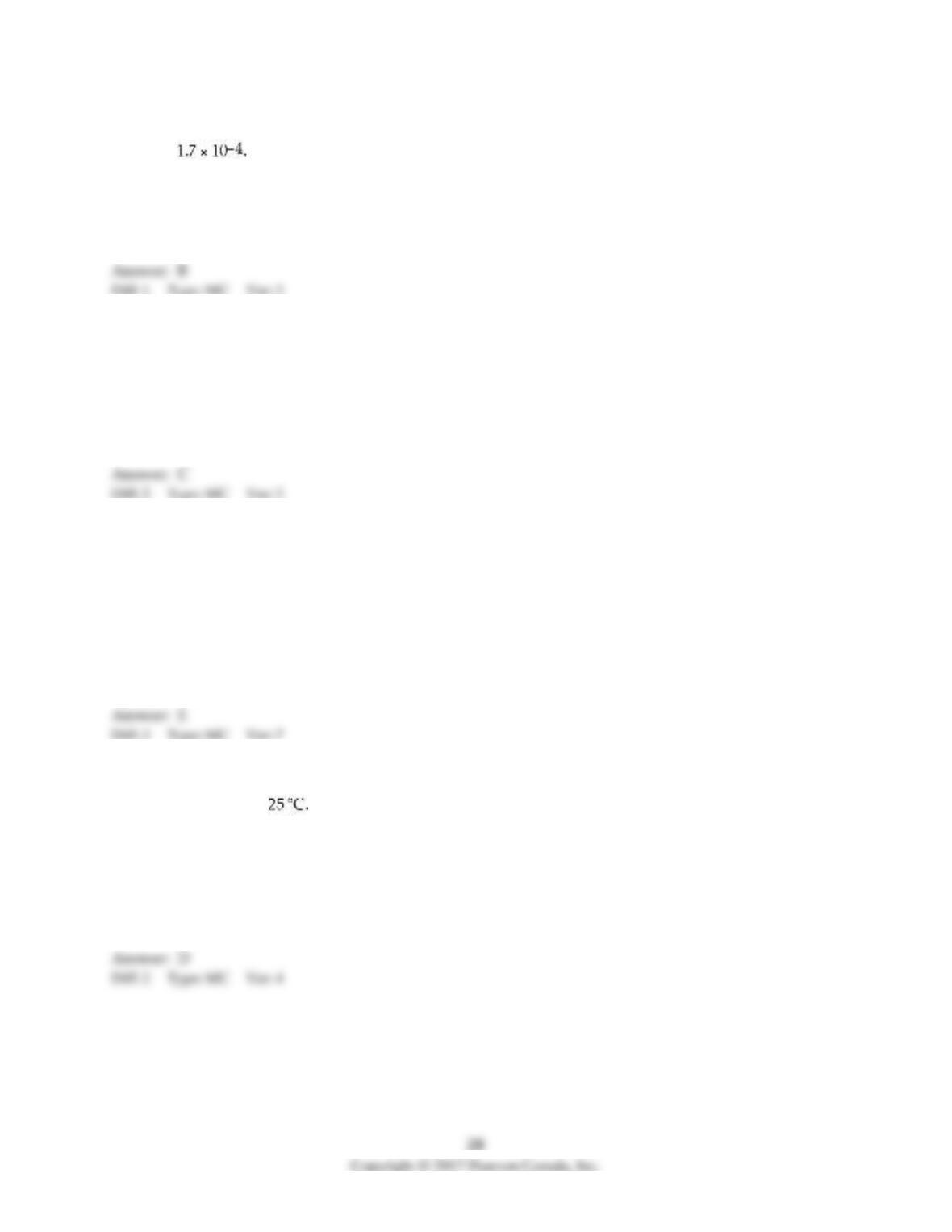
98) Calculate the molar solubility of thallium chloride (TlCl) in 0.30 mol L-1 NaCl(aq) at 25 °C. Ksp for
TlCl(s) is
A) 5.1 × 10⁻⁵ mol L-1
B) 5.7 × 10⁻⁴ mol L-1
C) 7.1 × 10⁻³ mol L-1
D) 1.3 × 10⁻² mol L-1
99) In which of the following aqueous solutions would solid AgCl be expected to be the least soluble at
25 °C?
A) 0.1 mol L-1 HCl
B) 0.1 mol L-1 KCl
C) 0.1 mol L-1 BaCl2
D) 0.1 mol L-1 KNO3
100) What is the molar solubility of manganese carbonate ( MnCO3 ) in water? The solubility-product
constant for MnCO3 (s)is 5.0 × 10⁻¹⁰ at 25 °C.
A) 2.5 × 10⁻¹⁰ mol L-1
B) 1.0 × 10⁻⁹ mol L-1
C) 9.3 mol L-1
D) 3.2 × 10⁻⁵ mol L-1
E) 2.2 × 10⁻⁵ mol L-1
101) What is the molar solubility of barium fluoride ( BaF2 ) in water? The solubility-product constant for
BaF2 (s) is 1.7 × 10⁻⁶ at
A) 6.5 × 10⁻⁴ mol L-1
B) 1.2 × 10⁻² mol L-1
C) 1.8 × 10⁻³ mol L-1
D) 7.5 × 10⁻³ mol L-1
E) 5.7 × 10⁻⁷ mol L-1
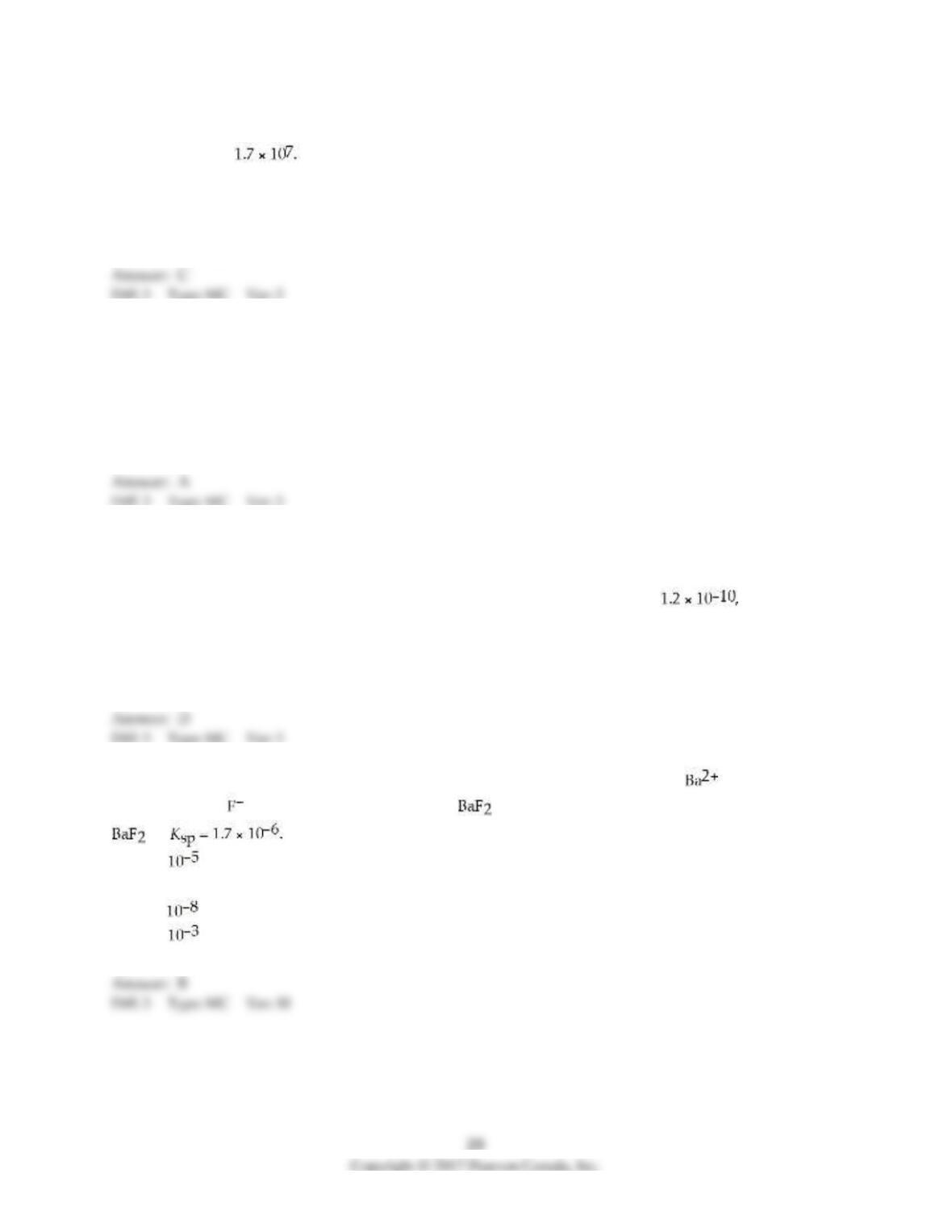
102) What is the molar solubility of AgCl in 0.40 mol L-1 NH3(aq)? Ksp for AgCl(s) is 1.8 × 10⁻¹⁰ and Kf
for Ag(NH3)2+ is
A) 1.3 × 10⁻⁵ mol L-1
B) 2.0 × 10⁻⁵ mol L-1
C) 2.2 × 10⁻² mol L-1
D) 5.5 × 10⁻² mol L-1
103) What is the molar solubility of AgCl(s) in 0.10 mol L-1 NaCN(aq) if the colourless complex ion
Ag(CN)2–(aq) forms? Ksp for AgCl(s) is 1.8 × 10⁻¹⁰ and Kf for Ag(CN)2–(aq) is 1.0 × 10²¹.
A) 0.050 mol L-1
B) 0.10 mol L-1
C) 0.20 mol L-1
D) 0.40 mol L-1
104) Solid potassium chromate (K2CrO4) is slowly added to a solution containing 0.50 mol L-1
AgNO3(aq) and 0.50 mol L-1 Ba(NO3)2(aq). What is the Ag+(aq) concentration when BaCrO4(s) just
starts to precipitate? The Ksp for Ag2CrO4(s) and BaCrO4(s) are 1.1 × 10⁻¹² and respectively.
A) 6.5 × 10⁻⁵ mol L-1
B) 1.3 × 10⁻⁴ mol L-1
C) 3.2 × 10⁻⁴ mol L-1
D) 6.8 × 10⁻² mol L-1
105) A solution of NaF(aq) is added dropwise to a solution that is 0.0102 mol L-1 in (aq). When the
concentration of (aq) exceeds ________ mol L-1, (s) will precipitate. Neglect volume changes. For
(s),
A) 8.6 ×
B) 1.3 × 10⁻²
C) 1.7 ×
D) 3.3 ×
E) 1.7 × 10⁻⁴