68) A handbook states that to prepare a particular buffer solution mix 63.0 mL of 0.200 M aqueous
HC2H3O2 with 37.0 mL of 0.200 M aqueous NaC2H3O2. What is the pH of this buffer? (Ka = 1.8 × 10⁻⁵)
A) 4.74
B) 4.51
C) 4.98
D) 5.33
E) 7.00
69) What is the pH of a solution made by dissolving 2.16 g of sodium benzoate (NaC6H5CO2) in a
sufficient volume of 0.033 M aqueous benzoic acid solution to prepare 500.0 mL of buffer? [Ka for benzoic
acid is 6.3 × 10⁻⁵]
A) 4.16
B) 4.37
C) 4.64
D) 5.77
E) 6.30
70) If 30.0 mmol HCl(g) is added to 1.00 L of a buffer that is 0.340 M NH3(aq) and 0.290 M NH4Cl(aq),
what are the final concentrations of NH3(aq) and NH4Cl(aq), respectively? Assume no volume change.
A) 0.310 M and 0.320 M
B) 0.310 M and 0.290 M
C) 0.370 M and 0.290 M
D) 0.370 M and 0.320 M
71) What is the pH of a buffer that is 0.88 M HCN(aq) and 0.53 M NaCN(aq)? The Ka of HCN is 6.2 × 10–
10.
A) 8.99
B) 9.21
C) 9.43
D) 4.79
72) A buffer is 0.282 M C6H5COOH(aq) and 0.282 M C6H5COONa(aq). Calculate the pH after the
addition of 0.150 moles of nitric acid to 1.0 L of the buffer. For C6H5COOH, pKa = 4.20.
A) 3.69
B) 4.20
C) 4.71
D) 3.87
E) 7.00
73) How many mL of 0.200 M aqueous acetic acid are mixed with 13.2 mL of 0.200 M aqueous sodium
acetate to give a buffer with pH = 4.2? (Ka for acetic acid is 1.8 × 10⁻⁵)
A) 37 mL
B) 18 mL
C) 3.8 mL
D) 14 mL
E) 46 mL
74) What mass of sodium acetate should be dissolved in 250.0 mL of 0.30 M aqueous acetic acid to form a
buffer of pH 5.0? (Ka for acetic acid is 1.8 × 10⁻⁵)
A) 11 g
B) 8.0 g
C) 7.5 g
D) 5.0 g
E) 1.4 g
75) What is the change in pH after addition of 10.0 mL of 1.0 M aqueous sodium hydroxide to 90.0 mL of
an aqueous 1.0 M NH3/1.0 M NH4+ buffer? (Kb for ammonia is 1.8 × 10⁻⁵)
A) 1.0 pH unit
B) 0.1 pH unit
C) 0.01 pH unit
D) 0.001 pH unit
E) zero
76) A pH 9.56 buffer was prepared by mixing 2.00 moles of ammonia (Kb for ammonia is 1.8 × 10⁻⁵) and
1.00 mol of ammonium chloride in water to form a solution with a volume of 1.00 L. To a 200.0 mL
aliquot of this solution was added 10.0 mL of 10.0 M aqueous sodium hydroxide. What was the resulting
pH?
A) 9.28
B) 9.56
C) 9.95
D) 10.50
E) 13.7
77) A handbook states that to prepare a particular buffer solution mix 39.0 mL of 0.20 M aqueous
NaH2PO4 with 61.0 mL of 0.20 M aqueous Na2HPO4. What will be the pH of this buffer? For phosphoric
acid Ka2= 6.2 × 10⁻⁸
A) 7.2
B) 7.4
C) 7.0
D) 6.8
E) 6.6
78) Twenty-five milliliters of 0.10 M HCl(aq) is titrated with 0.10 M NaOH(aq). What is the pH at
equivalence?
A) 7.0
B) 6.2
C) 7.5
D) 8.6
E) 7.1
79) What will the pH at the neutralization point of 0.00812 M Ba(OH)2(aq) be when titrated with HCl(aq)?
A) 7.0
B) 12.2
C) 8.0
D) 9.0
E) 6.0
80) What volume in mL of 2.0 M H2SO4(aq) is needed to neutralize 7.8 g of Al(OH)3(78.0 g/mol)?
Al2(SO4)3(aq) and water are the titration products.
A) 150 mL
B) 75 mL
C) 300 mL
D) 500 mL
E) 250 mL
81) Twenty-five milliliters of 0.10 M HCl(aq) is titrated with 0.10 M NaOH(aq). What is the pH when 30
mL of NaOH(aq) have been added?
A) 2.0
B) 12.0
C) 12.2
D) 1.8
E) 12.3
82) 25 ml of 0.10 M aqueous acetic acid is titrated with 0.10 M NaOH(aq). What is the pH before any
NaOH(aq) is added? Ka for acetic acid = 1.8 × 10⁻⁵.
A) 1.0
B) 5.7
C) 2.9
D) 4.3
E) 2.2
83) What is the pH at the equivalence point for the titration of 0.20 M aqueous nitrous acid by 0.20 M
aqueous sodium hydroxide? Ka for nitrous acid is 4.5 × 10⁻⁴
A) 5.83
B) 7.00
C) 8.17
D) 9.00
E) 10.67
84) Determine the pH of the following aqueous solution. Initial concentrations are given.
[NaCHO2] = 0.815 M, [HBr] = 0.105 M, Ka for HCHO2= 1.8 × 10⁻⁴
A) 2.91
B) 4.63
C) 4.57
D) 9.43
E) 11.09
85) Twenty-five milliliters of 0.10 M HCl(aq) is titrated with 0.10 M NaOH(aq). What is the pH before any
NaOH(aq) is added?
A) 0.40
B) 2.5
C) 0.1
D) 1.0
E) 25
86) Twenty-five milliliters of 0.10 M HCl(aq) is titrated with 0.10 M NaOH(aq). What is the pH after 15
mL of NaOH(aq) has been added?
A) 1.4
B) 1.2
C) 1.0
D) 2.0
E) 1.6
87) If 25 mL of 0.20 M NaOH(aq) is added to 50 mL of 0.10 M aqueous HC2H3O2 (Ka = 1.8 × 10⁻⁵), what is
the pH?
A) 5.33
B) 10.21
C) 8.78
D) 13.56
E) 1.34
88) 25 mL of 0.10 M aqueous acetic acid is titrated with 0.10 M NaOH(aq). What is the pH after 15 mL of
NaOH(aq) have been added? Ka for acetic acid = 1.8 × 10⁻⁵.
A) 7.0
B) 4.3
C) 4.7
D) 4.9
E) 4.6
89) 25 mL of 0.10 M aqueous acetic acid is titrated with 0.10 M NaOH(aq). What is the pH at the
equivalence point? Ka for acetic acid = 1.8 × 10⁻⁵.
A) 7.0
B) 10.6
C) 5.3
D) 8.7
E) 9.4
90) 25 mL of 0.10 M aqueous acetic acid is titrated with 0.10 M NaOH(aq). What is the pH after 30 mL of
NaOH have been added? Ka for acetic acid = 1.8 × 10⁻⁵.
A) 12.0
B) 2.0
C) 12.2
D) 8.7
E) 12.3
91) What volume in mL of 0.05 M NaOH(aq) would have to be added to 50.0 mL of 0.10 M H2SO4(aq) in
order to affect complete neutralization of the acid?
A) 50 mL
B) 20 mL
C) 100 mL
D) 150 mL
E) 200 mL
92) 1.80 grams of an impure mixture containing sodium carbonate required 84.0 mL of 0.125 M
H2SO4(aq) for complete neutralization. What percent of the mixture is sodium carbonate?
A) 62%
B) 31%
C) 120%
D) 57%
E) 1.1%
93) Determine the pH of the following aqueous solution. Initial concentrations are given.
[NH3] = 1.20 M, [KOH] = 0.320 M, Kb for NH3= 1.8 × 10⁻⁵
A) 13.5
B) 8.7
C) 9.8
D) 11.7
E) 12.2
94) What is the pH of a 0.30 M aqueous trisodium phosphate solution? Ka for monohydrogen phosphate
ion is 4.2 × 10⁻¹³
A) 13.3
B) 12.9
C) 10.5
D) 9.8
E) 8.6
95) What is the pH of a 1.0 M aqueous solution of Na3AsO4?(Ka1 = 6 × 10⁻³, Ka2 = 1 × 10⁻⁷, Ka3 = 3 × 10–
12)
A) 2.5
B) 7.0
C) 8.2
D) 11.5
E) 5.8
96) What is the pH of a 1.0 M aqueous solution of Na2SO3? Ka1 = 1.3 × 10⁻², Ka2 = 6.2 × 10⁻⁸?
A) 6.8
B) 7.2
C) 7.0
D) 10.4
E) 3.6
97) What is the pH of a 1.0 M aqueous solution of trisodium phosphate? Ka1 = 7.1 × 10⁻³, Ka2 = 6.3 × 10⁻⁸,
Ka3 = 4.2 × 10⁻¹³
A) 1.6
B) 7.0
C) 12.4
D) 6.2
E) 7.8
98) Calculate the pH of an aqueous solution that is 1.0 M Na2CO3. Ka2 for H2CO3 is 4.7 × 10⁻¹¹.
A) 8.8
B) 10.3
C) 3.7
D) 12.2
E) 1.8
99) An aqueous solution is prepared by dissolving 0.23 mol of hydrazoic acid and 0.27 mol of sodium
azide in water sufficient to yield 1.00 L of solution.The addition of 0.05 mol of NaOH to this buffer
solution causes the pH to increase slightly. The pH does not increase drastically because the NaOH reacts
with the ________ present in the buffer solution. The of hydrazoic acid is 1.9 × 10⁻⁵.
A) O
B)
C) azide
D) hydrazoic acid
E) This is a buffer solution: the pH does not change upon addition of acid or base.
100) An aqueous solution is prepared by dissolving 0.23 mol of nitrous acid and 0.27 mol of sodium
nitrite in water sufficient to yield 1.00 L of solution. The addition of 0.05 mol of HCl to this buffer solution
causes the pH to drop slightly. The pH does not decrease drastically because the HCl reacts with the
________ present in the buffer solution. The of nitrous acid is 1.36 × 10⁻³.
A) O
B)
C) nitrite ion
D) nitrous acid
E) This is a buffer solution: the pH does not change at all upon addition of acid or base.
101) Calculate the pH of an aqueous solution that is 0.295 mol L-1 in sodium formate (HCOONa) and
in formic acid (HCOOH). The of formic acid is 1.77 × .
A) 3.910
B) 3.587
C) 13.84
D) 10.10
E) 4.963
102) Calculate the pH of an aqueous solution that is 0.210 mol L-1 in nitrous acid ( ) and 0.290 mol
L-1 in potassium nitrite ( ). The acid dissociation constant of nitrous acid is 4.50 × .
A) 3.487
B) 3.210
C) 13.86
D) 10.51
E) 4.562
103) Calculate the percent ionization of nitrous acid in an aqueous solution that is 0.266 mol L-1 in nitrous
acid and 0.112 mol L-1 in potassium nitrite ( ). The acid dissociation constant of nitrous acid
is
A) 29.6
B) 0.402
C) 11.2
D) 1.34 ×
E) 1.55
104) Calculate the percent ionization of nitrous acid in an aqueous solution that is 0.249 mol L-1 in nitrous
acid. The acid dissociation constant of nitrous acid is
A) 1.12 × 10⁻⁴
B) 0.0450
C) 4.25
D) 0.342
E) 5.53
105) What is the pH of an aqueous buffer solution that is 0.211 mol L-1 in lactic acid and 0.111 mol L-1 in
sodium lactate? The of lactic acid is 1.4 × .
A) 14.28
B) 10.43
C) 5.48
D) 3.57
E) 4.13
106) What is the pH of a buffer solution that is 0.255 mol L-1 in hypochlorous acid (HClO) and 0.333 mol
L-1 in sodium hypochlorite (NaClO)? The of hypochlorous acid is 3.8 × .
A) 13.88
B) 6.46
C) 8.49
D) 7.30
E) 7.54
107) What is the pH of an aqueous solution prepared by mixing 25.00 mL of 0.10 mol L-1 CH3COOH
with 25.00 mL of 0.010 mol L-1 CH3COONa? Assume that the volume of the solutions are additive and
that Ka = 1.8 × 10⁻⁵ for CH3COOH.
A) 2.87
B) 3.74
C) 4.75
D) 5.74
108) What is the pH of an aqueous solution prepared by mixing 50.00 mL of 0.10 mol L-1 NH3 with 5.00
mL of 0.10 mol L-1 NH4Cl? Assume that the volume of the solutions are additive and that Kb = 1.8 × 10⁻⁵
for NH3.
A) 8.25
B) 9.28
C) 10.26
D) 11.13
109) What is the pH of an aqueous solution prepared by mixing 50.00 mL of 0.10 mol L-1 methylamine,
CH3NH2, with 20.00 mL of 0.10 mol L–1 methylammonium chloride, CH3NH3Cl? Assume that the
volume of the solutions are additive and that Kb = 3.70 × 10⁻⁴ for methylamine.
A) 10.17
B) 10.57
C) 10.97
D) 11.78
110) What is the pH of a buffer system prepared by dissolving 10.70 grams of NH4Cl and 25.00 mL of 12
mol L-1 NH3 in enough water to make 1.000 L of solution? Kb = 1.80 × 10⁻⁵ for NH3.
A) 9.08
B) 9.26
C) 9.43
D) 11.32
111) What is the pH of an aqueous solution prepared by mixing 100.00 mL of 0.020 mol L-1 Ca(OH)2 with
50.00 mL of 0.300 mol L-1 NaOH? Assume that the volumes are additive.
A) 13.05
B) 13.10
C) 13.28
D) 13.58
112) What is the hydronium ion concentration in an aqueous solution prepared by mixing 50.00 mL of
0.10 mol L-1 HCN with 50.00 mL of 0.010 mol L-1 NaCN? Assume that the volumes of the solutions are
additive and that Ka =
A) 4.9 × 10⁻¹¹ mol L-1
B) 4.9 × 10⁻¹⁰ mol L-1
C) 4.9 × 10⁻⁹ mol L-1
D) 7.0 × 10⁻⁶ mol L-1
113) What is the [CH3COO–]/[CH3COOH] ratio necessary to make an aqueous buffer solution with a pH
of 4.34? Ka = 1.8 × 10⁻⁵ for CH3COOH.
A) 0.39:1
B) 0.91:1
C) 1.09:1
D) 2.5:1
114) What volume of 5.00 × 10⁻³ mol L-1 HNO3(aq) is needed to titrate 80.00 mL of 5.00 × 10⁻³ mol L-1
Ca(OH)2(aq) to the equivalence point?
A) 10.0 mL
B) 40.0 mL
C) 80.0 mL
D) 160. mL
115) What is the pH of an aqueous solution made by mixing 25.00 mL of 0.100 mol L-1 HCl with 40.00 mL
of 0.100 mol L-1 KOH? Assume that the volumes of the solutions are additive.
A) 0.64
B) 1.64
C) 12.36
D) 13.36
116) How many millilitres of 0.0850 mol L-1 NaOH(aq) are required to titrate 25.0 mL of
(aq) to the equivalence point?
A) 21.2
B) 0.245
C) 3.92
D) 0.153
E) 29.5
117) How many millilitres of 0.120 mol L-1 NaOH(aq) are required to titrate 50.0 mL of 0.0998 mol L-1
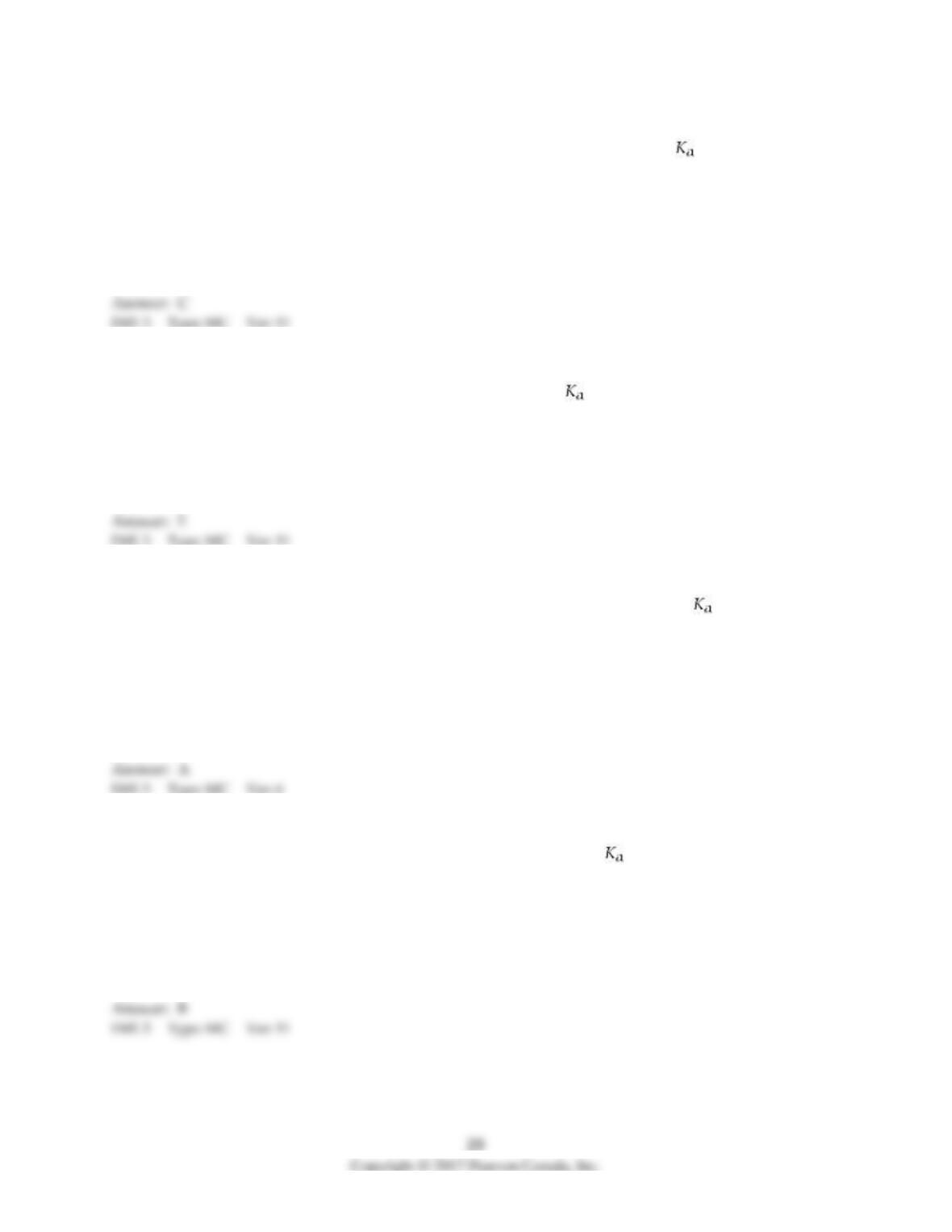
aqueous butanoic acid to the equivalence point? Butanoic acid is monoprotic. The of butanoic acid is
1.5 × 10⁻⁵.
A) 4.90
B) 50.0
C) 41.6
D) 60.1
E) 4.65
118) A 25.0 mL sample of 0.150 mol L-1 aqueous hydrofluoric acid is titrated with a 0.150 mol L-1
NaOH(aq) solution. What is the pH at the equivalence point? The of hydrofluoric acid is 3.5 × 10⁻⁴.
A) 10.17
B) 10.83
C) 3.17
D) 7.00
E) 8.17
119) A 25.0 mL sample of 0.150 mol L-1 aqueous butanoic acid is titrated with a 0.150 mol L–1 NaOH(aq)
solution. What is the pH before any base is added? Butanoic acid is monoprotic. The of butanoic acid
is 1.5 × 10⁻⁵.
A) 2.82
B) 1.5 × 10⁻³
C) 4.82
D) 4.00
E) 1.0 × 10⁴
120) A 25.0 mL sample of 0.150 mol L-1 aqueous hypochlorous acid is titrated with a 0.150 mol L-1
NaOH(aq) solution. What is the pH after 26.0 mL of base is added? The of hypochlorous acid is 3.0 ×
10-8.
A) 2.54
B) 11.47
C) 7.00
D) 7.51
E) 7.54
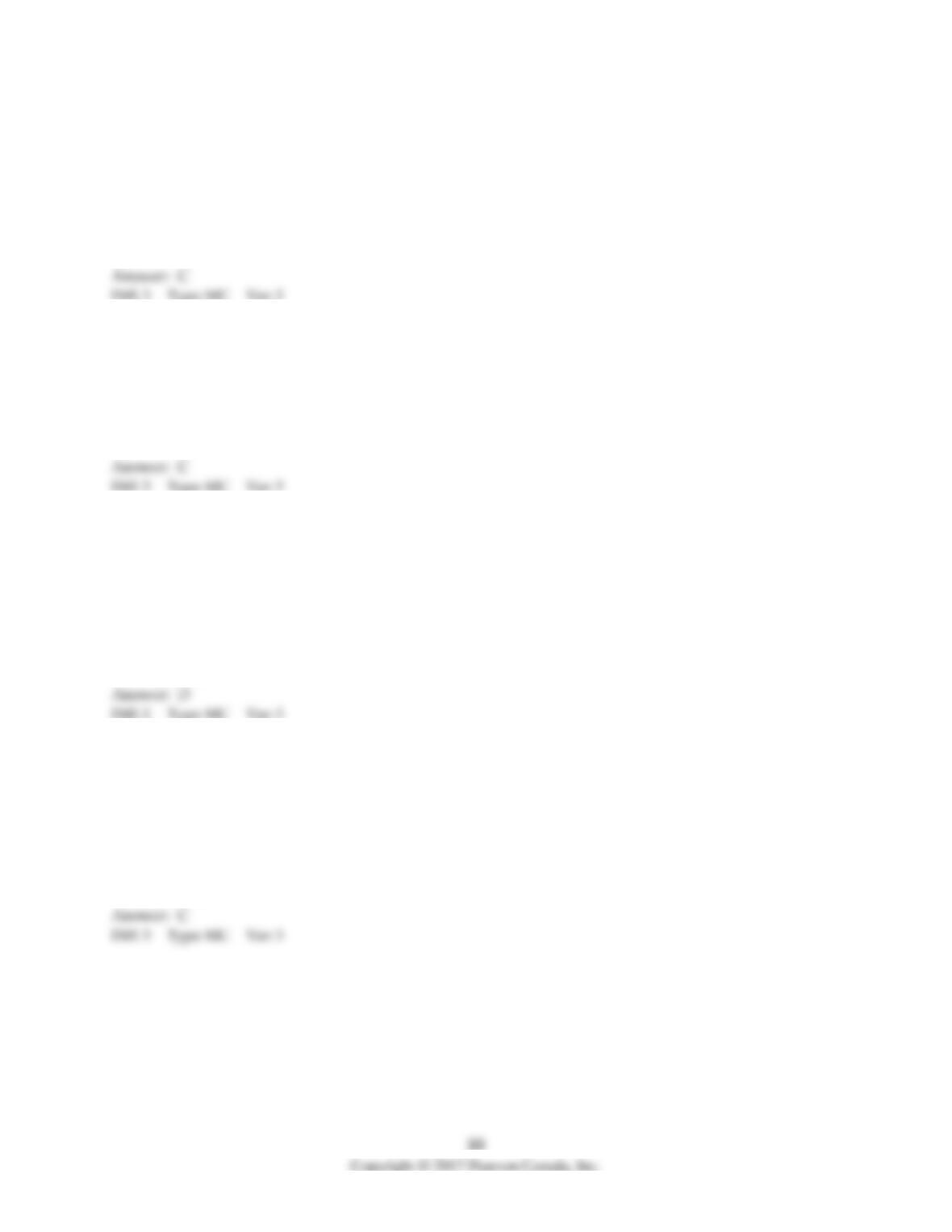
121) What is the approximate pH at the equivalence point of a weak acid-strong base titration if 25 mL of
aqueous formic acid (HCOOH) requires 29.80 mL of 0.3567 mol L-1 NaOH(aq)? Ka =1.8 × 10⁻⁴ for formic
acid.
A) 2.06
B) 5.48
C) 8.52
D) 11.94
122) What is the approximate pH at the equivalence point of a weak acid-strong base titration if 25 mL of
aqueous hydrofluoric acid requires 30.00 mL of 0.400 mol L-1 NaOH(aq)? Ka = 6.76 × 10⁻⁴ for HF.
A) 1.74
B) 5.75
C) 8.25
D) 12.26
123) Formic acid (HCOOH, Ka = 1.8 × 10⁻⁴) is the principal component in the venom of stinging ants.
What is the molarity of a formic acid solution if 25.00 mL of the aqueous formic acid solution requires
29.80 mL of 0.0567 mol L-1 NaOH(aq) to reach the equivalence point?
A) 0.0134 mol L-1
B) 0.0476 mol L-1
C) 0.0567 mol L-1
D) 0.0676 mol L-1
124) Sodium hypochlorite, NaOCl, is the active ingredient in household bleach. What is the concentration
of hypochlorite ion if 20.00 mL of bleach requires 32.00 mL of 0.500 mol L-1 HCl(aq) to reach the
equivalence point?
A) 0.300 mol L-1
B) 0.312 mol L-1
C) 0.800 mol L-1
D) 1.30 mol L-1
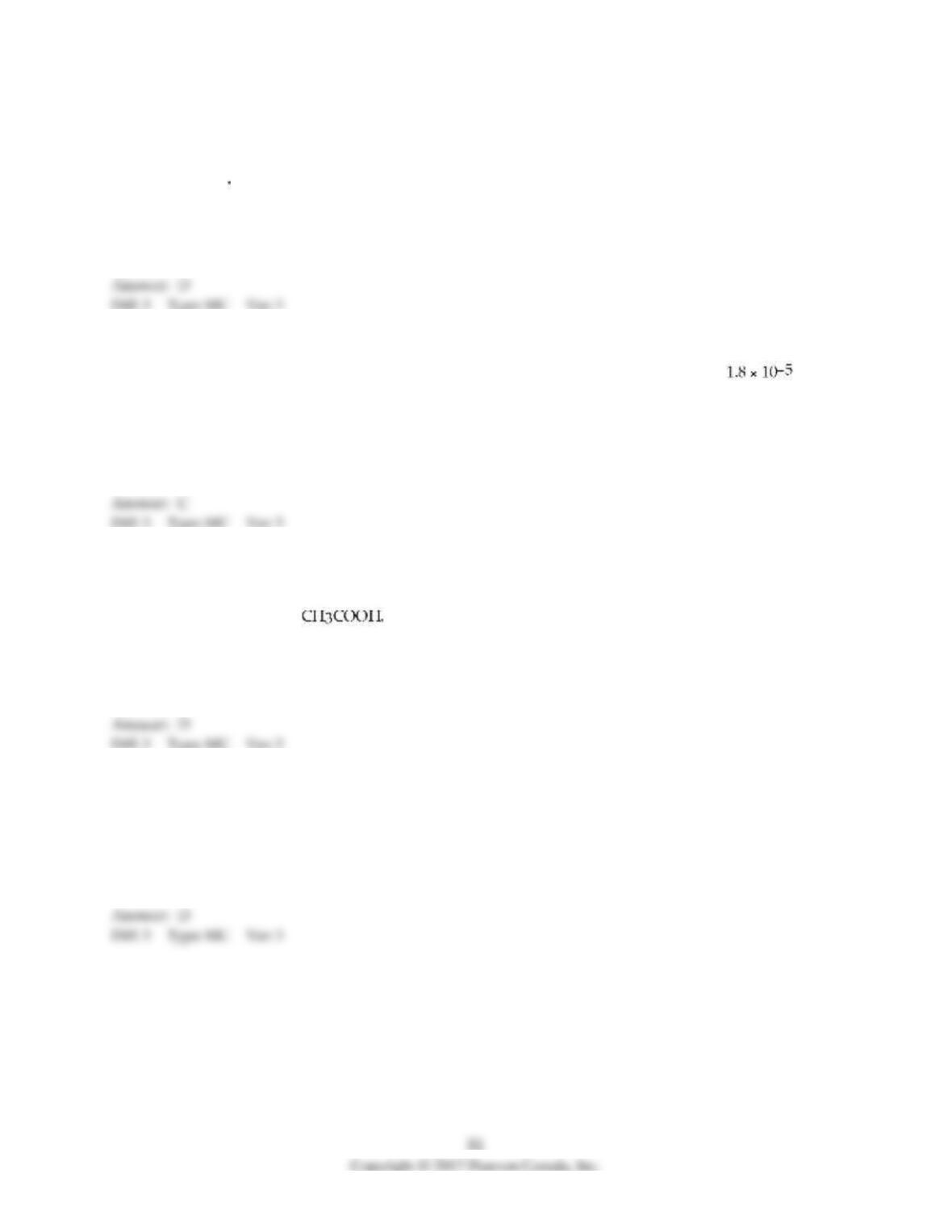
125) What is the pH of the resulting solution if 25.00 mL of 0.10 mol L-1 aqueous acetic acid is added to
10.00 mL of 0.10 mol L-1 NaOH(aq)? Assume that the volumes of the solutions are additive. Ka = 1.8 × 10–
5 for CH3COOH
A) 9.43
B) 9.08
C) 4.92
D) 4.57
126) What is the pH of a solution made by mixing 10.00 mL of 0.10 mol L-1 aqueous acetic acid with 10.00
mL of 0.10 mol L-1 KOH(aq)? Assume that the volumes of the solutions are additive. Ka = for
CH3COOH.
A) 5.28
B) 7.00
C) 8.72
D) 10.02
127) What is the pH of a solution made by mixing 30.00 mL of 0.10 mol L-1 aqueous acetic acid
(CH3COOH) with 50.00 mL of 0.100 mol L-1 KOH(aq)? Assume that the volumes of the solutions are
additive. Ka = 1.8 × 10⁻⁵ for
A) 8.26
B) 9.26
C) 11.13
D) 12.40
128) What is the pH at the equivalence point of a weak base-strong acid titration if 20.00 mL of NaOCl(aq)
requires 28.30 mL of 0.50 mol L-1 HCl(aq) for complete neutralization? Ka = 3.0 × 10⁻⁸ for HOCl.
A) 0.30
B) 3.18
C) 3.76
D) 4.03
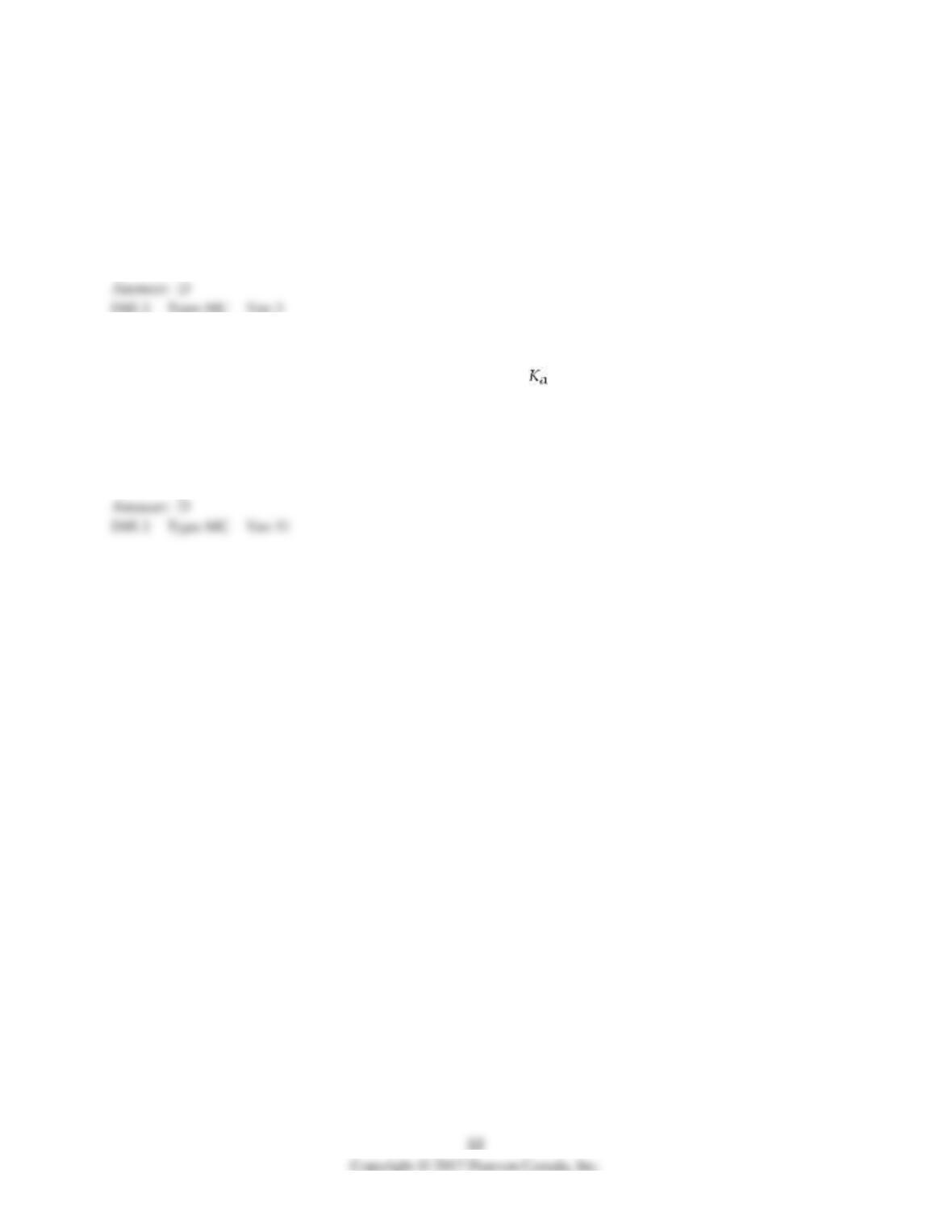
129) What is the pH of the resulting solution if 45 mL of 0.432 mol L-1 aqueous methylamine, CH3NH2, is
added to 15 mL of 0.234 mol L-1 HCl(aq)? Assume that the volumes of the solutions are additive. Ka =
2.70 × 10⁻¹¹ for CH3NH3+.
A) 2.77
B) 4.09
C) 9.91
D) 11.23
130) A 25.0 mL sample of 0.150 mol L-1 aqueous hydrazoic acid is titrated with a 0.150 mol L-1 NaOH(aq)
solution. What is the pH after 13.3 mL of base is added? The of hydrazoic acid is 1.9 × 10⁻⁵.
A) 4.45
B) 1.34
C) 3.03
D) 4.78
E) 4.66