General Chemistry, 11e (Petrucci)
Chapter 17 Additional Aspects of Acid–Base Equilibria
1) The common ion in an aqueous solution mixture of a weak base and a strong base is the hydronium
ion.
2) The common ion in an aqueous solution of a weak acid and a strong acid is the hydronium ion.
3) The pH of a buffer solution changes only slightly with addition of a small amount of acid or base.
4) Mixing comparable amounts of a strong acid and its conjugate base will form a buffer.
5) The pH of a buffer depends mainly on the pKa of the weak acid component of the buffer.
6) The color change range of most acid-base indicators is 1 pH unit.
7) Acid-base indicators have two forms: an acid of one color and a base of another color.
8) In the titration of a solution of HCN(aq) with NaOH(aq), the equivalence point occurs at a pH greater
than 7.
9) For an accurate titration, the end point needs to match the equivalence point.
2
10) The neutralization of a weak acid with a strong base will produce a longer vertical section of a
titration curve than will a strong acid with a strong base.
11) It is easier to calculate the pH of an aqueous solution of sodium carbonate than for sodium hydrogen
carbonate because there is only one hydrolysis reaction instead of two.
12) A salt of a polyprotic acid such as NaHCO3 cannot act as a source of an acid.
13) How will addition of sodium acetate to an aqueous acetic acid solution affect the pH?
A) It will lower the pH.
B) The pH will not change.
C) The solution becomes hotter.
D) The pH cannot be measured.
E) It will raise the pH.
14) How will addition of sodium chloride affect the pH of a HCl(aq) solution?
A) It will lower the pH.
B) The pH will not change.
C) The solution becomes hotter.
D) The pH cannot be measured.
E) It will raise the pH.
15) What is the [H3O+] of an aqueous solution measured to be 0.20 M in sodium acetate and 0.40 M in
acetic acid? (Ka = 1.8 × 10⁻⁵)
A) 1.8 × 10⁻⁵ M
B) 9.0 × 10⁻⁶ M
C) 3.6 × 10⁻⁵ M
D) 7.2 × 10⁻⁵ M
E) 4.7 M
3
16) What is the concentration of the acetate ion of an aqueous solution measured to be 0.20 M acetic acid
in 0.20 M hydrochloric acid? (Ka for acetic acid = 1.8 × 10⁻⁵)
A) 3.6 × 10⁻⁵ M
B) 9.0 × 10⁻⁶ M
C) 1.8 × 10⁻⁵ M
D) 7.2 × 10⁻⁵ M
E) 0.20 M
17) Ten milliliters of 0.10 M NH3(aq) (Kb = 1.8 × 10⁻⁵) is mixed with 10 mL of 0.10 M NH4Cl(aq).
Neglecting the differences between activities and concentrations, the resulting solution:
A) has a pH = 4.74
B) has a [H+] of approximately 10-3 M
C) has a [NH4+] greater than that of the NH4Cl(aq)
D) has an [OH–] of 1.8 × 10⁻⁵ M
E) is acidic
18) If some NH4Cl is added to an aqueous solution of NH3:
A) the pH of the solution will increase
B) the pH of the solution will decrease
C) the solution will not have pH
D) the pH of the solution will not change
E) NH4Cl cannot be added to NH3
19) In 0.100 M HC2H3O2(aq), [H3O+(aq)] = [C2H3O2–(aq)] = 1.3 × 10⁻³ M. If a few drops of concentrated
HCl(aq) are added to this solution, the C2H3O2–(aq) concentration is:
A) < 1.3 × 10⁻³ M
B) > 1.3 × 10⁻³ M
C) = 1.3 × 10⁻³ M
D) 0.100 M
20) Which among the following pairs is inefficient as buffer pair?
A) ammonia and ammonium chloride
B) sodium chloride and sodium hydroxide
C) boric acid and sodium borate
D) potassium carbonate and potassium bicarbonate
E) potassium bromide and hydrobromic acid
21) An aqueous solution containing equimolar amounts of a weak acid with Ka = 10-5 and its sodium salt
has:
A) pH > 7
B) pH < 7
C) pH = 7
D) pH dependent on concentration ratios
E) pH dependent on the nature of the acid anion
22) Which of the following can act as buffer solutions?
I) 0.1 M HC2H3O2/0.1 M NaC2H3O2
II) 0.1 M NH3/0.1 M NH4Cl
III) 0.1 M HNO3/0.1 M NaNO3
IV) 0.1 M H2SO3/0.1 M NaHSO3
V) 0.1 M KHSO4/ 0.1 M H2SO4
A) I), II), and III)
B) II), III) and IV)
C) III) and IV)
D) I), II) and IV)
E) III), IV) and V)
23) The Henderson-Hasselbach equation, used to calculate the pH of simple conjugate-pair buffer
systems, would be expressed for an ammonia/ammonium chloride buffer, for which Kb(NH3) is 1.8 ×
10-5, as:
A) pH = 4.74 + log([NH3]/[NH4+])
B) pH = 4.74 + log([NH4+]/[NH3])
C) pH = 9.25 + log([NH3]/[NH4+])
D) pH = 9.25 + log([NH4+]/[NH3])
E) pH = 14.0 – log(1.8 × 10⁻⁵)
24) What is the buffer range (for an effective 2.0 pH unit) for a benzoic acid/sodium benzoate buffer? [Ka
for benzoic acid is 6.3 × 10⁻⁵]
A) 8.8 – 10.8
B) 7.4 – 9.4
C) 5.3 – 7.3
D) 4.7 – 6.7
E) 3.2 – 5.2
25) Which of the following mixtures would you dismiss as a potential buffer in a laboratory?
A) mixing equal volumes of 0.10 M NaC2H3O2(aq) and 0.10 M HCl(aq)
B) mixing equal volumes of 0.10 M NaC2H3O2(aq) and 0.050 M HCl(aq)
C) mixing equal volumes of 0.10 M NaC2H3O2(aq) and 0.10 M HC2H3O2(aq)
D) mixing equal volumes of 0.10 M HC2H3O2(aq) and 0.050 M NaOH(aq)
E) mixing equal volumes of 0.10 M NH3(aq) and 0.10 M of NH4Cl(aq)
26) The following compounds are available as 0.10 M aqueous solutions: pyridine (pKb = 8.82),
triethylamine (pKb = 3.25), HClO4, phenol (pKa = 9.96), HClO (pKa = 7.54), NH3 (pKb = 4.74) and NaOH.
Identify two solutions that could be used to prepare a buffer with a pH of approximately 5.
A) pyridine and HClO4
B) triethylamine and HClO4
C) phenol and NaOH
D) HClO and NaOH
E) HClO and NH3
27) Phenol red indicator changes from yellow to red in the pH range from 6.6 to 8.0. State what color the
indicator will assume in the following solution: 0.20 M KOH(aq).
A) red
B) yellow
C) red-yellow mixture
D) orange
E) The indicator keeps its original color.
28) Phenol red indicator changes from yellow to red in the pH range from 6.6 to 8.0. State what color the
indicator will assume in the following solution: 0.1 M NaCl(aq).
A) red
B) yellow
C) red-yellow mixture
D) orange
E) The indicator keeps its original color.
29) Phenol red indicator changes from yellow to red in the pH range from 6.6 to 8.0. State what color the
indicator will assume in the following solution: 0.10 M NH4NO3(aq).
A) red
B) yellow
C) red-yellow mixture
D) The indicator is its original color.
E) There is not enough information to answer this question.
30) Phenol red indicator changes from yellow to red in the pH range from 6.6 to 8.0. State what color the
indicator will assume in the following solution: 0.10 M HC2H3O2(aq).
A) red
B) yellow
C) red-yellow mixture
D) The indicator is its original color.
E) There is not enough information to answer this question.
31) What factor governs the selection of an indicator for a neutralization titration?
A) the final volume of the solution
B) the volume of titrant
C) the molarity of the standard solution
D) the pH at the stoichiometric (equivalence) point
E) the solubility of the indicator
32) Phenolphthalein may be used as an indicator for the titration of:
A) a weak base with a strong acid
B) a weak acid with a weak base
C) any acid and base
D) a weak acid with a strong base
E) phenolphthalein cannot be used as an indicator
33) Which of the following statements correctly describe a typical titration curve for the titration of a
strong acid by a strong base?
I) The beginning pH is low.
II) The pH change is slow until near the equivalence point.
III) At the equivalence point, pH changes by a large value.
IV) Beyond the equivalence point, pH rises rapidly.
V) The equivalence point would be at a pH less than 3.5.
A) I), III) and V)
B) II), III) and IV)
C) I), III) and IV)
D) III), IV) and V)
E) I), II) and III)
34) Phenol red indicator changes from yellow to red in the pH range from 6.6 to 8.0. State what color the
indicator will assume in the following solution: 0.10 M NaCN(aq).
A) red
B) yellow
C) red-yellow mixture
D) The indicator is its original color.
E) There is not enough information to answer this question.
35) methyl orange: red at pH < 3.1: orange at pH 3.1-4.4: yellow-orange above pH 4.4
litmus: red at pH < 4.5: purple at pH 4.5-8.3: blue above pH 8.3
thymol blue: yellow at pH < 8.0: green at pH 8.0-9.6: blue above pH 9.6
trinitrobenzene: colorless at pH < 12: yellow at pH 12.0-1: orange above pH 14.0
Which of the pH indicators from the list above would be most appropriate for the titration of 0.30 M
aqueous acetic acid (Ka = 1.8 × 10⁻⁵) with 0.15 M aqueous sodium hydroxide?
A) methyl orange
B) litmus
C) thymol blue
D) trinitrobenzene
E) Both thymol blue and litmus can be used.
36) Which condition characterizes the stoichiometric point of a neutralization titration?
A) Equivalent amounts of acid and base have reacted.
B) The pH is exactly 7.0.
C) The indicator changes color.
D) A slight excess of titrant is present.
E) A slight excess of indicator is present.
37) Choose the correct statement.
A) 30 mL of 2 molar H3PO4(aq) will exactly react with 15 mL of a 2 molar NaOH(aq) solution.
B) One liter of 1 molar HCl(aq) will exactly neutralize 2 liters of 0.5 molar NaOH(aq).
C) A 1 molal solution always contains exactly 1 mole in a liter of solution.
D) One liter of a 1 molar solution of an acid always exactly neutralizes one liter of a one molar solution of
a base.
E) A 1 molar solution requires 2 moles of H2SO4(aq) per liter of solution.
38) The solution that is added from the buret during a titration is the:
A) buffer
B) titrant
C) indicator
D) base
E) titrator
39) In the titration of 50.0 mL of 0.0200 M C6H5COOH(aq) with 0.100 M NaOH(aq), what is/are the major
species in the solution after the addition of 5.0 mL of NaOH(aq)?
A) C6H5COOH, C6H5COO–, and Na+
B) C6H5COOH
C) C6H5COO– and Na+
D) C6H5COOH, OH–, and Na+
E) C6H5COOH, OH–, Na+,C6H5COO–
40) For the following titration, determine whether the solution at the equivalence point is acidic, basic or
neutral and why:
HCl(aq) is titrated with NH3(aq)
A) acidic because of hydrolysis of NH4+
B) basic because of hydrolysis of NH3
C) acidic because of hydrolysis of Cl–
D) acidic because of hydrolysis of HCl
E) neutral salt of strong acid and strong base
41) For the following titration, determine whether the solution at the equivalence point is acidic, basic or
neutral and why:
KOH(aq) is titrated with HI(aq)
A) basic because of hydrolysis of K+
B) basic because of hydrolysis of KOH
C) acidic because of hydrolysis of OH–
D) acidic because of hydrolysis of HI
E) neutral salt of strong acid and strong base
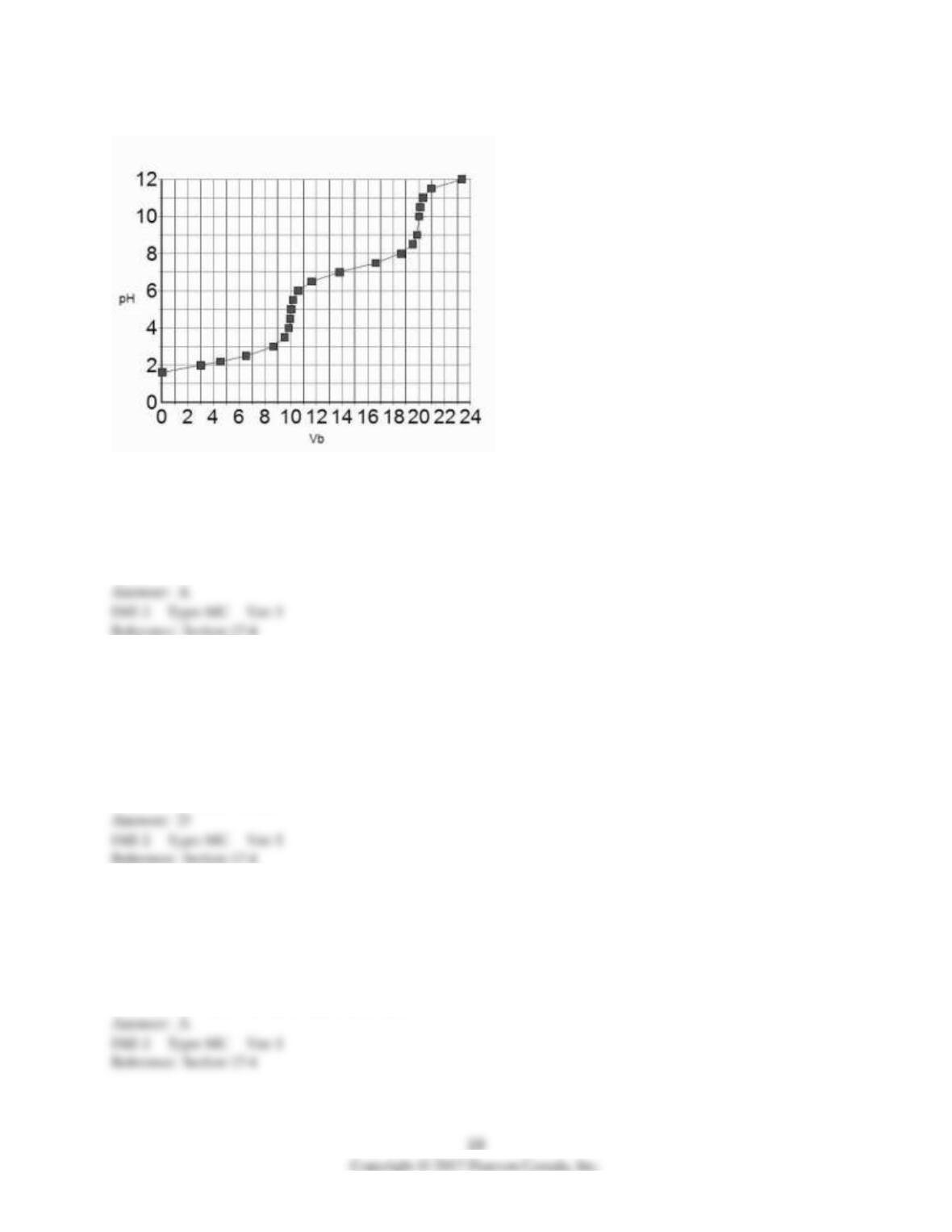
42) The titration curve for 10.0 mL of 0.100 M H3PO4(aq) with 0.100 M NaOH(aq) is given below.
Estimate the pKa2 of H3PO4.
A) 7.2
B) 4.8
C) 9.8
D) 2.2
E) 6.5
43) Choose the expression that gives the molar concentration of a H2SO4(aq) solution if 24.3 mL of a 0.105
M NaOH(aq) solution is required to titrate 60 mL of the acid.
A) (60 × 24.3)/0.105
B) (60 × 2)/(24.3 × 0.105)
C) (24.3 × 0.105)/(60)
D) (24.3 × 0.105)/(60 × 2)
E) (60 × 0.105)/(2 × 24.3)
44) Why do we avoid titrating ammonia with acetic acid?
A) The change in pH near the end point is not large enough to be accurately detected.
B) There is no known indicator which changes color at the right pH.
C) The reaction is too slow.
D) There is not enough difference between the ionization constants of ammonia and acetic acid.
E) Ammonia does not react with acetic acid.
45) An aqueous solution of an unknown acid had a pH of 3.70. Titration of a 25.0 mL aliquot of the acid
solution required 21.7 mL of 0.104 M aqueous sodium hydroxide for complete reaction. Assuming that
the acid is monoprotic, what is its ionization constant?
A) 9.0 × 10⁻²
B) 2.0 × 10⁻⁴
C) 4.4 × 10⁻⁷
D) 3.6 × 10⁻⁹
E) 2.7 × 10⁻¹¹
46) For the following titration, determine whether the solution at the equivalence point is acidic, basic, or
neutral and why: NaHCO3(aq) titrated with NaOH(aq)
A) basic because of excess OH–
B) acidic because of hydrolysis of HCO3–
C) acidic because of hydrolysis of Na+
D) neutral salt of strong acid and strong base
E) basic because of hydrolysis of CO32-
47) In a solution prepared by mixing equal volumes of 0.20 M aqueous acetic acid and 0.20 M aqueous
hydrobromic acid, the common ion is ________.
A) Br–
B) C2H3O22-
C) H2C2H3O2
D) H2Br+
E) H3O+
48) Determine the pH of the following aqueous solution. Initial concentrations are given.
[HC2H3O2] = 0.250 M, [HCl] = 0.120 M Ka (acetic acid) = 1.8 × 10⁻⁵
A) 0.60
B) 0.92
C) 0.43
D) 4.74
E) 13.08
49) Determine the [C2H3O2–] of the following aqueous solution. Initial concentrations are given.
[HC2H3O2] = 0.250 M, [HI] = 0.120 M Ka (acetic acid)= 1.8 × 10⁻⁵
A) 8.6 × 10⁻⁶ M
B) 3.8 × 10⁻⁵ M
C) 1.8 × 10⁻⁵ M
D) 0.25 M
E) 0.37 M
50) Determine the pH of the following aqueous solution. Initial concentrations are given.
[HF] = 1.296 M, [HCl] = 1.045 M Ka for HF is 6.6 × 10⁻⁴
A) 14
B) 3.1
C) 3.2
D) -0.019
E) 0.60
51) Calculate the pH of a 1.00 L solution of 0.100 M NH3(aq) after the addition of 0.010 mol HCl(g). For
NH3, pKb = 4.74.
A) 10.21
B) 9.26
C) 8.31
D) 11.46
E) 7.00
52) Determine the [F–] of the following aqueous solution. Initial concentrations are given.
[HF] = 1.296 M, [NaF] = 1.045 M, Ka for HF is 6.6 × 10⁻⁴
A) 1.046 M
B) 2.344 M
C) 5.3 × 10⁻⁴ M
D) 8.2 × 10⁻⁴ M
E) 0.251 M
53) Calculate the pH of a 1.00 L solution of 0.100 M NH3(aq) after the addition of 0.010 mol NH4Cl(s). For
NH3, pKb = 4.74.
A) 10.26
B) 9.26
C) 8.26
D) 11.56
54) What is the pH of a solution prepared by mixing equal volumes of 0.10 M aqueous hydrochloric and
0.1 M aqueous hydrofluoric acid? (Ka for HF is 6.6 × 10⁻⁴)
A) 1.0
B) 1.3
C) 1.6
D) 2.2
E) 5.0
55) Assuming no volume change on mixing, what mass of ammonium chloride should be added to 250.0
mL of 0.25 M aqueous ammonia to produce a solution of pH 10.70? (Kb for ammonia is 1.8 × 10⁻⁵)
A) 3.7 mg
B) 120 mg
C) 40 mg
D) 30 mg
E) 80 mg
56) Determine the pH of the following aqueous solution. Initial concentrations are given.
[HC2H3O2] = 0.250 M, [NaC2H3O2] = 0.120 M , Ka ( acetic acid) = 1.8 × 10⁻⁵
A) 5.1
B) 4.4
C) 8.9
D) 9.6
E) 7.0
57) Determine the pH of the following aqueous solution. Initial concentrations are given.
[HF] = 1.296 M, [NaF] = 1.045 M, Ka for HF is 6.6 × 10⁻⁴
A) 10.73
B) 3.27
C) 3.18
D) 3.09
E) 11.91
58) A weak acid has Ka = 4.2 × 10⁻³. If [A–] = 2.0 M, what must [HA] be so that [H+] = 2.1 × 10⁻³ M?
A) 1.5 M
B) 2.0 M
C) 1.0 M
D) 0.5 M
E) 0.25 M
59) A weak acid has Ka = 1.00 × 10⁻³. If [HA] = 1.00 M what must be [A–] for the pH to be 2.7?
A) 0.50 M
B) 2.0 M
C) 2.7 M
D) 0.37 M
E) 0.75 M
60) A buffer was prepared by adding 2.4 g of ammonium nitrate to 100.0 mL of 0.30 M aqueous ammonia
(Kb = 1.8 × 10⁻⁵). To this solution was then added 10.0 mL of 0.30 M aqueous sodium hydroxide, which
caused a pH change of ________.
A) 3.0 pH units
B) 0.30 pH units
C) 0.90 pH units
D) 0.09 pH units
E) zero
61) A pH 4.88 buffer was prepared by dissolving 0.10 mol of benzoic acid (Ka = 6.3 × 10⁻⁵) and 0.50 mol of
sodium benzoate in sufficient pure water to form a 1.00 L solution. To a 70.0 mL aliquot of this solution
was added 2.00 mL of 2.00 M aqueous HI solution. What was the pH of the new 72.0 mL solution?
A) 2.84
B) 3.16
C) 3.36
D) 4.65
E) 4.90
62) The buffer capacity of a solution may be defined as the number of moles of H+ that will change the
pH of 1.00 L of the buffer by 1.00 pH units. What is the buffer capacity of an aqueous solution which is
0.10 M in acetic acid (Ka = 1.8 × 10⁻⁵) and 0.30 M in sodium acetate, in units of mol (H+) per liter?
A) 0.20
B) 0.10
C) 0.087
D) 0.009
E) zero
63) For HClO2, Ka = 1.2 × 10⁻². What is the pH of an aqueous solution in which [NaClO2] = 0.193 M and
[HClO2] = 0.203 M?
A) 3.32
B) 0.11
C) 1.92
D) 1.94
E) 1.90
64) An acid has a Ka = 1 × 10⁻⁶. At what pH would this acid and its corresponding salt make a good
buffer?
A) 6
B) 7
C) 8
D) 5
E) 4
65) An aqueous solution has [HC7H5O2] = 0.100 M and [Ca(C7H5O2)2] = 0.200 M. Ka = 6.3 × 10⁻⁵ for
HC7H5O2. The solution volume is 5.00 L. What is the pH of this solution after 5.00 mL 10.0 M HCl(aq) is
added?
A) 4.80
B) 4.86
C) 4.65
D) 4.70
E) 4.75
66) An aqueous solution has [HC7H5O2] = 0.100 M and [Ca(C7H5O2)2] = 0.200 M. Ka = 6.3 × 10⁻⁵ for
HC7H5O2. The solution volume is 5.00 L. What is the pH of the solution after 10.00 mL of 5.00 M NaOH
is added?
A) 4.80
B) 4.86
C) 4.65
D) 4.70
E) 4.75
67) What is the pH of a buffer solution prepared by dissolving 25.5 g NaC2H3O2 in a sufficient volume of
0.550 M aqueous HC2H3O2 to make 500.0 mL of buffer?
A) 4.74
B) 4.68
C) 4.91
D) 4.57
E) 4.79