General Chemistry, 11e (Petrucci)
Chapter 16 Acids and Bases
1) According to the Arrhenius theory, a neutralization reaction involves the combination of an acid with a
base to make only water.
2) According to the Arrhenius theory, a neutralization reaction involves the combination of hydrogen
ions and hydroxide ions to form water.
3) Br∅nsted and Lowry suggested that bases be defined as proton acceptors.
4) The term pH = -ln [H+].
5) HNO3 is a strong acid.
6) Amine bases are known as strong bases.
7) The first ionization step is approximately 100% for H2SO3.
8) H2SO4 is a weaker acid than H2SO3.
9) When comparing binary acids of the elements in the same row of the periodic table, acid strength
increases as the polarity of the element-hydrogen bond increases.
10) In the reaction BF3 + NH3 → F3B:NH3, BF3 acts as a Br∅nsted acid.
11) The definition of a neutralization reaction as a reaction in which an acid reacts with a base to produce
water and a salt is inherent in:
A) only the Arrhenius theory
B) both the Arrhenius and the Br∅nsted-Lowry theories
C) only the Br∅nsted-Lowry theory
D) both the Br∅nsted-Lowry and the Lewis theories
E) only the Lewis theory
12) According to the Arrhenius theory, a neutralization reaction involves:
A) the combination of hydrogen ions and hydroxide ions to form water
B) the dissociation of a strong acid to hydrogen ions and an anion
C) the dissociation of a strong base into hydroxide ions and a cation
D) the addition of water to ammonia to make ammonium hydroxide
E) the combination of an acid with a base to make only water
13) Proton acceptor is an abbreviated definition of:
A) Br∅nsted-Lowry base
B) Br∅nsted-Lowry acid
C) Lewis base
D) Lewis acid
E) Arrhenius acid
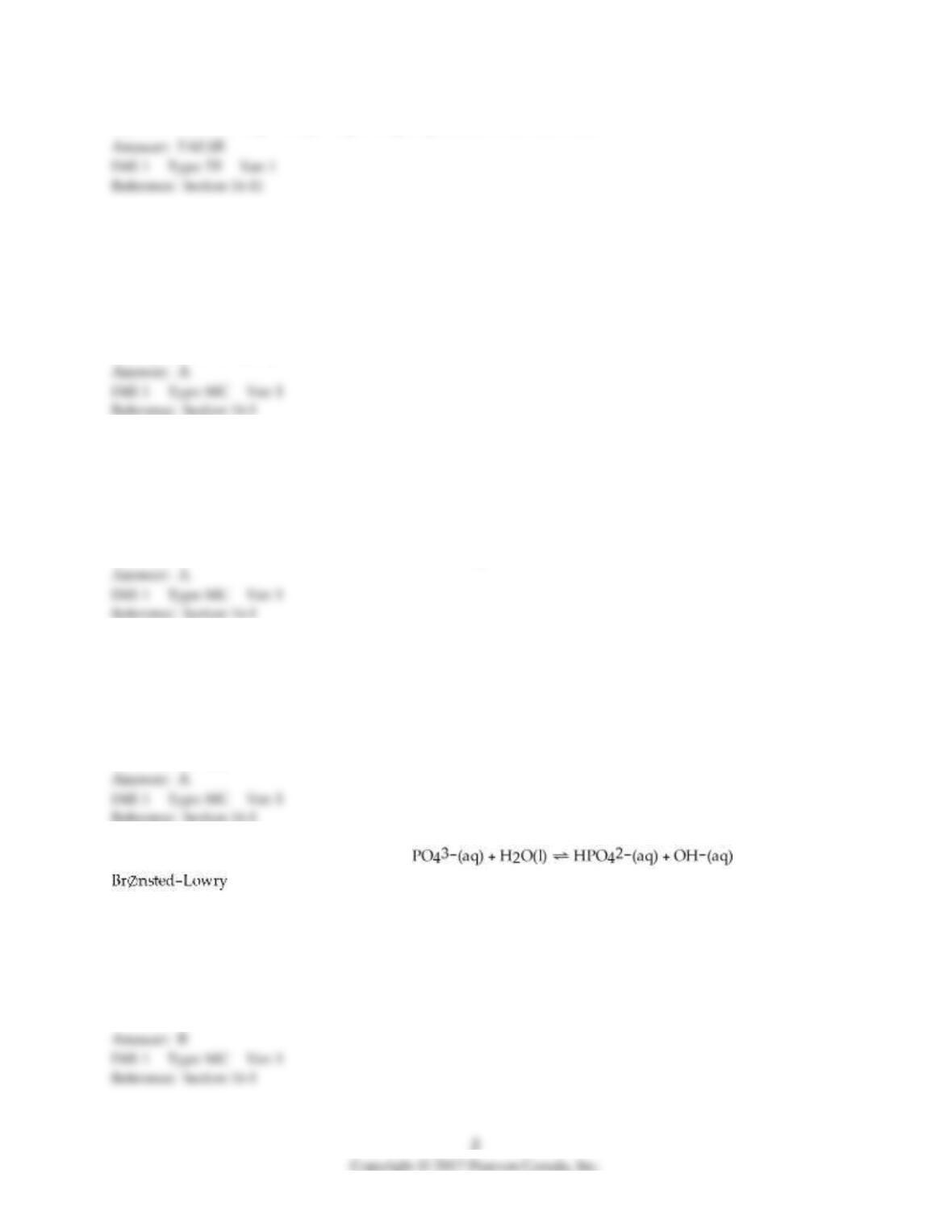
14) In the equilibrium system described by:
theory would designate:
A) PO43- and H2O as the bases
B) H2O and OH– as a conjugate pair
C) HPO42- and OH– as the acids
D) HPO42- and H2O as a conjugate pair
E) PO43- as amphiprotic
15) Which of the following are Br∅nsted-Lowry acids?
I) CH3COOH
II) [Cu(H2O)4]2+
III) H2O
IV) CH3NH2
V) H3O+
A) I), II) and III)
B) II), III), and IV)
C) I), II), III) and IV)
D) I), II), III), and V)
E) II), III) and V)
16) Choose the Br∅nsted-Lowry acids and bases in the following equation:
HCN + OH– ⇌ H2O + CN–
A) acids HCN, CN– bases OH–, H2O
B) acids CN–, OH– bases HCN, H2O
C) acids HCN, H2O bases OH–, CN–
D) acids OH–, H2O bases CN–, HCN
E) acids HCN, OH– bases H2O, CN–
17) Choose the Br∅nsted-Lowry acids and bases in the following equation:
NH4+ + OH– ⇌ H2O + NH3
A) acids NH4+, OH– bases H2O, NH3
B) acids OH–, H2O bases NH3, NH4+
C) acids NH4+, OH– bases NH4+, H2O
D) acids NH4+, H2O bases OH–, NH3
E) acids NH4+, NH3 bases OH–, H2O
18) Choose the Br∅nsted-Lowry acids and bases in the following equation:
H2O + NH2– ⇌ NH3 + OH–
A) acids H2O, OH– bases NH3, NH2–
B) acids NH2–, NH3 bases H2O, OH–
C) acids H2O, NH2– bases OH–, NH3
D) acids NH3, NH2– bases OH–, H2O
E) acids H2O, NH3 bases NH2–, OH–
19) Choose the Br∅nsted-Lowry acids and bases in the following equation:
HCO3– + OH– ⇌ H2O + CO32-
A) acids HCO3–, H2O bases OH–, CO32-
B) acids OH–, CO32- bases HCO3–, H2O
C) acids H2O, OH– bases HCO3–, CO32-
D) acids HCO3–, OH– bases CO32-, H2O
E) acids H2O, CO32- bases HCO3–, OH–
20) Choose the Br∅nsted-Lowry acids and bases in the following equation:
HSO4– + C2H3O2– ⇌ HC2H3O2 + SO42-
A) acids HSO4–, SO42- bases HC2H3O2, C2H3O2–
B) acids HSO4–, HC2H3O2 bases SO42-, C2H3O2–
C) acids SO42-, HC2H3O2 bases HSO4–, C2H3O2–
D) acids SO42-, C2H3O2– bases HSO4–, HC2H3O2
E) acids HSO4–, C2H3O2– bases HC2H3O2, SO42-
21) Consider the reaction:
HC2H3O2 + H2O ⇌ H3O+ + C2H3O2–
Choose the pair of substances that are both bases in the reaction.
A) HC2H3O2 and H3O+
B) H2O and C2H3O2–
C) H2O and H3O+
D) HC2H3O2 and C2H3O2–
E) H3O+ and HC2H3O2
22) pOH = 3.14 is equivalent to:
A) pH = 11
B) [H+] = 1.4 × 10⁻¹⁰ M
C) [OH–] = 7.2 × 10⁻⁴ M
D) [H+} = 7.0 × 10⁻⁴ M
E) [OH–] = 3.14 × 10⁻⁷ M
23) A solution has pOH of -0.47. This means that:
A) the solution has a pH of 13.53
B) the solution has an [OH–] = 0.34 M
C) the solution has an [OH–] greater than 10.0 M
D) the solution has an [OH–] = 2.95 M
E) The solution has an [H+] = 2.95 M
24) At 25 °C, the pH of pure water is:
A) 0
B) >0, <7
C) 7
D) >7, <14
E) 14
6
25) Choose the INCORRECT statement. The term pH:
A) refers to the “potential” of hydrogen ion
B) = -ln [H+]
C) = 14 – pOH
D) is more convenient than exponential notation
E) = -log [H3O+]
26) Choose the strongest acid.
A) HF
B) H2CO3
C) HCN
D) HC2H3O2
E) HClO4
27) Which of the following is the strongest base?
A) Cl–
B) ClO4–
C) F–
D) NO3–
E) H2O
28) A saturated aqueous solution of calcium hydroxide has a pH of 12.25. What is the [Ca2+] in such a
solution?
A) 0.018
B) 5.6 × 10⁻¹³
C) 2.3 × 10⁻⁵
D) 0.035
E) 8.9 × 10⁻³
29) 0.272 g of a monoprotic acid (MW = 189 g/mol) is dissolved in water to produce 25.0 mL of a solution
with pH = 4.93. Determine the ionization constant of the acid.
A) 4.1 × 10⁻⁸
B) 1.4 × 10⁻¹⁰
C) 2.1 × 10⁻⁴
D) 2.8 × 10⁻⁷
E) 2.4 × 10⁻⁹
30) 0.375 g of a monoprotic acid (MW = 245 g/mol) is dissolved in water to produce 25.0 mL of a solution
with pH = 3.28. Determine the ionization constant of the acid.
A) 8.56 × 10⁻³
B) 4.5 × 10⁻⁶
C) 7.4 × 10⁻⁵
D) 4.5 × 10⁻³
E) 2.3 × 10⁻²
31) 0.653 g of a monoprotic acid (MW= 157 g/mol) is dissolved in water to produce 50.0 mL of a solution
with pH = 2.13. Determine the ionization constant of the acid.
A) 7.9 × 10⁻³
B) 8.9 × 10⁻²
C) 6.6 × 10⁻⁴
D) 3.9 × 10⁻²
E) 3.6 × 10⁻⁶
32) A 0.632 M aqueous solution of a monoprotic base has a pH of 11.53. What is the ionization constant of
this base?
A) 1.8 × 10⁻⁵
B) 2.1 × 10⁻³
C) 1.6 × 10⁻²³
D) 5.0 × 10⁻¹²
E) 5.3 × 10⁻³
33) A 0.214 M aqueous solution of a monoprotic base has a pH of 11.48. What is the ionization constant of
this base?
A) 1.4 × 10⁻²
B) 4.3 × 10⁻⁵
C) 1.5 × 10⁻¹¹
D) 5.1 × 10⁻²³
E) 2.0 × 10⁻⁶
34) A 0.505 g sample of a monoprotic base (mm = 45.09 g/mol) was dissolved in water to produce 100.0
mL of solution with a pH = 11.84. What is the ionization constant of this base?
A) 4.3 × 10⁻⁵
B) 1.9 × 10⁻²³
C) 4.3 × 10⁻⁴
D) 3.4 × 10⁻¹
E) 1.3 × 10⁻¹¹
35) A 0.0925 g sample of a monoprotic base (mm = 17.03 g/mol) was dissolved in water to produce 100
mL of solution with a pH = 11.00. What is the ionization constant of this base?
A) 1.8 × 10⁻⁶
B) 1.8 × 10⁻¹¹
C) 1.8 × 10⁻²¹
D) 1.8 × 10⁻⁵
E) 1.1 × 10⁻⁶
36) For which of the following polyprotic acids is the first ionization step approximately 100%?
A) H2S
B) H2SO3
C) H2CO3
D) H2SO4
E) H3PO4
37) What is the [HPO4-2] of a solution labeled “0.10 M phosphoric acid”?
[Ka1 = 7.1 × 10⁻³; Ka2 = 6.3 × 10⁻⁸; Ka3 = 4.2 × 10⁻¹³]
A) 4.2 × 10⁻¹³ M
B) 6.3 × 10⁻⁸ M
C) 7.1 × 10⁻³ M
D) 1.6 × 10⁻⁹ M
E) 1.6 × 10⁻¹⁶ M
38) What is the [AsO43-] for a solution labeled “0.10 M arsenic acid (H3AsO4)”?
[Ka1 = 6 × 10⁻³, Ka2 = 1 × 10⁻⁷, Ka3 = 3 × 10–12]
A) 1 × 10⁻⁷ M
B) 1 × 10-17 M
C) 3 × 10-12 M
D) 3 × 10-19 M
E) 6 × 10⁻¹⁰ M
39) Which of the following is a logical inference from the fact that a 0.10 M solution of potassium acetate,
KC2H3O2, is less alkaline than a 0.10 M solution of potassium cyanide, KCN?
A) Hydrocyanic acid is a weaker acid than acetic acid.
B) Cyanides are less soluble than acetates.
C) Hydrocyanic acid is less soluble in water than acetic acid.
D) Acetic acid is a weaker acid than hydrocyanic acid.
E) 0.10 M potassium acetate is more concentrated than 0.10 M potassium cyanide.
40) The pH of a solution of NH4C2H3O2 is approximately 7. The best explanation is:
A) This salt does not react with water.
B) Ammonium acetate is a weak electrolyte.
C) All salts of weak acids and weak bases are neutral.
D) Aqueous ammonia and acetic acid have approximately equal ionization constants.
E) The salt is a product of a strong acid and a strong base.
10
41) Which of the following statements concerning aqueous solutions of salts is FALSE?
A) For any salt of a strong acid and a strong base, the pH will be about 7.
B) For any salt of a strong acid and a weak base, the pH will be <7.
C) For any salt of a weak acid and a strong base, the pH will be >7.
D) For any salt of a weak acid and a weak base, the pH will be about 7.
E) Salt solutions can have a pH of 7.
42) Which indication of relative acid strengths is INCORRECT?
A) HCl > HF
B) HClO2 > HClO
C) H2SO4 > H2SO3
D) H2SO3 > HNO3
E) CH3CO2H > CH3CH2OH
43) Which of the following are Lewis bases?
I) BCl3
II) H–
III) H2O
IV) NH3
V) AlCl3
A) II), III) and IV)
B) I), II), and III)
C) III), IV) and V)
D) I), II), and V)
E) I), II), and IV)
44) The concept of an acid not limited to H+ or species containing one or more protons is inherent in:
A) only the Arrhenius theory
B) both the Arrhenius and the Br∅nsted-Lowry theories
C) only the Br∅nsted-Lowry theory
D) both the Br∅nsted-Lowry and the Lewis theories
E) only the Lewis theory
45) In the reaction BF3 + NH3 ⇌ F3B:NH3, BF3 acts as:
A) an Arrhenius base
B) a Lewis base
C) a Br∅nsted acid
D) a Lewis acid
E) an Arrhenius acid
46) Which species in the following reaction acts as a Lewis acid?
CuSO4(s) + 4 NH3(aq) ⇌ [Cu(NH3)4]2+(aq) + SO42-(aq)
A) SO42-
B) Cu2+
C) [Cu(NH3)4]2+(aq)
D) NH3
E) [Cu(NH3)4]2+(aq) and SO42-
47) In which of the following cases is water acting as a base under the Lewis definitions, but not under
the Bronsted-Lowry definitions?
A) H2O(l) + HF(g) ⇌ H3O+(aq) + F–(aq)
B) H2O(l)+ CN–(aq) ⇌ OH–(aq) + HCN(aq)
C) 2 H2O(l) + Cu2+(aq) ⇌ Cu(H2O)22+(aq)
D) 2 H2O(l) + PO43-(aq) ⇌ 2 OH–(aq) + H2PO4–(aq)
E) 2 H2O(l) [electrolysis] ⇌ 2 H2(g) + O2(g)
48) In the following reversible reaction the Br∅nsted acids are ________.
HCO3–(aq) + OH–(aq) ⇌ CO32-(aq) + H2O
A) HCO3– and H2O
B) HCO3– and CO32-
C) OH– and CO32-
D) OH– and H2O
E) H2O and CO32-
49) Complete the following equation. List the conjugate acid base pairs. Put the base first in each pair.
HCl + NH3 ⇌
A) Cl– + NH4+ (NH3, NH4+) (Cl–, HCl)
B) Cl– + NH4+ (NH3, HCl) (Cl–, NH4+)
C) H2 + Cl– + NH2– (NH3, NH2–) (Cl–, HCl)
D) H2Cl+ + NH2– (NH3, NH2–) (HCl, H2Cl)
E) Cl– + NH4+ (NH3, Cl–) (NH4+, HCl)
50) What is the pH of a solution prepared by dissolving 0.140 g of potassium hydroxide in sufficient pure
water to prepare 250.0 ml of solution?
A) 2.000
B) 6.000
C) 10.000
D) 12.000
E) 14.000
51) What is the [OH–] of a solution prepared by dissolving 0.0912 g of hydrogen chloride in sufficient
pure water to prepare 250.0 ml of solution?
A) 1.00 × 10⁻² M
B) 1.00 × 10⁻⁸ M
C) 1.00 × 10⁻¹² M
D) 1.00 × 10⁻⁴ M
E) 1.0 M
52) What is the [K+] of a solution prepared by dissolving 0.140 g of potassium hydroxide in sufficient
pure water to prepare 250.0 ml of solution?
A) 10-5 M
B) 10-8 M
C) 10–12 M
D) 10-4 M
E) 10-2 M
53) What would be the pH of a solution prepared by dissolving 14.4 g NaOH (MW = 40.0 g/mol) in
enough water to make 1.05 L of solution?
A) 13.54
B) 0.46
C) 13.58
D) 13.66
E) 7.00
54) For HI, predict whether the solution is acidic, basic or neutral and why.
A) acidic because HI is a strong acid
B) basic because HI is a weak base
C) neutral because there is no hydrolysis
D) basic because HI is the salt of a weak acid
E) acidic because HI is the salt of a weak base
55) What is the [Cl–] of a solution prepared by dissolving 0.1824 g of hydrogen chloride in sufficient pure
water to prepare 500.0 ml of solution?
A) 1.00 × 10⁻² M
B) 1.00 × 10⁻⁸ M
C) 1.00 × 10⁻¹² M
D) 1.00 × 10⁻⁴ M
E) 1.0 M
56) If one mole of Ba(OH)2 is added to enough water to make 10 liters of solution, the pH of the resulting
solution is ________.
A) 13.3
B) 1.0
C) 0.7
D) 13.0
E) 12.5
57) A 250.0 ml sample of gaseous hydrogen bromide, measured at 22.9 °C and 0.930 atm, was dissolved in
sufficient pure water to form 250.0 ml of solution. What was the pH of that solution?
A) 1.42
B) 2.58
C) 3.83
D) 4.18
E) 5.68
58) A saturated aqueous solution of calcium hydroxide is approximately 0.13% calcium hydroxide, by
mass, and has a density of 1.02 g ml-1. What is the pH of such a solution?
A) 11.95
B) 12.25
C) 12.55
D) 12.75
E) 13.00
59) For NH3, predict whether a 1 M aqueous solution is acidic, basic or neutral and why.
A) acidic because NH3 is a strong acid
B) basic because NH3 is a weak base
C) neutral because there is no hydrolysis
D) basic because NH3 is the salt of a weak acid
E) acidic because NH3 is the salt of a weak base
60) What is the pH of a 0.470 M aqueous solution of pyridine? Kb = 1.5 × 10⁻⁹
A) 9.0
B) 11.2
C) 2.8
D) 9.4
E) 4.6
61) What is the pH of a 0.570 M aqueous solution of aniline? Kb = 7.4 × 10⁻¹⁰
A) 11.4
B) 2.6
C) 9.8
D) 4.7
E) 9.3
62) What is the pH of a 0.380 M aqueous solution of ethylamine? Kb = 4.3 × 10⁻⁴
A) 12.1
B) 1.9
C) 10.2
D) 5.5
E) 8.5
63) What is the pH of a 0.250 M aqueous solution of formic acid? Ka = 1.8 × 10⁻⁴
A) 11.8
B) 2.2
C) 0.60
D) 5.4
E) 8.6
64) What is the pH of a 0.375 M aqueous solution of benzoic acid? Ka = 6.3 × 10⁻⁵
A) 8.9
B) 5.1
C) 2.3
D) 0.43
E) 11.7
65) What is the pH of a 0.530 M aqueous solution of hypochlorus acid? Ka = 2.9 × 10⁻⁸
A) 10.6
B) 3.4
C) 10.1
D) 3.9
E) 0.28
66) The ionization constant for ammonia is 1.8 × 10⁻⁵. What is the pH of an aqueous solution labeled 0.50
M ammonia?
A) 7.30
B) 9.12
C) 10.26
D) 11.48
E) 12.52
67) The Kb value for methylamine is 4.2 × 10⁻⁴. What is the pH of an aqueous solution for which the label
reads “0.042 M CH3NH2“?
A) 2.4
B) 4.8
C) 9.2
D) 11.6
E) 12.3
68) Hypochlorous acid (HOCl) has an ionization constant of 3.2 × 10⁻⁸. What is its percent ionization in
1.0 M and 0.10 M solutions, respectively?
A) 0.018% and 0.057%
B) 0.032% and 0.0032%
C) 0.57% and 0.18%
D) 0.57% in both
E) 0.32% in both
69) What is the pH for a solution labeled “0.10 M arsenic acid (H3AsO4)”?
[Ka1 = 6 × 10⁻³, Ka2 = 1 × 10⁻⁷, Ka3 = 3 × 10–12]
A) 1.6
B) 4.0
C) 6.3
D) 1.0
E) 3.2
70) What is the concentration of free sulfate ion in an aqueous solution labeled “3.6 M H2SO4“?
[Ka2 = 1.1 × 10⁻²]
A) 0.011 M
B) 0.040 M
C) 0.20 M
D) 0.60 M
E) 1.8 M