General Chemistry, 11e (Petrucci)
Chapter 15 Principles of Chemical Equilibrium
1) In a system in equilibrium, two opposing reactions occur at equal rates.
2) For a solute (X) aq, in an ideal aqueous solution, its activity equals its concentration.
3) In an equilibrium process, the concentrations of products and of reactants are equal.
4) Equilibrium reactions are noted by a single straight arrow for a yield sign.
5) The value of the equilibrium constant for a given reaction depends on the initial concentrations of
reactants.
6) The concentration of a pure solid is left out of a equilibrium constant expression but a pure liquid is
included.
7) Large value for equilibrium constant K means the reaction will be less complete at the equilibrium
point.
8) Both products and reactants will be present in an equilibrium reaction unless K is very small or very
large.
9) Reaction quotient Q will always be equal to the reaction’s equilibrium constant K.
10) Changes in temperature cause change in the equilibrium position.
11) One method to aid in working out equilibrium problems is the ICE table.
12) Choose the INCORRECT statement.
A) A certain amount of energy, called the activation energy, must be available if a reaction is to take
place.
B) A reversible chemical reaction is one in which equilibrium is never established due to the constant
decomposition of the products.
C) When the rate of the reverse reaction equals the rate of the forward reaction, equilibrium has been
established.
D) Changes in temperature will change the value of an equilibrium constant.
E) Chemical equilibrium is a dynamic equilibrium.
13) What is the value for Kc if [CO] = 0.025 M, [H2] = 0.013 M and [CH3OH] = 0.0028 M for the following
reaction?
CH3OH(g) ⇌ CO(g) + 2 H2(g)
A) 1.5 × 10⁻³
B) 0.12
C) 6.6 × 10²
D) 8.6
E) 9.1 × 10⁻⁷
3
14) What is the value for Kc for the reaction below if the equilibrium concentrations are [N2] = 0.025 M,
[H2] = 0.0013 M and [NH3] = 0.028 M for the following reaction?
N2(g) + 3 H2(g) ⇌ 2 NH3(g)
A) 8.6 × 10²
B) 1.4 × 10⁷
C) 1.2 × 10⁻³
D) 7.1 × 10⁻⁸
E) 7.4 × 10⁵
15) For the reaction: H2(g) + I2(g) ⇌ 2 HI(g), Kc = 92.0
When equilibrium concentrations of HI and I2 are [HI] = 0.115 M and [I2] = 0.250 M, the equilibrium
concentration of [H2] is:
A) 5.00 × 10⁻³ M
B) 5.75 × 10⁻⁴ M
C) 1.74 × 10³ M
D) 0.135 M
E) 9.56 M
16) Given that the equilibrium concentrations of [N2] = 0.035 M, [C2H2] = 0.057 M, and [HCN] = 6.8 × 10⁻⁴
M, find the value of the equilibrium constant expression for the reaction:
N2(g) + C2H2(g) ⇌ 2 HCN
A) 3.4 × 10⁻¹
B) 2.9
C) 4300
D) 2.3 × 10⁻⁴
E) 6.8 × 10⁻¹
17) For which of the following reactions does Kp = Kc?
A) 3 Fe(s) + 4 H2O(g) ⇌ Fe3O4(s) + 4 H2(g)
B) C(s) + H2O(g) ⇌ CO(g) + H2(g)
C) 2 SO2(g) + O2(g) ⇌ 2 SO3(g)
D) H2(g) + I2(s) ⇌ 2 HI(g)
18) Which of the following substances present in the chemical reaction would be excluded from the
equilibrium constant expression?
A) Na+(aq)
B) H2O(g)
C) Cl–(aq)
D) H2O(l) (reactant and solvent)
E) CO(g)
19) Given the following:
I) N2O(g) + 1/2 O2(g) ⇌ 2 NO(g) Kc = 1.7 × 10⁻¹³
II) N2(g) + O2(g) ⇌ 2 NO(g) Kc = 4.1 × 10⁻³¹
Find the value of the equilibrium constant for the following equilibrium reaction:
N2(g) + 1/2 O2(g) ⇌ N2O(g)
A) 7.0 × 10-44
B) 4.2 × 10¹⁷
C) 2.4 × 10⁻¹⁸
D) 1.6 × 10⁻⁹
E) 2.6 × 10⁻²²
5
20) For the following chemical equilibrium, Kp = 4.6 × 10⁻¹⁴ at 25 °C, find the value of Kc for this reaction
at 25 °C.
2 Cl2(g) + 2 H2O(g) ⇌ 4 HCl(g) + O2(g)
A) Kc = 1.9 × 10⁻¹⁵
B) Kc = 2.2 × 10⁻¹⁴
C) Kc = 1.1 × 10⁻¹²
D) Kc = 9.4 × 10⁻¹⁴
E) Kc = 4.6 × 10⁻¹⁴
21) Which of the following equilibrium constants-reaction types is INCORRECT?
A) 1.4 × 1083 equilibrium reaction-goes to completion.
B) 1.6 × 10⁻²³ equilibrium reaction-does not occur.
C) 1.8 × 10⁻⁵ equilibrium reaction-more reactants than products at equilibrium.
D) 1.0 equilibrium reaction-equal amounts of products and reactants.
E) 3.2 × 10³ equilibrium reaction-more reactants than products at equilibrium.
22) For the reaction PCl5 (g) ⇌ PCl3 (g) + Cl2 (g) Kc = 0.0454 at 261 °C. If a vessel is filled with these gases
such that the initial concentrations are [PCl5] = 0.20 M, [PCl3] = 0.20 M, and [Cl2] = 2.5 M, in which
direction will a reaction occur and why?
A) toward products because Qc = 0.56
B) toward reactants because Qc = 2.5
C) toward products because Qc = 2.8
D) toward reactants because Qc = 0.0454
E) it is at equilibrium because Qc = 1
6
23) For the reaction 2 SO2 (g) + O2 (g) ⇌ 2 SO3 (g), Kc = 2.8 × 10² at 1000 K. If a vessel is filled with these
gases such that the initial concentrations are [SO2] = 0.025 M, [O2] = 0.035 M, and [SO3] = 0.046 M, in
which direction will a reaction occur and why?
A) toward products because Qc = 53
B) toward reactants because Qc = 0.019
C) toward products because Qc = 97
D) toward reactants because Qc = 2.8 × 10³
E) it is at equilibrium because Qc = 1
24) For the reaction CO(g) + 3 H2(g) ⇌ H2O(g) + CH4(g) , Kc = 190 at 1000 K. If a vessel is filled with these
gases such that the initial concentrations are [CO] = 0.025 M, [H2] = 0.045 M, [H2O] = 0.025, M and [CH4]
= 0.046 M, in which direction will a reaction occur and why?
A) toward products because Qc = 0.17
B) toward reactants because Qc = 0.0029
C) toward products because Qc = 0.35
D) toward reactants because Qc = 505
E) it is at equilibrium because Qc = 1
25) For the reaction CO(g) + 3 H2(g) ⇌ H2O(g) + CH4(g), Kc = 190 at 1000 K. If a vessel is filled with these
gases such that the initial concentrations are [CO] = 0.036 M, [H2] = 0.045 M, [H2O] = 0.020, M and [CH4]
= 0.031 M, in which direction will a reaction occur and why?
A) toward products because Qc = 0.38
B) toward reactants because Qc = 0.24
C) toward products because Qc = 4.1
D) toward reactants because Qc = 61
E) it is at equilibrium because Qc = 190
7
26) Consider the following reaction.
C(s) + H2O(g) ⇌ CO(g) + H2(g)
At equilibrium at a certain temperature, [H2O] = 0.12 M, and [CO] = [H2] = 1.2 M. If suddenly these
concentrations are increased by 0.50 M, which of the following is true?
A) more products are formed
B) Kc = 4.66
C) more H2O(g) will be formed
D) Since Kc does not change, nothing happens.
27) Which factor influences the value of the equilibrium constant for a reversible reaction?
A) addition of a catalyst
B) raising the temperature
C) removing product
D) removing reactant
E) increase in mixing rate
28) For the reaction: CH4(g) + 2 H2O(g) ⇌ CO2(g) + 4 H2(g), ΔrH° = +190 kJ, when catalyst is added:
A) the reaction shifts to the right
B) the reaction shifts to the left
C) the ΔH° increases
D) the temperature increases
E) there is no change, catalyst changes reaction rate only
29) For the reaction: CH4(g) + 2 H2O(g) ⇌ CO2(g) + 4 H2(g) ,ΔrH° = +190 kJ, when CH4 is added:
A) the reaction shifts to the right
B) the reaction shifts to the left
C) the ΔrH° increases
D) the temperature increases
E) there is no change in equilibrium position
8
30) For the reaction: CH4(g) + 2 H2O(g) ⇌ CO2(g) + 4 H2(g), ΔH° = +190 kJ,when H2(g) is added:
A) the reaction shifts to the right
B) the reaction shifts to the left
C) the ΔrH° increases
D) the temperature increases
E) there is no change in equilibrium position
31) For the reaction: CH4(g) + 2 H2O(g) ⇌ CO2(g) + 4 H2(g), ΔrH° = +190 kJ,when the temperature is
raised to 1200 K:
A) the reaction shifts to the right
B) the reaction shifts to the left
C) the ΔrH° increases
D) the temperature increases
E) there is no change in equilibrium position
32) In a reaction at equilibrium involving only gases, a change in pressure of the reaction mixture shifts
the position of equilibrium only when:
A) heat is absorbed by the reaction proceeding to the right
B) the gases are impure
C) the collision rate increases
D) the reaction is exothermic as written
E) the moles of gas are not equal on the two sides of the equation
33) For the reaction: 3 Fe(s) + 4 H2O(g) ⇌ Fe3O4(s) + 4 H2(g) what is the effect of removing H2?
A) The reaction shifts to the right.
B) There is no change.
C) The reaction shifts to the left.
D) The Kp is decreased.
E) The Kp is doubled.
34) For the reaction: 3 Fe(s) + 4 H2O(g) ⇌ Fe3O4(s) + 4 H2(g) what is the effect on equilibrium of
increasing temperature of an exothermic reaction?
A) The reaction shifts to the right.
B) There is no change.
C) The reaction shifts to the left.
D) The Kp is decreased.
E) The Kp is doubled.
35) According to Le Chatelier‘s Principle:
A) an increase in pressure always causes a change in the position of equilibrium for any reaction
B) the greatest yield of ammonia in the exothermic reaction N2 + 3 H2 ⇌ 2 NH3 is attained at a high
temperature
C) the equilibrium constant is increased for the reaction A + B ⇌ C if the concentration of A is increased
D) an increase of temperature causes a decrease in the value of the equilibrium constant for an exothermic
reaction
E) when an equilibrium system is stressed, the system reacts to offset the stress
36) Which of the following keep the equilibrium position unchanged?
A) temperature decrease
B) concentration change
C) temperature
D) pressure change
E) homogeneous catalyst
37) Consider the reaction:
CH4(g) + 4 Cl2(g) ⇌ CCl4(l) + 4 HCl(g), ΔrH° = –398 kJ/mol
The equilibrium is displaced to the right if:
A) the temperature is raised
B) the pressure is lowered
C) some carbon tetrachloride is removed
D) some hydrogen chloride is added
E) some chlorine gas is removed
38) Choose the correct statement about a container in which the chemical equilibrium is established:
2 SO2(g) + O2(g) ⇌ 2 SO3(g) + heat
A) A decrease in amount of O2 will decrease the amount of SO2 present.
B) A decrease in the volume will decrease the amount of SO2 present.
C) An increase in temperature will decrease the amount of SO2 present.
D) A decrease in the amount of SO3 present will increase the amount of SO2 present.
E) An increase in amount of O2 will increase the amount of SO2 present.
39) Choose the correct statement about the equilibrium:
N2(g) + 3 H2(g) ⇌ 2 NH3(g), Kp = 1 × 10⁻⁴
A) The rate constant for the forward reaction is greater than that of the reverse reaction.
B) Since the reaction has a high activation energy, a catalyst is not needed.
C) The equilibrium constant is given by Kp = [N2][H2]3/[NH3]2.
D) Conducting the reaction under high pressures will increase the yield of ammonia.
E) The Kp is independent of temperature.
40) Consider the exothermic reaction:
4 HCl(aq) + MnO2(s) ⇌ Cl2(g) + 2 H2O(l) + MnCl2(aq)
The equilibrium is displaced to the left if:
A) catalyst is added
B) pressure is lowered
C) temperature is lowered
D) MnCl2(aq) is added
E) MnO2(s) is added
11
41) Consider the reaction:
2 SO2(g) + O2(g) ⇌ 2 SO3(g), ΔrH° = -196.6 kJ/mol
The equilibrium is displaced to the left if:
A) some sulfur trioxide is removed
B) the temperature is raised
C) some sulfur dioxide is added
D) the pressure is raised
E) the temperature is lowered
42) In a reaction at equilibrium involving only gases, a pressure change will shift the reaction only when:
A) heat is absorbed by the reaction proceeding to the right
B) the number of molecules on one side is greater than the number on the other side of the balanced
equation
C) the number of molecules increases during the chemical reaction
D) the gases are impure
E) the collision rate increases
43) Equilibrium constant K is constant except when one varies the:
A) concentrations of the reactants
B) temperature of the reaction
C) concentration of the products
D) partial pressures of the reactants
E) K always remains constant
44) For the reaction; N2(g) + 3 H2(g) ⇌ 2 NH3(g), the equilibrium amount of NH3 will be increased by:
I) increasing the pressure
II) adding H2
III) removing N2
IV) decreasing the pressure
A) I, III
B) III only
C) II, III
D) I, II
E) II, IV
12
45) For the reaction: CH4(g) + 2 H2O(g) ⇌ CO2(g) + 4 H2(g), ΔrH° = +190 kJ, add N2(g) at constant
volume and:
A) the reaction reacts to the right
B) the reaction reacts to the left
C) the ΔH° increases
D) the temperature increases
E) there is no change
46) What will happen to the equilibrium in the reaction 2 A(g) ⇌ B(g) + C(g), Kc = 1.25 at 300 K, if a
catalyst is added?
A) The reaction is forced to the right.
B) The reaction is forced to the left.
C) No change, catalyst only changes the rate.
D) Kc is increased.
E) Kc is decreased.
47) Consider the following chemical reaction at equilibrium:
2 Cl2(g) + 2 H2O(g) ⇌ 4 HCl(g) + O2(g)
This equilibrium can be shifted to the right by:
A) removing H2O(g) from the mixture
B) adding more O2(g) to the mixture
C) adding Ne(g) to the mixture
D) decreasing the volume of the mixture
E) increasing the volume of the mixture
48) For the following reaction
O2(g) ⇌ 2 O(g)
what conditions favor production of oxygen atoms?
A) high temperature and low pressure
B) high temperature and high pressure
C) low temperature and low pressure
D) low temperature and high pressure
49) 0.75 mol of N2 and 1.20 mol of H2 are placed in a 3.0 liter container. When the reaction
N2(g) + 3 H2(g) ⇌ 2 NH3(g) reaches equilibrium, [H2] = 0.100 M. Which of the following is true?
A) [NH3] = 0.150 M
B) [NH3] = 0.200 M
C) [N2] = 0.650 M
D) [N2] = 0.250 M
E) [NH3] = [H2] = 0.05 M
50) 2.5 moles H2O and 100 g of C are placed in a 50-L container. At equilibrium for the reaction C(s) +
H2O(g) ⇌ CO(g) + H2(g), [H2] = 0.040 M. Which of the following is true?
A) [CO] = 0.020 M
B) [H2O] = 0.010 M
C) no carbon is left
D) [H2O] = 0.020 M
E) [C(s)] = 0.04 M
51) Consider the following reaction at a certain temperature.
2 SO3(g) ⇌ 2 SO2(g) + O2(g)
When the initial concentration of SO3(g) is 0.128 M, the concentration of oxygen gas at equilibrium is
found to be 0.0130 M. Calculate Kc for this reaction.
A) 8.45 × 10⁻⁴
B) 1.62 × 10⁻²
C) 7.64 × 10⁻⁵
D) 1.47 × 10⁻³
52) Consider the following equation:
N2O4(g) ⇌ 2 NO2(g) , Kc = 5.8 × 10⁻³
If the initial concentration of N2O4(g) = 0.040 M and the initial concentration of NO2(g) is 0 M, what is the
equilibrium concentration of N2O4(g)?
A) 1.7 × 10⁻² M
B) 1.9 × 10⁻² M
C) 3.3 × 10⁻² M
D) 2.6 × 10⁻² M
E) 2.3 × 10⁻⁶ M
53) Consider the following gas phase reaction at 25 °C.
N2(g) + C2H2(g) ⇌ 2 HCN(g)
1.600 mol N2(g) and 1.750 mol C2H2(g) are placed in a 1.000 L vessel and the mixture is allowed to react.
At equilibrium, there are 1.587 mol N2(g) in the mixture. What is Kc for this reaction at 25 °C?
A) 9.8 × 10⁻⁴
B) 9.4 × 10⁻³
C) 2.5 × 10⁻⁴
D) 4.7 × 10⁻³
E) 6.7 × 10⁻⁵
54) For the reaction below
CO(g) + 2 H2(g) ⇌ CH3OH(g)
the equilibrium concentrations at 483 K are [CO] = 0.0753 M, [H2] = 0.151 M, and [CH3OH] = 0.0247 M.
Calculate the value of Kc.
A) 14.4
B) 1.09
C) 2.17
D) 0.0694
E) 0.917
55) For the decomposition of SO3(g), Kc = [SO2]2[O2]/[SO3]2, at equilibrium, there are 0.090 mol SO2,
0.110 mol O2, 0.100 mol SO3 in a 25.0-L container. What is the value of Kc?
A) 3.6 × 10⁻³
B) 0.040
C) 2.23
D) 0.089
E) 7.89
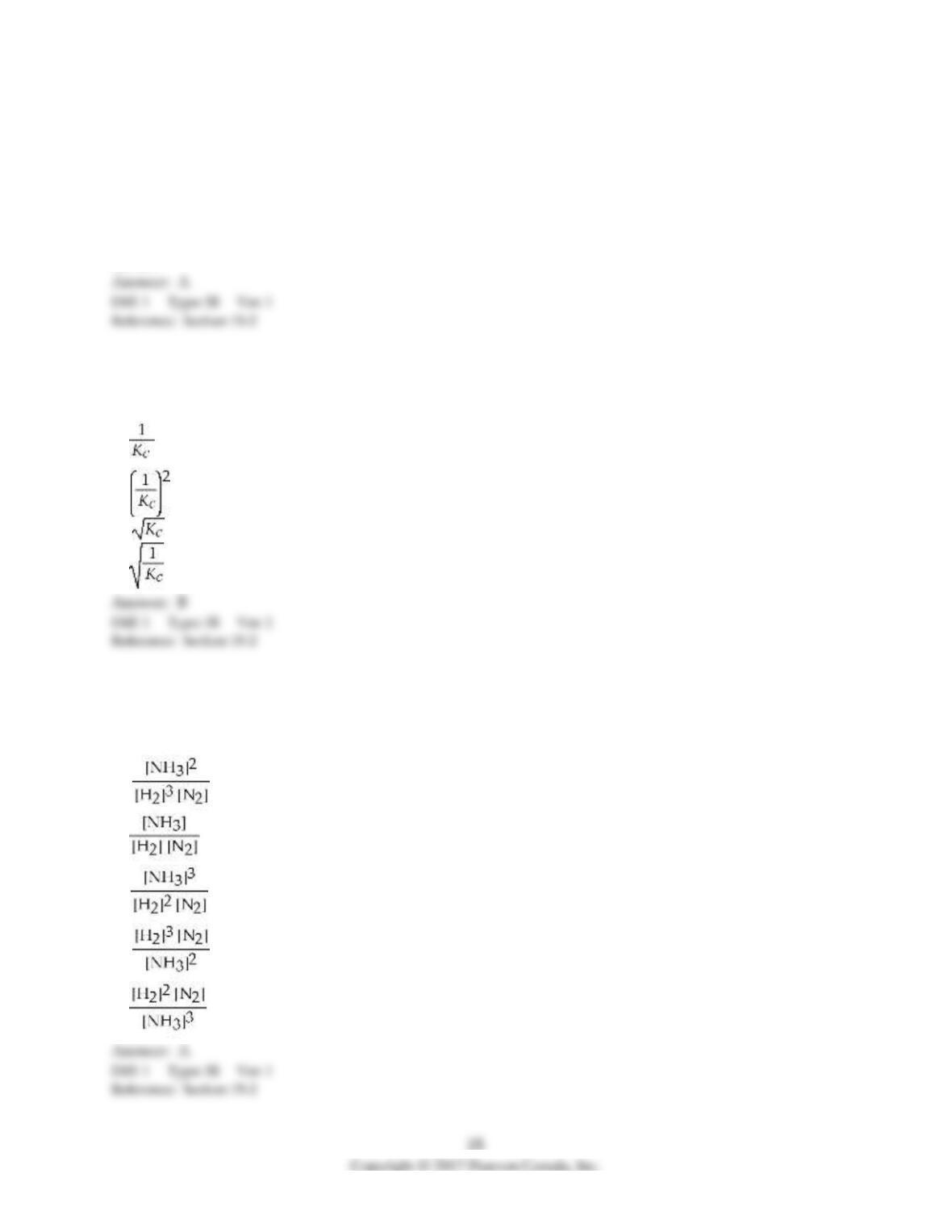
56) Consider the following equilibrium reaction: PCl3(g) + Cl2(g) ⇌ PCl5(g) Kc = 96.2 The equilibrium
constant for the decomposition of PCl5(g) to PCl3(g) and Cl2(g) is ________.
A) –Kc
B)
C)
D)
E)
57) Write the equilibrium constant expression for the following reaction:
N2(g) + 3 H2(g) ⇌ 2 NH3(g)
A)
B)
C)
D)
E)
16
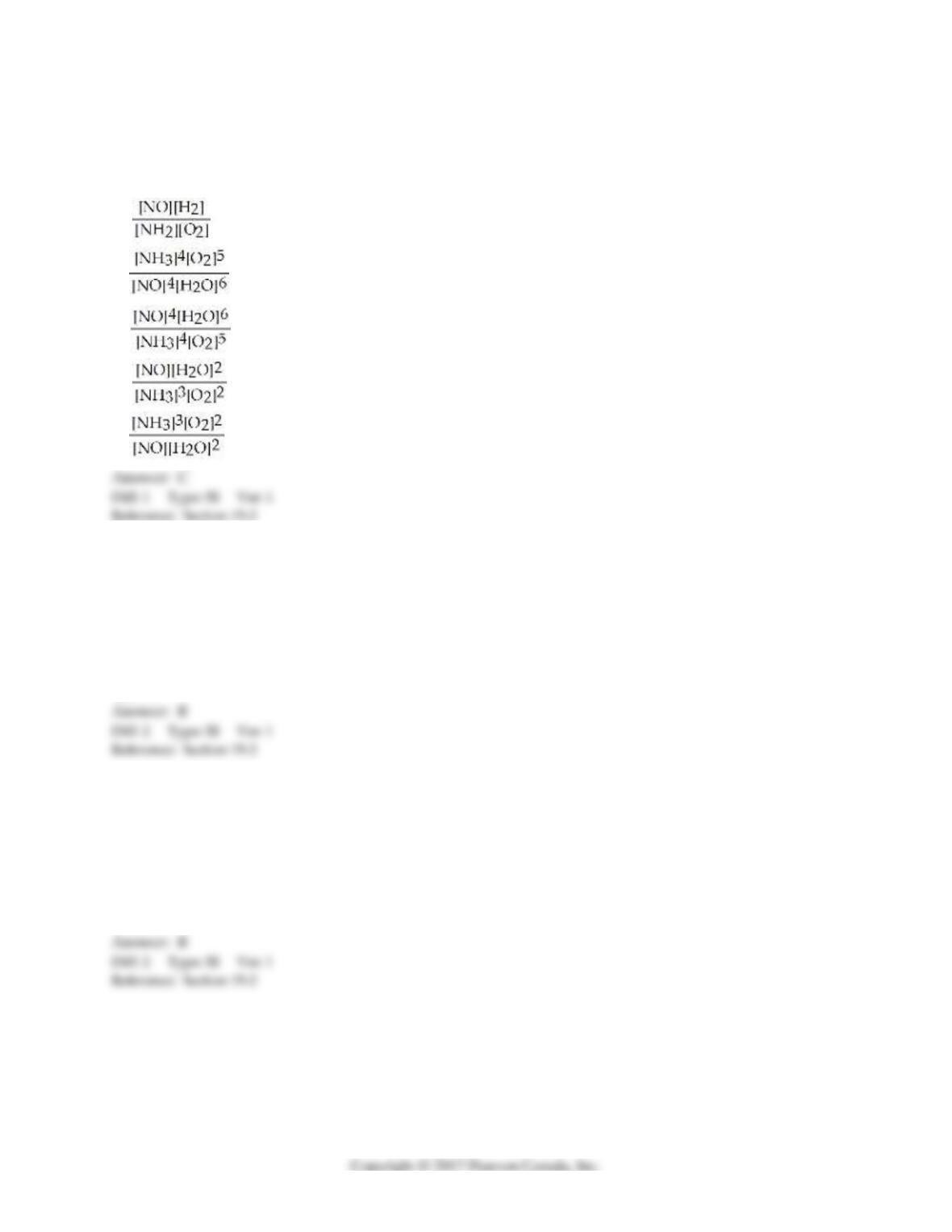
58) What is the equilibrium constant expression for:
4 NH3(g) + 5 O2(g) ⇌ 4 NO(g) + 6 H2O(g)
A)
B)
C)
D)
E)
59) For the production of NO2, Kc = [NO2]2/[NO]2[O2]. At equilibrium in a 2.50 L container, there are
3.00 mol NO, 4.00 mol O2 and 22.0 mol NO2. The value of Kc is ________.
A) 13.4
B) 33.6
C) 5.38
D) 0.0116
E) 3.75
60) For CO2(g) + H2(g) ⇌ CO(g) + H2O(g), Kc = [CO][H2]/[CO2][H2], if there are 1.43 mols each of CO
and H2O, 0.572 mol H2 and 4.572 mols CO2, in a 4.0 L container at equilibrium, what is Kc?
A) 0.547
B) 0.782
C) 1.28
D) 0.137
E) 2.34
61) For 2 NO2(g) ⇌ N2O4(g), Kc = [N2O4]/[NO2]2. At equilibrium there are 0.0270 mol N2O4 and 0.450
mol NO2 in a 50.0-L container. What is Kc?
A) 0.00267
B) 6.81
C) 6.67
D) 0.133
E) 2.45
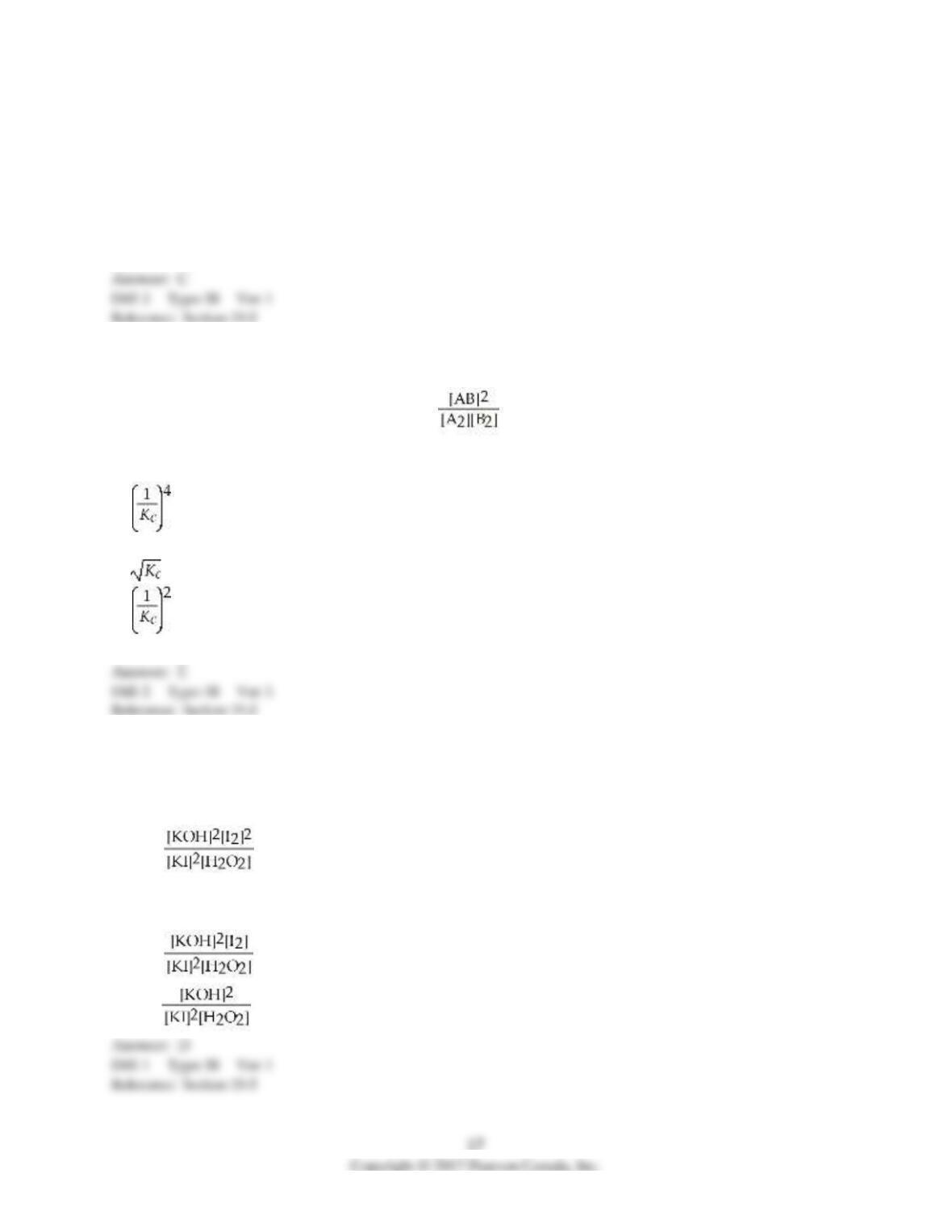
62) Consider the following hypothetical equilibrium reaction:
A2(g) + B2(g) ⇌ 2 AB(g) where Kc =
The equilibrium constant for the reaction: 2 A2(g) + 2 B2(g) ⇌ 4 AB(g) is ________.
A)
B) Kc4
C)
D)
E) Kc2
63) Write the equilibrium constant expression for the following reaction:
2 KI(aq) + H2O2(aq) ⇌ 2 KOH(aq) + I2(aq)
A) Kc =
B) Kc = [I2]
C) Kc = [I2]2
D) Kc =
E) Kc =
64) For the reaction 2 NO2(g)⇌ N2O4(g) Kp equals ________.
A) Kc
B) RT/Kc
C) Kc(RT)
D) Kc/RT
E) Kc(RT)2
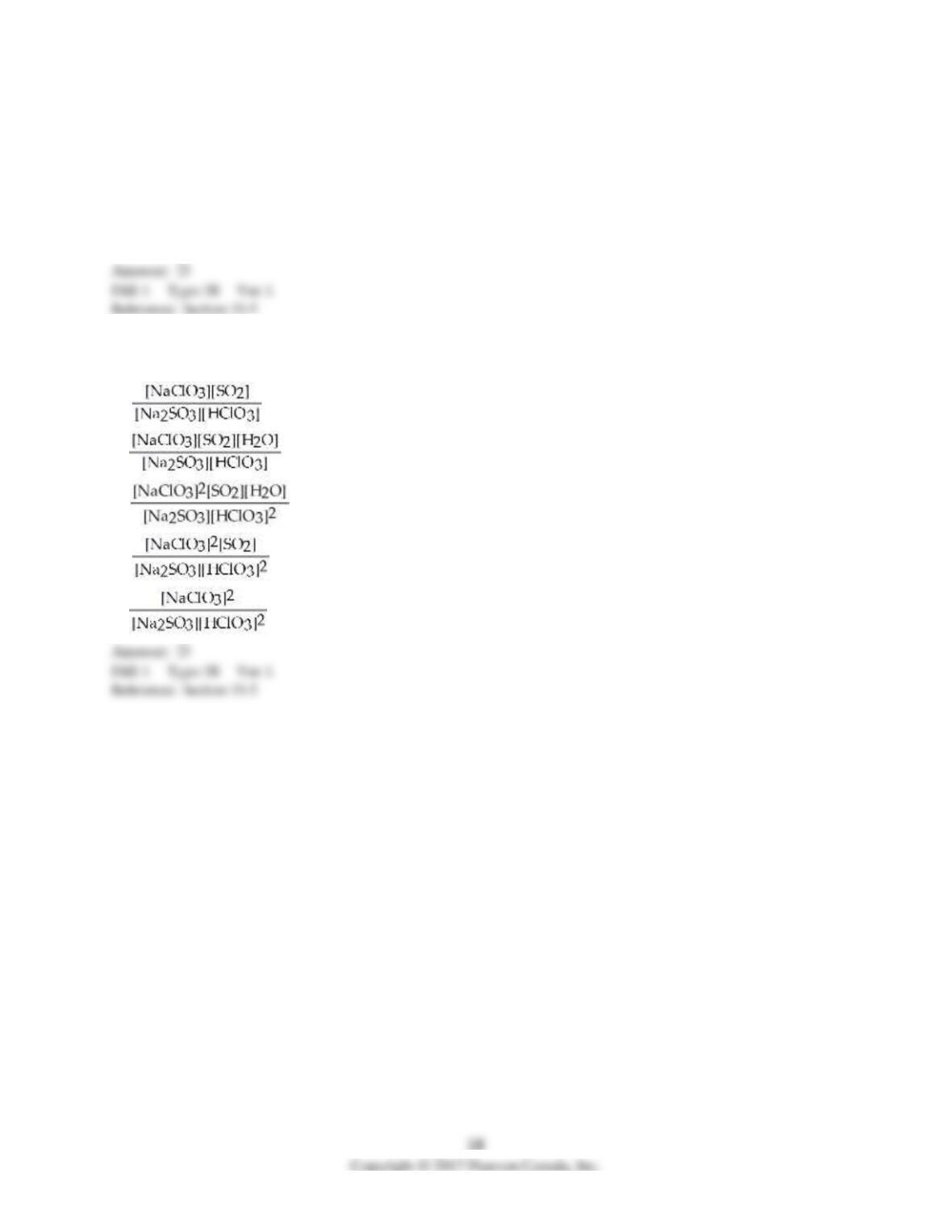
65) Write the equilibrium expression Kc for the reaction:
sodium sulfite(aq) + chloric acid (aq) ⇌ sodium chlorate(aq) + sulfur dioxide(g) + water(l).
A)
B)
C)
D)
E)