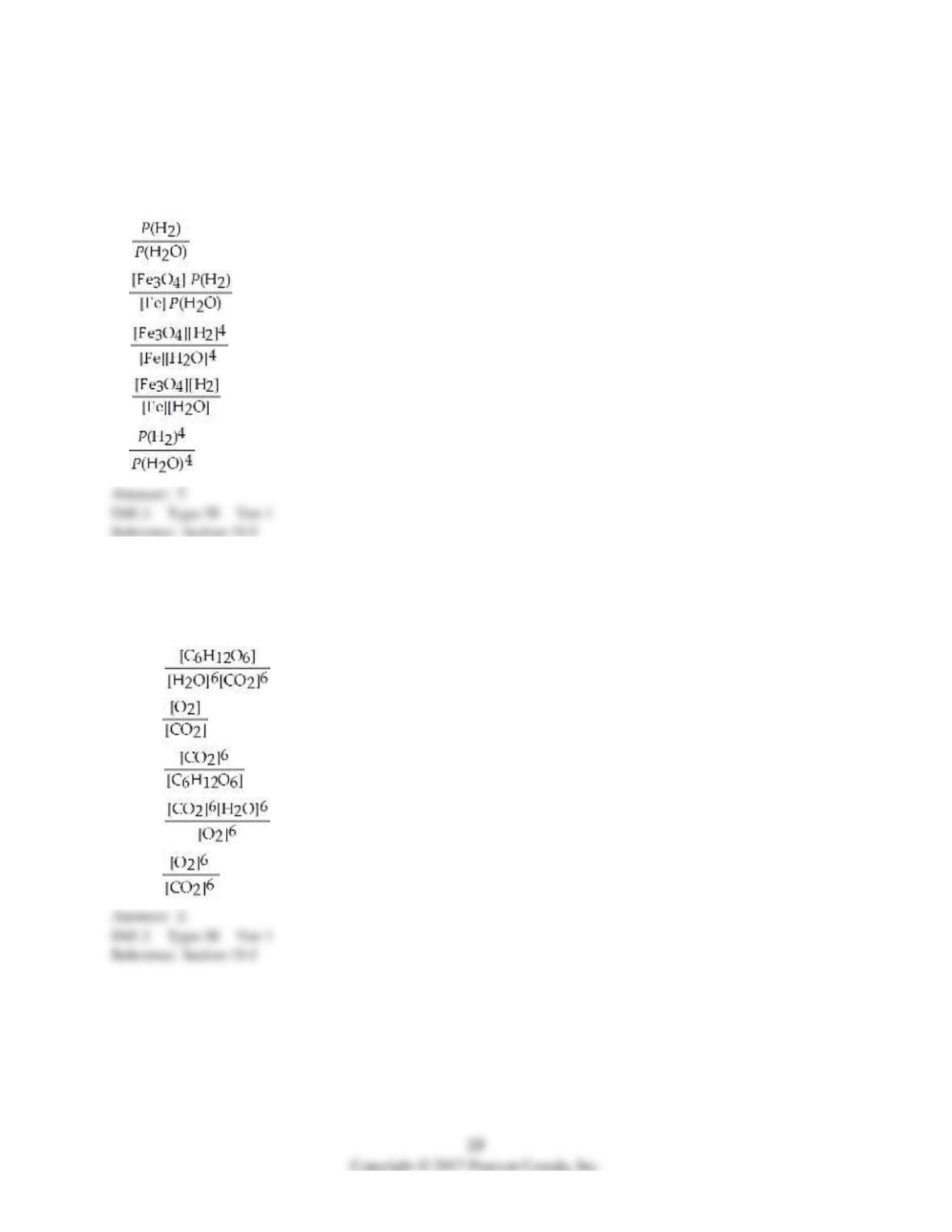
66) For the reaction:
3 Fe(s) + 4 H2O(g) ⇌ Fe3O4(s) + 4 H2(g)
write the expression for Kp.
A)
B)
C)
D)
E)
67) Write the equilibrium constant expression for the following reaction:
6 CO2(g) + 6 H2O(l) ⇌ C6H12O6(s) + 6 O2(g)
A) Kc =
B) Kc =
C) Kc =
D) Kc =
E) Kc =
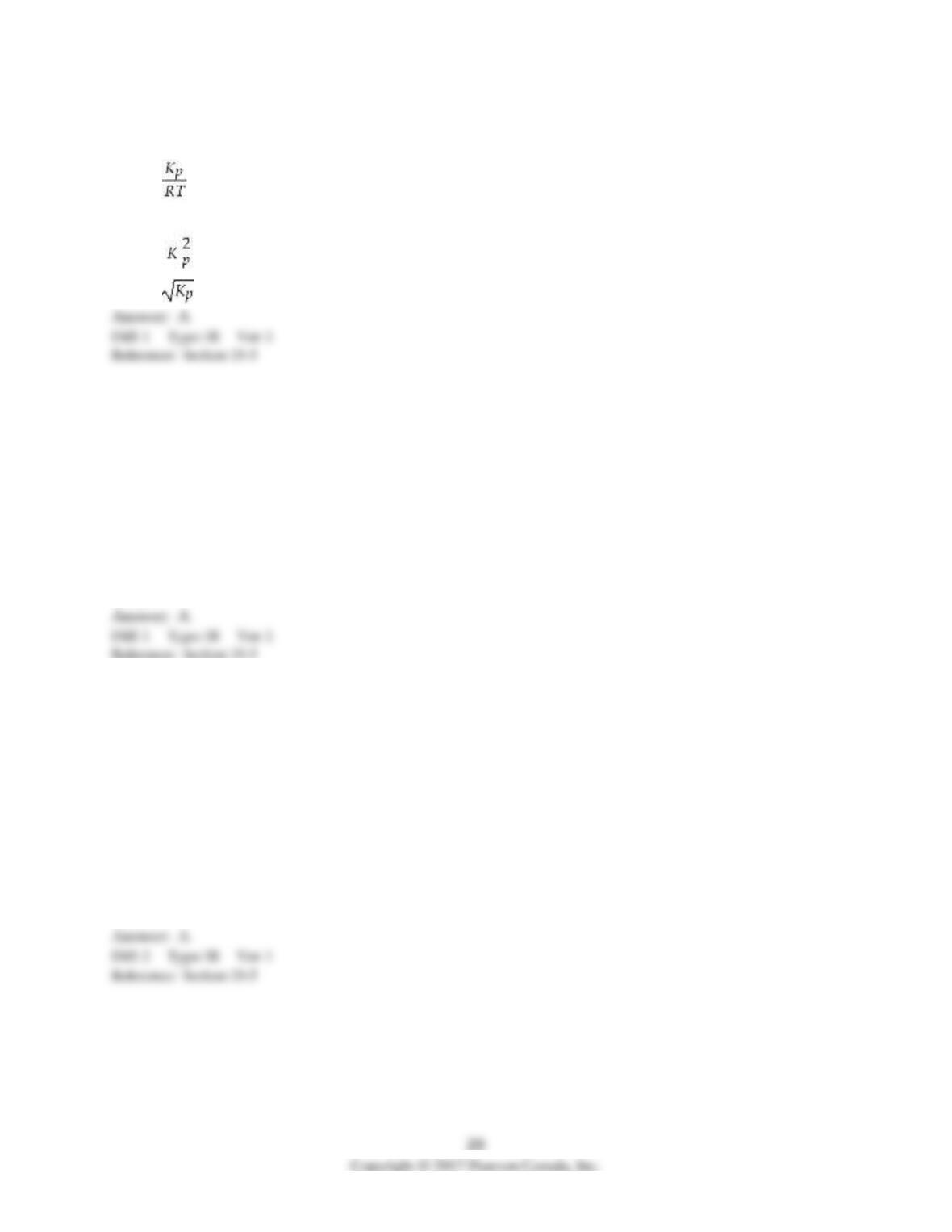
68) For the reaction: 3 Fe(s) + 4 H2O(g) ⇌ Fe3O4(s) + 4 H2(g) write the expression for Kc in terms of Kp.
A) Kc = Kp
B) Kc =
C) Kc = KpRT
D) Kc =
E) Kc =
69) What is the relationship between Kp and Kc for the reaction below?
4 NH3(g) + 7 O2(g) ⇌ 2 N2O4(g) + 6 H2O(g)
A) Kp = Kc(RT)-3
B) Kc = Kp(RT)-3
C) Kp = Kc(RT)3
D) Kp = Kc(RT)
E) Kp = Kc
70) Given the following reactions,
2 PCl3(g) ⇌ 2 P(g) + 3 Cl2(g) Kc = 0.0667
PCl3(g) + Cl2(g) ⇌ PCl5(g) Kc = 4.0
calculate Kc for the reaction below.
2 P(g) + 5 Cl2(g) ⇌ 2 PCl5(g)
A) 240
B) 1.1
C) 60
D) 23
E) 0.41
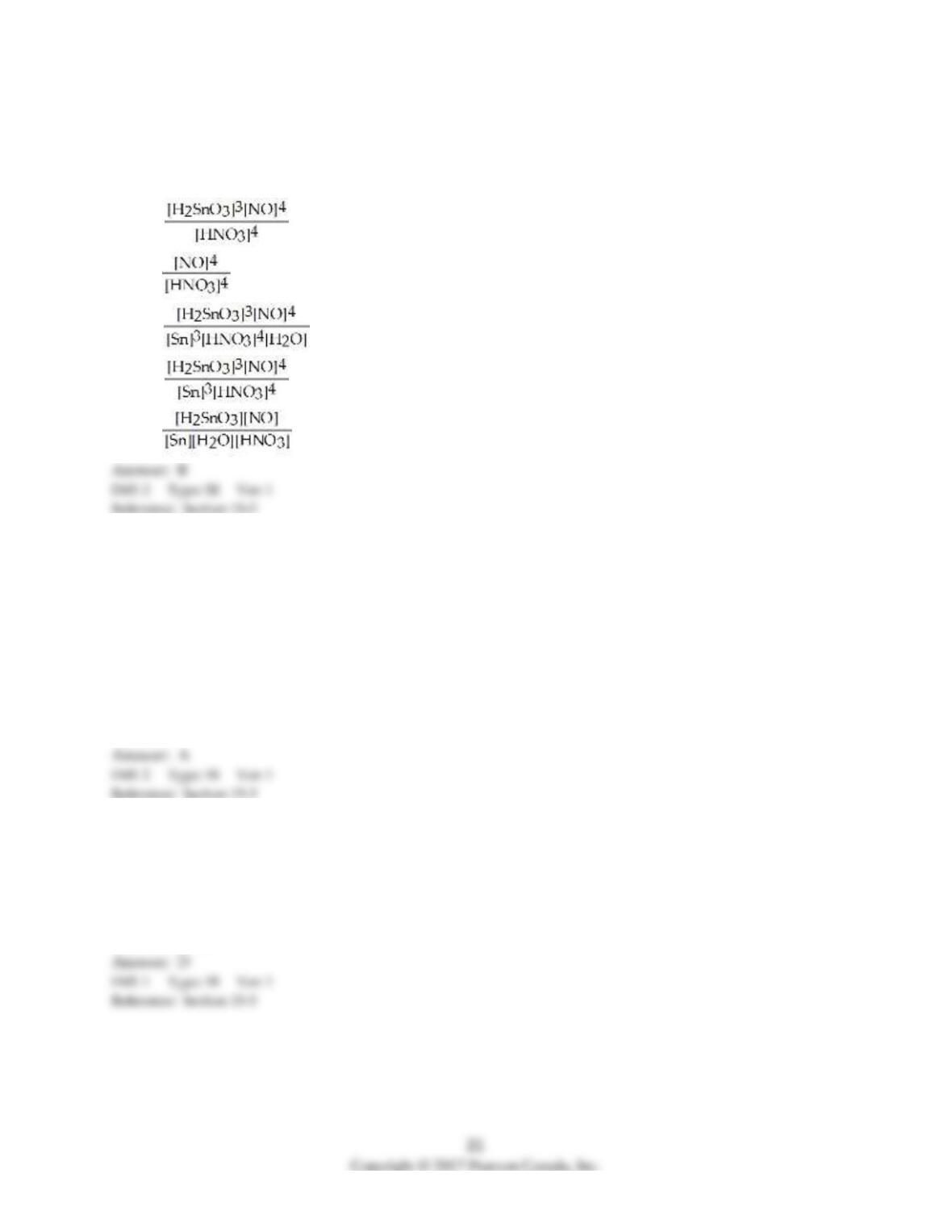
71) Write the equilibrium constant expression for the reaction:
3 Sn(s) + 4 HNO3(aq) + H2O(l) ⇌ 3 H2SnO3(s) + 4 NO(g)
A) Kc =
B) Kc =
C) Kc =
D) Kc =
E) Kc =
72) Find Kp for the following reaction at 25.0 °C.
SbCl5(g) ⇌ SbCl3(g) + Cl2(g) Kc = 2.51 × 10⁻²
A) 0.614
B) 1.03 × 10⁻³
C) 5.15 × 10⁻²
D) 9.74 × 10²
E) 39.8
73) For a reaction, the reaction quotient, Qc > Kc ,the reaction ________.
A) is at equilibrium
B) is exothermic
C) shifts to the right
D) shifts to the left
E) is endothermic
22
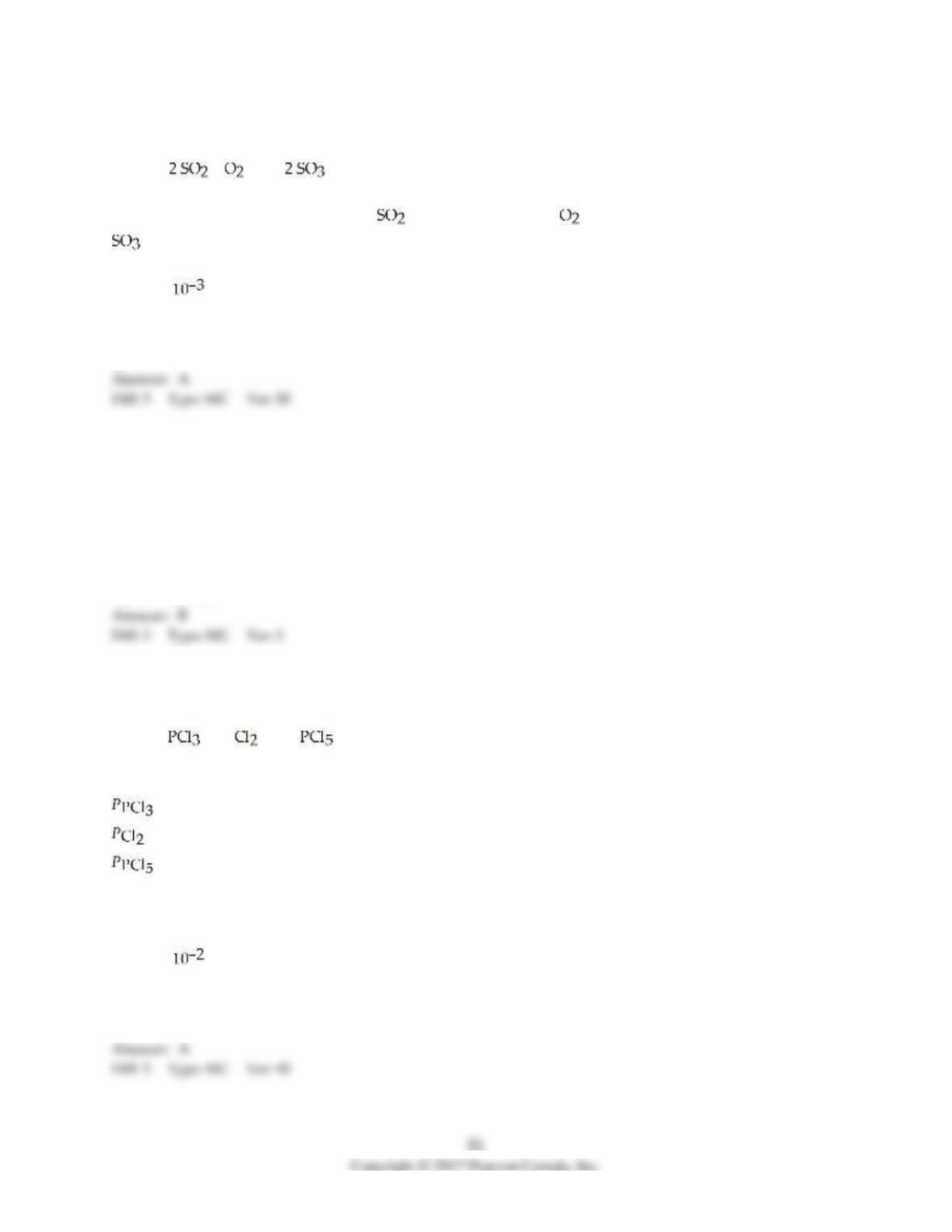
74) For the reaction: 2 SO2(g) + O2(g) ⇌ 2 SO3(g), Kc = 6.9 × 1024 at 25 °C. If a reaction vessel is filled with
these gases, such that [SO2] = 6.0 M, [O2] = 6.0 M and [SO3] = 6.0 M, in which direction will the reaction
proceed?
A) The reaction proceeds to the right.
B) The reaction proceeds to the left.
C) The reaction is already at equilibrium.
D) The reaction volume must be specified to answer this question.
E) The value of Kp must be specified to answer this question.
75) For the reaction: 2 Cl2(g) + 2 H2O(g) ⇌ 4 HCl(g) + O2(g), Kp = 6.4 × 10⁻⁶ at 500 K. If a fixed volume is
filled with initial concentrations of these gases at 227 °C such that [Cl2] = 0.5 M, [H2O] = 0.40 M, [HCl] =
0.5 M, and [O2] = 0.015 M, in which direction will the reaction proceed?
A) The reaction proceeds to the right.
B) The reaction proceeds to the left.
C) The reaction is already at equilibrium.
D) The reaction volume must be specified to answer this question.
E) The value of Kp at 25 °C must be specified to answer this question.
76) For the reaction 2 A(g) ⇌ B(g) + C(g), Kc = 1.25 at 300 K. If a 1.00 L mixture contains 0.619 mol A, 0.693
mol B, and 0.689 mol C at 300 K, will the mixture be in equilibrium? If not, in what direction will a net
reaction occur?
A) Yes, reaction is at equilibrium.
B) No, net reaction proceeds to the left.
C) No, net reaction proceeds to the right.
D) No, but there is no net reaction.
E) Yes, net reaction proceeds to the right
77) For the reaction: 3 Fe(s) + 4 H2O(g) ⇌ Fe3O4(s) + 4 H2(g) what is the effect of adding Fe(s)?
A) The reaction shifts to the right.
B) There is no change.
C) The reaction shifts to the left.
D) Kp is decreased.
E) Kp is doubled.
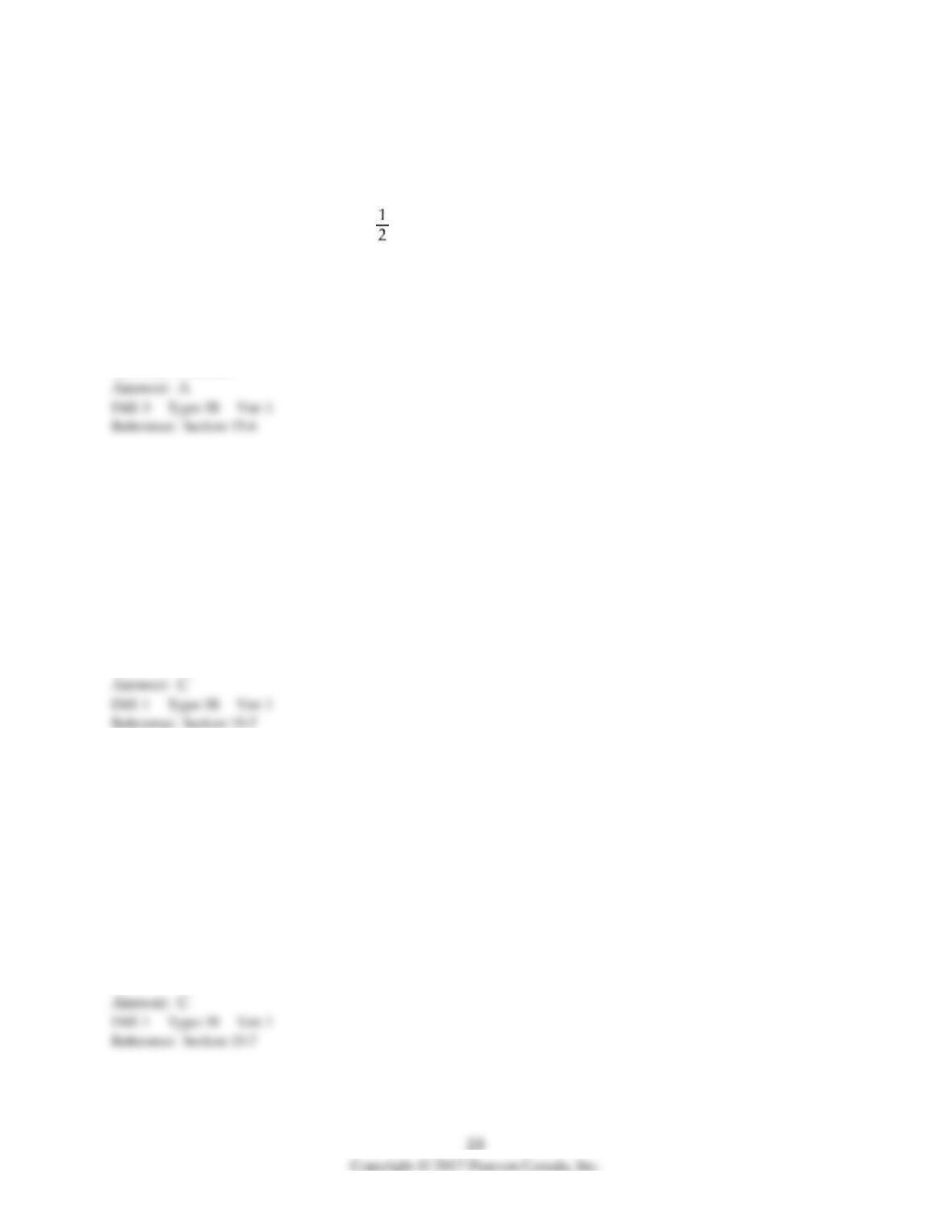
78) At a certain temperature, Kc = 0.0500 and △rH° = +39.6 kJ for the reaction below.
2 MgCl2(s) + O2(g) ⇌ 2 MgO(s) + 2 Cl2(g)
Calculate Kc for the reaction
MgO(s) + Cl2(g) ⇌ MgCl2(s) + O2(g)
and indicate whether its value will be larger or smaller at a lower temperature.
A) 4.47, larger
B) 400, smaller
C) 0.224, larger
D) 0.224, smaller
E) 0.0025, smaller
79) Two moles of NH3 are initially present for the reaction:
2 NH3(g) ⇌ N2(g) + 3 H2(g)
At equilibrium there is 1.00 mol NH3. How many moles of H2 are present at equilibrium?
A) 3.00 moles
B) 1.00 moles
C) 1.50 moles
D) 0.67 moles
E) 0.75 moles
80) In the reaction:
2 N2O(g) + N2H4(g) ⇌ 3 N2(g) + 2 H2O(g),
one starts with 0.10 mol N2O and 0.25 mol N2H4 in a 10.0 L container. If there are 0.06 mol N2O at
equilibrium, how many moles of N2 are present?
A) 0.02
B) 0.04
C) 0.06
D) 0.09
E) 0.07
81) For the reaction:
PCl3(g) + Cl2(g) ⇌ PCl5(g) at 70.5 °C, Kp = 1.05.
If one starts with 1.80 atm pressure of PCl3(g), 1.72 atm pressure of Cl2(g), and no PCl5(g), what is the
partial pressure of PCl5(g) at equilibrium?
A) 0.827 atm
B) 0.856 atm
C) 0.818 atm
D) 0.599 atm
E) 0.080 atm
82) A mixture containing 0.392 M A(g) and 0.452 M B(g) is allowed to come to equilibrium at 300 K. The
reaction 3 A(g) + 2 B(g) ⇌ C(g) + D(g) occurs. At equilibrium, [C] = 0.00128 M. What is the value of Kc?
A) 7.35 × 10⁻³
B) 1.39 × 10⁻⁴
C) 1.36 × 10²
D) 9.24 × 10⁻⁶
E) 7.19 × 10⁶
83) A mixture containing 0.0392 M A(g) and 0.0452 M B(g) is allowed to come to equilibrium at 300 K.
The reaction: 3 A(g) + 2 B(g) ⇌ C(g) + D(g) occurs. At equilibrium, [C] = 0.00128 M. What is the value of
Kc?
A) 2.13 × 10⁻³
B) 0.849
C) 20.4
D) 4.91 × 10⁻²
E) 470
84) For the decomposition of ammonium carbamate
NH4(NH2CO2)(s) ⇌ 2 NH3(g) + CO2(g)
Kp = 0.0596 at a certain temperature. A solid sample of ammonium carbamate is introduced into an
evacuated container and at equilibrium some solid remains in the container. What is the total pressure in
the container?
A) 0.738 atm
B) 1.17 atm
C) 0.930 atm
D) 0.179 atm
E) 0.358 atm
85) Consider the following equilibrium.
A(g) + 3 B(g) ⇌ 2 C(g)
If the initial concentrations are [A] = 1.00 M, [B] = 3.00 M, and [C] = 0, at equilibrium it is found that [C] =
0.980 M. Calculate Kc for this reaction.
A) 0.526
B) 0.268
C) 1.26
D) 0.131
E) 1.901
86) Consider the following reversible reaction:
POCl3(g) ⇌ POCl(g) + Cl2(g) Kc = 0.450
The following initial amounts of reactants and products were mixed: [POCl3] = 0.750 M, [POCl] = 0.550
M, and [Cl2] = 0.150 M. What is the equilibrium concentration of POCl?
A) 0.395 M
B) 0.155 M
C) 0.740 M
D) 0.945 M
E) 0.360 M
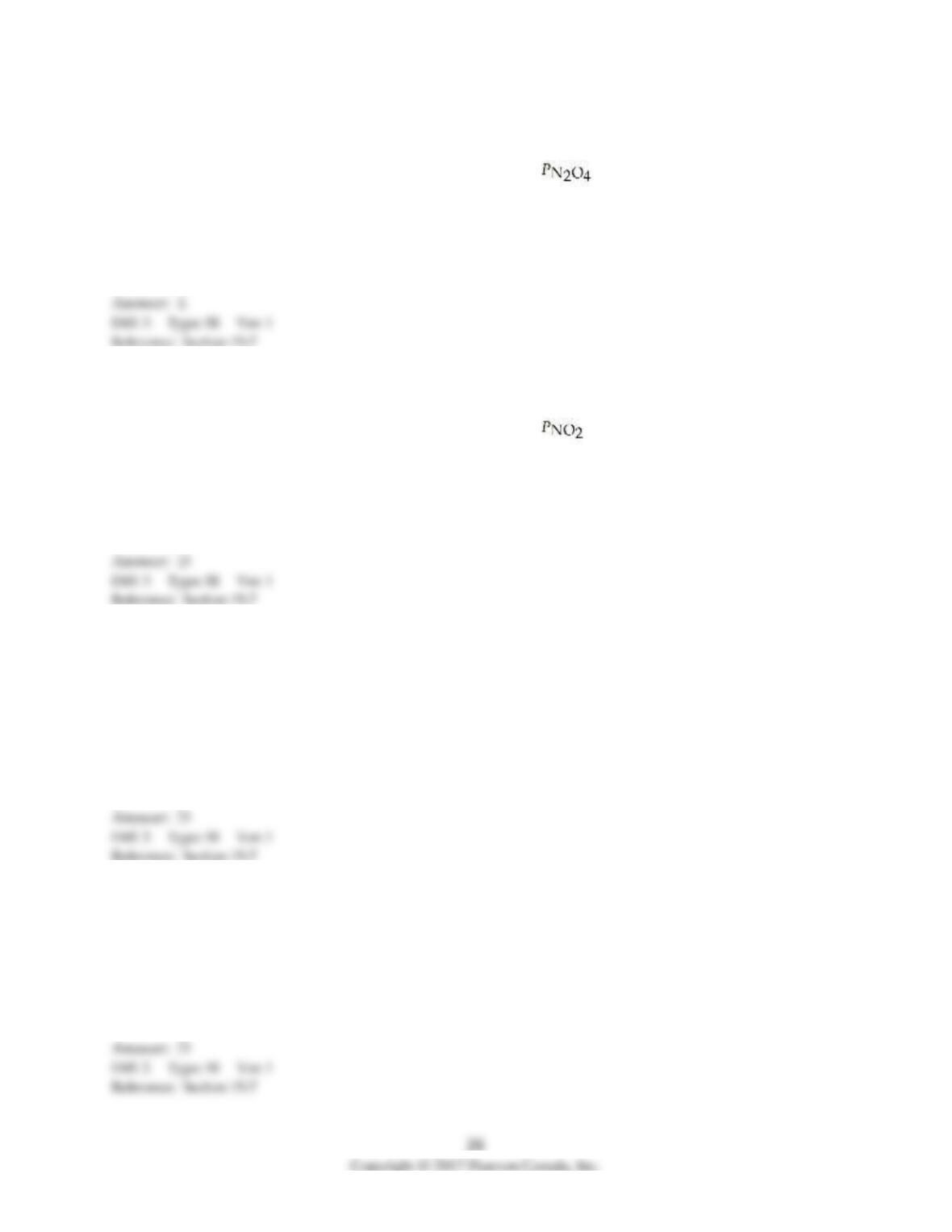
87) Consider the equilibrium system: N2O4(g) ⇌ 2 NO2(g) for which Kp = 0.1134 at 25 °C and ΔrH° =
58.03 kJ/mol. Assuming that the total pressure inside the container is 1.00 atm at equilibrium and that
initially only N2O4 was present inside the container, compute at equilibrium.
A) 0.398 atm
B) 0.113 atm
C) 0.602 atm
D) 0.285 atm
E) 0.715 atm
88) Consider the equilibrium system: N2O4(g) ⇌ 2 NO2(g) for which Kp = 0.1134 at 25 °C and ΔrH° =
58.03 kJ/mol. Assuming that the total pressure inside the container is 1.00 atm at equilibrium and that
initially only N2O4 was present inside the container, compute at equilibrium.
A) 0.398 atm
B) 0.113 atm
C) 0.602 atm
D) 0.285 atm
E) 0.715 atm
89) Consider the equilibrium system: N2O4(g) ⇌ 2 NO2(g) for which Kp = 0.1134 at 25 °C and ΔrH° =
58.03 kJ/mol. Assume that 1 mole of N2O4 and 2 moles of NO2 are introduced into a 5.0 liter container.
What will be the equilibrium value of [N2O4]?
A) 0.928 M
B) 0.0822 M
C) 0.358 M
D) 0.379 M
E) 0.042 M
90) At 35 °C, Kp = 0.315 for the reaction N2O4(g) ⇌ 2 NO2(g), if the initial pressure of NO2(g) in a
container is 3.00 atm, what is the equilibrium pressure of N2O4(g)?
A) 1.88 atm
B) 0.315 atm
C) 0.471 atm
D) 1.19 atm
E) 0.685 atm
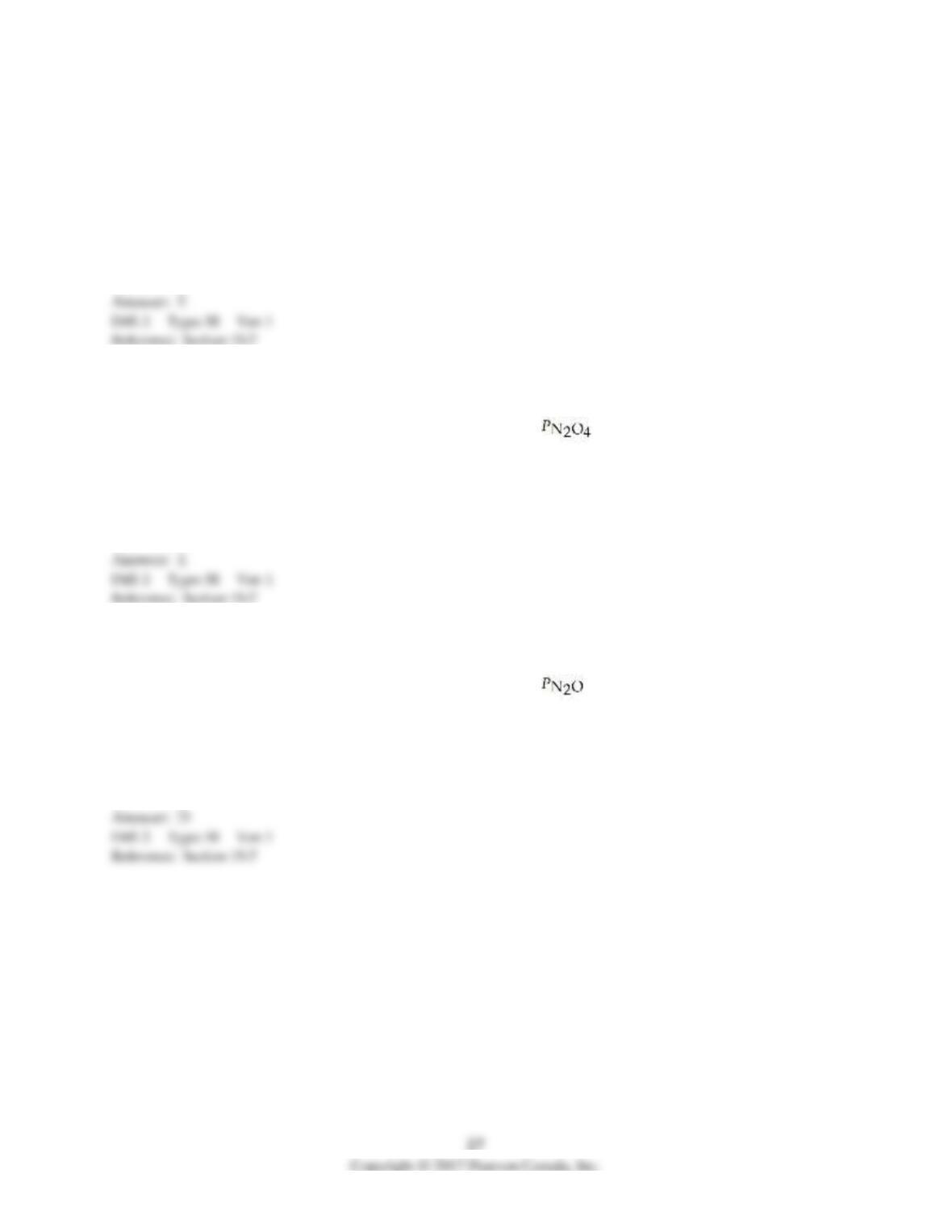
91) Consider the equilibrium system: N2O4(g) ⇌ 2 NO2(g) for which Kp = 0.1134 at 25 °C and ΔrH° =
58.03 kJ/mol. Assume that 1 mole of N2O4 and 2 moles of NO2 are introduced into a 5.0 liter container.
What will be the equilibrium value of [N2O]?
A) 0.928 M
B) 0.0822 M
C) 0.358 M
D) 0.379 M
E) 0.042 M
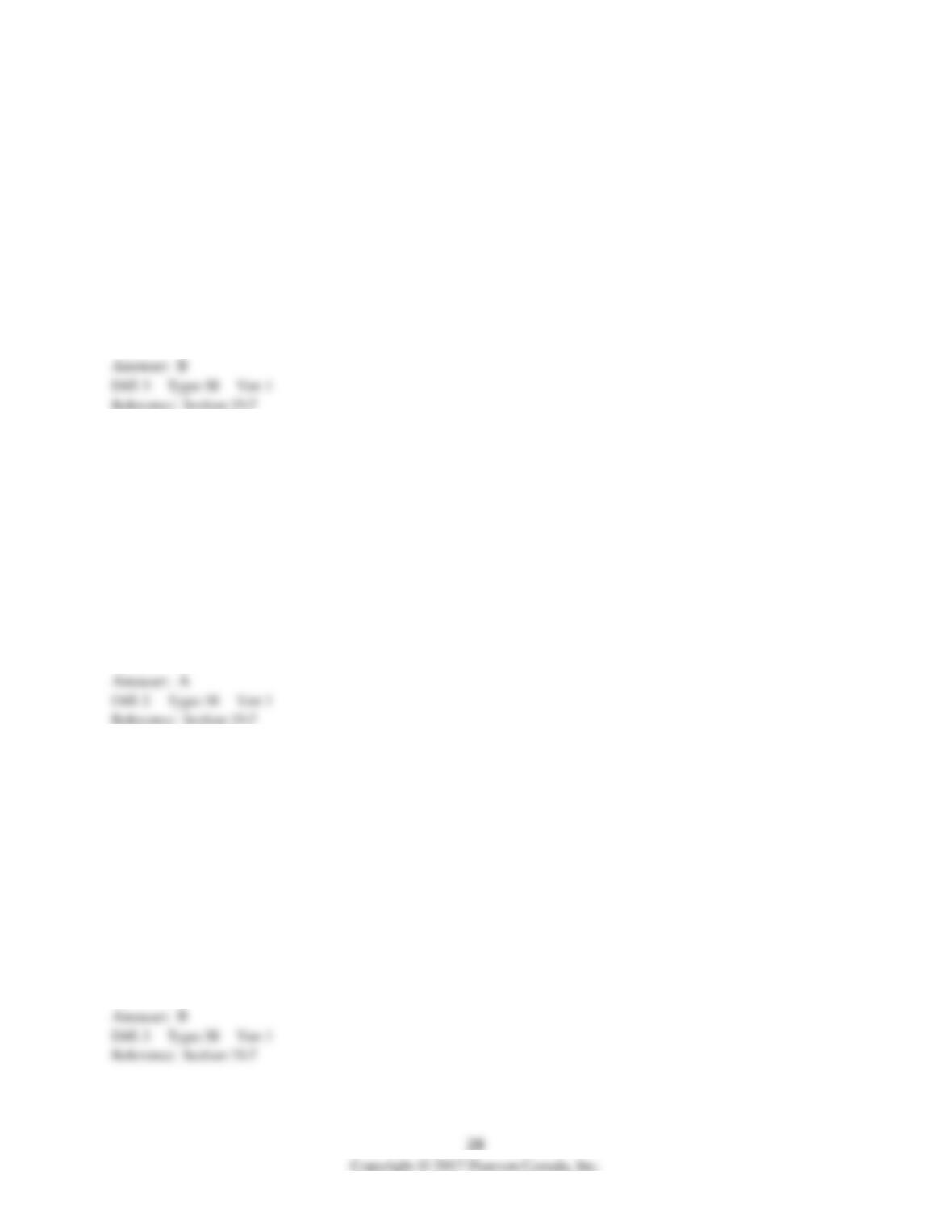
92) Consider the equilibrium system: N2O4(g) ⇌ 2 NO2(g) for which Kp = 0.1134 at 25 °C and ΔrH° =
58.03 kJ/mol. Assuming that the total pressure inside the container is 10 atm at equilibrium and that
initially only N2O4 was present inside the container, compute at equilibrium.
A) 7.98 atm
B) 8.88 atm
C) 1.12 atm
D) 1.01 atm
E) 8.99 atm
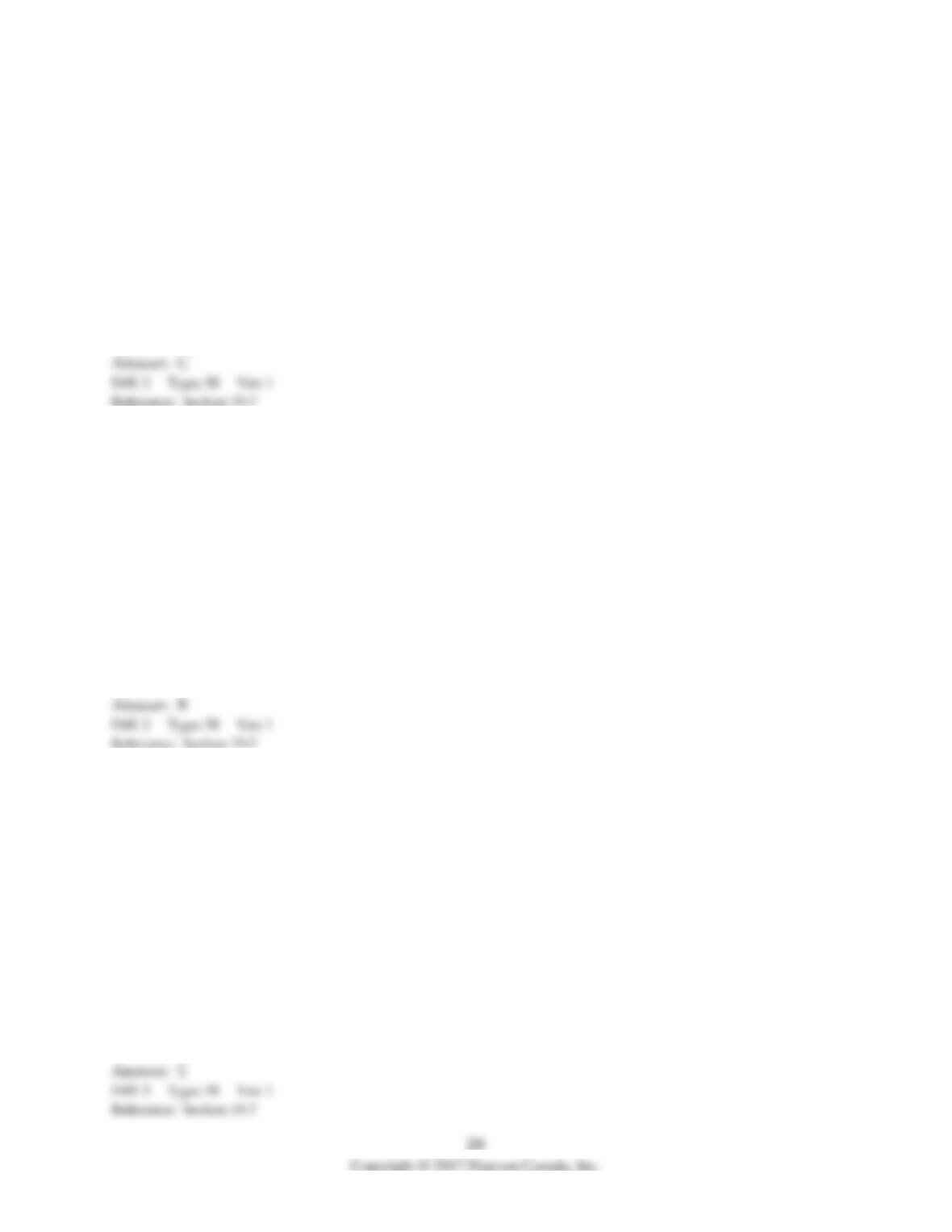
93) Consider the equilibrium system: N2O4(g) ⇌ 2 NO2(g) for which Kp = 0.1134 at 25 °C and ΔrH° =
58.03 kJ/mol. Assuming that the total pressure inside the container is 10 atm at equilibrium and that
initially only N2O4 was present inside the container, compute at equilibrium.
A) 7.98 atm
B) 8.88 atm
C) 1.12 atm
D) 1.01 atm
E) 8.99 atm
94) A mixture, containing 0.0750 M HCl(g) and 0.0330 M O2(g) is allowed to come to equilibrium at
480 °C.
4 HCl(g) + O2(g) ⇌ 2 Cl2(g) + 2 H2O(g)
At equilibrium [Cl2] = 0.030 M. What is the value of Kc?
A) 1.1 × 10⁻³
B) 890
C) 0.13
D) 1.3
E) 480
95) 4.000 mol chlorine and 2.000 mol bromine were placed in a 50.0 L container and kept at 293 K until
equilibrium was achieved for the reaction:
Br2(l) + Cl2(g) ⇌ BrCl(g)
At the point of equilibrium there were 82.63 g of Br2(l). Compute the value of Kc for this reaction.
A) 0.0699
B) 1.18
C) 0.849
D) 3.50
E) 2.36
96) 4.000 mol chlorine and 2.000 mol bromine were placed in a 50.0 L container and kept at 293 K until
equilibrium was achieved for the reaction:
Br2(l) + Cl2(g) ⇌ 2 BrCl(g)
At the point of equilibrium there were 82.63 g of Br2(l). Determine the total pressure in the 50.0 L
container at equilibrium.
A) 0.110 atm
B) 2.64 atm
C) 0.180 atm
D) 1.43 atm
E) 1.21 atm
97) For the reaction:
PCl3(g) + Cl2(g) ⇌ PCl5(g) at 85 °C, Kp = 1.19
If one starts with 2.00 atm pressure of PCl3, 1.00 atm pressure of Cl2 and no PCl5, what is the partial
pressure of PCl5(g) at equilibrium?
A) 0.167 atm
B) 0.739 atm
C) 0.621 atm
D) 0.465 atm
E) 0.553 atm
98) Consider the following reaction:
POCl3(g) ⇌ POCl(g) + Cl2(g) with Kc = 0.450
A sample of pure POCl3(g) was placed in a reaction vessel and allowed to decompose according to the
above reaction. At equilibrium, the concentrations of POCl(g) and Cl2(g) were each 0.150 M. What was
the initial concentration of POCl3(g)?
A) 0.225 M
B) 0.200 M
C) 0.633 M
D) 0.483 M
E) 0.350 M
99) Consider the following reaction occurring at 960 K:
CO2(g) + H2(g) ⇌ CO(g) + H2O(g)
At equilibrium, the concentrations of reactants and products are: [CO2] = 0.0400 M, [H2] = 0.0220 M, [CO]
= 0.0240 M, and [H2O] = 0.0190 M. This equilibrium is perturbed by adding CO2(g) to the system such
that when a new equilibrium is reached, the concentration of CO2 is 0.050 M. What is the concentration of
H2(g) at this equilibrium?
A) 0.050 M
B) 0.482 M
C) 0.462 M
D) 0.300 M
E) 0.0504 M
100) One of the reactions in the gasification of coal is
CO(g) + 3 H2(g) ⇌ CH4(g) + H2O(g) ΔrH° = -237 kJ
For each of the following changes, explain the effect (increase, decrease, no effect) on the number of moles
of CH4(g) produced.
(a) increase the concentration of H2O(g)
(b) decrease the volume of the container
(c) add a catalyst
(d) decrease the temperature
101) For the reaction: N2(g) + 2 O2(g) ⇌ 2 NO2(g), Kc = 8.3 × 10⁻¹⁰ M–1 at 25 °C. What is the concentration
of N2 gas at equilibrium when the concentration of NO2 is five times the concentration of O2 gas?
A) 3.3 × 10⁻¹¹ mol L-1
B) 1.7 × 10⁻¹⁰ mol L-1
C) 6.0 × 10⁹ mol L-1
D) 3.0 × 10¹⁰ mol L-1
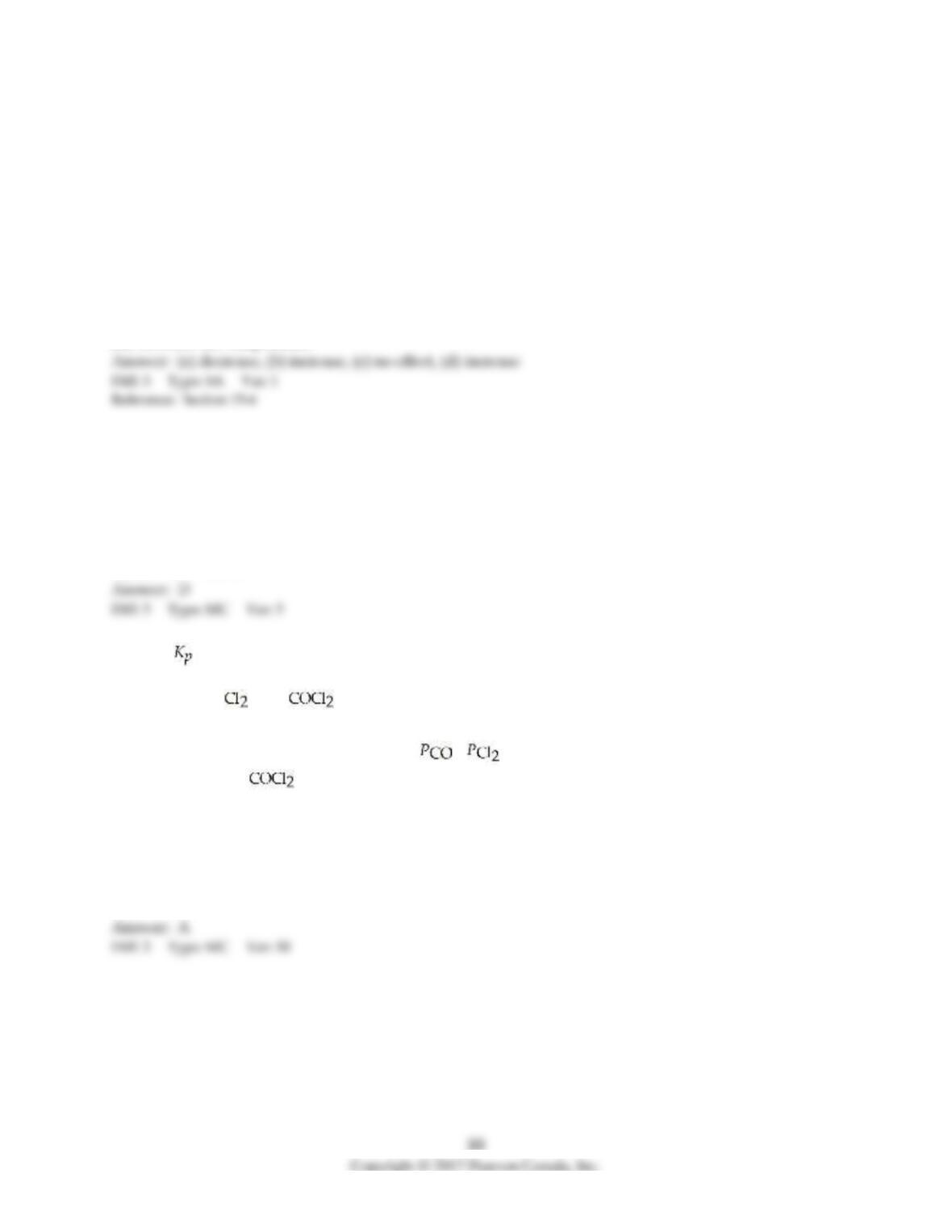
102) The for the reaction below is 1.49 × 10⁸ at 100.0 °C:
CO(g) + (g) → (g)
In an equilibrium mixture of the three gases, = = 2.22 × 10⁻⁴ bar. The partial pressure of the
product, phosgene ( ), is ________ bar.
A) 7.34
B) 3.02 × 10¹⁵
C) 3.31 × 10⁻¹⁶
D) 3.31 × 10⁴
E) 6.67 × 10¹¹
103) At 900.0 K, the equilibrium constant (Kp) for the following reaction is 0.345:
+ (g) → (g)
At equilibrium, the partial pressure of is 35.0 bar and that of is 15.9 bar. The partial pressure of
is ________ bar.
A) 82.0
B) 4.21 ×
C) 192
D) 6.20 × 10⁻⁴
E) 40.2
104) The decomposition of ammonia is 2 NH3(g) → N2(g) + 3 H2(g). If Kp is 1.5 × 10³ at 400 °C, what is
the partial pressure of ammonia at equilibrium when the partial pressure of N2(g) is 0.10 bar and that of
H2(g) is 0.15 bar?
A) 2.2 × 10⁻⁷ bar
B) 4.7 × 10⁻⁴ bar
C) 2.1 × 10³ bar
D) 4.4 × 10⁶ bar
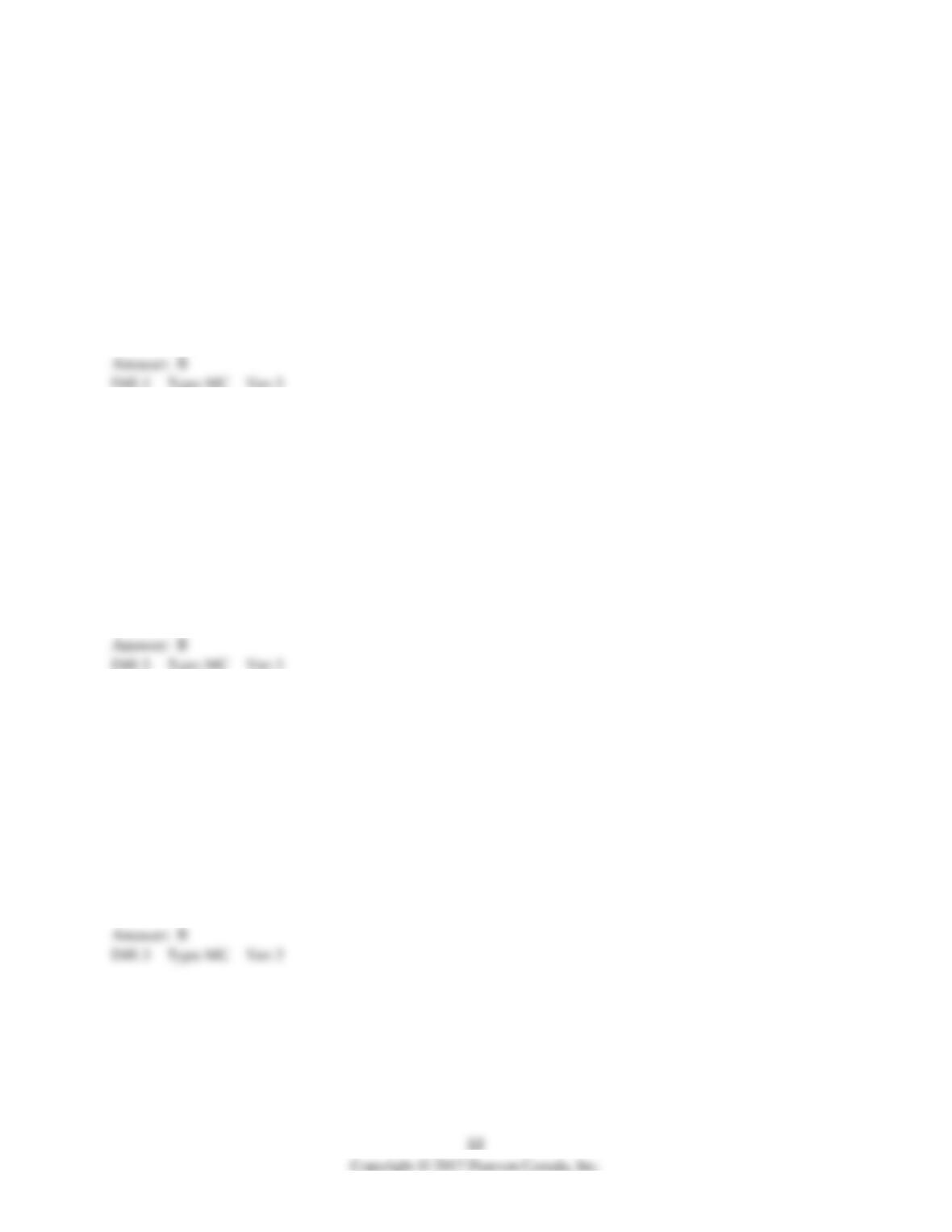
105) Phosphorus trichloride and phosphorus pentachloride equilibrate in the presence of molecular
chlorine according to the following reaction:
(g) + (g) → (g)
An equilibrium mixture at 450 K contains
= 0.124 bar,
= 0.157 bar, and
= 1.30 bar.
What is the value of Kp at this temperature?
A) 66.8
B) 1.50 ×
C) 2.53 × 10⁻²
D) 1.02
E) 4.63
106) An equilibrium mixture of CO, O2, and CO2 at a certain temperature contains 0.0010 mol L-1 CO2
and 0.0015 mol L-1 O2. At this temperature, Kc equals 1.4 × 10² L for the reaction:
2 CO(g) + O2(g) ⇌ 2 CO2(g)
What is the equilibrium concentration of CO?
A) 4.8 × 10⁻⁶ mol L-1
B) 8.5 × 10⁻³ mol L-1
C) 9.3 × 10⁻² mol L-1
D) 3.1 × 10⁻¹ mol L-1
107) At a certain temperature, Kc equals 1.40 × 10² M–1 for the reaction:
2 CO(g) + O2(g) ⇌ 2 CO2(g)
If a 3.00 L flask contains 0.400 mol of CO2 and 0.100 mol of O2 at equilibrium, how many moles of CO are
also present in the flask?
A) 0.555 mol
B) 0.185 mol
C) 0.107 mol
D) 0.0114 mol
108) At a certain temperature, nitogen and hydrogen react to form ammonia:
N2(g) + 3 H2(g) ⇌ 2 NH3(g)
When initial amounts of N2, H2, and NH3 are mixed, the concentration of NH3 increases. Which
statement below is TRUE?
A) Kc < Q
B) Kc > Q
C) Kc = Q
D) Kc = Q = 0
33
109) For the isomerization reaction:
butane ⇌ isobutane
Kp equals 25.0 at 500 °C. If the initial pressures of butane and isobutane are 20.0 atm and 0.0 atm,
respectively, what are the pressures of the two gases at equilibrium?
A) P(butane) = 0.77 atm and P(isobutane) = 19.2 atm
B) P(butane) = 0.80 atm and P(isobutane) = 20. atm
C) P(butane) = 19.2 atm and P(isobutane) = 0.77 atm
D) P(butane) = 20 atm and P(isobutane) = 0.80 atm
110) Cyclohexane, C6H12, undergoes a molecular rearrangement in the presence of AlCl3 to form
methylcyclopentane, CH3C5H9, according to the equation:
C6H12 ⇌ CH3C5H9
If Kc = 0.143 at 25 °C for this reaction, find the equilibrium concentrations of C6H12 and CH3C5H9 if the
initial concentrations are 0.200 mol L-1 and 0.075 mol L-1, respectively.
A) [C6H12] = 0.041 mol L-1, [CH3C5H9] = 0.041 mol L-1
B) [C6H12] = 0.159 mol L-1, [CH3C5H9] = 0.116 mol L-1
C) [C6H12] = 0.241 mol L-1, [CH3C5H9] = 0.034 mol L-1
D) [C6H12] = 0.253 mol L-1, [CH3C5H9] = 0.022 mol L-1
111) At a certain temperature the equilibrium constant, Kc, equals 0.11 for the reaction:
2 ICl(g) ⇌ I2(g) + Cl2(g)
What is the equilibrium concentration of ICl if 0.45 mol of I2 and 0.45 mol of Cl2 are initially mixed in a
2.0 L flask?
A) 0.14 mol L-1
B) 0.17 mol L-1
C) 0.27 mol L-1
D) 0.34 mol L-1
112) The equilibrium constant, Kp, equals 3.40 for the isomerization reaction:
cis-2-butene ⇌ trans-2-butene
If a flask initially contains 0.250 bar of cis-2-butene and 0.165 bar of trans-2-butene, what is the
equilibrium pressure of each gas?
A) P(cis-2-butene) = 0.0485 bar and P(trans-2-butene) = 0.165 bar
B) P(cis-2-butene) = 0.0458 bar and P(trans-2-butene) = 0.156 bar
C) P(cis-2-butene) = 0.0735 bar and P(trans-2-butene) = 0.250 bar
D) P(cis-2-butene) = 0.0943 bar and P(trans-2-butene) = 0.321 bar
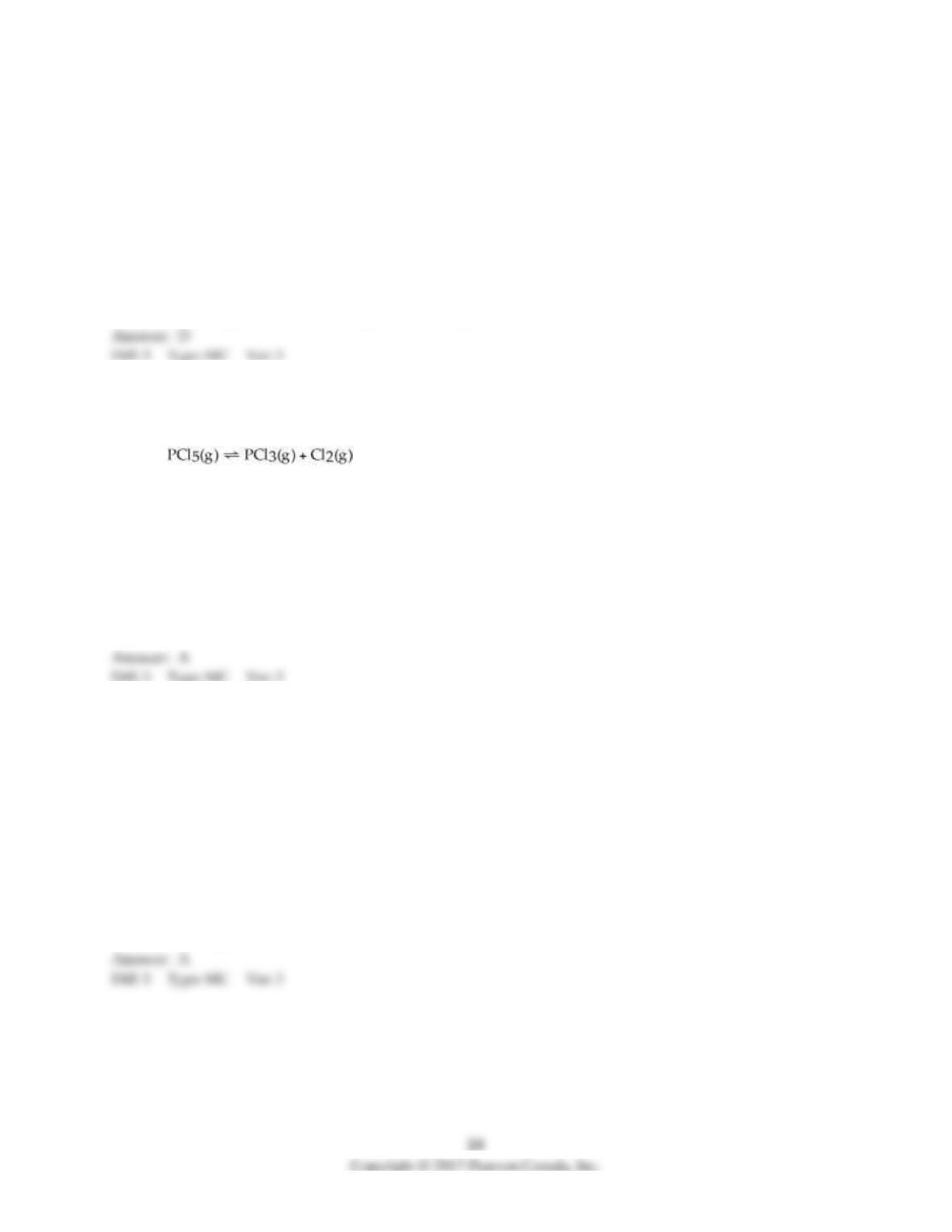
113) Phosphorus pentachloride decomposes to phosphorus trichloride at high temperatures according to
the equation:
At 250 °C 0.125 mol L-1 PCl5 is added to the flask. If Kc = 1.80, what are the equilibrium concentrations of
each gas?
A) [PCl5] = 0.00765 mol L-1, [PCl3] = 0.117 mol L-1, and [Cl2] = 0.117 mol L-1
B) [PCl5] = 0.0625 mol L-1, [PCl3] = 0.335 mol L-1, and [Cl2] = 0.335 mol L-1
C) [PCl5] = 1.80 mol L-1, [PCl3] = 1.80 mol L-1, and [Cl2] = 1.80 mol L-1
D) [PCl5] = 3.96 mol L–1, [PCl3] = 3.83 mol L-1, and [Cl2] = 3.83 mol L-1
114) Kc is 1.67 × 10²⁰ at 25 °C for the formation of iron(III) oxalate complex ion:
Fe3+(aq) + 3C2O42-(aq) ⇌ [Fe(C2O4)3]3-(aq)
If 0.0200 mol L-1 Fe3+ is initially mixed with 1.00 mol L-1 oxalate ion, what is the concentration of Fe3+
ion at equilibrium?
A) 1.44 × 10⁻²² mol L-1
B) 0.0100 mol L-1
C) 8.35 × 10¹⁹ mol L-1
D) 6.94 × 10²¹ mol L-1
115) Dinitrogen tetroxide partially decomposes according to the following equilibrium:
(g) ⇌ (g)
A 1.000 L flask is charged with 3.00 × 10⁻² mol of . At equilibrium, 2.36 × 10⁻² mol of
remains. for this reaction is:
A) 0.723 mol L-1
B) 0.391 mol L-1
C) 0.212 mol L-1
D) 6.94 × mol L-1
E) 1.92 × 10⁻⁴ mol L-1
116) Cyclohexane (C6H12) undergoes a molecular rearrangement in the presence of AlCl3 to form
methylcyclopentane (MCP) according to the equation:
C6H12 ⇌ MCP
If Kc = 0.143 at 25 °C for this reaction, predict the direction in which the system will shift if the initial
concentrations of C6H12 and MCP are 0.0400 mol L-1 and 0.0200 mol L-1, respectively. The system:
A) will shift left
B) will shift right
C) is already at equilibrium
D) is not at equilibrium and will remain in an unequilibrated state
117) The equilibrium constant Kc is equal to 5.00 L at 1300 K for the reaction:
2 SO2(g) + O2(g) ⇌ 2 SO3(g)
If initial concentrations are [SO2] = 6.00 mol L-1, [O2] = 0.45 mol L-1, and [SO3] = 9.00 mol L-1, the system
is:
A) at equilibrium
B) not at equilibrium and will remain in an unequilibrated state
C) not at equilibrium and will shift to the left to achieve an equilibrium state
D) not at equilibrium and will shift to the right to achieve an equilibrium state
118) The equilibrium constant, Kp, equals 3.40 at 25 °C for the isomerization reaction:
cis-2-butene ⇌ trans-2-butene
If a flask initially contains 5.00 bar of each gas, in what direction will the system shift to reach
equilibrium?
A) It will shift left.
B) It will shift right.
C) The system is already at equilibrium.
D) The system is not at equilibrium and will remain in an unequilibrated state.