Page 1
1.
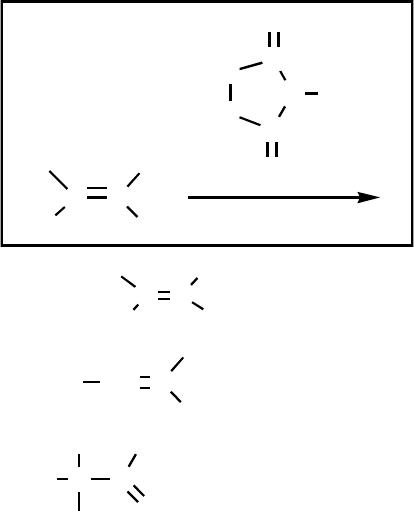
What product(s) would you expect the following radical reaction to provide in
reasonable yields?
H3C
C
HCCH3
H
H2C
H2CC
N
C
O
O
Br
?
(= NBS)
A)
C C CH3
H
HOCH2
H
B)
H3CCH CCH2Br
H
C)
H3C
CH C CH2
H
Br
D)
both B and C
E)
both A and C
Page 2
2.
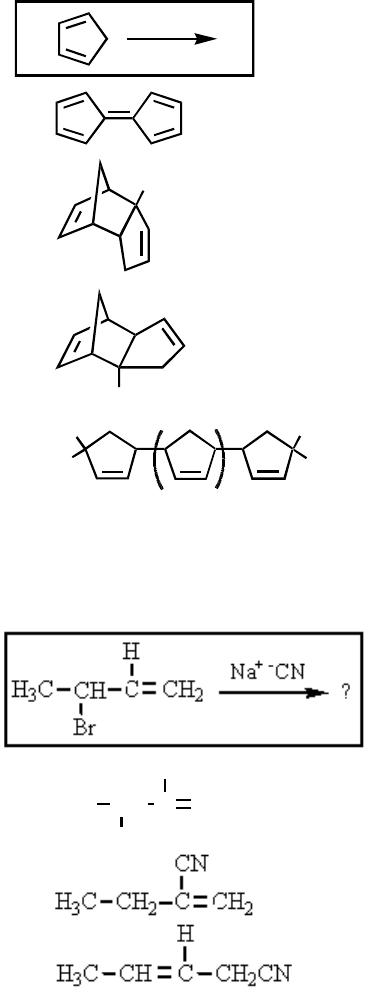
What would be the product of the following reaction?
2?
A)
B)
H
C)
H
D)
H
H
H
H
n
E)
No reaction occurs
3.
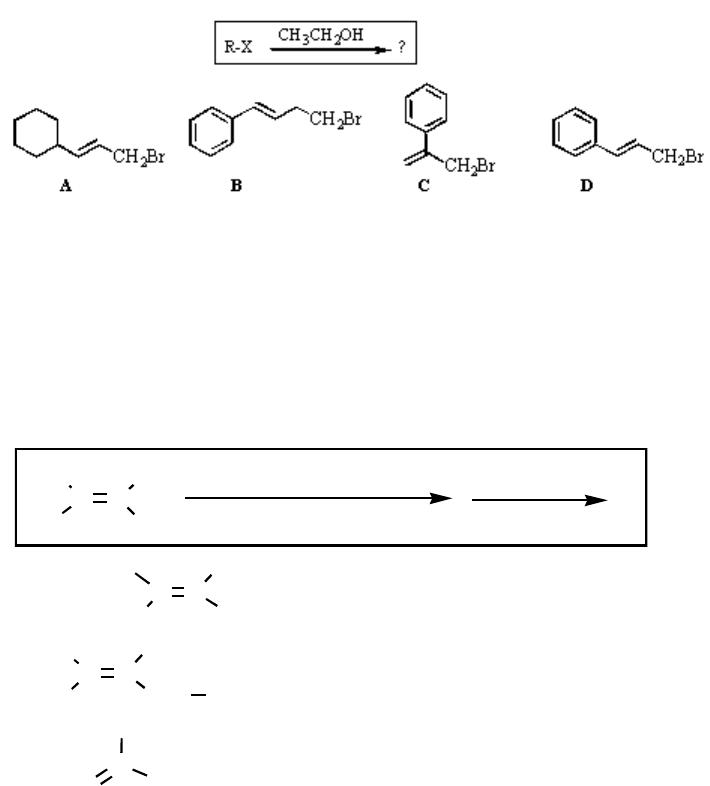
What product(s) would you expect from the following reaction?
A)
H3CCH CCH2
H
CN
B)
C)
D)
both A and B
E)
both A and C
Page 3
4.
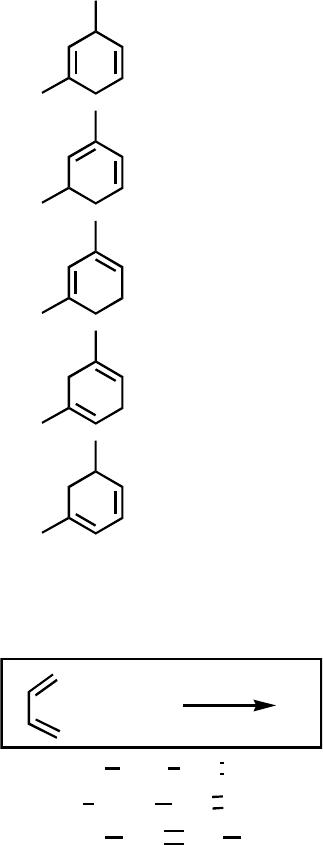
In order of decreasing reactivity, how would the bromides below rank in the following
reaction?
A)
B > A > D > C
B)
D > B > A > C
C)
A > C > D > B
D)
D > A > C > B
E)
C > D > B > A
5.
What would be the final product(s) of the following reactions?
H3CC C H
H
H2. CH2O
3. H2O
1. CH3CH2CH2CH2Li
(CH3)2NCH2CH2N(CH3)2
?
A)
C C CH3
H
HOCH2
H
B)
CH2
CC
H
H
H
CH2OH
C)
H2CCCH3
CH2OH
D)
both A and B
E)
both A and C
Page 4
6.
Which one of the following dienes would you expect to be the most stable?
A)
B)
C)
D)
E)
7.
What product(s) would NOT be formed from the reaction of 1,3-butadiene with HCl?
?+ HCl
A)
ClCH2CH2CH CH2
B)
H3C CHCl CH CH2
C)
ClCH2CH CH CH3
D)
neither A nor C
E)
neither B nor C
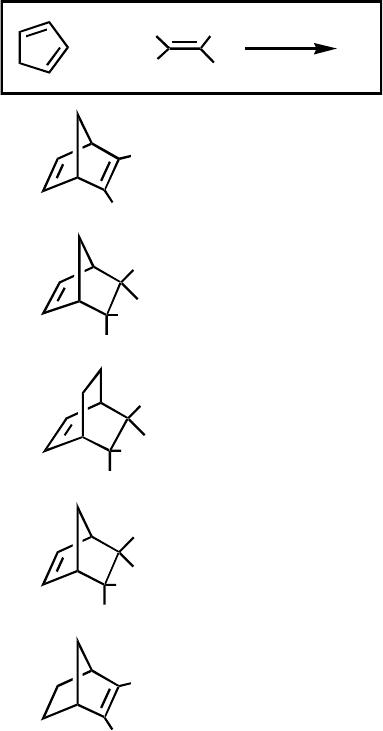
Page 5
8.
What would be the major product of the following reaction?
H
CN
NC
H
+?
A)
CN
CN
B)
CN
H
CN
H
C)
CN
H
CN
H
D)
CN
CN
H
H
E)
CN
CN
9.
UV-visible spectroscopy involves what type of phenomenon?
A)
Binding of chemical bonds
B)
Electron transitions between orbitals
C)
Molecular rotations
D)
Nuclear spin transitions
E)
Stretching of chemical bonds
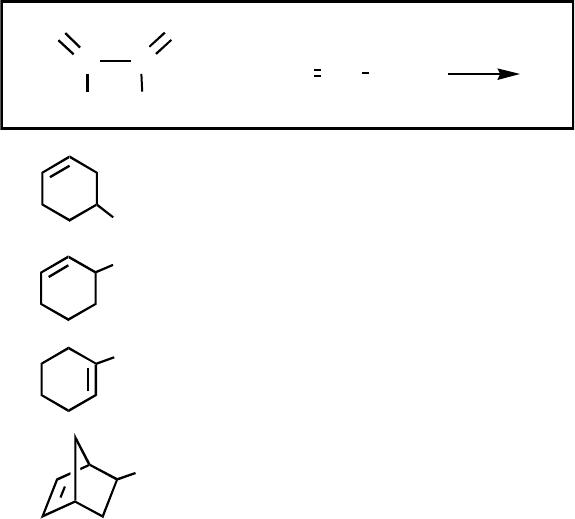
Page 6
10.
The reaction of butadiene with acrolien would yield what product?
H2CCH CHO+ ?
H2C
C C
CH2
H H
A)
CHO
B)
CHO
C)
CHO
D)
CHO
E)
None of these products are formed.
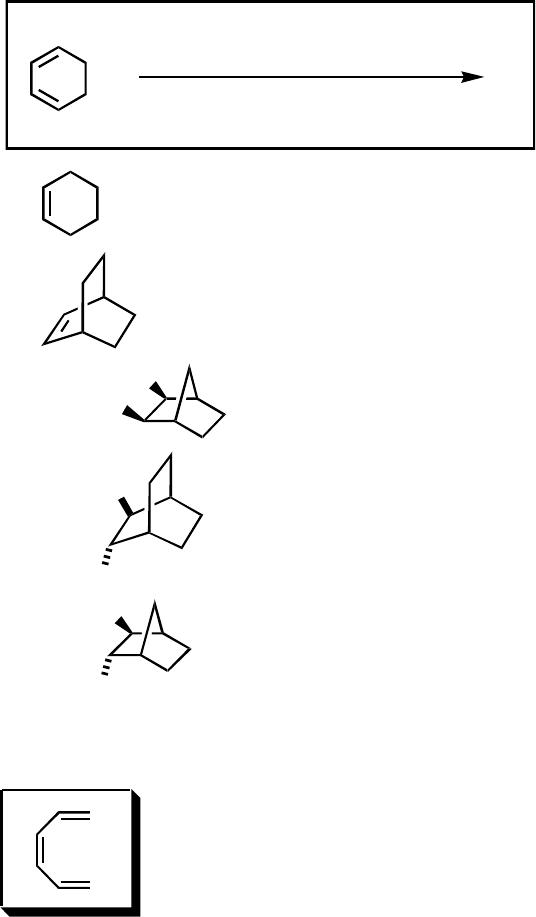
Page 7
11.
What would be the expected major product of the following reaction sequence?
1) ethene / heat
2) MCPBA / Na
2HPO4 / CH2Cl2
3) CH3CH2MgBr / Et2O
4) H3O+
?
A)
B)
C)
CH3CH2
HO
D)
HO
CH3CH2
E)
HO
CH3CH2
12.
The LUMO of 1,3,5-hexatriene is:
A)
1
B)
2
C)
3
D)
4
E)
5
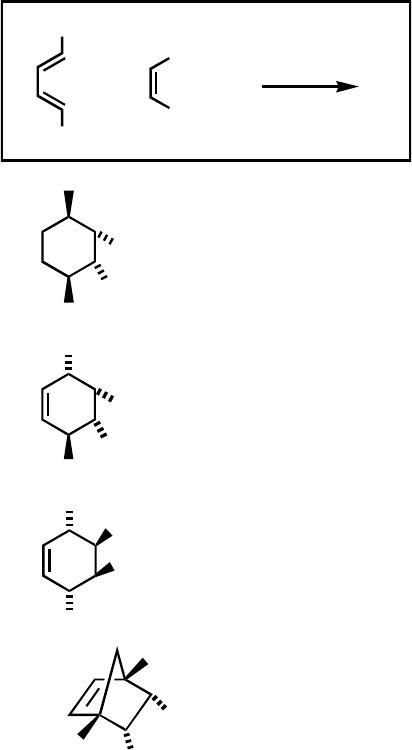
Page 8
13.
A typical Diels-Alder reaction involves
A)
an electron-rich diene and an electron-rich dienophile.
B)
an electron-poor diene and an electron-rich dienophile.
C)
an electron-rich diene and an electron-poor dienophile.
D)
an electron-poor diene and an electron-poor dienophile.
E)
a non-substituted diene and a non-substituted dienophile.
14.
What would be the major product of the following reaction?
CH3
CH3
CO2Et
CO2Et
?
+heat
A)
CH3
CH3
CO2Et
CO2Et
B)
CH3
CH3
CO2Et
CO2Et
C)
CH3
CH3
CO2Et
CO2Et
D)
CH3
H3CCO2Et
CO2Et
E)
None of these products are formed.
Page 9
15.
The presence of a bromine WHERE in the following carbon chain would give the most
reactive material for an SN2 reaction with a nucleophile (all other bonds would be to
hydrogen)?
C C C C C
1 2 3 4 5
A)
1
B)
2
C)
3
D)
4
E)
5
16.
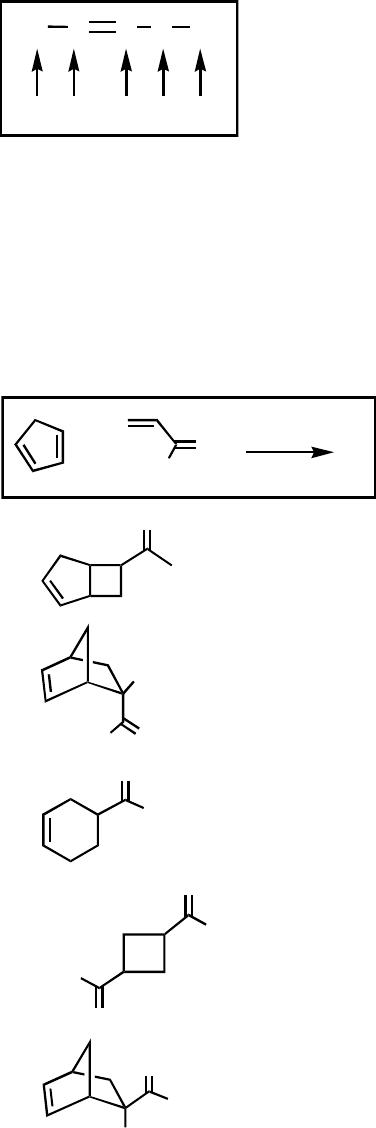
What would be the major product from the following reaction?
O
CH3
?
+heat
A)
O
CH3
B)
H
O
H3C
C)
O
CH3
D)
O
CH3
O
H3C
E)
H
O
CH3
Page 10
17.
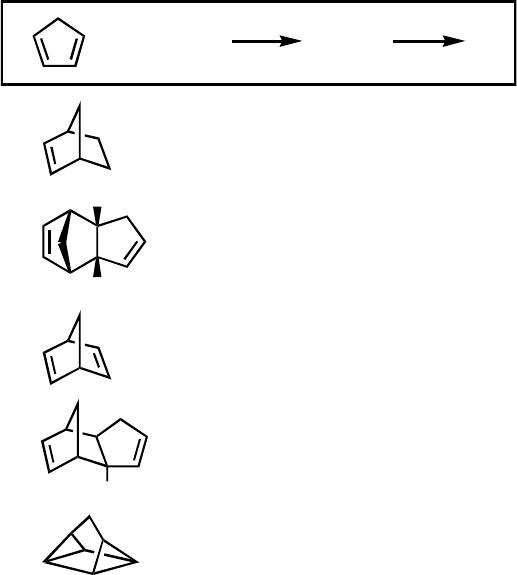
What major product would result from the following sequence of reactions?
?
+ C2H2C7H8light
A)
B)
H
H
C)
D)
H
E)
Page 11
18.
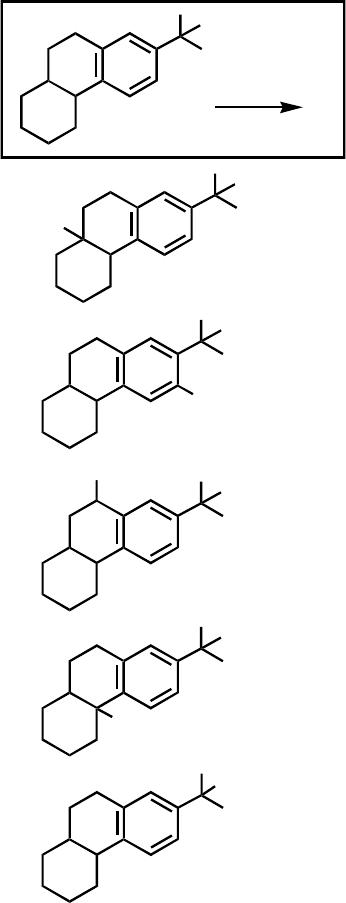
What would be the expected major product of the following reaction?
?
Br2
light
A)
Br
B)
Br
C)
Br
D)
Br
E)
Br
Page 12
19.
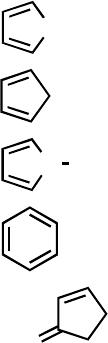
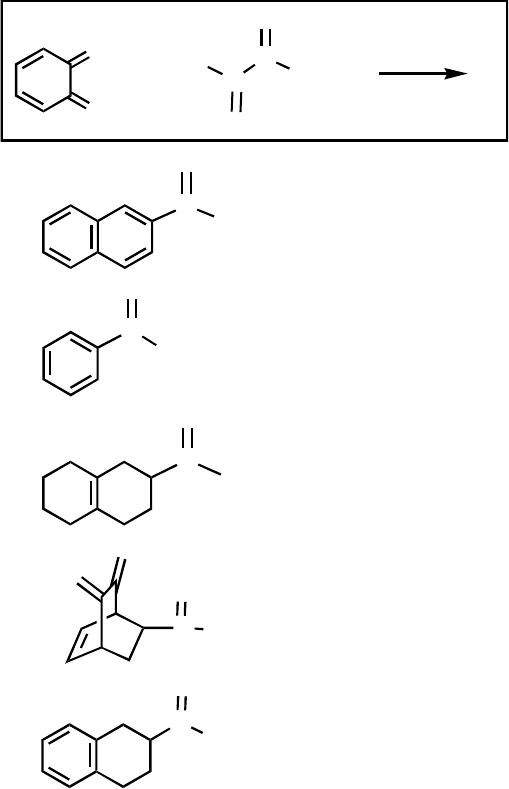
Which of the following dienes would you expect to be the most reactive in Diels-Alder
reactions?
A)
O
B)
C)
N H
D)
E)
H2C
Page 13
20.
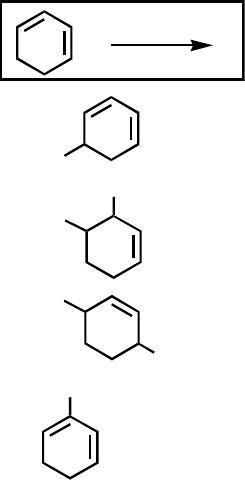
What product would you expect from the following reaction?
CH2
CH2C
CH2
COCH3
O
H?
+
A)
C
O
OCH3
B)
C
O
OCH3
C)
C
O
OCH3
D)
CH2
C
O
OCH3
H2C
E)
C
O
OCH3
Page 14
21.
The reaction shown below is expected to produce which product(s)?
?
Br2
A)
Br
B)
Br
Br
C)
Br
Br
D)
Br
E)
more than one of these
22.
The pi electrons in 1,3-butadiene are distributed as follows:
A)
One in each of 4 bonding orbitals
B)
Two in bonding orbitals, two in non-bonding orbitals
C)
Two in each of 2 bonding orbitals
D)
One in each of 4 non-bonding orbitals
E)
None of these.
23.
Predict the product of the hydrolysis of (S)-4-bromo-2-pentene.
A)
(R)-2-pentene-4-ol
B)
Racemic 3-pentene-2-ol
C)
(R)-2-hydroxy-3-pentene
D)
Racemic-3-hydroxy-3-pentene
E)
(S)-2-hydroxy-3-pentene
Page 15
24.
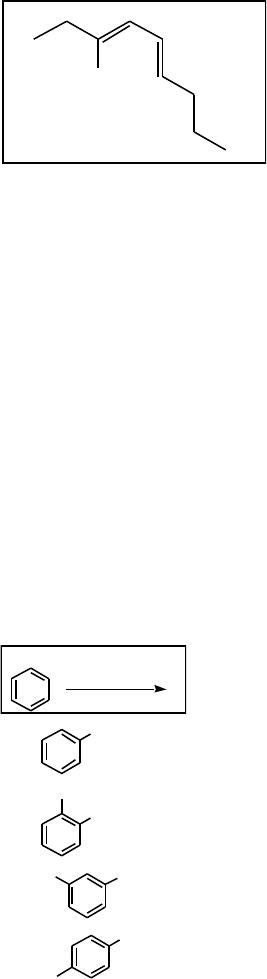
What is the IUPAC name for the following compound?
Br
A)
(3E,5E)-7-Bromo-4,6-nonadiene
B)
(3E,5E)-3-Bromo-3,5-nonadiene
C)
(3E,5Z)-7-Bromo-4,6-nonadiene
D)
(3Z,5E)-3-Bromo-3,5-nonadiene
E)
(3Z,5Z)-3-Bromo-3,5-nonadiene
25.
Which is the MAJOR product of combining 1,3-butadiene with HBr at 25 oC?
A)
1-bromo-2-butene
B)
3-bromo-1-butene
C)
1,3-dibromobutadiene
D)
2,3-dibromobutene
E)
3,3-dibromobutene
26.
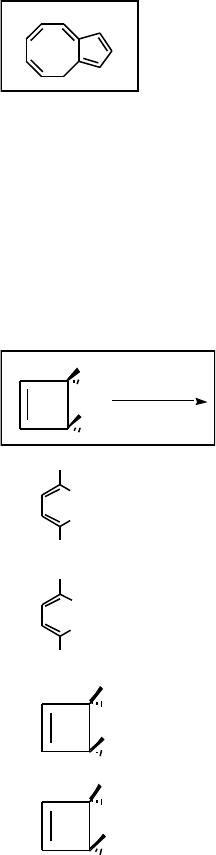
Predict the MAJOR product of the following reaction:
Br2, 25oC
A)
Br
B)
Br
Br
C)
Br Br
D)
Br
Br
E)
No reaction
Page 16
27.
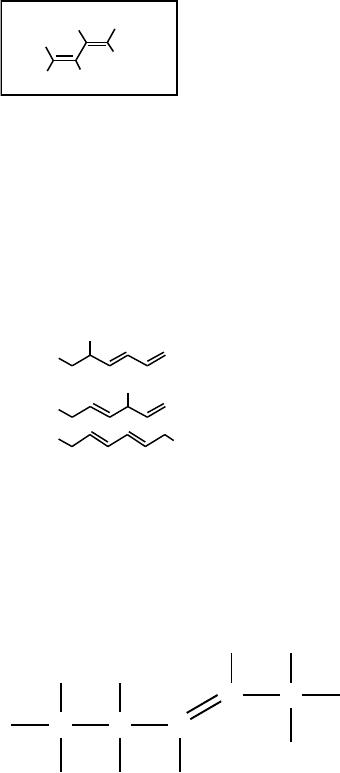
The UV spectrum of the following molecule is useful for determining _______.
A)
coupling constants between hydrogen atoms
B)
molecular weight
C)
conjugation resulting in electronic transitions
D)
molecular formula
E)
two of these are correct
28.
Predict the product of the following reaction:
CH3
H
CH3
H
A)
H
H
CH3
CH3
B)
H
CH3
H
CH3
C)
H
CH3
CH3
H
D)
CH3
H
H
CH3
E)
No reaction
Page 17
29.
What is the proper IUPAC name for the following molecule:
H3C
H
H CH2CH3
H
H
A)
(2E,4Z)-2,4-heptadiene
B)
(2E,3Z)-2,3-heptadiene
C)
(2Z,4E)-2,4-heptadiene
D)
(2E,4Z)-2,4-hexadiene
E)
(2Z,3E)-2,3-hexadiene
30.
Which of the following are most favored thermodynamically?
A)
Br
Br
B)
Br
Br
C)
Br Br
D)
All of these.
E)
None of these.
31.
When reacted with Br2 and light, which C-H bond 2-pentene will preferentially
dissociate to give a radical?
H C C C
C C H
He
H
Hd
Hc
Hb
H
Ha
H
A)
The C-Ha bond
B)
The C-Hb bond
C)
The C-Hc bond
D)
The C-Hd bond
E)
The C-He bond

Page 18
32.
Which of the structures below do not benefit from resonance stabilization?
A)
B)
H2C CH CH2
C)
H2C CH CH2
D)
H2C CH CH3
E)
None of the above.
33.
Which of the following alkylbromides cannot be a product of the allylic bromination of
1-methylcyclopentene with NBS?
A)
Br
B)
CH3
Br
C)
CH3
Br
D)
CH3
Br
E)
All of the above can be a product from the reaction.
Page 19
34.
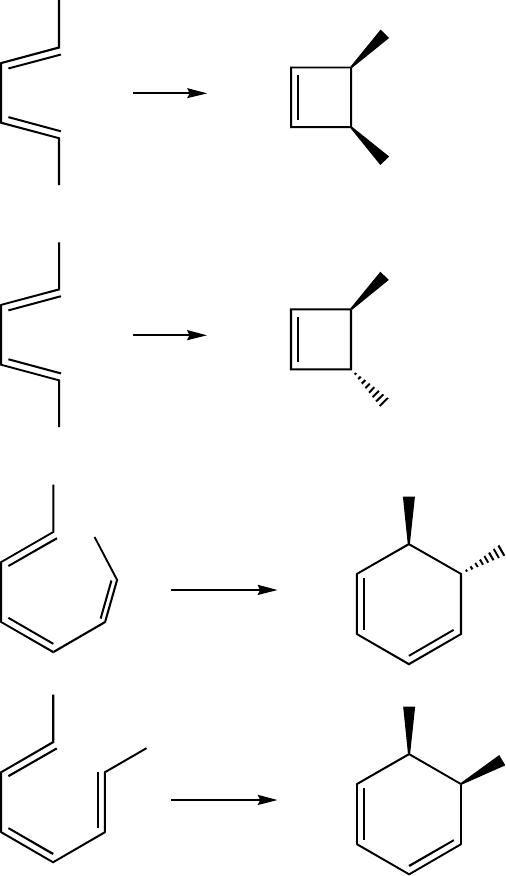
Which of the following electrocyclic reactions occurs via a conrotatory process?
A)
CH3
CH3
CH3
CH3
B)
CH3
CH3
CH3
CH3
C)
CH3
CH3
CH3
CH3
D)
CH3CH3
CH3
CH3
E)
Both B and C
Page 20
Answer Key