General Chemistry, 11e (Petrucci)
Chapter 14 Solutions and Their Physical Properties
1) In the solution, a solute is present in the greatest quantity.
2) Molality is independent of temperature, molarity is dependent on temperature.
3) For the formation of an ideal solution from two liquid hydrocarbons, ΔHsoln < 0.
4) The stronger the forces between solute and solvent molecules, the more exothermic the solution
process.
5) An unsaturated solution will have some undissolved solid in the bottom of the container.
6) Gas solubility always increases with temperature.
7) Most volatile liquids can be separated from each other by fractional distillation.
8) Osmotic pressure is a colligative property.
9) Adding a solute to a solvent lowers the freezing point of the solution compared to the pure solvent.
10) The van’t Hoff factor is due to ions being attracted to each other enough that they don’t react as
individual molecules.
11) A sweetened cup of coffee is an example of a:
A) heterogeneous mixture
B) homogeneous mixture
C) solid solution
D) pure liquid
E) gaseous solute in a liquid solvent
12) A solid solution of zinc in copper is an example of:
A) a solvent
B) a solute
C) the U.S. five-cent nickel
D) a non-uniform solute
E) an alloy
13) A solution prepared by dissolving 4.00 g KCl in 36.0 g H2O is said to be:
A) 11.1% KCl by mass
B) 0.100% KCl by mass
C) 0.111% KCl by mass
D) 10.0% KCl by mass
E) 9.00% KCl by mass
14) Which definition is INCORRECT?
A) mole fraction = moles of solute/mole of solution
B) molality = moles of solute/kilogram of solvent
C) weight percent = grams of solute/100 grams of solution
D) molarity = moles of solute/volume of solution (in L)
E) volume percent = volume of solute/volume of solvent
15) An aqueous solution containing 1.0 g ephedrine in 20.0 mL solution is said to be:
A) 5.0% ephedrine (mass/vol)
B) 1.0% ephedrine (mass/vol)
C) 0.50% ephedrine (mass/vol)
D) 0.050% ephedrine (mass/vol)
E) 20.0% ephedrine (mass/vol)
16) A 1.00 molal solution of NaCl in water contains:
A) 1.00 g NaCl per 1000.0 g H2O
B) 1.00 mol NaCl per 1000.0 g H2O
C) 1.00 mol NaCl per 1000.0 kg H2O
D) 1000.0 g NaCl per 1000.0 g H2O
E) 1.00 mol NaCl per 1000.0 mol H2O
17) A magnesium sulfate heptahydrate solution, which is 18.00% by weight in the anhydrous compound,
has a density at 20 °C of 1.20 g/mL. What is the molality of the anhydrous compound in the solution?
(Atomic masses in amu: H = 1.0, O = 16.0, S = 32.1, Mg = 24.3)
A) 5.54 M
B) 1.79 M
C) 1.82 M
D) 1.25 M
E) 1.49 M
18) Liquid Q is a polar solvent and liquid R is a nonpolar solvent. On the basis of this information, you
would expect:
A) both liquids to be miscible with a third liquid T
B) liquid Q to be miscible with liquid R
C) NaCl to be soluble in both Q and R
D) liquid Q and H2O to be miscible
E) liquid R and H2O to be miscible
19) Which of the following pairs are more likely to form a solution?
A) chloroform (CHCl3) and acetone (CH3COCH3)
B) water and octane (C8H18)
C) methanol (CH3OH) and hexane (C6H14)
D) water and octyl alcohol (C8H17OH)
E) acetone (CH3COCH3) and octane (C8H13)
20) Which compound is likely to be the most soluble in water?
A) butyl alcohol (CH3CH2CH2CH2OH)
B) ethylene glycol (HOCH2CH2OH)
C) hexane (C6H14)
D) benzene (C6H12)
E) iodine (I2)
21) Which compound is likely to be the most soluble in hexane?
A) water
B) acetone (CH3COCH3)
C) benzene (C6H12)
D) ethyl alcohol (CH3CH2OH)
E) chloroform (CHCl3)
22) Which of the following pairs of liquids would likely form a nonideal solution?
A) CS2 and (CH3)2CO
B) C6H5–CH3 (toluene) and C6H6 (benzene)
C) CH3CH2CH2OH and CH3CH(OH)CH3
D) H5C6-C6H5 (diphenyl) and C6H6 (benzene)
23) A solution is called “ideal” when:
A) all intermolecular forces of attraction are the same, resulting in no net enthalpy change when the
solution is formed from its components
B) the forces of attraction between solute molecules exceed those between solute and solvent molecules
C) the forces of attraction between solute and solvent molecules are somewhat smaller than between
solute-solute molecules or solvent-solvent molecules
D) the forces of attraction between solvent molecules exceed those between solute and solvent molecules
E) the forces of attraction between solute molecules and solvent molecules are much smaller than between
solute-solute molecules or solvent-solvent molecules
24) Which of the following compounds has the highest aqueous solubility?
A) CaCl2
B) SrI2
C) CaI2
D) MgI2
E) CaBr2
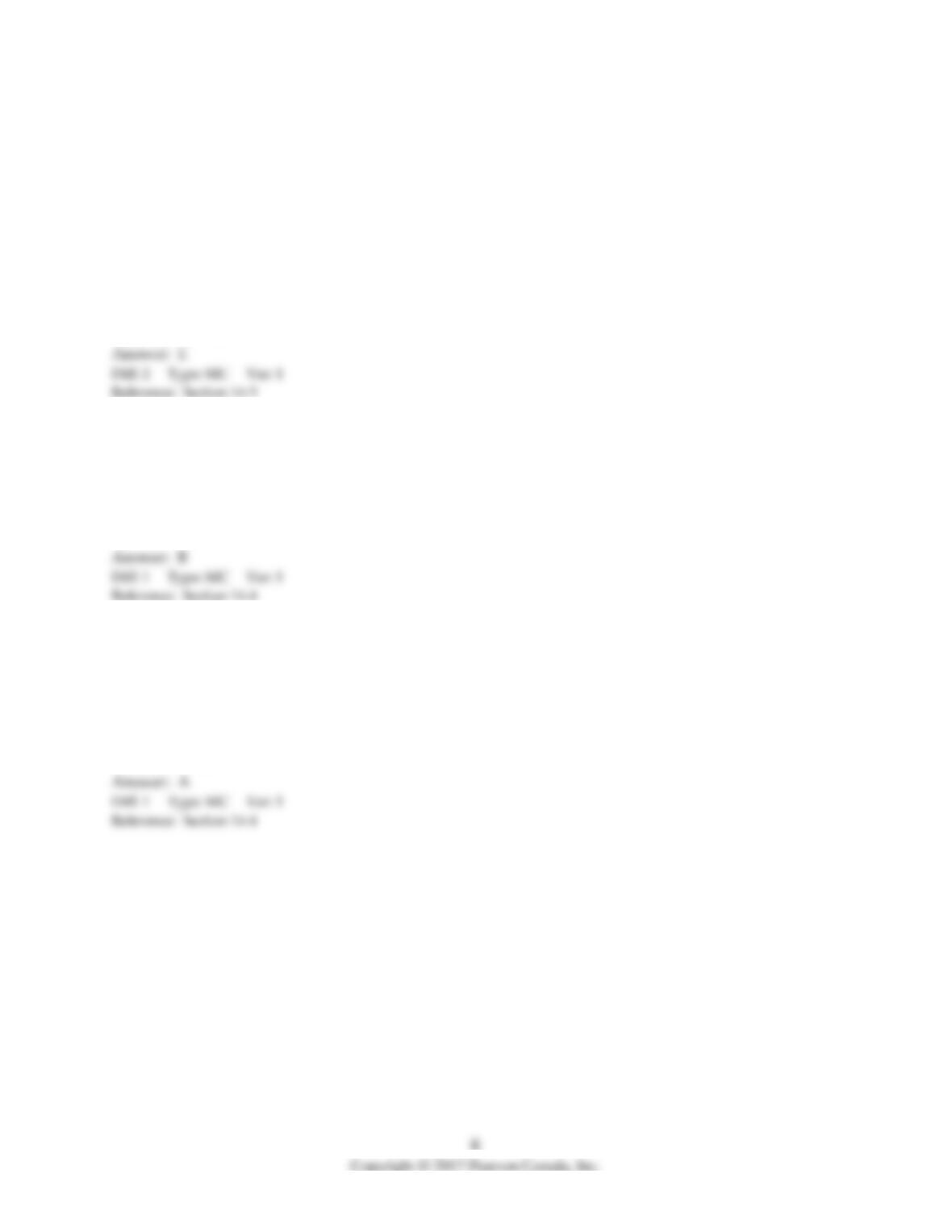
25) Which of the following organic substances is most readily soluble in water?
A) benzene
B) pyridine
C) octane
D) carbon tetrachloride
E) toluene
26) Which of the following statements about ideal solutions are true?
I) Entropy effects are important for the formation of ideal solutions.
II) The heat of solution is zero.
III) The vapor pressure varies linearly with the composition.
IV) The forces between like kinds of molecules are (almost) equal to the forces between unlike kinds of
molecules.
A) I), II), IV)
B) I), III), IV)
C) II), III), IV)
D) I), II), III)
E) I), II), III), IV)
27) A solution that can dissolve no more solute is called:
A) unsaturated
B) saturated
C) concentrated
D) supersaturated
E) oversaturated
28) A crystal is placed into a solution and the solution seems to solidify while getting much warmer at the
same time. The solution must have been:
A) supersaturated
B) dilute
C) saturated
D) unsaturated
E) concentrated
29) The solubilities of ammonium bromide, NH4Br, in water at 0 °C, 20 °C, and 80 °C are as follows:
T (°C) Sol. g NH4Br/100 g H2O
0 60.5
20 76.4
80 125
Which of the following fractional crystallization schemes would produce the highest percent yield for the
recrystallization of ammonium bromide?
A) A solution containing 50.5 g NH4Br in 100.0 g H2O at 20 °C is cooled to 0 °C.
B) A solution containing 115 g NH4Br in 200 g H2O at 80 °C is cooled to 0 °C.
C) A solution containing 120 g NH4Br in 100 g H2O at 80 °C is cooled to 20 °C.
D) A solution containing 100 g NH4Br in 100.0 g H2O at 80 °C is cooled to 20 °C.
E) A solution containing 95 g NH4Br in 175 g H2O at 80 °C is cooled to 0 °C.
30) Henry’s Law states that:
A) a supersaturated solution is unstable
B) the solubility of a gas increases as the gas pressure is increased
C) the solubility of a gas decreases as the gas pressure is increased
D) a concentrated solution lowers the freezing point of a solution
E) a concentrated solution increases the boiling point of a solution
31) Henry’s Law constants for aqueous solutions at 25 °C are 8.20 × 10⁻⁷ m/mmHg for N2 and 1.62 × 10⁻⁶
m/mmHg for O2. Determine the solubility of nitrogen in water under an atmospheric pressure of 760
mmHg, assuming that air is 80% N2 and 20% O2.
A) 6.23 × 10⁻⁴ m
B) 7.79 × 10⁻⁴ m
C) 4.99 × 10⁻⁴ m
D) 1.25 × 10⁻⁴ m
E) 6.16 × 10⁻³ m
32) Henry’s Law constants for aqueous solutions at 25 °C are 8.20 × 10⁻⁷ m/mmHg for N2 and 1.62 × 10⁻⁶
m/mmHg for O2. Determine the solubility of oxygen in water under an atmospheric pressure of 760
mmHg, assuming that air is 80% N2 and 20% O2.
A) 6.2 × 10⁻³ m
B) 2.5 × 10⁻⁴ m
C) 1.3 × 10⁻⁴ m
D) 5.0 × 10⁻⁴ m
E) 1.2 × 10⁻³ m
33) Nitrogen gas has a Henry’s law constant k = 6.3 × 10⁻⁴ M/atm at 25 °C. The “bends” in divers results
from bubbles of N2(g) being rapidly released from body fluids when a diver ascends to the surface too
quickly. Which of the following would be a good substitute for N2(g) in order to make the “bends” less
severe?
A) He(g), k = 3.7 × 10⁻⁴ M/atm
B) Ar(g), k = 1.5 × 10⁻³ M/atm
C) H2(g), k = 8.1 × 10⁻⁴ M/atm
D) CO2(g), k = 3.4 × 10⁻² M/atm
34) The solubility of CO in water at 0 °C and 1 atm CO pressure is 0.0354 mg of CO in 1 mL of water.
Calculate the molarity of aqueous CO solution at the normal partial pressure of CO of 0.00036 atm?
A) 4.5 × 10⁻⁷ M
B) 1.6 × 10⁻³ M
C) 1.3 × 10⁻⁵ M
D) 2.9 × 10⁻⁴ M
E) 3.2 × 10⁻³ M
35) The solubility of CO in water at 0 °C and 1 atm CO pressure is 0.0354 mg of CO in 1 mL of water.
Calculate the molarity of aqueous CO solution at 2 atm CO pressure.
A) 1.58 × 10⁻³ M
B) 6.32 × 10⁻² M
C) 1.59 M
D) 2.53 × 10⁻³ M
E) 3.16 × 10⁻³ M
36) Which of the following is a correct statement about azeotropes?
A) The components boil at distinct temperatures.
B) The mixture cannot be separated by fractional distillation.
C) The solution behaves as an ideal solution.
D) The vapor has a different composition than the liquid.
E) The solution has the same pressure as the pure solvent.
37) An azeotropic mixture is a:
A) mixture of two or more substances where boiling point cannot be determined
B) solution of two or more substances present in the same amounts in the liquid phase
C) liquid mixture of two or more substances in which the vapor has the same composition as the liquid
D) liquid mixture of two or more substances linked by azide functional groups
E) solution of two or more substances that cannot be made to freeze
38) A solution composed of 5 moles of acetone (CH3COCH3, P°A = 324 mmHg) and 5 moles of
chloroform (CHCl3, P° = 274 mmHg) has a vapor pressure of 236 mmHg. Which one of the following
statements is completely true about this solution?
A) The solution shows a negative deviation from Raoult’s law and thus possesses a maximum boiling
azeotrope.
B) The solution process is exothermic because the forces between unlike molecules are weaker than those
between like molecules.
C) The solution shows a positive deviation from Raoult’s law.
D) The solution possesses a minimum boiling azeotrope because it shows a negative deviation from
Raoult’s law.
E) The solution obeys Raoult’s Law.
39) The vapor pressures of pure propyl alcohol and isopropyl alcohol are 21.0 mmHg and 45.2 mmHg,
respectively, at 25 °C. What is the composition of the vapor in equilibrium with a propyl alcohol –
isopropyl alcohol solution in which the mole fraction of propyl alcohol is 0.250?
A) xiso = 0.866, xprop = 0.134
B) xiso = 0.750, xprop = 0.250
C) xiso = 0.317, xprop = 0.683
D) xiso = 0.512, xprop = 0.488
40) What is the osmotic pressure in mmHg of 6.00 L of a 0.108 M solution at 30 °C if three moles of ions
are produced in aqueous solution for every mole of solute dissolved?
A) 8.05 mmHg
B) 3.68 × 10⁴ mmHg
C) 2.04 × 10³ mmHg
D) 0.0612 mmHg
E) 6.12 × 10³ mmHg
41) Arrange the following three aqueous solutions (all 250 cm3 in volume) according to decreasing
osmotic pressure at 273 K: 5 g of C2H5OH, 5 g C6H12O6 ,and 5 g C12H22O11.
A) C2H5OH > C6H12O6 > C12H22O11
B) C2H5OH > C6H12O6 = C12H22O11
C) C6H12O6 > C2H5OH > C12H22O11
D) C12H22O11 > C6H12O6 > C2H5OH
E) C12H22O11 > C2H5OH> C6H12O6
42) Colligative properties are similar in that they all:
A) are due to solvent chemical interactions
B) depend on the number of solute particles in solution
C) depend on the solvent
D) have no effect on the properties of solution
E) describe colloids
43) Which of the following is a non-colligative property?
A) freezing point depression
B) boiling point elevation
C) osmotic pressure
D) solubility
E) vapour pressure lowering
44) A solution containing 3.24 g of sulfur in 40 g of benzene boils 0.81 °C above the boiling point of pure
benzene. Determine the number of S atoms in one molecule of dissolved sulfur. Kb for benzene is 2.53 °C
m-1.
A) 10
B) 12
C) 6
D) 8
E) 4
45) Solutions are made that contain 0.10 moles of each of the following compounds in 100 g of H2O.
Choose the compound whose solution will have the highest freezing point.
A) K2SO4
B) NaI
C) Mg(CH3CO2)2
D) Ca3(PO4)2
E) Sr(NO3)2
46) Solutions are made that contain 0.1 moles of each of the following compounds below in 100 g of H2O.
Choose the compound whose solution will have the lowest freezing point.
A) MgCl2
B) KClO3
C) CO2
D) MgSO4
E) NaBr
47) Which of the following aqueous solutions has the lowest freezing point?
A) 1.5 m aluminum perchlorate.
B) 1.0 m magnesium phosphate
C) 1.5 m calcium nitrate
D) 2.0 m potassium chloride
48) Which of the following aqueous solutions has the highest boiling point?
A) 1.0 m magnesium phosphate
B) 1.5 m sodium sulfate
C) 2.0 m lithium perchlorate
D) 1.5 m magnesium sulfate
49) We wish to lower the freezing point of the water in an automobile radiator to -40 °C. The total mass of
water present is 12.0 kg. For which one of the following compounds would we have to use the greatest
mass of solute to achieve this? You may assume that Kf for water = -1.86 °C/m and that all ionizable
solutes are completely ionized with unit activity even at this high concentration.
A) AlF3 (M.W. = 84 g/mol)
B) C2H5OH (M.W. = 46 g/mol)
C) CaCl2 (M.W. = 111 g/mol)
D) C3H6(OH)2 (M.W. = 76 g/mol)
E) NaCl (M.W. = 58.5 g/mol)
50) Which of the following is a true solution with particles less than 1 nm in size?
A) calcium chloride in water
B) oil in water
C) whipped cream
D) milk
51) Which of the following combination of dispersed phase in a dispersion medium with the colloid type
is INCORRECT?
A) Solid in liquid is a solution.
B) Solid in solid is a solid solution.
C) Solid in gas is an aerosol.
D) Liquid in solid is a solid foam.
E) Liquid in gas is an aerosol.
52) Choose the correct statement.
A) Colloids are homogeneous solutions.
B) A true colloidal particle will not settle out of the dispersing membrane.
C) Colloidal particles can usually pass through a semipermeable membrane.
D) Electrolytes are protective colloids.
E) Dispersion is the method of preparing colloids from ions or molecules.
53) Choose the INCORRECT statement.
A) Colloidal particles are large aggregates of atoms they are electrically neutral.
B) Colloidal suspensions can be prepared in which the particles do not settle.
C) The addition of electrolytes to a colloidal suspension will sometimes cause the particles to coalesce and
precipitate.
D) Colloidal particles reflect light from a beam.
E) Colloidal suspensions exhibit the Tyndall effect.
54) Which of the following material-colloid type combinations is INCORRECT?
A) mayonnaise – emulsion
B) whipped cream – foam
C) smoke – aerosol
D) lava – solid foam
E) opal – solid solution
55) Which of the following is an example of a colloid?
A) sucrose in water
B) whipped cream
C) steel
D) salt in water
56) A solution component present in lesser quantity than the solvent is called ________.
A) a diluent
B) an alloy
C) a heterogeneous solid
D) a solute
E) a mixture
57) Moles of solute per mole of solution is a definition of ________.
A) molarity
B) mole fraction
C) percent by weight
D) molality
E) normality
58) An aqueous solution contains 64.0 g of ethanol (C2H5OH) in 122.0 g of solution. What is the mole
fraction of ethanol in the solution?
A) 0.301
B) 0.432
C) 0.205
D) 0.698
E) 0.317
59) Moles of solute per liter of solution is the definition of ________.
A) molality
B) solubility
C) molarity
D) normality
E) mole fraction
60) 85.0 grams of potassium bromide are to be used to produce a 0.300 M solution. What will be the total
volume of this solution?
A) 2.38 L
B) 2.83 L
C) 283 L
D) 0.214 L
E) 0.420 L
61) Commercial nitric acid is 16.0 M HNO3(aq) and has a density of 1.42 g/mL. What is the mole fraction
of HNO3 in this solution?
A) 0.412
B) 0.699
C) 0.589
D) 0.704
62) Commercial perchloric acid is 70.0% by mass, HClO4(aq). Calculate the mole fraction of perchloric
acid in the solution.
A) 0.295
B) 0.420
C) 0.705
D) 0.697
63) Commercial perchloric acid is 70.0% by mass, HClO4(aq), and has a density of 1.67 g/mL. Calculate
the molarity of perchloric acid in the solution.
A) 11.6 M
B) 1.17 M
C) 23.7 M
D) 16.5 M
64) 252 mL of 3.00 M H2SO4(aq) are added to 1.50 L of 0.500 M H2SO4(aq). What is the concentration of
the resulting solution?
A) 1.50 M
B) 0.860 M
C) 2.64 M
D) 1.75 M
E) 1.25 M
65) What is the mass/vol % ethanol in an ethanol-water solution with a density of 0.875 g/mL and
containing 65.0% ethanol by volume? The density of pure ethanol is 0.789 g/mL.
A) 90.2% ethanol (mass/vol)
B) 56.9% ethanol (mass/vol)
C) 51.3% ethanol (mass/vol)
D) 58.6% ethanol (mass/vol)
E) 74.5% ethanol (mass/vol)
66) An aqueous solution containing 12.0% MgCl2 by mass. What is the mol fraction of water in this
solution?
A) 0.975
B) 0.880
C) 0.868
D) 0.133
E) 0.952
67) 138.0 grams of ethanol (46.0 g/mol), 99.0 grams of water (18.0 g/mol), and 80.0 grams of methanol
(32.0 g/mol) comprise a solution. What is the mole fraction of methanol present in the solution?
A) 0.273
B) 0.338
C) 0.294
D) 0.252
E) 0.227
68) A magnesium sulfate heptahydrate solution, which is 18.00% by weight in the anhydrous compound,
has a density at 20 °C of 1.20 g/mL. What is the molarity of the anhydrous compound in the solution?
(Atomic masses in au: H = 1.0, O = 16.0, S = 32.1, Mg = 24.3)
A) 5.54 M
B) 1.79 M
C) 1.82 M
D) 1.25 M
E) 1.49 M