General Chemistry, 11e (Petrucci)
Chapter 13 Spontaneous Change: Entropy and Gibbs Energy
1) A microstate is a specific microscopic configuration describing how particles
of a system are distributed among the available energy levels.
2) Entropy is related to the way in which the energy of a system is distributed among the available
microscopic energy levels.
3) If a process is spontaneous, the reverse process is non spontaneous.
4) An increase in entropy is observed when a liquid forms from a gas.
5) An increase or a decrease in the number of microstates parallels an increase or
decrease in the number of microscopic particles and the space available to them.
6) Entropy changes depend on the quantities of substances involved.
7) The entropy of a pure perfect crystal at 25 K is zero.
8) Standard molar entropy, S∘, increases as molecular complexity increases.
9) A spontaneous process will occur only if an external action is continually applied.
10) ΔG is positive for a spontaneous reaction.
11) A zero ΔG means the system is at equilibrium.
12) The entropy of a system always increases for a spontaneous process.
13) Standard Gibbs energy of formation requires the reactants be compounds in their standard state.
14) In a reversible reaction, a forward spontaneous reaction corresponds to a negative ΔG.
15) ΔrG∘ is independent of temperature.
16) A non spontaneous reaction can be made to occur by coupling it with a spontaneous reaction to form
an overall spontaneous reaction.
17) Non spontaneous reactions and spontaneous reactions cannot be coupled.
18) As the activity a of a substances increases so does its chemical potential m.
19) The chemical potential of a substance, m, represents the ability of a substance to change the Gibbs
energy of a system.
20) A spontaneous process:
A) will happen quickly
B) releases large amounts of energy
C) requires an external action in order to begin reacting
D) will continue on its own once begun
E) is never endothermic
21) Find correct statements.
I) A spontaneous process is a process that occurs in a system left to itself.
II) A non spontaneous process will not occur unless some external force is applied.
III) If a reaction is spontaneous, the reverse is also spontaneous.
IV) Only spontaneous processes occur naturally.
V) Entropy is inversely proportional to the degree of randomness.
A) I), II) and V)
B) II), III), and IV)
C) I), II), and IV)
D) I), III) and IV)
E) I), IV), and V)
22) Which of the following statements are true?
I) Liquids have more entropy than their solids.
II) Solutions have more entropy than the solids dissolved.
III) Gases and their liquids have equal entropy.
IV) Gases have less entropy than their solids.
V) Entropy of a substance increases as its temperature increases.
A) II), III), and V)
B) I), III), and V)
C) I), IV), and V)
D) I), II), and V)
E) II), IV) and V)
23) Which material has the largest entropy?
A) pure water
B) powdered sugar
C) salt water
D) crystalline salt
E) cannot be determined
24) Which of the following processes would result in a decrease in system entropy?
A) melting of an ice cube
B) sublimation of a moth ball
C) evaporation of a puddle of gasoline
D) a glass of cool lemonade warming in the sun
E) condensation of water vapor on a cold windshield
25) Which of the following has the highest entropy?
A) 1 mole of liquid water at 30 °C
B) 1 mole of water vapor at 30 °C
C) 1 mole of regular ice at –10 °C
D) 1 mole of “dry ice” at -10 °C
E) 1 mole of water under 10 atm of pressure at -10 °C
26) Choose the correct statements concerning entropy.
I) Following the mixing of two gases, ΔS is positive.
II) Entropy is a thermodynamic property related to the degree of disorder.
III) If the temperature of a gas is decreased, ΔS is positive.
IV) Molecules in the liquid state have higher entropy than the same molecules in the gaseous state.
A) I and III
B) I, II, III
C) I and II
D) I, II, IV
E) II and III
27) Indicate the statement(s) which is (are) true for the process:
Al+3(aq) + 3 OH–(aq) → Al(OH)3(s)
if it occurs in a closed container.
I) ΔS increases because the final molecule is more complicated.
II) Entropy decreases because the product is in the solid phase.
III) The two ions achieve a high degree of order as they crystalize, therefore ΔS is positive.
IV) Entropy of the system is unchanged because the system is sealed and at a constant temperature.
A) I and II
B) I and III
C) II only
D) I, II, IV
E) I and IV
28) Which of the following best expresses the increase in entropy associated with melting and
sublimation, respectively?
A) ΔfusS – ΔsubS = 0
B) ΔfusS = 144.3 J/mol-K, ΔsubS = 9.0 J/mol-K
C) ΔfusS = 9.0 J/mol-K, ΔsubS = -144.3 J/mol-K
D) ΔH for both processes is zero
E) ΔfusS = 9.0 J/mol-K, ΔsubS= 144.3 J/mol-K
29) The normal melting and boiling points of SO2 are 198 and 263 K, respectively. For a plot of the
standard molar entropy of SO2 versus temperature, which of the following is INCORRECT?
A) At 263 K, S° is constant.
B) S° increases with increasing temperature.
C) S° equals zero at 0 K.
D) At 198 K, S° increases by the value of △fusS.
E) At 263 K, S° jumps suddenly as SO2 undergoes phase change.
30) Which of the following has the largest molar entropy?
A) I2(g)
B) Xe(g)
C) H2(g)
D) He(g)
E) O2(g)
31) Which of the following relations is true for the molar entropy of sublimation of a substance?
A) ΔsubS = ΔfusS + ΔvapS
B) ΔsubS < ΔvapS
C) ΔsubS = ΔfusS – ΔvapS
D) ΔsubS < (ΔfusS + ΔvapS)
E) ΔsubS > (ΔfusS + ΔvapS)
32) Which of the following substances under equal conditions and in the same phase has the greatest
molar entropy?
A) NO
B) NO2
C) N2O3
D) N2O4
E) N2O5
33) Choose the INCORRECT statement.
A) One form of the second law of thermodynamics is all spontaneous processes produce an increase in
the entropy of the universe.
B) Gibbs energy is defined by: G = H – TS.
C) If ΔG < 0, the process is spontaneous.
D) If ΔG > 0, the process is nonspontaneous.
E) If ΔG = 0, the process is spontaneous.
34) Choose the INCORRECT statement.
A) The third law of thermodynamics states that the entropy of a pure crystal at 298 K is zero.
B) ΔrS° = Σ (ν S°) products – Σ (ν S°) reactants.
C) The activity of pure liquids or pure solids is 1.
D) ΔrG ° = –RT ln Keq.
E) ΔrG ° = ΔrH° – TΔrS°.
35) The change in Gibbs energy of a reaction:
A) = work
B) predicts speed
C) = ΔH + TΔS
D) depends on the standard state chosen
E) tells us if the reaction is spontaneous or not
36) If ΔG < 0 for a reaction, then the reaction is said to be:
A) endothermic
B) reversible
C) spontaneous
D) exothermic
E) fast
37) The maximum quantity of energy available for useful work is:
A) constant
B) Gibbs energy change
C) the entropy change
D) the internal energy change
E) the enthalpy change
38) The change in Gibbs energy for a reaction:
A) = ΔH – TΔS
B) = q (heat)
C) = ΔS + TΔH
D) = ΔS – TΔH
E) = ΔH + TΔS
39) The Gibbs energy change for a reaction is -298 kJ. The reaction is therefore:
A) exothermic
B) irreversible
C) spontaneous
D) endothermic
E) nonspontaneous
40) In a sealed container, the rate of dissolving is equal to the rate of crystallization. Therefore we would
expect:
A) ΔG < 0
B) ΔG > 0
C) ΔG = 0
D) ΔS = 0
E) must know ΔH to determine
41) If ΔG is positive for a certain reaction, then:
A) the reaction is spontaneous
B) the reverse of the reaction is spontaneous
C) the system is in equilibrium
D) one would need to know the Kelvin temperature to determine spontaneity
E) there would be no reaction possible for a negative value
42) A reaction is spontaneous if:
I) ΔG is a negative value
II) both enthalpy and entropy increase
III) ΔH is negative and ΔS is positive
IV) both enthalpy and entropy decrease
V) ΔH is positive and ΔS is negative
A) I and III
B) I and II
C) II and V
D) III and IV
E) II and IV
43) Which of the following combinations of signs for △H and △S will always result in a reaction being
non spontaneous?
A) ΔH+, ΔS–
B) ΔH–, ΔS+
C) ΔH–, ΔS–
D) ΔH+, ΔS+
E) cannot determine without temperature
44) The following reaction is exothermic.
2 N2O(g) → 2 N2(g) + O2(g)
This means the reaction:
A) will be spontaneous at all temperatures
B) will be spontaneous only at high temperature
C) will be spontaneous only at low temperatures
D) is not spontaneous at any temperature
E) cannot determine without temperature
45) The following reaction is endothermic.
2 NH3(g) → N2(g) + 3 H2(g)
This means the reaction:
A) will be spontaneous at high temperature
B) will be spontaneous at low temperature
C) is not spontaneous at any temperature
D) is spontaneous at all temperatures
E) cannot determine without temperature
46) For an exothermic reaction to be non spontaneous at high temperatures, the enthalpy must be
________ while the entropy is ________.
A) positive, also positive
B) positive, negative
C) a relatively small negative value, also negative
D) a relatively large negative value, positive
E) a very large negative value, also negative
10
47) Which of the following quantities for an element has a value of zero in the standard state?
I) DfH°
II) DfG°
III) S°
A) I only
B) II only
C) III only
D) I and II
E) I, II, and III
48) Which of the following quantities is practically independent of temperature?
I) ΔH
II) ΔS
III) ΔG
A) I only
B) II only
C) III only
D) I and II
E) I, II, and III
49) For Cl2O(g) + 3/2 O2(g) → 2 ClO2 △rH° = 126 kJ/mol, and ΔrS° = -74.9 J/(mol K) at 377 °C. What is
Keq?
A) 0.97
B) 6.12 × 10⁻⁷
C) 4.27 × 10⁻²²
D) 9.17 × 10⁻¹⁵
E) 1.07 × 10¹⁴
50) Consider the reaction:
N2(g) + 3 X2(g) → 2 NX3(g)
△fH° (kJ/mol) 0.0 0.0 43
S° (J/(mol K)) 192 210 172
What is Keq for this reaction at 591 K?
A) 2.3 × 10¹⁷
B) 4.3 × 10⁻¹⁸
C) 1.04
D) 0.96
E) 132
51) For the reaction PCl5(g) → PCl3(g) + Cl2(g) at 298 K, Keq = 1.87 × 10⁻⁷, what is ΔrG ° and is the
reaction spontaneous?
A) 3.84 × 10⁴ kJ/mol, no
B) 7.68 kJ/mol, no
C) -7.68 kJ/mol, yes
D) 38.4 kJ/mol, no
E) -38.4 kJ/mol, yes
52) If the vapor pressure of water in an open system at 25 °C is 23.8 mmHg, what is ΔrG for the reaction
below at 25 °C?
H2O(l) → H2O(g, 23.8 mmHg)
A) 0 kJ/mol
B) -8.58 kJ/mol
C) +8.58 kJ/mol
D) -0.720 kJ/mol
E) +0.720 kJ/mol
53) Consider the reaction of 25.0 mL of 0.20 M AgNO3(aq) with 25.0 mL of 0.20 M NaBr(aq) to form
AgBr(s) at 25 °C. What is ΔG for this reaction? The Ksp of AgBr is 5.0 × 10⁻¹³ at 25 °C.
A) -58.8 kJ/mol
B) -70.2 kJ/mol
C) +58.8 kJ/mol
D) +70.2 kJ/mol
E) -28.3 kJ/mol
54) The equilibrium constant for the reaction below is 7.2 × 10⁻⁴ at 298 K and 1 atm.
HNO2(aq) + H2O(l) ⇌ NO2–(aq) + H3O+(aq)
When [HNO2(aq)] = 1.0 M and [NO2–(aq)] = [H3O+(aq)] = 1.0 × 10⁻⁵ M, calculate ΔG.
A) -39.1 kJ/mol
B) +17.9 kJ/mol
C) -17.9 kJ/mol
D) +39.1 kJ/mol
E) -23.02 kJ/mol
55) The equilibrium constant for the reaction below is 7.2 × 10⁻⁴ at 298 K and 1 atm.
HNO2(aq) + H2O(l) ⇌ NO2–(aq) + H3O+(aq)
Which of the below statements is TRUE under the following conditions:
[HNO2(aq)] = 1.0 M and [NO2–(aq)] = [H3O+(aq)] = 1.0 × 10⁻⁵ M
A) the reaction is at equilibrium
B) the forward reaction is spontaneous
C) the reverse reaction is spontaneous
D) the forward reaction is endothermic
E) the reverse reaction is exothermic
56) For the reaction PCl5 (g) ⇌ PCl3 (g) + Cl2 (g) , Kc = 0.0454 at 261 °C. If a vessel is filled with theses
gases such that the initial concentrations are [PCl5] = 0.2 M, [PCl3] = 0.2 M, and [Cl2] = 2.25 M, the value
of the reaction quotient is:
A) Qc = 1.8
B) Qc = 0.56
C) Qc = 2.8
D) Qc = 0.0454
E) Qc = 1
57) For the reaction PCl5 (g) ⇌ PCl3 (g) + Cl2 (g) , Kc = 0.0454 at 261 °C. If a vessel is filled with theses
gases such that the initial concentrations are [PCl5] = 0.2 M, [PCl3] = 0.2 M, and [Cl2] = 2.25 M, which of
the following statements is TRUE?
A) the reaction is at equilibrium
B) the forward reaction is spontaneous
C) the reverse reaction is spontaneous
D) the forward reaction is exothermic
E) the reverse reaction is exothermic
58) Choose the INCORRECT statement.
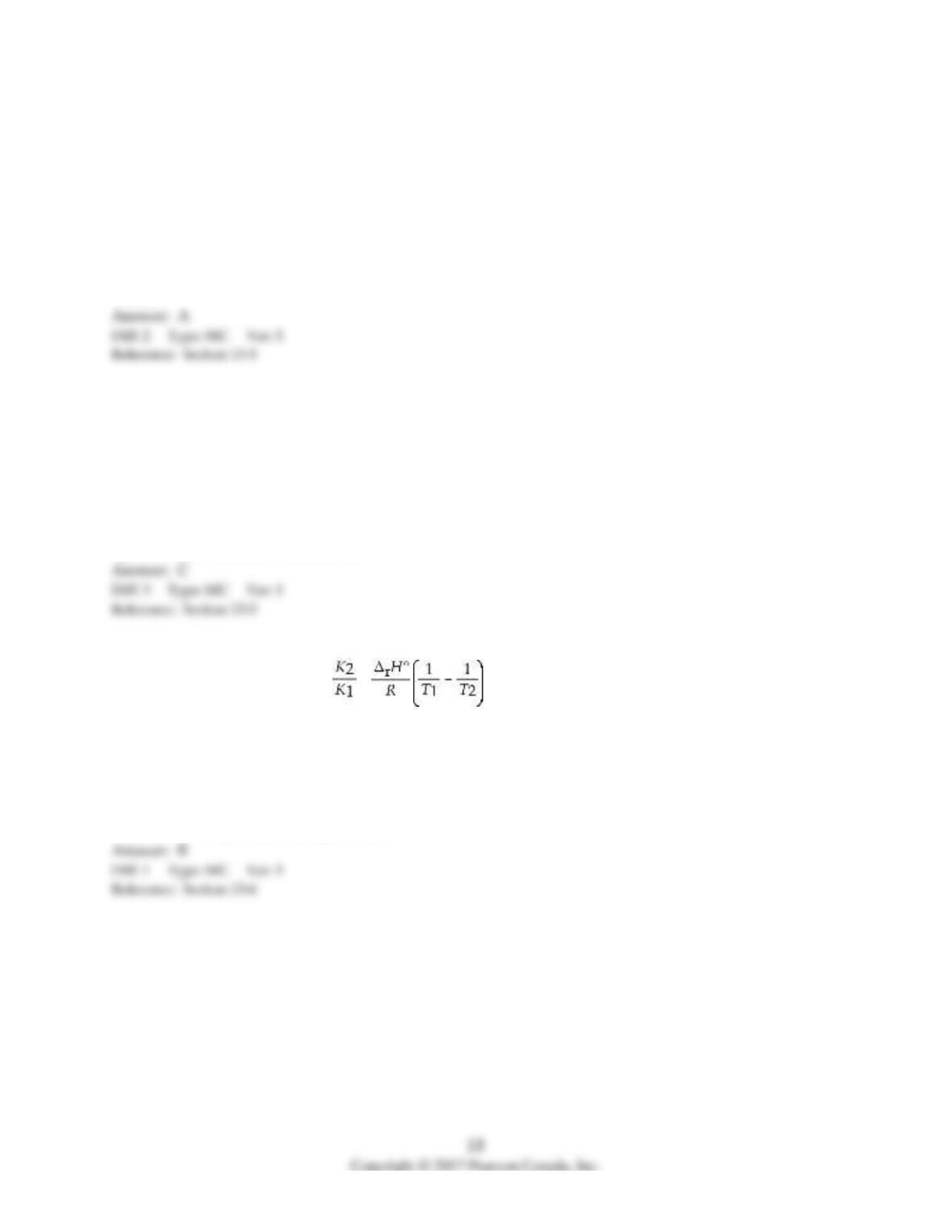
A) The van’t Hoff equation is ln = .
B) Keq is independent of temperature.
C) In a thermodynamic equilibrium constant expression, the activity of a gas is replaced by its partial
pressure in atmosphere.
D) In a Keq expression, the activity of an aqueous species can be approximated by the numerical value of
its molarity.
E) If ΔG = 0, the process is at equilibrium.

59) For the reaction: CO(g) + 2 H2(g) → CH3OH(g)
Kp = 91.4 at 350 K and Kp = 2.05 × 10⁻⁴ at 298 K.
What is the value of ΔrH°?
A) 49.9 kJ/mol
B) 2.08 × 10³ kJ/mol
C) 3.74 × 10⁻² kJ/mol
D) 217 kJ/mol
E) 446 kJ/mol
60) Choose the INCORRECT statement about coupled reactions.
A) The usual practice of coupling reactions is to join two nonspontaneous reactions.
B) The usual reason to couple reactions is to produce an overall spontaneous reaction.
C) The reaction added to a nonspontaneous reaction needs to be spontaneous.
D) The reaction added to a nonspontaneous reaction needs to be more spontaneous than the original
reaction is nonspontaneous.
E) One of the coupled reactions has a negative ΔG, the other a positive ΔG.
61) Which of the listed reactions would couple with the following reaction to produce silver?
Ag2O(s) → 2 Ag(s) + 1/2 O(g) ΔrG° = 11.2 kJ/mol
A) Ag(s) + 1/2 Br2 → AgBr(s) ΔrG° = 96.9 kJ/mol
B) C + 1/2 O2 → CO ΔrG° = -137.2 kJ/mol
C) N + 1/2 O2 → NO ΔrG° = 149.3 kJ/mol
D) N + O2 → NO2 ΔrG° = 51.3 kJ/mol
E) C + 2 S → CS2(l) ΔrG° = 65.3 kJ/mol
62) Order the following by increasing entropy.
CO(g), COCl2(g), CO2(g), CaO(s)
A) CO2 < CO < CaO < COCl2
B) CaO < CO < CO2 < COCl2
C) COCl2 < CO < CaO < CO2
D) CO2 < CaO < COCl2 < CO
E) CO < CaO < COCl2 < CO2
63) Predict whether ΔS is positive or negative for the following process:
H2(g) + 1/2 O2(g) → H2O(g)
A) negative
B) positive
C) ΔS doesn’t change.
D) There is not enough information to determine.
64) Predict whether ΔS is positive or negative for the following process:
2 Cl2O7(g) → 2 Cl2(g) + 7 O2(g)
A) negative
B) positive
C) ΔS doesn’t change.
D) There is not enough information to determine.
65) Predict whether ΔS is positive or negative for the following process:
H2O(g) → H2O(s)
A) negative
B) positive
C) ΔS doesn’t change.
D) There is not enough information to determine.
16
66) For the reaction, N2O4(g) → 2 NO2(g)
S° (J/mol K) 304.2 240.0
what is DrS°?
A) 544.2 J/mol ∙ K
B) –64.2 J/mol ∙ K
C) 175.8 J/mol ∙ K
D) –175.8 J/mol ∙ K
E) 64.2 J/mol ∙ K
67) If the enthalpy of vaporization of chloromethane, CH3Cl, is 21.5 kJ/mol at the normal boiling point,
249 K, calculate Δvap S°.
A) 86.3 J mol-1 K-1
B) 5.35 J mol-1 K-1
C) 11.6 J mol-1 K-1
D) 896 J mol-1 K-1
68) Calculate the entropy change for methanol at its normal boiling point of 64.5 °C. ΔrH° = 38.0 kJ/mol.
A) 0.589 kJ/mol ∙ K
B) 0.112 kJ/mol ∙ K
C) 589 kJ/mol ∙ K
D) 112 kJ/mol ∙ K
E) 0.589 × 10⁻² kJ/mol ∙ K

69) For the reaction, CaCO3(s) → CaO(s) + CO2(g)
S° (J/mol K) 88.70 39.75 213.6
what is DrSo?
A) 262.5 J/mol ∙ K
B) –85.1 J/mol ∙ K
C) –164.7 J/mol ∙ K
D) 164.7 J/mol ∙ K
E) 85.1 J/mol ∙ K
70) For the reaction, CO(g) + 2 H2(g) → CH3OH(g)
S° (J/mol K) 197.6 130.6 239.7
what is DrSo?
A) –88.5 J/mol ∙ K
B) –176.7 J/mol ∙ K
C) 219 J/mol ∙ K
D) 176.7 J/mol ∙ K
E) –219.1 J/mol ∙ K
71) Consider the following reaction:
C(g) + 2 H2(g) → CH4(g)
S° (J/mol K) 5.69 130.58 186.19
What is ΔrS° for the above reaction in J/mol K?
A) -49.9 J/mol K
B) 49.9 J/mol K
C) 80.7 J/mol K
D) 115.2 J/mol K
E) -80.7 J/mol K