
72) Consider the following reaction:
NH3(g) + HCl(g) → NH4Cl(s)
S° (J/mol K) 192.51 186.69 94.56
What is ΔrS° for this reaction in J/mol K?
A) -284.6 J/mol K
B) 284.6 J/mol K
C) -92.3 J/mol K
D) 94.6 J/mol K
E) 92.3 J/mol K
73) Consider the following reaction:
C3H4(g) + 2 H2(g) → C3H8(g)
S° (J/mol K) 266.9 130.6 269.9
What is ΔrS° in J/mol K?
A) 127.6 J/mol K
B) -127.6 J/mol K
C) 3.0 J/mol K
D) -258.2 J/mol K
E) -3.0 J/mol K
74) For the reaction,
2 O3(g) → 3 O2(g)
S° (J/mol K) 238.8 205.0
what is ΔrS°?
A) 137.4 J/mol ∙ K
B) –137.4 J/mol ∙ K
C) 33.8 J/mol ∙ K
D) 171.2 J/mol ∙ K
E) –33.8 J/mol ∙ K

75) What is ΔrG° at 25 °C?
N2O4(g) → 2 NO2(g) ΔrH° = 58.03 kJ ΔrS° = 176.7 J/K
A) 58.21 kJ
B) 62.45 kJ
C) 53.6 kJ
D) 5.37 kJ
E) 111 kJ
76) What is ΔrG° at 25 °C?
CaCO3(s) → CaO(s) + CO2(g) ΔrH° = 177.8 kJ ΔrS° = 160.7 J/K
A) 1779 kJ
B) 173.8 kJ
C) 225.7 kJ
D) 181.8 kJ
E) 129.9 kJ
77) What is ΔrG° at 25 °C?
CO2(g) → CO2(aq) ΔrH° = -19.4 kJ ΔrS° = 92.3 J/K
A) 2.1 kJ
B) -46.9 kJ
C) -17.1 kJ
D) -19.5 kJ
E) -21.7 kJ

78) What is ΔrG° at 25 °C?
CO(g) + 2 H2(g) → CH3OH(g) ΔrH° = -90.7 kJ ΔrS° = -221 J/K
A) -90.9 kJ
B) -24.8 kJ
C) -156.6 kJ
D) -96.2 kJ
E) -85.2 kJ
79) What is ΔrG° at 25 °C?
2O3(g) → 3 O2(g) ΔrH° = -284 kJ ΔrS° = 139 J/K
A) -145 kJ
B) -243 kJ
C) -325 kJ
D) -281 kJ
E) -287 kJ
80) Consider the following reaction.
S2Cl2(g) + 2 OCl2(g) → 2 SOCl2(g) + Cl2(g)
ΔfG° (kJ/mol) –32 97.9 –320 0.0
What is ΔrG° for this reaction in kJ?
A) -804
B) -476
C) -386
D) -413
E) -799

81) Consider the following reaction:
4 NH3(g) + 7 O2(g) → 4 NO2(g) + 6 H2O (l)
ΔfG° (kJ/mol) -16.7 0.0 51.8 -237.2
What is ΔrG° for this reaction in kJ?
A) -1282
B) -1149
C) -169
D) 169
E) 1149
82) What is ΔrG°?
N2O4(g) → 2 NO2(g)
ΔfG° (kJ/mol) 97.8 51.3
A) 149.1 kJ
B) -4.8 kJ
C) -46.5 kJ
D) 4.8 kJ
E) 46.5 kJ
83) What is ΔrG°?
CaCO3(s) → CaO(s) + CO2(g)
ΔfG° (kJ/mol) -1128 –604 -394.4
A) 1338 kJ
B) 918 kJ
C) -130 kJ
D) -918 kJ
E) 130 kJ

84) What is ΔrG°?
CO(g) + 2 H2(g) → CH3OH(g)
ΔfG° ( kJ/mol) -137.2 0 -162.0
A) -24.8 kJ
B) -299.2 kJ
C) +24.8 kJ
D) 149.6 kJ
E) +299.2 kJ
85) What is ΔrG°?
2 O3(g) → 3 O2(g)
ΔfG° (kJ/mol) 163.2 0
A) 326.2 kJ
B) -326.4 kJ
C) -163.2 kJ
D) 163.2 kJ
E) 54.4 kJ
86) Consider the reaction:
3 N2(g) + 2 O3(g) → 6 NO(g)
ΔfH° (kJ/mol) 0.00 142.26 90.37
S° (J/mol K) 191.5 237.7 210.6
What is ΔrG° for this reaction in kJ at 500 K?
A) 93 kJ
B) 151 kJ
C) 365 kJ
D) -1.00 × 10⁵ kJ
E) 441 kJ

23
87) Calculate ΔrG° for the reaction Cu(s) + H2O(g) → CuO(s) + H2(g) at 500 K.
ΔfH° (kJ/ mol) S° (J/mol K)
Cu(s) 0 33.3
H2O(g) -241.8 188.7
CuO(s) -155.2 43.5
H2(g) 0 130.6
A) 231.8 kJ
B) -135.4 kJ
C) -58.6 kJ
D) 110.6 kJ
E) 86.74 kJ
88) For the reaction I2(s) + Cl2(g) → 2 ICl(g) , ΔrH° = 36 kJ and ΔrS° = 158.8 J/K at 25 °C. Calculate ΔrG°
for the process at 25 °C.
A) -11.3 kJ
B) -4730 kJ
C) -393 kJ
D) 32 kJ
E) 83.3 kJ
89) For CO(g) + H2(g) → H2CO(g), ΔrH° = –5.36 kJ/mol, and ΔrS° = –109.8 J/mol K. What is ΔrG° in kJ/mol
at 300 K?
A) -38.3 kJ/mol
B) 57.6 kJ/mol
C) 38.3 kJ/mol
D) 27.6 kJ/mol
E) -57.6 kJ/mol

90) For CdO(s) + SO3(g) → CdSO4(s), ΔrH° = –279.4 kJ/mol, and ΔrS° = –118.4 J/mol K. What is ΔrG° in
kJ/mol at 127 K?
A) -256 kJ/mol
B) -303 kJ/mol
C) -264 kJ/mol
D) -355 kJ/mol
E) -460 kJ/mol
91) For Cl2O(g) + 3/2 O2(g) → 2 ClO2 , ΔrH° = 126 kJ/mol, and ΔrS° = -74.9 J/mol K at 377 °C. What is
ΔrG° in kJ/mol?
A) 77.8
B) 51.4
C) 98.3
D) 175
E) 129.2
92) Consider the reaction:
N2(g) + 3 X2(g) → 2 NX3(g)
ΔfH° 0.0 0.0 -43 kJ/mol
S° 192 210 172 J/mol K
What is ΔrG° for this reaction at 591 K? Is the reaction spontaneous at 591 K?
A) -196 kJ/mol, no
B) 196 kJ/mol, yes
C) 196 kJ/mol, no
D) 239 kJ/mol, yes
E) -239 kJ/mol, no

93) Consider the following reaction:
4 NH3(g) + 7 O2(g) → 4 NO2(g) + 6 H2O (l)
ΔfG° -16.7 0.0 51.8 -237.2 kJ/mol
What is Keq for this reaction at 25 °C?
A) e-464
B) e464
C) 1.59
D) 0.63
E) 252
94) Consider the following reaction:
S2Cl2(g) + 2 OCl2(g) → 2 SOCl2(g) + Cl2(g)
ΔfG° –32 97.9 –320 0.0 kJ/mol
What is Keq for this reaction at 25 °C?
A) e324
B) e-324
C) e162
D) e-162
E) 1.38
95) Consider the reaction:
H2X(g) → HX(g) + X(g)
ΔrH° = 18.4 kJ/mol ΔrS°= 23.1 J/mol K
What is Keq for this reaction at 525 K?
A) 0.387
B) 0.993
C) 0.238
D) 4.23
E) 1.01

26
96) For a reaction Keq = 1.2 × 10⁻⁶ at T = 200 K. What is ΔrG° for the reaction?
A) -22.7 kJ/mol
B) 53.6 kJ/mol
C) 22.7 kJ/mol
D) -53.6 kJ/mol
E) 170 kJ/mol
97) For the reaction SO2(g) + Cl2(g) → SO2Cl2(g) Keq = 0.377 at 25 °C, what is ΔrG° for the reaction?
A) 202.7 J/mol
B) 88.02 J/mol
C) 2420 J/mol
D) 1049 J/mol
E) -1049 J/mol
98) Consider the reaction: N2O4(g) → 2 NO2(g)
Keq = 0.1134 at 20 °C ΔrH°= 58.03 kJ/mol
What is ΔrG° for this reaction at 20 °C?
A) 0.36 kJ/mol
B) -5.4 kJ /mol
C) 4.9 kJ/mol
D) 5.3 kJ/mol
E) 5.4 kJ/mol
99) For the reaction N2O3(g) → NO(g) + NO2(g) ΔrG° = –4.78 kJ/mol. Calculate Keq at 25 °C.
A) 1.023
B) 1.002
C) 1.005
D) 0.9484
E) 0.9981

27
100) For the reaction PCl5(g) → PCl3(g) + Cl2(g) at 298 K, Keq = 1.87 × 10⁻⁷, ΔrS° = 181.92 J/mol K.
Compute ΔrH° for this reaction.
A) 15.8 kJ/mol
B) 220 kJ/mol
C) 143 kJ/mol
D) 54.2 kJ/mol
E) 92.6 kJ/mol
101) For the reaction PCl5(g) → PCl3(g) + Cl2(g) at 298 K, Keq = 1.87 × 10⁻⁷, ΔrS° = 181.92 J/mol K, what is
Keq at 200 K if ΔrH° = 92.6 kJ/mol?
A) 2.08 × 10⁻¹⁵
B) 16.8
C) 1.87 × 10⁻⁷
D) 5.35 × 10⁶
E) 5.95 × 10⁻²
102) What is ΔrH° for a reaction that has Kp = 1.456 at 273 K and Kp = 14.2 at 298 K?
A) 8.42 × 10⁻⁵ kJ/mol
B) 61.6 kJ/mol
C) -61.6 kJ/mol
D) 462 kJ/mol
E) -462 kJ/mol
103) Consider the reaction: AB(g) → A(g) + B(g)
(Keq = 0.729 at 20 °C ΔrH° = 45.9 kJ/mol)
What is Keq for this reaction at 425 K?
A) 476
B) 0.733
C) 0.725
D) 254
E) 2.10 × 10⁻³

28
104) Consider the reaction: AB(g) → A(g) + B(g)
(Keq = 0.729 at 20 °C ΔrH° = 45.9 kJ/mol)
What is Keq for this reaction at 377 K?
A) 45.9
B) 191
C) 91.2
D) 66.6
E) 48.5
105) For the reaction I2(s) + Cl2(g) → 2 ICl(g) , ΔrH = 36 kJ/mol, and ΔrS = 158.8 J/mol K at 25 °C. Calculate
the temperature at which Keq is 4.0 × 10³.
A) 128 °C
B) -115 °C
C) 83 °C
D) 25 °C
E) -175 °C
106) For CO(g) + H2(g) → H2CO(g) , ΔrH° = –5.36 kJ/mol, and ΔrS° = -109.8 J/mol K. What is the
temperature at which Keq is 1.0 × 10⁻²?
A) 5.19 × 10³ °C
B) 218 °C
C) 25 °C
D) -198 °C
E) -237 °C
107) For CdO(s) + SO3(g) → CdSO4(s) , ΔrH° = –279.4 kJ/mol, and ΔrS° = –118.4 J/mol ∙ K. What is the
temperature at which Keq is 1.0 × 10⁴?
A) 1890 °C
B) 6950 °C
C) 1160 °C
D) 1710 °C
E) 6410 °C

108) Consider the endothermic reaction:
N2(g) + O2(g) → 2 NO(g), ΔrH° = 192.5 kJ/mol
At 2000 K the equilibrium constant is 5.0 × 10⁻⁴. At 2500 K the value of the equilibrium constant:
A) is greater than 5.0 × 10⁻⁴
B) depends on the concentration of oxygen
C) is 10.0 × 10⁻⁴
D) is 5.0 × 10⁻⁴
E) is less than 5.0 × 10⁻⁴
109) Calculate the temperature for which Keq for a reaction is 1.04 × 10³ where ΔrH° = –83.2 kJ/mol and
ΔrS° = -246 J/mol K.
A) 0.274 K
B) 307 K
C) 0.307 K
D) 274 K
E) cannot be determined without ΔrG°
110) Calculate the total quantity of heat required to convert 25.0 g of liquid CCl4(l) at 35.0 °C to gaseous
CCl4 at 76.8 °C (the normal boiling point for CCl4). The specific heat of CCl4(l) is its heat
of fusion is and its heat of vaporization is
A) 0.896 kJ
B) 1.43 kJ
C) 5.74 kJ
D) 6.28 kJ
111) The enthalpy change for converting 1.00 mol of ice at -50.0 °C to water at 70.0 °C is The
specific heats of ice, water, and steam are and respectively.
For O, = 6.01 kJ mol-1, and .
A) 12.28
B) 6.41
C) 13.16
D) 7154
E) 9.40

112) The enthalpy change for converting 10.0 g of ice at -25.0 °C to water at 80.0 °C is ________ kJ. The
specific heats of ice, water, and steam are and respectively.
For O, = 6.01 kJ mol-1, and .
A) 12.28
B) 6.16
C) 3870
D) 7.21
E) 9.88
113) The fluorocarbon has a normal boiling point of 47.6 °C. The specific heats of and
(g) are 0.91 J g-1 °C-1 and 0.67 J g-1 °C-1, respectively. The heat of vaporization of the compound
is 27.49 kJ mol-1. The heat required to convert 50.0 g of the compound from the liquid at to the gas
at 80.0 °C is ________ kJ.
A) 8.19
B) 1454
C) 30.51
D) 3031
E) 10.36
114) Ethanol ( OH) melts at -114 °C. The enthalpy of fusion is 5.02 kJ mol-1. The specific heats of
solid and liquid ethanol are 0.97 J g-1 °C-1 and 2.3 J g-1 °C-1, respectively. How much heat (kJ) is needed
to convert 25.0 g of solid ethanol at -135 °C to liquid ethanol at -50 °C?
A) 207.3 kJ
B) -12.7 kJ
C) 6.91 kJ
D) 4192 kJ
E) 9.21 kJ
115) Ethyl chloride, C2H5Cl, is used as a local anesthetic. It works by cooling tissue as it vaporizes; its
heat of vaporization is 26.4 kJ mol-1. How much heat could be removed by 20.0 g of ethyl chloride?
A) 8.19 kJ
B) 341 kJ
C) 528 kJ
D) 3410 kJ
31
116) How much heat is released when 85.0 g of steam at 100.0 °C is cooled to ice at -15.0 °C? The enthalpy
of vaporization of water is 40.67 kJ mol-1, the enthalpy of fusion for water is 6.01 kJ mol-1, the molar heat
capacity of liquid water is 75.4 J mol-1 °C-1, and the molar heat capacity of ice is 36.4 J mol-1 °C-1.
A) 54.8 kJ
B) 221 kJ
C) 258 kJ
D) 281 kJ
117) Which one of the following would be expected to have the lowest standard molar entropy, S°, at 25
°C?
A) C10H22(s)
B) C10H22(l)
C) C14H30(s)
D) C14 OH(l)
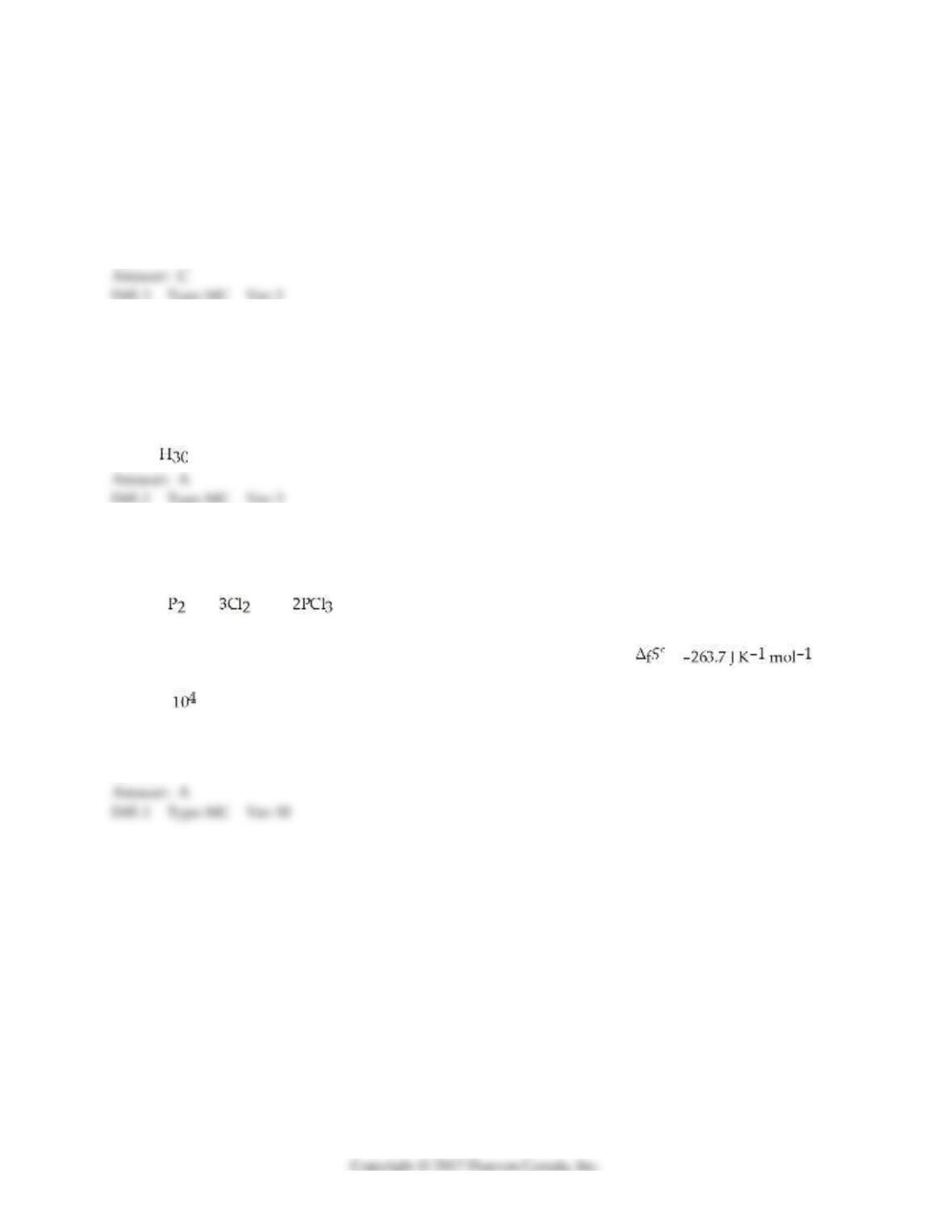
118) The value of ΔfG at 100.0 °C for the formation of phosphorus trichloride from its constituent
elements,
(g) + (g) → (g)
is ________ kJ mol-1. At 25.0 °C for this reaction, ΔfH° is -720.5 kJ mol-1 and is .
A) -622.1
B) 2.56 ×
C) 9.77 × 10⁴
D) -694.1
E) -818.9

119) The value of ΔfG at 100.0 °C for the formation of calcium chloride from its constituent elements,
Ca(s) + (g) → (s)
is ________ kJ mol-1. At 25.0 °C for this reaction, ΔfH° is -795.8 kJ mol-1l, ΔfG ° is -748.1 kJ mol-1, and
is
A) -855.4
B) -736.2
C) 5.88 ×
D) -779.8
E) 1.52 ×
120) For a given reaction, ΔrH = -19.9 kJ mol-1 and ΔrS = -55.5 J K–1 mol-1. The reaction will have
at Assume that ΔrH and ΔrS do not vary with temperature.
A) 359
B) 2789
C) 298
D) 2.79
E) 0.359
121) For a given reaction, ΔrH = -26.6 kJ mol-1 and ΔrS = -77.0 J K–1 mol-1. The reaction is spontaneous
________. Assume that ΔrH and ΔrS do not vary with temperature.
A) at T > 345 K
B) at T < 345 K
C) at T > 298 K
D) at T < 298 K
E) at all temperatures
122) Under which of the following conditions would one mole of He have the highest entropy, S?
A) 17 °C and 15 L
B) 127 °C and 15 L
C) 17 °C and 25 L
D) 127 °C and 25 L
33
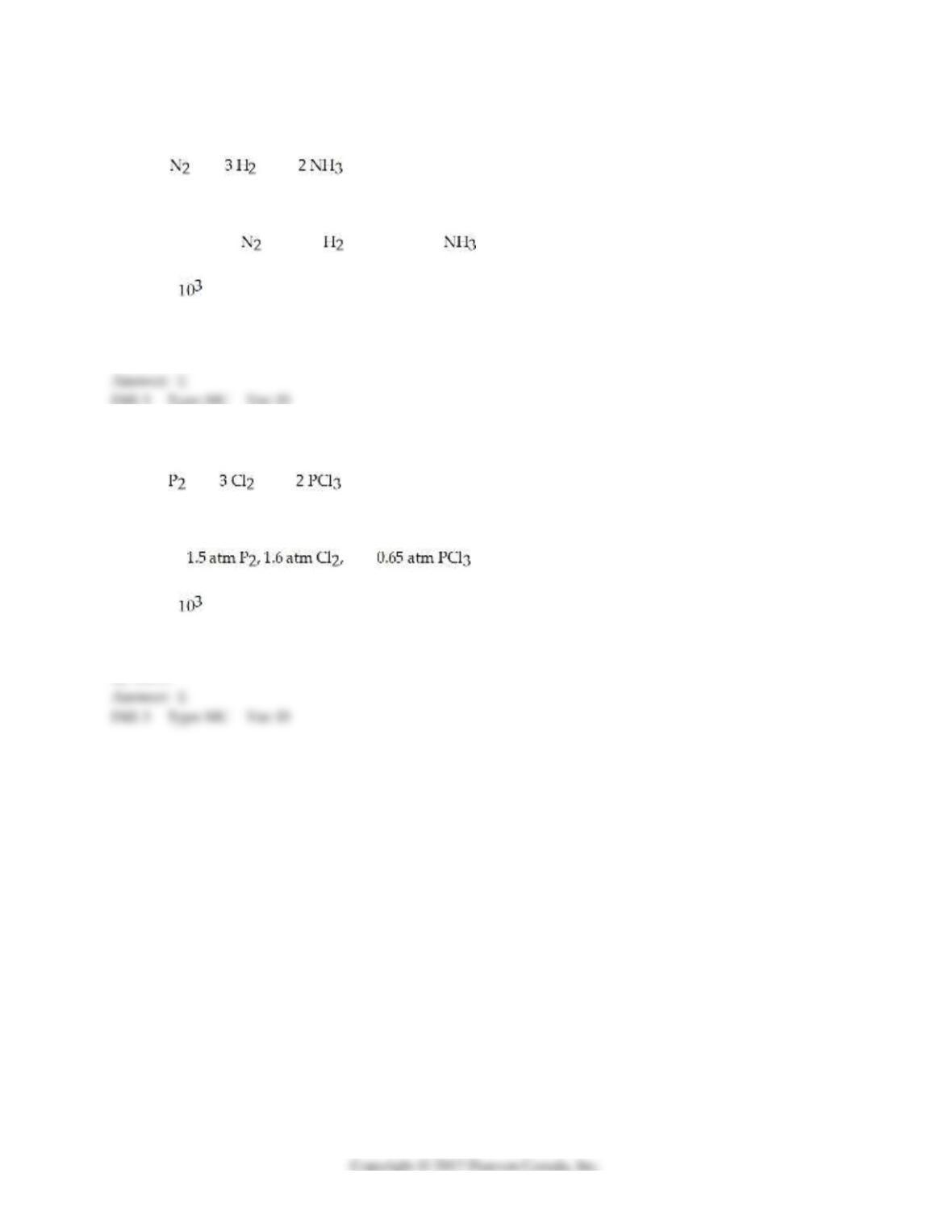
123) In the Haber process, ammonia is synthesized from nitrogen and hydrogen:
(g) + (g) → (g)
ΔrG ° at 298 K for this reaction is -33.3 kJ mol-1. The value of ΔrG at 298 K for a reaction mixture that
consists of 1.9 atm , 1.6 atm , and 0.65 atm is ________ kJ mol-1.
A) –1.8
B) -3.86 ×
C) -7.25 × 10³
D) -104.5
E) -40.5
124) Phosphorus and chlorine gases combine to produce phosphorus trichloride:
(g) + (g) → (g)
ΔrG° at 298 K for this reaction is -642.9 kJ mol-1. The value of ΔrG at 298 K for a reaction mixture that
consists of and is ________ kJ mol-1.
A) -44.2
B) -3.88 ×
C) -7.28 × 10³
D) -708.4
E) -649.5