General Chemistry, 11e (Petrucci)
Chapter 12 Intermolecular Forces: Liquids and Solids
1) Van der Waals forces are a type of London force.
2) H2NCH2CH2NH2 probably has a higher boiling point at 1.00 atm pressure than CH3CH2CH2NH2.
3) The property of a liquid that measures its resistance to flow is called resistivity.
4) Surface tension of a liquid is the work or energy required to increase the surface area of a liquid.
5) The heat of deposition equals the negative of the heat of sublimation.
6) The phenomenon of supercooling refers to the existence of a metastable liquid at a temperature below
that of its sublimation point.
7) The process in which a gas is transformed into a solid is called solidification.
8) CH4 probably has a lower boiling point at 1 atm than SnH4.
9) Consider a parallelepiped with all edges being equal in length. There is an atom at each corner and one
in the center. This is a simple cubic cell.
10) Consider a parallelepiped with all edges being equal in length. There is an atom at each corner and
one at the center of each face. This is a face-centered cubic cell.
11) Which of the following statements concerning molecules in the liquid state is true?
A) Cohesive forces are not important.
B) The molecules contract to fit the size of the container.
C) The molecules have no motion.
D) The molecules are in a patterned (oriented) arrangement.
E) The molecules are mobile and relatively close together.
12) Which probably has the lowest boiling point at 1.0 atm pressure?
A) PbH4
B) SnH4
C) SiH4
D) GeH4
E) CH4
13) Which probably has the lowest boiling point at 1.0 atm pressure?
A) C2H6
B) C4H10
C) C6H14
D) C3H8
E) C5H12
14) If one compares compound A, composed of nonpolar molecules, with compound B, composed of
polar molecules, and both molecules have the same molecular formula, then it is true that:
A) both compounds have the same boiling point
B) A boils at a lower temperature than B
C) B will not boil
D) B boils at a lower temperature than A
E) we have to know the structural formula to determine the differences in boiling points of A and B
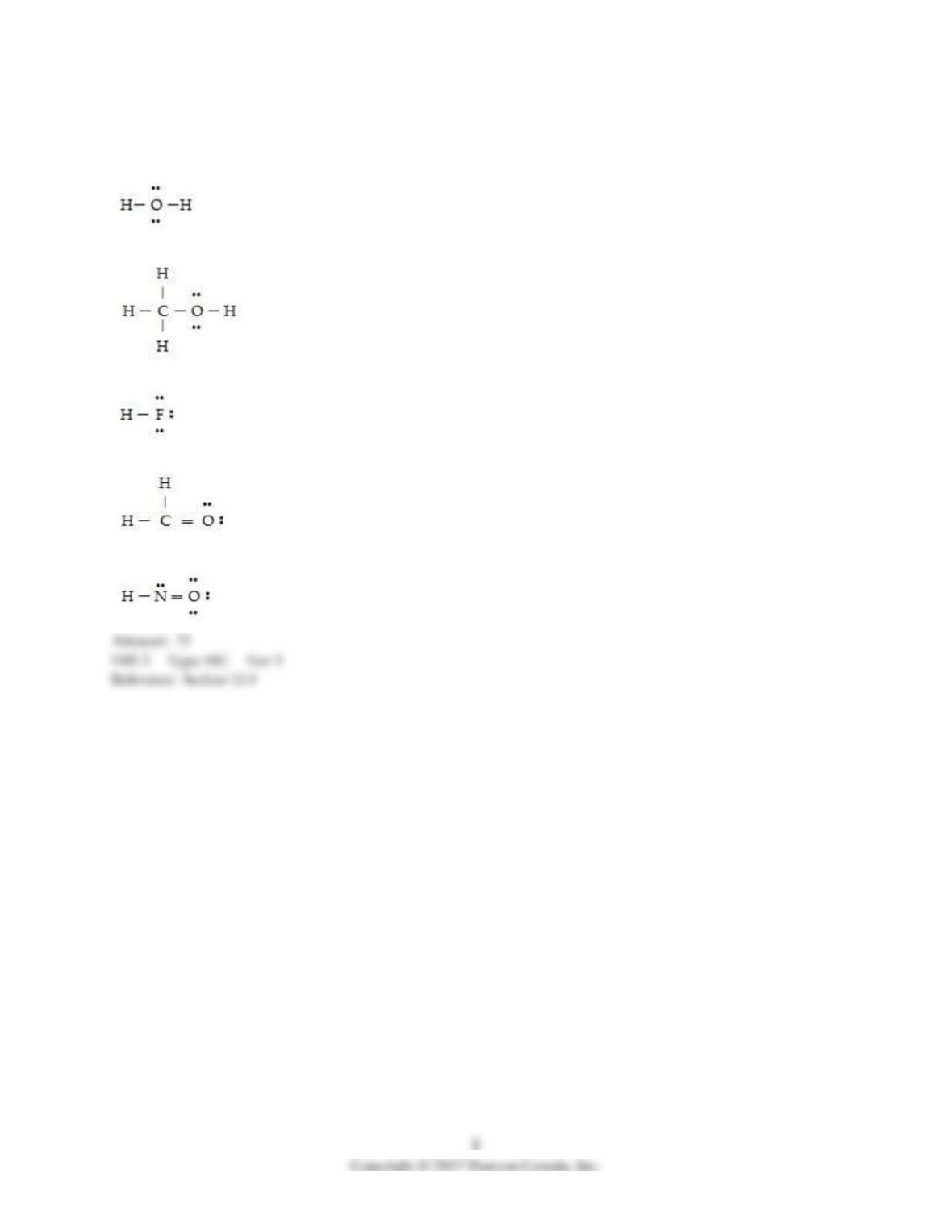
15) Below are given the Lewis structures of five molecules. Which one displays the LEAST hydrogen
bonding?
A)
B)
C)
D)
E)
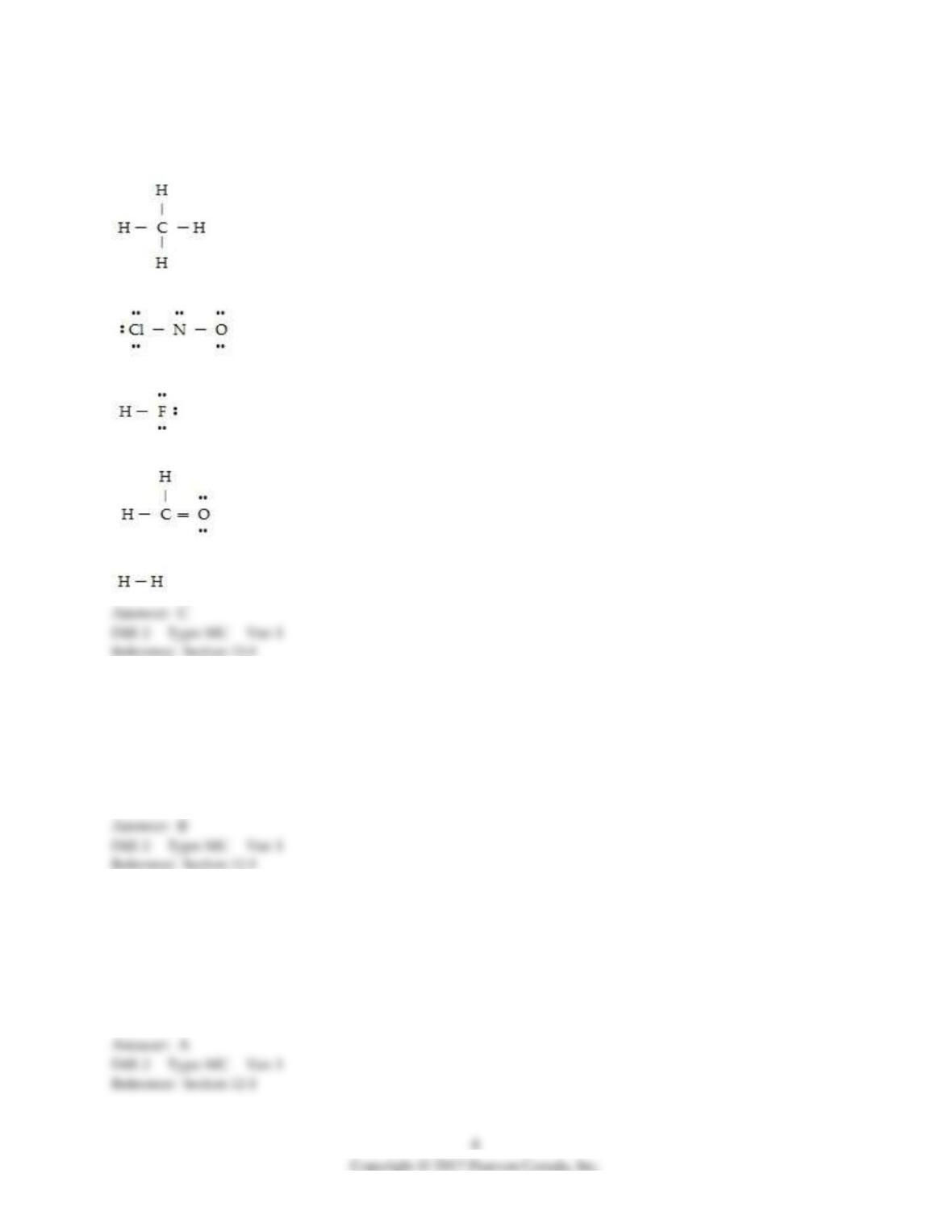
16) Below are given the Lewis structures of five molecules. Which one displays the MOST hydrogen
bonding?
A)
B)
C)
D)
E)
17) Which of the following compounds has the highest boiling point?
A) NH3
B) H2O
C) HF
D) CH4
E) HBr
18) Which probably has the highest boiling point at 1.00 atm pressure?
A) H2NCH2CH2NH2
B) CH3CH2CH2NH2
C) (CH3)2CHNH2
D) CH3CH2NHCH3
E) (CH3)3N
19) A liquid will “wet” a surface if:
A) the liquid has a lesser density than the surface
B) the forces between the liquid molecules are weak
C) the liquid has a low vapor pressure
D) the forces between the molecules and the surface are greater than the forces between the molecules of
the liquid
E) The liquid has low viscosity and the surface is smooth
20) Surface tension is thought to be due to:
A) surface area trying to increase
B) air absorbed on the surface
C) solute concentrated on the surface
D) surface molecules having lower energy than bulk molecules
E) surface molecules having higher energy than molecules in the bulk
21) What is the difference between “normal boiling point” and “boiling point” of a liquid?
A) “Normal boiling point” is a boiling point of a liquid at normal (standard) pressure and temperature,
while “boiling point” is measured at any other conditions of pressure and temperature.
B) “Normal boiling point” is a boiling point of 1 mol of a liquid with a surface of 1 m2, while “boiling
point” is boiling temperature for any other amount of a substance.
C) “Normal boiling point” is a boiling point a liquid has at 1 atm of pressure; “boiling point” is a boiling
temperature of a liquid at any other pressure.
D) “Normal boiling point” and “boiling point” are synonyms.
E) “Normal boiling point” refers to 1 g of substance; “boiling point” refers to any other amount of
substance.
22) Which of the following describe the critical point of a liquid?
I) the temperature and pressure at which a liquid’s meniscus disappears
II) the point where the vapor pressure curve intersects the fusion temperature curve
III) the highest temperature and pressure at which a liquid can exist
IV) the highest temperature at which it is possible to obtain a liquid from its vapor by increasing pressure
A) I), II), III)
B) I), III), IV)
C) II), III)
D) II), III), IV)
E) I), IV)
23) A liquid is in equilibrium with its vapor. If some of the vapor is allowed to escape, what is the
immediate result?
A) The condensation rate decreases.
B) The vaporization rate increases.
C) The condensation rate increases.
D) The vaporization rate decreases.
E) The rates of condensation and vaporization are not effected.
24) When a liquid is in dynamic equilibrium with its vapor at a given temperature, the following
conditions could exist:
I) There is no transfer of molecules between liquid and vapor.
II) The vapor pressure has a unique value.
III) The opposing processes, (liquid to vapor) and (vapor to liquid), proceed at equal rates.
IV) The concentration of vapor is dependent on time.
Which of the above choices are applicable?
A) I
B) II and III
C) I, II, and III
D) II and IV
E) II, III and IV
25) When a liquid is in equilibrium with its vapor in a closed container:
A) the rate at which molecules from the liquid phase enter the gas phase exactly equals the rate at which
molecules from the gas phase pass into the liquid phase
B) a change in temperature will not change the pressure in the container
C) the amount of gas in the container must exactly equal the amount of liquid
D) molecules cannot go from the liquid phase to the gas phase because the amount of liquid in the
container is constant
E) the vapor will gradually change back to the liquid state, that is, no vapor will be left
26) Under which of the following conditions will vaporization best occur?
A) high mass, large surface area, high kinetic energy
B) weak forces between molecules, high kinetic energy, large surface area
C) high molecular energy, small surface area
D) low kinetic energy, strong molecular forces, large surface area
E) small surface area, low kinetic energy, low molecular mass
27) Which of the following keeps the rate of vaporization unchanged?
A) closing container lid
B) increasing forces between molecules
C) increasing mass of molecule
D) decreasing temperature
E) decreasing surface area
28) A liquid has a normal boiling point of 78 °C and its vapor pressure is 400 mmHg at 50 °C. To compute
the molar heat of vaporization, one needs:
A) the mole weight
B) the vapor pressure at another temperature
C) the specific heat
D) molarity
E) all information has been provided
29) The phenomenon in which a steel needle can, with proper care, be made to float on the surface of
some water illustrates a property of liquids known as:
A) compressibility
B) polarizability
C) surface tension
D) triple point
E) viscosity
30) Which of the following statements about viscosity are true:
I) Viscosity is liquid’s resistance to flow.
II) Viscosity decreases with a decrease in temperature.
III) Viscosity is not related to the forces between molecules in a liquid.
IV) Viscous liquids have low rate flows.
A) I) and IV)
B) I) and III)
C) I) and II)
D) II) and IV)
E) III and IV)
31) Vaporization occurs more readily with:
A) increased temperature, increased surface area, decreased volume
B) increased temperature, increased surface area, increased intramolecular forces
C) increased temperature, decreased surface area, decreased intermolecular forces
D) increased temperature, increased surface area, decreased intermolecular forces
E) decreased temperature, decreased surface area, decreased intermolecular forces
32) The phenomenon of supercooling refers to the existence of a metastable:
A) liquid at a temperature below that of its critical point
B) liquid at a temperature below that of its sublimation point
C) liquid at a temperature below that of its freezing point
D) gas at a temperature below that of its critical point
E) two-phase liquid/solid mixture at the freezing point
33) The enthalpy of fusion is:
A) the quantity of heat required to melt one mole of a solid
B) the quantity of heat released when a solid melts
C) the quantity of heat when two elements are fused together to produce binary compound
D) the quantity of heat required to fuse two atomic nuclei
E) the quantity of heat released when an organic compound burns in an atmosphere of pure oxygen
34) A passage of substance directly from the vapor to the solid state is known as:
A) deposition
B) decomposition
C) sublimation
D) solidification
E) fusion
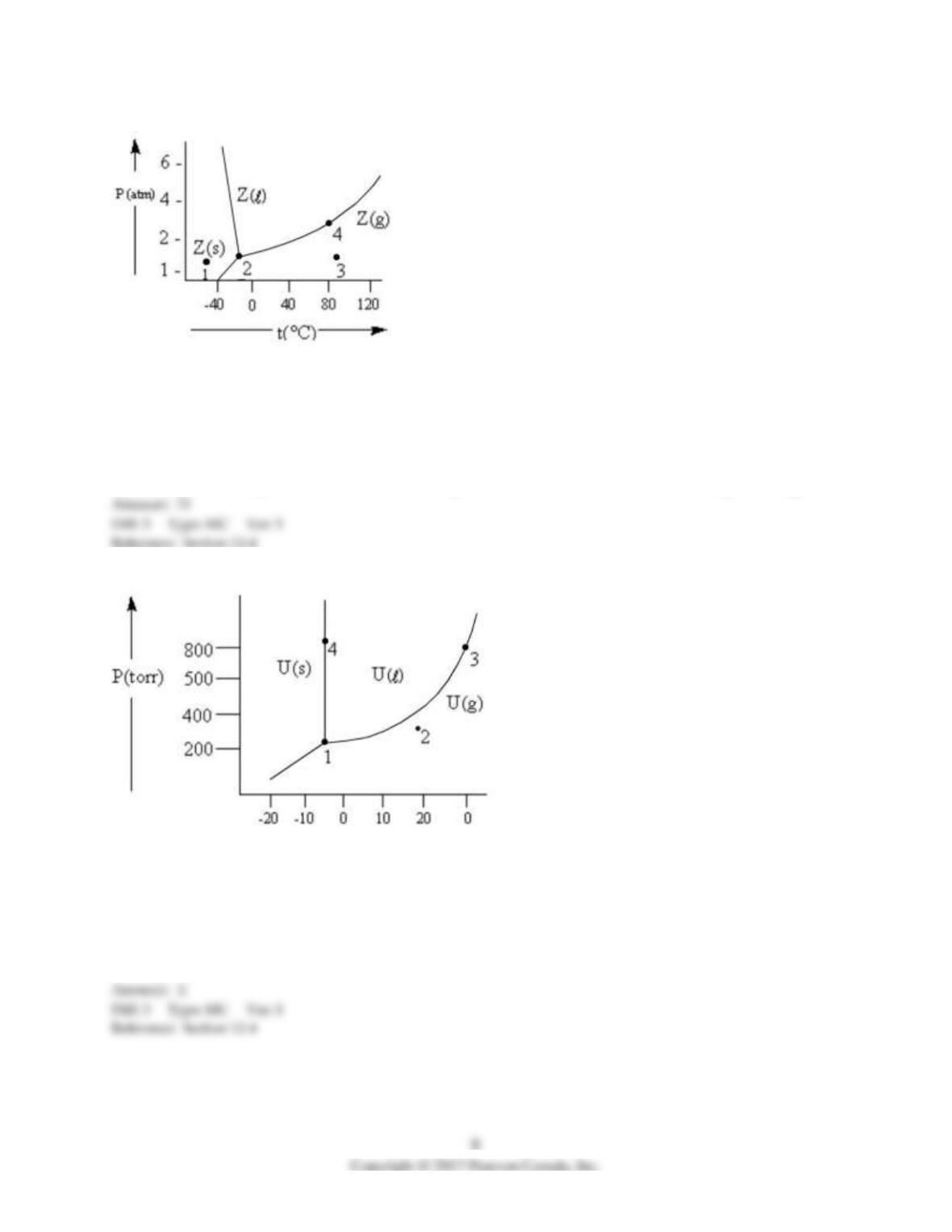
35) According to the phase diagram given, which of the following statements is INCORRECT?
A) At the temperature and pressure of point 2, substance Z exists as a three-phase equilibrium system.
B) At the temperature and pressure of point 3, substance Z exists as a one-phase gaseous system.
C) If the Z(s) = Z(l) = Z(g) system is maintained at the temperature of point 2 while pressure is decreased,
more Z will vaporize.
D) If liquid Z is maintained at the pressure of point 4 while the temperature is decreased to 30 °C, the
liquid will vaporize.
E) The existence of liquid Z at -50 °C and 2 atm represents the metastable condition of “supercooling.”
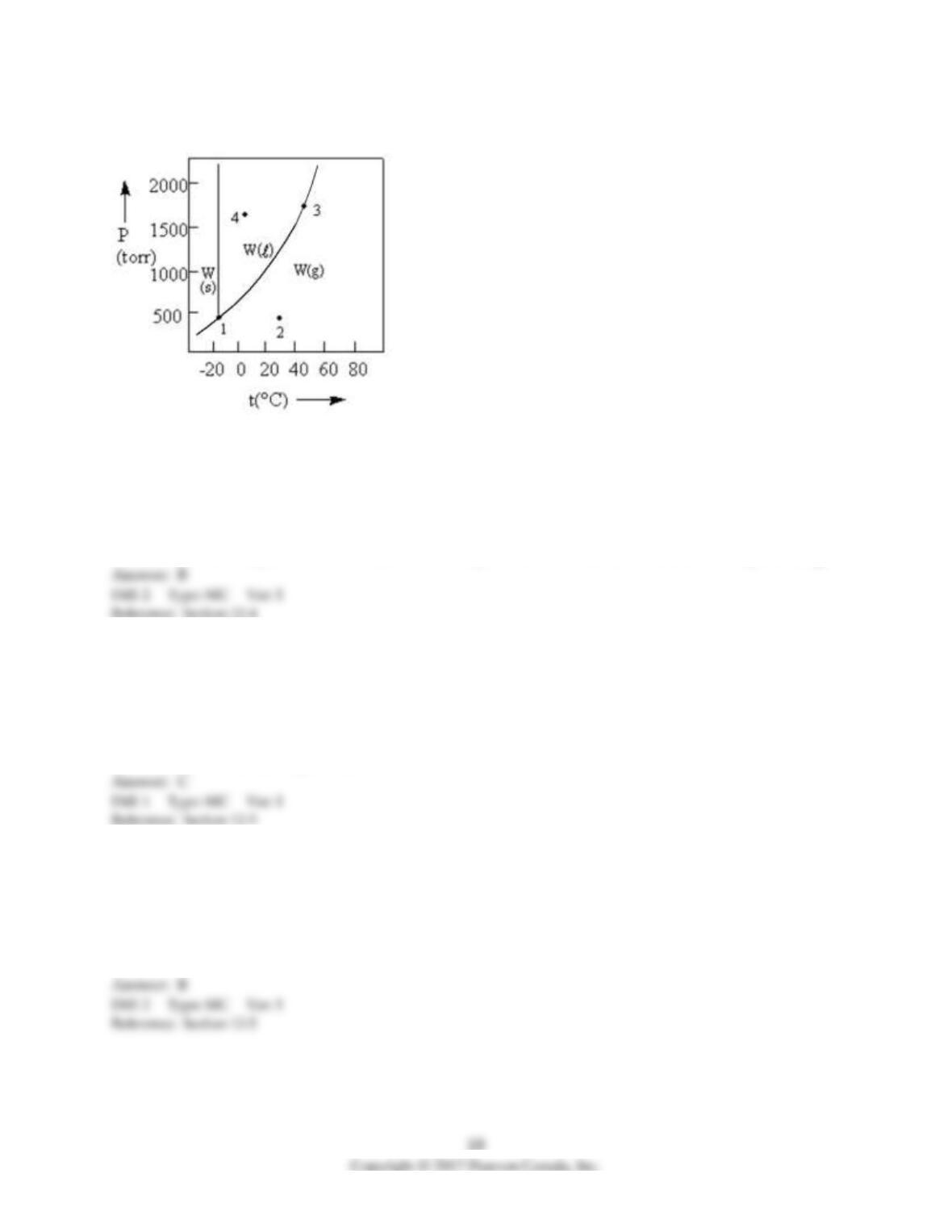
36) According to the phase diagram given, which of the following is INCORRECT?
A) At the temperature and pressure of point 1, substance U exists as a three-phase equilibrium system.
B) At the temperature and pressure of point 2, substance U exists as a one-phase gaseous system.
C) At the temperature and pressure of point 3, substance U exists as a two-phase system.
D) If the U(s)⇔ U(l) system is maintained at the temperature of point 4 while pressure is decreased
steadily to about 300 Torr, more U will freeze.
E) There are no conditions of temperature and pressure under which solid U will vaporize without
melting first.
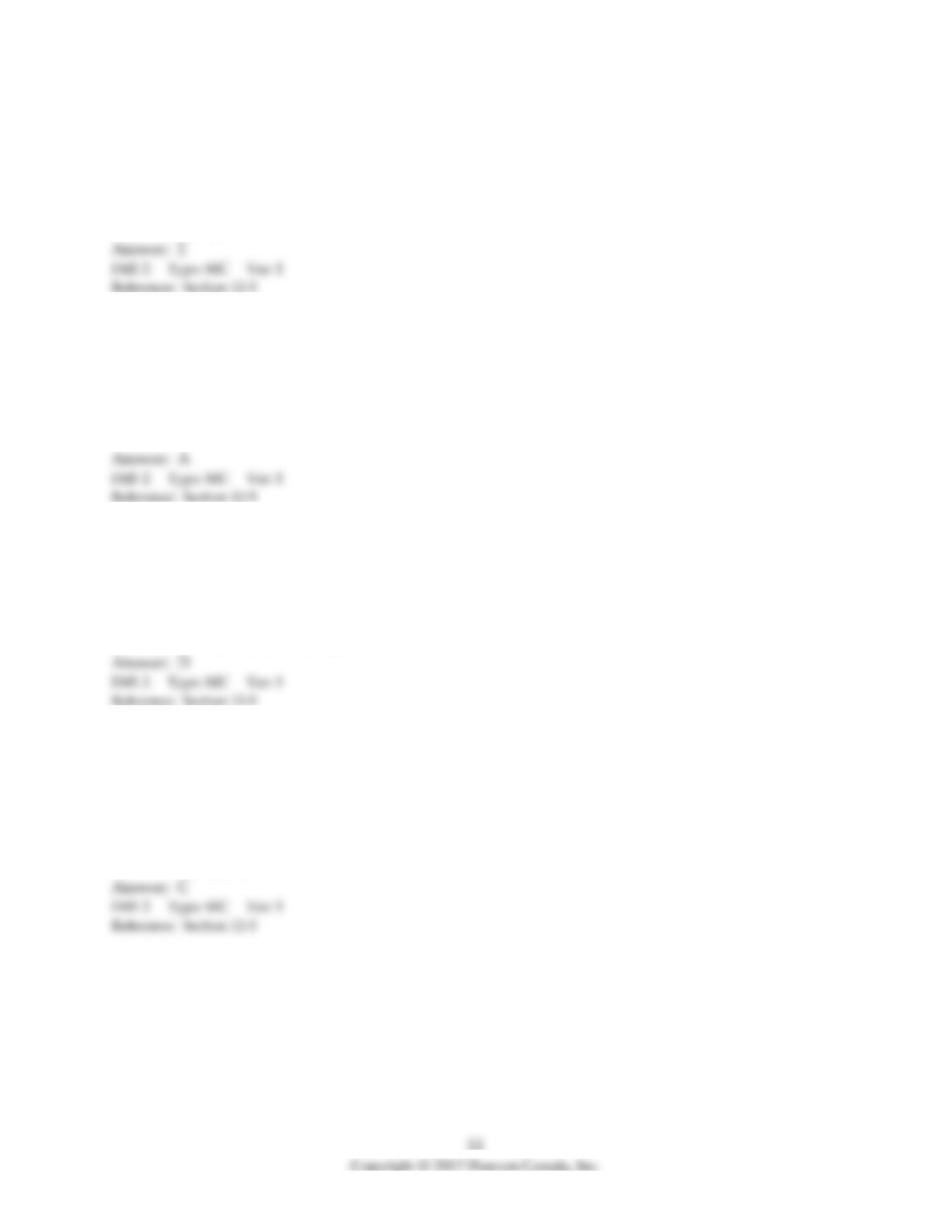
37) According to the phase diagram given, which of the following statements is INCORRECT?
A) At the temperature and pressure of point 1, W exists as a three-phase equilibrium system.
B) At the temperature of point 2, a pressure of 500 Torr will cause W to liquefy.
C) If the system is maintained at the temperature of point 3 while pressure is decreased, more W will
vaporize.
D) If W is maintained at the pressure of point 4 while the temperature is increased to 80 °C, the liquid will
vaporize.
E) The existence of liquid W at -40 °C and 500 Torr represents the metastable condition of “supercooling.”
38) Choose the INCORRECT statement.
A) In a network covalent solid, covalent bonds extend throughout the crystalline solid.
B) Diamond has sp3 hybridization.
C) Graphite has sp hybridization.
D) Fullerenes are a recently discovered allotropic form of carbons.
E) Nanotubes are an allotropic form of carbon.
39) Which of the following ionic compounds should have the highest melting point?
A) NaI
B) MgO
C) NaCl
D) LiBr
E) CaS
40) There are no types of crystalline solids that are held together by:
A) dipole-dipole interactions
B) ionic attractions
C) hydrogen bonds
D) covalent bonds
E) pi bonds only
41) Which of the substances below would produce the hardest crystals?
A) SiC
B) Xe
C) Cu
D) KNO3
E) H2O
42) Which combination of “type of solid” and specific example is INCORRECT?
A) ionic/”table salt”
B) metallic/copper wire
C) molecular/”dry ice”
D) network covalent/iodine
E) network covalent/silicon carbide
43) A crystal and its melt readily conduct electricity. The crystal also has a luster and is easily deformed.
Thus, it is:
A) a covalent network crystal
B) an ionic crystal
C) a metallic crystal
D) a molecular crystal
E) a covalent crystal
44) Find a FALSE statement about X-rays.
A) diffracted by crystals
B) radiation of wavelength approximating 1 angstrom
C) visible to the naked eye
D) used to determine the structure of molecules
E) produced using high-energy electrons
45) A compound of iron and sulfur crystallizes in a lattice pattern described as cubic closest packed
sulfide ions, with iron ions in all octahedral sites. What is its empirical formula?
A) FeS
B) FeS2
C) Fe3S4
D) Fe2S
E) Fe2S3
46) Three types of holes of the cubic closest packed structure are:
A) trigonal, tetrahedral and octahedral
B) tetrahedral, pyramidal and octahedral
C) tetrahedral, bipyramidal and octahedral
D) cubic, tetrahedral, and octahedral
E) tetragonal, tetrahedral and octahedral
47) Coordination number is:
A) the number of atoms per unit cell
B) the number of atoms in the corners of the unit cell
C) the number of atoms in contact with a given atom
D) the number of atoms in the holes of closest packed structures
E) the number of layers in close packed structures
48) An atom at the corner of cubic unit cell is shared among:
A) six adjoining unit cells
B) four adjoining unit cells
C) eight adjoining unit cells
D) ten adjoining unit cells
E) twelve adjoining unit cells
49) Arrange in order by decreasing boiling point:
Cl2, I2, HI
A) I2, Cl2, HI
B) Cl2, I2, HI
C) Cl2, HI, I2
D) HI, Cl2, I2
E) HI, I2, Cl2
50) Arrange the following compounds in order of increasing boiling point:
pentane (CH3CH2CH2CH2CH3), methyl butane (CH3CH(CH3)CH2CH3), neopentane (CH3C(CH3)3).
A) pentane, methyl butane, neopentane
B) neopentane, methyl butane, pentane
C) neopentane, pentane, methyl butane
D) pentane, neopentane, methyl butane
E) methyl butane, pentane, neopentane
51) Arrange the following compounds in order of increasing boiling point: HCl, HBr, HI.
A) HCl, HBr, HI
B) HBr, HI, HCl
C) HI, HBr, HCl
D) HCl, HI, HBr
E) HI, HCl, HBr
52) Arrange in order by decreasing boiling point:
CH3CH2OH, HOCH2CH2OH, C4H10
A) HOCH2CH2OH, CH3CH2OH, C4H10
B) C4H10, HOCH2CH2OH, CH3CH2OH
C) HOCH2CH2OH, C4H10, CH3CH2OH
D) C4H10, CH3CH2OH, HOCH2CH2OH
E) CH3CH2OH, C4H10, HOCH2CH2OH
53) What is the maximum number of glycerol molecules [HOCH2CH(OH)CH2OH] that could form
hydrogen bonds to a single molecule of the compound?
A) 1
B) 3
C) 5
D) 9
E) 14
54) The property that causes water to have a concave meniscus but mercury to have a convex meniscus is
________.
A) heat of vaporization
B) sublimation
C) surface tension
D) vapor pressure
E) critical point
55) The property of a liquid that measures its resistance to flow is called ________.
A) capillarity
B) polarizability
C) resistivity
D) viscosity
E) wettability
56) Which of the following compounds is the most viscous?
CH3CH2OH, CH3CH2CH2CH3, HOCH2CH2OH, CH3OCH2CH3
A) CH3CH2OH
B) CH3CH2CH2CH3
C) CH3OCH2CH3
D) HOCH2CH2OH
57) The enthalpy of condensation is equal to, but opposite in sign from, the enthalpy of ________.
A) crystallization
B) formation
C) fusion
D) sublimation
E) vaporization
58) The enthalpy of vaporization at 298 K for diethylether (C4H10O) is 26.0 kJ/mol. How much heat
would be required to vaporize 1.00 L of the ether at 298 K if its density is 0.714 g/L?
A) 440 J
B) 250 J
C) 186 J
D) 130 J
E) 74.1 J
59) Flask A has a volume of 0.50 L and contains 50 g of a volatile liquid. Flask B has a volume of 1.0 L and
contains 25 g of the same liquid. Both flasks are stoppered and both are at 30 °C. The ratio of the vapor
pressure of the liquid in Flask A to that in Flask B is:
A) 4:1
B) 2:1
C) 1:1
D) 1:2
E) 1:4
60) The temperature at which the vapor pressure of a liquid equals the external pressure is called the
________.
A) boiling point
B) critical point
C) melting point
D) sublimation point
E) thermal point
61) When the vapor pressure of a liquid equals atmospheric pressure, the temperature of the liquid equals
________.
A) 100 °C
B) the boiling point
C) the normal boiling point
D) the vaporization point
E) the sublimation point
62) How much heat would be released by the condensation of 5.40 g of steam at 100 °C and the
subsequent cooling of the water to 25 °C? [ΔvapH = 40.7 kJ/mol at 100 °C; Cp for H2O(l) is 4.18 J g-1 °C-1]
A) 12.2 kJ
B) 12.8 kJ
C) 13.9 kJ
D) 18.3 kJ
E) 23.7 kJ
63) The normal boiling point of acetone is 56.2 °C and the molar heat of vaporization is 32.0 kJ/mol. At
what temperature will acetone boil under a pressure of 50.0 mmHg?
A) 156 °C
B) 6.0 °C
C) -6.0 °C
D) 40.7 °C
E) 73.6 °C
64) A liquid has a molar heat of vaporization of 22.7 kJ/mol. Its normal boiling point is 459 K. What is the
vapor pressure, in mmHg, at 70 °C?
A) 102 mmHg
B) 7.48 mmHg
C) 56.8 mmHg
D) 742 mmHg
E) 580 mmHg
65) Given the data below, determine the molar enthalpy of vaporization of COCl2.
COCl2, P1 = 40 mmHg, t1 = -50.3 °C, P2 = 100 mmHg, t2 = -35.6 °C
A) 0.518 kJ/mol
B) 27.4 kJ/mol
C) 4.32 kJ/mol
D) 0.928 kJ/mol
E) 0.112 kJ/mol
66) Given the data below, determine the molar enthalpy of vaporization of liquid Rb.
Rb, P1 = 1.00 mmHg, t1 = 297 °C, P2 = 400 mmHg, t2 = 620 °C
A) 5.49 kJ/mol
B) 28.4 kJ/mol
C) 78.5 kJ/mol
D) 12.8 kJ/mol
E) 4.62 kJ/mol
67) Given the data below, determine the normal boiling point of COCl2.
P1 = 100 mmHg, t1 = -35.6 °C, ΔvapH = 27.4 kJ/mol
A) 278 °C
B) -65.1 °C
C) -36.4 °C
D) 5.0 °C
E) -5.0 °C