68) Given the data below, determine the normal boiling point of liquid Rb.
P1 = 400 mmHg, t1 = 620 °C, ΔvapH = 78.5 kJ/mol
A) 374 °C
B) 920 °C
C) 647 °C
D) 951 °C
E) 678 °C
69) The maximum temperature at which a gas can be liquefied is just below the ________.
A) boiling temperature
B) critical temperature
C) melting temperature
D) normal temperature
E) superheating temperature
70) Liquid and vapor phases of a substance become indistinguishable at the ________.
A) triple point
B) normal point
C) permanent point
D) critical point
E) absolute point
71) The relationship between the vapor pressure of a liquid and temperature can be expressed by the
Clausius-Clapeyron equation:
ln[P2/P1] = [ΔvapH/R] × [1/T1 – 1/T2]
Ethanol (C2H5OH) has a normal boiling point of 78.3 °C and, with ΔvapH = 39.3 kJ/mol. What is the
vapor pressure of ethanol at 50.0 °C?
A) 118 Torr
B) 234 Torr
C) 354 Torr
D) 485 Torr
E) 670 Torr
72) Arrange the following compounds in order of increasing viscosity:
I) 1-propanol, CH3CH2CH2OH;
II) 1,2-propanediol, CH3CH(OH)CH2OH;
III) 1,2,3-propanetriol, (glycerol), HOCH2CH(OH)CH2OH.
A) I, II, III
B) II, III, I
C) III, I, II
D) III, II, I
E) I, III, II
73) Arrange the following compounds in order of increasing boiling point:
I) 1-propanol, CH3CH2CH2OH;
II) 1,2-propanediol, CH3CH(OH)CH2OH;
III) 1,2,3-propanetriol, (glycerol), HOCH2CH(OH)CH2OH.
A) II, III, I
B) I, II, III
C) III, I, II
D) III, II, I
E) I, III, II
74) A 0.90 g sample of liquid water was introduced into an evacuated 2.00 L flask, which was then sealed
and heated to 37 °C. What percentage, by mass, of the water remained as liquid? [Vapor pressure of
water at 37 °C = 48.2 Torr.]
A) 10%
B) 18%
C) 82%
D) 90%
E) 0%
75) What would be the appropriate equilibrium temperature of a system obtained by adding 25.0 g of ice
at 0 °C to 250.0 mL of “hot” (80 °C) coffee, assuming that the heat capacity and density of the coffee are
the same as for pure water (4.18 J g-1 °C-1 and 0.997 g mL-1), and also assuming negligible heat transfer
with the surroundings? [For water, ΔfusH = 6.02 kJ/mol.]
A) 33 °C
B) 40 °C
C) 65 °C
D) 73 °C
E) 79 °C
76) The factor that has the largest effect on the vapor pressure of a molecular substance is ________.
A) liquid surface area
B) molecular dipole moment
C) presence of H-bonding
D) liquid mole weight
E) volume available for vapor
77) The heat of deposition equals the negative of the heat of ________.
A) fusion
B) condensation
C) sublimation
D) solidification
E) reposition
78) A substance has a heat of fusion of 61.5 kJ/mol and a heat of deposition of -167.4 kJ/mol. What is the
heat of sublimation in kJ/mol?
A) -61.5 kJ/mol
B) 61.5 – 167.4 kJ/mol
C) 61.5 + 167.4 kJ/mol
D) 167.4 – 61.5 kJ/mol
E) 167.4 kJ/mol
79) If a substance has a heat of condensation of -1.46 kJ/g and a heat of sublimation of 4.60 kJ/g, what is its
heat of solidification in kJ/g?
A) 4.60 – 1.46 kJ/g
B) -(4.60 + 1.46) kJ/g
C) 1.46 – 4.60 kJ/g
D) 4.60 + 1.46 kJ/g
E) 0 kJ/g
80) If 34 g of a solid with a molar mass = 174 g/mol requires 21.3 kJ to melt it, what is the molar heat of
fusion in kJ/mol?
A) (21.3)(174)(34) kJ/mol
B) (21.3/174)(34) kJ/mol
C) (21.3/174)/34 kJ/mol
D) (21.3)(174/34) kJ/mol
E) (34/21.3)(174) kJ/mol
81) Ethyl alcohol (CH3CH2OH) has a heat of fusion of 5.01 kJ/mol. How much heat in kJ is required to
melt 137 g of ethyl alcohol?
A) 1.70 × 10³ kJ
B) 129 kJ
C) 686 kJ
D) 5.01 kJ
E) 14.9 kJ
82) The heat of fusion for water is 6.01 kJ/mol and for ethyl alcohol is 5.01 kJ/mol. The amount of heat
that would melt 25.0 grams of water would melt how many grams of ethyl alcohol?
A) 76.7 g
B) 53.3 g
C) 11.7 g
D) 8.2 g
E) 30.0 g
83) The heat of fusion for napthalene (C10H8) is 18.98 kJ/mol and for sodium is 2.60 kJ/mol. The amount
of heat that would melt 37.0 grams of napthalene would melt how many grams of sodium?
A) 0.909 g
B) 1510 g
C) 28.3 g
D) 48.4 g
E) 270. g
84) The process in which a gas is transformed into a solid is called ________.
A) vaporization
B) condensation
C) solidification
D) deposition
E) fusion
85) The triple point of H2O is at 4.58 mmHg and +0.01 °C. Some H2O at -50 °C is heated to 120 °C at a
constant pressure of 0.5 atm. The changes of state occurring in this process are:
A) solid to gas
B) solid to liquid to gas
C) liquid to gas
D) solid to liquid
E) gas to liquid to solid
86) List the following ionic compounds in order of increasing solubility in water:
RbI, CaO, KCl
A) RbI, CaO, KCl
B) KCl, CaO, RbI
C) KCl, RbI, CaO
D) CaO, KCl, RbI
E) RbI, KCl, CaO
87) Which of the following compounds has the largest lattice energy?
MgCO3, Na2CO3, Al2(CO3)3
A) Na2CO3
B) MgCO3
C) Al2(CO3)3
D) They all have the same lattice energy.
E) Not enough information is available to determine which is largest.
88) Consider a parallelepiped with all edges being equal in length. There is an atom at each corner and
one in the absolute center. This is a ________.
A) face-centered cubic cell
B) simple cubic cell
C) unit cell
D) body-centered cubic cell
E) hexagonal unit cell
89) Consider a parallelepiped with all edges being equal in length. There is an atom at each corner and
one at the center of each face. This is a ________.
A) body-centered cubic cell
B) simple cubic cell
C) unit cell
D) face-centered cubic cell
E) hexagonal unit cell
90) An arrangement in which every other layer is identical (ABABABAB) is ________.
A) octahedral holes
B) tetrahedral holes
C) hexagonal close packed
D) cubic close packing
E) cubic face centered
24
91) A crystal does not conduct electricity, yet its melt and aqueous solutions do. It is hard and brittle and
melts at a high temperature. What type of crystal is it?
A) a molecular crystal
B) a network covalent crystal
C) a metallic crystal
D) an ionic crystal
E) an intermetallic crystal
92) A crystal does not conduct electricity, even after melting. It is hard and brittle and melts at a very high
temperature. What type of crystal is it?
A) an ionic crystal
B) an intermetallic (alloy) crystal
C) a network covalent crystal
D) a metallic crystal
E) a molecular crystal
93) Given the following information, calculate ΔH° (in kcal mol-1) for: Cl(g) + e– → Cl–(g)
Process ΔH° (kcal mol-1)
Li(s) → Li(g) +37
Li(g) → Li+(g) + e– +124
Cl2(g) → 2Cl(g) +58 (per mole Cl2)
LiCl(s) → Li+(g) + Cl–(g) +216
2Li(s) + Cl2(g) → 2LiCl(s) -109 (per mole LiCl)
A) + 83 kcal mol-1
B) -83 kcal mol-1
C) 161 kcal mol-1
D) -112 kcal mol-1
E) 190 kcal mol-1
25
94) Given the following information, calculate ΔH° (in kcal mol-1) for: LiCl(s) → Cl–(g) + Li+(g)
Process ΔH° (kcal mol–1)
Li(s) → Li(g) +37
Li(g) → Li+(g) + e– +124
Cl2(g) → 2 Cl(g) +29 (per mole Cl)
Cl(g) + e– → Cl–(g) –83
2 Li(s) + Cl2(g) → 2 LiCl(s) -109 (per mole LiCl)
A) +73 kcal mol-1
B) +148 kcal mol-1
C) +216 kcal mol-1
D) -96 kcal mol-1
E) -49 kcal mol-1
95) Given the following information, calculate ΔH° (in kcal mol-1) for: NaI(s) → Na+(g) + I–(g)
Process ΔH° (kcal mol–1)
Na(s) → Na(g) +26
I2(g) → 2 I(g) +36 (per mole I2)
I2(s) → I2(g) +15
Na(g) → Na+(g) + e– +118
I(g) + e– → I–(g) -71
2 Na(s) + I2(s) → 2 NaI(s) -699 (per mole NaI)
A) 816 kcal mol-1
B) 823 kcal mol-1
C) 562 kcal mol-1
D) 746 kcal mol-1
E) 798 kcal mol-1
26
96) Given the following information, calculate ΔH° (in kcal mol-1) for: I(g) + e– → I–(g)
Process ΔH° (kcal mol–1)
Na(s) → Na(g) +26
I2(g) → 2 I(g) +36 (per mole I2)
I2(s) → I2(g) +15
Na(g) → Na+(g) + e– +118
NaI(s) → Na+(g) + I– (g) +798
2 Na(s) + I2(s) → 2NaI(s) -699 (per mole NaI)
A) -633 kcal mol-1
B) -450 kcal mol-1
C) -71 kcal mol-1
D) -696 kcal mol-1
E) +712 kcal mol-1
97) Given the following information, calculate ΔH° (in kcal mol-1) for: I(g) + e– → I–(g)
Process ΔH° (kcal/mole)
Ca(s) → Ca(g) +178
I2(g) → 2 I(g) +36 (per mole I2)
I2(s) → I2(g) +15
Ca(g) → Ca+(g) + e– +590
Ca+(g) → Ca+2(g) + e– +1145
CaI2(s) → Ca+2(g) +2 I– (g) +1288
Ca(s) + I2(s) → CaI2(s) +534 (per mole CaI2)
A) -715 kcal mol-1
B) -338 kcal mol-1
C) -89 kcal mol-1
D) -71 kcal mol-1
E) -142 kcal mol-1
98) Given the following information, calculate ΔH° (in kcal mol-1) for: CaI2(s) → Ca+2(g) +2 I–(g)
Process ΔH° (kcal mol–1)
Ca(s) → Ca(g) +178
I2(g) → 2 I(g) +36 (per mole I2)
I2(s) → I2(g) +15
Ca(g) → Ca+(g) + e– +590
Ca+(g) → Ca+2(g) + e– +1145
I(g) + e– → I–(g) –71
Ca(s) + I2(s) → CaI2(s) +534 (per mole CaI2)
A) 1359 kcal mol-1
B) 1270 kcal mol-1
C) 2356 kcal mol-1
D) 1572 kcal mol-1
E) 1288 kcal mol-1
99) Given the tabulated data, what is the lattice energy of crystalline calcium chloride?
heat of sublimation for calcium +178 kJ/mol
first ionization energy for calcium +590 kJ/mol
second ionization energy for calcium +1145 kJ/mol
heat of dissociation for chlorine +122 kJ/mol(Cl2)
electron affinity for chlorine -349 kJ/mol
heat of formation for calcium chloride -796 kJ/mol
A) -1996 kJ/mol
B) -2101 kJ/mol
C) -2255 kJ/mol
D) -2345 kJ/mol
E) -2450 kJ/mol
100) Given the tabulated data, what is the electron affinity for chlorine?
heat of sublimation for calcium +178 kJ/mol
first ionization energy for calcium +590 kJ/mol
second ionization energy for calcium +1145 kJ/mol
heat of dissociation for chlorine +122 kJ/mol(Cl2)
heat of formation for calcium chloride -796 kJ/mol
lattice energy of crystalline calcium chloride -2255 kJ/mol
A) -508 kJ/mol
B) -288 kJ/mol
C) -698 kJ/mol
D) -349 kJ/mol
E) -983 kJ/mol
101) Which has the smallest dipole-dipole forces?
A) CH3Cl
B) HBr
C) O2
D) NO
102) Which is expected to have the largest dispersion forces?
A) C3H8
B) C12H26
C) F2
D) BeCl2
103) Which of the following compounds exhibits hydrogen bonding?
A) CH3Cl
B) HI
C) CH3OC H3
D) NH3
104) In liquid propanol,
CH3CH2CH2OH
which intermolecular forces are present?
A) Dispersion, hydrogen bonding and dipole-dipole forces are present.
B) Only dipole-dipole and ion-dipole forces are present.
C) Only dispersion and dipole-dipole forces are present.
D) Only hydrogen bonding forces are present.
105) Which of the following compounds exhibits only dispersion and dipole-dipole intermolecular
interactions?
A) H2
B) HI
C) CO2
D) CH3NH2
106) The normal boiling point for H2Se is higher than the normal boiling point for H2S . This can be
explained by:
A) larger dipole-dipole forces for H2Se
B) larger dispersion forces for H2Se
C) larger hydrogen-bond forces for H2Se
D) larger dipole-dipole forces, larger dispersion forces, and larger hydrogen-bond forces for H2Se
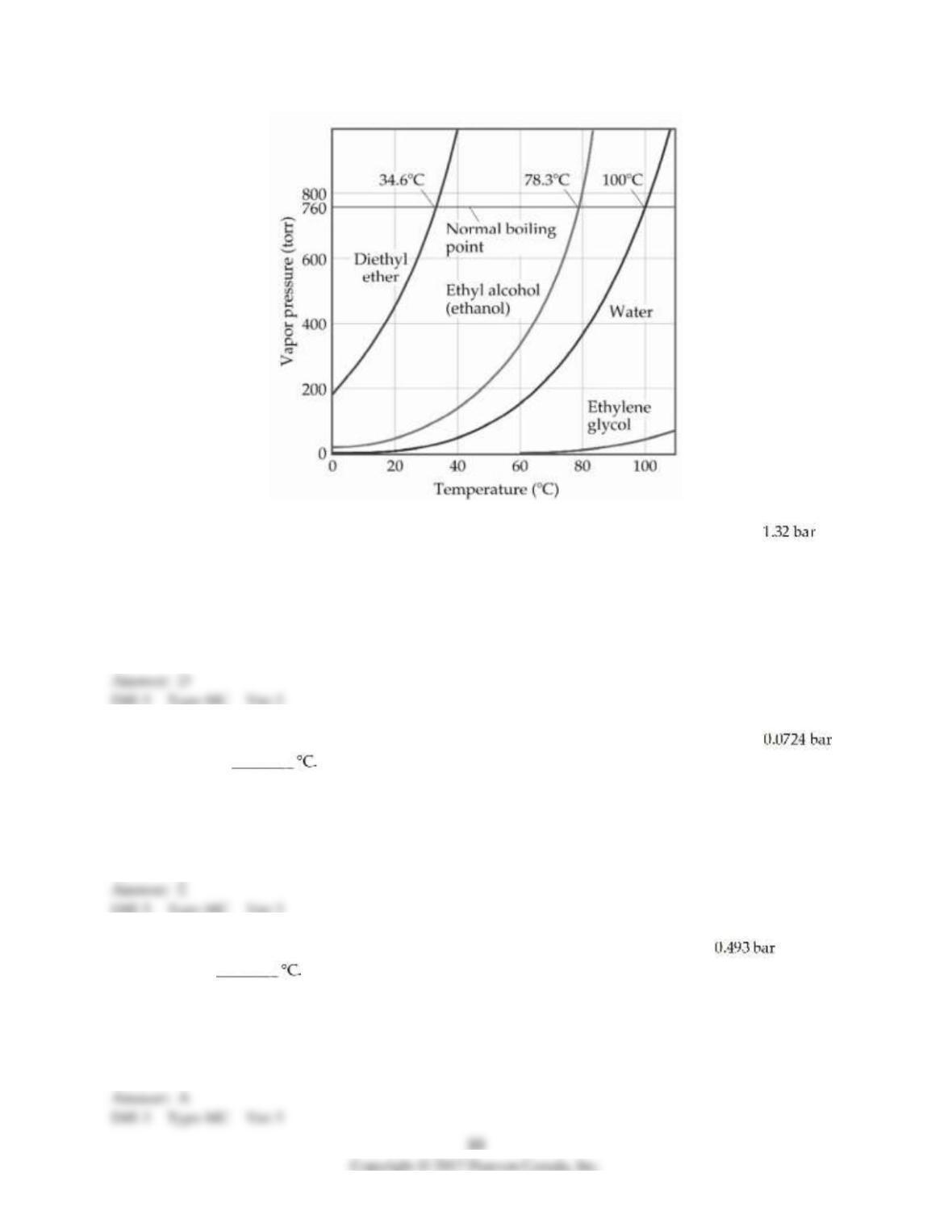
107) Based on the figure above, the boiling point of diethyl ether under an external pressure of is
approximately ________ °C.
A) 10
B) 20
C) 30
D) 40
E) 0
108) Based on the figure above, the boiling point of ethyl alcohol under an external pressure of
is approximately
A) 80
B) 60
C) 70
D) 40
E) 20
109) Based on the figure above, the boiling point of water under an external pressure of is
approximately
A) 80
B) 40
C) 60
D) 70
E) 50
110) Which of the following compounds has the highest boiling point?
A) H2O
B) HI
C) Sb H3
D) SnH4
111) The heat of vaporization of water at 100 °C is 40.66 kJ mol-1. Calculate the quantity of heat that is
absorbed/released when 9.00 g of steam condenses to liquid water at 100 °C.
A) 20.3 kJ of heat are absorbed.
B) 20.3 kJ of heat are released.
C) 81.3 kJ of heat are absorbed.
D) 81.3 kJ of heat are released.
112) What is the edge length of a face-centred cubic unit cell made up of atoms having a radii of 128 pm?
A) 181 pm
B) 362 pm
C) 512 pm
D) 1020 pm
113) Nickel has a face-centred cubic structure and has a density of 8.90 g cm-3. What is its atomic radius?
A) 125 pm
B) 249 pm
C) 353 pm
D) 997 pm
114) Gold crystallizes in a face-centred cubic structure. What is the edge length of the unit cell if the
atomic radius of gold is 144 pm?
A) 204 pm
B) 288 pm
C) 333 pm
D) 407 pm
115) Cesium has a radius of 272 pm and crystallizes in a body-centred cubic structure. What is the edge
length of the unit cell?
A) 314 pm
B) 385 pm
C) 544 pm
D) 628 pm
116) Lithium crystallizes in a body-centred cubic structure. What is the coordination number of each
atom?
A) 4
B) 6
C) 8
D) 12
117) NaCl crystallizes in a cubic unit cell with Cl– ions on each corner and each face. How many Na+ and
Cl– ions are in each unit cell of NaCl?
A) 1 Na+ ion and 1 Cl– ion
B) 2 Na+ ions and 2 Cl– ions
C) 4 Na+ ions and 4 Cl– ions
D) 8 Na+ ions and 8 Cl– ions
118) How many H– ions are around each Na+ ion in NaH, which has a cubic unit cell with H– ions on each
corner and each face?
A) 1
B) 4
C) 6
D) 8
119) Which of the following forms a molecular solid?
A) NH4NO3
B) C6H4Cl2
C) SiO2
D) copper
33
120) Which of the following forms an ionic solid?
A) Cu
B) C2H5NH2
C) NH4NO3
D) NO2
121) Which type of bonding does Sr form upon solidification?
A) covalent network
B) ionic
C) metallic
D) molecular