General Chemistry, 11e (Petrucci)
Chapter 11 Chemical Bonding II: Valence Bond and Molecular Orbital Theories
1) The valence-bond method describes covalent bonding as the overlap of partially filled orbitals.
2) The valence-bond method provides energy information about molecules.
3) A double bond is two sigma bonds.
4) A triple bond is two sigma bonds and one pi bond.
5) Molecular orbitals can be formed by adding and subtracting atomic orbitals.
6) Unhybridized p orbitals must be present for electron delocalization to occur.
7) Resonance structures and delocalized orbitals are different ways to describe the same bonding.
8) The description of covalent bond formation as a region of high electronic charge density resulting from
overlap of atomic orbitals between the two bonded atoms is referred to as:
A) atomic orbital theory
B) the electron-sea model
C) hybridization theory
D) valence-bond method
E) VSEPR method
9) Which of the following statements concerning the carbon dioxide molecule is correct?
A) The molecule contains two lone pairs of valence electrons.
B) The molecule contains two σ bonds.
C) The molecule contains four π bonds.
D) The carbon is described by sp2 hybridization.
E) Each oxygen is described by sp3 hybridization.
10) Which statement regarding VB theory is INCORRECT?
A) d orbitals are not included in hybrid orbitals.
B) Hybrid orbitals use atomic orbitals from the outermost shell.
C) Sigma bonds are formed by the end-to-end overlap of orbital lobes.
D) Pi bonds are overlaps of parallel p orbitals.
E) A double bond is a sigma bond and a pi bond.
11) According to the principles of VSEPR applied on ICl5, which of the following is INCORRECT?
A) VSEPR formula = AX5E
B) molecular geometry = square pyramidal
C) hybridization = sp3d
D) electron-group geometry = octahedral
E) one lone pair and 5 bonding pairs
12) According to principles of VSEPR theory applied on AsCl52-, which of the following is INCORRECT?
A) VSEPR formula = AX5E
B) molecular geometry = square planar
C) electron-group geometry = octahedral
D) hybridization = sp3d2
E) one lone pair and 5 bonding pairs
13) Which statement is INCORRECT?
A) The bond length is the internuclear distance.
B) The covalent bond is a region of high electron charge density between two atoms.
C) Hybrid orbitals are combinations of atomic orbitals.
D) There are the same number of hybrid orbitals produced as the number of atomic orbitals combined.
E) An sp hybridization produces a tetrahedral molecule.
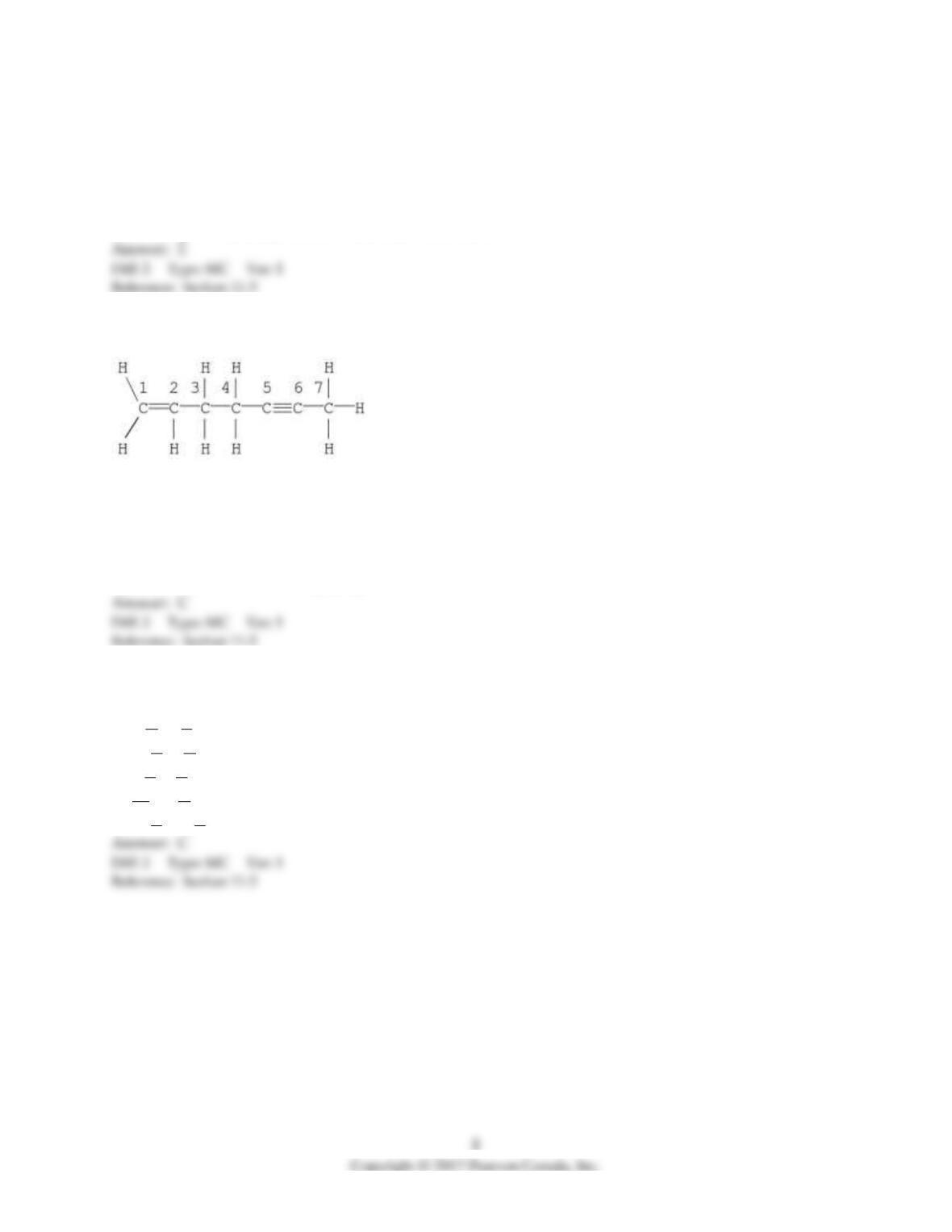
14) Which statement is correct for the structure shown?
A) Carbon no. 1 is described by sp3 hybridization.
B) The molecule contains 19 σ bonds.
C) Carbon no. 2 is described by sp2 hybridization.
D) The molecule contains a total of five π bonds.
E) Carbon no. 7 is described by sp hybridization.
15) Which of the pairs of molecules below have the same hybridization on the central atom? (The central
atom is underlined.)
A) HOCl, ClF3
B) H2O, HNO
C) HCN, CO2
D) BeH2, NH3
E) H3COH, CH2O
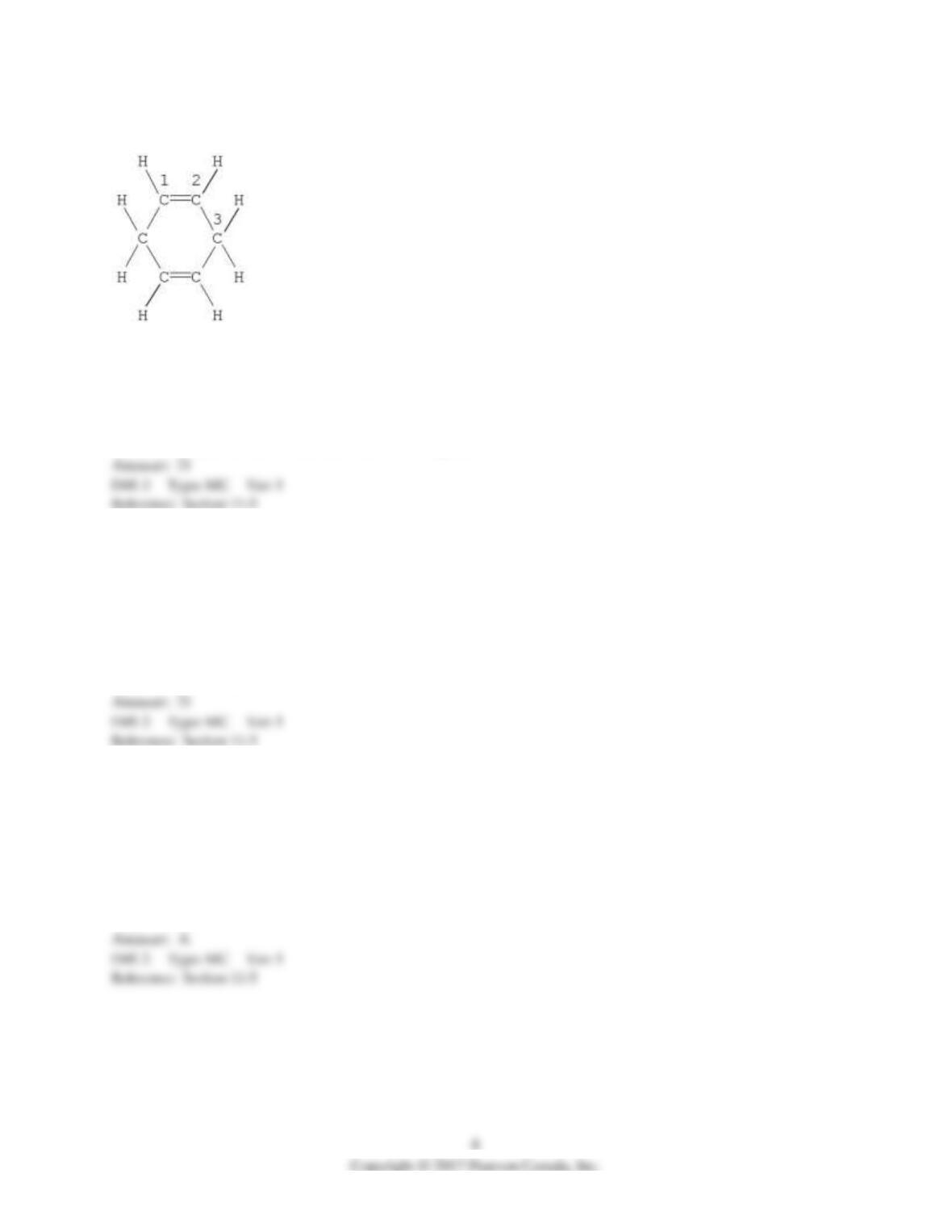
16) Which statement is correct for the structure shown?
A) The molecule contains a total of 16 σ bonds.
B) Carbon no. 1 is described by sp hybridization.
C) The molecule contains a total of four π bonds.
D) Carbon no. 3 is described by sp3 hybridization.
E) The molecule contains a delocalized π bond system.
17) Which combination of hybrid orbital descriptions and electron-group geometry descriptions is
INCORRECT?
A) sp/linear
B) sp2/trigonal planar
C) sp3/tetrahedral
D) sp3d/square planar
E) sp3d2/octahedral
18) Which hybrid orbitals are impossible in electrically neutral molecules containing only the elements
shown?
A) sp3/Al and H
B) sp2/B and F
C) sp/C and H
D) sp2/N and O
E) sp3/O and F
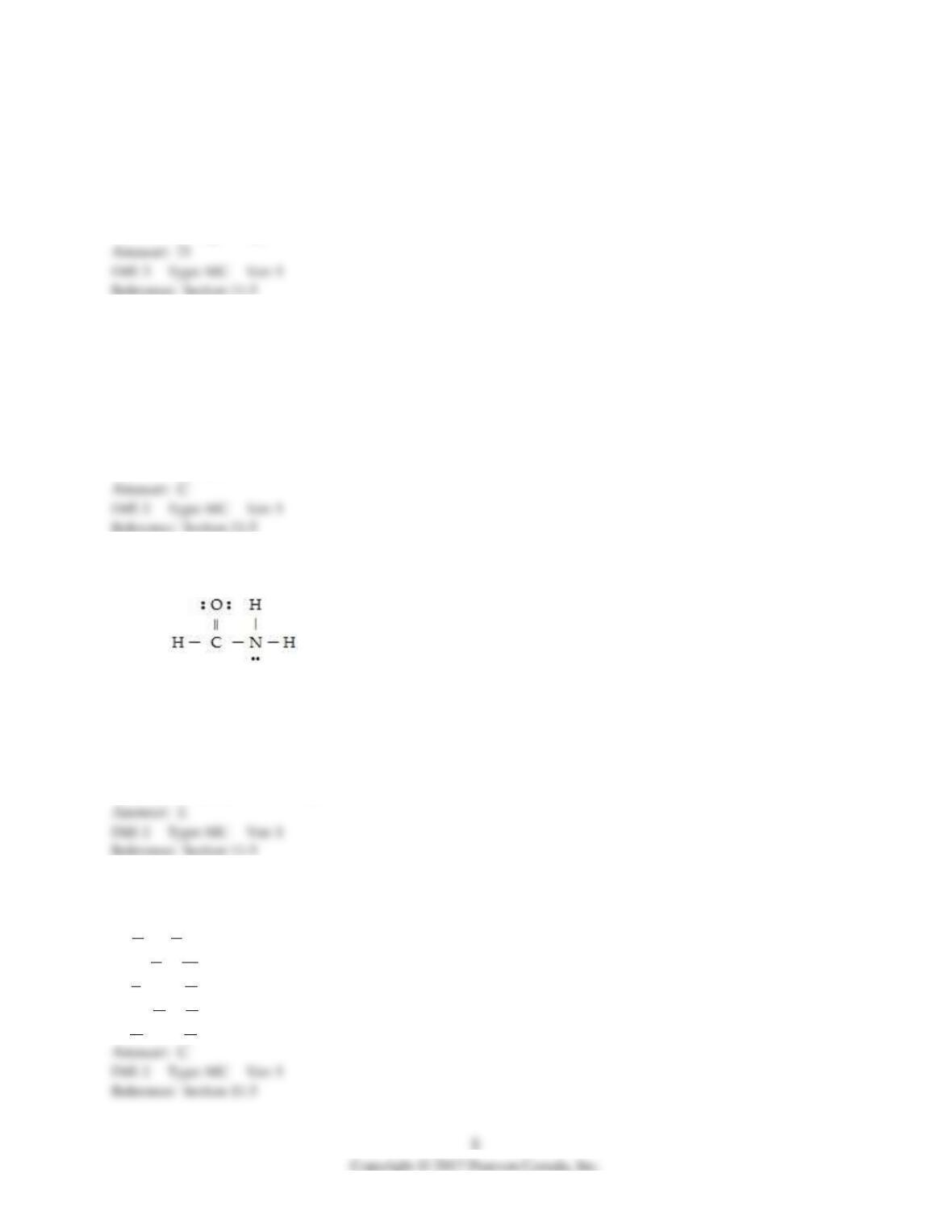
19) Three of the molecular shapes which a sp3d hybridized molecule can have are:
A) triangular, trigonal bipyramid, linear
B) linear, square planar, T-shaped
C) irregular tetrahedron, T-shaped, bent
D) T-shaped, linear, trigonal bipyramid
E) linear, tetragonal pyramid, octahedral
20) For BeCl2, the dipole moment of the molecule, hybridization on the central atom, and number of lone
pairs on the central atom, respectively, are:
A) toward Be, sp2, none
B) away from Be, sp2, one
C) none, sp, none
D) toward Be, sp, one
E) none, sp3, two
21) For the molecule
A) the hybridization for C is sp3
B) the hybridization for N is sp2
C) the hybridization for O is sp3
D) N is not hybridized
E) the hybridization for C is sp2
22) Which of the pairs of molecules below have the same hybridization on the central atom? (The central
atom is underlined in each molecule.)
A) CO2, CH4
B) H2CO, BeH2
C) BCl3, HNO
D) H2O, HF
E) NH3, HNO
23) Find the correct statements about the bonding in methane, CH4.
I) The carbon s and p orbitals combine to form four equivalent sp3 orbitals
II) All C-H bonds have the same strength
III) Molecular geometry is different from electron group geometry
IV) Four C sp3 orbitals combine with the s orbitals of the hydrogens to form bonds
A) I), II), III)
B) I), II), IV)
C) II), III), IV)
D) I), III) IV)
E) I), II)
24) Choose the INCORRECT statement about PCl5.
A) There are no π bonds.
B) P has one lone pair.
C) P has sp3d hybridization.
D) Each Cl has 3 lone pairs.
E) There are 5 σ bonds.
25) Choose the INCORRECT statement about HCN.
A) There are two π bonds.
B) There are two σ bonds.
C) N has a lone pair.
D) The molecule is bent.
E) C has sp hybridization.
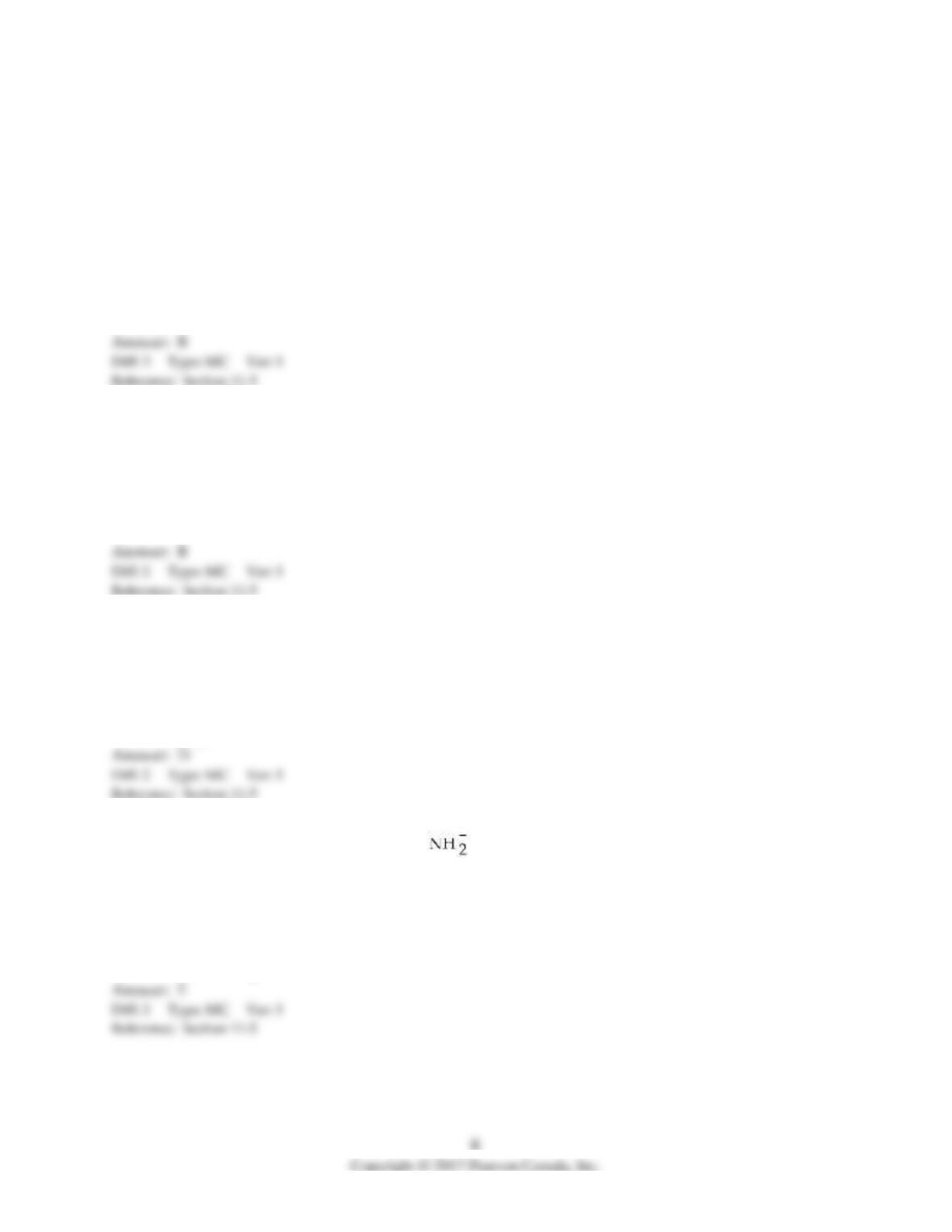
26) Choose the INCORRECT statement about .
A) There are no π bonds.
B) There are two σ bonds.
C) N is sp3 hybridization.
D) The molecule is bent.
E) There is one lone pair on N.
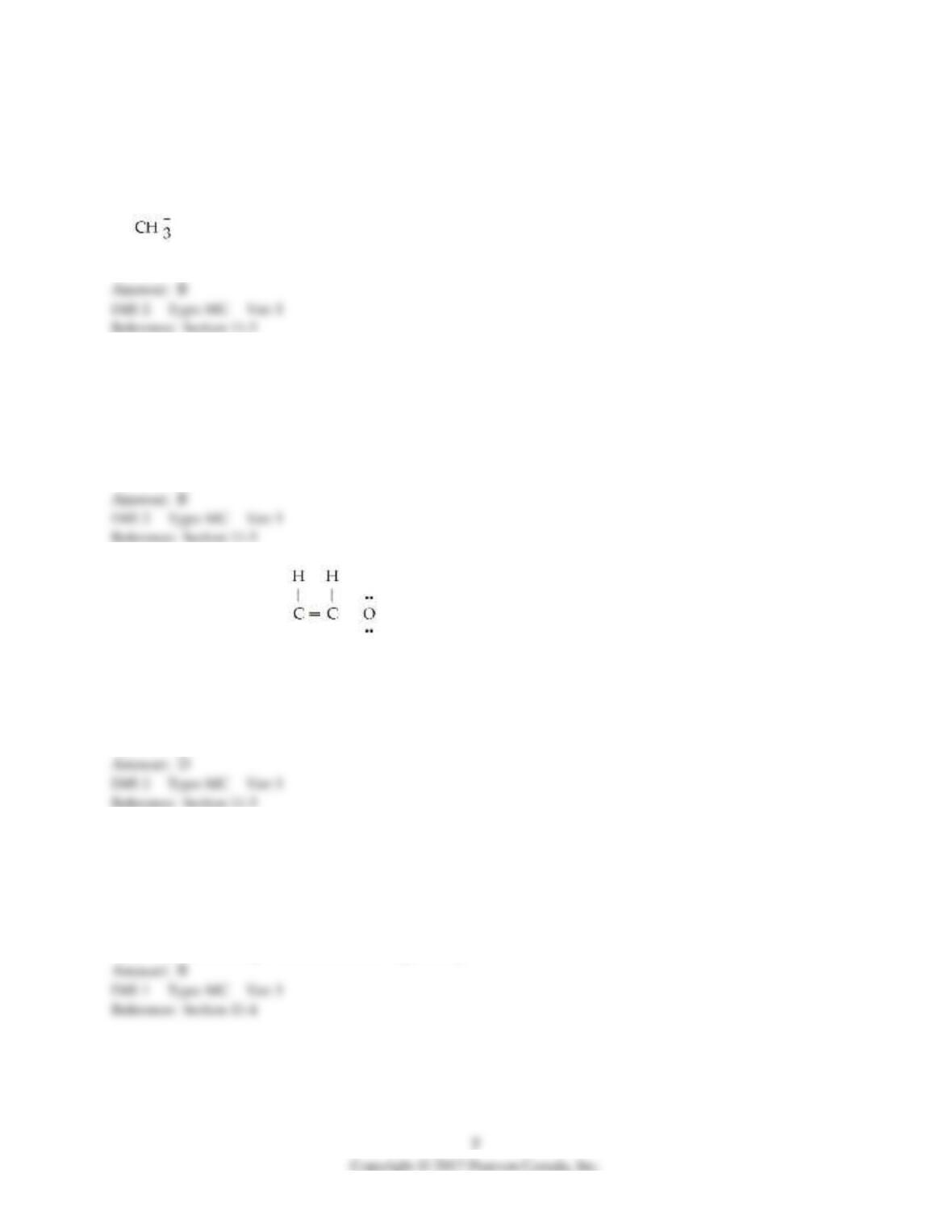
27) Which of the following carbon molecules has sp hybridization?
A) CH4
B) C2H2
C) Cl2CS
D)
E) CO2
28) Choose the INCORRECT statement about SnCl2.
A) The hybridization of Sn is sp2.
B) The molecule is linear.
C) There is one lone pair of electrons on Sn.
D) There are no π bonds.
E) There are two σ bonds.
29) For the molecule H —— — H
A) the geometry about O is linear
B) the hybridization on O is sp
C) O is not hybridized
D) both carbons are sp2 hybridized
E) there are two π bonds between the two carbons
30) Which statement regarding VB theory is INCORRECT?
A) A single bond is a sigma bond.
B) A triple bond is two sigma bonds and a pi bond.
C) A double bond requires each atom to have an unhybridized p orbital.
D) Both atoms in a triple bond have linear geometry.
E) sp3 hybridization produces tetrahedral geometry.
8
31) According to VB theory, sigma bonds are:
A) always present in double bonds
B) formed only by p orbitals
C) formed only by hybrid orbitals
D) formed only by s orbitals
E) formed only by unhybridized orbitals
32) π bonds:
A) are the only kind of bonds present in double bonds
B) have very little electron density along the internuclear axis
C) are formed by endwise overlap of p orbits
D) are formed from hybrid orbitals
E) are formed from s orbitals
33) A σ bond:
A) can only be formed by s orbitals
B) is weaker than a pi bond
C) has high electron probability along the axis between atoms
D) cannot be formed by two p orbitals
E) is formed through side-on overlap of two atomic orbitals
34) The double covalent bond between two carbon atoms in ethylene (C2H4):
A) is free to rotate because of delocalized electrons
B) is a sigma bond
C) consists of one sigma and one pi bond
D) has a low electron density
E) includes a “lone pair” of electrons on one of the carbons
35) Choose the INCORRECT statement about H3O+.
A) There is one π bond.
B) There are 3 σ bonds.
C) There is one lone pair of electrons on O.
D) The hybridization on O is sp3.
E) The OH bonds are O(sp3) – H(1s).
36) A pi bond is:
A) formed from two s orbitals
B) formed from two p orbitals
C) formed from hybridized orbitals
D) formed from one s and one p orbital
E) stronger than a sigma bond
37) According to VB theory, a double bond that results from the sharing of four electrons consists of:
A) 2 sigma bonds
B) one sigma and one pi bond
C) one sigma bond
D) two pi bonds
E) one sigma bond and one coordinate bond
38) Choose the INCORRECT statement about NH4+.
A) The hybridization of N is sp3.
B) The molecule is tetrahedral.
C) There is one lone pair of electrons on N.
D) There are no π bonds.
E) There are four σ bonds.
39) Choose the INCORRECT statement about AsF6–.
A) The hybridization is sp3d2.
B) The molecule is octahedral.
C) There are no π bonds.
D) There is one lone pair of electrons.
E) There are six σ bonds.
40) Choose the INCORRECT statement about CO2.
A) There are two π bonds.
B) There are two σ bonds.
C) C has one lone pair.
D) The hybridization on C is sp.
E) The molecule is linear.
41) Choose the INCORRECT statement about NO2+.
A) There is one π bond.
B) There are two σ bonds.
C) The hybridization is sp.
D) There are no lone pairs on N.
E) There are two lone pairs on each O.
42) The structure of aspirin is given below. (Note that lone pairs of electrons are not shown.)
Which set of hybrid orbitals best describes the O-C bond, labeled “a,” “b,” in aspirin?
A) sp3–sp2
B) sp3–sp3
C) sp2–sp2
D) sp–sp2
43) Which of the following statements is INCORRECT?
A) A double bond is stronger than a single bond for the same atoms.
B) A double bond is less than twice as strong as a single bond for the same atoms.
C) Bonded atoms cannot rotate freely around a double bond.
D) Molecular geometry depends on the σ bond framework.
E) There are no hybridized orbitals in multiple bonds.
44) According to the molecular orbital (MO) theory, when two oxygen atoms bond together, their 2p
orbitals combine to form:
A) two sigma molecular orbitals (MOs) and four pi MOs
B) two sigma MOs and two pi MOs
C) four pi MOs only
D) one sigma and one pi MO
E) a delocalized set of MO
45) Which statement is INCORRECT about molecular orbital theory?
A) The number of molecular orbitals produced is equal to the number of atomic orbitals combined.
B) Each pair of sigma molecular orbitals is a bonding orbital and an antibonding orbital.
C) The antibonding orbital is at a lower energy than the bonding orbital.
D) The bond order (BO) is .
E) Hund’s rule says that each orbital of identical energy has one electron before pairs are formed.
46) According to molecular orbital (MO) theory, which statement below is true?
A) A molecule with an even number of electrons must be diamagnetic.
B) There are as many sigma bonds as pi bonds in a molecule.
C) There are as many molecular orbitals as there are atomic orbitals.
D) There are as many bonding as antibonding electrons in a molecule.
E) All molecules contain pi bonds.
47) According to MO theory, assuming that the molecular orbitals are the same as a diatomic molecule,
which is an INCORRECT statement for CN–?
A) The BO is 2.
B) There are no unpaired electrons.
C) The σ2p is the highest filled level.
D) The molecule is diamagnetic.
E) There are 10 electrons in the n = 2 level orbitals.
48) According to MO theory, which is an INCORRECT statement for ?
A) The B.O. is 1/2.
B) There are no unpaired electrons.
C) The σ1s* orbital has one electron.
D) The molecule is paramagnetic.
E) There are 3 electrons in the molecular orbitals.
49) According to MO theory, which is the INCORRECT statement for ?
A) The BO is 2.5.
B) There is one unpaired electron.
C) The σ2p orbital has two electrons.
D) The molecule is paramagnetic.
E) There are 9 electrons in the molecular orbitals.
50) According to MO theory, which is the INCORRECT statement for ?
A) The BO is 2.5.
B) There is one unpaired electron.
C) The σ2p orbital has one electron in it.
D) The molecule is diamagnetic.
E) There are 9 electrons in the molecular orbitals.
51) Which of the following species is paramagnetic?
A) B2
B) C2
C) N2
D) CO
52) The concept of an anti-bonding orbital is unique to the:
A) theory of bond hybridization
B) valence bond theory
C) molecular orbital theory
D) concept of resonance
E) electrostatic repulsion theory
53) According to MO theory, all of the following have a bond order of 2 EXCEPT:
A) NO
B) CN+
C) C2
D) O2
54) Which of the following statements concerning molecular orbital (MO) theory is FALSE?
A) The number of MOs formed equals the number of atomic orbitals combined.
B) Any set of MOs from 2 atomic orbitals involves 1 bonding and 1 antibonding orbital.
C) Electrons normally enter the lowest energy MO available to them.
D) No more than two electrons can enter a particular MO.
E) Electrons enter MOs of identical energies in pairs before any enter singly.