55) Which of the following statements concerning the relative energy levels of molecular orbitals for the
O2 molecule is INCORRECT?
A) σ1s < σ1s*
B) σ2s < σ2p
C) π2p < σ2p
D) π2p* < σ2p*
E) σ1s* < σ2s
56) The extra stability that a molecule gains due to electron delocalizations (the electrons being free to
move throughout large parts of the molecule) is called:
A) ionization energy
B) lattice energy
C) covalent strength
D) resonance energy
E) bond energy
57) Which of the following involves delocalized π bonds?
A) acetylene (C2H2)
B) benzene (C6H6)
C) carbon tetrachloride (CCl4)
D) dichlorodifluoromethane (CF2Cl2)
E) ethylene (C2H4)
58) If the HCOO– ion is described using delocalized electrons, why can the oxygen atoms not have sp3
hybrids?
A) There must be an unhybridized p orbital to form the pi bond system.
B) The s orbital must be unhybridized to form the pi bond system.
C) There is no hybridization in systems with delocalized electrons.
D) Molecular orbital theory does not include hybridization.
E) The four lobes repel each other too strongly.
59) How would replacing one of benzene’s C atoms and the H atom attached to it with an N atom
(C5H5N) affect the delocalized electrons?
A) The molecule would not be stable.
B) The N can have delocalized electrons like C.
C) Only the five C atoms would be included in the delocalized electrons.
D) There would be no delocalized electrons but a double bond between the N and a C.
E) There would be no delocalized electrons but a double bond between the N and the C on each side of
the N.
60) Which of the following does NOT involve any delocalized π bonds?
A) acetate ion
B) carbonate ion
C) nitric acid
D) nitrous acid
E) ozone
61) If the wave functions describing the 2s and two of the 2p orbitals are combined, the identical orbitals
derived form bond angles of ________.
A) 90°
B) 120°
C) 180°
D) 109.5°
E) 360°
62) The hybridization of N in NO2– is ________.
A) sp
B) sp2
C) sp3d
D) sp3
E) sp3d2
63) What are the ideal bond angles for H2O?
A) 120°
B) 109.5°
C) 90°
D) 180°
E) 75°
64) The octahedral hybrid configuration is composed of which orbital combination?
A) sp3d2
B) sp2d3
C) spd2
D) sp3d
E) sp3
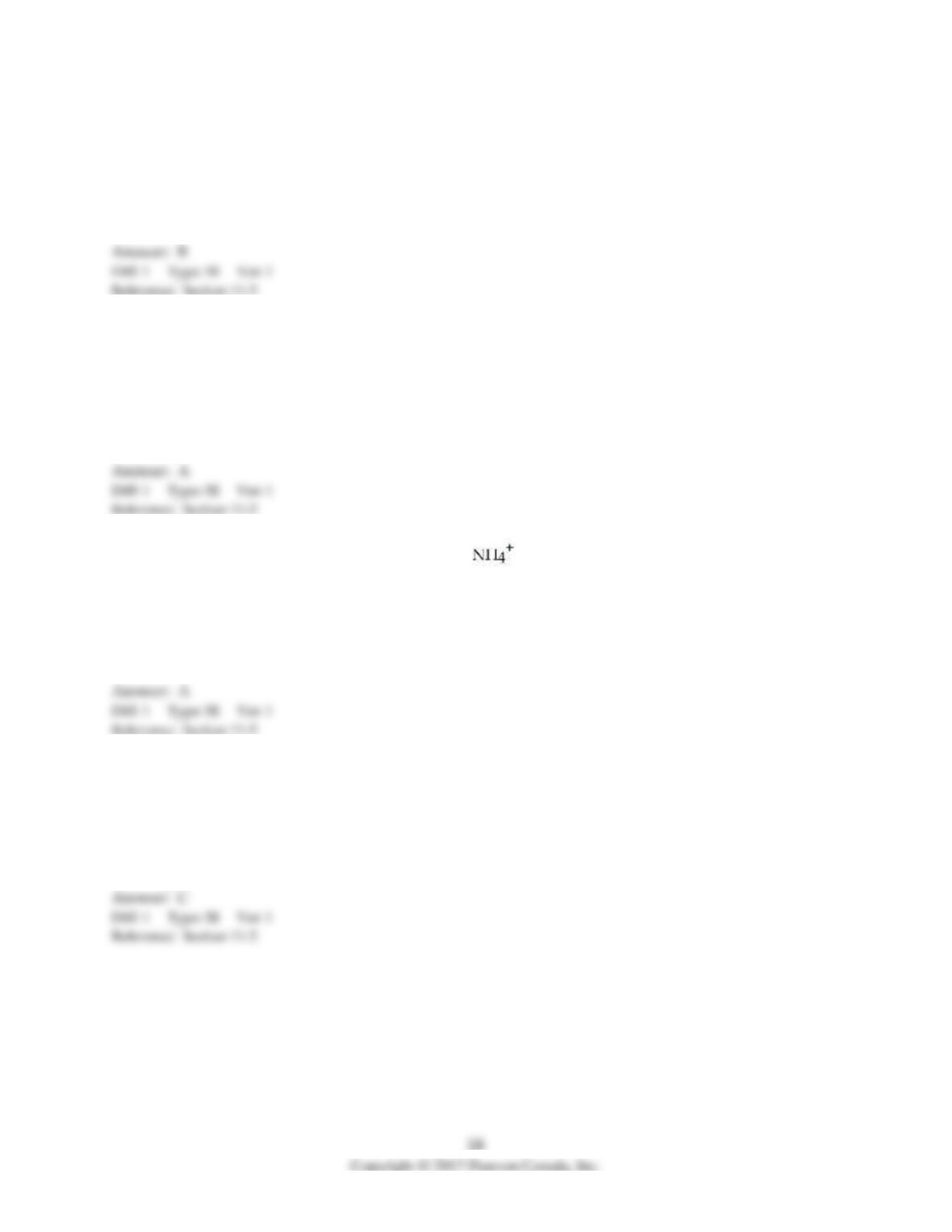
65) According to the valence bond theory, in the ion , nitrogen is using which orbitals for bonding?
A) sp3
B) p
C) sp2d
D) sp
E) s
66) The geometry of sp2 hybridized orbitals is ________.
A) linear
B) tetrahedral
C) trigonal planar
D) octahedral
E) T-shaped
67) The hybridization on Xe in XeF4 is ________.
A) not hybridized
B) sp3
C) sp3d
D) sp3d2
E) sp2d
68) What is the hybridization of the S atom in SF4?
A) sp3d
B) sp3
C) sp3d2
D) spd2
69) What is the hybridization of the Xe atom in XeF2?
A) sp3d
B) sp
C) sp3
D) sp2
70) The three molecular shapes an sp3 hybridized molecule can have are ________.
A) triangular, bent, T-shaped
B) irregular tetrahedral, T-shaped, linear
C) octahedral, square pyramidal, square planar
D) tetrahedral, trigonal pyramidal, bent
E) tetrahedral, T-shaped, bent
71) For XeF4, what are the dipole moment orientation, hybridization on the central atom, and the number
of lone pairs, respectively, on the central atom?
A) none, sp3d2, two
B) none, sp3, none
C) away from one pair, sp3d, one
D) toward one pair, sp3d, one
E) toward Xe, sp3d2, one
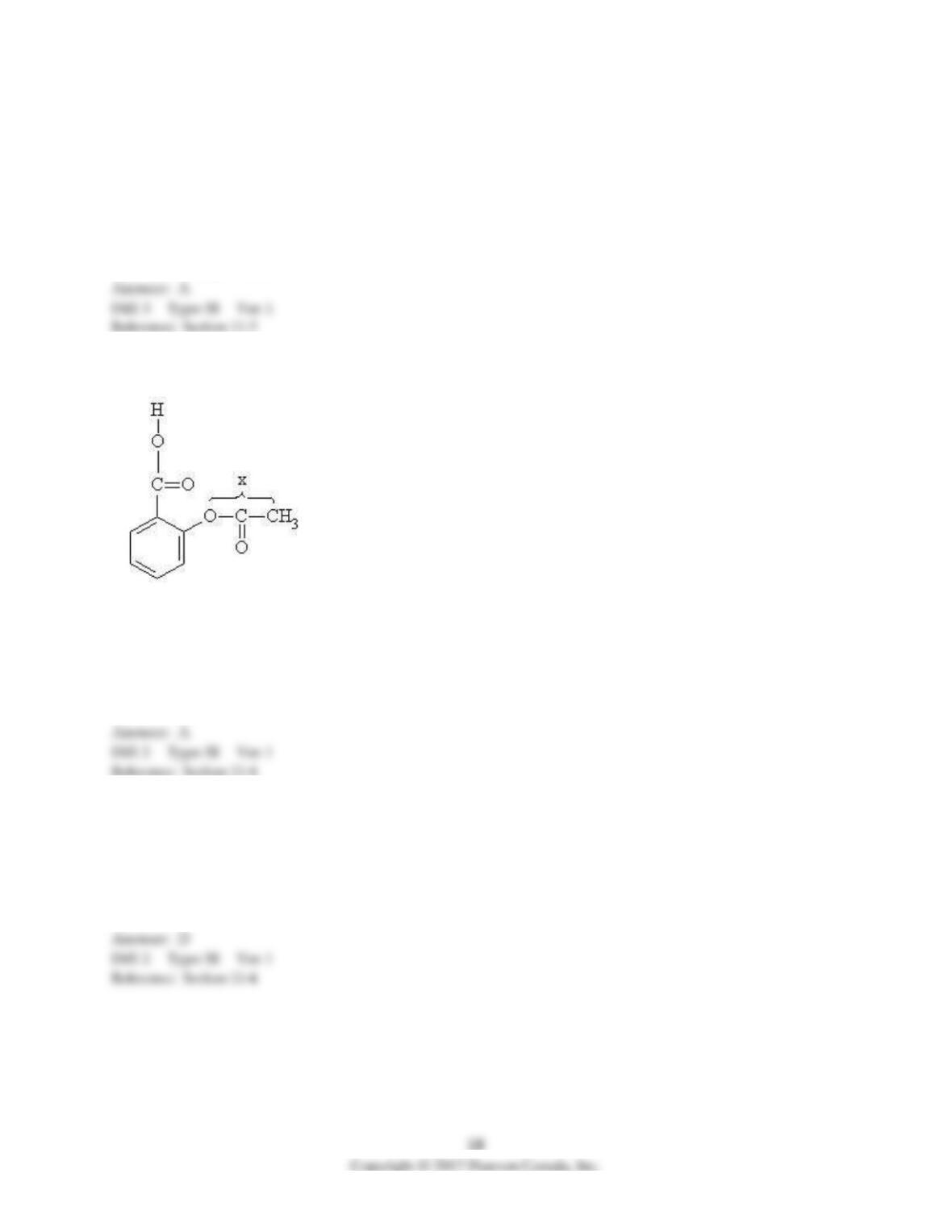
72) The structure of aspirin is given below. (Note that lone pairs are not shown.)
What is the O-C-C bond angle, “x,” in aspirin?
A) ~120°
B) ~109°
C) ~90°
D) ~180°
73) How many σ bonds and how many π bonds are present in the carbonic acid molecule, H2CO3?
A) 2σ/4π
B) 3σ/3π
C) 4σ/2π
D) 5σ/1π
E) 6σ/0π
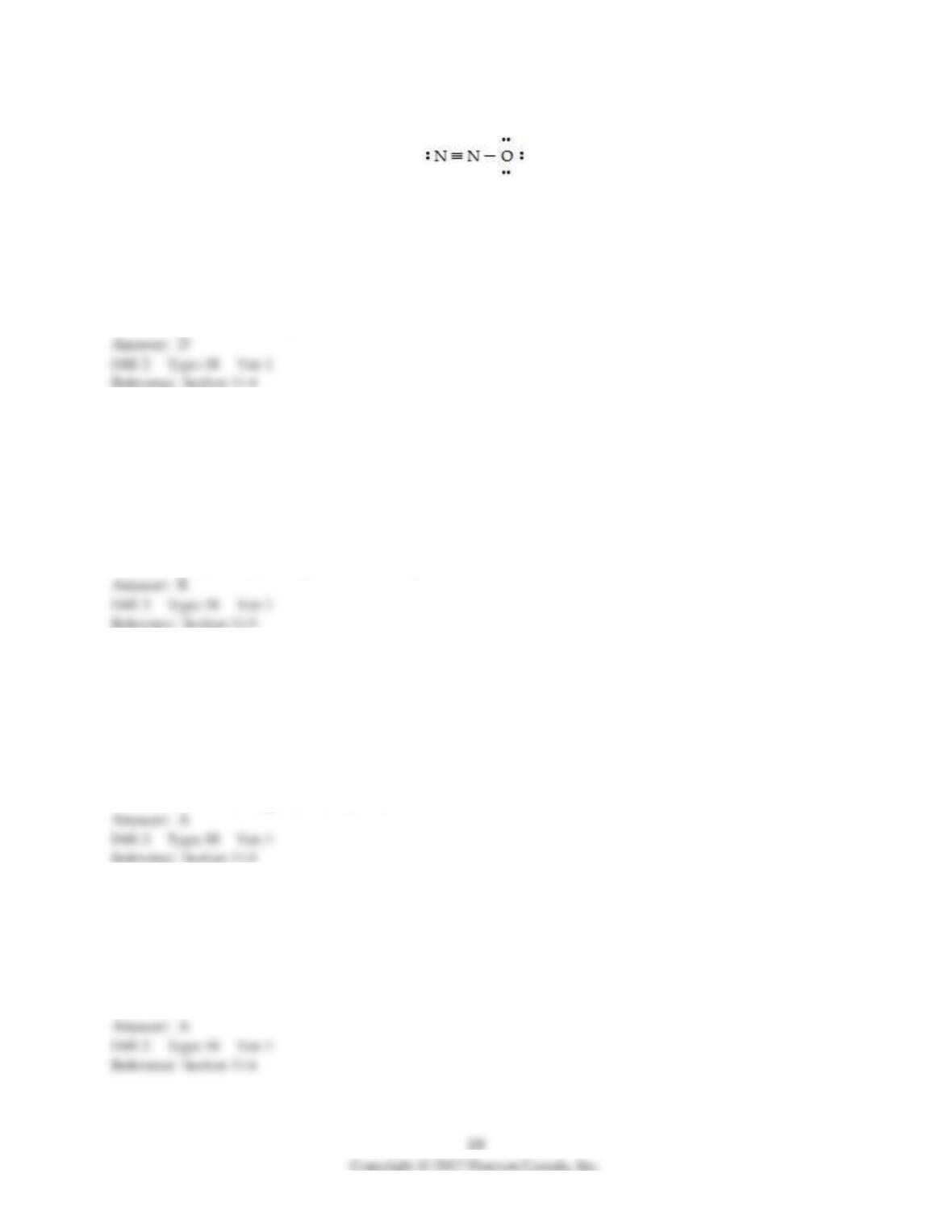
74) One resonance structure of N2O is
The hybridized atomic orbitals of the central nitrogen atom which are consistent with this structure are
________.
A) four sp3 orbitals
B) three sp2 orbitals and a p orbital
C) two sp2 orbitals and two sp orbitals
D) two sp orbitals and two p orbitals
E) one sp orbital and two p orbitals
75) Which is the correct molecular orbital diagram for O2– ion?
A) σ 2s ↑ ↓ σ 2s* ↑ ↓ σ2p ↑ ↓ π2p ↑ ↓ π2p* ↑ ↓, ↑
B) σ 2s ↑ ↓ σ 2s* ↑ ↓ σ2p ↑ ↓ π2p ↑ ↓, ↑ ↓ π2p* ↑ ↑, ↑
C) σ 2s ↑ ↓ σ 2s* ↑ ↓ σ2p ↑ π2p ↑ ↓, ↑ ↓ π2p* ↑ ↓
D) σ 2s ↑ ↓ σ 2ss* ↑ ↓ σ2p ↑ ↓ π2p ↑ ↓, ↑ ↓ π2p* ↑
E) σ 2s ↑ ↓ σ 2ss* ↑ σ2p ↑ ↓ π2p ↑ ↓, ↑ ↓, ↑ ↓ π2p* ↑
76) Which is the correct molecular orbital diagram for carbon monoxide?
A) σ 2s ↑ ↓ σ 2s* ↑ ↓ π2p ↑ ↓, ↑ ↓ σ2p ↑ ↓
B) σ 2s ↑ ↓ σ 2s* ↑ ↓ π2p ↑ ↓, ↑ ↓ σ2p ↑ π2p* ↑
C) σ 2s ↑ ↓ σ 2s* ↑ ↓ π2p ↑ ↓, σ2p ↑ ↓ π2p* ↑ ↓
D) σ 2s ↑ ↓ σ 2s* ↑ ↓ π2p ↑, ↑, σ2p ↑ ↓ π2p* ↑ ↓
E) σ 2s ↑ ↓ σ 2s* ↑ ↓ π2pp ↑ ↓, ↑ ↓ π2p* ↑ ↓
77) How many σ– and π-bonds, respectively, are there in phenylisothiocyanate, C6H5NCS? Ignore the
C—H bonds in your counting.
A) 9 and 5
B) 8 and 4
C) 5 and 5
D) 9 and 2
78) How many π-electrons are there in S2O where S is the central atom?
A) 4
B) 2
C) 6
D) 0
79) The HCOO– ion can be described by using delocalized electrons. What is the hybridization of the C
atom?
A) sp
B) sp3
C) sp2d
D) sp3d
E) sp2
80) What would be the hybridization of the N in the benzene-like molecule (C5H5N)?
A) sp
B) sp3
C) sp3d2
D) sp3d
E) sp2
81) What would be the bond order of the N-C bonds in the benzene-like molecule (C5H5N)?
A) 0
B) 1
C) 1/2
D) 3/2
E) 2
82) What geometric arrangement of charge clouds is expected for an atom that has four charge clouds?
A) trigonal bipyramidal
B) octahedral
C) tetrahedral
D) square planar
83) What is the molecular geometry of ClF4 –?
A) seesaw
B) square planar
C) square pyramidal
D) tetrahedral
84) What is the molecular geometry of NCl3?
A) T-shaped
B) tetrahedral
C) trigonal planar
D) trigonal pyramidal
85) What is the molecular geometry of SF5–?
A) octahedral
B) seesaw
C) square pyramidal
D) trigonal bipyramidal
86) Which of the following best describes ClF2–? It has a molecular geometry that is:
A) linear with no lone pairs on the Cl atom
B) linear with lone pairs on the Cl atom
C) nonlinear with no lone pairs on the Cl atom
D) nonlinear with lone pairs on the Cl atom
87) What is the molecular geometry of TeCl4?
A) seesaw
B) square planar
C) square pyramidal
D) tetrahedral
88) Using the VSEPR model, the electron-domain geometry of the central atom in SF6 is:
A) linear
B) trigonal planar
C) tetrahedral
D) trigonal bipyramidal
E) octahedral
89) Using the VSEPR model, the molecular geometry of the central atom in N2O is:
A) linear
B) trigonal planar
C) tetrahedral
D) bent
E) trigonal pyramidal
90) Using the VSEPR model, the molecular geometry of the central atom in NO3– is:
A) linear
B) trigonal planar
C) tetrahedral
D) bent
E) trigonal pyramidal
91) Using the VSEPR model, the molecular geometry of the central atom in NH4+ is:
A) linear
B) trigonal planar
C) tetrahedral
D) bent
E) trigonal pyramidal
92) Using the VSEPR model, the molecular geometry of the central atom in H2Se is:
A) linear
B) trigonal planar
C) tetrahedral
D) bent
E) trigonal pyramidal
93) Using the VSEPR model, the molecular geometry of the central atom in NCl3 is:
A) linear
B) trigonal planar
C) tetrahedral
D) bent
E) trigonal pyramidal
94) Using the VSEPR model, the molecular geometry of the central atom in XeF4 is:
A) tetrahedral
B) seesaw
C) square planar
D) trigonal bipyramidal
E) square pyramidal
95) Using the VSEPR model, the electron-group geometry of the central atom in BF3 is:
A) linear
B) trigonal planar
C) tetrahedral
D) trigonal bipyramidal
E) octahedral
96) Using the VSEPR model, the electron-group geometry of the central atom in CF4 is:
A) linear
B) trigonal planar
C) tetrahedral
D) trigonal bipyramidal
E) octahedral
97) Using the VSEPR model, the electron-group geometry of the central atom in SF4 is:
A) linear
B) trigonal planar
C) tetrahedral
D) trigonal bipyramidal
E) octahedral
98) What is the O-B-O bond angle in BO33-?
A) less than 109.5°
B) 109.5°
C) 120°
D) greater than 120°
99) What are the F-Po-F bond angles in PoF6 ?
A) 60°
B) 90°
C) 109.5°
D) 120°
100) The VSEPR model predicts the H—O—H bond angle in H3O+ to be:
A) 60°
B) 90°
C) less than 109.5° but greater than 90°
D) 109.5°
101) The orbital hybridization on the carbon atoms in C2H2 is:
A) sp
B) sp2
C) sp3
D) sp3d2
102) The hybrid orbital set used by the central atom in NO3– is:
A) sp
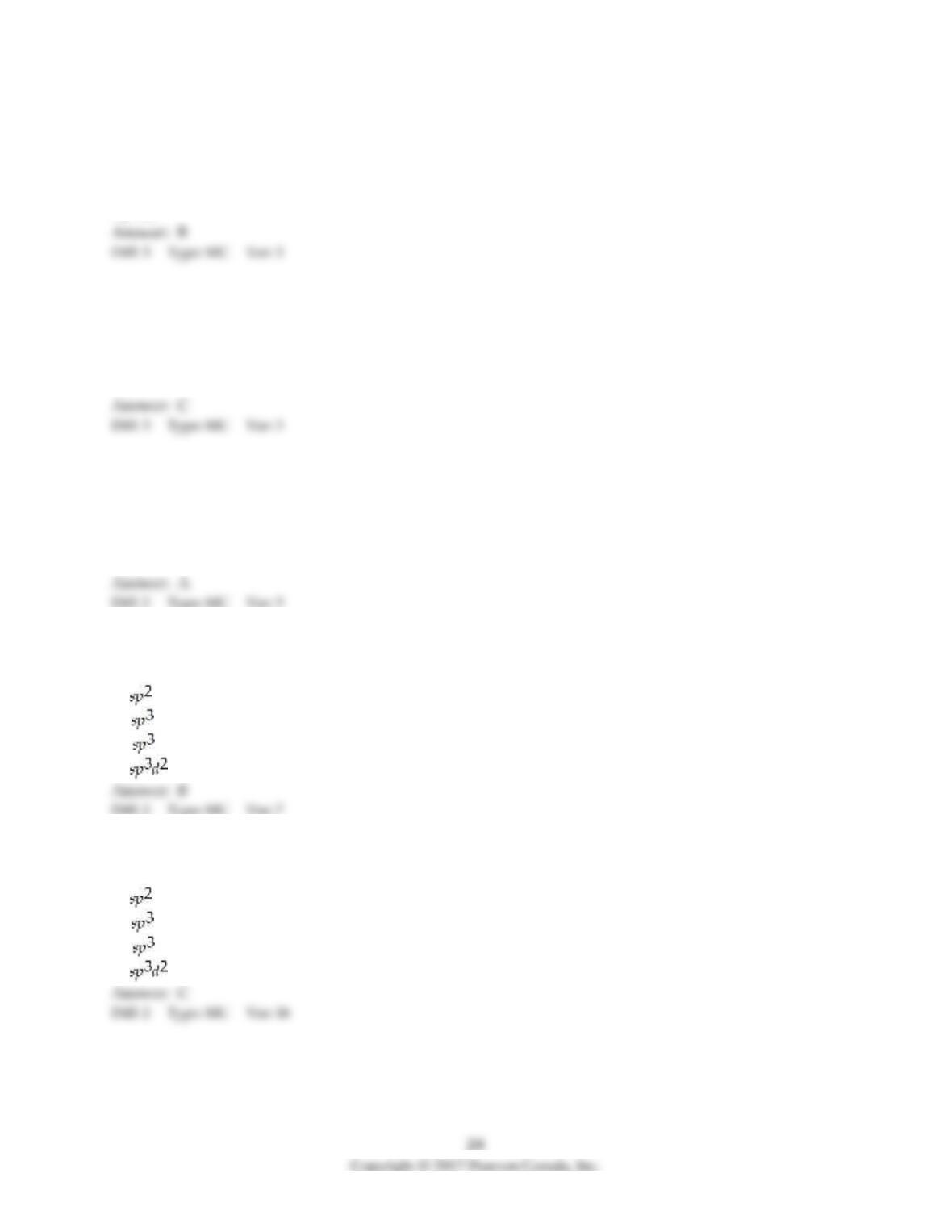
B)
C)
D) d
E)
103) The hybrid orbital set used by the central atom in NCl3 is:
A) sp
B)
C)
D) d
E)
25
104) The hybrid orbital set used by the central atom in KrF2 is:
A) sp
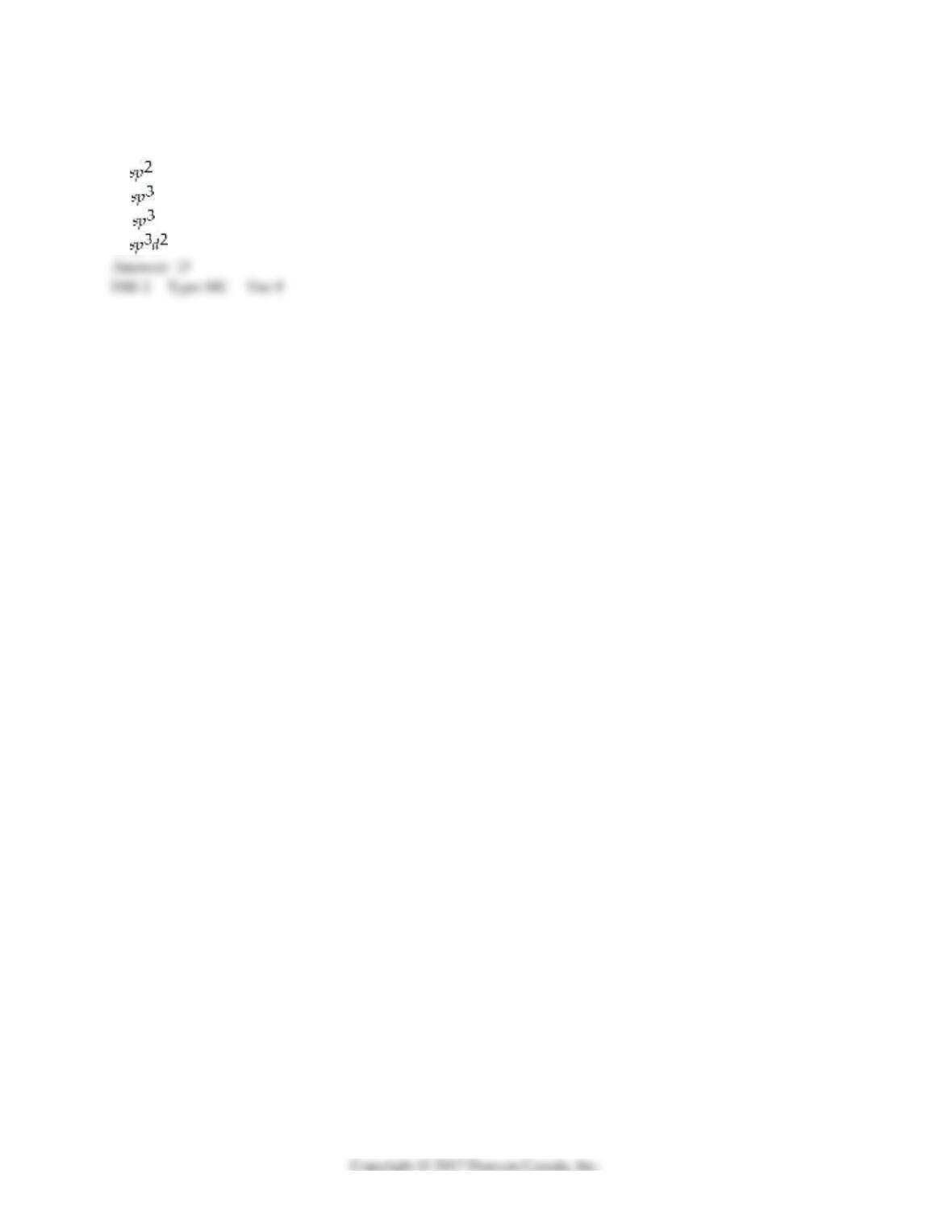
B)
C)
D) d
E)