Page 1
1.
In nuclear magnetic resonance, stronger magnetic fields
A)
give a higher sensitivity spectrum than do lower magnetic fields.
B)
give different chemical shifts (in ppm) than would weaker magnets.
C)
give better separation between peaks in the spectrum (in Hz) than would weaker
magnets.
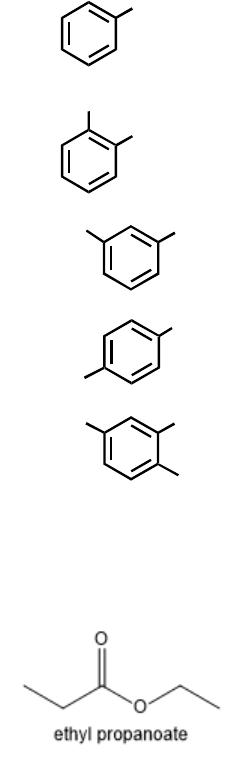
D)
give different coupling constants than would be observed with weaker magnetic
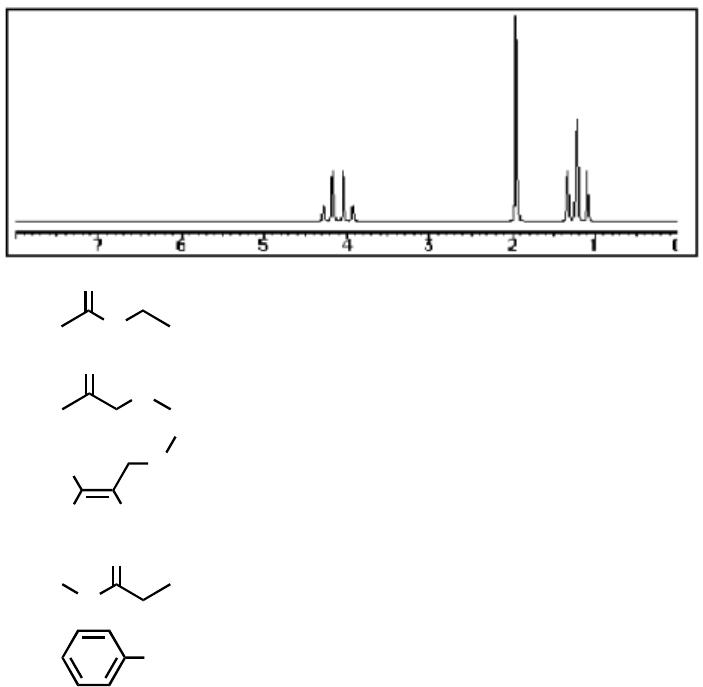
fields.
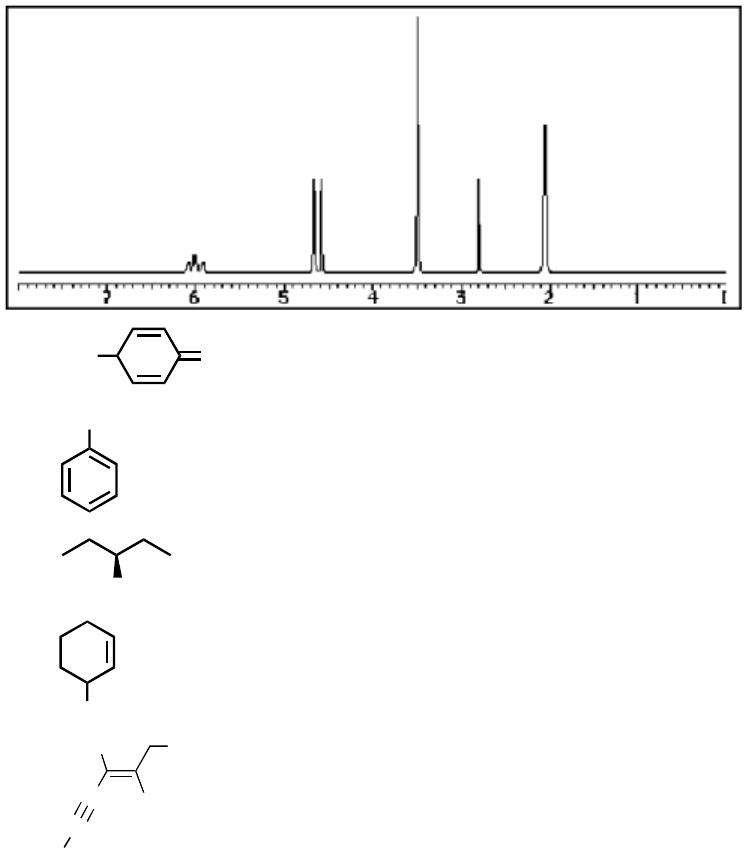
E)
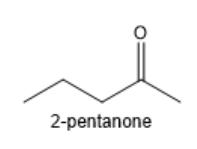
Both A and C are true.
2.
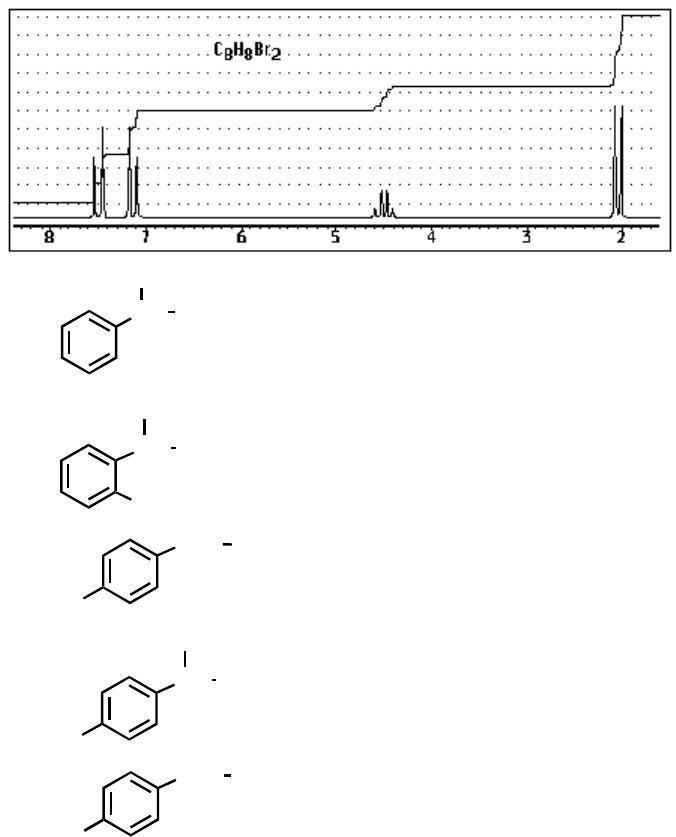
Which of the following structures of formula C8H8Br2 would give the NMR spectrum
shown below?
A)
CH CH2Br
Br
B)
Br
CH
CH3
Br
C)
Br
CH2CHBr2
D)
Br
CH
CH3
Br
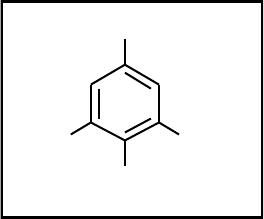
E)
Br
CH2CH2Br
Page 2
3.
The type of electromagnetic energy required to cause nuclear magnetic resonance is
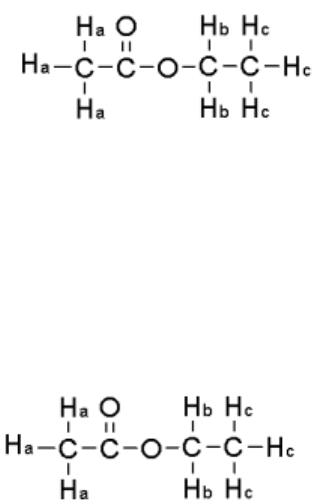
A)
infrared.
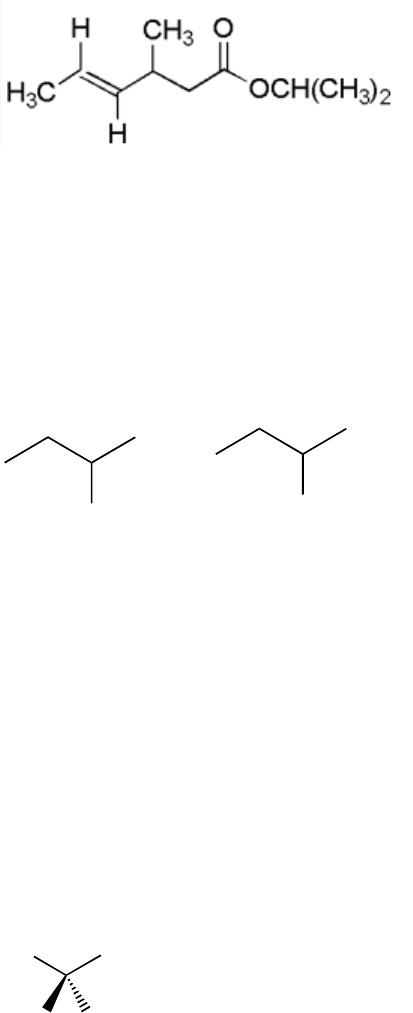
B)
radio.
C)
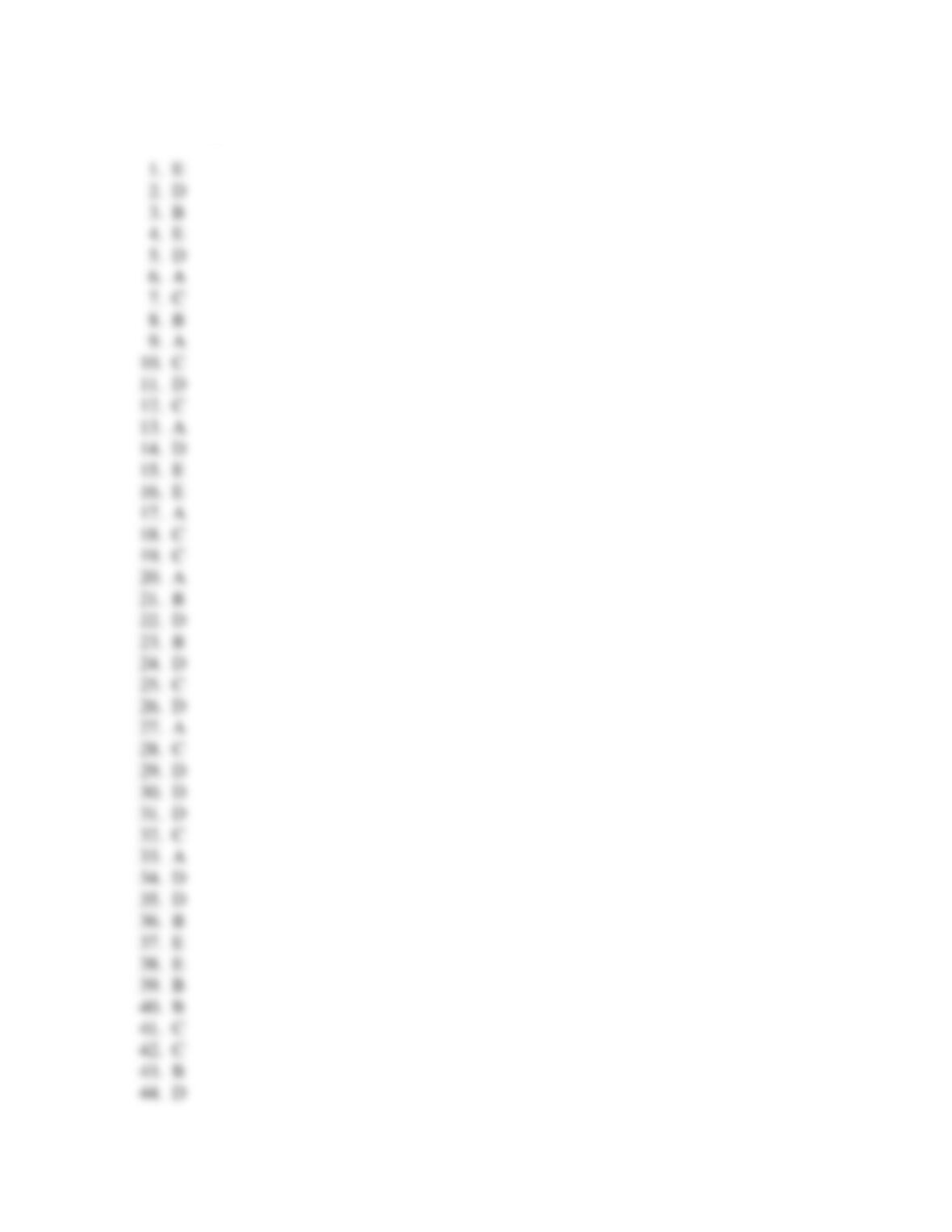
ultraviolet.
D)
visible.
E)
microwave.
4.
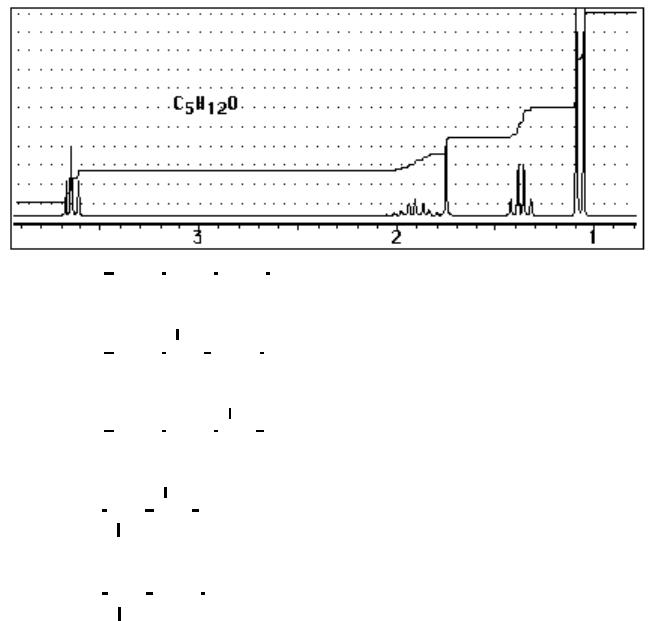
Which of the following structures C5H12O would give the NMR spectrum shown?
A)
H3CCH2CH2CH2CH2OH
B)
H3CCH2CH CH2CH3
OH
C)
H3CCH2CH2CH CH3
OH
D)
CH3
CH3CH CH CH3
OH
E)
CH3
CH3CH CH2CH2OH
5.
Which of the following is not true of 13C NMR?
A)
The sensitivity of 13C NMR is much less than that of proton NMR.
B)
By simultaneously decoupling the proton region, 13C peaks appear as singlets.
C)
13C chemical shifts cover a much larger range than do 1H chemical shifts.
D)
The 13C NMR spectrum can show more peaks than there are carbons in the
molecular formula.
E)
The 13C NMR spectrum will show one peak for each type of carbon in a molecule.
Page 3
6.
How many different types of hydrogens are present in the following molecule?
H3CCH CH CH
Br
Br
CH3
Br
A)
three
B)
four
C)
five
D)
six
E)
seven
7.
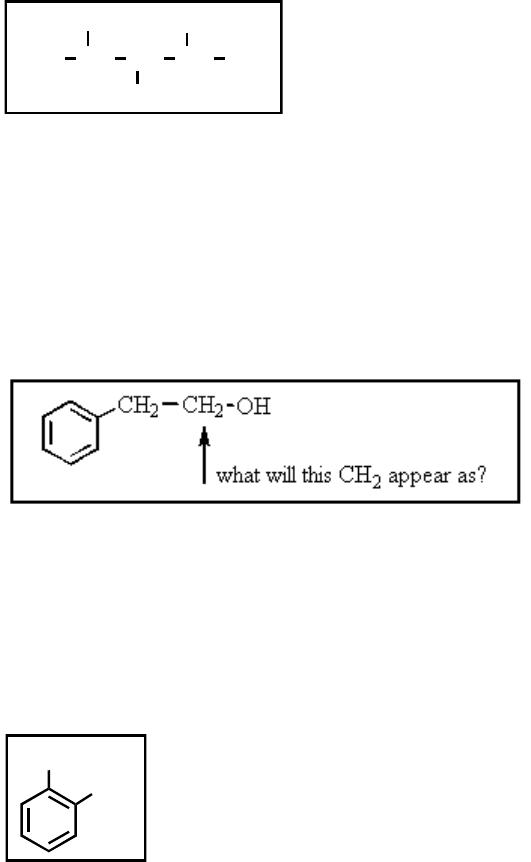
The CH2 group indicated would most likely appear as what in the proton NMR
spectrum?
A)
singlet
B)
doublet
C)
triplet
D)
quartet
E)
pentet
8.
How many different types of carbon would be present in the following molecule?
CH3CH3
A)
three
B)
four
C)
five
D)
six
E)
eight
Page 4
9.
A bottle in a chemical stockroom was labeled simply “dichlorobenzene” without
specifying which isomer was present. Capillary GC showed that it was a single pure
compound, and the proton decoupled carbon NMR spectrum showed three peaks (not
including solvent). You conclude that the bottle contained
A)
Cl Cl
(ortho)
B)
Cl
Cl
(para)
C)
Cl
Cl
(meta)
D)
any of the dichlorobenzene isomers
E)
none of the dichlorobenzene isomers
10.
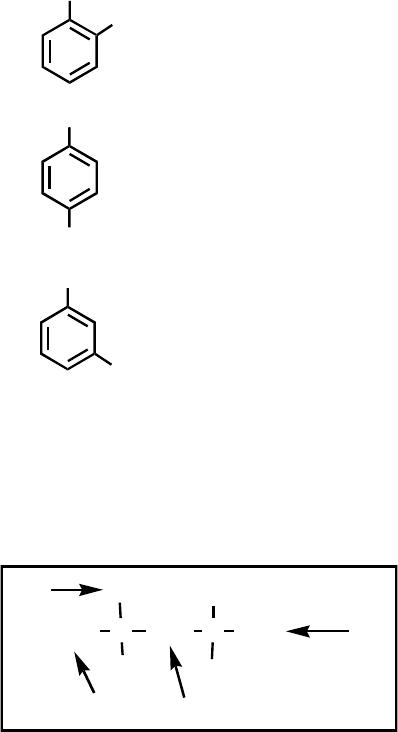
The most downfield proton NMR signal (i.e., signal most to the left in the spectrum) in
the following molecule would be
H3C C CH2CCH3
Br
Br
CH3
Br
D
C
B
A
A)
A
B)
B
C)
C
D)
D
E)
there is no way to tell
Page 5
11.
A very old bottle labeled only “chlorinated benzene” was found in the stockroom.
Capillary GC showed (surprisingly) that the compound was pure, and a
proton-decoupled 13C NMR spectrum showed only two peaks. Which of the following
compounds was in the bottle?
A)
Cl
B)
Cl
Cl
C)
Cl
Cl
D)
Cl
Cl
E)
Cl
Cl
Cl
12.
How many different signals will be present in the proton NMR for ethylpropanoate?
(Do not count TMS as one of the signals!)
A)
2
B)
3
C)
4
D)
5
E)
6
Page 6
13.
Which compound most likely exhibits the following proton NMR?
A)
O
O
B)
O
O
C)
H H
H O
D)
O
O
E)
CH2CH3

Page 7
14.
Which of the following structures will give three signals (not counting TMS) in the
proton decoupled 13C NMR?
A)
O
B)
Br
Cl
C)
O
O
D)
O
O
E)
N
CH3
Page 8
15.
Which compound most likely matches the following proton NMR?
A)
OHO
B)
CH3
C)
Br
D)
OH
E)
C
C
H
H
OCH3
H3C
Page 9
16.
2-pentanone would show how many signals in the proton-decoupled 13C NMR spectrum
(not counting TMS)?
A)
1
B)
2
C)
3
D)
4
E)
5
17.
Acetone would show how many doublets in the proton-coupled 13C NMR spectrum?
A)
0
B)
1
C)
2
D)
3
E)
4
Page 10
18.
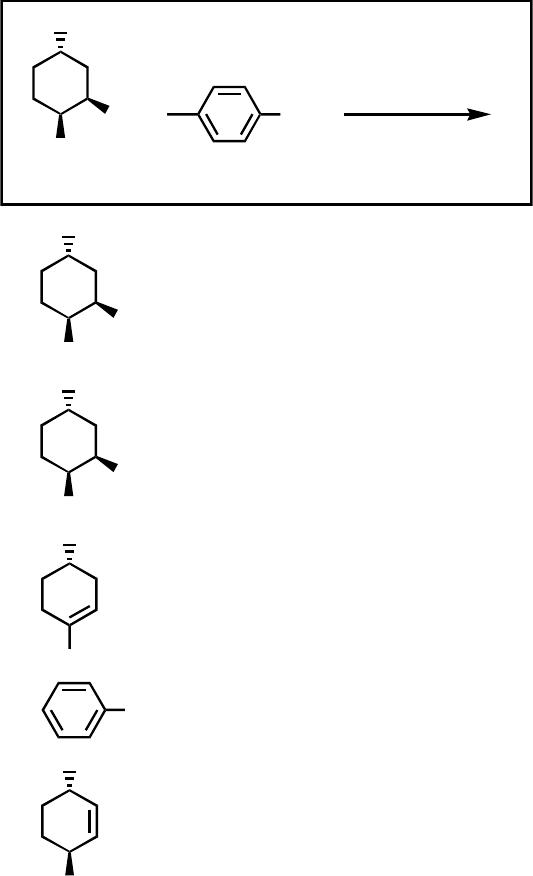
Heating the 4-methylbenzenesulfonate ester of the isomer shown below in
2,2,2-trifluoroethanol (a highly ionizing solvent of low nucleophilicity) leads two
products with the molecular formula C10H18. The major product displays 9 different
signals in its 13C NMR spectrum. Two of them occur at relatively low field, about =
120 and 145 ppm, respectively. The 1H NMR spectrum exhibits a multiplet near = 5
ppm (1 H); all other signals are upfield of = 3 ppm. Identify the compound.
CH3
OSO2
iPr
CH3
CF3CH2OH
heat ?
Note: iPr = isopropyl
A)
CH3
OSO2H
iPr
B)
CH3
OSO2H
iPr
C)
CH3
iPr
D)
CH3
E)
CH3
iPr
Page 11
19.
The molecular formulas and 13C NMR data (in ppm) are given below. The splitting
pattern of each signal, taken from the non-decoupled spectrum is given in parentheses.
Deduce the correct structure:
C4H6O: 18.2 (q), 134.9 (d), 153.7 (d), 193.4 (d)
A)
O
B)
O
C)
H
O
D)
H
O
E)
O
20.
The molecular formulas and 13C NMR data (in ppm) are given below. The splitting
pattern of each signal, taken from the non-decoupled spectrum is given in parentheses.
Deduce the correct structure:
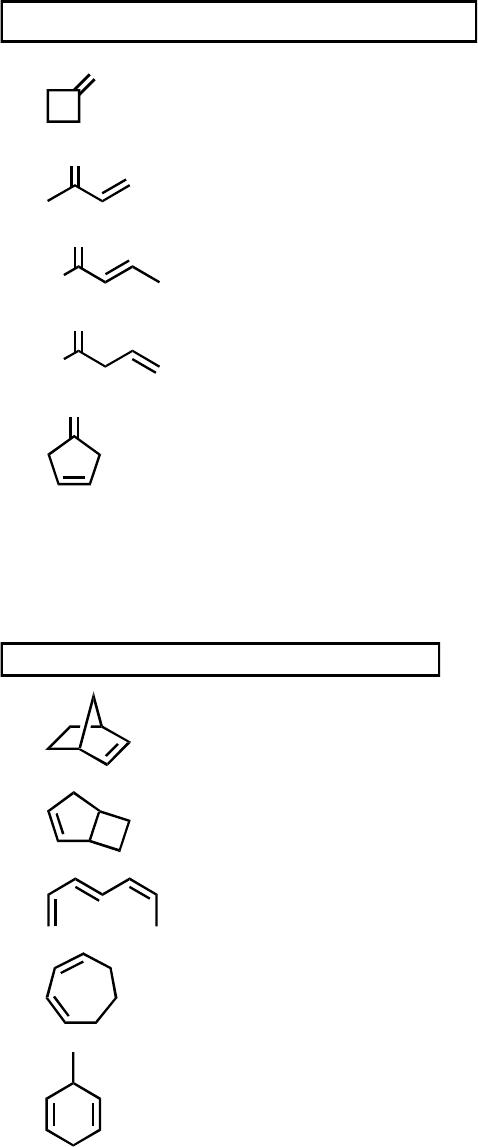
C7H10
: 25.2 (t), 41.9 (d), 48.5 (t), 135.2 (d)
A)
B)
C)
D)
E)
Page 12
21.
The NMR peak intensities for a first-order quartet are:
A)
1:2:2:1
B)
1:3:3:1
C)
1:4:4:1
D)
1:1:1:1
E)
None of the above.
22.
The natural abundance of 13C is
A)
2.1%.
B)
10%.
C)
1.5%.
D)
1.1%.
E)
16%.
Page 13
23.
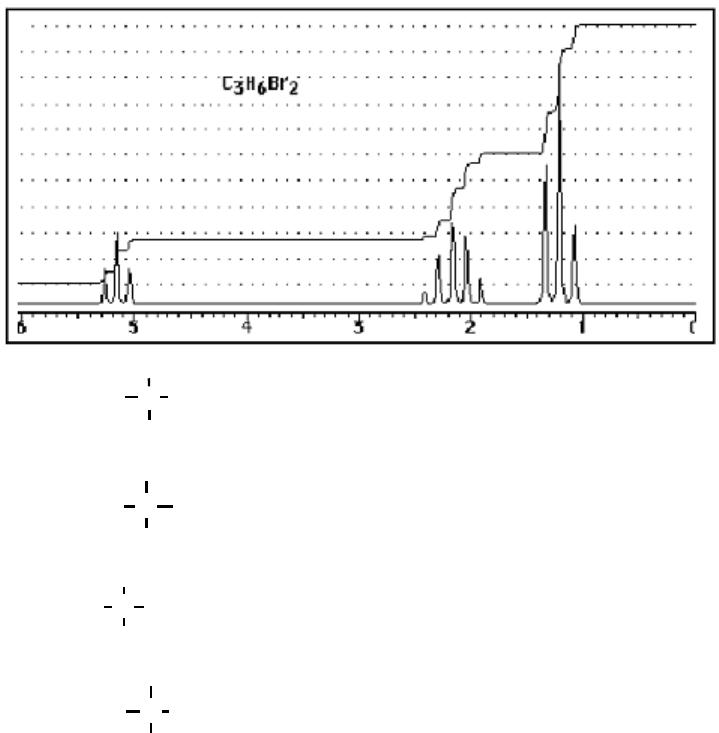
What structure of formula C3H6Br2 would give the following proton NMR spectrum?
A)
BrCH2CCH3
Br
H
B)
Br2CH CCH3
H
H
C)
H3C C CH3
Br
Br
D)
BrCH2CCH2Br
H
H
E)
None of the above.
Page 14
24.
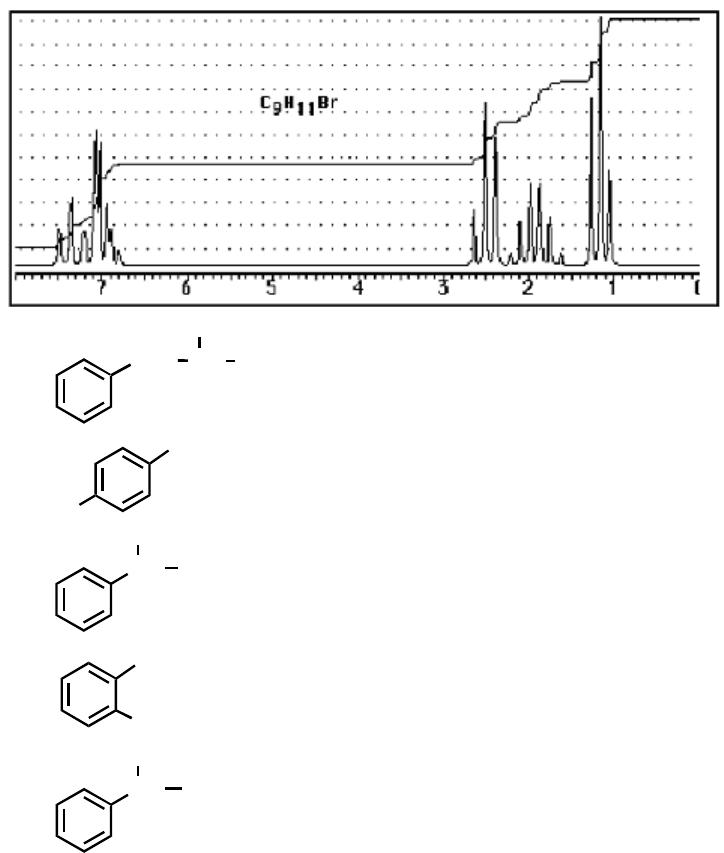
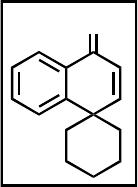
Which compound C9H11Br would give the proton NMR spectrum shown below?
A)
CH2CH CH3
Br
B)
Br
CH2CH2CH3
C)
CH CH2CH3
Br
D)
Br
CH2CH2CH3
E)
CH CH2Br
CH3
Page 15
25.
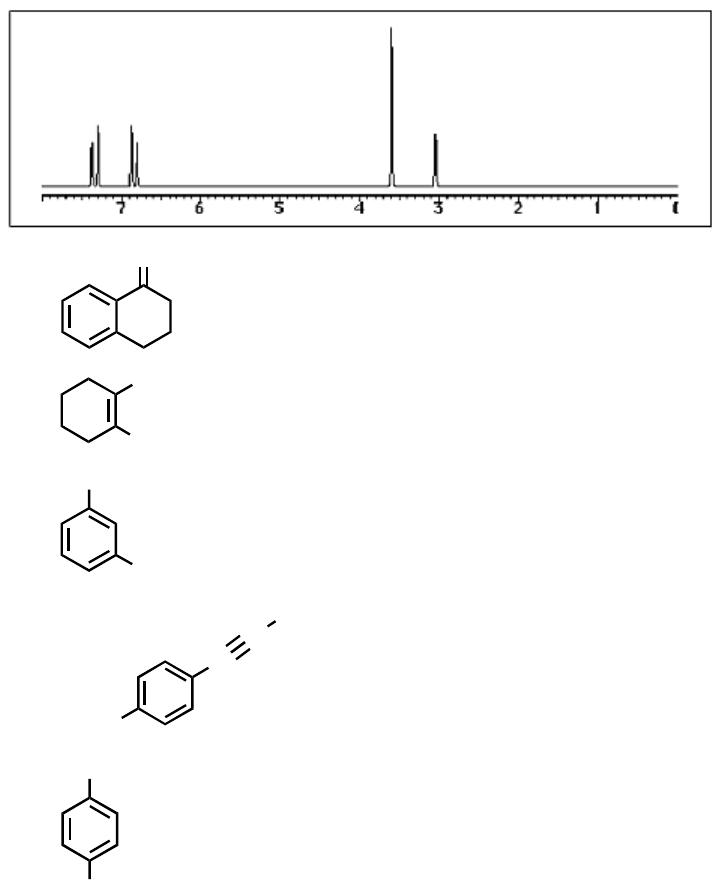
In the proton-coupled 13C-NMR spectrum of the following molecule, how many
doublets would be observed?
O
A)
2
B)
4
C)
6
D)
8
E)
None of the above.
Page 16
26.
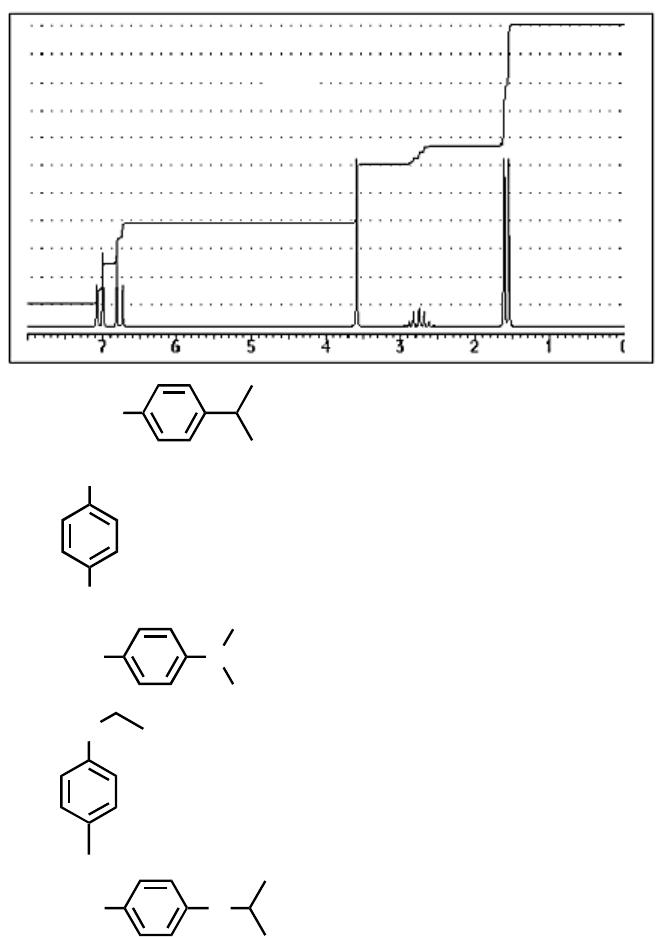
The following 1H-NMR spectrum was most likely obtained from which of the
compounds listed below?
A)
O
B)
H
CH3
C)
OCH3
OCH3
D)
C
H3CO
CH
E)
OCH3
OCH3
Page 17
27.
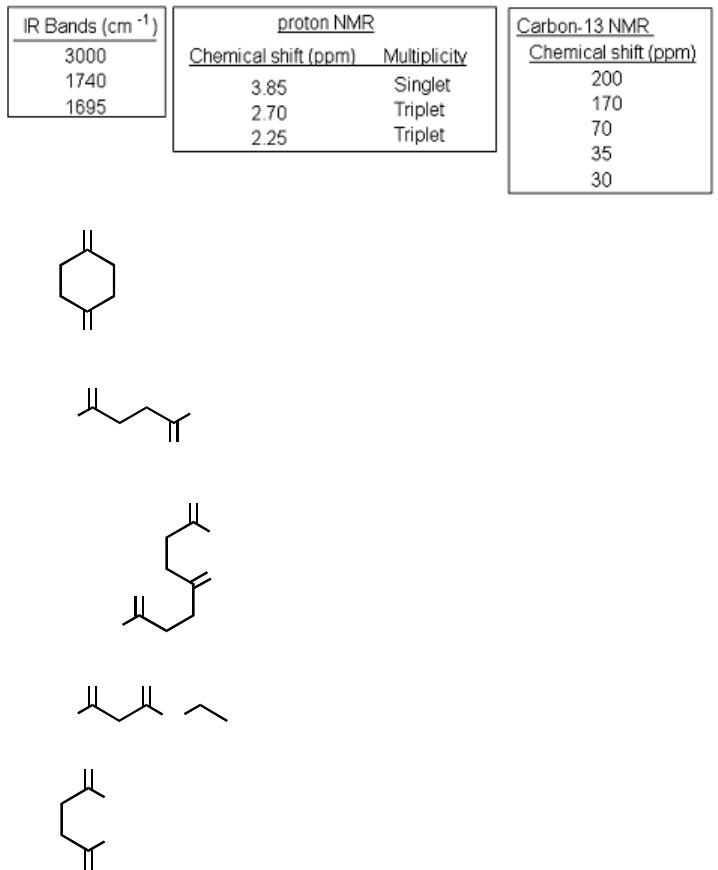
The following 1H-NMR was most likely obtained from which of the compounds listed
below?
A)
H3CO
B)
OH
i-Pr
C)
H3C O
D)
O
E)
H3C O
Page 18
28.
The following spectra data was most likely obtained from which compound?
A)
O
O
B)
H
O
O
OCH3
C)
OCH3
O
O
O
H3CO
D)
H
O
O
O
E)
OCH3
OCH3
O
O
Page 19
29.
Consider the 1H-NMR of the molecule shown below. Assume that JCB = 7 Hz and JCA
= 1 Hz. What coupling pattern will Hc exhibit?
C
CCH3
O
HA
HA
Cl
HB
HB
HC
A)
pentet
B)
quartet
C)
doublet of quartets
D)
triplet of triplets
E)
doublet of triplets
30.
A seven-carbon compound which gives three signals in the 13C NMR spectrum could
be:
A)
heptane
B)
2-methylhexane
C)
3,3-dimethylpentane
D)
2,4-dimethylpentane
E)
2,2,3-trimethylbutane
31.
Carbon-13 NMR is
A)
impossible since 13C has no magnetic moment.
B)
complicated by 13C-13C splitting.
C)
impossible since 13C does not occur in nature.
D)
more difficult than 1H NMR.
E)
None of the above.
Page 20
32.
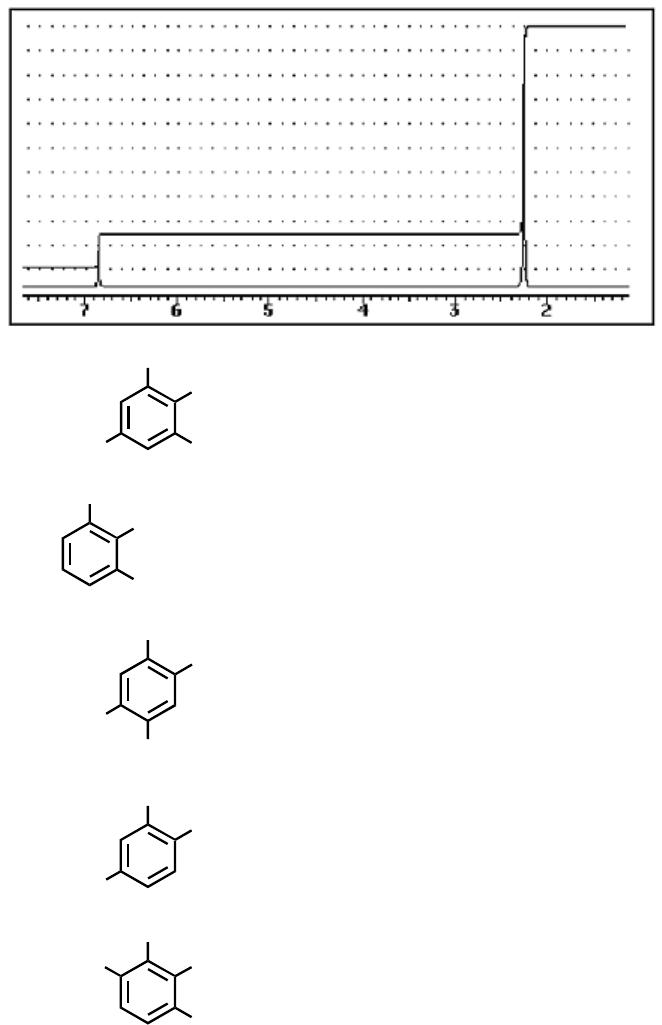
A compound of the formula C10H14 gave the 1H NMR spectrum shown below and
exhibited three peaks in the 13C NMR spectrum. What compound might it be?
A)
CH3CH3
H3CCH3
B)
CH3CH3
CH3
C)
CH3CH3
H3C
CH3
D)
CH3CH3
H3C
E)
CH3CH3
H3C
CH3
Page 21
33.
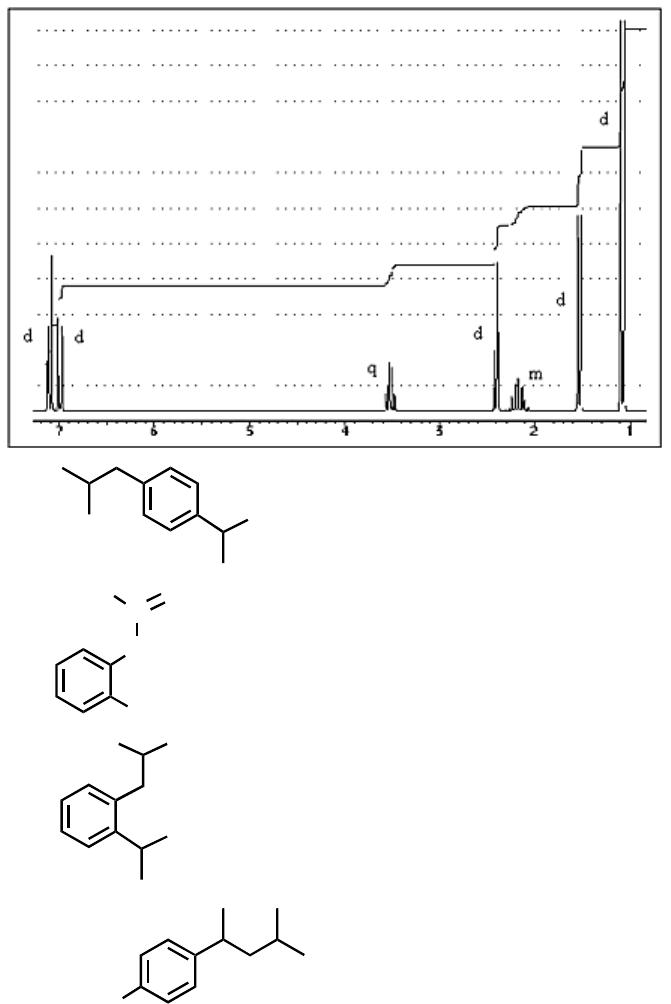
The proton NMR spectrum of a carboxylic acid, C13H18O2, commonly sold as an
over-the-counter headache remedy, is shown below. Note: the CO2H proton is not
shown, and the multiplicity of the peaks are noted (d = doublet, q = quartet, m =
multiplet). Which structure is that of this pharmaceutical?
A)
CO2H
B)
CO2H
O
C
H3CO
C)
CO2H
D)
HO2C
Page 22
E)
CO2H
34.
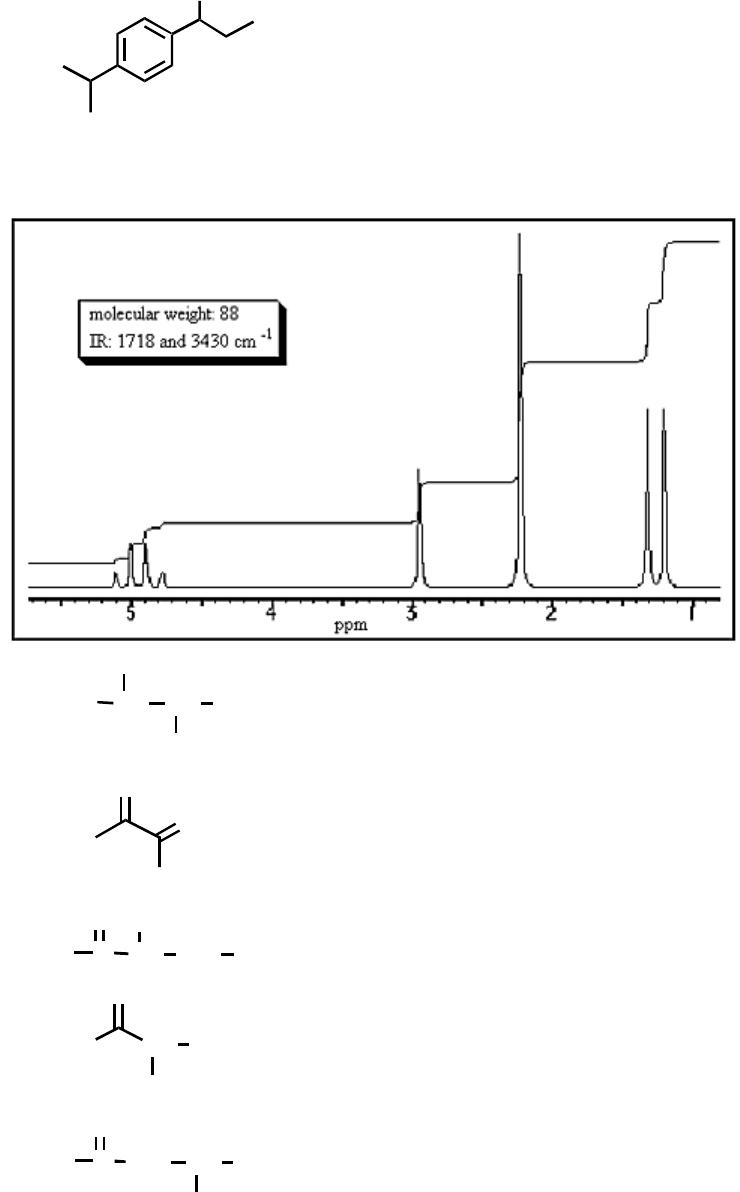
What structure would be consistent with the following NMR spectrum and data?
A)
H3CCH CH OH
OH
CH3
B)
H3CO
O
CH3
C)
CCH CH2
OH
O
CH3
H
D)
H3CCH OH
O
CH3
E)
CCH2CH OH
O
CH3
H
Page 23
35.
How many magnetically different types of hydrogens and carbons are in the following
compound?
O2N
OCH3
NO2
CHO
A)
6 hydrogens, 8 carbons
B)
3 hydrgens, 8 carbons
C)
6 hydrogens, 6 carbons
D)
3 hydrogens, 6 carbons
E)
3 hydrogens, 3 carbons
36.
Typical hydrogen chemical shifts for aromatic protons occur in the range from
A)
•
0.8-2.0.
B)
•
7.0-8.0.
C)
•
0.5-5.0.
D)
•
3.3-4.0.
E)
None of the above.
37.
Which of the following is not true about the information from a proton NMR spectrum?
A)
It identifies the number of different types of hydrogens in a molecule.
B)
It gives the ratios of one type of hydrogen to another.
C)
It gives information about what environment each hydrogen is in.
D)
It tells how many neighboring hydrogens each type of hydrogen has.
E)
None of the above. Proton NMR gives all these types of information.
38.
Which of the following nuclei are incapable of magnetic resonance?
A)
Hydrogen (1H)
B)
Carbon (13C)
C)
Fluorine (19F)
D)
Phosphorus (31P)
E)
All are NMR active.
Page 24
39.
A chemist is evaluating a proton NMR spectrum taken on a 300 MHz NMR
spectrometer. She wishes to determine the chemical shift in ppm of a singlet that
appears at 1140 Hz from TMS. What is the chemical shift in ppm?
A)
0.26 ppm
B)
3.8 ppm
C)
7.6 ppm
D)
300 ppm
E)
None of the above.
40.
For the compound below give the spin-spin splitting that would be observed for each of
the protons sets in the 1H NMR spectrum.
A)
Ha = triplet Hb = doublet, Hc = quartet
B)
Ha = singlet Hb = quartet, Hc = triplet
C)
Ha = singlet Hb = pentet, Hc = quartet
D)
Ha = triplet Hb = quartet, Hc = singlet
E)
None of the above.
41.
For the compound below give the integration ratio that would be observed for each of
the protons sets in the 1H NMR spectrum.
A)
Ha = 3, Hb = 2, Hc = 1
B)
Ha = 1 Hb = 2, Hc = 1
C)
Ha = 3 Hb = 2, Hc = 3
D)
Ha = 1 Hb = 1, Hc = 1
E)
None of the above.
Page 25
42.
How many signals will be present in a decoupled 13C NMR spectrum for the molecule
below?
A)
7
B)
8
C)
9
D)
10
E)
None of the above.
43.
Indicate how 1H NMR spectroscopy can be used to distinguish between the following
sets of structures.
Br Cl
A)
The spin-spin splitting for the protons on the carbon next to the halogen will be
different.
B)
The chemical shift of the resonance for the protons on the carbon attached to the
chlorine atom will be shifted downfield relative to the protons on the carbon
attached to the bromine atom.
C)
The chemical shift of the resonance for the protons on the carbon attached to the
chlorine atom will be shifted upfield relative to the protons on the carbon attached
to the bromine atom.
D)
The integration of the protons on the carbon next to the halogen will be different.
E)
None of the above.
44.
Describe the splitting that would be observed by Ha in the proton NMR spectrum,
assuming Ha is coupled to all its neighboring protons in an equivalent manner.
CH2CH3
Ha
H3C CH2CH2CH3
A)
Ha will be split into a pentet.
B)
Ha will be split into a sextet.
C)
Ha will be split into a septet.
D)
Ha will be split into an octet.
E)
None of the above.

Page 26
45.
Arrange each of the following labeled hydrogens in the order of increasing chemical
shift.
CH3SCH2
Ha
CH3OCH2
Hc
CH3
Hb
CH3COOCH2
Hd
A)
Ha < Hb < Hc < Hd
B)
Hb < Hc < Ha < Hd
C)
Hd < Hc < Ha < Hb
D)
Hb < Ha < Hc < Hd
E)
Hb < Ha < Hd < Hc
Page 27
Answer Key

Page 28