General Chemistry, 11e (Petrucci)
Chapter 1 Matter: Its Properties and Measurement
1) A theory is a model used to explain natural laws and make predictions about natural phenomena.
2) The scientific method is used to make theories that can no longer be changed.
3) The composition refers to the components of a sample of matter and their relative proportions.
4) A physical property is the ability of a sample of matter to undergo a change in composition under
certain conditions.
5) On a very cold day in Alaska, the temperature was -40 °F. The temperature in Celsius on the same day
was also -40 °C.
6) A homogeneous mixture has regions that are different in composition or phase.
7) The SI unit of mass is 1 gram.
8) An intensive property is dependent of the amount of matter observed.
9) Several values close together guarantee good accuracy.
10) Systematic errors are consequence of inherent errors in measuring devices.
11) The result of addition can have more significant figures than any of the numbers added.
12) Which statement is INCORRECT?
A) Natural laws are concise statements about natural phenomena.
B) Induction is to infer a set of naturals laws from a set of observations.
C) The key to the scientific method is valid assumptions.
D) A hypothesis is a tentative explanation of a natural law.
E) A pattern of thinking is known as a paradigm.
13) A model that explains and makes predictions about natural phenomena is referred to as a:
A) natural law
B) hypothesis
C) theory
D) generalization
E) deduction
14) The scientific method involves:
I) observations
II) generalizations
III) experiments
IV) deduction
V) induction
A) I, III, IV
B) I, II, III
C) I, II, III, IV
D) I, II, III, V
E) I, III, V
15) Choose the INCORRECT statement.
A) A natural law is a generalization of natural phenomena.
B) A hypothesis is a conclusion that must follow logically from observations of nature.
C) A theory is a model of nature that can be used to describe natural phenomena.
D) An experiment is a test of conclusions about natural law.
E) The scientific method is the combination of observations, experimentation, and the formulation of
laws, hypothesis, and theories.
16) Which of the following is a physical property?
A) the density of lead
B) sulfur burns in oxygen to form sulfur trioxide
C) ozone reacts with silver to give silver oxide
D) platinum metal does not react with hydrochloric acid
17) A physical property is:
A) the ability of a sample to undergo change
B) a substance comprised of a single type of atom
C) a property the sample displays without changing its composition
D) always visible
E) a property the sample displays that results in a change in composition
18) A chemical change always involves a change in:
I) appearance
II) state
III) composition
IV) temperature
A) I and II
B) I, II, IV
C) III only
D) II and IV
E) all of the above
19) Which of the following is a chemical property of gold?
A) does not react with hydrochloric acid
B) is a good conductor of electricity
C) is malleable
D) is a good conductor of heat
20) Which of the following is a physical change?
A) the freezing of water to form ice
B) the burning of paper
C) the sodium metal reacts vigorously with water
D) the reaction of zinc with hydrochloric acid
E) the inability of gold to react with water
21) Oxygen is:
A) a mixture
B) a compound
C) an element
D) a solution
E) always combined with hydrogen
22) Sulfur dioxide gas is:
A) a homogeneous mixture
B) a compound
C) an element
D) a heterogeneous mixture
E) a solid at room temperature
23) Sulfuric acid is:
A) a homogeneous mixture
B) a compound
C) an element
D) a heterogeneous mixture
E) an atom
24) The term substance should be used for:
A) chemical elements
B) compounds
C) both chemical elements and compounds
D) chemical elements, compounds, and mixtures
E) any mixture
25) Choose the INCORRECT statement.
A) Matter is made of tiny units called atoms.
B) An element is a substance made of one type of atom.
C) A compound contains regions that are unlike other regions of the compound.
D) Homogeneous mixtures are solutions.
E) Elements and compounds are substances.
26) Which of the following are forms of matter?
I) hydrogen gas
II) sunlight
III) ice
IV) wind
V) iron
A) III and V
B) I, III and V
C) I and V
D) II and IV
E) all of the above
27) Which one of the following would be classified as a heterogeneous mixture?
A) salt water
B) copper nitrate solution
C) brass
D) mix of table salt and black pepper
E) a sugar solution
28) Which of the following is a chemical change?
A) the freezing of water to form ice
B) hammering zinc into a thin film
C) crushing of lump of sulfur into yellow powder
D) the boiling of water to form steam
E) the reaction of chlorine gas and sodium to form salt
29) From ammonia gas, one can obtain two different gases, each of which is a pure substance. Using only
this information, it can be said with certainty that:
A) one of the products is an element
B) neither of the products can be an element
C) ammonia cannot be an element
D) both products are elements
E) gases do not produce solids
30) Which of the following is a compound?
A) water
B) oxygen
C) heat
D) salad dressing
E) nitrogen
31) The content of a container filled with sand and water would best be described as:
A) elements
B) a homogeneous mixture
C) a heterogeneous mixture
D) a compound
E) a solution
32) Water is:
A) a mixture
B) a compound
C) an element
D) a molecule
E) an atom
33) Saltwater is:
A) a mixture
B) only one compound
C) an element
D) a molecule
E) an atom
34) The SI unit for mass is:
A) kilogram
B) gram
C) pound
D) ounce
E) newton
35) Which of the following represents a base unit in the SI system of measurements?
A) m2
B) kg
C) g/cm3
D) m/s
E) liter
36) The quantity of matter in an object is the object’s ________ and is measured on a ________.
A) weight, scale
B) mass, scale
C) weight, balance
D) mass, balance
E) Any of the above since the terms are interchangeable.
37) One inch is equal to:
A) 2.54 cm
B) 2.54 m
C) 1/(2.54) cm
D) 1.09 m
E) 100 cm
38) The prefix “milli” and the prefix “micro” correspond, respectively, to the factors:
A) 10-3 and 10-6
B) 10-6 and 10-9
C) 10-3 and 10–12
D) 10-1 and 10-6
E) 103 and 106
39) Which of the following is longest?
A) 3.0 nm
B) 300 pm
C) 3.0 × 10⁻⁴ m
D) 3.0 × 10⁻¹⁰ cm
E) 3.00 × 10⁻⁹ km
40) If gasoline costs 98.5 cents per liter in Canada, what is the price in dollars per gallon?
A) $3.73
B) $3.94
C) $1.04
D) $4.16
41) In Europe, the volume of soda is given in cL. How many mL are contained in a can of soda labeled “75 cL”?
A) 750 mL
B) 75 mL
C) 7.5 mL
D) 7500 mL
E) 0.75 mL
42) Which of the following is the proper set of conversion factors for changing lb/in2 to pascals? (Hint: A
pascal is a unit of force equal to 1 N/m2.)
A) (1 lb/4.45 N)(1 m2/1550 in2)
B) (4.45 N/1 lb)(1 m2/1550 in2)
C) (1 lb/4.45 N)(1550 in2/1 m2)
D) (4.45 N/1 lb)(1550 in2/1 m2)
E) (1 lb/4.45 N)
43) Without doing a calculation, find which of the following represents the highest temperature.
A) 20 °F
B) 0 °C
C) 0 K
D) 270 K
E) 0 °F
44) Convert 82 °F to the Kelvin scale.
A) 452 K
B) 245 K
C) 195 K
D) 301 K
E) 373 K
45) One centimeter is equal to:
A) 1.09 yards
B) 0.30 ft
C) 2.54 inches
D) 0.0109 yards
E) 0.109 yards
46) If the density of aviation fuel is 1.77 lb/L, how many liters must be added to a tank to give 16,131 kg?
A) 2.01 × 10⁴ L
B) 9.11 × 10³ L
C) 1.30 × 10³ L
D) 1.61 × 10⁴ L
E) 1.30 × 10⁴ L
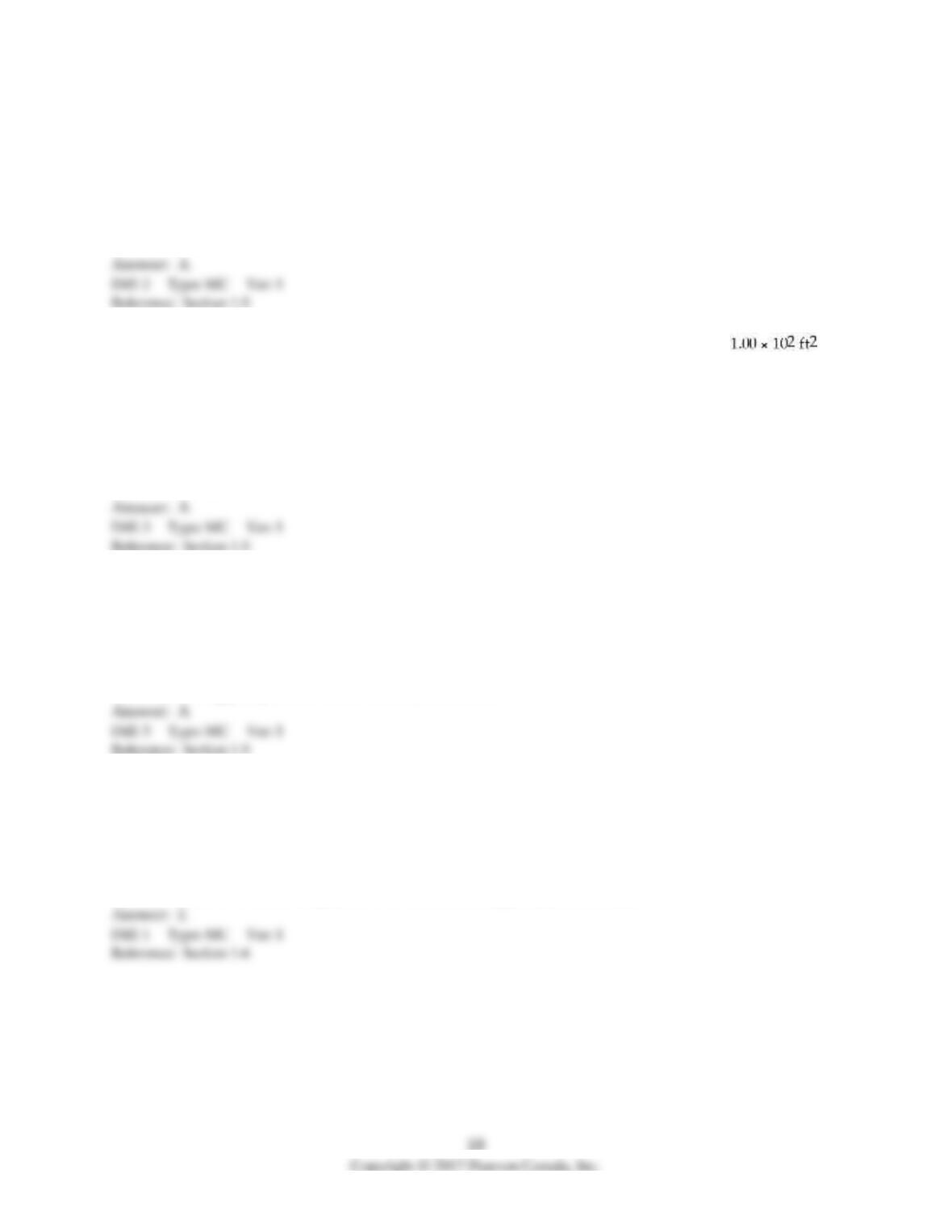
47) 1.00 oz of gold (density = 19.3 g/mL) can be hammered into a sheet that would cover a
area. How thick would such a sheet be in centimeters? (1 oz= 28.350 g)
A) 1.58 × 10⁻⁵ cm
B) 4.82 × 10⁻⁴ cm
C) 4.02 × 10⁻⁵ cm
D) 6.33 × 104 cm
E) 2.11 × 10⁻⁵ cm
48) An extensive property is:
A) dependent on the quantity of matter observed
B) difficult to measure
C) independent of the quantity of matter observed
D) is a unique value regardless of the measurement conditions
E) always strongly dependent on the external conditions
49) Which of the following defines or expresses the concept of accuracy?
A) the closest value to the expected answer
B) deviation of the average
C) average of the data
D) reproducibility of a measurement
E) difference between the accepted answer and the average value of the data
50) The following measurements were made by a group of students using the same balance and a 25.00
gram weight.
Trial Mass (g)
1 23.96
2 24.01
3 23.98
4 23.97
The data would be considered:
I) accurate and precise
II) accurate but not precise
III) precise but not accurate
IV) neither precise nor accurate
V) evidence of a systematic error
VI) evidence of large random errors
A) I only
B) II and VI
C) III and V
D) IV and VI
E) IV, V, VI
51) The definition of pH is pH = -log[H3O+], where [H3O+] is the hydronium ion concentration.
If [H3O+] = 1.2 × 10⁻⁵, the pH, expressed to the correct number of significant figures, is:
A) 4.92
B) 4.9
C) 5.08
D) 5.1
52) How many significant figures should the answer to the following calculation have?
(1.4312 – 1.1 × 10⁻²) ÷ (1.0712 × 10⁻⁴)
A) 4
B) 5
C) 2
D) 3
53) One centimeter is equal to how many meters?
A) 100 m
B) 1000 m
C) 10 m
D) 0.10 m
E) 0.01 m
54) During a winter blizzard the temperature was -20 °F. What temperature is this on the Celsius scale?
A) -29 °C
B) -94 °C
C) -6.2 °C
D) -22 °C
E) -20 °C
55) Convert 1400 mm to inches.
A) 5500 in
B) 550 in
C) 36 in
D) 360 in
E) 55 in
56) A sprinter runs exactly 200 meters in 19.98 seconds. What is his/her average speed in miles per hour?
A) 22.39 miles/h
B) 22.4 miles/h
C) 10.01 miles/h
D) 0.373 miles/h
E) 10.0 miles/h
57) It takes light one second to travel 2.998 × 10⁸ m. How many kilometers does light travel in a day?
A) 1.086 × 10⁹ km
B) 2.590 × 10¹⁰ km
C) 7.195 × 10⁹ km
D) 4.317 × 10⁸ km
E) 1.086 × 10⁸ km
58) A track star ran exactly 400 meters in 45.23 seconds. What was the average speed in miles per hour?
A) 19.8 miles/h
B) 19.78 miles/h
C) 8.844 miles/h
D) 0.3297 miles/h
E) 8.84 miles/h
59) What is 21.1 miles/hour in furlongs/fortnight? (8 furlongs = 1 mile; 14 days = 1 fortnight)
A) 0.502 furlongs/fortnight
B) 8.862 × 10³ furlongs/fortnight
C) 5.67 × 10⁴ furlongs/fortnight
D) 8.86 × 10³ furlongs/fortnight
E) 5.672 × 10⁴ furlongs/fortnight
60) At what temperature will the numerical values of the Celsius and Fahrenheit scales be the same?
A) 0 °
B) -40 °
C) 40 °
D) -273 °
E) 80 °
61) Convert -41.0 °F to degrees Celsius.
A) -40.6 °C
B) -57.6 °C
C) -73.0 °C
D) -9.0 °C
E) -117 °C
62) A field is 100.0 yd long and 50.0 yd wide. If covered with water to a uniform depth of 2.00 in, what
volume of water is present in U.S. gallons?
A) 8.70 × 10³ gal
B) 5.61 × 10⁴ gal
C) 5.31 × 10⁴ gal
D) 2.42 × 10² gal
E) 1.56 × 10³ gal
63) The temperature in the core of the warp drive of the starship Enterprise is supposedly 3 million (3.00 ×
106) degrees Celsius. What is this in degrees Fahrenheit?
A) 5.40 × 10⁶ °F
B) 2.99 × 10⁶ °F
C) 1.67 × 10⁶ °F
D) 3.27 × 10⁶ °F
E) 8.13 × 10⁶ °F
64) A weatherman incorrectly stated that the temperature was 85 °F, 35 °C. If the Fahrenheit temperature
was correct, how far off was the Celsius temperature?
A) 8 °C
B) 6 °C
C) 29 °C
D) 31 °C
E) 3 °C
65) Determine the number of cm2 in one in2.
A) 64.5 cm2
B) 6.45 cm2
C) 100 cm2
D) 8.95 cm2
E) 39.7 cm2
66) Determine the number of cm3 in 21.0 U.S. qt.
A) 19,900
B) 5.548
C) 20.0
D) 0.0199
E) 10.0
67) Convert 35 ft/s to SI derived units.
A) 4.2 m/s
B) 1100 m/s
C) 1.65 m/s
D) 0.074 m/s
E) 11 m/s
68) An elephant’s bathtub is 8.0 feet long, 2.5 yards wide, and 70 inches deep. What is the capacity of the
elephant’s bathtub in U.S. quarts?
A) 9.3 × 10³ qt
B) 1.1 × 10⁴ qt
C) 3.4 × 10⁴ qt
D) 34 qt
E) 2.2 × 10⁴ qt
69) At what temperature does the Fahrenheit reading equal twice the Celsius temperature?
A) 160 °C, 320 °F
B) 12 °C, 24 °F
C) -12 °C, -24 °F
D) -288 °C, -576 °F
E) 40 °C, 80 °F
70) Convert 21.8 in3 to liters. (2.54 cm = 1.00 in)
A) 0.0554 L
B) 1.33 × 10³ L
C) 8.58 L
D) 0.357 L
E) 8.58 × 10³ L
71) Ethylene glycol has a density of 1.11 g/mL. What is the volume occupied by 30.0 g of ethylene glycol?
A) 33.3 mL
B) 27.0 mL
C) 31.1 mL
D) 0.037 mL
E) 30.0 mL
72) What is the mass of a 468 mL sample of ethanol? The density of ethanol is 0.789 g/mL.
A) 234 g
B) 739 g
C) 468 g
D) 593 g
E) 369 g
73) Two hundred mL of solution has a mass of 198 g. What is the density of the solution?
A) 1.01 g/mL
B) 3.98 g/mL
C) 99.0 g/mL
D) 0.990 g/mL
E) 1.98 g/mL