20) Which of the following statements about the quantum-mechanical model is FALSE?
A) Orbitals are a probability map of finding electrons.
B) Electrons do not behave as particles.
C) Orbitals are specific paths electrons follow.
D) Electron paths cannot be described exactly.
E) All of the above are correct statements.
21) The principal quantum number (n):
A) specifies the 3-D shape of the orbital.
B) specifies the subshell of the orbital.
C) specifies the maximum number of electrons.
D) specifies the principal shell of the orbital.
E) none of the above
22) The subshell letter:
A) specifies the 3-D shape of the orbital.
B) specifies the principal quantum number of the orbital.
C) specifies the maximum number of electrons.
D) specifies the principal shell of the orbital.
E) none of the above
23) How many subshells are there in the n = 4 principal shell?
A) 1
B) 2
C) 3
D) 4
E) not enough information
24) How many subshells are there in the n = 2 principal shell?
A) 1
B) 2
C) 3
D) 4
E) not enough information
25) The n = ________ principal shell is the lowest that may contain a d-subshell.
A) 1
B) 2
C) 3
D) 4
E) not enough information
26) Which subshell letter corresponds to a spherical orbital?
A) s
B) p
C) d
D) f
E) not enough information
27) Which subshell letter corresponds to a 4-leaf clover orbital pattern?
A) s
B) p
C) d
D) f
E) not enough information
28) Which statement is NOT true about “p” orbitals?
A) A subshell contains three “p” orbitals.
B) These orbitals are shaped like dumbbells.
C) A 3p orbital has a higher energy than a 2p orbital.
D) All three of these statements are true.
E) none of the above
29) The “d” subshell can hold a maximum of ________ electrons.
A) 2
B) 5
C) 6
D) 10
E) none of the above
30) How many electrons can exist in an orbital?
A) 1
B) 2
C) 3
D) 4
E) none of the above
31) The lowest energy orbital in the quantum-mechanical model is the:
A) zero orbital.
B) 1a orbital.
C) 1p orbital.
D) 1s orbital.
E) none of the above

32) “When filling orbitals of equal energy, electrons fill them singly first with parallel spins.”
This is known as:
A) Hund’s rule.
B) Pauli exclusion principle.
C) Bohr’s model.
D) Ground state.
E) none of the above
33) The subshell that has three orbitals and can hold up to six electrons is the:
A) s subshell
B) p subshell
C) d subshell
D) f subshell
E) none of the above
34) The subshell that has five orbitals and can hold up to ten electrons is the:
A) d subshell
B) f subshell
C) s subshell
D) p subshell
E) none of the above
35) Which orbital would the electron of a ground state hydrogen atom occupy?
A) 1s
B) 2p
C) 0s
D) 1p
E) none of the above

36) How many electrons are unpaired in the orbitals of carbon?
A) 12
B) 6
C) 4
D) 2
E) none of the above
37) How many electrons are unpaired in the orbitals of nitrogen?
A) 14
B) 5
C) 9
D) 3
E) none of the above
38) An accepted abbreviation format is to write an electron configuration that includes a noble
gas symbol in brackets. If you were writing an electron configuration for a bromine atom, which
elemental symbol would you place in the bracket?
A) He
B) Ne
C) Ar
D) Kr
E) Xe
39) Which element is represented by the electron configuration 1s22s22p2?
A) C
B) He
C) Be
D) O
E) none of the above
40) What is the electron configuration for Kr?
A) 1s22s22p63s23p43d104s24p6
B) 1s22s22p63s23p64s23d24p6
C) 1s22s22p63s23p64s23d104p6
D) 1s22s22p63s23p24s23d104p6
E) none of the above
41) What is the electron configuration for Ga?
A) 1s22s22p63s23p63d104s24p6
B) 1s22s22p63s23p64s23d104p1
C) 1s22s22p63s23p53d104s24p1
D) 1s22s22p63s23p64s24d104p1
E) none of the above
42) What is the electron configuration for P?
A) [Ar]3s23p64s23d104p3
B) [Ne]1s21p62s22p3
C) [Ne]3s23p3
D) [Ar]3s23p3
E) none of the above
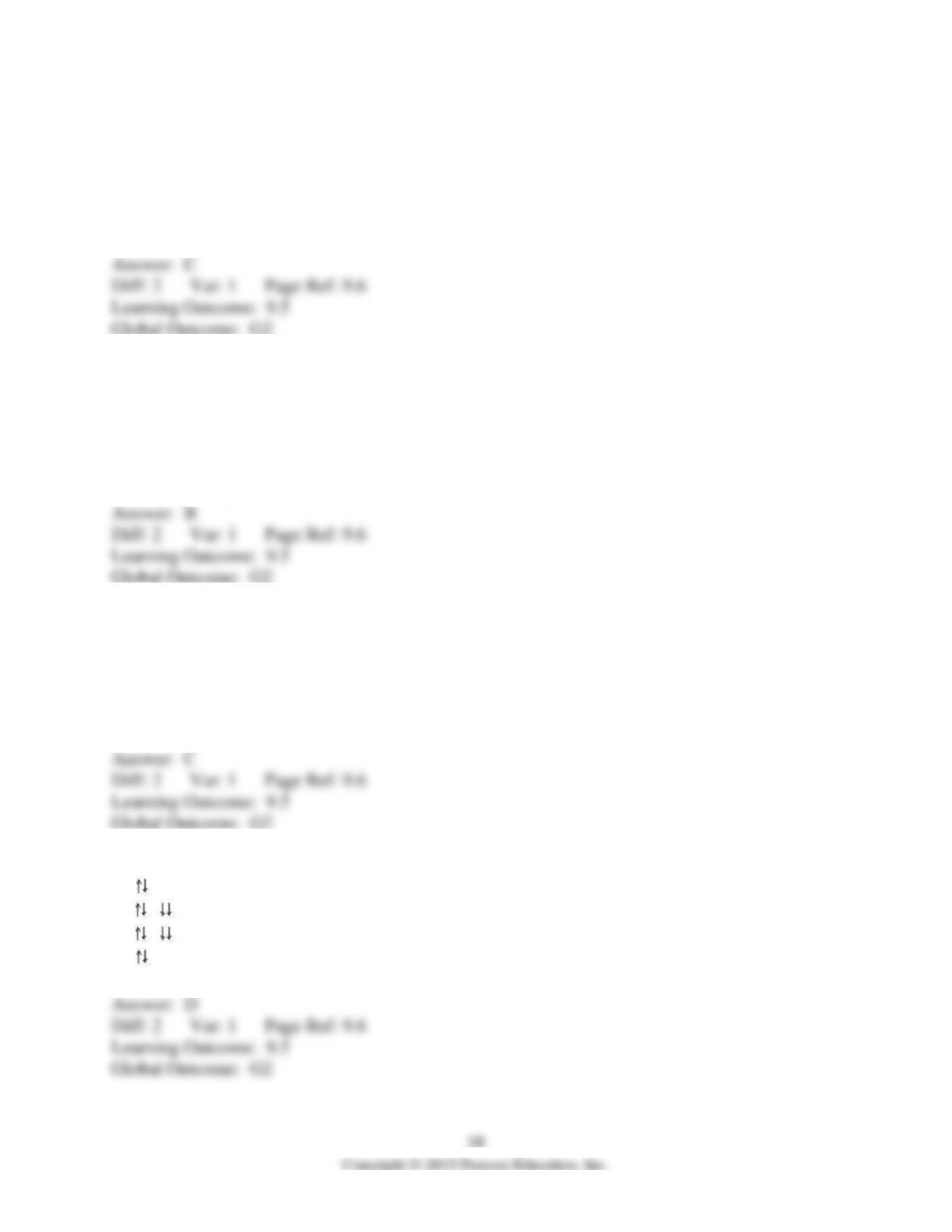
43) Which one of the following is the correct orbital diagram for nitrogen?
A) ↑↓ ↓ ↓ ↑
B) ↓ ↑ ↑
C) ↑ ↑ ↑
D) ↑↓ ↑ ↑ ↑
E) none of the above
44) The element with a completely filled p-subshell is:
A) Na.
B) Al.
C) P.
D) Ar.
E) none of the above
45) What is the element in which at least one electron is in the d-orbital?
A) Ar
B) K
C) Ca
D) Sc
E) none of the above
46) How many core electrons are in a chlorine atom?
A) 1
B) 17
C) 10
D) 7
E) none of the above
47) How many valence electrons are in a chlorine atom?
A) 1
B) 17
C) 10
D) 7
E) none of the above
48) What do the alkali metals all have in common?
A) They all undergo similar reactions.
B) They all have similar physical properties.
C) They all form +1 ions.
D) They all have the same number of valence electrons.
E) all of the above
49) Which of the following elements has the electron configuration of 3s23p4 in its outermost
shell?
A) Al
B) Si
C) S
D) Cl
E) none of the above
50) Chlorine and bromine have very similar chemical properties. This is best explained by the
fact that both elements:
A) are gases.
B) are in period 3 of the Periodic Table.
C) have the same number of valence electrons.
D) have equal number of protons and electrons.
E) none of the above
51) Consider the electron configuration of the ion to determine which ion shown below has an
incorrect ionic charge?
A) Al3-
B) Se2-
C) Rb+
D) Ba2+
E) none of the above

52) Which one of the following species has the electron configuration of 1s22s22p6?
1. Na+
2. O2-
3. F–
A) 1 and 2 only
B) 1 and 3 only
C) 2 and 3 only
D) All of 1, 2, and 3
E) Neither 1, 2, or 3
53) If the electron configuration of a ground state potassium atom is 1s22s22p63s1, the electron
configuration of the potassium cation (K+) would be:
A) 1s22s22p63s2
B) 1s22s22p6
C) 1s22s22p63s1
D) 1s12s22p63s1
E) none of the above
54) Choose the answer that best completes the following statement: When an aluminum atom
reacts so as to attain a noble gas electron configuration,
A) the atom gains five electrons.
B) the result is a configuration of 1s22s22p6.
C) a 3- ion forms.
D) the noble gas configuration of argon is achieved.
E) none of the above
55) The size of an atom generally increases:
A) down a group and from right to left across a period.
B) up a group and from left to right across a period.
C) down a group and from left to right across a period.
D) up a group and from right to left across a period.
E) up a group and diagonally across the Periodic Table.
56) Which of the following elements has the lowest ionization energy?
A) Rb
B) Na
C) C
D) F
E) He
57) Which of the following elements has the highest ionization energy?
A) Ba
B) Ca
C) Al
D) Cl
E) Ne
58) Which of the following atoms is the largest?
A) Li
B) Na
C) K
D) Rb
E) Cs
59) Which of the following atoms is the smallest?
A) Li
B) Be
C) B
D) O
E) Ne
60) Which of the following atoms has the least metallic character?
A) Li
B) Na
C) K
D) Rb
E) Cs
61) Which of the following atoms has the greatest metallic character?
A) Cs
B) Be
C) Cu
D) Ti
E) Au

9.3 Algorithmic Questions
1) Which color of visible light has a wavelength in between that of blue and violet light?
A) green
B) yellow
C) red
D) indigo
E) none of the above
2) Which one of the following types of electromagnetic radiation has a higher energy per photon
than visible radiation?
A) microwave
B) ultraviolet
C) radio
D) infrared
E) none of the above
3) How many core electrons are in a ground state atom of arsenic?
A) 15
B) 33
C) 28
D) 5
E) none of the above
4) Which of the atoms represented below is the largest in size?
A) N
B) As
C) Sb
D) Bi
E) P