
Chapter 9: Models of Chemical Bonding
1. Which of the following contains ionic bonding?
A) CO B) SrF2 C) Al D) OCl2 E) HCl
2. Which of the following is an ionic compound?
A) H2S B) NH3 C) I2 D) KI E) CCl4
3. Which of the following is a covalent compound?
A) Na2O B) CaCl2 C) Cl2O D) CsCl E) Al2O3
4. Which of the following contains covalent bonds?
A) BaO B) IBr C) Mg D) LiBr E) Cu
5. In which of these substances are the atoms held together by polar covalent bonding?
A) SrCl2 B) CsCl C) ClF D) TiF2 E) S8
6. In which of these substances are the atoms held together by metallic bonding?
A) CO2 B) Si C) Br2 D) S8 E) Cr
7. For which of the following elements (in their normal, stable, forms) would it be correct
to describe the bonding as involving “electron pooling”?
A) hydrogen B) helium C) sulfur D) iodine E) aluminum
8. Select the element whose Lewis symbol is correct.
A)
Fr
B)
Ra
C)
Pb
D)
Te
E)
He
9. Select the element whose Lewis symbol is correct.
A)
Ga
B)
Al
C)
Br
D)
Tl
E)
Al

Chapter 9: Models of Chemical Bonding
10. Select the correct formula for a compound formed from calcium and chlorine.
A) CaCl B) CaCl2 C) Ca2Cl D) Ca2Cl2 E) CaCl3
11. Select the correct formula for a compound formed from barium and nitrogen.
A) BaN B) BaN2 C) Ba2N3 D) Ba2N E) Ba3N2
12. The diameter of a chloride ion is 362 pm, and the diameter of a potassium ion is 276 pm.
What is the distance between the nuclei of adjacent chloride and potassium ions in solid
potassium chloride?
A) 1276 pm B) 638 pm C) 319 pm D) 181 pm E) 138 pm
13. The lattice energy for ionic crystals increases as the charge on the ions _____________
and the size of the ions __________________.
A) increases, increases
B) increases, decreases
C) decreases, increases
D) decreases, decreases
E) None of the above is generally correct.
14. Select the compound with the highest (i.e., most negative) lattice energy.
A) CaS(s) B) BaO(s) C) NaI(s) D) LiBr(s) E) MgO(s)
15. Select the compound with the lowest (i.e., least negative) lattice energy.
A) CsBr(s) B) NaCl(s) C) SrO(s) D) CaO(s) E) KBr(s)
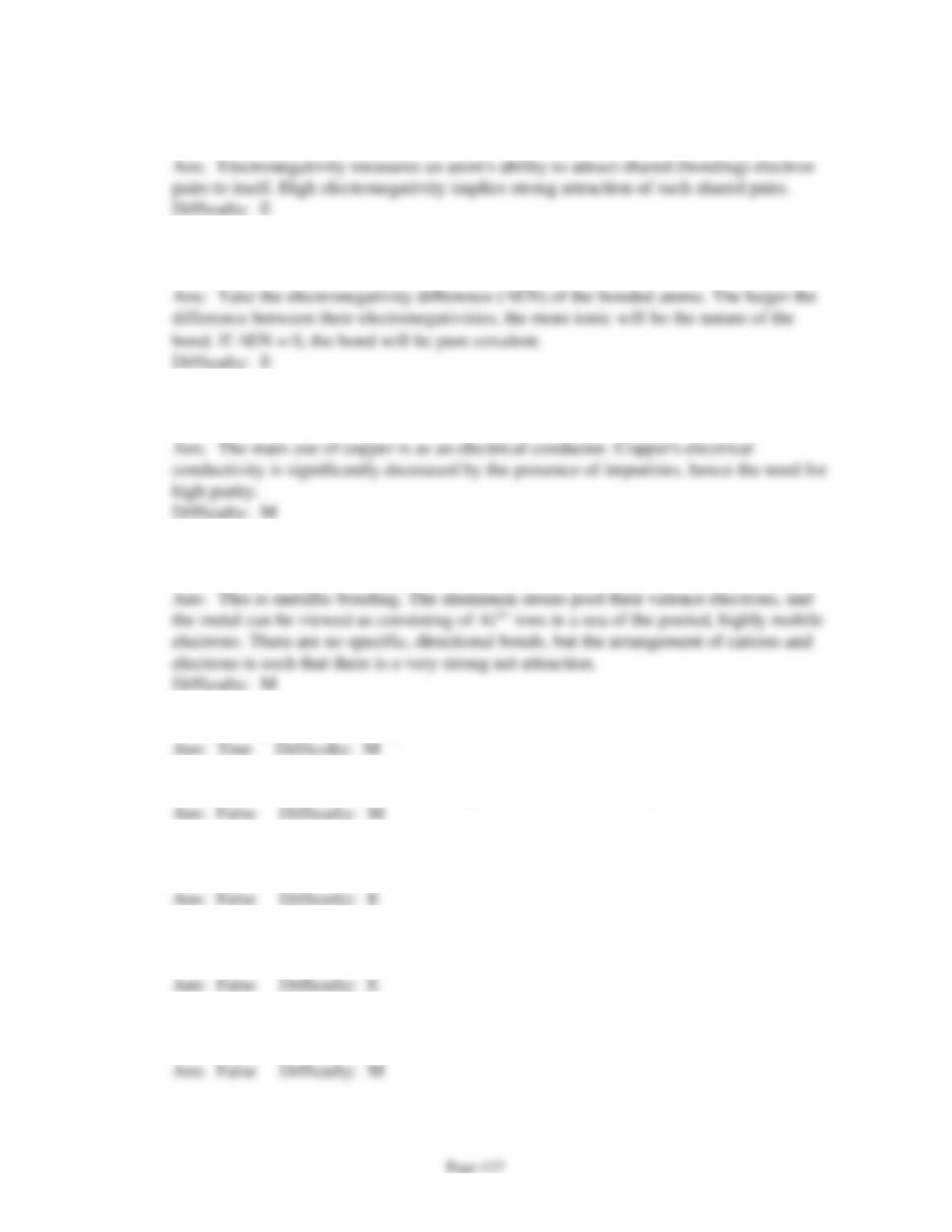
16. Calculate the lattice energy of magnesium sulfide from the data given below.
Mg(s) → Mg(g) H° = 148 kJ/mol
Mg(g) → Mg2+(g) + 2e– H° = 2186 kJ/mol
S8(s) → 8S(g) H° = 2232 kJ/mol
S(g) + 2e– → S2–(g) H° = 450 kJ/mol
8Mg(s) + S8(s) → 8MgS(s) H° = –2744 kJ/mol
Mg2+(g) + S2–(g) → MgS(s) H°lattice = ?
A) –3406 kJ/mol D) 3406 kJ/mol
B) –2720. kJ/mol E) none of the above
C) 2720. kJ/mol

Chapter 9: Models of Chemical Bonding
17. The lattice energy of CaF2 is the energy change for which one, if any, of the following
processes?
A) Ca2+(s) + 2F–(g) → CaF2(g) D) CaF2(aq) → CaF2(s)
B) CaF2(g) → CaF2(s) E) none of the above
C) Ca(g) + 2F(g) → CaF2(s)
18. The lattice energy of MgCl2 is the energy change for which one of the following
processes?
A) Mg(s) + Cl2(g) → MgCl2(s) D) Mg2+(g) + 2Cl–(g) → MgCl2(s)
B) Mg(g) + 2Cl(g) → MgCl2(s) E) MgCl2(aq) → MgCl2(s)
C) Mg2+(s) + 2Cl–(g) → gCl2(g)
19. A Born-Haber cycle applied to the formation reaction of an ionic solid
A) is normally used to calculate ionization energy.
B) is normally used to calculate electron affinity.
C) is normally used to calculate bond energy.
D) is normally used to determine the overall enthalpy change.
E) is an application of Hess’s Law.
20. Analysis of an unknown substance showed that it has a high boiling point and is brittle.
It is an insulator as a solid but conducts electricity when melted. Which of the following
substances would have those characteristics?
A) HCl B) Al C) KBr D) SiF4 E) I2
21. Which one of the following properties is least characteristic of typical ionic compounds?
A) high melting point
B) high boiling point
C) brittleness
D) poor electrical conductor when solid
E) poor electrical conductor when molten
22. When two atoms form a covalently-bonded diatomic molecule, the distance between the
nuclei at which the potential energy is at a minimum is called
A) the bond energy. D) the covalent radius.
B) the bond length. E) the covalent diameter.
C) the molecular diameter.

Chapter 9: Models of Chemical Bonding
23. Arrange the following bonds in order of increasing bond strength.
A) C–I < C–Br < C–Cl < C–F D) C–I < C–Br < C–F< C–Cl
B) C–F < C–Cl < C–Br < C–I E) None of the above orders is correct.
C) C–Br < C–I < C–Cl < C–F
24. Select the strongest bond in the following group.
A) C–S B) C–O C) C=C D) CN E) C–F
25. Which one of the following properties is least characteristic of substances composed of
small, covalently-bonded molecules?
A) low melting point
B) low boiling point
C) weak bonds
D) poor electrical conductor when solid
E) poor electrical conductor when molten
26. Quartz (SiO2) is a solid with a melting point of 1550 °C. The bonding in quartz is best
described as
A) lattice energy. D) covalent bonding.
B) network attractions. E) metallic bonding.
C) ionic bonding.
27. Nitrogen and hydrogen combine to form ammonia in the Haber process. Calculate (in kJ)
the standard enthalpy change H° for the reaction written below, using the bond energies given.
N2(g) + 3H2(g) → 2NH3(g)
Bond: NN H–H N–H
Bond energy (kJ/mol): 945 432 391
A) –969 kJ B) –204 kJ C) –105 kJ D) 204 kJ E) 595 kJ
28. Hydrogenation of double and triple bonds is an important industrial process. Calculate (in
kJ) the standard enthalpy change H° for the hydrogenation of ethyne (acetylene) to ethane.
H–CC–H(g) + 2H2(g) → H3C–CH3(g)
Bond: C–C CC C–H H–H
Bond energy (kJ/mol): 347 839 413 432
A) –296 kJ B) –51 kJ C) 51 kJ D) 296 kJ E) 381 kJ
Chapter 9: Models of Chemical Bonding
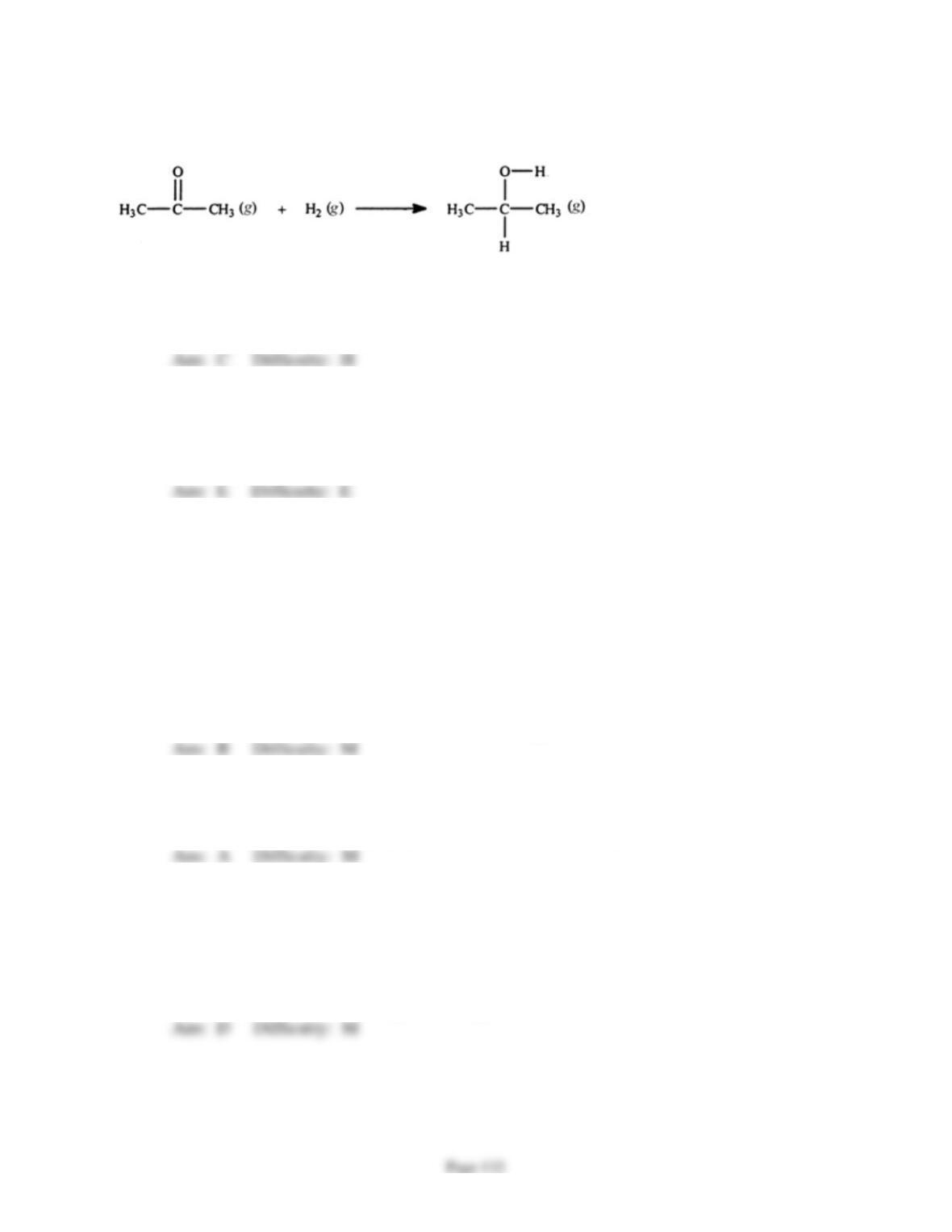
29. Acetone can be easily converted to isopropyl alcohol by addition of hydrogen to the
carbon–oxygen double bond. Calculate the enthalpy of reaction using the bond energies given.
Bond: C=O H–H C–H O–H C–C C–O
Bond energy (kJ/mol): 745 436 414 464 347 351
A) –484 kJ B) –366 kJ C) –48 kJ D) +48 kJ E) +366 kJ
30. Using the bond energies provided below, calculate H° for the reaction
CH4(g) + 4Cl2(g) → CCl4(g) + 4HCl(g)
Bond energies: C–H = 413 kJ/mol, Cl–Cl = 243 kJ/mol, C–Cl = 339 kJ/mol, H–Cl = 427 kJ/mol
A) 1422 kJ B) 440 kJ C) 110 kJ D) –110 kJ E) – 440 kJ
31. Combustion of a fat will release more energy than combustion of an equal mass of
carbohydrate because
A) fats contain more bonds to oxygen than carbohydrates.
B) fats contain fewer bonds to oxygen than carbohydrates.
C) the total energy of the carbon-carbon and carbon-hydrogen bonds in fats is greater
than the energy content of the carbon-oxygen and oxygen-hydrogen bonds in the
reaction products (carbon dioxide and water).
D) the total energy of the carbon-carbon and carbon-hydrogen bonds in fats is greater
than the energy content of the bonds in carbohydrates.
E) fats have higher molar masses than carbohydrates.
32. When one mole of each of the following liquids is burned, which will produce the most
heat energy?
A) C6H14 B) C5H12 C) C6H14O D) C6H12O E) C6H10O3
33. Electronegativity is a measure of
A) the energy needed to remove an electron from an atom.
B) the energy released when an electron is added to an atom.
C) the magnitude of the negative charge on an electron.
D) the attraction by an atom for electrons in a chemical bond.
E) the magnitude of the negative charge on a molecule.
Chapter 9: Models of Chemical Bonding
34. Which of the following elements is the most electronegative?
A) S B) Ru C) Si D) Te E) Cs
35. Which of the following elements is the least electronegative?
A) Si B) Se C) S D) Sc E) Sr
36. Which of the following elements is the most electronegative?
A) Ne B) Rb C) P D) I E) Cl
37. Arrange aluminum, nitrogen, phosphorus, and indium in order of increasing
electronegativity.
A) Al < In < N < P D) In < P < Al < N
B) Al < In < P < N E) None of the above orders is correct.
C) In < Al < P < N
38. Arrange calcium, rubidium, sulfur, and arsenic in order of decreasing electronegativity.
A) S > As > Rb > Ca D) As > S > Ca > Rb
B) S > As > Ca > Rb E) None of the above orders is correct.
C) As > S > Rb > Ca
39. Arrange oxygen, sulfur, calcium, rubidium, and potassium in order of decreasing
electronegativity.
A) O > S > Ca > K > Rb D) O > S > Rb > Ca > K
B) O > S > Ca > Rb > K E) None of the above orders is correct.
C) O > S > Rb > K > Ca
40. Based on electronegativity trends in the periodic table, predict which of the following
compounds will have the greatest % ionic character in its bonds.
A) H2O B) LiI C) CaO D) RbF E) HCl
41. Which of the following period 3 chlorides would be expected to have the highest melting
point?
A) MgCl2 B) AlCl3 C) SiCl4 D) PCl3 E) SCl2
42. Select the most polar bond amongst the following.
A) C–O B) Si–F C) Cl–F D) C–F E) C–I
Chapter 9: Models of Chemical Bonding
43. Which of the following compounds displays the greatest ionic character in its bonds?
A) NO2 B) CO2 C) H2O D) HF E) NH3
44. Analysis of an unknown substance showed that it has a moderate melting point and is a
good conductor of heat and electricity in the solid phase. Which of the following substances
would have those characteristics?
A) NaCl B) Si C) CCl4 D) I2 E) Ga
45. Which one of the following properties is least characteristic of typical metals?
A) moderately high melting point
B) high boiling point
C) brittleness
D) good electrical conductor when solid
E) good electrical conductor when molten
46. The melting points of metals are only moderately high because
A) metallic bonding is weak.
B) metals have fewer bonding electrons than non-metals.
C) metals also have relatively low boiling points.
D) the melting process does not break the metallic bonds.
E) metals prefer to be bonded to non-metals.
47. Ionic bonding typically occurs when a ______________ bonds with a ______________.
48. Covalent bonding typically occurs when a ______________ bonds with a
______________.
49. When an atom is represented in a Lewis electron dot symbol, the element symbol
represents ______________ and the dots represent ______________.
Chapter 9: Models of Chemical Bonding
50. In not more than three sentences, describe the electron arrangement responsible for
bonding in solid SrCl2.
51. Describe, with appropriate explanations, the key factors which affect the magnitude of
the lattice energy of an ionic substance.
52. A hypothetical ionic substance will not form merely because it has a high lattice energy.
Explain why, using energy-based arguments.
53. The lattice energy of rubidium chloride is the energy change accompanying the process
Rb+(g) + Cl–(g) → RbCl(s)
Calculate the lattice energy of RbCl using the following data:
H° (kJ)
Rb(s) → Rb(g) 86
Rb(g) → Rb+(g) + e– 409
Cl2(g) → 2Cl(g) 242
Cl(g) + e– → Cl–(g) –355
Rb(s) +
12
Cl2(g) → RbCl(s) –435
Chapter 9: Models of Chemical Bonding
54. In not more than three sentences, describe the electron arrangement responsible for
bonding in Cl2 molecules.
55. Using appropriate, real examples to illustrate your answer, describe the correlation
between bond energy and bond length for a series of single bonds.
56. Using appropriate, real examples to illustrate your answer, describe the correlation
between bond energy and bond length for a series of varying bond order.
57. Oxygen difluoride is an unstable molecule that reacts readily with water. Calculate the
bond energy of the O–F bond using the standard enthalpy of reaction and the bond energy data
provided.
OF2(g) + H2O(g) → O=O(g) + 2HF(g) H° = –318 kJ
Bond: O–H O=O H–F
Bond energy (kJ/mol): 467 498 565
58. Ethanol is sometimes used as an additive in oxygenated gasoline. Calculate its enthalpy
of combustion using the bond energies given.
Bond: C–C C–H C–O C=O O–H O=O
Bond energy (kJ/mol): 347 413 358 799 467 498
Chapter 9: Models of Chemical Bonding
59. Give a clear and concise definition of the term “electronegativity”; i.e., what does it
measure?
60. Describe in brief how electronegativity values can be used to predict the percent ionic
character of a bond between two atoms.
61. Most of the copper sold in major metal markets is highly purified, typically to 99.99%.
Why is this?
62. In not more than three sentences, describe the key features of bonding in solid
aluminum.
63. The majority of elements are good electrical conductors when in solid form.
64. A single covalent bond consists of a single delocalized electron pair.
65. The lattice energy is the energy released when separated ions in the gas phase combine
to form ionic molecules in the gas phase.
66. The lattice energy of large ions is greater in magnitude than that of small ions of the
same charge.
67. The electrostatic energy of two charged particles is inversely proportional to the square
of the distance between them.
Chapter 9: Models of Chemical Bonding
68. The electrostatic energy of two charged particles is inversely proportional to the distance
between them.
69. In covalent bond formation, the potential energy reaches a maximum when the
internuclear distance is equal to the bond length.
70. Bond energy increases as bond order increases, for bonding between a given pair of
atoms.
71. Covalently bonded substances do not necessarily exist as separate molecules.
72. The more C–O and O–H bonds there are in a substance, the greater will be the amount of
heat released when a fixed mass of the substance is burned.
73. The stronger the bonds in a fuel, the more energy it will yield.
74. Electronegativities on Pauling’s scale are calculated from ionization energies and
electron affinities.
75. No real bonds are 100% ionic in character.
76. As a measure of the strength of metallic bonding, the boiling point of a metal is a better
indicator than its melting point.