17
33) Consider the following generic chemical equation: 2W + 3X → 3Y + Z
When 5 units of W and 6 units of X are allowed to react, the limiting reactant would be:
A) W
B) X
C) Y
D) Z
E) There is no limiting reactant in this situation.
34) Determine the theoretical yield of C when 3 units of A and 10 units of B are reacted in the
following generic chemical equation: 2A + 5B → 4C.
A) 3
B) 4
C) 6
D) 8
E) none of the above
35) Given the balanced equation CO2 + Si → SiO2 + C, if you were to react 1 mole of CO2 with
1 mole of Si, which statement is TRUE?
A) The CO2 is the limiting reactant.
B) The Si is the limiting reactant.
C) The SiO2 is the limiting reactant.
D) You have equal stoichiometric amounts of reactants.
E) none of the above
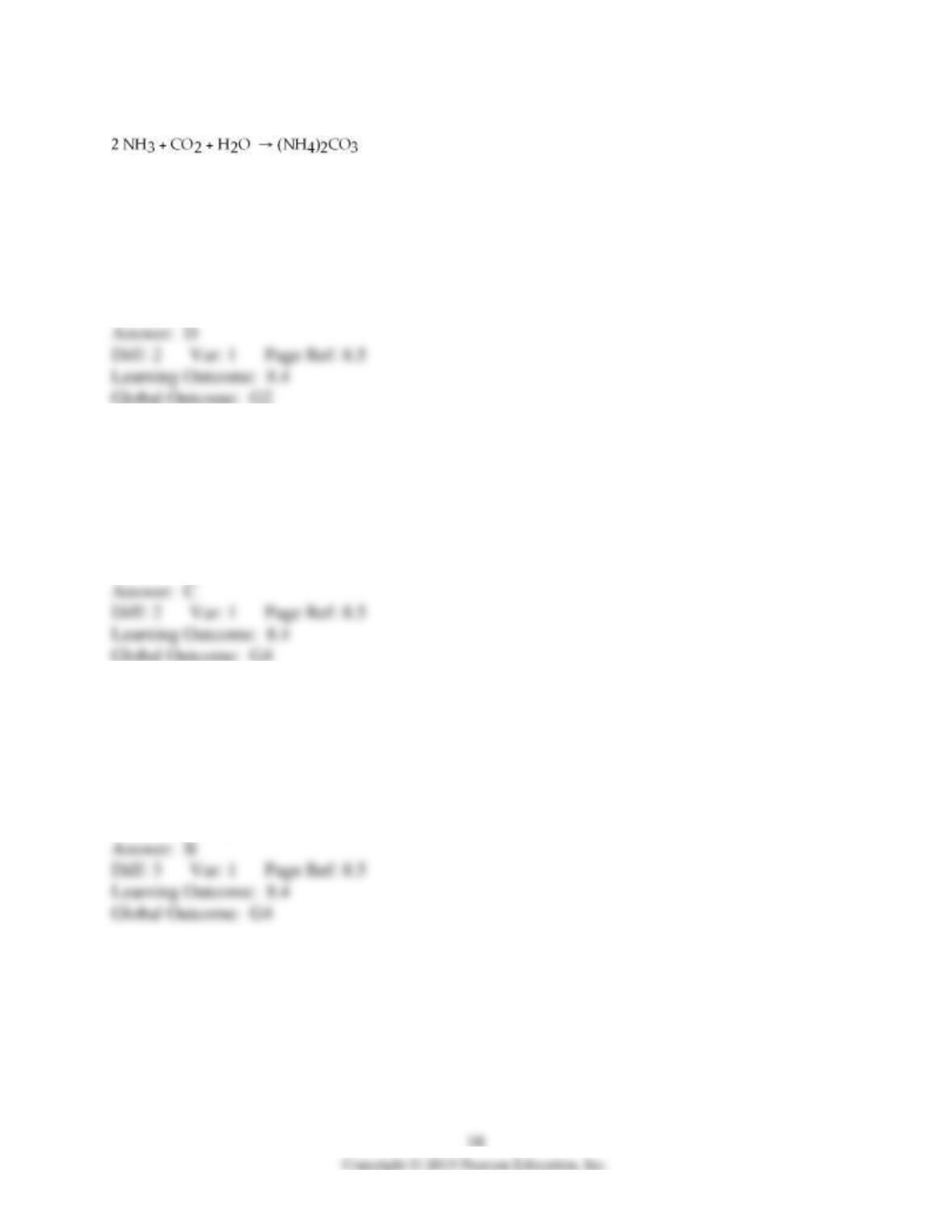
36) A balanced chemical equation used to prepare ammonium carbonate, (NH4)2CO3 , is:
Which choice of reactant quantities shown below would result in the greatest amount of
ammonium carbonate being formed?
A) React 2 moles NH3 , 1 mole CO2 , and 1 mole H2O
B) React 2 moles NH3 , 8 moles CO2 , and 8 moles H2O
C) React 4 moles NH3 , 1 mole CO2 , and 2 moles H2O
D) React 4 moles NH3 , 2 moles CO2 , and 2 moles H2O
E) none of the above
37) If the theoretical yield of a reaction is 42.0 grams of product and the percent yield is 75%.
How many grams were actually produced?
A) 5400
B) 56
C) 32
D) 1.8
E) none of the above
38) The theoretical yield of a reaction is 75.0 grams of product and the actual yield is 42.0g.
What is the percent yield?
A) 75.0
B) 56.0
C) 31.5
D) 178
E) none of the above
39) What is the theoretical yield of a reaction if 25.0 grams of product were actually produced
from a reaction that has a 88% yield?
A) 28.4
B) 22.0
C) 3.52
D) 352
E) none of the above
40) What is the limiting reactant for the following reaction given we have 3.4 moles of
Ca(NO3)2 and 2.4 moles of Li3PO4?
Reaction: 3Ca(NO3)2 + 2Li3PO4 → 6LiNO3 + Ca3(PO4)2
A) Ca(NO3)2
B) Li3PO4
C) LiNO3
D) Ca3(PO4)2
E) not enough information
41) What is the excess reactant for the following reaction given we have 3.4 moles of Ca(NO3)2
and 2.4 moles of Li3PO4?
Reaction: 3Ca(NO3)2 + 2Li3PO4 → 6LiNO3 + Ca3(PO4)2
A) Ca(NO3)2
B) Li3PO4
C) LiNO3
D) Ca3(PO4)2
E) not enough information
42) How many moles of lithium nitrate are theoretically produced if we start with 3.4 moles of
Ca(NO3)2 and 2.4 moles of Li3PO4?
Reaction: 3Ca(NO3)2 + 2Li3PO4 → 6LiNO3 + Ca3(PO4)2
A) 7.2
B) 6.8
C) 1.2
D) 1.1
E) not enough information
43) How many grams of calcium phosphate are theoretically produced if we start with 3.40
moles of Ca(NO3)2 and 2.40 moles of Li3PO4?
Reaction: 3Ca(NO3)2 + 2Li3PO4 → 6LiNO3 + Ca3(PO4)2
A) 310
B) 248
C) 1054
D) 351
E) not enough information
44) How many grams of NO2 are theoretically produced if we start with 1.20 moles of S and
9.90 moles of HNO3?
Reaction: S + 6HNO3 → H2SO4 + 6NO2 + 2H2O
A) 7.20
B) 331
C) 455
D) 786
E) not enough information
45) What is the limiting reactant for the following reaction given we have 2.6 moles of HCl and
of Ca(OH)2?
Reaction: 2HCl + Ca(OH)2 → 2H2O + CaCl2
A) Ca(OH)2
B) HCl
C) H2O
D) CaCl2
E) not enough information
46) What is the excess reactant for the following reaction given we have 2.6 moles of HCl and
of Ca(OH)2?
Reaction: 2HCl + Ca(OH)2 → 2H2O + CaCl2
A) Ca(OH)2
B) HCl
C) H2O
D) CaCl2
E) not enough information
47) How many moles of calcium chloride are theoretically produced for the following reaction
given we have 2.6 moles of HCl and 1.4 moles of Ca(OH)2?
Reaction: 2HCl + Ca(OH)2 → 2H2O + CaCl2
A) 0.7
B) 1.0
C) 1.4
D) 1.3
E) not enough information
48) How many grams of water are theoretically produced for the following reaction given we
have 2.6 moles of HCl and 1.4 moles of Ca(OH)2?
Reaction: 2HCl + Ca(OH)2 → 2H2O + CaCl2
A) 25.2
B) 50.4
C) 46.8
D) 103.6
E) not enough information
49) In order to determine the limiting reactant in a particular reaction, one must know each of the
following EXCEPT:
A) the mass of each reactant present.
B) the molar mass of each reactant present.
C) the coefficient of each reactant in a balanced equation.
D) the mass of each product formed.
50) What is the limiting reactant for the reaction below given that you start with 2.50 grams C
and 2.50 grams SiO2?
Reaction: C + SiO2 → SiC + O2
A) C
B) SiO2
C) SiC
D) O2
E) There is no limiting reactant.
51) What is the limiting reactant for the reaction below given that you start with 10.0 grams of
Al and 19.0 grams of O2?
Reaction: 4Al + 3O2 → 2Al2O3
A) Al
B) O2
C) Al2O3
D) both Al and O2
E) not enough information
52) What is the excess reactant for the reaction below given that you start with 10.0 grams of Al
and of O2?
Reaction: 4Al + 3O2 → 2Al2O3
A) Al
B) O2
C) Al2O3
D) both Al and O2
E) not enough information
53) How many moles of aluminum oxide are produced according to the reaction below given
that you start with 10.0 grams of Al and 19.0 grams of O2?
Reaction: 4Al + 3O2 → 2Al2O3
A) 0.396
B) 0.185
C) 0.741
D) 5.00
E) not enough information
54) How many grams of aluminum oxide are produced according to the reaction below given
that you start with 10.0 grams of Al and 19.0 grams of O2?
Reaction: 4Al + 3O2 → 2Al2O3
A) 40.4
B) 5.00
C) 0.185
D) 18.9
E) not enough information
55) If 16.0 grams of aluminum oxide were actually produced, what is the percent yield of the
reaction below given that you start with 10.0 g of Al and 19.0 grams of O2?
Reaction: 4Al + 3O2 → 2Al2O3
A) 75.0%
B) 100%
C) 84.7%
D) 39.6%
E) not enough information
56) A sample of 8.5 g NH3 on oxidation produces 4.5 g of NO. Calculate the percent yield.
Reaction: 4 NH3 + 5 O2 → 4 NO + 6 H2O
A) 15 %
B) 30%
C) 60%
D) 70%
E) none of the above
57) The reaction for the oxidation of NH3 is given as:
4 NH3 + 5 O2 → 4 NO + 6 H2O
Under certain conditions the reaction will proceed at 29.8% yield of NO. How many grams of
NH3 must be made to react with excess oxygen to yield 70.5 g of NO?
A) 134
B) 237
C) 21.0
D) 2.37
E) none of the above
58) How many grams of the excess reactant are left over according to the reaction below given
that you start with 10.0 g of Al and 19.0 grams of O2?
Reaction: 4Al + 3O2 → 2Al2O3
A) 8.90
B) 10.1
C) 1.1
D) 14.6
E) not enough information
59) How many moles of NH3 can be produced by the reaction of 2.00 g of N2 with 3.00 g H2?
Reaction: N2(g) + 3 H2(g) → 2 NH3(g)
A) 0.143
B) 0.0567
C) 0.235
D) 1.00
E) none of the above
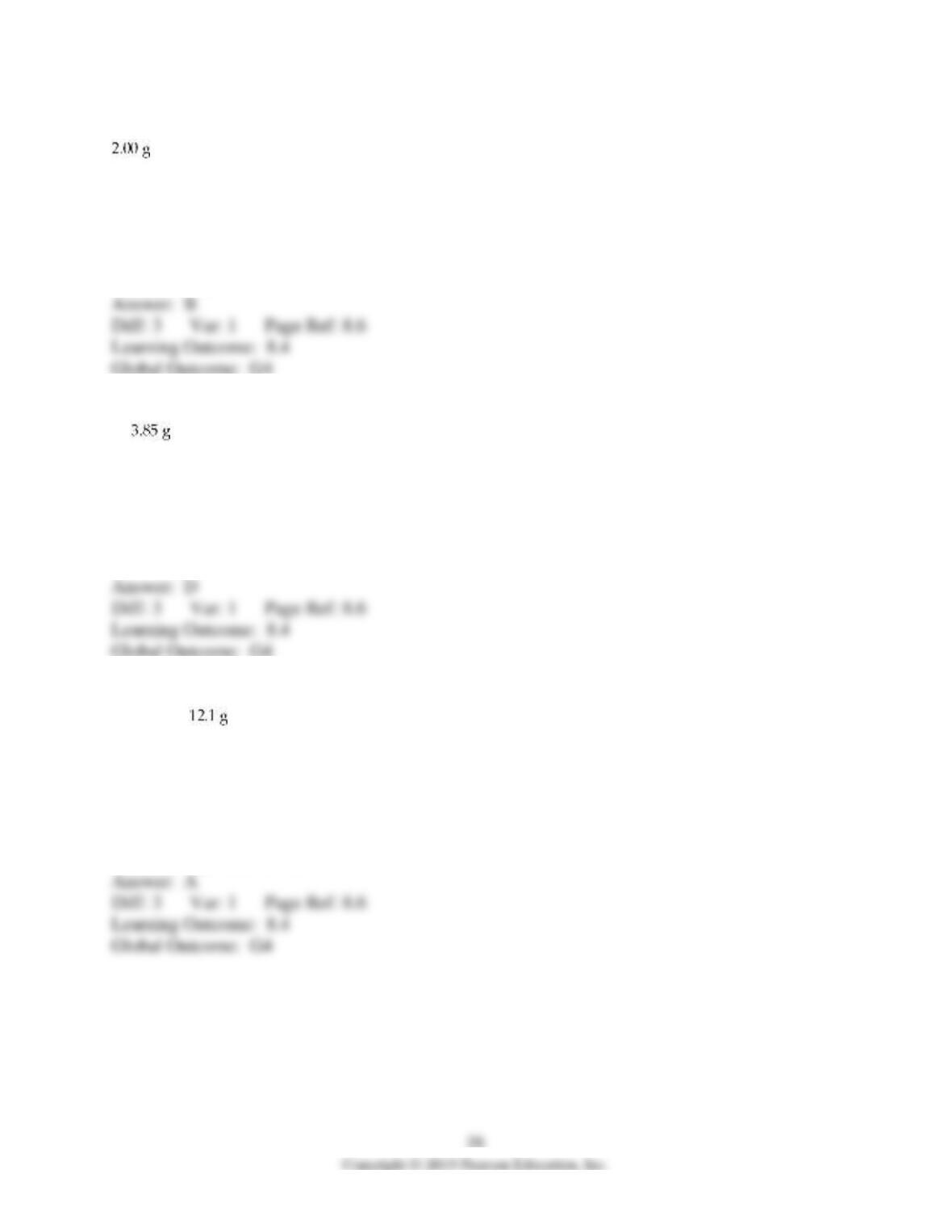
60) Calculate the maximum number of grams of NH3 that can be produced by the reaction of
of N2 with 3.00 g H2.
Reaction: N2(g) + 3 H2(g) → 2 NH3(g)
A) 0.964
B) 2.43
C) 4.00
D) 17.0
E) none of the above
61) A 24.0 g sample of nitrogen gas reacts with an excess of hydrogen gas to give an actual yield
of NH3. What is the percent yield for this reaction?
Reaction: N2(g) + 3 H2(g) → 2 NH3(g)
A) 86.8%
B) 73.6%
C) 26.4%
D) 13.2%
E) none of the above
62) Which is the excess reactant in the following reaction given that you start with 15.5 g of
Na2S and CuSO4?
Reaction: Na2S + CuSO4 → Na2SO4 + CuS
A) Na2S
B) CuSO4
C) Na2SO4
D) CuS
E) not enough information
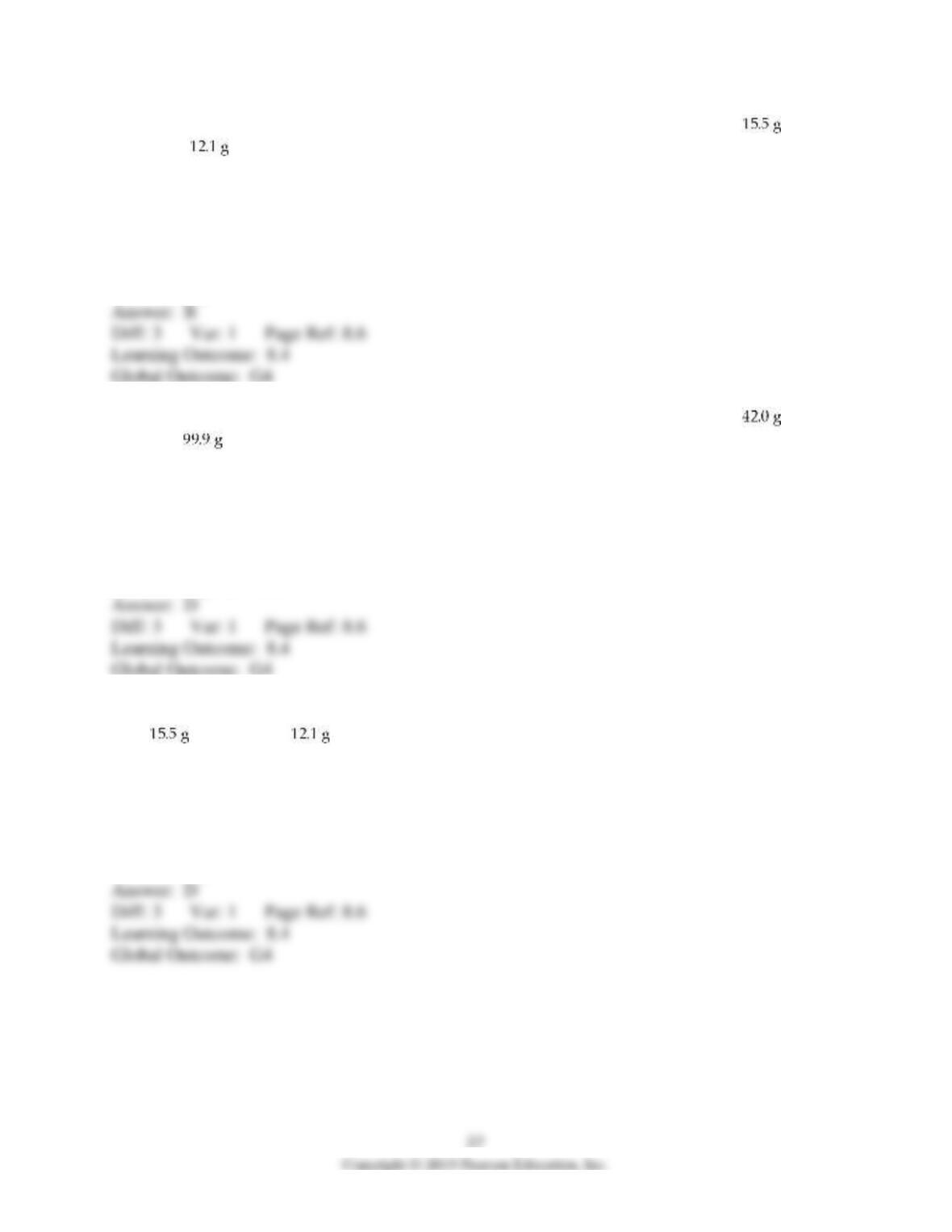
63) Which is the limiting reactant in the following reaction given that you start with of
Na2S and CuSO4?
Reaction: Na2S + CuSO4 → Na2SO4 + CuS
A) Na2S
B) CuSO4
C) Na2SO4
D) CuS
E) not enough information
64) Which is the limiting reactant in the following reaction given that you start with of
CO2 and KOH?
Reaction: CO2 + 2KOH → K2CO3 + H2O
A) K2CO3
B) H2O
C) CO2
D) KOH
E) not enough information
65) What is the theoretical yield in grams of CuS for the following reaction given that you start
with of Na2S and CuSO4?
Reaction: Na2S + CuSO4 → Na2SO4 + CuS
A) 0.0758
B) 0.198
C) 18.93
D) 7.25
E) not enough information
28
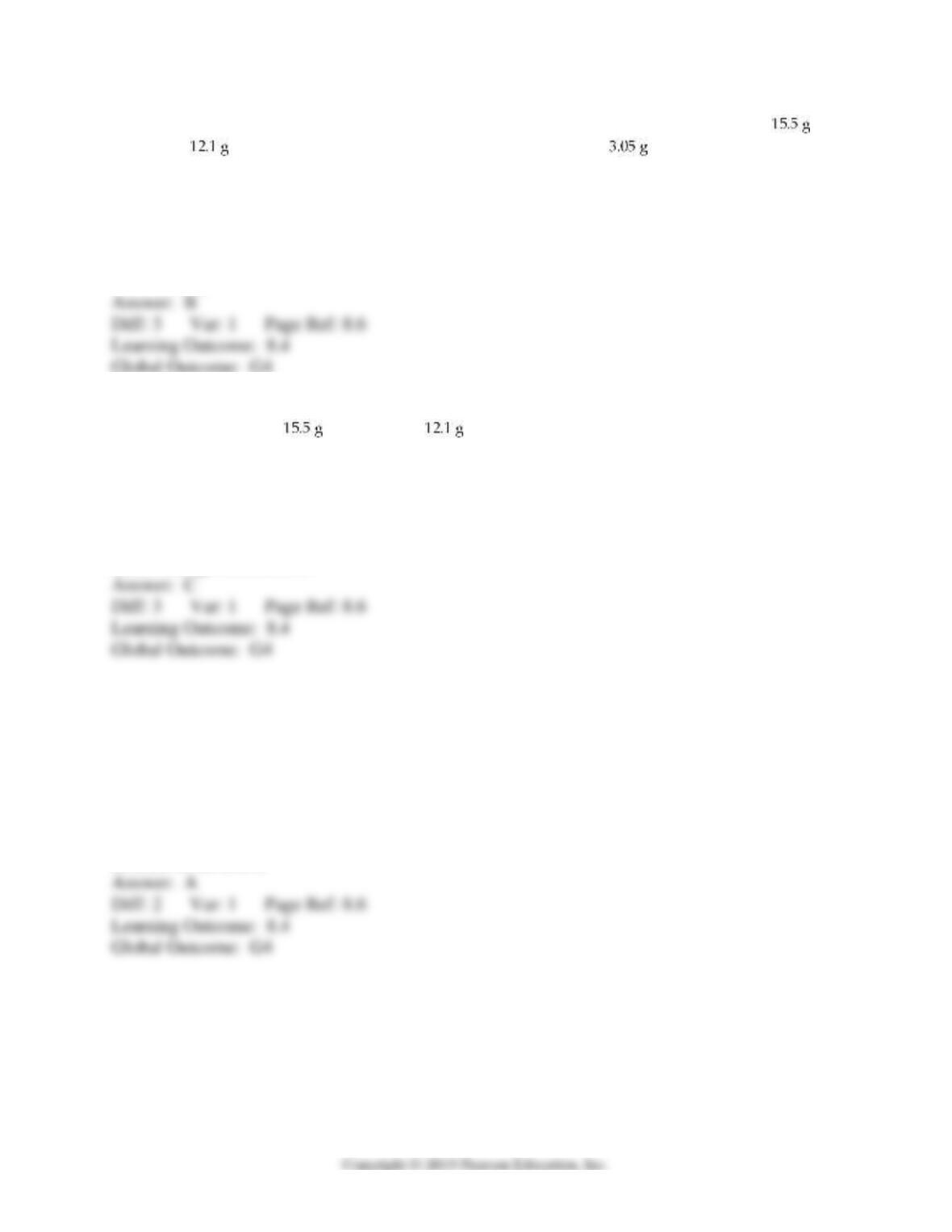
66) What is the percent yield of CuS for the following reaction given that you start with of
Na2S and CuSO4? The actual amount of CuS produced was .
Reaction: Na2S + CuSO4 → Na2SO4 + CuS
A) 16.1%
B) 42.1%
C) 18.93%
D) 7.25%
E) not enough information
67) How many grams of the excess reactant remain assuming the reaction goes to completion
and that you start with of Na2S and CuSO4?
Reaction: Na2S + CuSO4 → Na2SO4 + CuS
A) 0.05
B) 15.45
C) 9.58
D) 5.92
E) not enough information
68) Consider the reaction: 2 Al + 3Br2 → 2 AlBr3
Suppose a reaction vessel initially contains 5.0 mole Al and 6.0 mole Br2. What is in the reaction
vessel once the reaction has occurred to the fullest extent possible?
A) 1.0 mole Al; 0 mole Br2; 4.0 mole AlBr3
B) 0 mole Al; 0 mole Br2; 11.0 mole AlBr3
C) 2.0 mole Al; 3.0 mole Br2; 2.0 mole AlBr3
D) 0 mole Al; 1.0 mole Br2; 4.0 mole AlBr3
E) none of the above
29
69) The reaction of one mole of nitrogen gas with three moles of hydrogen gas releases 92 kJ of
thermal energy to the surroundings. Which of the following is TRUE?
A) This reaction is exothermic.
B) This reaction has a negative enthalpy of reaction.
C) Complete reaction of two moles of nitrogen gas would release 184 kJ of thermal
energy in this reaction.
D) All of the above are true.
E) None of the above are true.
70) Consider the following reaction: 2 Mg + O2 → 2 MgO △H rxn = -1203 kJ
Calculate the amount of heat (in kJ) associated with complete reaction of 4 moles of Mg.
A) -1203 kJ
B) -2406 kJ
C) -601.5 kJ
D) -4812 kJ
E) none of the above
71) Consider the following equation: CO + 2 H2 → CH3OH △H rxn = -128 kJ
Calculate the amount of heat (in kJ) associated with complete reaction of 8.08 g H2.
A) -1024 kJ
B) -1034 kJ
C) -256 kJ
D) -512 kJ
E) none of the above
8.3 Algorithmic Questions
1) Suppose a computer manufacturer can build circuit boards according to the following process:
12 resistors + 20 insulators + 8 memory chips → 4 circuit boards.
How many circuit boards could you make using 30 insulators, assuming you have enough of all
the other parts?
A) 20
B) 4
C) 10
D) 6
E) none of the above
2) How many moles of water are needed to react with 2.2 moles of O?
Given: O + O → 2 LiOH
A) 4.4
B) 1.1
C) 1.5
D) 2.2
E) none of the above
3) How many grams of water are needed to react with 27.2 grams of O?
Given: O + O → 2 LiOH
A) 0.910
B) 16.4
C) 1.51
D) 38.94
E) none of the above
31
4) If the theoretical yield of the reaction below corresponds to and the actual yield was 60.9
g, calculate the percent yield.
Given: O + O → 2 LiOH
A) 16.0 %
B) 71.8 %
C) 38.0 %
D) 61.4 %
E) none of the above
5) If the theoretical yield of the reaction below corresponds to 25.3 g and the percent yield of the
reaction is known to be reproducibly 81.1%, calculate the actual yield.
Given: O + O → 2 LiOH
A) 20.5 g
B) 48.9 g
C) 45.8 g
D) 81.1 g
E) none of the above
6) Consider a reaction of chemicals depicted as A + B → C + D. Suppose reaction of 17.8 grams
of A with 29.5 grams of B gave 24.7 grams of C. However, the theoretical yield of C for this
reaction was 33.3 grams. What was the percent yield of chemical C?
A) 74.2
B) 47.3
C) 11.7
D) 135
E) none of the above
7) Starting with 156 g O and 33.3 g O, decide which reactant is present in limiting
quantities.
Given: O + O → 2 LiOH
A) lithium oxide
B) water
C) lithium hydroxide
D) insufficient data
E) none of the above
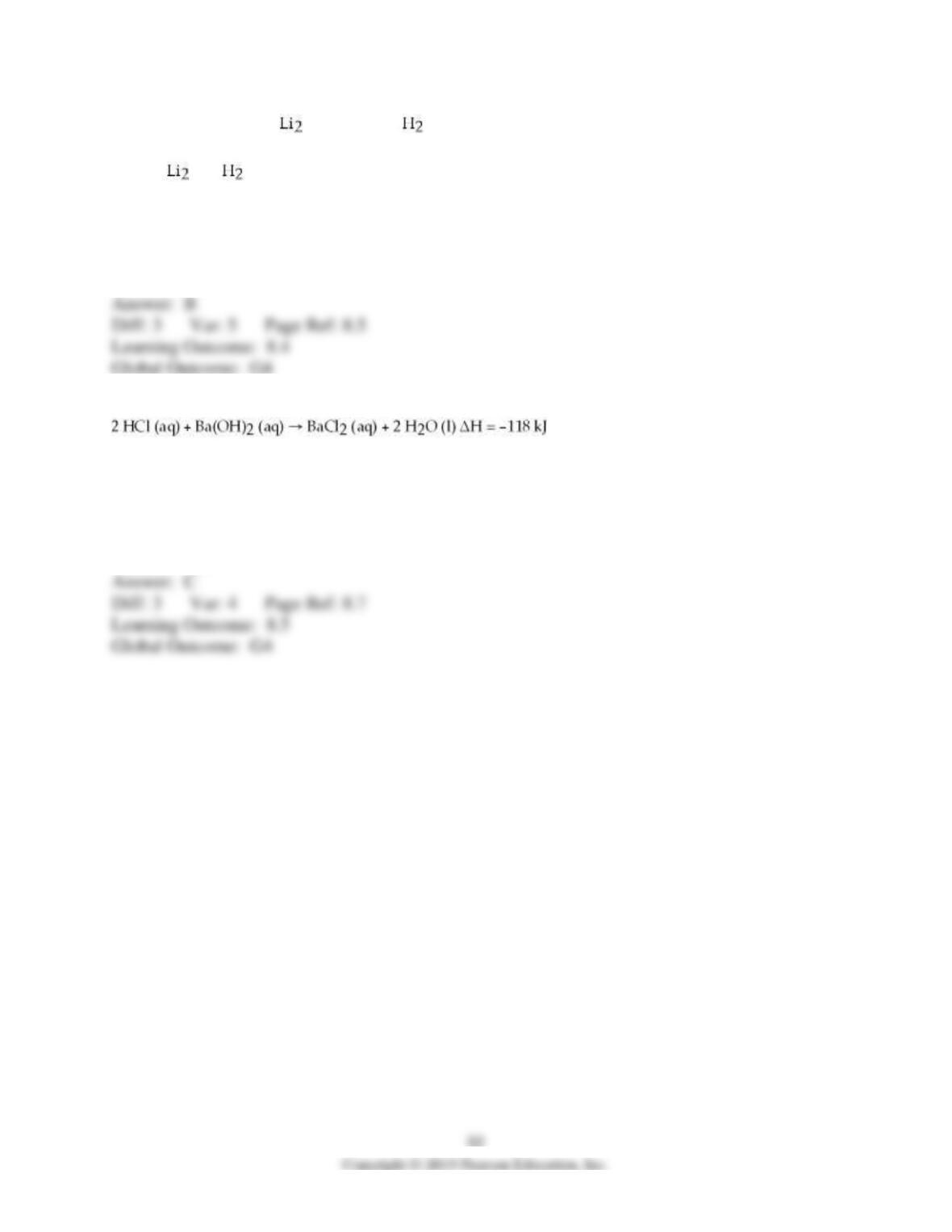
8) Hydrochloric acid reacts with barium hydroxide according to the equation:
Calculate the heat (in kJ) associated with the complete reaction of 18.2 grams of HCl (aq).
A) -58.9
B) +58.9
C) -29.5
D) -236
E) none of the above