30) If you had an aqueous mixture that contained Ag+, K+, and Pb2+ cations, how many
different solids could precipitate if a chloride solution was added?
A) 1
B) 2
C) 3
D) 4
E) no solids will precipitate
31) In writing the chemical equation for a precipitation reaction, what abbreviation of the
physical state must appear with one of the products?
A) (s)
B) (g)
C) (l)
D) (w)
E) none of the above
32) What type of a reaction occurs when a potassium nitrate solution is mixed with a barium
acetate solution?
A) precipitation
B) acid-base neutralization
C) oxidation-reduction
D) gas evolution
E) no reaction
33) A precipitate is expected to be formed when an aqueous solution of sodium sulfate is added
to an aqueous solution of:
A) iron(III) chloride.
B) potassium chloride.
C) magnesium chloride.
D) barium chloride.
E) none of the above
34) What would be the formula of the precipitate that forms when Pb(NO3)2 (aq) and K2SO4
(aq) are mixed?
A) K(NO3)2
B) PbSO4
C) PbK2
D) H2O
E) none of the above
35) Considering the following precipitation reaction:
Pb(NO3)2(aq) + 2KI(aq) → PbI2(s) + 2KNO3(aq)
Which compound would not form ions in the complete ionic equation?
A) PbI2
B) KNO3
C) Pb(NO3)2
D) KI
E) All compounds form ions in the complete ionic equation.
36) Considering the following precipitation reaction:
Pb(NO3)2(aq) + 2KI(aq) → PbI2(s) + 2KNO3(aq)
Which ion would NOT be present in the complete ionic equation?
A) Pb2+
B) K+
C) NO3–
D) I–
E) All the above ions are in the complete ionic equation.
37) Considering the following precipitation reaction:
Pb(NO3)2(aq) + 2KI(aq) → PbI2(s) + 2KNO3(aq)
Which ion(s) would NOT be present in the net ionic equation?
A) Pb2+, NO3–
B) K+, NO3–
C) K+, Pb2+
D) K+, I–
E) All the above ions are in the net ionic equation.
38) Considering the following precipitation reaction:
Pb(NO3)2(aq) + 2KI(aq) → PbI2(s) + 2KNO3(aq)
Which ion(s) would NOT be spectator ions?
A) Pb2+, NO3–
B) K+, I–
C) NO3–, Pb2+
D) Pb2+, I –
E) All the above ions are in the net ionic equation.
39) Considering the following precipitation reaction:
Pb(NO3)2(aq) + 2KI(aq) → PbI2(s) + 2KNO3(aq)
What is the correct complete ionic equation?
A) Pb2+ + (NO3)2– + 2K+ + 2I– → PbI2(s) + 2K+ + 2NO3–
B) Pb2+ + 2NO3– +2K+ + I– → PbI2(s) + 2K+ + NO3–
C) Pb2+ + 2NO3– + 2K+ + 2I– → PbI2(s) + 2K+ + 2NO3–
D) Pb2+ + 2NO3– + 2K+ + 2I– → Pb2+ + 2I– + 2K+ + 2NO3–
E) none of the above
40) Considering the following precipitation reaction:
Pb(NO3)2(aq) + 2KI(aq) → PbI2(s) + 2KNO3(aq)
What is the correct net ionic equation?
A) Pb2+ + I2– → PbI2(s)
B) 2NO3– + 2K+ → 2KNO3
C) Pb2+ + 2NO3– + 2K+ + 2I– → PbI2(s) + 2K+ + 2NO3–
D) Pb2+ + 2I– → PbI2(s)
E) none of the above
41) Which of the following statements about writing molecular, complete and net ionic equations
is FALSE?
A) A molecular equation is a chemical equation showing the complete, neutral formulas for
every compound in a reaction.
B) A complete ionic equation is a chemical equation showing all of the species as they are
actually present in solution.
C) A net ionic equation is an equation showing only the species that actually participate in the
reaction.
D) A spectator ion remains unchanged in the reaction and appears on both sides of the equation.
E) All of the statements are true.
42) Which is a spectator ion from the following complete ionic equation:
Ag+(aq) + NO3–(aq) + K+ (aq) + Br–(aq) → AgBr(s) + K+(aq) + NO3– (aq)
A) Ag+
B) Br–
C) K+
D) AgBr
E) none of the above
43) Which is a spectator ion from the following complete ionic equation:
H+(aq) + Br–(aq) + K+ (aq) + OH–(aq) → H2O(l) + K+(aq) + Br– (aq)
A) K+
B) H+
C) OH–
D) H2O
E) none of the above
44) Which of the following everyday substances does NOT typically contain an acid?
A) lemons
B) vinegar
C) soap
D) limes
E) all of the above
45) Which of the following is NOT an acid?
A) HClO4
B) HNO3
C) HC2H3O2
D) H2SO4
E) none of the above
46) What type of a reaction occurs when a silver nitrate solution is mixed with sodium chloride
solution?
A) precipitation
B) acid-base neutralization
C) oxidation-reduction
D) gas evolution
E) no reaction
47) What type of a reaction occurs when a sodium hydroxide solution is mixed with an acetic
acid solution?
A) precipitation
B) acid-base neutralization
C) oxidation-reduction
D) gas evolution
E) no reaction
48) What is the net ionic equation for the reaction of hydrochloric acid with potassium
hydroxide?
A) H+ + Cl– + K+ + OH– → H2O + K+ + Cl–
B) HCl + KOH → H2O + KCl
C) H+ + OH– → H2O
D) 2H+ +2Cl– + K2+ + 2OH– → H2O + K2+ +2 Cl–
E) none of the above
49) What is the molecular equation for the reaction of hydrochloric acid with potassium
hydroxide?
A) H2Cl + 2KOH → H2O +2KCl
B) 2HCl + K(OH)2 → 2H2O + KCl2
C) H+ + OH– → H2O
D) HCl + KOH → H2O + KCl
E) none of the above
50) What is the complete ionic equation for the reaction of hydrochloric acid with potassium
hydroxide?
A) H+ + Cl– + K+ + OH– → H2O + K+ + Cl–
B) H+ + Cl– + K+ + OH– → 2H+ + O2- + K+ + Cl–
C) H+ + OH– → H2O
D) 2H+ +2Cl– + K2+ + 2OH– → H2O + K2+ +2 Cl–
E) none of the above
51) When a solution of MgCl2 and one of AgNO3 are mixed, the net ionic equation is:
A) Mg2+(aq) + 2Cl–(aq) + 2Ag+(aq) + 2NO3– (aq) → Mg2+(aq) + 2NO3–aq) + 2AgCl(s)
B) Mg2+(aq) + 2Cl–(aq) + 2Ag+(aq) + 2NO3– (aq) → Mg(NO3)2 (aq) + 2 AgCl(s)
C) Mg2+(aq) + 2NO3–(aq) → Mg(NO3)2(aq)
D) Cl–(aq) + Ag+(aq) → AgCl(s)
E) none of the above
52) Which of the following types of compounds will NOT undergo a gas evolution reaction
when acid is added?
A) sulfides
B) carbonates
C) hydroxides
D) bisulfites
E) none of the above
53) What is the gas produced when hydrochloric acid is reacted with ammonium carbonate?
A) ammonia
B) chlorine
C) hydrogen
D) carbon dioxide
E) none of the above
54) What type of a reaction occurs when a hydrochloric acid solution is mixed with a sodium
bicarbonate solution?
A) precipitation
B) acid-base neutralization
C) oxidation-reduction
D) gas evolution
E) no reaction
55) Which of the following would NOT be a product from mixing hydrochloric acid with a
solution of sodium sulfite?
A) H2O (l)
B) SO2 (g)
C) NaCl (aq)
D) H2 (g)
E) none of the above
56) As defined in the text, identify the “gas evolution” reactions among the following:
1. 2HCl(aq) + K2CO3(aq) → H2O(l) + CO2(g) + 2KCl(aq)
2. CH4(g) + 2O2(g) → CO2(g) + 2H2O(l)
3. 2HCl(aq) + K2S(aq) → H2S(g) + 2KCl(aq)
A) 1 and 2 only
B) 1 and 3 only
C) 2 and 3 only
D) All of 1, 2, and 3
E) None of 1, 2, and 3
57) What type of a reaction occurs when potassium metal reacts with fluorine gas?
A) precipitation
B) acid-base neutralization
C) oxidation-reduction
D) gas evolution
E) no reaction
58) Identify the oxidation-reduction reactions among the following:
1. Zn(s) + Cu2+(aq) → Zn2+(aq) + Cu(s)
2. 2 Na(s) + Cl2(aq) → 2NaCl(s)
3. 2 Mg(s) + O2(g) → 2 MgO
A) 1 and 2 only
B) 1 and 3 only
C) 2 and 3 only
D) All of 1, 2, and 3
E) None of 1, 2, and 3
59) Methane gas (CH4), on complete combustion in air, produces:
1. CO2
2. H2
3. H2O
A) 1 and 2 only
B) 1 and 3 only
C) 2 and 3 only
D) All of 1 and 2 only
E) None of

60) A redox reaction has occurred ________.
A) when a substance reacts with elemental oxygen
B) when an alkali metal reacts with an alkaline earth metal
C) when one substance transfers protons to another
D) when one substance forms a solid
E) when all of the above occur
61) Which of the following statements about redox reactions is FALSE?
A) Oxidation is the loss of electrons.
B) Reduction is the gain of electrons.
C) A reaction can result in either oxidation or reduction, not both.
D) A reaction involving elemental oxygen is a redox reaction.
E) All of the above statement are true.
62) The reaction CH4 (g) + 2 O2 (g) → CO2 (g) + 2 H2O (g) is:
A) a combustion reaction.
B) a redox reaction.
C) an exothermic reaction.
D) all of the above
E) none of the above
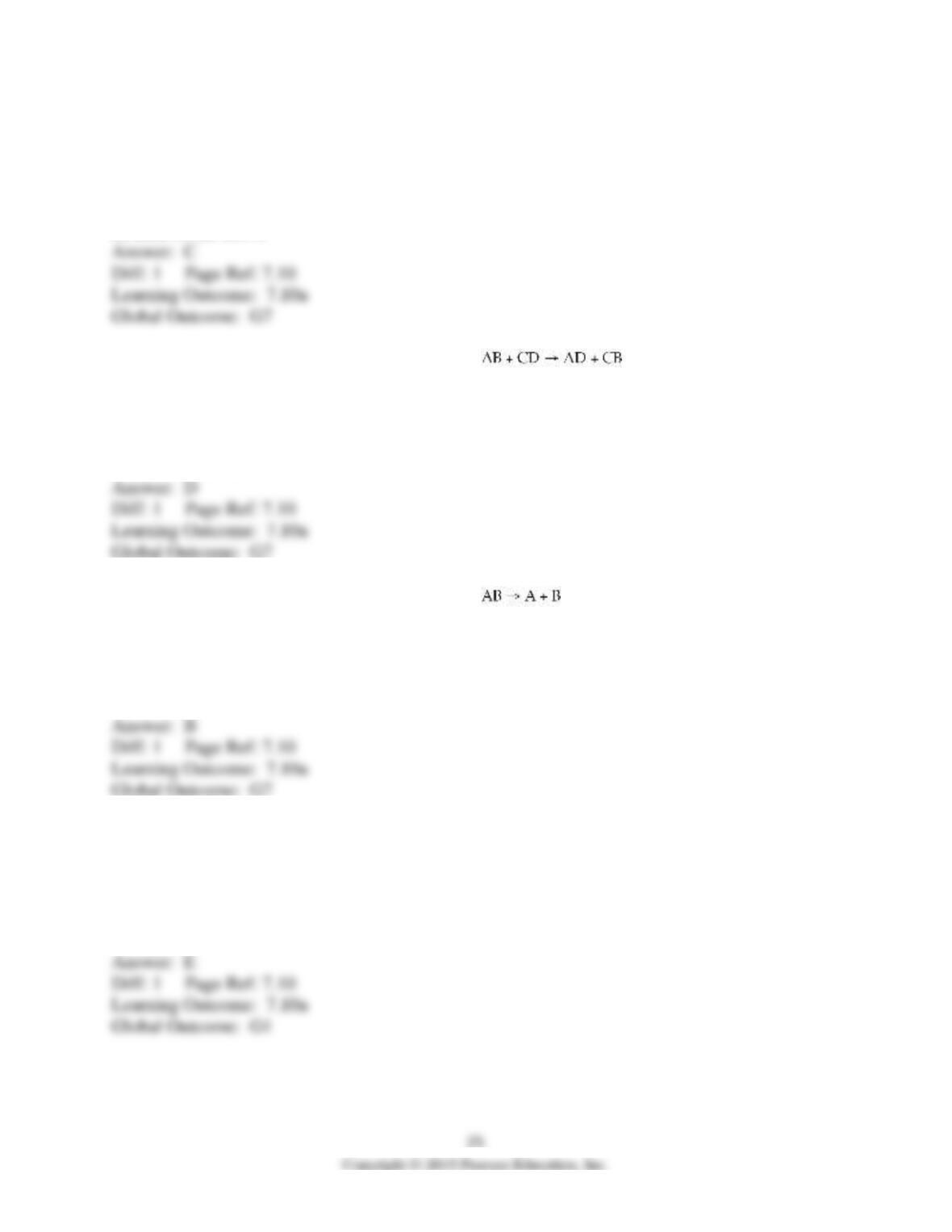
63) What type of reaction is the generic equation ?
A) synthesis/combination
B) decomposition
C) single displacement
D) double-displacement
E) none of the above
64) What type of reaction is the generic equation A + BC → AC + B?
A) synthesis/combination
B) decomposition
C) single displacement
D) double-displacement
E) none of the above
65) What type of reaction is the generic equation ?
A) synthesis/combination
B) decomposition
C) single displacement
D) double-displacement
E) none of the above
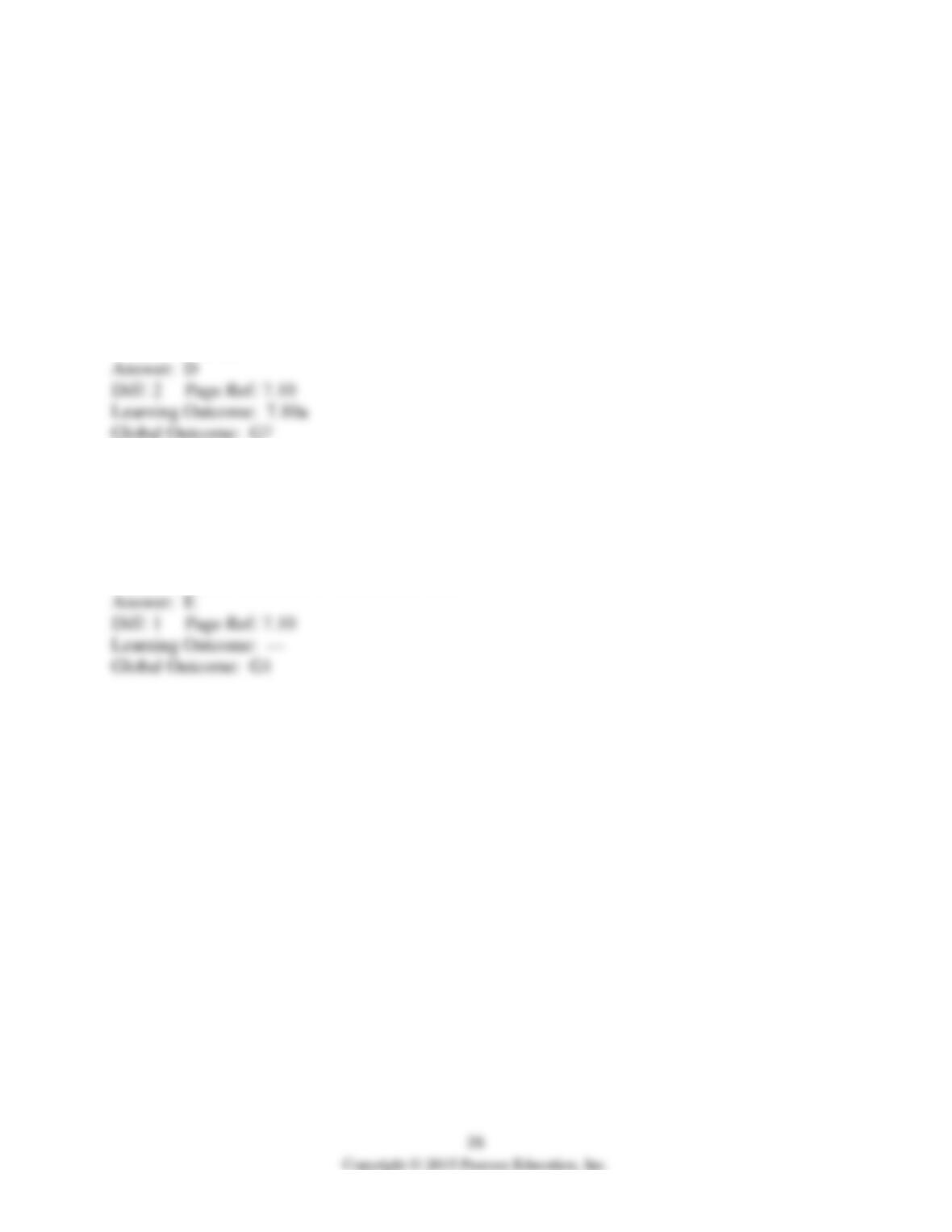
66) What type of reaction is the generic equation ?
A) synthesis/combination
B) decomposition
C) single displacement
D) double-displacement
E) none of the above
67) What must be supplied for a decomposition reaction to happen?
A) energy
B) heat
C) electrical current
D) light
E) any of the above
68) Identify the double displacement reactions among the following:
1. KCl(aq) + AgNO3(aq) → AgCl(s) + KNO3(aq)
2. Na2SO4(aq) + BaCl2(aq) → BaSO4(s) + 2NaCl(aq)
3. H2SO4((aq) + 2NaOH(aq) → Na2SO4((aq) + 2H2O(l)
A) 1 and 2 only
B) 1 and 3 only
C) 2 and 3 only
D) All of 1, 2, and 3
E) None of 1, 2, and 3
69) Which statement about ozone is TRUE?
A) Ozone normally forms in the upper atmosphere.
B) Chlorofluorocarbons deplete the ozone layer.
C) Ozone protects life on Earth from harmful ultraviolet light.
D) None of the above statements are true.
E) All the of the first three statements are true.
27
Algorithmic Questions
1) The mixing of sodium metal and chlorine gas would be the type of reaction known as:
A) oxidation-reduction
B) gas evolution
C) neutralization
D) precipitation
E) none of the above
2) When the equation, ___O2 + ___C6 H14 → ___CO2 + ___H2O is balanced, the coefficient
of O2 is:
A) 3
B) 10
C) 19
D) 38
E) none of the above