Introduction to Chemical Principles, 11e (Stoker)
Chapter 7 Chemical Bonds
7.1 Multiple Choice
1) A(n) ________ is a chemical bond that results from the sharing of a pair of electrons between
two atoms.
A) ionic bond
B) covalent bond
C) molecular bond
D) electrostatic attraction
2) A(n) ________ results from a transfer of one or more electrons from one atom or molecule to
another.
A) ionic bond
B) covalent bond
C) molecular bond
D) nonpolar bond
3) An ionic bond forms between two atoms through ________.
A) sharing of electron pairs
B) transferring of electrons from metallic atoms to nonmetallic atoms
C) transferring protons from the nucleus of the nonmetal to the nucleus of the metal
D) each atom acquiring a negative charge
4) For representative elements, valence electrons are those electrons ________.
A) which occupy the outermost s and p orbitals
B) that are located closest to the nucleus
C) located in the outermost d subshell
D) located in the outermost orbital
5) How many valence electrons does the representative element with the electron configuration
1s2 2s2 2p6 3s2 3p5 possess?
A) 5
B) 2
C) 6
D) 7
6) Elements in groups IIA and VA of the periodic table possess, respectively, how many valence
electrons?
A) 2 and 2
B) 2 and 6
C) 3 and 4
D) 2 and 5
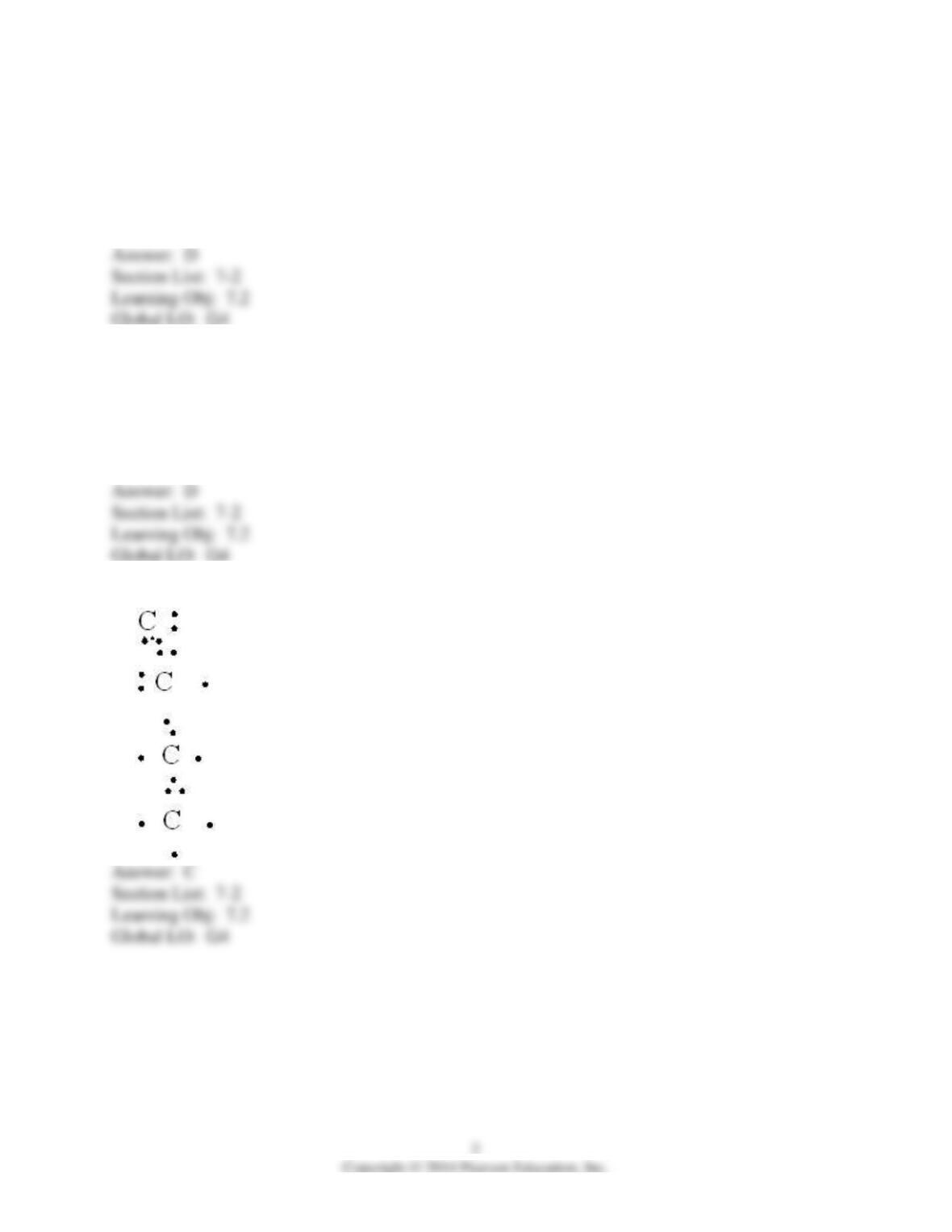
7) Which of the following is the correct Lewis symbol diagram for carbon?
A)
B)
C)
D)
8) Determine the number of valence electrons in an atom of antimony (Sb).
A) 1
B) 2
C) 4
D) 5
9) How many valence electrons does a tin (Sn) atom have?
A) 2
B) 4
C) 14
D) 8
10) The “octet rule” relates to the number eight because ________.
A) only atoms with 8 valence electrons undergo chemical reaction
B) all atoms have 8 valence electrons
C) electron arrangements involving 8 valence electrons are extremely stable
D) all orbitals can hold 8 electrons
11) Which of the following statements about the noble gases is incorrect?
A) All exist in nature as individual atoms rather than molecular form.
B) They are the most reactive of all gases.
C) All have very stable electron arrangements.
D) All have 8 valence electrons.
12) Which option will correctly fill in the blank to define the octet rule? Atoms will ________
electrons so each atom involved will have a noble gas configuration.
A) share
B) lose
C) lose or gain
D) lose, gain or share
13) The notation Y3− denotes a Y atom that has ________.
A) lost 3 electrons
B) lost 3 protons
C) gained 3 electrons
D) gained 3 protons
14) Which of the following ions would not possess an octet of electrons?
A) P2−
B) Be2+
C) K+
D) S2−
15) Which statement is incorrect?
A) An anion is a negatively charged ion.
B) Ions have different chemical properties than its corresponding atom.
C) An ionic bond is the attractive force between positively and negatively charged ions.
D) Ions are electrically neutral.
16) In order to form an octet, an atom of selenium will:
A) lose 6 electrons.
B) gain 6 electrons.
C) lose 2 electrons.
D) gain 2 electrons.
17) Which is the electron configuration for a Sc3+ ion?
A) 1s2 2s2 2p6 3s2 3p6
B) 1s2 2s2 2p6
C) 1s2 2s2 2p 3s2
D) 1s2 2s2 2p6 3s2 3p3
18) Which of the following represents the electron configuration of a selenium ion in its common
oxidation state?
A) 1s2 2s2 2p6 3s2 3p6 4s2 3d10 4p4
B) 1s2 2s2 2p6 3s2 3p6 4s2 3d10
C) 1s2 2s2 2p6 3s2 3p6 4s2 3d10 4p6
D) 1s2 2s2 2p6 3s2 3p6 4s2 3d10 4p2
19) Elements in groups IIA and VIA of the periodic table would, respectively, be expected to
form ions with charges of: ________.
A) +1 and +7
B) −1 and −5
C) +2 and −1
D) +2 and −2
20) The electron configuration for an Al3+ ion is ________.
A) 1s2 2s2 2p6
B) 1s2 2s2 2p6 3s2 3p1
C) 1s2 2s2 2p6 3s2 3p64s2 3d104p6
D) 1s2 2s2 2p6 3s2 3p6 4s2
21) The electron configuration 1s2 2s2 2p6 3s2 3p6 fits all of the following species except one.
The exception is ________.
A) F−
B) Ca2+
C) S2−
D) P3−
22) What behavior is expected from an atom with the electron configuration 1s2 2s2 2p6 3s2 3p6
4s2?
A) gain of 2 electrons
B) loss of 2 electrons
C) gain of 6 electrons
D) loss of 4 electrons
23) Which ion is isoelectronic with Kr?
A) Cl−
B) O2−
C) Rb+
D) Ba2+
7
24) Which of the following is not isoelectronic with a noble gas?
A) Li+
B) Ba2+
C) S−
D) F−
25) Which one of the following sets contains species that are all isoelectronic?
A) O, F, Ne
B) C+4, N-3, O-2
C) P-3, S-2, Ar
D) Na, Mg, Al
26) Which of the following ions is not isoelectronic with the noble gas neon?
A) O-2
B) F–
C) Al+3
D) S-2
27) Which of the following compounds contains an ion with a 3+ charge?
A) KCl
B) AlP
C) BeF2
D) BaO
28) Which of the following compounds contains an ion with a 2− charge?
A) AlP
B) MgS
C) KBr
D) BaCl2
29) In the formation of the ionic compound CaBr2, the number of electrons transferred from one
Ca atom to two Br atoms, per formula unit, is ________.
A) 1
B) 2
C) 3
D) 4
30) In the process of forming sodium nitride, Na3N, each sodium atom ________ electron(s) and
each nitride atom ________ electron(s).
A) loses one; gains two
B) loses three; gains one
C) loses three; gains three
D) loses one; gains three
31) In which of the following pairings is the formula not consistent with the ions shown?
A) K2O (K+ and O−)
B) BaF2 (Ba2+ and F−)
C) Co2S3 (Co3+ and S2-)
D) Na3P (Na+ and P3−)
32) The correct formula for the ionic compound formed between Ca and I is ________.
A) Ca2I
B) CaI2
C) Ca2I3
D) Ca3I2
33) Which statement is incorrect?
A) Ionic compounds generally contain metal and nonmetal elements.
B) Formulas of ionic compounds are written with the anion first, then the cation.
C) Cations and anions combine in the simplest ratio which achieves electrical neutrality.
D) The number of electrons lost by the cation(s) must equal the number gained by the anion(s) in
an ionic compound.
34) Which one of the compounds below is most likely to be ionic?
A) GaAs
B) CBr4
C) SrBr2
D) N2O5
35) Which of the following statements is an accurate description of the structure of the ionic
compound NaCl?
A) Alternating layers of Na and Cl atoms are present.
B) Alternating layers of Na+ and Cl− ions are present.
C) Alternating rows of Na+ and Cl− ions are present.
D) Each ion present is surrounded by six ions of opposite charge.
10
36) What term best describes the smallest whole number repeating ratio of ions in an ionic
compound?
A) covalent unit
B) formula unit
C) unit cell
D) lattice
37) A polyatomic ion is an ion that ________.
A) has a negative charge < −1
B) contains both a metal and a nonmetal
C) develops a charge as a result of the combination of two or more types of atoms
D) does not bond further with other ions
38) Which of the following formulas for an ionic compound is incorrect as written?
A) Ca(SO4)2
B) KOH
C) MgS
D) NH4ClO4
39) What is the correct chemical formula for a compound that contains K+ and CO32− ions?
A) K2CO3
B) KCO3
C) K(CO3)2
D) K3(CO3)2
40) Which of the following formulas for an ionic compound is incorrect as written?
A) Al2(CO3)3
B) Na2S
C) Li2SO4
D) MgHCO3
41) The correct formula for the ionic compound containing Ni2+ and NO31- ions is ________.
A) NiNO3
B) Ni2NO3
C) Ni(NO3)3
D) Ni(NO3)2
42) What is the formula for the ionic compound which forms when Co3+ combines with SO42−?
A) CoSO4
B) Co2(SO4)3
C) Co(SO4)2
D) Co3(SO4)2
43) Which of the following statements concerning differences between ionic and covalent
compounds is correct?
A) Covalent compounds contain two elements, and ionic compounds contain three or more
elements.
B) Ionic compounds contain oxygen and covalent compounds do not.
C) Ionic compounds contain a metal ion or a positive polyatomic ion, and covalent compounds
do not contain ions.
D) Ionic compounds possess a molecular structural unit and covalent compounds do not.
44) For which of the following pairs of elements would electron transfer between atoms most
likely occur?
A) Na and Cd
B) Ca and O
C) As and I
D) V and Li
45) Which of the following pairs of elements would most likely form a covalent compound?
A) Na and Pb
B) F and S
C) Cu and Ar
D) Zn and K
46) The total number of shared electron pairs in the molecule H2S is ________.
A) 1
B) 2
C) 3
D) 4
47) The total number of valence electrons in a molecule of SOF2 is ________.
A) 26
B) 19
C) 18
D) 20
48) Indicate the total number of electrons which would be shown as “dots” in a correctly written
Lewis structure for OF2.
A) 18
B) 32
C) 26
D) 20
49) Which of the following molecules contains a covalent triple bond?
A) Br2
B) C2H2Cl2
C) SO2
D) HCN
50) Which of the following statements concerning covalent double bonds is correct?
A) They are found only in molecules containing S.
B) They are found only in molecules containing polyatomic ions.
C) They occur only between atoms containing 4 valence electrons.
D) They always involve the sharing of 2 electron pairs.
51) Which of the following general statements concerning covalent bond characteristics is
incorrect?
A) Triple bonds are stronger than double bonds.
B) Double bonds are stronger than single bonds.
C) Double bonding can occur with Group VIIA elements.
D) Triple bonds are possible when 3 or more electrons are needed to complete an octet.
52) When drawing a Lewis structure, pairs of electrons that are not between atoms but are used
to fill the octet of an atom are called ________.
A) bonding pairs
B) lone pairs
C) filled shells
D) excess electrons
53) Which bonding is not possible for carbon with its 4 valence electrons?
A) 4 single bonds
B) 2 single bonds and 1 double bond
C) 1 single bond and 1 triple bond
D) 1 double bond and 1 triple bond
54) Which of the following types of bonding is possible for nitrogen with its five valence
electrons?
A) three single bonds
B) one single and one double bond
C) one triple bond
D) all of the above
55) Which of the following statements concerning coordinate covalent bonds is correct?
A) One of the atoms involved must be a metal and the other a nonmetal.
B) Both atoms involved in the bond contribute an equal number of electrons to the bond.
C) Once formed, they are always indistinguishable from any other covalent bond.
D) They must always be single bonds.