
Chapter 7: Quantum Theory and Atomic Structure
1. Who was the first scientist to propose that the atom had a dense nucleus which occupied
only a small fraction of the volume of the atom?
A) Planck B) Bohr C) Rydberg D) Rutherford E) Thomson
2. Who was the first scientist to propose that an object could emit only certain amounts of
energy?
A) Planck B) Einstein C) Bohr D) Rydberg E) de Broglie
3. Who proposed a model that successfully explained the photoelectric effect?
A) Planck B) Einstein C) Compton D) Rydberg E) Bohr
4. Who developed an empirical equation from which the wavelengths of lines in the
spectrum of hydrogen atoms can be calculated?
A) Planck B) de Broglie C) Bohr D) Rutherford E) Rydberg
5. Which scientist first proposed that the electron in the hydrogen atom can have only
certain energies?
A) Planck B) Einstein C) Bohr D) Rydberg E) Heisenberg
6. Which scientist first proposed that particles of matter could have wave properties?
A) Einstein B) Planck C) de Broglie D) Compton E) Heisenberg
7. Which scientist demonstrated that photons transferred momentum during collisions with
matter?
A) Bohr B) de Broglie C) Planck D) Compton E) Billiard
8. Who proposed the principle which states that one cannot simultaneously know the exact
position and velocity of a particle?
A) Einstein B) Planck C) Heisenberg D) Compton E) de Broglie

Chapter 7: Quantum Theory and Atomic Structure
9. Which word best describes the phenomenon which gives rise to a rainbow?
A) reflection
B) dispersion
C) diffraction
D) interference
E) deflection
10. Contact lenses can focus light due to the ____________ of the waves.
A) diffraction
B) reflection
C) refraction
D) dispersion
E) interference
11. The interference pattern seen when light passes through narrow, closely spaced slits, is
due to
A) diffraction.
B) reflection.
C) refraction.
D) dispersion.
E) deflection.
12. Interference of light waves
A) separates light into its component colors.
B) creates a pattern of light and dark regions.
C) focuses a broad beam of light into a point.
D) bends light as it passes the edge of an object.
E) creates a laser beam.
13. Select the arrangement of electromagnetic radiation which starts with the lowest energy
and increases to greatest energy.
A) radio, visible, infrared, ultraviolet
B) infrared, visible, ultraviolet, microwave
C) visible, ultraviolet, infrared, gamma rays
D) X-radiation, visible, infrared, microwave
E) microwave, infrared, visible, ultraviolet

Chapter 7: Quantum Theory and Atomic Structure
14. Select the arrangement of electromagnetic radiation which starts with the lowest energy
and increases to greatest energy.
A) radio, infrared, ultraviolet, gamma rays
B) radio, ultraviolet, infrared, gamma rays
C) gamma rays, infrared, radio, ultraviolet
D) gamma rays, ultraviolet, infrared, radio
E) infrared, ultraviolet, radio, gamma rays
15. Which of the following frequencies of electromagnetic radiation has the shortest
wavelength?
A) 1 kilohertz
B) 1 terahertz
C) 1 dekahertz
D) 1 gigahertz
E) 1 megahertz
16. Select the arrangement of electromagnetic radiation which starts with the lowest
wavelength and increases greatest wavelength.
A) radio, infrared, ultraviolet, gamma rays
B) radio, ultraviolet, infrared, gamma rays
C) gamma rays, radio, ultraviolet, infrared
D) gamma rays, infrared, radio, ultraviolet
E) gamma rays, ultraviolet, infrared, radio
17. Electromagnetic radiation can be specified by its wavelength (), its frequency () or its
period (). The period is the time it takes one complete wavelength to pass a point in space.
Based on this information, what is the mathematical relationship between and ?
A) = 1/ B) = C) = /c D) c = x E) = c/
18. Electromagnetic radiation of 500 nm wavelength lies in the __________ region of the
spectrum.
A) infrared B) visible C) ultraviolet D) X-ray E) -ray
19. The FM station KDUL broadcasts music at 99.1 MHz. Find the wavelength of these
waves.
A) 1.88 × 10⁻² m B) 0.330 m C) 3.03 m D) 5.33 × 10² m E) > 103 m

Chapter 7: Quantum Theory and Atomic Structure
20. The AM station KBOR plays your favorite music from the 20’s and 30’s at 1290 kHz.
Find the wavelength of these waves.
A) 4.30 × 10⁻² m B) 0.144 m C) 6.94 m D) 232 m E) > 103 m
21. An infrared wave has a wavelength of 6.5 × 10⁻⁴ cm. What is this distance in angstroms,
Å? A) 6.5 × 10⁻⁴ Å D) 6.5 × 10⁴ Å
B) 2.2 × 10⁻⁴ Å E) 6.5 × 10⁶ Å
C) 4.6 × 10³ Å
22. A radio wave has a frequency of 8.6 × 10⁸ Hz. What is the energy of one photon of this
radiation?
A) 7.7 × 10–43 J D) 1.7 × 10⁻¹⁶ J
B) 2.3 × 10⁻³⁴ J E) > 10–15 J
C) 5.7 × 10⁻²⁵ J
23. Infrared radiation from the sun has a wavelength of 6200 nm. Calculate the energy of
one photon of that radiation.
A) 4.l × 10–39 J D) 3.2 × 10⁻²⁶ J
B) 4.l × 10–30 J E) between 10–20 and 10–19 J
C) 3.2 × 10⁻²⁹ J
24. Green light has a wavelength of 5200 Å. Calculate the energy of one photon of green
light. A) 3.4 × 10–40 J D) 3.4 × 10⁻²⁷ J
B) 3.4 × 10⁻³⁰ J E) 3.8 × 10⁻¹⁹ J
C) 3.8 × 10⁻²⁹ J
25. If the energy of a photon is 1.32 × 10⁻¹⁸ J, what is its wavelength in nm?
A) 1.50 × 10⁻⁷ nm D) 1.99 × 1024 nm
B) 150. nm E) none of the above
C) 1.99 × 10¹⁵ nm
26. A photon has an energy of 5.53 × 10⁻¹⁷ J. What is its frequency in s–1?
A) 3.66 × 10–50 s–1 D) 2.78 × 10⁸ s–1
B) 1.20 × 10⁻¹⁷ s–1 E) 8.35 × 10¹⁶ s–1
C) 3.59 × 10⁻⁹ s–1

Chapter 7: Quantum Theory and Atomic Structure
27. A modern compact fluorescent lamp contains 1.4 mg of mercury. If each mercury atom
in the lamp were to emit a single photon of wavelength 254 nm, how many joules of energy
would be emitted?
A) 7.8 × 10⁻¹⁹ J B) 3.3 J C) 6.6 × 10² J D) 3.3 × 10³ J E) 4.2 × 10¹⁸ J
28. For potassium metal, the work function
(the minimum energy needed to eject an
electron from the metal surface) is 3.68 × 10⁻¹⁹ J. Which is the longest wavelength of the
following which could excite photoelectrons?
A) 550. nm B) 500. nm C) 450. nm D) 400. nm E) 350. nm
29. Platinum, which is widely used as a catalyst, has a work function
(the minimum energy
needed to eject an electron from the metal surface) of 9.05 × 10⁻¹⁹ J. What is the longest
wavelength of light which will cause electrons to be emitted?
A) 2.196 × 10⁻⁷ m D) 1.370 × 10¹⁵ m
B) 4.553 × 10⁻⁶ m E) > 106 m
C) 5.654 × 10² m
30. In the photoelectric effect, a photon with an energy of 5.3 × 10⁻¹⁹ J strikes an electron in
a metal. Of this energy, 3.6 × 10⁻¹⁹ J is the minimum energy required for the electron to escape
from the metal. The remaining energy appears as kinetic energy of the photoelectron. What is
the velocity of the photoelectron, assuming it was initially at rest?
A) 3.7 × 10¹⁴ m/s D) 6.1 × 10⁵ m/s
B) 3.7 × 10¹¹ m/s E) 1.7 × 10⁻¹⁹ m/s
C) 1.9 × 10⁶ m/s
31. Consider the following adjectives used to describe types of spectrum:
continuous line atomic emission absorption
How many of them are appropriate to describe the spectrum of radiation given off by a black
body?
A) none B) one C) two D) three E) four
32. Consider the following adjectives used to describe types of spectrum:
continuous line atomic emission absorption
How many of them are appropriate to describe the spectrum of radiation absorbed by a sample
of mercury vapor?
A) one B) two C) three D) four E) five

Chapter 7: Quantum Theory and Atomic Structure
33. What type of spectrum, if any, would be produced if the light radiated by a heated
atomic gas were to be dispersed through a prism?
A) a continuous band of color
B) a continuous band of color with some dark lines (missing wavelengths)
C) only blue light
D) only red light
E) discrete lines of different colors
34. Use the Rydberg equation to calculate the frequency of a photon absorbed when the
hydrogen atom undergoes a transition from n1 = 2 to n2 = 4. (R = 1.096776 × 10⁷ m–1)
A) 2.056 × 10⁶ s–1 D) 8.226 × 10¹⁴ s–1
B) 2.742 × 10⁶ s–1 E) > 1015 s–1
C) 6.165 × 10¹⁴ s–1
35. Line spectra from all regions of the electromagnetic spectrum, including the Paschen
series of infrared lines for hydrogen, are used by astronomers to identify elements present in the
atmospheres of stars. Calculate the wavelength of the photon emitted when the hydrogen atom
undergoes a transition from n = 5 to n = 3. (R = 1.096776 × 10⁷ m–1)
A) 205.1 nm B) 384.6 nm C) 683.8 nm D) 1282 nm E) > 1500 nm
36. According to the Rydberg equation, the line with the shortest wavelength in the emission
spectrum of atomic hydrogen is predicted to lie at a wavelength (in nm) of
A) 91.2 nm. D) 1.10 × 10¹⁶ nm.
B) 1.10 × 10⁻² nm. E) none of the above.
C) 1.10 × 10² nm.
37. According to the Rydberg equation, the longest wavelength (in nm) in the series of H-
atom lines with n1 = 3 is
A) 1875 nm. B) 1458 nm. C) 820. nm. D) 656 nm. E) 365 nm.
38. An electron in the n = 6 level emits a photon with a wavelength of 410.2 nm. To what
energy level does the electron move?
A) n = 1 B) n = 2 C) n = 3 D) n = 4 E) n = 5

Chapter 7: Quantum Theory and Atomic Structure
39. The Bohr theory of the hydrogen atom predicts the energy difference (in J) between the n
= 3 and the n = 5 state to be
A) 8.72 × 10⁻²⁰ J. D) 1.55 × 10⁻¹⁹ J.
B) 1.36 × 10⁻¹⁹ J. E) 1.09 × 10⁻¹⁸ J.
C) 2.42 × 10⁻¹⁹ J.
40. Excited hydrogen atoms radiate energy in the
A) infrared region only.
B) visible region only.
C) ultraviolet region only.
D) visible and ultraviolet regions only.
E) infrared, visible, and ultraviolet regions.
41. According to the Bohr theory of the hydrogen atom, the minimum energy (in J) needed
to ionize a hydrogen atom from the n = 2 state is
A) 2.18 × 10⁻¹⁸ J. D) 3.03 × 10⁻¹⁹ J.
B) 1.64 × 10⁻¹⁸ J. E) none of the above.
C) 5.45 × 10⁻¹⁹ J.
42. The ionization energy is the energy needed to remove an electron from an atom. In the
Bohr model of the hydrogen atom, this means exciting the electron to the n = state. What is
the ionization energy in kJ/mol, for hydrogen atoms initially in the n = 2 energy level?
A) 290 kJ/mol D) 983 kJ/mol
B) 328 kJ/mol E) 1311 kJ/mol
C) 656 kJ/mol
43. For all the allowed vibration(s) (wavelength(s)) of a plucked guitar string, what is the
correct relationship between the length of the string, L, and the wavelength, ?
A) L = /2 D) L = n where n is a positive integer
B) L = E) L = 1/
C) L = n/2 where n is a positive integer
44. A sprinter must average 24.0 mi/h to win a 100-m dash in 9.30 s. What is his wavelength
at this speed if his mass is 84.5 kg?
A) 7.29 × 10–37 m D) 1.34 × 10⁻³⁰ m
B) 3.26 × 10–37 m E) none of the above
C) 5.08 × 10⁻³⁰ m

Chapter 7: Quantum Theory and Atomic Structure
45. The de Broglie equation predicts that the wavelength (in m) of a proton moving at 1000.
m/s is A) 3.96 × 10⁻¹⁰ m. D) 2.52 × 10⁹ m.
B) 3.96 × 10⁻⁷ m. E) > 1010 m.
C) 2.52 × 10⁶ m.
46. According to the Heisenberg uncertainty principle, if the uncertainty in the speed of an
electron is 3.5 × 10³ m/s, the uncertainty in its position (in m) is at least
A) 1.7 × 10⁻⁸ m. D) 66 m.
B) 6.6 × 10⁻⁸ m. E) none of the above.
C) 17 m.
47. The size of an atomic orbital is associated with
A) the principal quantum number (n).
B) the angular momentum quantum number (l).
C) the magnetic quantum number (ml).
D) the spin quantum number (ms).
E) the angular momentum and magnetic quantum numbers, together.
48. The shape of an atomic orbital is associated with
A) the principal quantum number (n).
B) the angular momentum quantum number (l).
C) the magnetic quantum number (ml).
D) the spin quantum number (ms).
E) the magnetic and spin quantum numbers, together.
49. The orientation in space of an atomic orbital is associated with
A) the principal quantum number (n).
B) the angular momentum quantum number (l).
C) the magnetic quantum number (ml).
D) the spin quantum number (ms).
E) none of the above.

Chapter 7: Quantum Theory and Atomic Structure
50. Atomic orbitals developed using quantum mechanics
A) describe regions of space in which one is most likely to find an electron.
B) describe exact paths for electron motion.
C) give a description of the atomic structure which is essentially the same as the Bohr
model.
D) allow scientists to calculate an exact volume for the hydrogen atom.
E) are in conflict with the Heisenberg Uncertainty Principle.
51. In an atom, the square of an electron’s wave function
A) becomes zero at the nucleus.
B) is smallest near the nucleus.
C) is largest near the nucleus.
D) may be zero at more than one point.
E) tends to infinity at large distances from the nucleus.
52. The energy of an electron in the hydrogen atom is determined by
A) the principal quantum number (n) only.
B) the angular momentum quantum number (l ) only.
C) the principal and angular momentum quantum numbers (n & l ).
D) the principal and magnetic quantum numbers (n & ml).
E) the principal, angular momentum and magnetic quantum numbers.
53. Which of the following is a correct set of quantum numbers for an electron in a 3d
orbital?
A) n = 3, l = 0, ml = –1 D) n = 3, l = 3, ml = +2
B) n = 3, l = 1, ml = +3 E) n = 3, l = 2, ml = –2
C) n = 3, l = 2, ml = 3
54. Which of the following is a correct set of quantum numbers for an electron in a 5f
orbital?
A) n = 5, l = 3, ml = +1 D) n = 4, l = 2, ml = +1
B) n = 5, l = 2, ml = +3 E) n = 5, l = 4, ml = 3
C) n = 4, l = 3, ml = 0
Chapter 7: Quantum Theory and Atomic Structure
Page 110
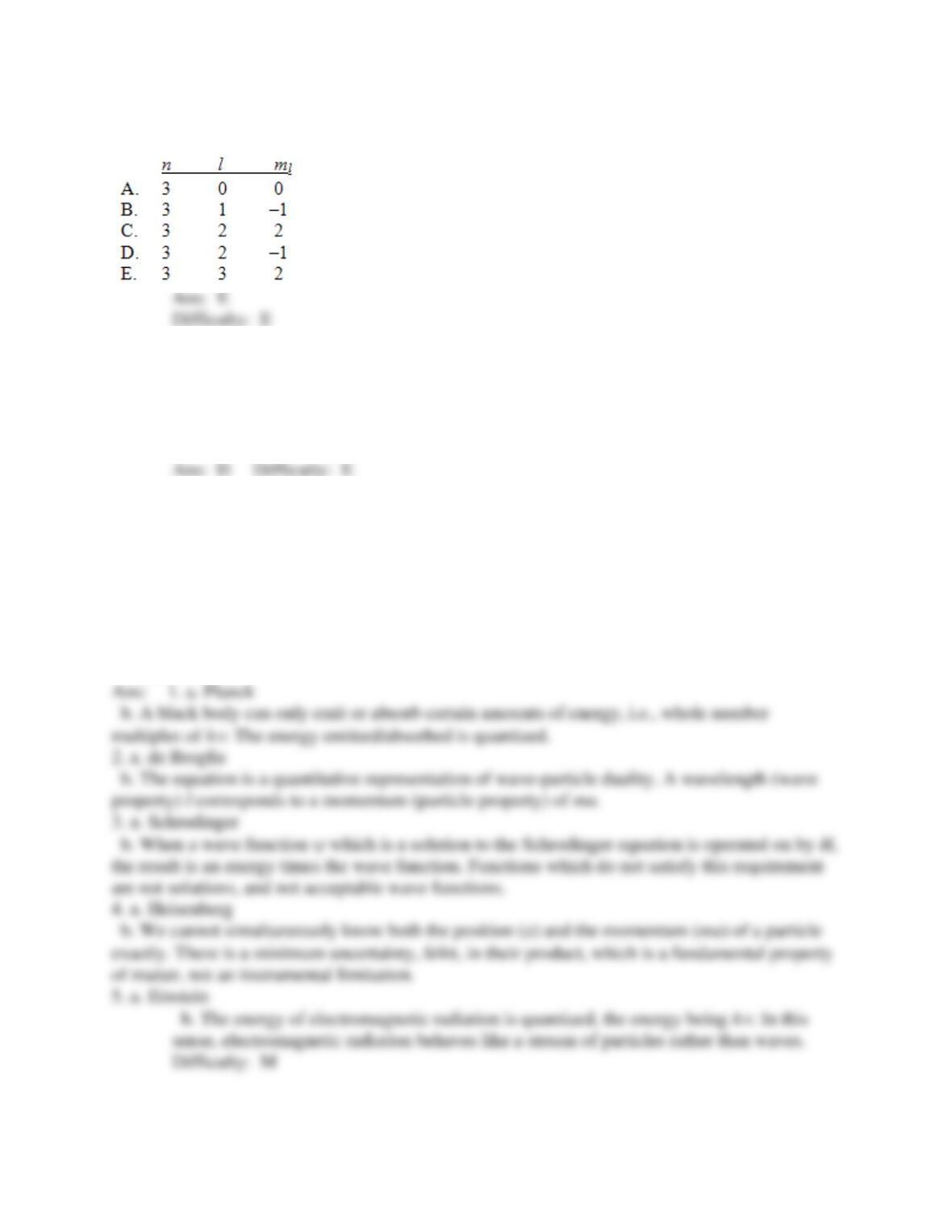
55. In the quantum mechanical treatment of the hydrogen atom, which one of the following
combinations of quantum numbers is not allowed?
56. Which one of the following sets of quantum numbers can correctly represent a 3p
orbital?
A) n = 3 l = 1 ml = 2 D) n = 3 l = 1 ml = –1
B) n = 1 l = 3 ml = 3 E) n = 3 l = 0 ml = 1
C) n = 3 l = 2 ml = 1
57. For the following equations
a. name the scientist to whom the equation is attributed.
b. in not more than three lines, explain clearly what the equation means or represents.
1. E = nh
2.
= h/mu
3. H = E
4. x
mu
h/4
5. Ephoton = h
Chapter 7: Quantum Theory and Atomic Structure
58. In not more than three lines for each answer, briefly outline one important scientific
contribution of each of the following:
a. Planck
b. de Broglie
c. Heisenberg
59. a. What is the frequency of microwave radiation which has a wavelength of 10.7 cm?
b. What is the energy of one photon of this radiation?
60. Use the Rydberg equation to calculate the wavelength, in nm, of the least energetic
(longest wavelength) line in the visible series (n1 = 2) of the spectrum of atomic hydrogen.
61. a. Calculate the wavelength in nm of a photon whose energy is 6.00 × 10⁻¹⁹ J.
b. Would the photon in (a) have enough energy to ionize a hydrogen atom in its ground state
(i.e., to separate the proton and electron completely)? Use the Bohr equation to explain your
answer.
62. a. Use Bohr’s equation to calculate how much energy (in J) is needed to promote an
electron from the H-atom ground state to the n = 4 level.
b. If a photon provides the energy in (a), what is its wavelength in nm?

Chapter 7: Quantum Theory and Atomic Structure
63. a. Use the Bohr equation to calculate the energy needed to ionize a hydrogen atom from
its ground state.
b. What is the minimum wavelength of a photon needed for it to have the energy needed in (a)?
64. Use the Bohr equation to calculate the energy of
a. the largest energy absorption or emission process involving the n = 2 state of the hydrogen
atom.
b. the smallest energy absorption or emission process involving the n = 2 state of the hydrogen
atom.
65. What is the speed of an electron in m/s if its wavelength is 0.155 nm?
66. a. Calculate the momentum of a photon of green light, wavelength 515 nm.
b. If this photon is traveling in a vacuum, what is its “mass”?
67. What is the minimum uncertainty in the position of a neutron if the uncertainty in its
speed is 0.0250 m/s?
68. In the quantum mechanical treatment of the hydrogen atom, the functions and 2 both
feature prominently. Briefly explain (in principle) how they are obtained and what, if anything,
their physical meanings are.

Chapter 7: Quantum Theory and Atomic Structure
69. Explain the context and meanings of the terms “orbit” and “orbital”, making a clear
distinction between them.
70. The following combinations of quantum numbers are not allowed. Correct each set by
changing only one quantum number, and write in an appropriate corrected value.
a. n = 2 l = 2 ml = 2 Corrected: ______ = ______
b. n = 4 l = –2 ml = 0 Corrected: ______ = ______
71. What are the possible values for the following quantum numbers in an atom?
a. n
b. l
c. ml
72. For the following orbitals, state the values or n, l and ml which apply, and draw a sketch
showing the shape and orientation of the orbital.
a. 3s
b. 2px
73. As the frequency of electromagnetic radiation increases, its wavelength also increases.
74. The energy of a photon is directly proportional to the wavelength of the radiation.
75. Line spectra are characteristic of atoms in the gas phase.
76. Continuous spectra are characteristic of heated solids.

Chapter 7: Quantum Theory and Atomic Structure
77. Continuous spectra are characteristic of molecules in the gas phase.
78. In the Rydberg equation, for a fixed value of n1, the longest wavelength line has n2 = .
79. The Rydberg equation is an example of an empirical equation.
80. The Rydberg equation, giving the wavelengths of lines in the spectrum of the hydrogen
atom, was obtained by assuming that energy is quantized.
81. In the Bohr model of the hydrogen atom, the electron moves in a circular path which
Bohr referred to as an orbital.
82. Other factors being constant, a heavy object will have a longer de Broglie wavelength
than a light object.
83. A wave function for an electron is called an atomic orbital.
84. In the quantum mechanical treatment of the hydrogen atom, the probability of finding an
electron at any point is proportional to the wave function .
85. In the quantum mechanical treatment of the hydrogen atom, the energy depends on the
principal quantum number n but not on the values of l or ml.