Introduction to Chemical Principles, 11e (Stoker)
Chapter 6 Electronic Structure and Chemical Periodicity
6.1 Multiple Choice
1) The periodic law states that when elements are arranged in order of ________ their properties
repeat themselves at regular intervals.
A) increasing atomic number
B) decreasing atomic number
C) increasing atomic mass
D) decreasing atomic mass
2) Elements constituting a period in the periodic table ________.
A) have similar chemical properties
B) are called isotopes
C) have consecutive atomic numbers
D) will always be in the same group
3) In which of the following sets of elements are all members of the set in the same group in the
periodic table?
A) 9F, 10Ne, and 11Na
B) 31Ga, 49In, and 81Tl
C) 14Si, 15P, and 16S
D) 20Ca, 26Fe, and 34Se
4) Which one of the following elements occupies position period 5 and group IIA on the periodic
table?
A) B
B) Y
C) Sr
D) Mg
5) Which element/classification pair is incorrectly matched?
Element Classification
A) Cd Transition metal
B) Li Alkali metal
C) Ce Transition metal
D) Ne Noble gas
6) Which of the following elements occupies position Period 5 and Group IIIA on the periodic
table?
A) P
B) In
C) As
D) Tl
7) Which of the following elements belongs to the halogen group?
A) Na
B) Cl
C) Fe
D) S
8) Which of the following is a period 2 alkaline earth metal?
A) Li
B) P
C) Be
D) Ca
9) Group IA elements are called:
A) alkali metals.
B) alkaline earth metals.
C) noble gases.
D) halogens.
10) The elements in groups IA, VIIA and VIIIA are called, respectively:
A) alkaline earth metals, halogens, chalcogens.
B) alkali metals, chalcogens, halogens.
C) alkali metals, halogens, noble gases.
D) alkaline earth metals, transition metals, halogens.
11) Which of the following is a quantized property of an electron?
A) energy
B) nuclear charge
C) number
D) charge to mass ratio
12) Which of the following would be an example of something that is quantized?
A) walking up a ramp
B) sliding down a hill
C) climbing a flight of stairs
D) all of the above
13) The maximum number of electrons found in a shell ________.
A) is the same as the shell number
B) doubles as the shell number increases by one
C) varies in an unpredictable manner
D) is equal to 2n2
14) What is the maximum number of electrons in the second energy level?
A) 2
B) 8
C) 10
D) 18
15) What is the maximum number of electrons in the n = 4 shell?
A) 16
B) 8
C) 18
D) 32
16) In the ground state of an atom
A) the excited states are all filled.
B) all the electrons are in their lowest energy levels.
C) the protons and neutrons fill all the available energy states.
D) the energy of the electrons are at a maximum.
17) Which response includes all the following statements that are true, and no others?
I. The f subshell contains 7 orbitals.
II. The third energy shell (n=3) has no f orbitals.
III. There are ten d orbitals in the d subshell.
IV. The second energy shell contains only s and p orbitals.
V. A p orbital can accommodate a maximum of 2 electrons.
A) I, II, and IV
B) II, III, and V
C) II and IV
D) I, II, IV, and V
18) Which of the following subshells is lowest in energy?
A) 6s
B) 3d
C) 4s
D) 5d
19) Which types of subshells are allowed in the n=2 energy level?
A) s
B) p
C) d
D) both s and p
20) How many types of subshells are in the n = 4 shell?
A) 2
B) 3
C) 4
D) 5
21) How many types of subshells are present in the third electron shell?
A) 1
B) 2
C) 4
D) 3
22) The term “main energy level” is closely associated with the term ________.
A) supershell
B) shell
C) subshell
D) orbital
23) Which of the following statements concerning electron subshells is correct?
A) Electrons in a subshell have equal energies.
B) The number of subshells in a shell is equal to S2.
C) Subshells are identified by a whole number integer only.
D) A p subshell exists in all shells.
24) Which of the following statements about a d subshell is incorrect?
A) It contains 5 orbitals.
B) It may contain a maximum of 10 electrons.
C) Is found in the 3rd energy level only.
D) It is found in all energy levels where n ≥ 3.
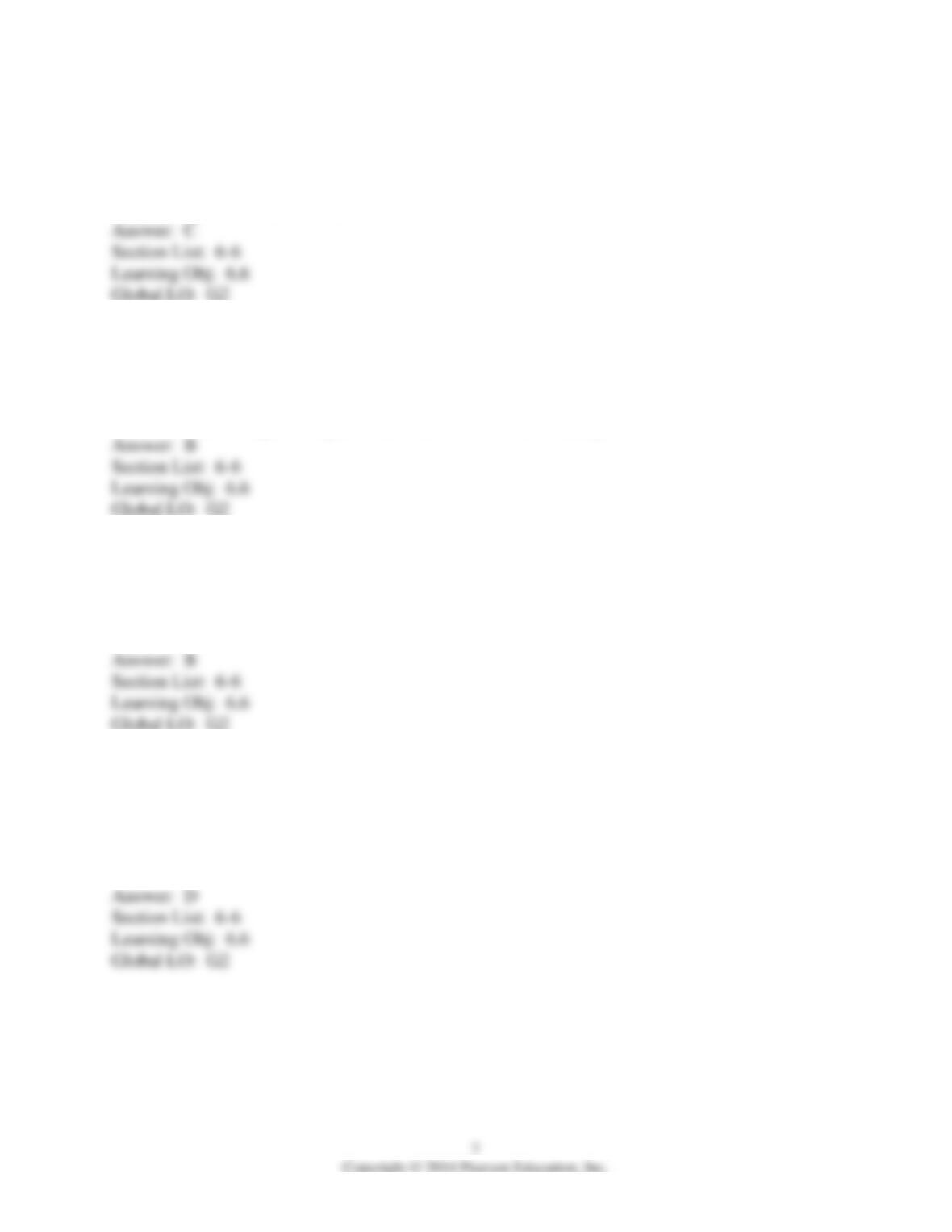
25) The shape of an orbital is most closely related to which of the following factors?
A) the average energy of electrons within the shell containing the orbital
B) the shell in which the orbital is located
C) the type of subshell in which the orbital is located
D) the number of electrons within the orbital
26) Which statement about orbitals is incorrect?
A) Different subshells have different shapes.
B) Two electrons can occupy each lobe of a p orbital.
C) At a given time, an electron can only be at one point in an orbital.
D) An orbital is a region of space where an electron is most likely to be found.
27) What is the maximum number of electrons that the d subshell can hold?
A) 32
B) 10
C) 5
D) 6
28) What is the maximum number of orbitals possible for the third principal energy level of an
atom?
A) 5
B) 8
C) 10
D) 9
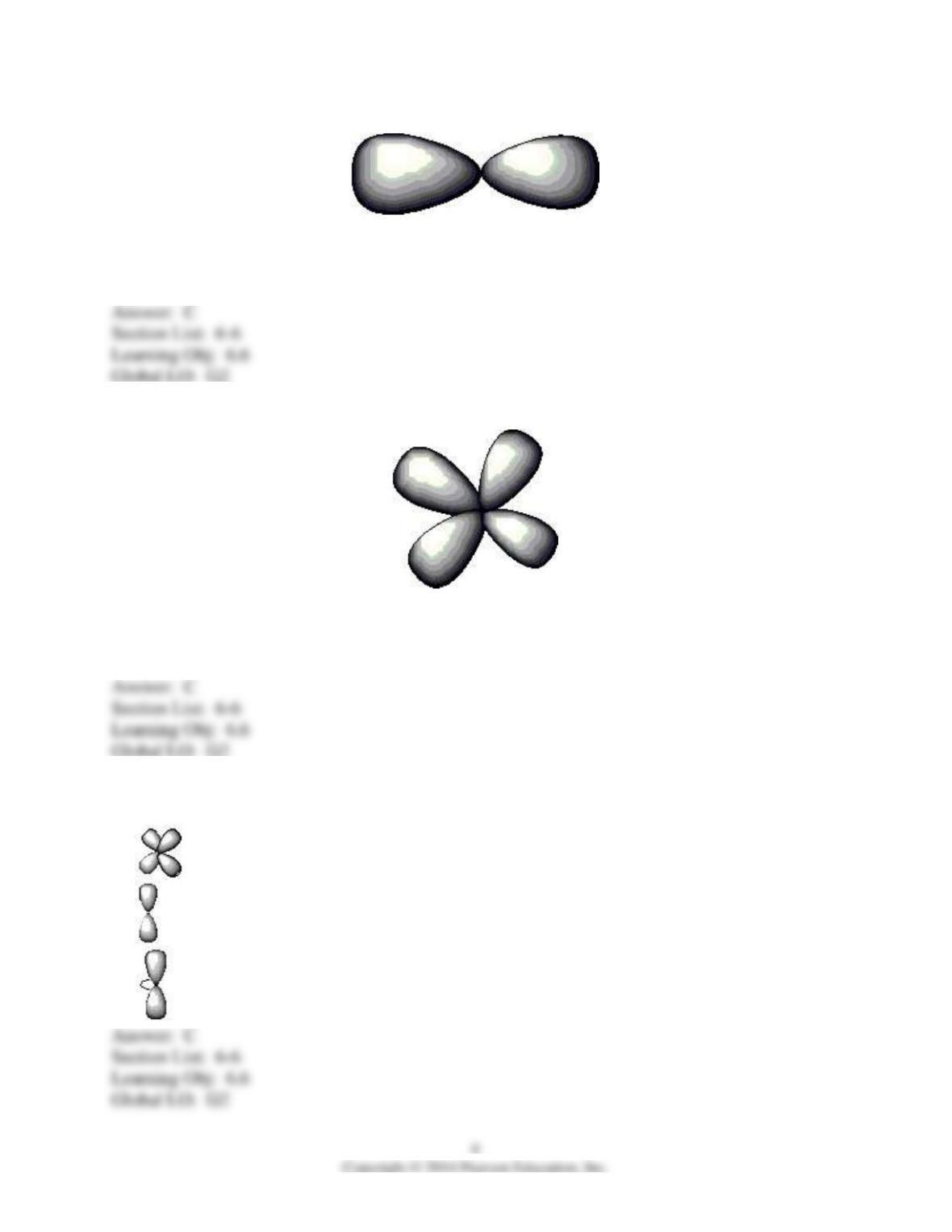
29) The atomic orbital depicted is a(n) ________ orbital.
A) d
B) s
C) p
D) f
30) The atomic orbital depicted below would be found in a ________ subshell.
A) 3p
B) 2s
C) 5d
D) 4f
31) Which of the following is a representation for a p orbital?
A) sphere
B)
C)
D)
32) At maximum, an f subshell can hold ________ electrons, a d subshell can hold ________
electrons and a p subshell can hold ________ electrons.
A) 14, 10, 6
B) 10, 14, 6
C) 18, 8, 2
D) 2, 12, 21
33) Which of the following subshell notations for electron occupancy is an impossibility?
A) 5s3
B) 4p5
C) 4f11
D) 2p1
34) In an atom with many electrons, which of the following orbitals would be highest in energy?
A) 7s
B) 6d
C) 4p
D) 4f
35) After the 5s subshell of an atom is filled with electrons, the next electron added will enter the
________.
A) 5p subshell
B) 4d subshell
C) 4p subshell
D) 5f subshell
36) Indicate the missing words in the following statement: The Aufbau principle states that
________ normally occupy the lowest energy subshell available.
A) nucleus
B) electrons
C) protons
D) neutrons
37) The correct electron configuration for manganese is ________.
A) 1s2 2s22p63s23p64s23d5
B) 1s22s22p63s23p63d6
C) 1s22s22p63s23p6
D) 1s22s22p63s23p64s23d104p1
38) The electron configuration 1s22s22p63s23p64s23d104p65s24d105p2 is that for the element
________.
A) Sb
B) Pb
C) As
D) Sn
39) How many electrons are there in the outermost shell and subshell, respectively, in an atom
with the electron configuration 1s22s22p63s23p64s23d104p1?
A) 10, 1
B) 2, 2
C) 4, 1
D) 3, 1
40) The element with the electron configuration given below is ________.
1s22s22p63s23p64s23d104p65s24d1
A) Sc
B) Si
C) La
D) Y
41) Which of the following electron configurations is incorrect as written?
A) 1s22s22p63s23p64s23d104p4
B) 1s22s22px22py22pz23s2
C) 1s22s22p63s23p63d10
D) 1s22s22p63s2
42) The electron configuration shown below is for the element ________.
1s22s22p63s23p64s23d104p4
A) Se
B) Ga
C) As
D) Br
43) Which element has the electron configuration [Kr]5s24d105p2?
A) Sn
B) Sb
C) Pb
D) Ge
44) Hund’s rule is needed in drawing an orbital diagram for which of the following elements?
A) krypton
B) lithium
C) boron
D) selenium
45) The number of unpaired electrons present in a magnesium atom is ________.
A) 0
B) 1
C) 3
D) 2
46) How many unpaired electrons are in a Ru atom?
A) 2
B) 4
C) 6
D) 0
47) In which pair are the atoms, Ba and Xe, correctly identified regarding their magnetic
properties?
A) Ba: diamagnetic Xe: diamagnetic
B) Ba: diamagnetic Xe: paramagnetic
C) Ba: paramagnetic Xe: diamagnetic
D) Ba: paramagnetic Xe: paramagnetic