48) Which of the following atoms is paramagnetic?
A) Ar
B) Ca
C) O
D) Zn
49) In the electron configuration of an arsenic atom, there are ________ unpaired electrons.
A) 2
B) 0
C) 1
D) 3
50) How many unpaired electrons are there in a phosphorous atom?
A) 1
B) 2
C) 3
D) 4
51) How many unpaired electrons are there in a oxygen atom?
A) 0
B) 1
C) 2
D) 3
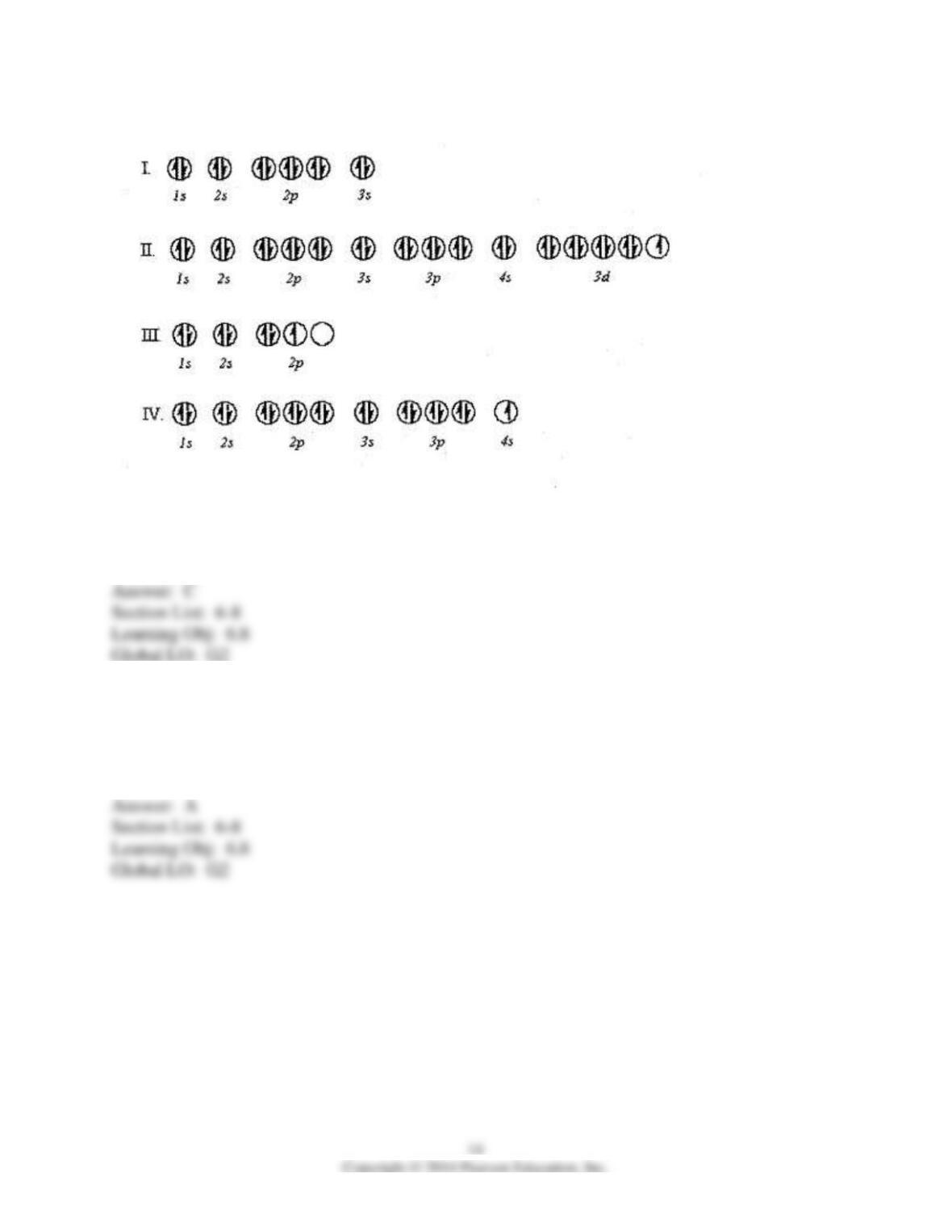
52) Which orbital diagram is incorrect according to Hund’s Rule?
A) Diagram I
B) Diagram II
C) Diagram III
D) Diagram IV
53) How many unpaired electrons would be present in an orbital diagram for a strontium atom?
A) 0
B) 1
C) 2
D) 3
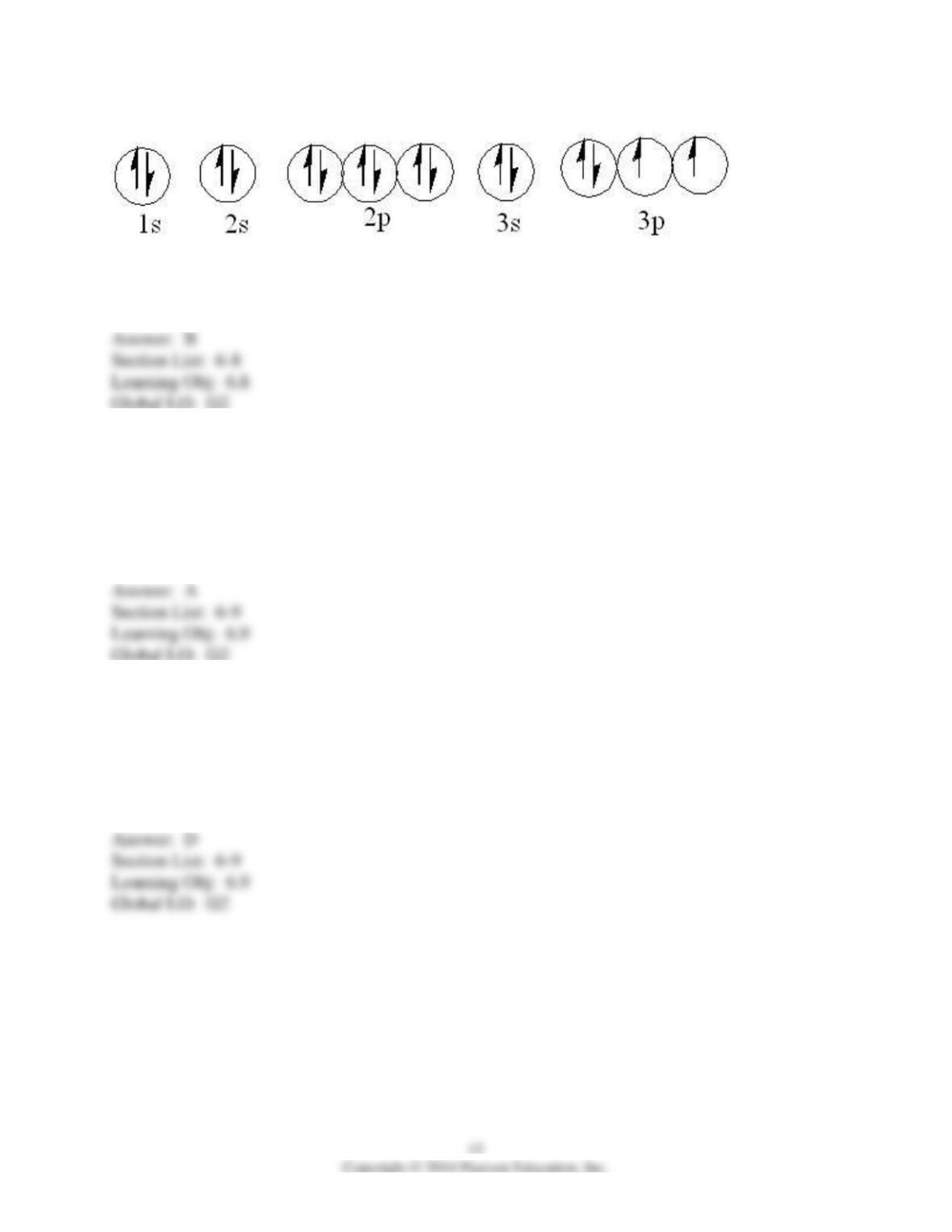
54) Which element is represented by the electronic orbital diagram given?
A) phosphorus
B) sulfur
C) chlorine
D) selenium
55) Which one of the following elements would be in the same group of the periodic table as the
element whose configuration is 1s22s22p63s23p64s1?
A) 3Li
B) 15P
C) 18Ar
D) 34Se
56) The elements in group IIA of the periodic table all have electron configurations ending in
________.
A) p2
B) p4
C) d4
D) s2
57) All of the elements in Group VIIA have an electron configuration that ends in ________.
A) p6
B) s2
C) d10
D) p5
58) Which of the following pairings is incorrect?
A) Au – d area of periodic table
B) Pr – d area of periodic table
C) Xe – p area of periodic table
D) Be – s area of periodic table
59) Which of the following elements has an electron configuration ending in 4f3?
A) 40Zr
B) 60Nd
C) 73Ta
D) 72Hf
60) The distinguishing electron is in the same type of subshell for which of the following pairs of
elements?
A) 3Li and 48Cd
B) 17Cl and 30Zn
C) 51Sb and 16S
D) 77Ir and 20Ca
61) An atom of an element has an electron configuration ending in 3p4. Which of the following
statements about the element’s electron configuration is incorrect?
A) There are eight electrons in the 2nd shell.
B) The 3rd shell needs two more electrons to be completely filled.
C) There are six electrons in the 3rd shell.
D) Five different subshells contain electrons.
62) Which of the following elements is an alkaline earth metal?
A) 38Sr
B) 21Sc
C) 34Se
D) 54Xe
63) Which of the following element-classification pairings is incorrect?
A) K – representative element
B) Ar – noble gas
C) Mo – transition element
D) Po – halogen
64) In which of the following pairs of elements is one element a metalloid and one element a
nonmetal?
A) 3As and 14Si
B) 51Sb and 20Ca
C) 32Ge and 9F
D) 82Pb and 83Bi
65) The number of known nonmetals is ________ the number of known metals.
A) about 1/4 that of
B) very small compared to
C) about four times greater than
D) about double
66) In which of the following areas of the periodic table do you find both metals and nonmetals?
(Ignoring the position of hydrogen).
A) both s and p areas
B) s area only
C) p area only
D) both p and d areas
67) Which column of the periodic table has 3 nonmetal and 2 metalloid elements?
A) Group IIIA
B) Group IVA
C) Group VA
D) Group VIA
68) Which type of subshell is filled by the distinguishing electron of an alkaline earth metal?
A) d
B) s
C) p
D) f
69) Which of the following pairs is incorrectly matched?
Element Type of Element
A) antimony metal
B) silicon metalloid
C) nitrogen nonmetal
D) arsenic metalloid
70) Which of the following statements concerning periodic trends is correct?
A) Metallic character decreases in moving from right to left across a given period in the periodic
table.
B) Nonmetallic character increases in moving from top to bottom down a group in the periodic
table.
C) Atomic radii tend to decrease from left to right in a period of the periodic table.
D) Atomic radii tend to decrease from top to bottom within a periodic table group.
71) The largest atoms are found where in the periodic table?
A) in the transition metals
B) in the lower left
C) in the upper left
D) in the lower right
72) Which of the following elements would be expected to have the least metallic character?
A) F
B) Ga
C) V
D) Ba
73) Which of the following is not a metallic property?
A) shiny
B) conducting
C) malleable
D) brittle
74) Which of the following elements would be expected to have the greatest nonmetallic
character?
A) Al
B) Ga
C) In
D) B
75) Which of the following elements has the largest atomic radius?
A) 11Na
B) 13Al
C) 15P
D) 17Cl
76) Which of the following elements is a metal?
A) 14Si
B) 13Al
C) 16S
D) 33As
77) Which is a characteristic property of nonmetals?
A) brittle
B) malleability
C) thermal conductivity
D) luster
78) Which element has the smallest atomic radius?
A) S
B) Br
C) Cl
D) Se
79) Which of the following elements would exhibit chemical properties most similar to nitrogen?
A) Ge
B) Zn
C) Sb
D) Ne
80) Which element has the largest atomic radius?
A) Cs
B) Ba
C) B
D) S
81) Which of the following elements is a metalloid?
A) Al
B) Si
C) N
D) Mg
82) Which element is the most metallic?
A) fluorine
B) barium
C) zinc
D) scandium
83) Which of the following atomic numbers is that of a noble gas?
A) 11
B) 32
C) 24
D) 10
84) Arrange the following elements in order of increasing atomic radius.
Sr, Rb, Sb, I, In
A) Rb < Sr < In < Sb < I
B) I < Sb < In < Rb < Sr
C) In < Sb < I < Sr < Rb
D) I < Sb < In < Sr < Rb
85) Rank the elements below in order of decreasing atomic radius:
Mg, Na, P, Si, Ar
A) Mg, Na, P, Si, Ar
B) Na, Mg, Si, P, Ar
C) Si, P, Ar, Na, Mg
D) Ar, Si, P, Na, Mg
6.2 Short Answer
1) Indicate whether the following statements are true or false.
A) An electron that has n = 5 could be in a s , p, d, or f subshell
B) The maximum number of electrons accommodated by the 4th energy shell (n = 4) is 32.
C) The third energy shell contains a total of 10 orbitals.
2) Circle the correct answer:
I) Electron configuration ends in 5p3
A) 33As B) 51Sb C) 73Ta D) 83Bi
II) 1s22s22p63s23p64s23d104p6
A) 36Kr B) 34Se C) 38Sr D) 52Te
III) 4f subshell begins filling
A) 37Rb B) 55Cs C) 58Ce D) 87Fr
IV) 2nd energy shell contains 4 electrons
A) 6C B) 14Si C) 4Be D) 8O
V) 3rd shell becomes completely filled
A) 12Mg B) 80Hg C) 30Zn D) 48Cd
VI) Number of electrons in the 3d subshell of Mn
A) 0 B) 5 C) 7 D) 10
VII) Contains a total of twenty-one p electrons
A) 36Kr B) 51Sb C) 54Xe D) 83Bi
VIII) Contains an equal number of d and p electrons
A) 16S B) 30Zn C) 36Kr D) 50Sn
IX) All orbitals in the outermost subshell are half filled
A) 9F B) 34Se C) 43Tc D) 19K
3) Write the electron configurations for the following:
A) O B) W C) Mg D) Br
4) Draw an orbital diagram for the electrons in the element cobalt.
5) Draw the orbital diagrams (for the valence shell only) for atoms with the following
condensed electron configurations. For each, tell what element it corresponds to.
A) [He] 2s22p5 B) [Ar] 4s2 3d7 C) [Kr] 5s24d105p3
6) A) Write the noble gas electron configuration and orbital diagram for an atom of niobium
(Nb).
B) Will this atom be larger or smaller than tantalum (Ta)?
7) A) Write the noble gas electron configuration and electron orbital diagram for an atom of
selenium (Se).
B) Will this atom be larger or smaller than krypton (Kr)?