Introductory Chemistry, 5e (Tro)
Chapter 6 Chemical Composition
True/False Questions
1) The chemical formula clearly indicates the relationship between the mass of each element in
the formula.
2) Mass is used as a method of counting atoms.
3) One hundred nickels must have the same mass as one hundred pennies.
4) The numerical value of the mole is defined as being equal to the number of atoms in exactly
12 grams of pure carbon-12.
5) The mole has a value of 6.023 × 10²².
6) Avogadro’s Number is 6.022 × 10²³.
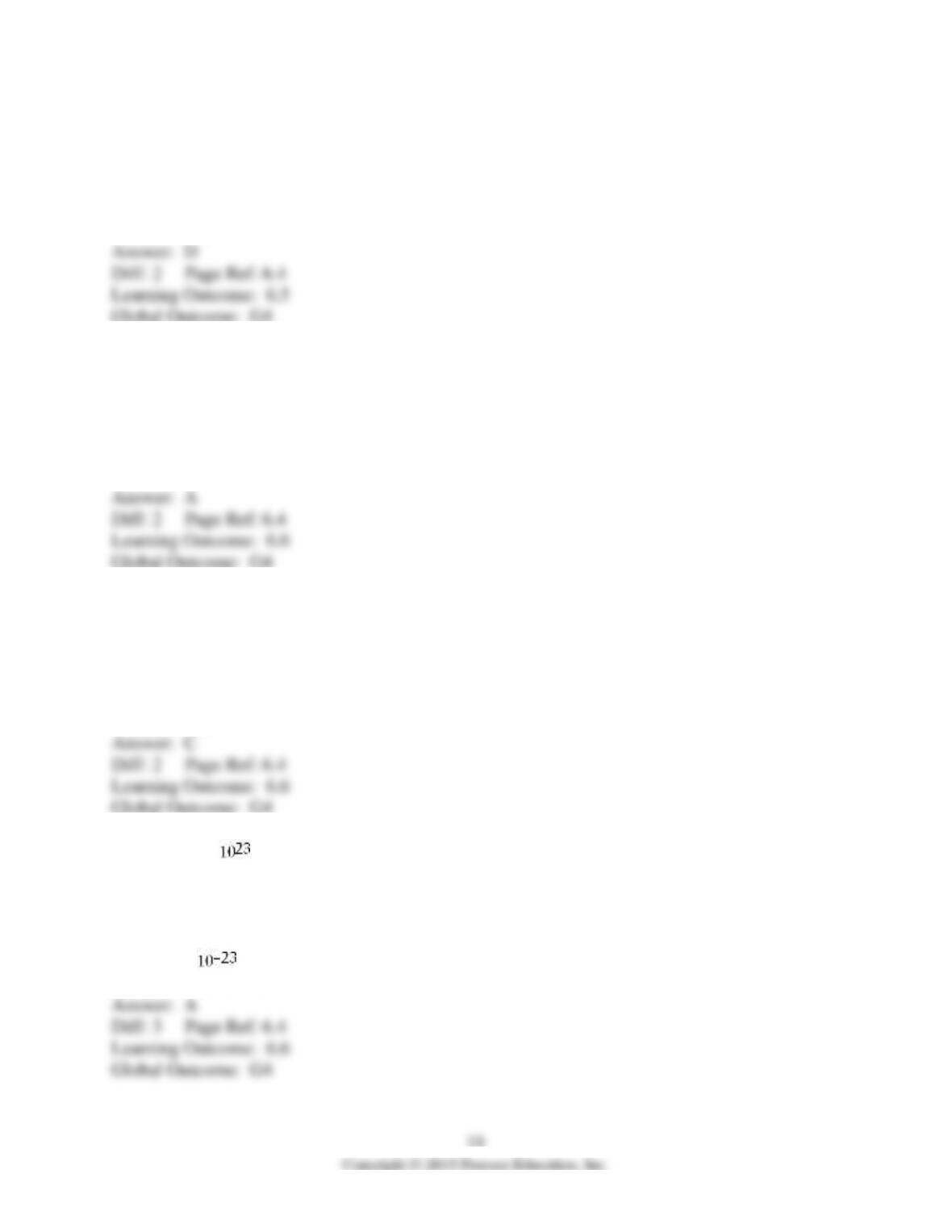
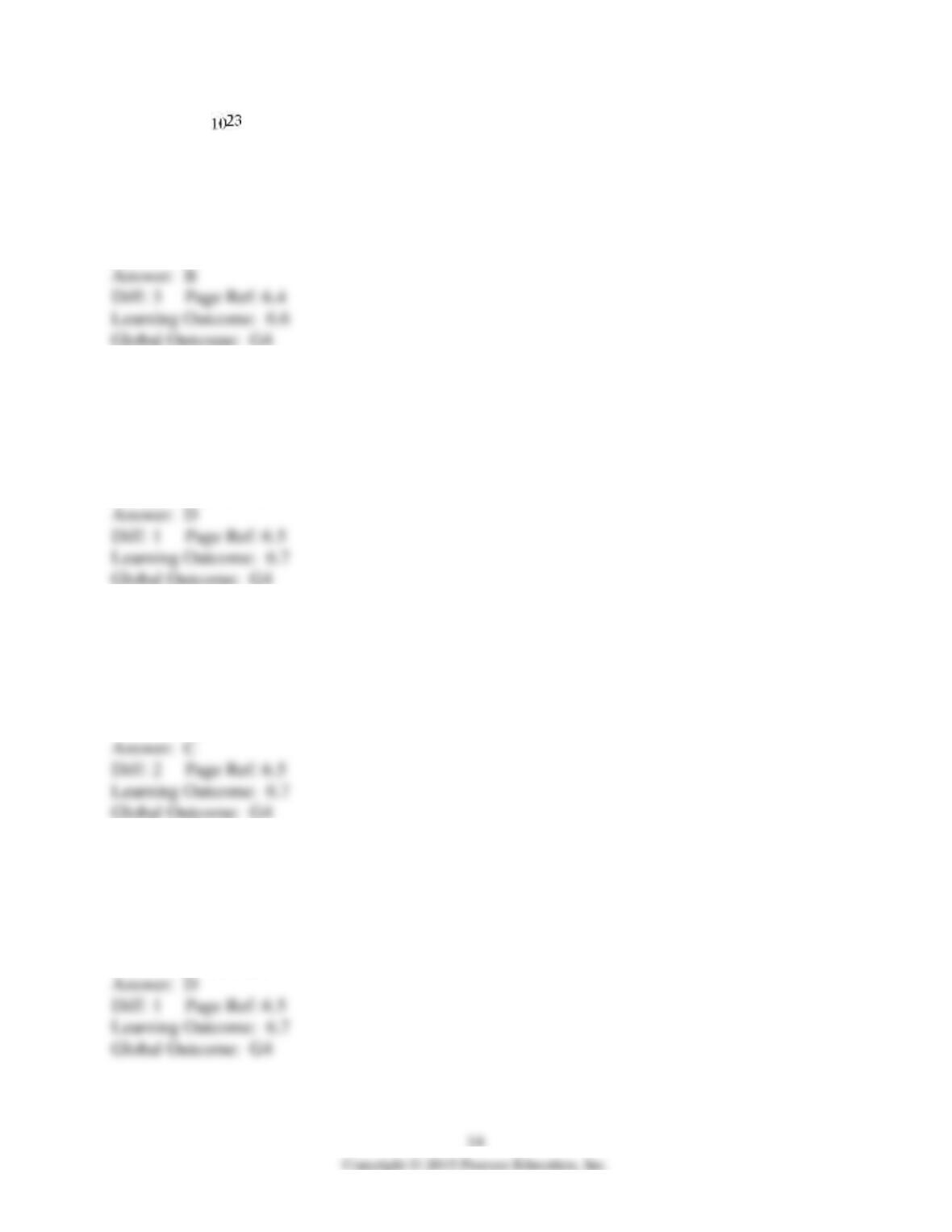
7) The number 6.022 × is six times larger than the number 6.022 × .
8) The lighter the atom, the less mass in one mole of that atom.
9) One mole of argon has more atoms in it than one mole of neon.
10) One mole of nitrogen gas contains (2) × (6.022 × 1023) nitrogen atoms.
11) One mole of zinc contains 65.39 zinc atoms.
12) One mole of copper atoms is 6.022 × 10²³ copper atoms.
13) The mass of 2.0 moles of H2O is greater than the mass of 1.0 mole of CO2.
14) One mole of chlorine gas has a mass of 35.45 grams.
15) Two moles of cobalt atoms have a mass of 117.87 grams.
16) Six grams of carbon contains 3.008 × 10²³ atoms.
17) One mole of I2 has more atoms in it than one mole of Na.
18) One mole of CO2 gas contains 1 mole of carbon atoms and 2 moles of oxygen atoms.
19) The molar mass of a compound in grams per mole is numerically equal to the formula mass
of the compound in atomic mass units.
20) One mole of water contains 16 grams of oxygen atoms.
21) One mole of water contains 6.022 × 10²³ hydrogen atoms.
22) There are 6 grams of carbon in 22 grams of carbon dioxide.
23) The molar mass of a compound serves as a conversion factor between grams and moles.
24) One mole of lead(II) nitrate contains six moles of oxygen atoms.
25) The chemical formula CuBr2 indicates that this compound is composed of 1 gram of copper
and of bromine.
26) The correct formula for calculating mass percent of X in compound XY is:
= Mass % X
27) Water is 11.2% hydrogen by mass.
28) C2H3O2 could be an empirical formula.
29) C2H6O3 could be an empirical formula.
30) C2H6O4 could be an empirical formula.
31) An empirical formula gives the specific number of each type of atom in a molecule.
32) An empirical formula gives the smallest whole number ratio of each type of atom in a
molecule.
33) The empirical formula for C6H6 is C3H3.
34) The molecular formula is equal to the empirical formula multiplied by a whole number
integer.
35) A molecule that has an empirical formula of HO and a molar mass of 34.02 gram must have
a molecular formula of H2O2.
36) The empirical formula mass is 18.0 and the molecular formula mass is 90, therefore n = 5.
37) The empirical formula mass must be 25.0 if the molecular formula mass is 250 and n = 5.
Multiple Choice Questions
1) What is the correct value for Avogadro’s number?
A) 6.022 × 10²³
B) 6.022 × 1033
C) 6.023 × 10²²
D) 6.022 × 102.3
E) none of the above
2) One half of a mole of atoms would contain how many atoms?
A) 0.5
B) 3.011 × 10²³
C) 6.022 × 10²³
D) 6.022 × 1011.5
E) none of the above
3) Which of the following statements about the mole is FALSE?
A) One mole of atoms makes up an amount of atoms that can be seen with the naked eye.
B) A mole of a monatomic element corresponds to one Avogadro’s number of atoms.
C) One mole of a monatomic element has a mass equal to its atomic mass expressed in grams.
D) One mole of water contains 1/2 mole of oxygen atoms.
E) none of the above
4) How many atoms are in 5.80 moles of He?
A) 6.02 × 10²³
B) 1.03 × 10²³
C) 4.00
D) 3.49 × 1024
E) none of the above
5) How many atoms are in 1.50 moles of fluorine gas?
A) 6.022 × 10²³
B) 9.03 × 10²³
C) 18.98
D) 1.81 × 1024
E) none of the above
6) How many moles of Cu are in 1.48 × 1025 Cu atoms?
A) 0.0408
B) 24.6
C) 1.54 × 1025
D) 6.022 × 10²³
E) none of the above
7) One mole of boron has a mass of ________ g.
A) 9.012
B) 6.022 × 10²³
C) 5
D) 10.811
E) none of the above
8) One mole of oxygen gas has a mass of ________ g.
A) 16.0
B) 32.0
C) 6.022 × 10²³
D) 8
E) none of the above
9) What is the mass in grams of 5.40 moles of lithium?
A) 6.94
B) 37.5
C) 1.29
D) 3.25 × 1024
E) none of the above
10) What is the mass of 0.560 moles of chlorine gas?
A) 19.9
B) 63.3
C) 127
D) 39.7
E) none of the above
11) You have 10.0 g each of Na, C, Pb, Cu and Ne. Which contains the largest number of moles?
A) Na
B) C
C) Pb
D) Cu
E) Ne
12) You have 10.0 g each of Na, C, Pb, Cu and Ne. Which contains the smallest number of
moles?
A) Na
B) C
C) Pb
D) Cu
E) Ne
13) How many moles of iron are contained in 1.75 kg of iron?
A) 3.13 × 10⁻²
B) 3.13 × 10⁻⁴
C) 31.3
D) 3.13 × 10⁴
E) none of the above
14) How many moles are there in 17.5 grams of sodium?
A) 22.99
B) 1.05 × 1025
C) 0.761
D) 1.31
E) none of the above
15) How many moles are there in 82.5 grams of iron?
A) 4.97 × 1025
B) 55.85
C) 0.677
D) 1.48
E) none of the above
16) How many moles of bromine gas are in 37.7 grams?
A) 0.236
B) 0.472
C) 3.01 × 10³
D) 79.9
E) none of the above
17) How many atoms are in 15.6 grams of silicon?
A) 2.64 × 1026
B) 3.34 × 10²³
C) 0.555
D) 438
E) none of the above
18) How many hydrogen atoms are in 35.0 grams of hydrogen gas?
A) 4.25 × 1025
B) 2.09 × 1025
C) 2.12 × 1025
D) 1.05 × 1025
E) none of the above
19) What is the mass of 3.09 × 1024 atoms of sulfur in grams?
A) 9.64 × 10²²
B) 9.91 × 1025
C) 165
D) 0.160
E) none of the above
20) How many moles of Pb are in 4.71 × 10²¹ Pb atoms?
A) 0.00782
B) 2.84 × 1045
C) 207.2
D) 6.022 × 10²³
E) none of the above
21) What is the mass of 1.56 × 10²¹ atoms of magnesium in grams?
A) 4.72 × 10⁻⁵
B) 0.0630
C) 0.142
D) 1.07 × 10⁻⁴
E) none of the above
22) In comparing a balloon containing 25 grams of helium to a balloon containing 25 grams of
neon, which one of the following statements is TRUE?
A) Each balloon has an equal number of atoms.
B) The helium balloon has more atoms.
C) The neon balloon has more atoms.
D) This scenario cannot happen because gases have no mass.
E) none of the above
23) In comparing 1 mole of carbon atoms to one mole of magnesium atoms, which statement is
TRUE?
A) The mass of 1 mole of carbon is greater than the mass of 1 mole of magnesium.
B) The mass of 1 mole of magnesium is greater than the mass of 1 mole of carbon.
C) The mass of 1 mole of carbon is the same as the mass of 1 mole of magnesium.
D) There are more atoms in 1 mole of magnesium than in 1 mole of carbon.
E) none of the above
24) Which of the following contains 9.02 × 10²³ atoms?
A) 4.00 g H2
B) 9.00 g H2O
C) 28.0 g N2
D) 32.0 g O2
E) none of the above
25) The mass of one mole of carbon dioxide is ________ g.
A) 28.01
B) 384.4
C) 32.00
D) 44.01
E) none of the above
26) What is the molar mass of aluminum sulfate?
A) 123.0 g/mol
B) 278.0 g/mol
C) 306.2 g/mol
D) 315.2 g/mol
E) 342.2 g/mol
27) Calculate the molar mass of ammonium carbonate.
A) 78.05 g/mol
B) 88.05 g/mol
C) 96.09 g/mol
D) 112.09 g/mol
E) none of the above
28) Calculate the molar mass of calcium nitrate.
A) 136.03 g/mol
B) 102.09 g/mol
C) 132.10 g/mol
D) 164.10 g/mol
E) none of the above
29) How many molecules of sulfur trioxide are in 78.0 grams?
A) 5.87 × 10²³
B) 7.33 × 10²³
C) 3.76 × 1027
D) 0.974
E) none of the above
30) How many molecules of nitrogen monoxide are in a 22.5 gram sample?
A) 5.86 × 10²³
B) 7.33 × 10²³
C) 4.51 × 10²³
D) 4.06 × 10²³
E) none of the above
31) If 3.011 × molecules have a mass of 20.04 grams, what is the molar mass of this
substance?
A) 40.08 g/mol
B) 10.02 g/mol
C) 20.04 g/mol
D) 6.658 × g/mol
E) none of the above
32) If 2.01 × atoms of an element from Group IA of the periodic table has a mass of 7.675
grams, this element is most likely:
A) Li.
B) Na.
C) K.
D) Rb.
E) Cs.
33) One mole of (NH4)2HPO4 contains how many moles of hydrogen atoms?
A) 4
B) 2
C) 8
D) 9
E) none of the above
34) One mole of ammonium nitrate contains:
A) 3 moles of hydrogen.
B) 2 moles of oxygen.
C) 2 moles of nitrogen.
D) 1 mole of nitrogen.
E) none of the above
35) One mole of ammonium nitrite contains:
A) 2 moles of nitrogen atoms.
B) 4 moles of hydrogen atoms.
C) 2 moles of oxygen atoms.
D) All of A, B, and C.
E) None of A, B, and C.