Introduction to Chemical Principles, 11e (Stoker)
Chapter 5 Atoms, Molecules, and Subatomic Particles
5.1 Multiple Choice
1) Which of the following statements is not a part of atomic theory?
A) Chemical change involves a union, separation, or rearrangement of atoms.
B) A pure substance will have a varying relative number of atom types.
C) All matter is made up of atoms.
D) Atoms are considered indestructible during chemical change.
2) The diameters and masses of atoms are, respectively, on the order of ________.
A) 10−11 m and 10−11 g
B) 10−23 m and 10−10 g
C) 10−24 m and 10−10 g
D) 10−10 m and 10−23 g
3) Which of the following statements is incorrect according to the modern atomic theory?
A) An atom of 18O has the same approximate mass of an atom of 18F.
B) An example of a chemical reaction is 2C + O2 → 2 CO.
C) Some carbohydrates have a formula of C4.5H9O4.5.
D) H2O and H2O2 are possible compounds of hydrogen and oxygen.
4) Which one of the following statements about atoms is correct?
A) The proton is the smallest “piece” of an atom that can exist and still have the properties of the
atom.
B) Free, isolated atoms are virtually never encountered in nature.
C) Atoms may be decomposed using physical change.
D) Two kinds of atoms may be present in a homoatomic molecule.
5) Which one of the following statements about molecules is correct?
A) Some compounds have molecules as their basic structural unit.
B) For a molecular compound, the atom is the limit of chemical subdivision.
C) For a molecular compound, the atom is the limit of physical subdivision.
D) Molecules of compounds may be either heteroatomic or homoatomic.
6) Which one of the following statements about heteroatomic molecules is incorrect?
A) Atoms in a heteroatomic molecule may be the same atom.
B) Upon chemical subdivision, heteroatomic molecules always yield two or more kinds of
atoms.
C) Heteroatomic molecules do not maintain the properties of their constituent elements.
D) Elements are never heteroatomic molecules.
7) Which statement about ionic compounds is incorrect?
A) Ionic compounds do not contain individual molecules.
B) Ionic compounds are charged, they are not electrically neutral.
C) Ionic compounds have an extended 3-dimensional assembly of ions.
D) Ionic compounds do not share the characteristics of the constituent elements.
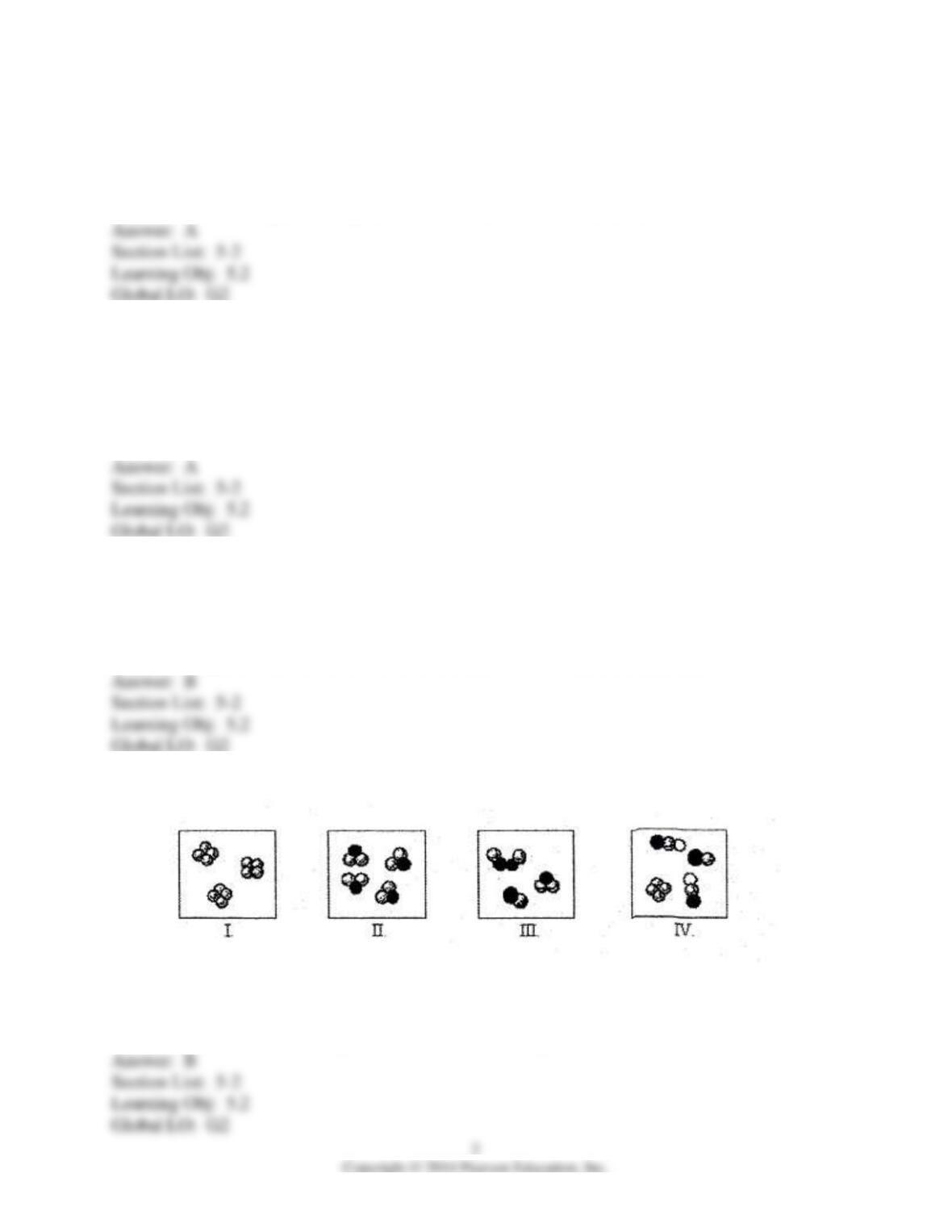
8) Which statement concerning the molecules depicted is incorrect?
A) The molecules in box I represent a pure substance.
B) The molecules in box III represent a mixture of elements.
C) The molecules in box II represent a compound composed of two different elements.
D) The molecules in box IV represents two different compounds and an element.
9) A compound that is made in the laboratory is called a ________ compound while a compound
found in nature is called a ________ compound.
A) synthetic, natural
B) natural, synthetic
C) synthetic, synthetic
D) natural, natural
10) An example of a compound that was once found in mold but is now made synthetically is
________.
A) cyclosporin
B) penicillin
C) vitamin C
D) aspirin
11) In the formula C4H8O2 ________.
A) there are 2 different elements
B) the ratio of carbon to hydrogen to oxygen atoms is 2:4:1
C) the percentage by mass of hydrogen is the same as oxygen
D) there is a total of 10 atoms
12) In which of the following compounds does one molecule of the compound contain 3
elements and 8 atoms?
A) NaHCO3
B) C2H7N
C) H3AsO4
D) POCl3
13) In which of the following pairs of formulas do the two members of the pair contain the same
number of elements as well as the same number of atoms?
A) Co and CO
B) NaHCO3 and NaHSO4
C) SO3 and SO2
D) Cl2CO and C2HCl
14) The total number of atoms present in 2 formula units of Ca(NO3)2 is ________.
A) 9
B) 18
C) 25
D) 30
15) The total number of atoms present in five formula units of Sr(C2H3O2)2 is ________.
A) 65
B) 75
C) 18
D) 15
16) How many atoms of each element are present in 3 formula units of (NH4)2HAsO4?
A) 10 N atoms, 18 H atoms, 5 As atoms, 18 O atoms
B) 6 N atoms, 9 H atoms, 3 As atoms, 12 O atoms
C) 5 N atoms, 45 H atoms, 4 As atoms, 18 O atoms
D) 6 N atoms, 27 H atoms, 3 As atoms, 12 O atoms
17) Which formula is correct for a molecule with 4 P atoms, and 10 O atoms?
A) P4O10
B) (P2O3)2
C) P2O5
D) P3O6
18) What is the total number of hydrogen atoms present in 6 formula units of Mg(C2H3O2)2?
A) 12
B) 6
C) 36
D) 24
19) What is the total number of atoms in 5 formula units of Fe2(C2O4)3?
A) 55
B) 80
C) 100
D) 96
20) What is the total number of O atoms in 6 formula units of hydroxyapetite,
Ca10(PO4)6(OH)2, present in tooth enamel?
A) 156
B) 144
C) 106
D) 88
21) Which of the following pairs of subatomic particles have charges of equal magnitude but
opposite in sign?
A) electron and neutron
B) neutron and proton
C) proton and electron
D) proton and positron
22) The nucleus of an atom ________.
A) contains all protons and electrons
B) is negatively charged because of the presence of electrons
C) is neutral since it contains only neutrons
D) is 1/10,000 of the size of the atom
23) Two atoms must represent the same element if they both have the same:
A) number of electron shells.
B) atomic number.
C) number of neutrons.
D) atomic mass.
24) Which one of the following carries no electrical charge?
A) an electron
B) a proton
C) a neutron
D) a cation
25) Atoms are neutral because ________.
A) all atoms contain neutrons
B) neutrons neutralize the (+) and (−) charges in the atom
C) the atomic number equals the number of electrons
D) equal numbers of protons and neutrons are present
26) Which statement about an atom is false?
A) The nucleus is the center region of an atom.
B) The space occupied by the electrons is primarily empty.
C) The nucleus accounts for a small portion of the mass of an atom.
D) The volume occupied by electrons is referred to as an electron cloud.
27) Adding one proton to the nucleus of an atom:
A) converts it to an atom of a different element.
B) increases its atomic mass by one unit, but does not change its atomic number.
C) increases its atomic number by one unit but does not change its atomic mass.
D) does not change either its atomic number or its atomic mass.
28) A neutral atom contains 12 neutrons and 14 electrons. The mass number and the number of
protons for this atom are, respectively, ________.
A) 14 and 26
B) 40 and 14
C) 26 and 14
D) 26 and 12
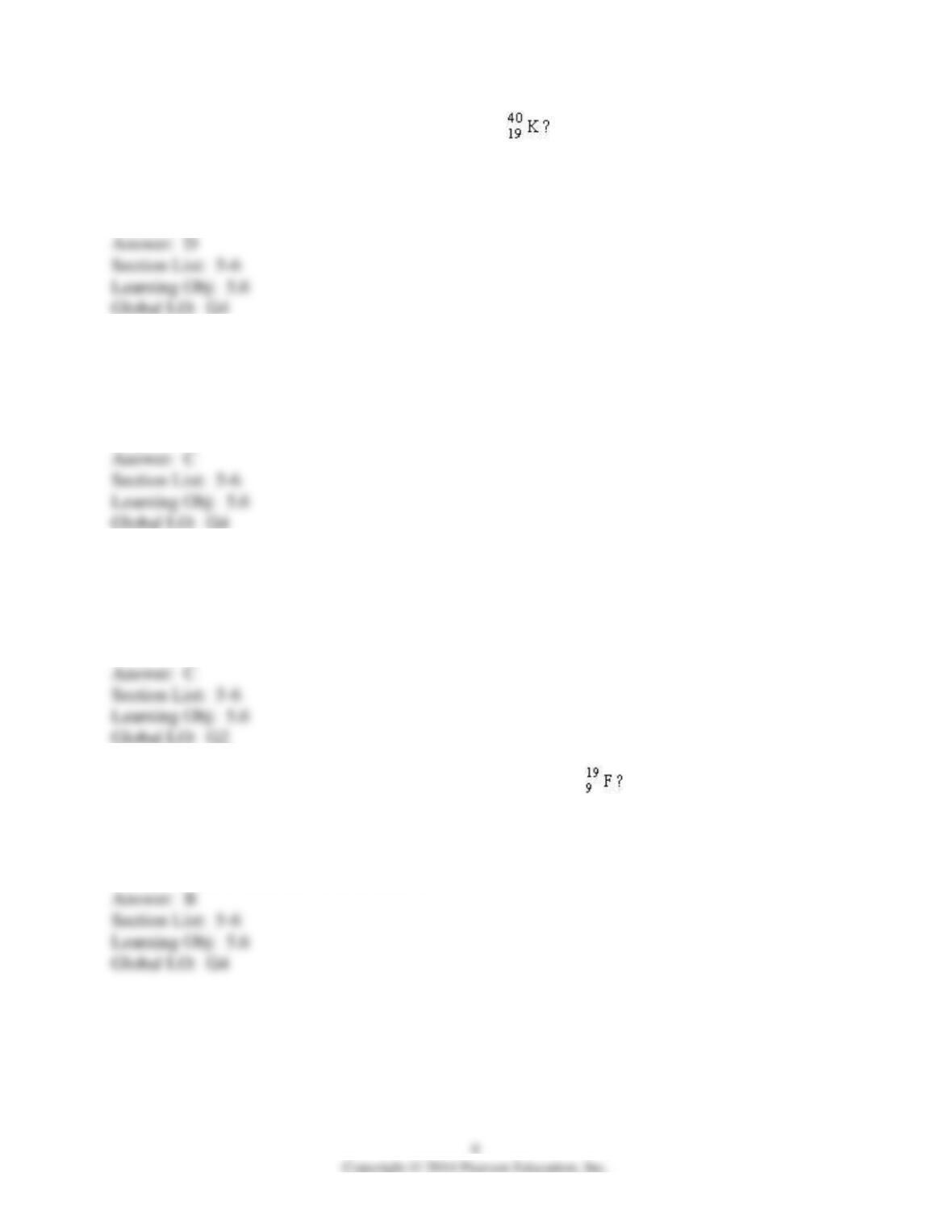
29) Which of the following statements is correct for
A) contains more protons than neutrons
B) contains more electrons than protons
C) contains an equal number of protons and neutrons
D) contains more neutrons than electrons
30) All atoms of a given element may have different numbers of ________.
A) gamma rays
B) nucleons
C) neutrons
D) protons
31) Where is most of the mass of an atom concentrated?
A) electrons
B) protons
C) nucleus
D) neutrons
32) What are the number of protons, neutrons, and electrons in
A) 9 protons, 9 neutrons, and 10 electrons
B) 9 protons, 10 neutrons, and 9 electrons
C) 19 protons, 19 neutrons, and 19 electrons
D) 9 protons, 9 neutrons, and 19 electrons
33) The number of electrons and neutrons in an atom of the type given below is ________.
25Mg
A) 12 e, 13 n
B) 25 e, 12 n
C) 13 e, 25 n
D) 12 e, 12 n
34) The number of neutrons in an atom is equal to:
A) the number of protons.
B) atomic number – mass number.
C) mass number – atomic number.
D) the number of electrons.
35) Which of the following statements is incorrect?
A) All atoms of an element have the same atomic number.
B) All atoms of an element must have the same mass.
C) All atoms of an element have the same number of electrons.
D) Atoms of an element may have different numbers of neutrons.
36) The total number of subatomic particles (protons, electrons, and neutrons) in an atom of
75Ge is ________.
A) 86
B) 84
C) 107
D) 143
37) Mercury-202 has how many neutrons in its nucleus?
A) 22
B) 102
C) 122
D) 202
38) What are the number of neutrons in a neutral atom of Ar-40?
A) 18
B) 22
C) 40
D) 58
39) Cobalt is atomic number 27. Cobalt-60 is used in the medical treatment of cancer. How many
neutrons and protons are contained in the nucleus of this isotope?
A) 27 neutrons, 33 protons
B) 33 neutrons, 27 protons
C) 27 neutrons, 27 protons
D) 33 neutrons, 33 protons
40) The number of protons, electrons and neutrons in an atom of the type given below is
________.
207Pb
A) 82 p, 125 e, 82 n
B) 82 p, 82 e, 125 n
C) 82 p, 125 e, 125 n
D) 125 p, 125 e, 164 n
41) An atom with a mass number of 58 and contains 32 neutrons will have ________ protons.
A) 32
B) 58
C) 26
D) 36
42) Choose the correct chemical symbol for an atom that contains 20 e− and 24 n.
A) 2420Ca
B) 4420Ca
C) 4424Cr
D) 2444Ru
43) Isotopes of a given element ________.
A) have the same mass number but different numbers of protons
B) have the same number of protons, but different mass numbers
C) have the same atomic number but different chemical properties
D) have the same mass number but different chemical properties
44) The nucleus of atom A contains 20 protons and 20 neutrons and that of atom B contains 22
protons and 22 neutrons. It is true that atoms A and B are ________.
A) isotopes
B) isobars
C) both isotopes and isobars
D) neither isotopes nor isobars
45) What is the mass number of a chromium isotope containing 28 neutrons?
A) 28
B) 24
C) 52
D) 76
46) The element Rhenium (Re) exists as two stable isotopes and 18 unstable isotopes. Rhenium-
185 (185Re) has in its nucleus:
A) 75 protons, 75 neutrons.
B) 75 protons, 130 neutrons.
C) 130 protons, 75 neutrons.
D) 75 protons, 110 neutrons.
47) Iron is element number 26. This means that it has ________.
A) a mass number of 26
B) 26 neutrons in the nucleus
C) 26 protons inside its nucleus
D) 56 electrons
48) What is the atomic number of an isobar of 188O in which there is an equal number of all
three types of subatomic particles present?
A) 8
B) 9
C) 10
D) 11