49) Which pair of neutrons and protons correspond to the isobars of Ar and Ca, which have a
mass number of 40?
A) Ar: 18 protons and 22 neutrons Ca: 20 protons and 20 neutrons
B) Ar: 18 protons and 22 neutrons Ca: 20 protons and 22 neutrons
C) Ar: 20 protons and 20 neutrons Ca: 18 protons and 22 neutrons
D) Ar: 22 protons and 18 neutrons Ca: 20 protons and 20 neutrons
50) Which of the following pairs of atoms contain the same number of neutrons?
A) 27Al and 31P
B) 9Be and 7Li
C) 22Ne and 23Na
D) 58Ni and 58Fe
51) Which of the following represents a pair of isotopes?
A) 14C, 14N
B) 1H, 2H
C) 32S, 32S-2
D) O2, O3
52) Chlorine, which exists in nature in two isotopic forms, has an atomic mass of 35.5 amu. This
means that ________.
A) all chlorine atoms have masses of 35.5 amu
B) 35.5 amu is the upper limit for the mass of a chlorine atom
C) 35Cl and 37Cl each constitute approximately 50% of all chlorine atoms
D) 35Cl constitutes 75% of full chlorine atoms, 37Cl represents 25%
53) An isotope of which element is used as the standard for the relative mass scale for atoms?
A) carbon
B) oxygen
C) hydrogen
D) helium
54) The isotopic mass for a particular isotope of gold is 196.9665 amu. The mass number for this
gold isotope ________.
A) is 79
B) is 196
C) is 197
D) cannot be determined from the information given
55) Three naturally occurring isotopes exist for the hypothetical element athenium. 2.50% of
athenium atoms have a relative mass of 26.0 amu, 75.0% of athenium atoms have a relative mass
of 27.0 amu, and 22.5% of athenium atoms have a relative mass of 28.0 amu. What is the atomic
mass of athenium?
A) 26.8 amu
B) 27.0 amu
C) 28.0 amu
D) 27.2 amu
56) Element A exists in three isotopic forms with masses of 21.0, 25.0 and 26.0 amu
respectively. Element B also exists in three isotopic forms with masses of 22.0, 24.0 and 26.0
amu respectively. It is true that ________.
A) element A has a higher atomic mass than B
B) element B has a higher atomic mass than A
C) A and B have identical atomic masses since the sums of their isotopic masses are equal
D) you need the percentages of each isotope to determine their atomic masses
57) What is the atomic mass of B if 19.9% of all B atoms have a mass of 10.01 amu and 80.1%
have a mass of 11.01 amu?
A) 10.21 amu
B) 10.50 amu
C) 10.63 amu
D) 10.81 amu
58) On a hypothetical relative mass scale, the average mass of the atoms of element A was
assigned a value of 64.00 gigs. The average mass of the atoms of element B is 36.40% that of
element A, and the average mass of the atoms of element C is 6.43 times the mass of A. What is
the average mass of the atoms of element C rounded to the nearest 0.01 gigs?
A) 34.98 gigs
B) 439.70 gigs
C) 87.67 gigs
D) 411.52 gigs
59) A hypothetical element, Rz, has two isotopes: 169Rz = 168.94 amu and 171Rz = 170.98
amu. Eleven of every fifteen atoms of Rz found in nature exist as the 169Rz isotope. What is the
average atomic mass of the element Rz?
A) 169.48 amu
B) 168.95 amu
C) 170.56 amu
D) 171.01 amu
60) Three naturally occurring isotopes of carbon exist: The atomic mass of carbon is 12.01 amu.
Which of the
three carbon isotopes is most abundant in nature?
A) carbon-12
B) carbon-13
C) carbon-14
D) all three occur with equal abundance
61) Which of the following was not a conclusion obtained from the gold foil-alpha particle
scattering experiment?
A) An atom is mostly empty space.
B) An atom’s nucleus is positively charged.
C) An atom’s nucleus contains protons and neutrons.
D) Most of the mass of an atom is concentrated in its nucleus.
62) Which is a conclusion about the atom’s structure from Rutherford’s gold foil-alpha particle
experiments?
A) The electrons occupy most of the total volume of an atom
B) The mass of an atom is distributed uniformly throughout the atom.
C) All alpha particles are affected the same way by the atoms in the gold foil.
D) The positive charge of the atom is uniformly distributed throughout the atom.
63) Which experiment led to the notion that the atom contains an extremely small, positively
charged nucleus?
A) Millikan’s oil drop experiment
B) Rutherford’s gold foil experiment
C) Thomson’s cathode ray experiment
D) Dalton’s atomic experiment
5.2 Short Answer
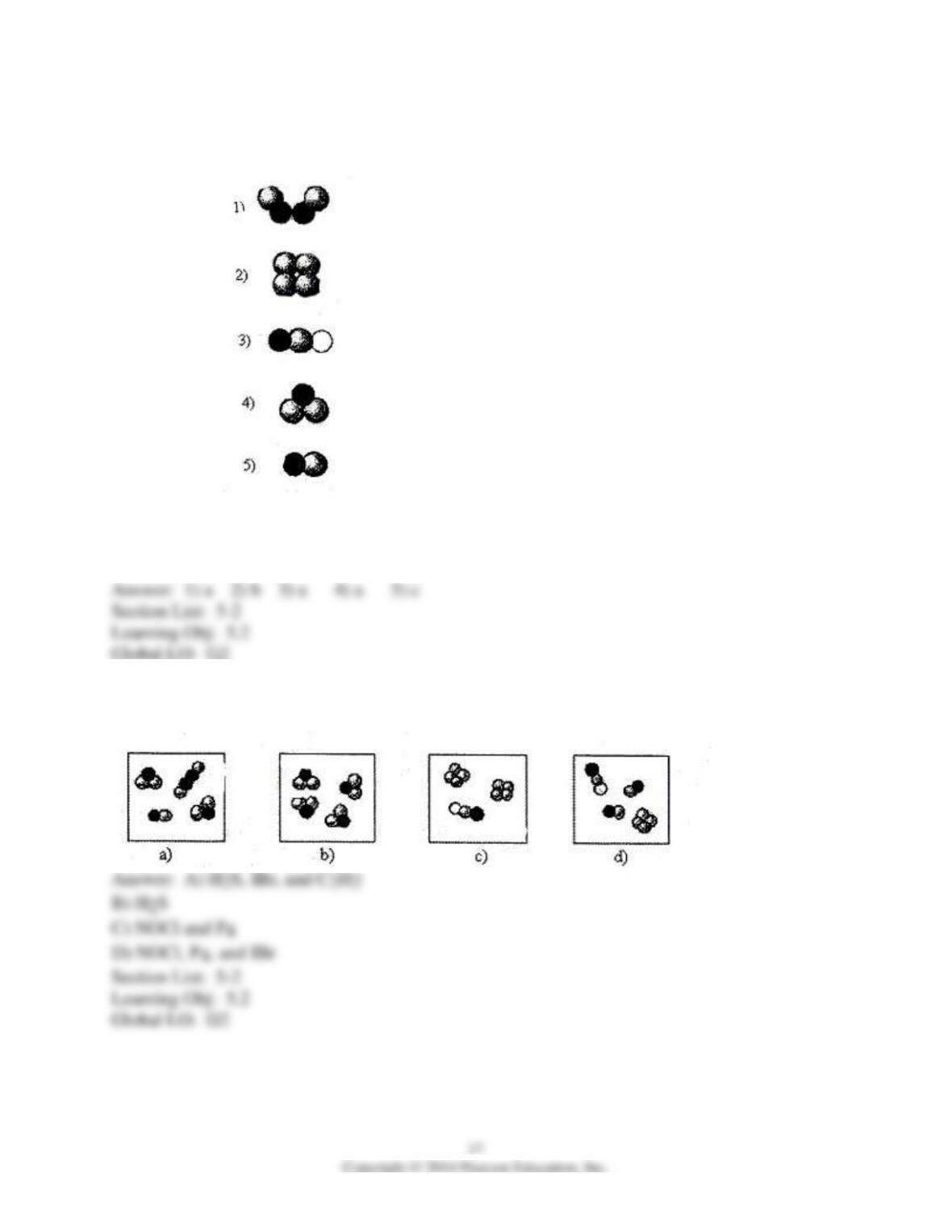
1) Match the molecules with the appropriate classification.
A) heteroatomic — polyatomic molecule
B) homoatomic — polyatomic molecule c
C) heteroatomic — diatomic molecule
D) homoatomic — diatomic molecule
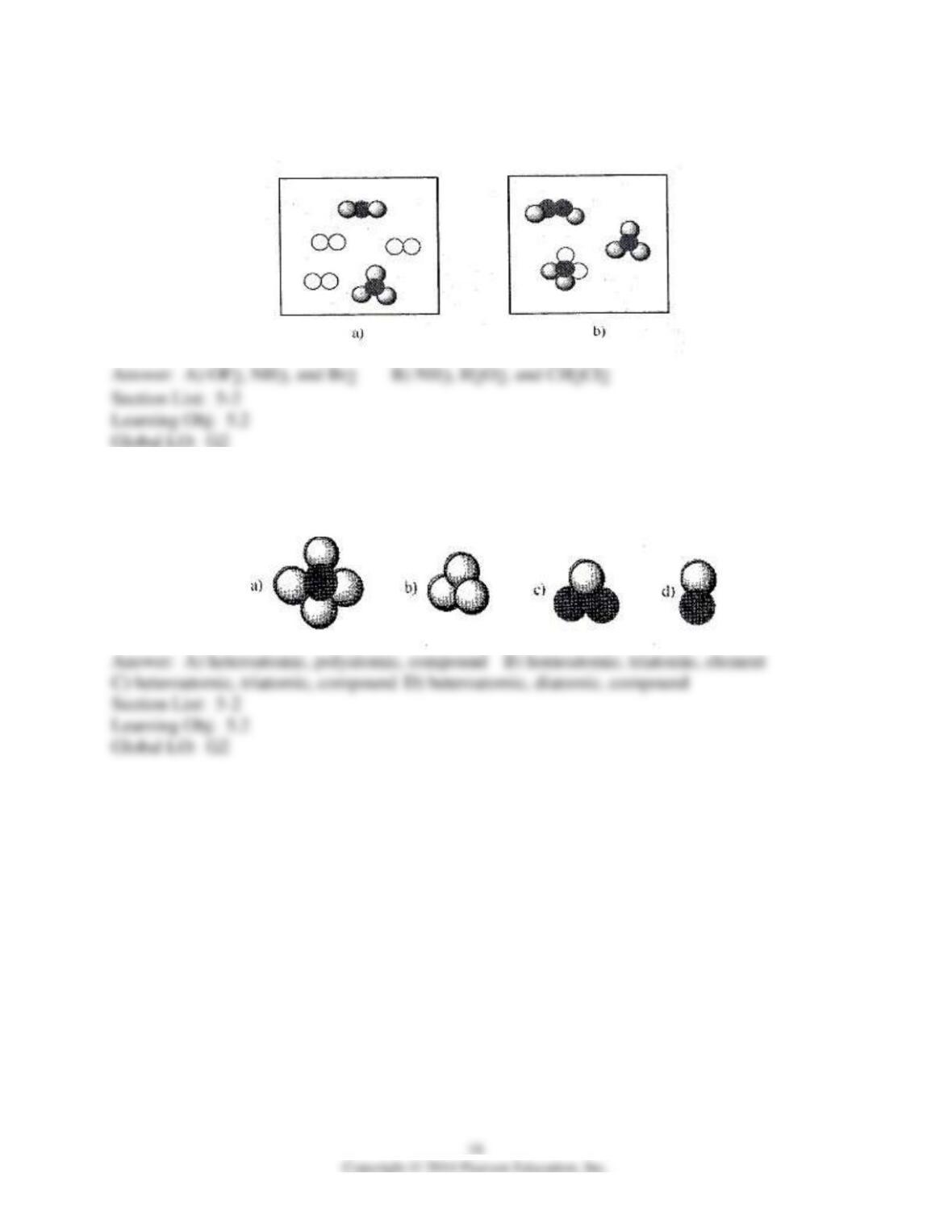
2) Depicted are molecules that represent the following substances: NOCl, P4, H2S, IBr, and
C2H2. Identify the substances present in each box.
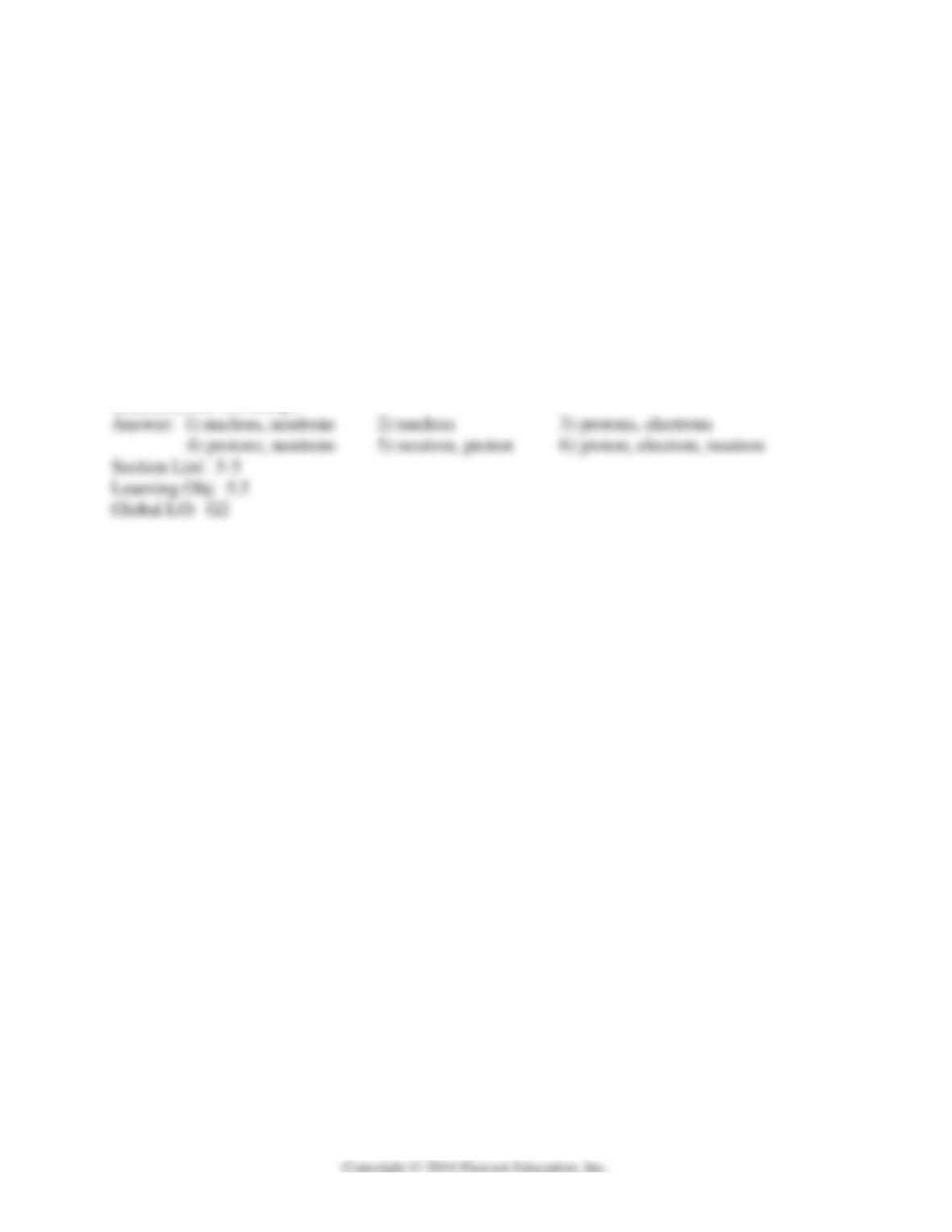
3) Depicted below are molecules that represent the following substances: OF2, NH3, H2O2,
CH2Cl2, and Br2. Identify the substances present in each box.
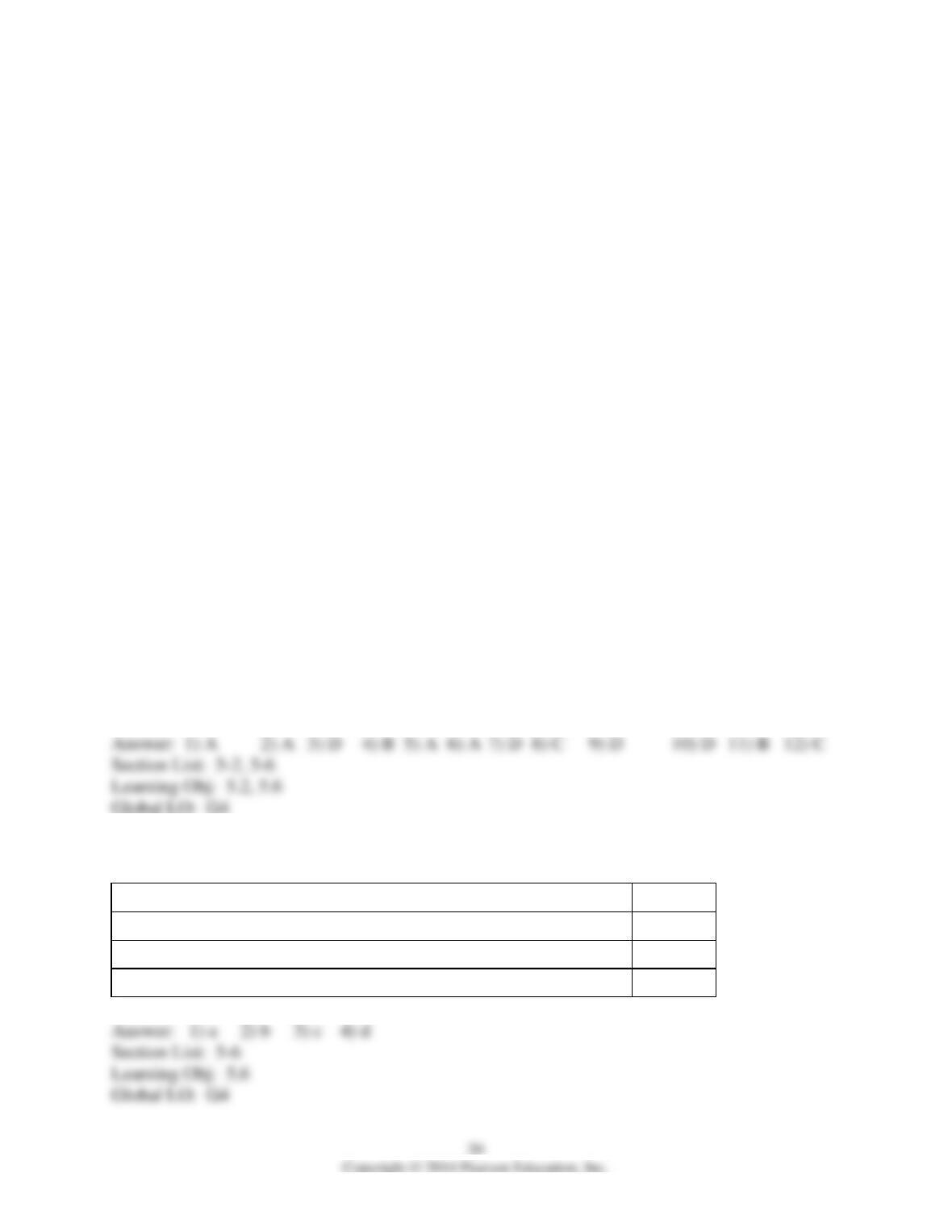
4) Which of the terms heteroatomic, homoatomic, diatomic, triatomic, polyatomic, element and
compound apply to each of the following molecules? More than one term may apply in a given
situation.
19
5) Fill in the blanks in the following sentences using words from the following response list:
Response List: proton(s) neutron(s) electron(s) nucleus
atomic number mass number atomic mass
Items in the response list may be used more than once or need not be used at all.
1) The ________ of an atom contains protons and ________.
2) The identity of an atom (which element it is) is determined by the number of protons in its
________.
3) The atomic number gives the number of ________ and ________ in a neutral atom.
4) The mass number for an atom equals the sum of the ________ and ________ in the atom’s
nucleus.
5) The mass of a ________ (a neutral species) is many times greater than the mass of an
electron and is approximately the same as the mass of a ________.
6) The ________ possesses a plus one charge, the ________ a minus one charge, and the
________ has no charge.
6) Place in the blank the letter of the correct response in each horizontal row of choices.
1) ________ Number of elements in the compound Al2SO4
A) 3 B) 4 C) 5 D) 7
2) ________ Number of atoms in the formula Ca(HCO3)2
A) 11 B) 15 C) 9 D) 10
3) ________ Number of neutrons in 3216S
A) 15 B) 17 C) 20 D) 16
4) ________ Number of electrons in 2010Ne
A) 20 B) 10 C) 30 D) 12
5) ________ Number of subatomic particles in 188O
A) 26 B) 8 C) 18 D) 22
6) ________ Number of protons in 147N
A) 7 B) 8 C) 14 D) 20
7) ________ Identity of X in 18675X
A) Ti B) Cr C) I D) Re
8) ________ Mass number of a K isotope containing 21 neutrons
A) 19 B) 21 C) 40 D) 28
9) ________ Mass number of an isotope containing 45 protons and 58 neutrons
A) 13 B) 45 C) 58 D) 103
10) ________ An isobar of 5728X
A)5626X B) 5627X C) 5828X D) 5729X
11) ________ An atom of Cu containing an equal number of protons, neutrons and electrons
A) 2929Cu B) 5829C C) 8729Cu D) 2958Cu
12) ________ Nuclear charge of 2311Na
A) +10 B) +12 C) +11 D) +23
7) For each description on the left select the correct atom from the response list on the right.
Responses may be used more than once or need not be used at all.
1) ________ Has a mass number of 80
a) 8040A
2) ________ Has an equal number of protons and neutrons
b) 4020B
3) ________ Has more electrons than neutrons
c) 4121C
4) ________ Has more neutrons than electrons
d) 3919D
8) Fill in the chart below for each of the following isotopes. Be careful there may be more than
one ion present.
Symbol Atomic # Mass # #Protons #Neutrons #Electrons
13153I ________ ________ ________ ________ ________
________ 43 99 ________ ________ 43
3717Cl– ________ ________ 17 20 ________
________ 26 56 ________ ________ 23
9) The hypothetical element supposium exists in four isotopic forms. The relative masses and
percentage abundances for these four isotopes are, respectively,
66.0 amu and 1.230% 67.0 amu and 9.800%
69.0 amu and 2.410% 70.0 amu and 86.56%
Calculate the atomic mass of supposium.
10) Naturally occurring iron contains 5.82% 54Fe, 91.66% 56Fe, 2.19% 57Fe, and 0.33% 58Fe.
The respective atomic masses are 53.940 amu, 55.935 amu, 56.935 amu, and 57.933 amu.
Calculate the average atomic mass of iron.
11) There are five naturally abundant isotopes of elemental nickel are 58Ni, 60Ni, 61Ni, 62Ni
and 64Ni. Based on these five isotopes, calculate the average atomic mass for elemental nickel
given the following isotope masses and percent abundances.
Isotope Isotopic mass Percent abundance
58Ni 57.9353 amu 68.08
60Ni 59.9308 amu 26.22
61Ni 60.9311 amu 1.14
62Ni 61.9283 amu 3.63
64Ni 63.9280 amu 0.93
12) On a new atomic mass scale suppose the reference point is fluorine-19 whose mass is
arbitrarily set at 10.0 dingbats. (Note that only one type of fluorine atom exists; that is, fluorine is
monoisotopic). Calculate the atomic mass of silicon on this new “dingbat” scale.
13) The hypothetical element athenium (Ah) occurs in two isotopic forms: (86.500%
abundance, relative mass of 230.145 amu) and (13.500% abundance, relative mass of
231.769 amu). Calculate the atomic mass of athenium.
14) Determine the relative mass for the hypothetical elements Zp and Wq given the following
information.
The element Xu has an atomic mass of 24.00 jigs.
The element Wq is three times lighter than Xu.
The element Zp is two and a half times heavier than a Xu.
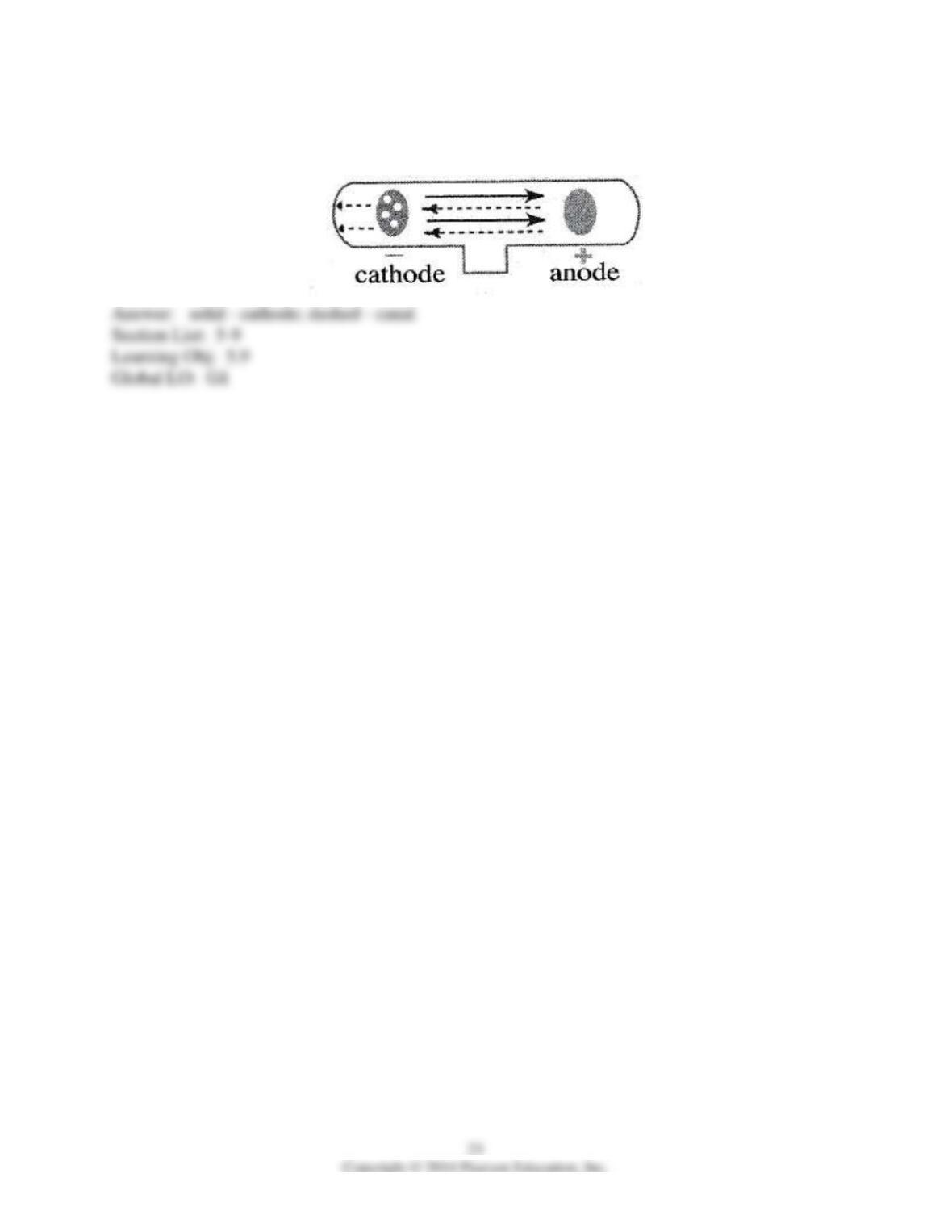
15) Depicted below is discharge tube. The cathode and the anode are composed of two different
metals. If a voltage is applied to the electrodes, the solid arrows represent the flow of ________
rays and the dashed lines represent the flow of ________ rays.