
Chapter 5: Gases and the Kinetic-Molecular Theory
1. A ballerina weighs 103 lbs and is up on her toes with only 10.0 cm2 of her slippers in
contact with the floor. What pressure is she exerting on the floor?
A) 4.59 × 10⁵ Pa D) 4.59 × 10⁻¹ Pa
B) 4.59 × 10³ Pa E) 4.59 × 10⁻³ Pa
C) 4.59 × 101 Pa
2. Given that pressure has dimensions of force ÷ area; that force has dimensions of mass ×
acceleration; and that the S.I. unit of pressure is the pascal, what is 1 pascal in terms of S.I. base
units? A) 1 Pa = 1000 g/cms2 D) 1 Pa = 1 kgm/s2
B) 1 Pa = 1 g/ms2 E) 1 Pa = 1 kg/ms2
C) 1 Pa = 10-3 kgm/s2
3. Mineral oil can be used in place of mercury in manometers when small pressure changes
are to be measured. What is the pressure of an oxygen sample in mm of mineral oil if its pressure
is 28.5 mm Hg?
(d of mineral oil = 0.88 g/mL; d of Hg = 13.5 g/mL)
A) 1.9 mm mineral oil D) 380 mm mineral oil
B) 15 mm mineral oil E) 440 mm mineral oil
C) 32 mm mineral oil
4. Mercury is 13.6 times as dense as liquid water. What would be the reading of a water-
filled barometer at normal atmospheric pressure, 760. mmHg?
A) 1.03 × 10³ torr
B) 1.03 × 10³ Pa
C) 1.03 × 103 mm height of water column
D) 1.03 × 103 cm height of water column
E) 13.6 atm
5. A flask containing helium gas is connected to an open-ended mercury manometer. The
open end is exposed to the atmosphere, where the prevailing pressure is 752 torr. The mercury
level in the open arm is 26 mm above that in the arm connected to the flask of helium. What is
the helium pressure, in torr?
A) –26 torr B) 26 torr C) 726 torr D) 778 torr E) none of the above
Chapter 5: Gases and the Kinetic-Molecular Theory
6. A flask containing neon gas is connected to an open-ended mercury manometer. The
open end is exposed to the atmosphere, where the prevailing pressure is 745 torr. The mercury
level in the open arm is 50. mm below that in the arm connected to the flask of neon. What is the
neon pressure, in torr?
A) –50. torr B) 50. torr C) 695 torr D) 795 torr E) none of the above
7. A flask containing argon gas is connected to a closed-ended mercury manometer. The
closed end is under vacuum. If the mercury level in the closed arm is 230. mm above that in the
arm connected to the flask, what is the argon pressure, in torr?
A) –230. B) 230. C) 530. D) 790. E) none of the above
8. Hydrogen gas exerts a pressure of 466 torr in a container. What is this pressure in
atmospheres?
A) 0.217 atm B) 0.466 atm C) 0.613 atm D) 1.63 atm E) 4.60 atm
9. The pressure of hydrogen sulfide gas in a container is 35,650 Pa. What is this pressure in
torr?
A) 46.91 torr B) 267.4 torr C) 351.8 torr D) 3612 torr E) 27090 torr
10. The pressure of sulfur dioxide in a container is 159 kPa. What is this pressure in
atmospheres?
A) 0.209 atm B) 0.637 atm C) 1.57 atm D) 21.2 atm E) 15900 atm
11. The air pressure in a volleyball is 75 psi. What is this pressure in torr?
A) 520 torr B) 562 torr C) 3900 torr D) 7600 torr E) 75000 torr
12. “The volume of an ideal gas is directly proportional to the number of moles of the gas at
constant temperature and pressure” is a statement of _____________ Law.
A) Charles’s B) Boyle’s C) Amontons’s D) Avogadro’s E) Dalton’s
13. “The pressure of an ideal gas is inversely proportional to its volume at constant
temperature and number of moles” is a statement of __________________ Law.
A) Charles’s
B) Boyle’s
C) Amontons’s
D) Avogadro’s
E) Gay-Lussac’s
Chapter 5: Gases and the Kinetic-Molecular Theory
14. “The pressure of an ideal gas is directly proportional to its absolute temperature at
constant volume and number of moles” is a statement of ________________ Law.
A) Charles’s
B) Boyle’s
C) Amontons’s
D) Avogadro’s
E) Gay-Lussac’s
15. “The volume of an ideal gas is directly proportional to its absolute temperature at
constant pressure and number of moles” is a statement of ________________ Law.
A) Charles’s B) Boyle’s C) Amontons’s D) Avogadro’s E) Dalton’s
16. “The total pressure in a mixture of unreacting gases is equal to the sum of the partial
pressures of the individual gases” is a statement of __________________ Law.
A) Charles’s B) Graham’s C) Boyle’s D) Avogadro’s E) Dalton’s
17. “The rate of effusion of a gas is inversely proportional to the square root of its molar
mass” is a statement of ______________________ Law.
A) Charles’s B) Graham’s C) Dalton’s D) Avogadro’s E) Boyle’s
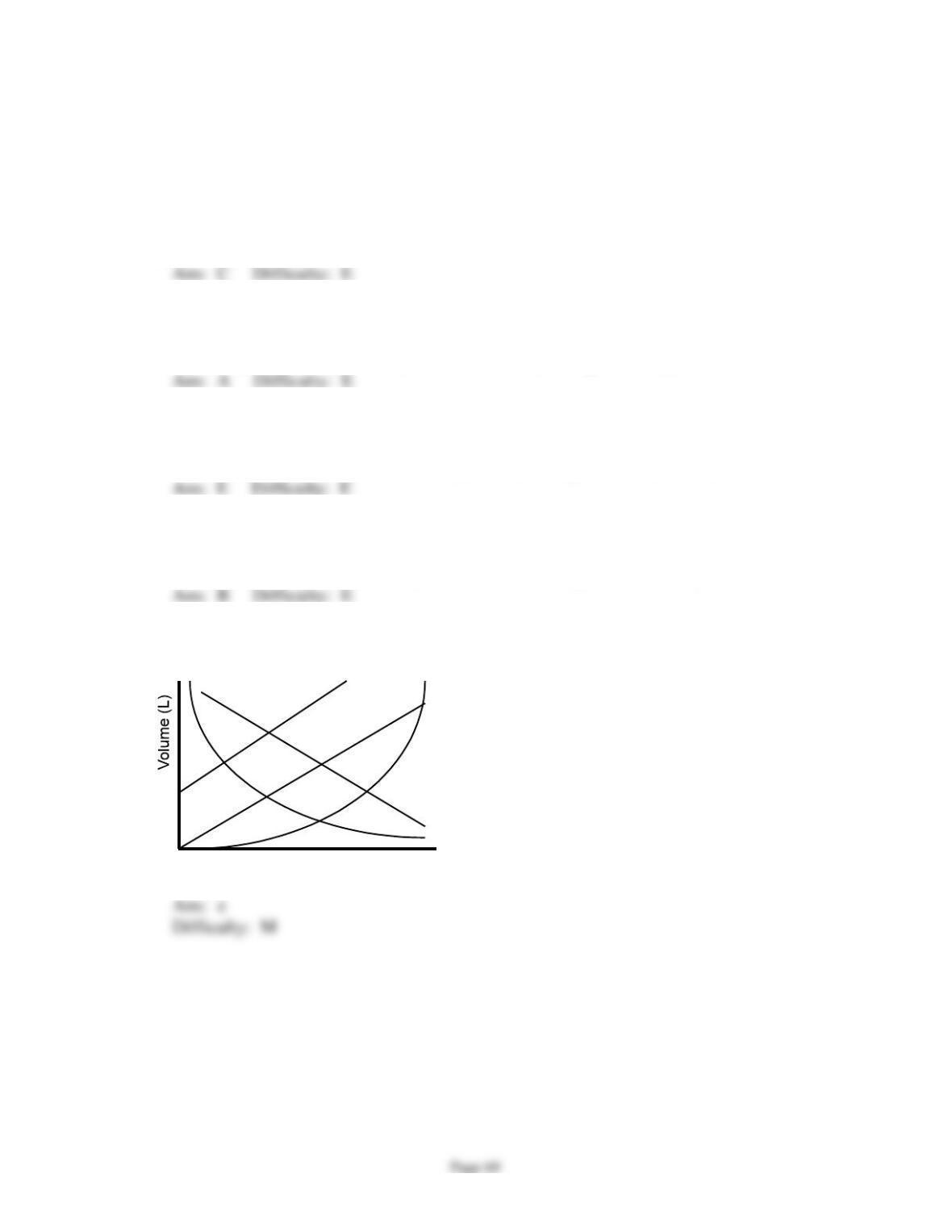
18. Which of the lines on the figure below is the best representation of the relationship
between the volume of a gas and its pressure, other factors remaining constant?
0
0
b
c
d
e
Pressure (atm)
a
Chapter 5: Gases and the Kinetic-Molecular Theory
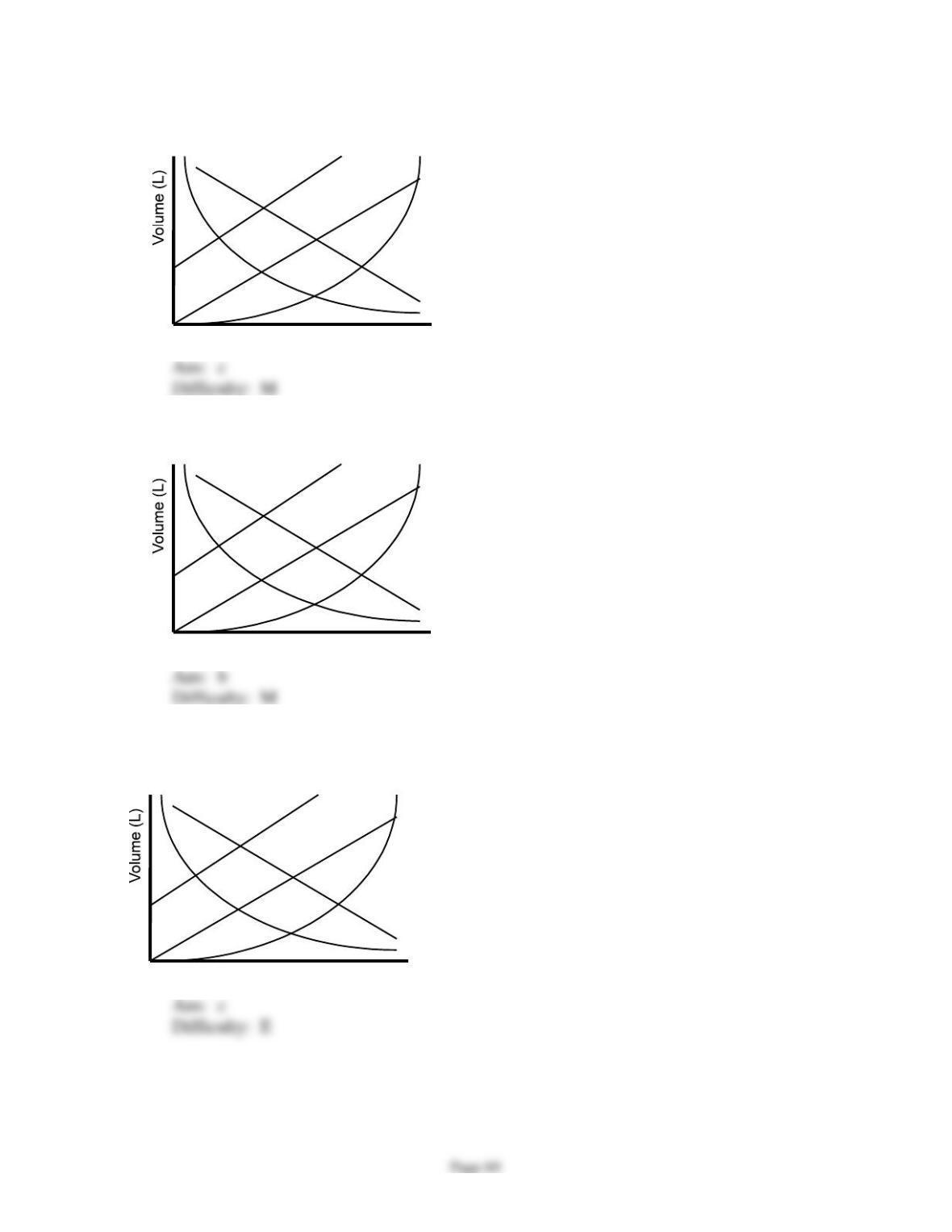
19. Which of the lines on the figure below is the best representation of the relationship
between the volume of a gas and its absolute temperature, other factors remaining constant?
0
0
b
c
d
e
Temperature (K)
a
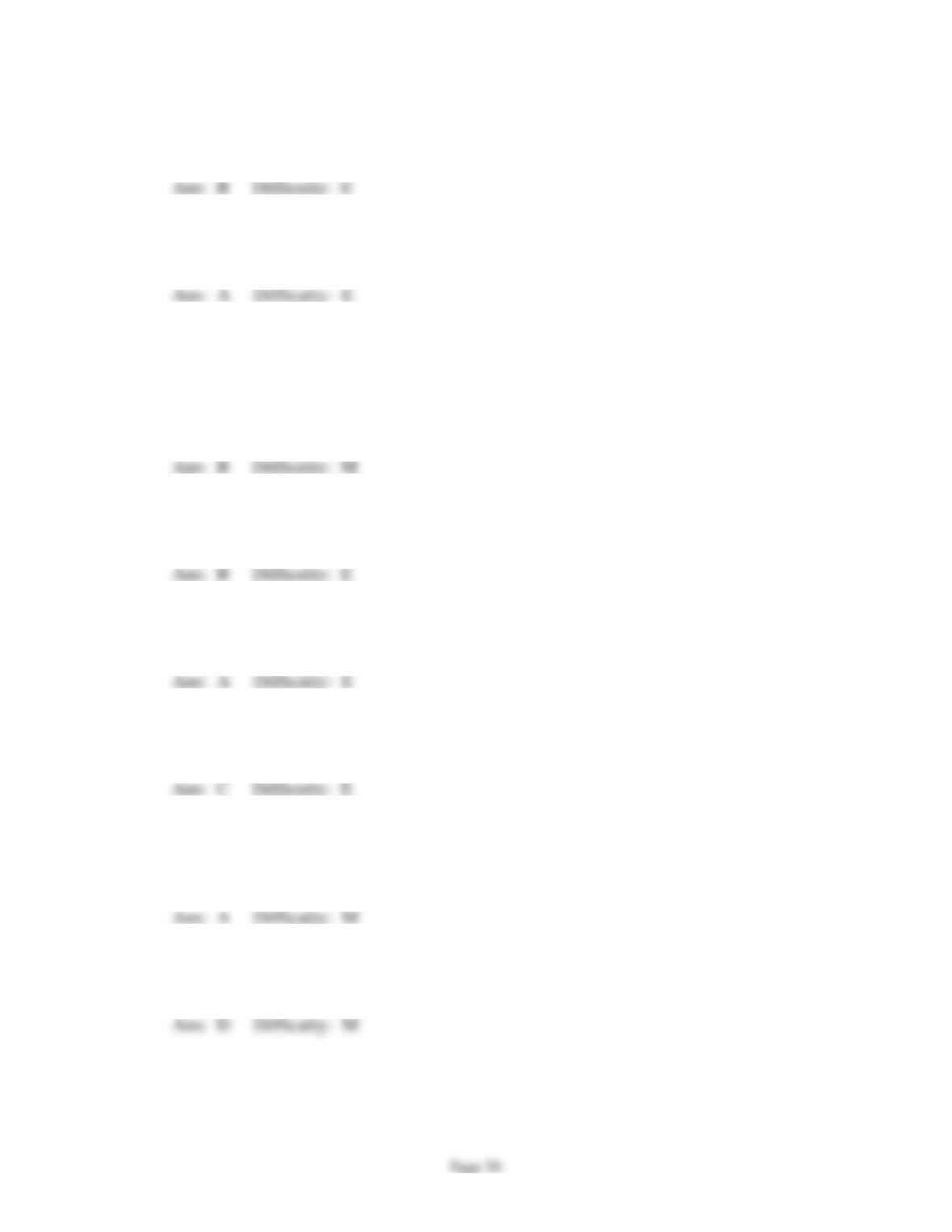
20. Which of the lines on the figure below is the best representation of the relationship
between the volume of a gas and its Celsius temperature, other factors remaining constant?
0
0
b
c
d
e
Temperature (C)
a
21. Which of the lines on the figure below is the best representation of the relationship
between the volume and the number of moles of a gas, measured at constant temperature and
pressure?
0
0
b
c
d
e
n (mol)
a
Chapter 5: Gases and the Kinetic-Molecular Theory
22. A sample of an ideal gas has its volume doubled while its temperature remains constant.
If the original pressure was 100 torr, what is the new pressure?
A) 10 torr B) 50 torr C) 100 torr D) 200 torr E) 1000 torr
23. A sample of the inert gas krypton has its pressure tripled while its temperature remained
constant. If the original volume is 12 L, what is the final volume?
A) 4.0 L B) 6.0 L C) 9 L D) 36 L E) 48 L
24. A weather balloon was initially at a pressure of 0.950 atm, and its volume was 35.0 L.
The pressure decreased to 0.750 atm, without loss of gas or change in temperature. What was
the change in the volume?
A) increased by 44.3 L D) decreased by 27.6 L
B) increased by 9.3 L E) decreased by 7.4 L
C) increased by 7.4 L
25. A sample of nitrogen gas at 298 K and 745 torr has a volume of 37.42 L. What volume
will it occupy if the pressure is increased to 894 torr at constant temperature?
A) 22.3 L B) 31.2 L C) 44.9 L D) 112 L E) 380 L
26. A sample of carbon dioxide gas at 125°C and 248 torr occupies a volume of 275 L. What
will the gas pressure be if the volume is increased to 321 L at 125°C?
A) 212 torr B) 289 torr C) 356 torr D) 441 torr E) 359 torr
27. A sample of oxygen gas has its absolute temperature halved while the pressure of the gas
remained constant. If the initial volume is 400 mL, what is the final volume?
A) 20 mL B) 133 mL C) 200 mL D) 400 mL E) 800 mL
28. A sample container of carbon monoxide occupies a volume of 435 mL at a pressure of
785 torr and a temperature of 298 K. What would its temperature be if the volume were changed
to 265 mL at a pressure of 785 torr?
A) 182 K B) 298 K C) 387 K D) 489 K E) 538 K
29. A 0.850-mole sample of nitrous oxide, a gas used as an anesthetic by dentists, has a
volume of 20.46 L at 123°C and 1.35 atm. What would be its volume at 468°C and 1.35 atm?
A) 5.38 L B) 10.9 L C) 19.0 L D) 38.3 L E) 77.9 L
Chapter 5: Gases and the Kinetic-Molecular Theory
30. A sample of ammonia gas at 65.5°C and 524 torr has a volume of 15.31 L. What is its
volume when the temperature is –15.8°C and its pressure is 524 torr?
A) 3.69 L
B) 11.6 L
C) 20.2 L
D) 63.5 L
E) not possible, since the volume would have to be negative
31. A 500-mL sample of argon at 800 torr has its absolute temperature quadrupled. If the
volume remains unchanged what is the new pressure?
A) 200 torr B) 400 torr C) 800 torr D) 2400 torr E) 3200 torr
32. A 750-mL sample of hydrogen exerts a pressure of 822 torr at 325 K. What pressure
does it exert if the temperature is raised to 475 K at constant volume?
A) 188 torr D) 1.20 × 10³ torr
B) 562 torr E) 1.90 × 10³ torr
C) 1.11 × 10³ torr
33. A sample of methane gas, CH4(g), occupies a volume of 60.3 L at a pressure of 469 torr
and a temperature of 29.3°C. What would be its temperature at a pressure of 243 torr and
volume of 60.3 L?
A) –116.5°C B) 15.2°C C) 15.5°C D) 57.7°C E) 310.6°C
34. What are the conditions of STP?
A) 0 K and l atm D) 273.15°C and 760 torr
B) 273.15 K and 760 torr E) none of the above
C) 0°C and 760 atm
35. A sample of propane, a component of LP gas, has a volume of 35.3 L at 315 K and 922
torr. What is its volume at STP?
A) 25.2 L B) 30.6 L C) 33.6 L D) 37.1 L E) 49.2 L
36. Nitrogen dioxide is a red-brown gas that is responsible for the color of photochemical
smog. A sample of nitrogen dioxide has a volume of 28.6 L at 45.3°C and 89.9 kPa. What is its
volume at STP?
A) 21.8 L B) 27.6 L C) 29.6 L D) 37.6 L E) 153 L
Chapter 5: Gases and the Kinetic-Molecular Theory
37. Calculate the pressure of a helium sample at –207.3°C and 768 mL if it exerts a pressure
of 175 kPa at 25.0°C and 925 mL.
A) 32.1 kPa
B) 46.6 kPa
C) 657 kPa
D) 953 kPa
E) not possible, since the pressure would have to be negative
38. Calculate the temperature of an argon sample at 55.4 kPa and 18.6 L if it occupies 25.8 L
at 75.0°C and 41.1 kPa.
A) 95.0°C B) 85.1°C C) 77.2°C D) 72.9°C E) 65.2°C
39. A carbon dioxide sample weighing 44.0 g occupies 32.68 L at 65°C and 645 torr. What
is its volume at STP?
A) 22.4 L B) 31.1 L C) 34.3 L D) 35.2 L E) 47.7 L
40. A sample of nitrogen gas is confined to a 14.0 L container at 375 torr and 37.0°C. How
many moles of nitrogen are in the container?
A) 0.271 mol B) 2.27 mol C) 3.69 mol D) 206 mol E) 227 mol
41. A compressed gas cylinder containing 1.50 mol methane has a volume of 3.30 L. What
pressure does the methane exert on the walls of the cylinder if its temperature is 25°C?
A) 9.00 × 10⁻² atm
B) 0.933 atm
C) 1.11 atm
D) 1.70 atm
E) 11.1 atm
42. Assuming ideal behavior, what is the density of argon gas at STP, in g/L?
A) 0.0176 g/L B) 0.0250 g/L C) 0.0561 g/L D) 1.78 g/L E) 181. g/L
43. What is the density of carbon dioxide gas at –25.2°C and 98.0 kPa?
A) 0.232 g/L B) 0.279 g/L C) 0.994 g/L D) 1.74 g/L E) 2.09 g/L
Chapter 5: Gases and the Kinetic-Molecular Theory
44. Ima Chemist found the density of Freon-11 (CFCl3) to be 5.58 g/L under her
experimental conditions. Her measurements showed that the density of an unknown gas was
4.38 g/L under the same conditions. What is the molar mass of the unknown?
A) 96.7 g/mol
B) 108 g/mol
C) 127 g/mol
D) 165 g/mol
E) 175 g/mol
45. A flask with a volume of 3.16 L contains 9.33 grams of an unknown gas at 32.0°C and
1.00 atm. What is the molar mass of the gas?
A) 7.76 g/mol
B) 66.1 g/mol
C) 74.0 g/mol
D) 81.4 g/mol
E) 144 g/mol
46. Dr. I. M. A. Brightguy adds 0.1727 g of an unknown gas to a 125-mL flask. If Dr. B
finds the pressure to be 736 torr at 20.0°C, is the gas likely to be methane, CH4, nitrogen, N2,
oxygen, O2, neon, Ne, or argon, Ar?
A) CH4 B) N2 C) Ne D) Ar E) O2
47. A 250.0-mL sample of ammonia, NH3(g), exerts a pressure of 833 torr at 42.4°C. What
mass of ammonia is in the container?
A) 0.0787 g B) 0.180 g C) 8.04 g D) 17.0 g E) 59.8 g
48. What is the pressure in a 7.50-L flask if 0.15 mol of carbon dioxide is added to 0.33 mol
of oxygen? The temperature of the mixture is 48.0°C.
A) 0.252 atm B) 0.592 atm C) 1.69 atm D) 3.96 atm E) 4.80 atm
49. If 0.750 L of argon at 1.50 atm and 177°C and 0.235 L of sulfur dioxide at 95.0 kPa and
63.0°C are added to a 1.00-L flask and the flask’s temperature is adjusted to 25.0°C, what is the
resulting pressure in the flask?
A) 0.0851 atm B) 0.244 atm C) 0.946 atm D) 1.74 atm E) 1.86 atm

Chapter 5: Gases and the Kinetic-Molecular Theory
50. A gas mixture consists of equal masses of methane (molecular weight 16.0) and argon
(atomic weight 40.0). If the partial pressure of argon is 200. torr, what is the pressure of
methane, in torr?
A) 80.0 torr B) 200. torr C) 256 torr D) 500. torr E) 556 torr
51. A gas mixture, with a total pressure of 300. torr, consists of equal masses of Ne (atomic
weight 20.) and Ar (atomic weight 40.). What is the partial pressure of Ar, in torr?
A) 75 torr
B) 100. torr
C) 150. torr
D) 200. torr
E) none of the above
52. An unknown liquid is vaporized in a 273-mL flask by immersion in a water bath at
99°C. The barometric pressure is 753 torr. If the mass of the vapor retained in the flask is 1.362
g, what is its molar mass?
A) 20.4 g/mol
B) 40.9 g/mol
C) 112 g/mol
D) 154 g/mol
E) 184 g/mol
53. A gas consists of 85.7 % carbon and 14.3 % hydrogen, by weight. A sample of this gas
weighing 0.673 g occupies 729 mL at a pressure of 720.0 mmHg and a temperature of 77°C.
Calculate its empirical and molecular formulas.
A) CH, C2H2
B) CH2, C2H4
C) CH2, C3H6
D) CH3, C2H6
E) CH4, CH4
54. Magnesium metal (0.100 mol) and a volume of aqueous hydrochloric acid that contains
0.500 mol of HCl are combined and react to completion. How many liters of hydrogen gas,
measured at STP, are produced?
Mg(s) + 2HCl(aq) → MgCl2(aq) + H2(g)
A) 2.24 L of H2 D) 11.2 L of H2
B) 4.48 L of H2 E) 22.4 L of H2
C) 5.60 L of H2

Chapter 5: Gases and the Kinetic-Molecular Theory
55. Linolenic acid (C18H30O2) can be hydrogenated to stearic acid by reacting it with
hydrogen gas according to the equation:
C18H30O2 + 3H2 → C18H36O2
What volume of hydrogen gas, measured at STP, is required to react with 10.5 g of linolenic
acid in this reaction?
A) 2.53 L B) 1.69 L C) 1.27 L D) 845 mL E) 422 mL
56. Hydrogen peroxide was catalytically decomposed and 75.3 mL of oxygen gas was
collected over water at 25°C and 742 torr. What mass of oxygen was collected? (Pwater = 24 torr
at 25°C)
A) 0.00291 g B) 0.0931 g C) 0.0962 g D) 0.0993 g E) 0.962 g
57. Small quantities of hydrogen can be prepared by the addition of hydrochloric acid to
zinc. A sample of 195 mL of hydrogen was collected over water at 25°C and 753 torr. What
mass of hydrogen was collected? (Pwater = 24 torr at 25°C)
A) 0.00765 g B) 0.0154 g C) 0.0159 g D) 0.0164 g E) 0.159 g
58. Lithium oxide is an effective absorber of carbon dioxide and can be used to purify air in
confined areas such as space vehicles. What volume of carbon dioxide can be absorbed by 1.00
kg of lithium oxide at 25°C and 1.00 atm?
Li2O(aq) + CO2(g) → Li2CO3(s)
A) 687 mL B) 819 mL C) 687 L D) 819 L E) 22.4 L
59. Methane, CH4(g), reacts with steam to give synthesis gas, a mixture of carbon monoxide
and hydrogen, which is used as starting material for the synthesis of a number of organic and
inorganic compounds.
CH4(g) + H2O(g) → CO(g) + H2(g) [unbalanced]
What mass of hydrogen is formed if 275 L of methane (measured at STP) is converted to
synthesis gas?
A) 12.3 g B) 24.7 g C) 37.1 g D) 49.4 g E) 74.2 g
60. Hydrochloric acid is prepared by bubbling hydrogen chloride gas through water. What is
the concentration of a solution prepared by dissolving 225 L of HCl(g) at 37°C and 89.6 kPa in
5.25 L of water?
A) 1.49 M B) 1.66 M C) 7.82 M D) 12.5 M E) 16.6 M
Chapter 5: Gases and the Kinetic-Molecular Theory
61. Which of the following gases effuses most rapidly?
A) nitrogen D) ammonia
B) oxygen E) carbon monoxide
C) hydrogen chloride
62. Which of the following gases will be the slowest to diffuse through a room?
A) methane, CH4 D) water, H2O
B) hydrogen sulfide, H2S E) neon, Ne
C) carbon dioxide, CO2
63. Arrange the following gases in order of increasing rate of effusion.
C2H6 Ar HCl PH3
A) Ar < HCl < PH3 < C2H6 D) C2H6 < HCl < PH3 < Ar
B) C2H6 < PH3 < HCl < Ar E) Ar < PH3 < HCl < C2H6
C) Ar < PH3 < C2H6 < HCl
64. A 3.0-L sample of helium was placed in a container fitted with a porous membrane. Half
of the helium effused through the membrane in 24 hours. A 3.0-L sample of oxygen was placed
in an identical container. How many hours will it take for half of the oxygen to effuse through
the membrane?
A) 8.5 h B) 12 h C) 48 h D) 60. h E) 68 h
65. A compound composed of carbon, hydrogen, and chlorine effuses through a pinhole
0.411 times as fast as neon. Select the correct molecular formula for the compound.
A) CHCl3 B) CH2Cl2 C) C2H2Cl2 D) C2H3Cl E) CCl4
66. The volume of a single molecule of water is 2.99 × 10⁻²³ mL. For a sample of gaseous
water at 1.00 atm and 150 °C, what fraction of the container’s volume is occupied by the
molecules themselves?
A) 5.2 × 10⁻⁷ D) 5.2 × 10⁻¹
B) 4.5 × 10⁻⁵ E) none of the above
C) 5.2 × 10⁻⁴

Chapter 5: Gases and the Kinetic-Molecular Theory
67. Helium gas is being pumped into a rigid container at a constant temperature. As a result,
the pressure of helium in the container is increasing. Select the one correct statement below.
A) As the pressure increases, helium atoms move faster, on average.
B) As the pressure increases, helium atoms move more slowly, on average.
C) As the pressure increases, the volume of the container must decrease.
D) As the pressure increases, helium atoms stay closer to the wall of the container, on
average.
E) As the pressure increases, there are more collisions of helium atoms with the
container wall.
68. Which of the following changes will NOT affect the total pressure of gas in a container,
assuming all other factors remain constant?
A) The frequency of collisions of molecules with the walls is increased.
B) The average velocity of the molecules is lowered.
C) The temperature of the sample is altered.
D) Half of the molecules are replaced by an equal number of molecules of a gas with
a different molecular weight.
E) The total number of molecules is altered.
69. Select the statement which does NOT apply to an ideal gas.
A) There are no attractive forces between the gas molecules.
B) There are strong repulsive forces between the gas molecules.
C) The volume occupied by the molecules is negligible compared to the container
volume.
D) The gas behaves according to the ideal gas equation.
E) The average kinetic energy of the molecules is proportional to the absolute
temperature.
70. At what temperature in kelvin is the root mean square speed of helium atoms (atomic
weight = 4.00) equal to that of oxygen molecules (molecular weight = 32.00) at 300. K?
A) 37.5 K B) 75 K C) 106 K D) 292 K E) 2400. K
71. Select the gas with the highest average kinetic energy per mole at 298 K.
A) O2
B) CO2
C) H2O
D) H2
E) All have the same average kinetic energy.

Chapter 5: Gases and the Kinetic-Molecular Theory
72. The most probable speed of an oxygen molecule in the gas phase at room temperature is
450 m/s. The root-mean-square speed (urms) is therefore
A) equal to 450 m/s. D) slightly greater than 450 m/s.
B) slightly less than 450 m/s. E) much greater than 450 m/s.
C) much less than 450 m/s.
73. Select the gas with the largest root-mean-square molecular speed at 25°C.
A) NH3
B) CO
C) H2
D) SF6
E) All the gases have the same root-mean-square molecular speed at 25°C.
74. Calculate the root-mean-square speed of methane, CH4 (g), at 78°C.
A) 23 m/s B) 350 m/s C) 550 m/s D) 667 m/s E) 740 m/s
75. Freon-12, CF2Cl2, which has been widely used in air conditioning systems, is considered
a threat to the ozone layer in the stratosphere. Calculate the root-mean-square velocity of Freon-
12 molecules in the lower stratosphere where the temperature is –65°C.
A) 20 m/s B) 120 m/s C) 210 m/s D) 260 m/s E) 4.4 × 10⁴ m/s
76. Calculate the rms speed of carbon dioxide molecules at STP.
A) 12.4 m/s
B) 155 m/s
C) 393 m/s
D) 1.55 × 10⁵ m/s
E) The answer can’t be calculated without more data.
77. If the molecular mass of a gas increases by a factor of 4 at constant temperature, its rms
speed will
A) decrease by a factor of 4. D) increase by a factor of 16.
B) increase by a factor of 4. E) decrease by a factor of 2.
C) decrease by a factor of 16.

Chapter 5: Gases and the Kinetic-Molecular Theory
78. The temperature of the carbon dioxide atmosphere near the surface of Venus is 475°C.
Calculate the average kinetic energy per mole of carbon dioxide molecules on Venus.
A) 2520 J/mol D) 9330 J/mol
B) 4150 J/mol E) 5920 kJ/mol
C) 5920 J/mol
79. The ozone layer is important because
A) ozone absorbs low energy radiation which warms the troposphere.
B) ozone purifies the atmosphere by reacting with excess fluorocarbons.
C) ozone absorbs ultraviolet radiation.
D) ozone reflects high energy radiation such as X-rays and gamma rays.
E) humans need to breathe air containing some ozone.
80. Nitrogen will behave most like an ideal gas
A) at high temperature and high pressure.
B) at high temperature and low pressure.
C) at low temperature and high pressure.
D) at low temperature and low pressure.
E) at intermediate (moderate) temperature and pressure.
81. The ideal gas law tends to become inaccurate when
A) the pressure is lowered and molecular interactions become significant.
B) the pressure is raised and the temperature is lowered.
C) the temperature is raised above the temperature of STP.
D) large gas samples are involved.
E) the volume expands beyond the standard molar volume.
82. Use the van der Waals equation for real gases to calculate the pressure exerted by 1.00
mole of ammonia at 27°C in a 750-mL container. (a = 4.17 L2atm/mol2, b = 0.0371 L/mol)
A) 23.2 atm B) 27.1 atm C) 32.8 atm D) 42.0 atm E) 32.8 torr
83. At moderate pressures (~ 200 atm), the measured pressure exerted by CO2 gas is less
than that predicted by the ideal gas equation. This is mainly because
A) such high pressures cannot be accurately measured.
B) CO2 will condense to a liquid at 200 atm pressure.
C) gas phase collisions prevent CO2 molecules from colliding with the walls of the
container.
D) of attractive intermolecular forces between CO2 molecules.
E) the volume occupied by the CO2 molecules themselves becomes significant.
Chapter 5: Gases and the Kinetic-Molecular Theory
84. At very high pressures (~ 1000 atm), the measured pressure exerted by real gases is
greater than that predicted by the ideal gas equation. This is mainly because
A) such high pressures cannot be accurately measured.
B) real gases will condense to form liquids at 1000 atm pressure.
C) gas phase collisions prevent molecules from colliding with the walls of the
container.
D) of attractive intermolecular forces between gas molecules.
E) the volume occupied by the gas molecules themselves becomes significant.
85. State Charles’s Law and illustrate it with a graph, using standard x-y coordinate axes. Be
sure to label the axes unambiguously with the correct gas variables.
86. State Boyle’s Law and illustrate it with a graph, using standard x-y coordinate axes. Be
sure to label the axes unambiguously with the correct gas variables.
87. State Avogadro’s Law.
88. State Amontons’s Law and illustrate it with a graph, using standard x-y coordinate axes.
Be sure to label the axes unambiguously with the correct gas variables.
89. Briefly state the conditions corresponding to STP (standard temperature and pressure).
Chapter 5: Gases and the Kinetic-Molecular Theory
90. Starting from the Ideal Gas Equation, derive an equation corresponding to Charles’s
Law, stating all important assumptions or conditions.
91. An oxygen sample of 1.62 L is at 92.3 kPa and 30.0°C.
a. What is the pressure of oxygen, in torr?
b. What volume would the oxygen occupy if the pressure were 120.0 kPa and the temperature
were 0.0°C?
c. How many moles of oxygen are in the sample?
92. Calculate the density in g/L of gaseous SF6 at 50.0°C and 650. torr.
93. A 255-mL gas sample weighing 0.292 g is at 52810 Pa and 127°C.
a. How many moles of gas are present?
b. What is the molar mass of the gas?
94. A 1.00-L sample of a pure gas weighs 0.785 g and is at 0.965 atm and 29.2°C.
a. What is the molar mass of the gas?
b. If the volume and temperature are kept constant while 0.400 g of the same gas are added to
that already in the container, what will the new pressure be?
95. A 1.30-L sample of argon gas is at 1.02 atm and 21.5°C.
a. What mass of argon is in the container?
b. If the temperature is raised to 500.0°C while the volume remains constant, calculate the new
pressure, in atmospheres.
Chapter 5: Gases and the Kinetic-Molecular Theory
96. A 3.60-L gas sample is at a pressure of 95.5 kPa and a temperature of 25.0°C.
a. Calculate the volume occupied by the gas at STP, assuming it behaves ideally.
b. If the gas sample weighs 6.10 g, calculate the molar mass of the gas.
97. Dry air is approximately 78% nitrogen, 21% oxygen, and 1% argon, by number of
molecules. What is the partial pressure of oxygen in a sample of dry air, if atmospheric pressure
is 751 torr?
98. Aluminum metal shavings (10.0 g) are placed in 100. mL of 6.00 M hydrochloric acid.
What is the maximum volume of hydrogen, measured at STP, which can be produced?
2Al(s) + 6HCl(aq) → 2AlCl3(aq) + 3H2(g)
99. In the fermentation process, yeast converts glucose to ethanol and carbon dioxide. What
volume of carbon dioxide, measured at 745 torr and 25.0°C, can be produced by the fermentation
of 10.0 g of glucose?
C6H12O6(aq) → 2C2H5OH(aq) + 2CO2(g)
100. Chlorofluorocarbons are important air pollutants implicated in global warming and ozone
depletion. How fast does the chlorofluorocarbon CF2Cl2 diffuse relative to N2, the main
component of the atmosphere?
In other words, calculate the ratio of diffusion rates:
22
2
CF Cl
N
Rate
Rate
101. Use plots of PV/nRT versus P to show the behavior of an ideal gas and of typical real
gases. Label the axes and show their scales.
Chapter 5: Gases and the Kinetic-Molecular Theory
102. A 20.0-L container holds 15.3 mol of Cl2 gas at 227°C.
a. Calculate the pressure in atmospheres, assuming ideal behavior.
b. Calculate the pressure in atmospheres, assuming van der Waals behavior. The van der Waals
constants for Cl2 are a = 6.49 atmL2/mol2 and b = 0.0562 L/mol.
103. When a closed-ended manometer is used for pressure measurements, and the closed end
is under vacuum, the level of manometer liquid in the closed arm can never be lower than that in
the other arm.
104. For a gas obeying Boyle’s Law, a plot of V versus 1/P will give a straight line passing
through the origin.
105. For a gas obeying Charles’s Law, a plot of V versus 1/T will give a straight line passing
through the origin.
106. At a temperature of absolute zero, the volume of an ideal gas is zero.
107. According to the postulates of kinetic-molecular theory, the molecules of all gases at a
given temperature have the same average speed.
108. According to the postulates of kinetic-molecular theory, the molecules of all gases at a
given temperature have the same average kinetic energy.
109. According to the kinetic theory of gases, in a collision between two molecules the kinetic
energy of one molecule will decrease by the same amount that the kinetic energy of the other
one increases.
110. According to the postulates of kinetic-molecular theory, the average kinetic energy of
gas molecules is proportional to the absolute temperature.
111. For a pure gas sample, the average kinetic energy is also the most probable kinetic
energy.

Chapter 5: Gases and the Kinetic-Molecular Theory
112. The rate of diffusion of a gas is inversely proportional to its molar mass.
113. For an ideal gas, a plot of PV/nRT versus P gives a straight line with a positive slope.
114. For real gases, PV > nRT, always.
115. For real gases, PV < nRT, always.