Introduction to Chemical Principles, 11e (Stoker)
Chapter 4 Basic Concepts about Matter
4.1 Multiple Choice
1) Which of the following would not be considered matter?
A) light
B) cheese
C) plants
D) blood
2) Which of the following is a property of both solids and liquids?
A) definite shape
B) indefinite shape
C) definite volume
D) indefinite volume
3) Gallium has a melting point of 30 °C and boiling point of 2403 °C. At which temperature
below will gallium be a gas?
A) −25 °C
B) 25 °C
C) 250 °C
D) 2500 °C
4) Which statement best describes a sample of gas?
A) A gas has a definite volume and a definite shape.
B) The volume and the shape of a gas are determined by its container.
C) A gas has a definite volume, but its shape is determined by its container.
D) The volume of a gas is determined by its container, but it has a definite shape.
5) The state of matter a substance is in is determined by its ________.
A) electrical conductivity
B) density
C) temperature
D) solubility
6) Molten iron metal has a(n) ________ volume and a(n) ________ shape.
A) definite; definite
B) indefinite; indefinite
C) definite; indefinite
D) indefinite; definite
7) Nitrogen gas has a(n) ________ volume and a(n) ________ shape.
A) definite; definite
B) indefinite; definite
C) definite; indefinite
D) indefinite; indefinite
8) Which of the following statements does not describe a physical property?
A) Sparks are created when sodium metal is added to water.
B) A strip of magnesium metal weighs 7.49 grams.
C) Snow forms in the clouds via deposition.
D) Mercury is a liquid at room temperature.
9) A solid substance is subjected to a number of tests and observations. Which of the following
test results would not be classified as a physical property of the substance?
A) It reacts with base to form water.
B) Its density is 1.84 g/mL.
C) It tastes sour.
D) It is a white-colored solid.
10) In which of the following pairs are both chemical properties?
A) has metallic luster, soluble in ammonia
B) flammable, reacts with acid
C) green in color, reacts violently with water
D) has a high density, is very brittle
11) Which of the following is a chemical change?
A) rusting of iron
B) dissolving salt in water
C) evaporation of gasoline
D) cutting a copper wire into two pieces
12) Which of the following is a physical process?
A) the rusting of iron
B) the condensation of water vapor
C) the baking of a potato
D) the explosion of nitroglycerin
13) Which of the following is a chemical property?
A) condensation
B) mass
C) solubility
D) burning
14) Which of these is an intensive property?
A) temperature
B) mass
C) length
D) volume
15) Which of the following is not an intensive property?
A) melting point
B) volume
C) boiling point
D) density
16) Which of these is an extensive property?
A) density
B) color
C) mass
D) melting point
17) Which of the following is not an extensive property?
A) mass
B) volume
C) length
D) temperature
18) When a substance undergoes a chemical change it is always true that ________.
A) it condenses
B) it changes state
C) new substances are formed
D) heat is absorbed
19) Which of the following is not a physical change?
A) boiling water
B) dissolving Kool-aid
C) frying an egg
D) liquefying oxygen
20) Which of the following is not a chemical change?
A) frying an egg
B) rusting of iron
C) slicing a ham
D) burning a candle
21) Which of the following represents a physical change in matter?
A) A substance melts when heated.
B) A substance gives off a gas when heated.
C) A substance burns when heated.
D) A substance changes color when heated.
22) Which of the following is a chemical change?
A) distilling ocean water
B) making tea from a tea bag
C) rusting of iron
D) melting of snow
23) Which of the following is a physical change?
A) Burning coal
B) Synthesis of methane from carbon and hydrogen
C) Smoking a cigarette
D) Filtering muddy water
24) The condensation of steam is an example of a(n) ________.
A) change of state
B) extensive property
C) sublimation
D) chemical change
25) Which response includes all of the following that involve chemical changes?
I. burning charcoal
II. melting of gold
III. fermentation of grapes
IV. burning of natural gas
V. melting of ice
A) II and V
B) I and IV
C) I, II, and III
D) I, III, and IV
26) As two liquid solutions are added together, a yellow solid forms. This change is most likely:
A) physical change.
B) chemical change.
C) neither.
D) both.
27) Which response contains all of the following that are physical changes?
I. Candle wax melts.
II. Skin turns yellow when it comes in contact with nitric acid.
III. Milk curdles.
IV. Ice freezes to water.
V. Windows fog when the temperature drops rapidly.
A) II and IV
B) I, III, and V
C) II and III
D) I, IV, and V
28) Which answer includes all of the following that are chemical changes?
I. The cutting of an iron bar into smaller pieces.
II. The solidification of mercury by cooling.
III. The dropping of iron into hydrochloric acid, producing hydrogen gas.
IV. The mixing of water and drinking alcohol.
V. The fermentation of grape juice.
A) II, III, IV, and V
B) III and V
C) I, III, and IV
D) I and IV
29) Which of the following is not a pure substance?
A) blood
B) calcium
C) sodium bicarbonate
D) distilled water
30) A liter sample of oxygen has been purified. Which of the following characteristics will not
apply to the oxygen sample?
A) Only oxygen is present in the sample.
B) The sample can be separated into two parts by physical means.
C) All molecules in the sample will be composed of two atoms, (O2).
D) At 25 °C and 1 atm pressure, all portions of the sample will have the same properties.
31) Which of the following can be classified as a mixture and not as a pure substance?
I. oxygen
II. antifreeze
III. distilled water
IV. human blood
V. brass alloy
A) II and V
B) II and III
C) I only
D) II, IV, and V
32) The description “three substances present, two phases present” is correct for ________.
A) heterogeneous mixtures
B) homogeneous mixtures
C) elements
D) compounds
33) Which is an example of a homogeneous mixture?
A) chocolate chip cookie
B) a rock collection
C) sugar water
D) oil & vinegar salad dressing
34) Which of the following is an example of a heterogeneous mixture?
A) sugar water
B) oil and vinegar
C) air
D) vodka
35) Which statement is false?
A) Different mixtures of the same two substances must have the same composition.
B) A mixture of sea sand and table salt is an example of a heterogeneous mixture.
C) An example of a homogeneous mixture is one prepared by mixing drinking alcohol and water.
D) A compound is a substance that can be decomposed into two or more simpler substances by
chemical means.
36) Which of the following substances is a heterogeneous mixture?
A) sodium
B) baking soda
C) dextrose (a sugar) dissolved in water
D) salt and pepper in a glass
37) Which of the following is a heterogeneous mixture?
A) ice and water
B) tap water
C) pure water
D) gasoline
38) Which of the following type of matter/classification of matter pairs is incorrectly matched?
type of matter classification of matter
A) pure gold element
B) concrete homogeneous mixture
C) fruitcake heterogeneous mixture
D) saline solution homogeneous mixture
39) A pure substance has been isolated in the laboratory. Based on the two characteristics below,
how can the substance be classified?
I. The species can not be separated by physical means.
II. The species can be separated by chemical means.
A) an element
B) a compound
C) a homogeneous mixture
D) a heterogeneous mixture
40) If a tablespoon of table salt is mixed with a tablespoon of water, the resulting solution can be
classified as a ________.
A) homogeneous mixture
B) pure substance
C) homogeneous pure substance
D) heterogeneous mixture
41) Which of the following statements is correct?
A) Elements, but not compounds, are pure substances.
B) Compounds, but not elements, are pure substances.
C) Both elements and compounds are pure substances.
D) Neither elements nor compounds are pure substances.
42) An element is a substance which ________.
A) can be broken down into simpler substances by physical means.
B) cannot be broken down into simpler substances by physical or chemical means.
C) can be broken down into simpler substances by chemical means.
D) none of the above
43) Which of the following is a compound?
A) copper
B) magnesium
C) copper (II) oxide
D) iron
44) Which of the following is an element?
A) ammonia
B) water
C) copper
D) sucrose
45) A pure substance A is found to change upon heating into two new pure substances, B and C.
C can be decomposed by chemical means, B cannot be decomposed by chemical means. From
this we may conclude that ________.
A) A is an element, B and C are compounds
B) A is a compound, B and C are elements
C) A, B and C are all elements
D) A and C are compounds, B is an element
46) Two pure substances A and B react to form a new substance C. From this we may conclude
that:
A) A and B are both elements.
B) C is a compound, A and B may or may not be elements.
C) C is an element, A and B are compounds.
D) A, B and C are all compounds.
47) Which of the following statements about compounds and mixtures is correct?
A) Since two or more simpler substances can be obtained from a compound, all compounds are
mixtures.
B) Compounds cannot be broken down into simpler substances by chemical means.
C) Mixtures retain the properties of their individual components.
D) Compounds always have properties that are identical to those of the elements used to produce
them.
48) A pure substance A is found to change upon heating into two new, pure substances, B and C.
A → B + C
Neither B nor C can be decomposed by chemical means. From this we may conclude that
________.
A) A is an element, B and C are compounds
B) B is a compound, A and C are elements
C) B and C are elements, A is a compound
D) A, B, and C are all compounds
49) The most abundant elements in the universe are ________.
A) oxygen and iron
B) hydrogen and helium
C) helium and carbon
D) hydrogen and oxygen
50) The most abundant elements in the Earth’s crust are ________.
A) oxygen and silicon
B) oxygen and carbon
C) hydrogen and helium
D) hydrogen and oxygen
51) The most abundant elements, in terms of atom percent, in the human body are ________.
A) carbon and oxygen
B) oxygen and hydrogen
C) hydrogen and carbon
D) nitrogen and carbon
52) In which of the following sequences of elements does each of the elements have a one-letter
symbol?
A) sulfur, vanadium, cobalt
B) chlorine, iron, lithium
C) nickel, yttrium, potassium
D) hydrogen, fluorine, phosphorous
53) In which of the following sequences of elements does each of the elements have a two-letter
symbol?
A) sodium, lithium, iodine
B) potassium, fluorine, carbon
C) tin, hydrogen, iodine
D) silicon, chlorine, chromium
54) In which of the following sequences of elements does each of the elements have a symbol
which starts with a letter that is not the first letter of the element’s English name?
A) silver, gold, mercury
B) copper, helium, neon
C) cobalt, chromium, sodium
D) argon, iron, lead
55) Which statement is true about elements?
A) Elements have similar symbols and names.
B) Element names are derived either from geographical names or from the plants.
C) The first letter of any chemical symbol is capitalized.
D) The elements whose symbols are derived from non-English names are the recently found
elements.
56) In which pair does the symbol not match the name of the element?
A) nitrogen – N
B) iron – Fe
C) strontium – Sr
D) arsenic – Ar
57) In which pair does the symbol match the element name?
A) strontium – St
B) chlorine – Cl
C) gallium – Gl
D) tungsten – Th
58) Which of the following element/chemical symbol pairs is incorrectly matched?
Element Chemical Symbol
A) chromium Cr
B) lithium Li
C) gold Au
D) krypton Kp
59) Which of the following element/chemical symbol pairs is incorrectly matched?
Element Chemical Symbol
A) bismuth B
B) cobalt Co
C) selenium Se
D) cesium Cs
60) How many of the following pairs of elements and symbols are entirely correct?
silver, Si manganese, Mg copper, Co potassium, P
A) none
B) 1
C) 2
D) 3
61) How many of the following elements and symbols are entirely correct?
magnesium, Mg iron, Ir potassium, K gold, Go
A) none
B) 1
C) 2
D) 3
4.2 Short Answer
1) What is the difference between an extensive and an intensive property? Give one example of
each.
2) Indicate whether each of the following statements represents a chemical change, a physical
change, or no change.
A) Sodium metal is cut with a knife. ________
B) Hydrochloric acid was added to baking soda resulting in the evolution of carbon dioxide
gas. ________
C) A red piece of copper wire is added to a beaker containing hydrochloric acid (a clear,
colorless solution). After an hour a red wire is observed in a clear, colorless solution. ________
D) A chunk of cheddar cheese is grated. ________
E) Candle wax is melted. ________
F) Candle wax is burned. ________
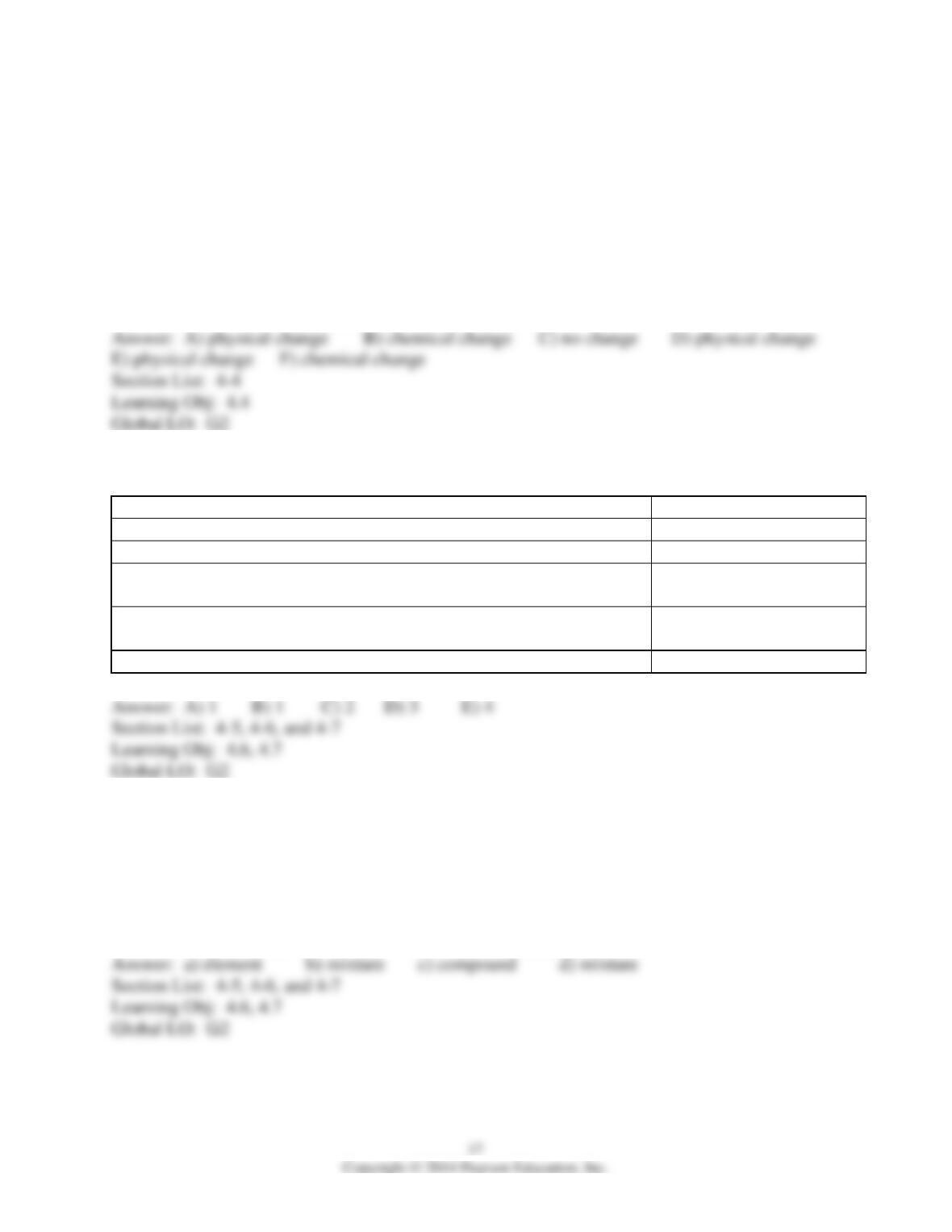
3) For each characterization of matter, choose the appropriate classification from the response
list. Responses may be used more than once or need not be used at all.
A) ________ 2 substances present, 3 phases present
1) heterogeneous mixture
B) ________ 2 substances present, 2 phases present
2) homogeneous mixture
C) ________ 2 substances present, 1 phase present
3) compound
D) ________ 1 substance present, 1 phase present, substance can be
decomposed by chemical means
4) element
E) ________ 1 substance present, 1 phase present, substance cannot be
decomposed by chemical means
4) Indicate whether the following descriptions of matter represents an element, a compound, or a
mixture.
I. One substance present, one phase present, substance cannot be decomposed by chemical
means. ________
II. Two substances present, two phases present. ________
III. One substance present, two elements present. ________
IV. Two elements present, composition is variable. ________
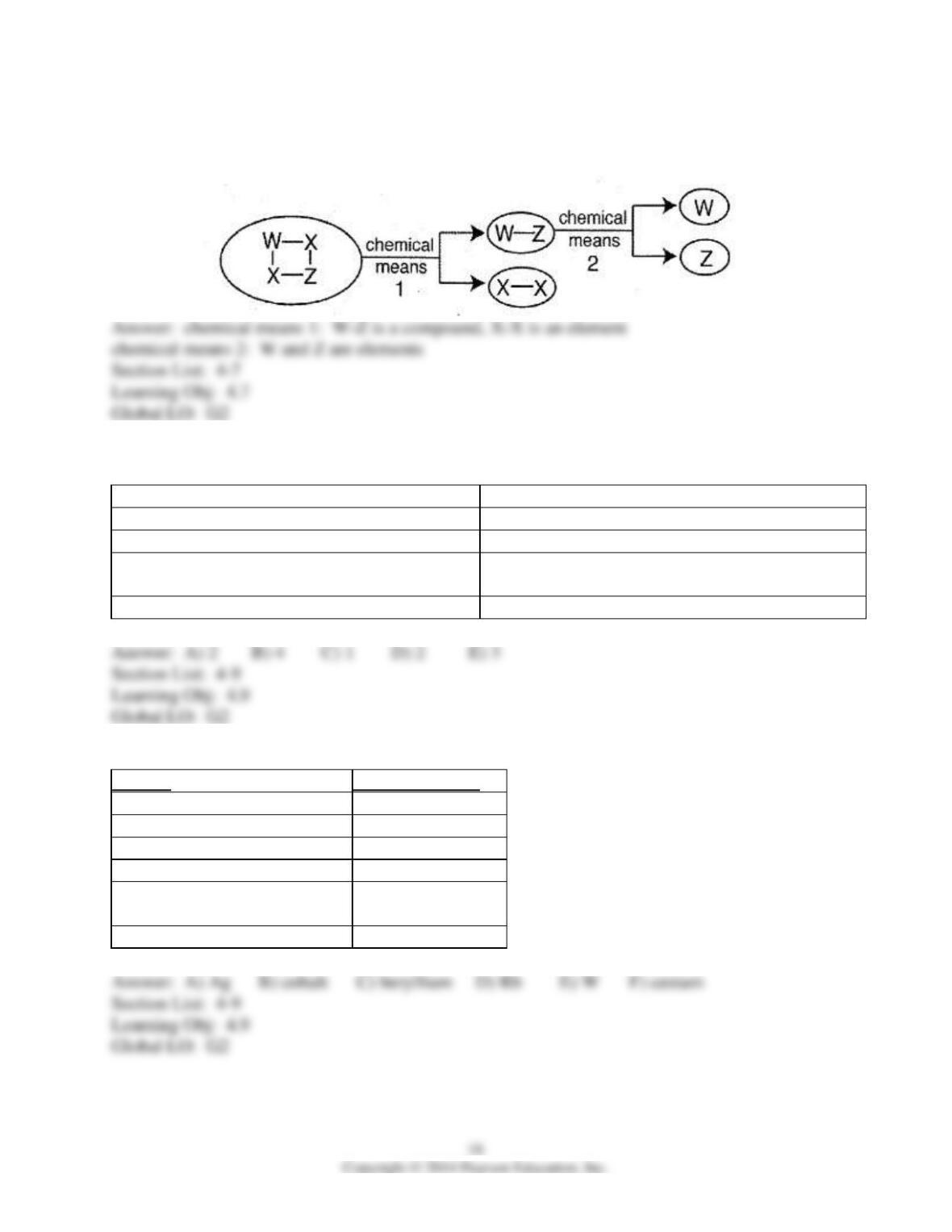
5) The schematic below illustrates the breakdown of a compound via chemical means. Identify
the products (as elements or compounds) formed at the end of chemical means 1 and the products
formed at the end of chemical means 2.
6) For each set of elements choose the appropriate characterization of the set’s elemental symbols
from the response list. Responses may be used more than once or need not be used at all.
A) ________ neon, lithium, scandium
1) all symbols have one letter
B) ________ iron, tungsten, potassium
2) all symbols have two letters
C) ________ oxygen, fluorine, tungsten
3) all symbols start with the same letter
D) ________ carbon, chlorine, copper
4) all symbols start with a letter not the first letter
of the element’s English name
E) ________ gold, silver, iron
7) Fill in the missing chemical symbol or element name for each of the following pairs.
element
chemical symbol
A) silver
________
B) ________
Co
C) ________
Be
D) rubidium
________
E)
tungsten
________
F) ________
Cs