32) Examine the elements listed below and identify the one element that is from a different
periodic table group than the others.
A) Si
B) Sn
C) Ti
D) Ge
E) All of these are from the same group.
33) Cr is a member of which family?
A) noble gases
B) halogens
C) alkaline earth metals
D) alkali metals
E) none of the above
34) All of the following statements about different elements are true EXCEPT:
A) Barium is an alkaline earth metal.
B) Manganese is a transition metal.
C) Sulfur is considered a metalloid.
D) Krypton is one of the noble gases.
E) Iodine is a halogen.
35) Identify the element that is a nonmetal, a gas, and has an elemental symbol that starts with
the letter “A.”
A) Ac
B) Ar
C) Au
D) Al
E) none of the above
36) Ions are formed when atoms:
A) gain or lose protons.
B) gain or lose electrons.
C) gain or lose neutrons.
D) Each of these results in ion formation.
E) None of these results in ion formation.
37) When an atom loses an electron, the resulting particle is called:
A) a proton.
B) an anion.
C) a cation.
D) an isotope.
E) none of the above
38) When an atom gains an electron, the resulting particle is called:
A) a proton.
B) an anion.
C) a cation.
D) an isotope.
E) none of the above
39) Which of the following statements about ions is INCORRECT?
A) Cations are positive ions and anions are negative ions.
B) Cations are formed when an atom loses electrons.
C) Anions are formed when an atom gains electrons.
D) Cations always have the same number of protons as electrons.
E) All statements are correct.
40) What is the correct formula for a potassium ion with 18 electrons?
A) P+
B) K+
C) K–
D) P–
E) none of the above
41) How many electrons are in Br–?
A) 4
B) 7
C) 34
D) 36
E) none of the above
42) How many protons and electrons are present in O2-?
A) 8 protons and 8 electrons
B) 10 protons and 8 electrons
C) 8 protons and 10 electrons
D) 16 protons and 8 electrons
E) none of the above
43) What is the charge on the barium ion?
A) 1-
B) 2-
C) 1+
D) 2+
E) none of the above
44) What is the charge on the ion formed by selenium?
A) 1-
B) 2-
C) 1+
D) 2+
E) none of the above
45) There is very little of the element astatine (symbol = At) on earth. If astatine formed an ion,
it would most likely have the charge of:
A) 1+
B) 1-
C) 2+
D) 2-
E) none of the above
46) What is the charge on the ion formed by aluminum?
A) 5-
B) 3-
C) 13+
D) 3+
E) none of the above
47) What is the charge on the cesium ion?
A) 1-
B) 2-
C) 1+
D) 2+
E) none of the above
48) How many electrons would be in a -2 charged anion of sulfur?
A) 2
B) 16
C) 18
D) 36
E) none of the above
49) Isotopes are:
A) atoms of the same element that have different number of neutrons.
B) atoms of the same element that have different number of protons.
C) atoms of the same element that have different number of electrons.
D) atoms of the same element that have the same number of neutrons.
E) none of the above
50) The number of protons in the nucleus of an atom:
A) is called the atomic number.
B) is given the symbol “Z.”
C) identifies the atom as a particular element.
D) is the same for all isotopes of an element.
E) all of the above
51) The nucleus of an atom consists mainly of:
A) neutrons and electrons.
B) protons and electrons.
C) protons and neutrons.
D) protons, neutrons, and electrons.
E) none of the above
52) How many neutrons are present in Ne-22?
A) 12
B) 10
C) 22
D) 32
E) none of the above
53) How many neutrons are present in C-14?
A) 14
B) 12
C) 6
D) 8
E) none of the above
54) What is the mass number of the hydrogen isotope that contains 2 neutrons?
A) 1
B) 2
C) 3
D) 4
E) none of the above
55) How many protons and neutrons are in Cl-37?
A) 20 protons, 17 neutrons
B) 17 protons, 37 neutrons
C) 17 protons, 20 neutrons
D) 37 protons, 17 neutrons
E) none of the above
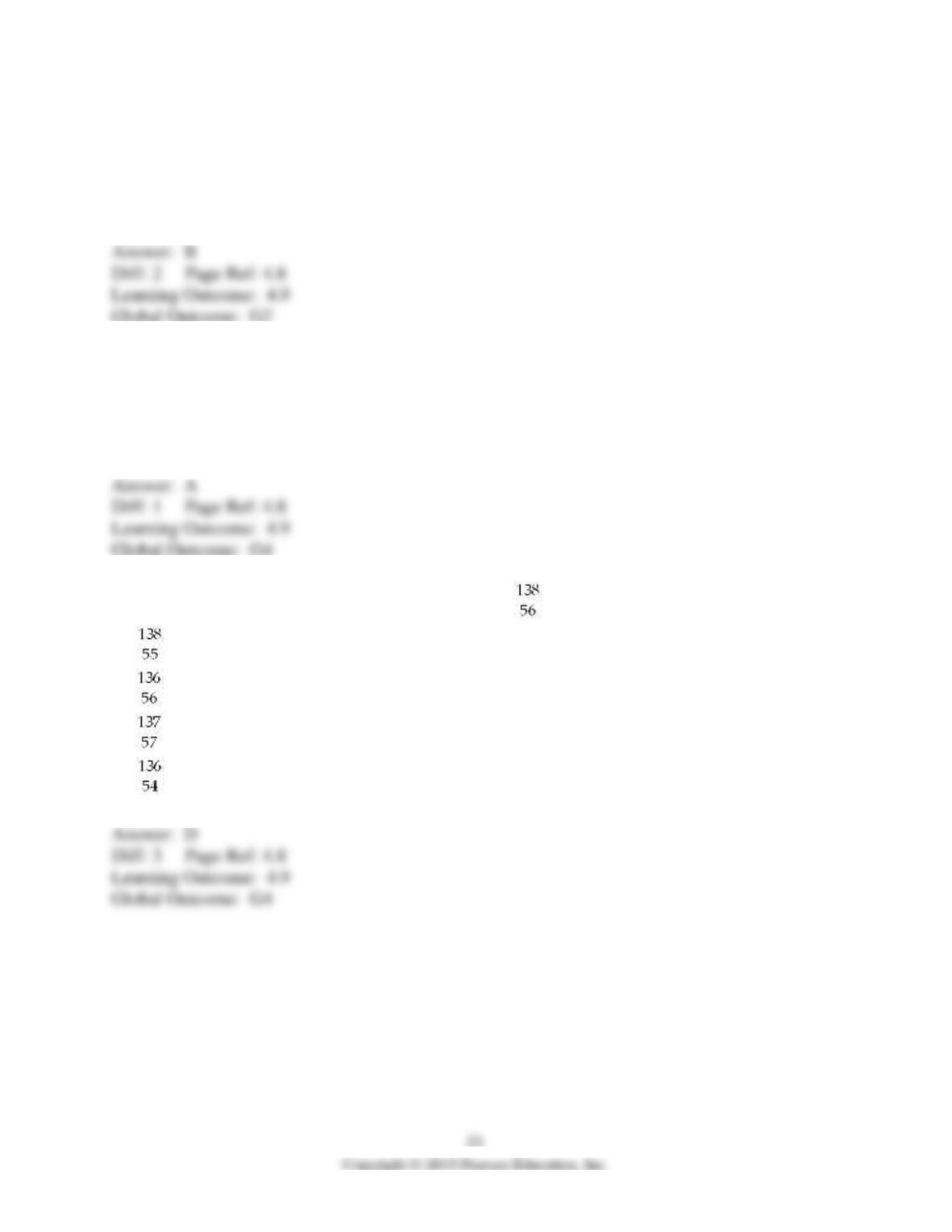
56) An isotope represented as S-34:
A) is an isotope of sodium.
B) contains exactly 18 neutrons.
C) has 34 protons.
D) must have exactly 18 electrons.
E) none of the above
57) An atom of a carbon-14 isotope would contain:
A) 6 protons, 8 neutrons, and 6 electrons.
B) 8 protons, 6 neutrons, and 8 electrons.
C) 6 protons, 8 neutrons, and 8 electrons.
D) 14 protons, 6 neutrons, and 6 electrons.
E) 20 protons, 6 neutrons, and 20 electrons.
58) An atom that has the same number of neutrons as Ba is:
A) Cs
B) Ba
C) La
D) Xe
E) none of the above
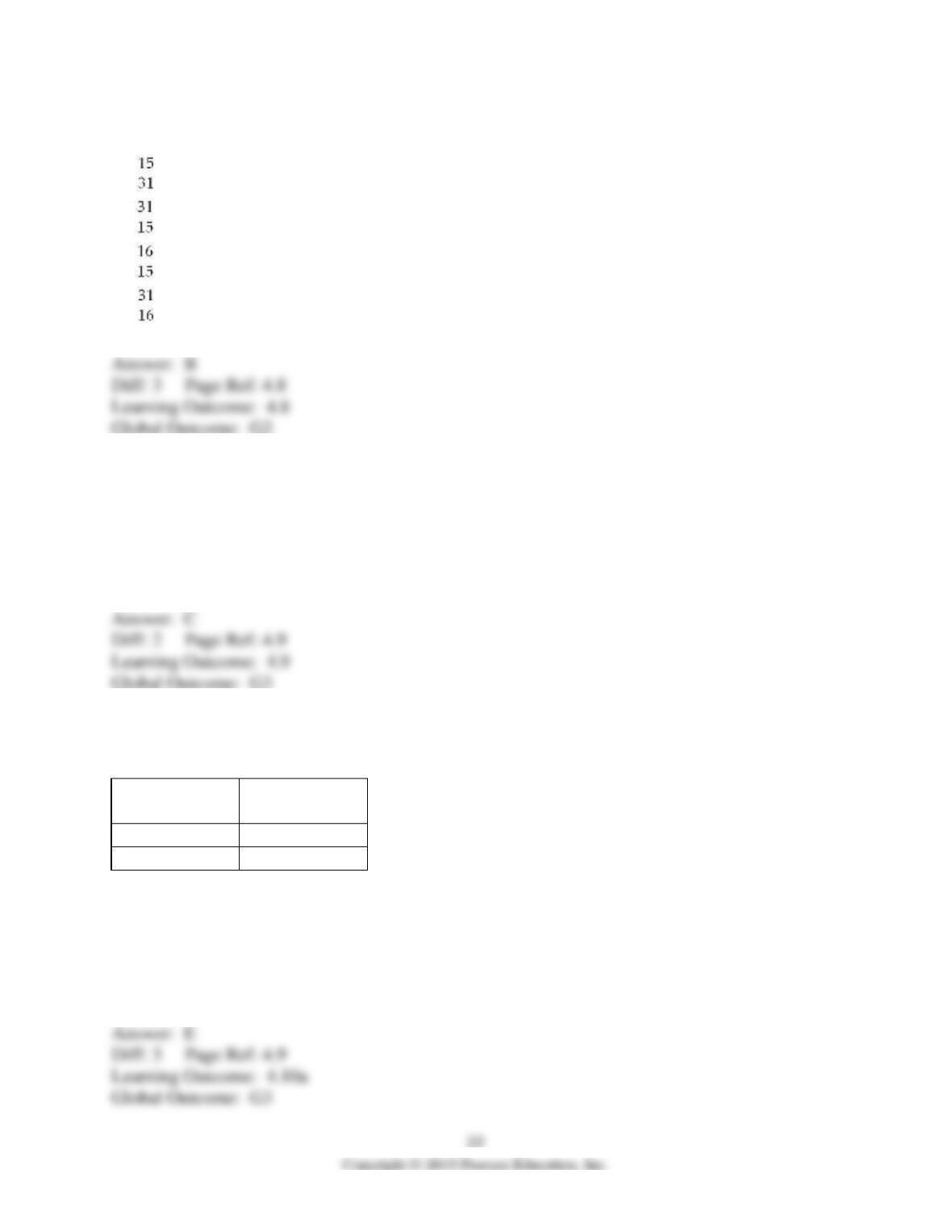
59) A specific isotope of an element is known to have 15 protons and 16 neutrons. Which
symbol would properly represent this isotope?
A) Ga
B) P
C) X
D) S
E) none of the above
60) The only known atom that does not contain a neutron is one of the isotopes of hydrogen. The
mass number, symbolized as “A” in the text, of this hydrogen isotope must be:
A) 1.01
B) 0
C) 1
D) 2
E) none of the above
61) A fictional element has two naturally occurring isotopes with the natural abundances shown
here:
ISOTOPE
ABUNDANCE
16
50.0%
18
50.0%
Which statement is TRUE for this element?
A) The atomic mass would be 16.
B) The atomic mass would be less than 16.
C) The atomic mass would be 18.
D) The atomic mass would be more than 18.
E) The atomic mass would be 17.
62) A fictional element has two naturally occurring isotopes with the natural abundances shown
here:
ISOTOPE
ABUNDANCE
18
40.0%
20
60.0%
Which statement is TRUE for this element?
A) The atomic mass would be less than 18.
B) The atomic mass would be closer to 18 than to 20.
C) The atomic mass would be exactly 19.
D) The atomic mass would be closer to 20 than to 18.
E) The atomic mass would be greater than 20.
63) A fictional element has two isotopes, each making up 50% of the population. Isotope 1 has a
mass of 80.0 amu, Isotope 2 has a mass of 85.0 amu. Calculate the atomic mass of the fictional
element.
A) 82.5 amu
B) 42.5 amu
C) 40 amu
D) 165 amu
E) none of the above
64) A fictional element has two isotopes and an atomic mass of 87.08 amu. If the first isotope is
86 amu and the second isotope has a mass of 90 amu. Which isotope has the greatest natural
abundance?
A) 86 amu
B) 90 amu
C) There are equal amounts.
D) Not enough information provided.
E) none of the above
65) A fictional element named Nivadium is found to have three naturally occurring isotopes with
the natural abundances shown here:
MASS (amu)
ABUNDANCE
22.1760
45.00%
23.1847
45.00%
24.1934
10.00%
The calculated atomic mass of Nivadium is:
A) 7.61 amu
B) 22.83 amu
C) 23.18 amu
D) 69.55 amu
E) none of the above
66) Chlorine has two stable isotopes, Cl-35 and Cl-37. If their exact masses are 34.9689 amu and
36.9695 amu, respectively, what is the natural abundance of Cl-35? (The atomic mass of chlorine
is 35.45 amu.)
A) 75.95%
B) 24.05%
C) 50.00%
D) 35.00%
E) 37.00%
Algorithmic Questions
1) The elemental symbol Mn represents the element ________.
A) mendelevium
B) magnesium
C) molybdenum
D) manganese
E) meitnerium
F) none of the above
2) Which one of the following is a main-group nonmetal element in period number 3 of the
periodic table?
A) bromine
B) selenium
C) sodium
D) gallium
E) sulfur
F) none of the above
3) What is the charge on an ion that has an atomic number of 24 and contains 22e-?
A) 2+
B) 2-
C) 1+
D) 1-
E) none of the above
4) What is the charge on a calcium atom that contains 18 e-?
A) 1+
B) 20+
C) 2+
D) 2-
E) none of the above
5) How many neutrons are found in Ne-21?
A) 11
B) 21
C) 10
D) 0
E) none of the above
6) How many protons are found in C-14?
A) 8
B) 14
C) 6
D) 0
E) none of the above
7) If an isotope of an element has 27 neutrons and a mass number of 52, how many electrons
must it have?
A) 25
B) 27
C) 52
D) 79
E) none of the above
8) Given that the molecular mass of bromine is 79.90 grams, which of the following isotopes
would you expect to have the greatest natural abundance?
A) Br-79
B) Br-80
C) Br-81
D) Br-82
E) none of the above