
Page 417
Chapter 24: Nuclear Reactions and Their Applications
1. Who discovered radioactivity?
A) Geiger B) Curie C) Roentgen D) Becquerel E) Rutherford
2. Which one of the following is an incorrect representation of the indicated particle or
nucleus?
A) positron:
0
1β
D) alpha particle:
4
2He
B) neutron:
1
0n
E) proton:
1
1p
C) helium-3:
5
2He
3. Which one of the following descriptions relating to nuclear reactions is correct?
A) The ratio of neutrons to protons remains constant.
B) The number of protons plus neutrons remains constant.
C) The number of electron remains constant.
D) The total charge changes.
E) The total number of nucleons changes.
4. Which one of the following is a subatomic particle closely related to the positron?
A) proton B) electron C) negatron D) neutron E) neutrino
5. Which of the following types of radioactive decay does not produce new element?
A) gamma emission D) alpha emission
B) electron capture E) double beta emission
C) beta emission
6.
108 108
49 48
In Cd ?→+
In the equation above, what particle or type of radiation needs to be included on the right hand
side in order to balance it?
A) alpha B) beta C) gamma D) positron E) proton

Chapter 24: Nuclear Reactions and Their Applications
7. Which one of the following equations correctly represents alpha decay of
222
86 Rn
?
A)
222 218 4
86 84 2
Rn Po He→+
B)
222 220 2
86 82 4
Rn Pb He→+
C)
222 222 0
86 87 –1
Rn Fr β→+
D)
222 4 226
86 2 88
Rn He Ra +→
E)
222 222 0
86 85 1
Rn At β→+
8. Which one of the following equations correctly represents positron decay of
40
19 K
?
A)
40 36 4
19 17 2
K Cl He→+
D)
40 40 0
19 20 -1
K Ca β →+
B)
40 0 40
19 -1 18
K e Ar +→
E)
40 40 0
19 18 1
K Ar β →+
C)
40 0 40
19 1 20
K e Ca +→
9. Which one of the following equations correctly represents electron capture by
the
204
84 Po
nucleus?
A)
204 204 0
84 85 -1
Po At β →+
B)
204 204 0
84 83 1
Po Bi β →+
C)
204 0 204
84 -1 83
Po e Bi +→
D)
204 0 204
84 -1 85
Po e At +→
E)
204 0 204
84 1 85
Po β At +→
10. Select the nuclide that completes the following nuclear reaction.
147 4
62 2
Sm ? He →+
A)
151
64 Gd
B)
149
64 Gd
C)
145
60 Nd
D)
151
60 Nd
E)
143
60 Nd
11. Select the nuclide that completes the following nuclear reaction.
216 4
84 2
Po ? He →+
A)
212
82 Pb
B)
214
82 Pb
C)
220
86 Rn
D)
218
86 Rn
E)
220
82 Pb
12. Select the nuclide that completes the following nuclear reaction.
123 0
52 -1
Te e ? +→
A)
122
51Sb
B)
122
52Te
C)
123
51Sb
D)
123
53 I
E) none of the above

Chapter 24: Nuclear Reactions and Their Applications
13. Select the nuclide that completes the following nuclear reaction.
50 0
23 -1
V e ? +→
A)
50
22Ti
B)
50
24 Cr
C)
51
23V
D)
49
23V
E) none of the above
14. Select the nuclide that completes the following nuclear reaction.
115 0
49 -1
In β ?→+
A)
114
49 In
B)
115
50Sn
C)
115
48Cd
D)
116
50Sn
E)
114
50Sn
15. Select the nuclide that completes the following nuclear reaction.
40 0
19 -1
K β ?→+
A)
39
19 K
B)
39
20 Ca
C)
40
18 Ar
D)
40
20 Ca
E)
41
20 Ca
16. Select the nuclide that completes the following nuclear reaction.
26 0
13 1
Al β ?→+
A)
25
12 Mg
B)
25
13 Al
C)
26
12 Mg
D)
26
14Si
E)
25
14Si
17. Select the nuclide that completes the following nuclear reaction.
58 0
27 1
Co β ?→+
A)
58
26 Fe
B)
58
28 Ni
C)
57
26 Fe
D)
57
27 Co
E)
59
26 Fe
18. An isotope with a high value of N/Z will tend to decay through
A) decay. D) electron capture.
B) decay. E) decay.
C) positron decay.
19. The radioisotope
90
37 Rb
will decay through
A) decay. D) electron capture.
B) decay. E) decay.
C) positron decay.

Chapter 24: Nuclear Reactions and Their Applications
20. An isotope with a low value of N/Z will generally decay through
A) decay. D) electron capture.
B) decay. E) spontaneous fission.
21. The radioisotope
82
38Sr
will decay through
A) decay. D) electron capture.
B) decay. E) spontaneous fission.
C) decay.
22. An isotope with Z > 83, which lies close to the band of stability, will generally decay
through
A) decay. D) positron decay.
B) decay. E) electron capture.
C) decay.
23. The radioisotope
222
86 Rn
will decay through
A) decay. D) positron decay.
B) decay. E) electron capture.
C) decay.
24. The isotopes
20 21 22
10 10 10
Ne, Ne, and Ne
are all stable, while
23
10 Ne
is radioactive. The mode of
decay for
23
10 Ne
is most likely to be
A) positron decay. D) electron capture.
B) decay. E) decay.
C) decay.
25. The isotopes
28 29
14 14
Si, Si,
and
30
14Si
are all stable, while
27
14Si
is radioactive. The mode of
decay for
27
14Si
is most likely to be
A) positron decay. D) gamma decay.
B) alpha decay. E) fission.
C) beta decay.

Chapter 24: Nuclear Reactions and Their Applications
26. The isotope
14
6C
is unstable. This is predictable because
A) N/Z 1. D) Z is small.
B) N/Z is relatively low and Z < 20. E) N is large.
C) N/Z is relatively large and Z < 20.
27. The isotope
42
21Sc
is unstable. This is predictable because
A) the number of neutrons is too large in relation to the number of protons.
B) the number of neutrons is too small in relation to the number of protons.
C) the atomic number is too large.
D) the mass number is too large.
E) Sc isotopes are all unstable.
28. Which of the following isotopes is most likely to be unstable?
A)
20
10 Ne
B)
72
37 Rb
C)
16
8O
D)
11
5B
E)
1
1H
29. Which of the following isotopes is most likely to be unstable?
A)
19
9F
B)
39
19 K
C)
58
24 Cr
D)
66
30 Zn
E)
40
20 Ca
30. Which of the following isotopes is most likely to be unstable?
A)
23
12 Mg
B)
28
14Si
C)
38
18 Ar
D)
46
22Ti
E)
56
26 Fe
31. Which of the following isotopes is definitely unstable?
A)
150
B)
197
C)
191
D)
204
E)
56
32. The isotopes of promethium,
144
59 Pr
and
134
59 Pr,
are unstable, and lie on opposite sides of
the “line of stability”. Which of the following combinations is most likely to represent the type
of decay for these isotopes?
A) promethium-144, decay; promethium-134, positron decay
B) promethium-144, positron decay; promethium-134, decay
C) promethium-144, positron decay; promethium-134, electron capture
D) promethium-144, electron capture; promethium-134, positron decay
E) promethium-144, decay; promethium-134, decay

Chapter 24: Nuclear Reactions and Their Applications
33. So–called “magic numbers” of particles are thought to convey extra stability to certain
nuclei. These magic numbers (e.g., 2, 8, 20, 28, 50, and 82) refer to which of the following
particles?
A) protons only D) neutrons only
B) electrons only E) protons and neutrons
C) positrons only
34. Which one of the following nuclei has a magic number of neutrons and/or protons?
A)
56
26 Fe
B)
52
24 Cr
C)
12
6C
D)
128
52Te
E)
32
16S
35. Which of the following series of radioactive decays would convert Pa-234 to Ra-226?
A) beta, alpha, beta D) beta, alpha, alpha
B) alpha, alpha E) alpha, beta, gamma
C) beta, alpha, alpha, beta
36. The nuclide Pb-210 undergoes three successive decays (beta, alpha, and beta,
respectively) to form a stable nuclide. What are the three nuclides which form from Pb-210 in
this decay series?
A) Tl-210, Au-206, Pt-206 D) Bi-210, Pb-206, Bi-206
B) Bi-210, Tl-206, Pb-206 E) none of the above
C) Pb-209, Hg-205, Hg-204
37. Detection of radiation by a Geiger-Müller counter depends on
A) the emission of a photon from an excited atom.
B) the ability of an ionized gas to carry an electrical current.
C) the emission of a photon of light by the radioactive particle.
D) the ability of a photomultiplier tube to amplify the electrical signal from a
phosphor.
E) the detection of the sound made by decay particles.
38. A scintillation counter
A) measures the signal coming from an ionized gas.
B) measures light emissions from excited atoms.
C) depends on an avalanche of electrons generated as a particle moves through a tube
of argon gas.
D) detects high energy radiation better than low energy radiation.
E) detects an electric current in a gas.

Chapter 24: Nuclear Reactions and Their Applications
39. What is the specific activity (in Ci/g) of an isotope if 3.56 mg emits 4.26 × 10⁸
particles per second?
A) 0.003232 Ci/g D) 3.23 Ci/g
B) 0.0115 Ci/g E) none of the above
C) 0.309 Ci/g
40. A certain isotope has a specific activity of 7.29 × 10⁻⁴ Ci/g. How many particles will a
75.0 mg sample emit in one hour?
A) 9.99 × 10⁴ D) 1.29 × 10¹²
B) 2.02 × 10⁶ E) none of the above
C) 7.28 × 10⁹
41. The radiochemist, Will I. Glow, studied thorium-232 and found that 2.82 × 10⁻⁷ moles
emitted 8.42 × 10⁶ particles in one year. What is the decay constant for thorium-232?
A) 3.35 × 10⁻¹⁴ yr–1 D) 2.99 × 10¹³ yr–1
B) 4.96 × 10⁻¹¹ yr–1 E) none of the above
C) 1.40 × 10¹⁰ yr–1
42. A 7.85 × 10⁻⁵ mol sample of copper-61 emits 1.47 × 10¹⁹ positrons in 90.0 minutes.
What is the decay constant for copper-61?
A) 0.00230 h–1 D) 0.311 h–1
B) 0.00346 h–1 E) none of the above
43. The isotope
28
12 Mg
has a half-life of 21 hours. If a sample initially contains exactly 10000
atoms of
28
12 Mg
, approximately how many of these atoms will remain after one week?
A) 1250 B) 78 C) 39 D) 0 E) none of the above
44. The isotope
179
79 Au
has a half-life of 7.5 seconds. If a sample contains 144 atoms of
179
79 Au
,
approximately how many such atoms were there present 30 seconds earlier?
A) 576 B) 1152 C) 2304 D) 4320 E) 4.30 × 10⁸
45. A 9.52 × 10⁻⁵ mol sample of rubidium-86 emits 8.87 × 10¹⁶ particles in one hour. What
is the half-life of rubidium-86?
A) 2.23 × 10⁻³ h D) 645 h
B) 1.55 × 10⁻³ h E) none of the above
C) 448 h

Chapter 24: Nuclear Reactions and Their Applications
46. Iodine-131, t1/2 = 8.0 days, is used in diagnosis and treatment of thyroid gland diseases.
If a laboratory sample of iodine-131 initially emits 9.95 × 10¹⁸ particles per day, how long will
it take for the activity to drop to 6.22 × 10¹⁷ particles per day?
A) 2.0 days
B) 16 days
C) 32 days
D) 128 days
E) none of the above
47. Cesium-134 is a emitter with a half-life of 2.0 years. How much of a 2.50-g sample of
cesium-134 will remain after 10 years?
A) 0.0024 g B) 0.078 g C) 0.25 g D) 0.50 g E) none of the above
48. Palladium-107 undergoes decay (t1/2 = 6.5 × 10⁵ yr) to form silver-107. How long will
it take for 0.150 mol of silver-107 to form from 1.25 mol of palladium-107?
A) 2.0 × 10⁷ y D) 8.3 × 10⁵ y
B) 1.4 × 10⁷ y E) 1.2 × 10⁵ y
C) 1.2 × 10⁶ y
49. A pure sample of tritium, 3H, was prepared and sealed in a container for a number of
years. Tritium undergoes decay with a half-life of 12.32 years. How long has the container
been sealed if analysis of the contents shows there are 5.25 mol of 3H and 6.35 mol of 3He
present?
A) 2.34 y B) 3.38 y C) 9.77 y D) 14.1 y E) 25.6 y
50. All the disintegrations of a sample of an unknown nuclide weighing 4.6 × 10⁻² g were
counted. In the first half-life of the sample, the total number of disintegrations counted was 4.3 ×
1020. What is the atomic weight of the unknown element?
A) 32 amu B) 16 amu C) 8 amu D) 4 amu E) none of the above
51. In living organisms, C-14 atoms disintegrate at a rate of 15.3 atoms per minute per gram
of carbon. A charcoal sample from an archaeological site has a C-14 disintegration rate of 9.16
atoms per minute per gram of carbon. Estimate the age of this sample. The half-life of C-14 is
5730 years.
A) 3170 years D) 4790 years
B) 3430 years E) 6750 years
C) 4020 years

Chapter 24: Nuclear Reactions and Their Applications
52. Identify the missing species in the following nuclear transmutation.
45 42
21 19
Sc(n, ?) K
A) 2
2
1H
B) 3
1
1H
C)
3
3Li
D)
3
2He
E)
4
2He
53. Identify the missing species in the following nuclear transmutation.
16 1
81
O(n, ?) H
A)
17
8O
B)
15
7N
C)
16
7N
D)
15
9F
E)
15
6C
54. Identify the missing species in the following nuclear transmutation.
246 12 1
96 6 0
Cm C 4 n ?+ → +
A)
254
102 No
B)
258
102 No
C)
238
98Cf
D)
238
90Th
E) none of the above
55. Identify the missing species in the following nuclear transmutation.
238 1 249
92 0 100
U ? 5 n Fm+ → +
A)
11
8O
B)
12
8O
C)
16
13 Al
D)
12
8O
E)
11
3Li
56. Assuming that no other particles are produced, which of the following particles could be
used to bombard nitrogen-14 in order to make fluorine-18?
A) alpha particle B) beta particle C) neutron D) proton E) positron
57. A N-14 nucleus is hit by a particle, forming a C-14 nucleus and a proton as the only
products. Identify the type of particle which struck the N-14 nucleus.
A) alpha B) proton C) electron D) neutron E) deuterium
58. An 85-kg person exposed to barium-141 receives 2.5 × 10⁵ particles, each with an
energy of 5.2 × 10⁻¹³ J. How many rads does the person receive?
A) 2.4 × 10⁻²⁰ D) 6.1 × 10⁻¹⁵
B) 1.5 × 10⁻⁷ E) none of the above
C) 1.8 × 10⁻¹⁶

Chapter 24: Nuclear Reactions and Their Applications
59. A 55-kg person exposed to thorium-234 receives 7.5 × 10⁴ particles, each with an
energy of 1.6 × 10⁻¹⁴ J. How many rads does the person receive?
A) 2.1 × 10⁻¹⁹ D) 1.2 × 10⁻⁹
B) 1.2 × 10⁻¹⁷ E) none of the above
C) 2.2 × 10⁻⁹
60. A 30.0-kg child receives 2.65 × 10⁷ particles, each with an energy of 4.60 × 10⁻¹³ J. If
the RBE = 0.78, how many millirem did the child receive?
A) 3.2 × 10⁻⁷ D) 3.2 × 10⁻²
B) 5.2 × 10⁻⁷ E) none of the above
C) 5.2 × 10⁻⁴
61. A patient’s thyroid gland is to be exposed to an average of 5.5 Ci for 16 days as an
ingested sample of iodine-131 decays. If the energy of the radiation is 9.7 × 10⁻¹⁴ J and the
mass of the thyroid is 32.0 g, what is the dose received by the patient?
A) 0.027 rads
B) 1.2 rads
C) 37 rads
D) 85 rads
E) none of the above
62. Exposure to 10 nCi for 10 minutes is more hazardous for a child than for an adult
because
A) the child’s cells are dividing more rapidly than the adult’s and are, therefore, more
susceptible to the radiation.
B) the child’s smaller body size makes the effective dose larger for the child than for
the adult.
C) the child’s immune system is not developed well enough to resist damage.
D) the child’s skin is not as thick as an adult’s and cannot block as much radiation.
E) None of the above reasons is correct.
63. Carbon-14 will emit a particle with an energy of 0.1565 MeV. What is this energy in
joules? A) 1.0 × 10⁻²⁴ J D) 2.5 × 10⁻¹⁴ J
B) 2.5 × 10⁻²⁰ J E) none of the above
C) 1.0 × 10⁻¹⁸ J

Chapter 24: Nuclear Reactions and Their Applications
64. Sodium-21 will emit positrons each having an energy of 4.0 × 10⁻¹³ J. What is this
energy in MeV?
A) 4.0 × 10⁻⁷ MeV D) 2.5 × 10⁶ MeV
B) 2.5 MeV E) none of the above
C) 40 MeV
65. Calcium-39 undergoes positron decay. Each positron carries 5.49 MeV of energy. How
much energy will be emitted when 0.0025 mol of calcium-39 decays?
A) 13.2 kJ D) 1.32 × 10⁹ kJ
B) 1.32 × 10⁴ kJ E) none of the above
C) 1.32 × 10⁶ kJ
66. Which of the following materials is put into a nuclear reactor to slow the chain reaction?
A) heavy water
B) moderators
C) control rods
D) reflectors
E) chlorine
67. It is believed that two carbon-12 nuclei can react in the core of a supergiant star to form
sodium-23 and hydrogen-1. Calculate the energy released from this reaction for each mole of
hydrogen formed. The masses of carbon-12, sodium-23, and hydrogen-1 are 12.0000 amu,
22.989767 amu, and 1.007825, respectively.
12 12 23 1
6 6 11 1
C C Na H+ → +
A) 2.16 × 10¹⁴ kJ D) 2.16 × 10⁵ kJ
B) 2.16 × 10¹¹ kJ E) none of the above
C) 2.16 × 10⁸ kJ
68. Which one of the following elements is formed largely in supernova explosions?
A) H B) He C) Mg D) Fe E) U
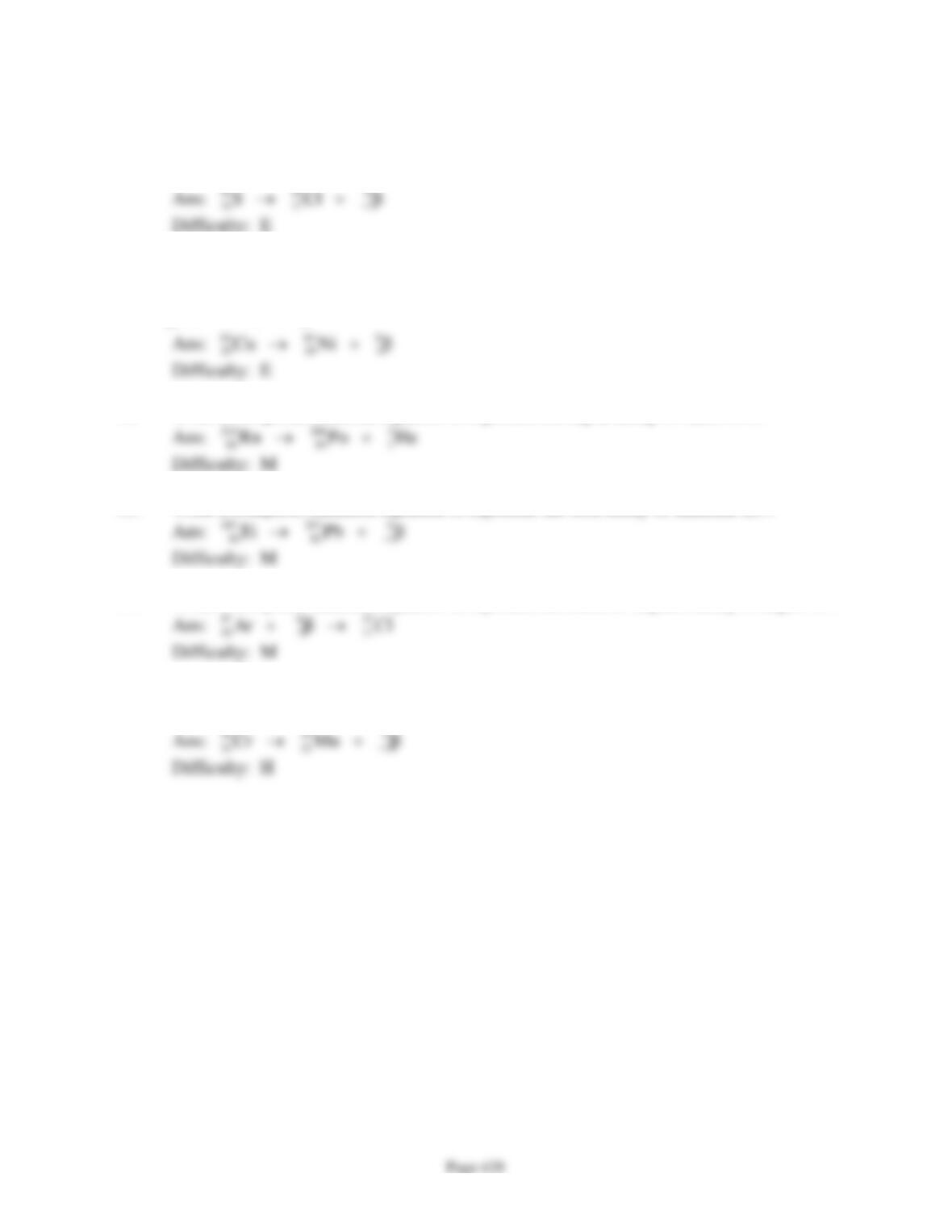
69. Fill in missing sub- and superscripts for all particles to complete the following equation
for alpha decay.
257
100 Fm Cf He→+
Chapter 24: Nuclear Reactions and Their Applications
70. Fill in missing sub- and superscripts for all particles to complete the following equation
for beta decay.
35
16S Cl β→+
71. Fill in missing sub- and superscripts for all particles to complete the following equation
for positron decay.
64
72. Write a complete, balanced equation to represent the alpha decay of radon-210.
73. Write a complete, balanced equation to represent the beta decay of thallium-207.
74. Write a complete, balanced equation to represent the electron capture decay of argon-37.
75. Write a complete, balanced equation to represent the formation of manganese-55 by the
beta decay of another nuclide.
Chapter 24: Nuclear Reactions and Their Applications
Page 429
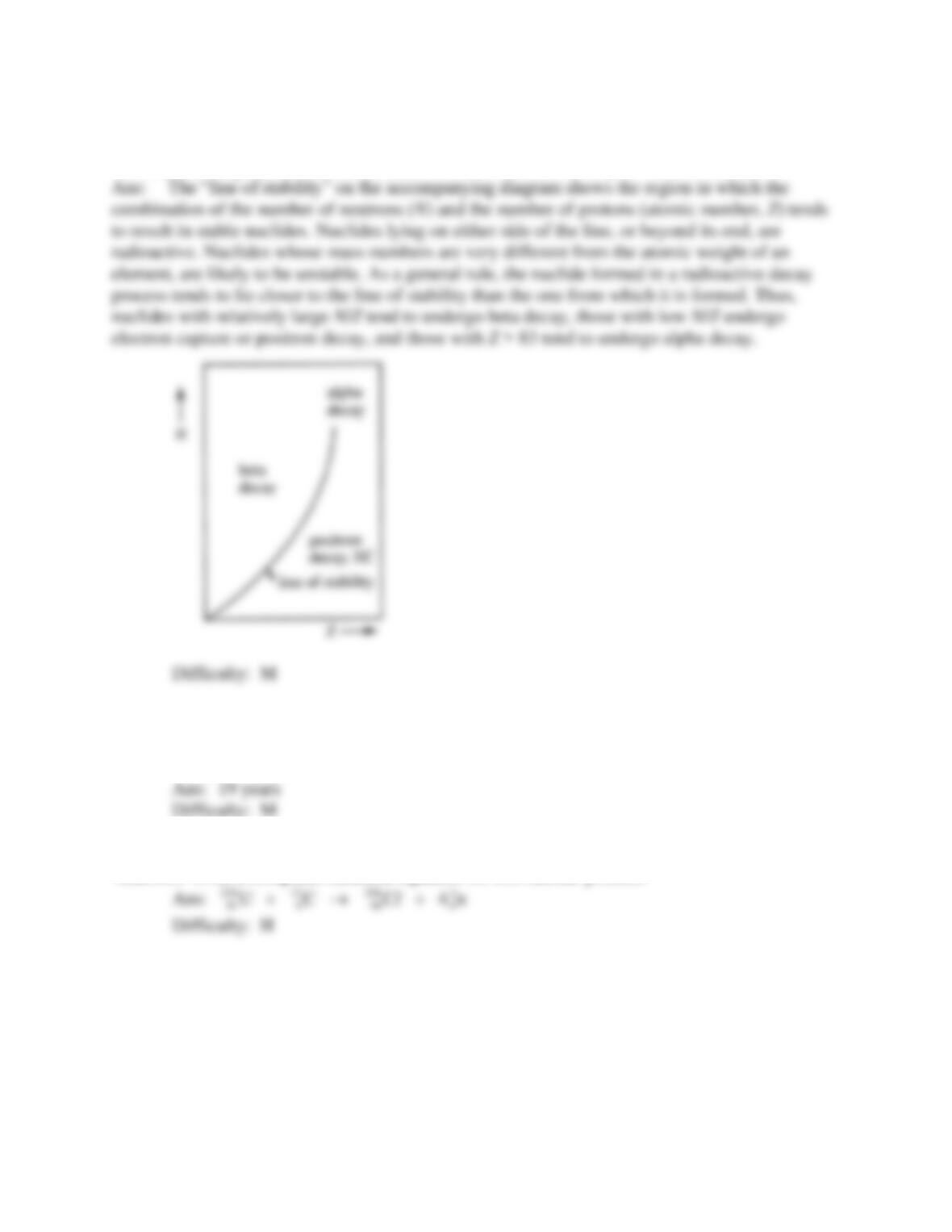
76. Explain how the number of protons and neutrons in a radioactive nucleus can be used to
predict its probable mode of decay. Illustrate your answer with a schematic graph, properly
labeled, showing stable nuclides (nuclei) in relation to number of protons and neutrons.
77. A bottle of vintage red wine has lost its label. The concentration of tritium (
3
1H
) in the
wine is 0.34 times that found in freshly bottled wines. If the half-life of tritium is 12.3 years,
estimate the time elapsed since the wine was bottled.
78. Bombardment of uranium-238 nuclei by carbon-12 nuclei produces californium-246 and
Chapter 24: Nuclear Reactions and Their Applications
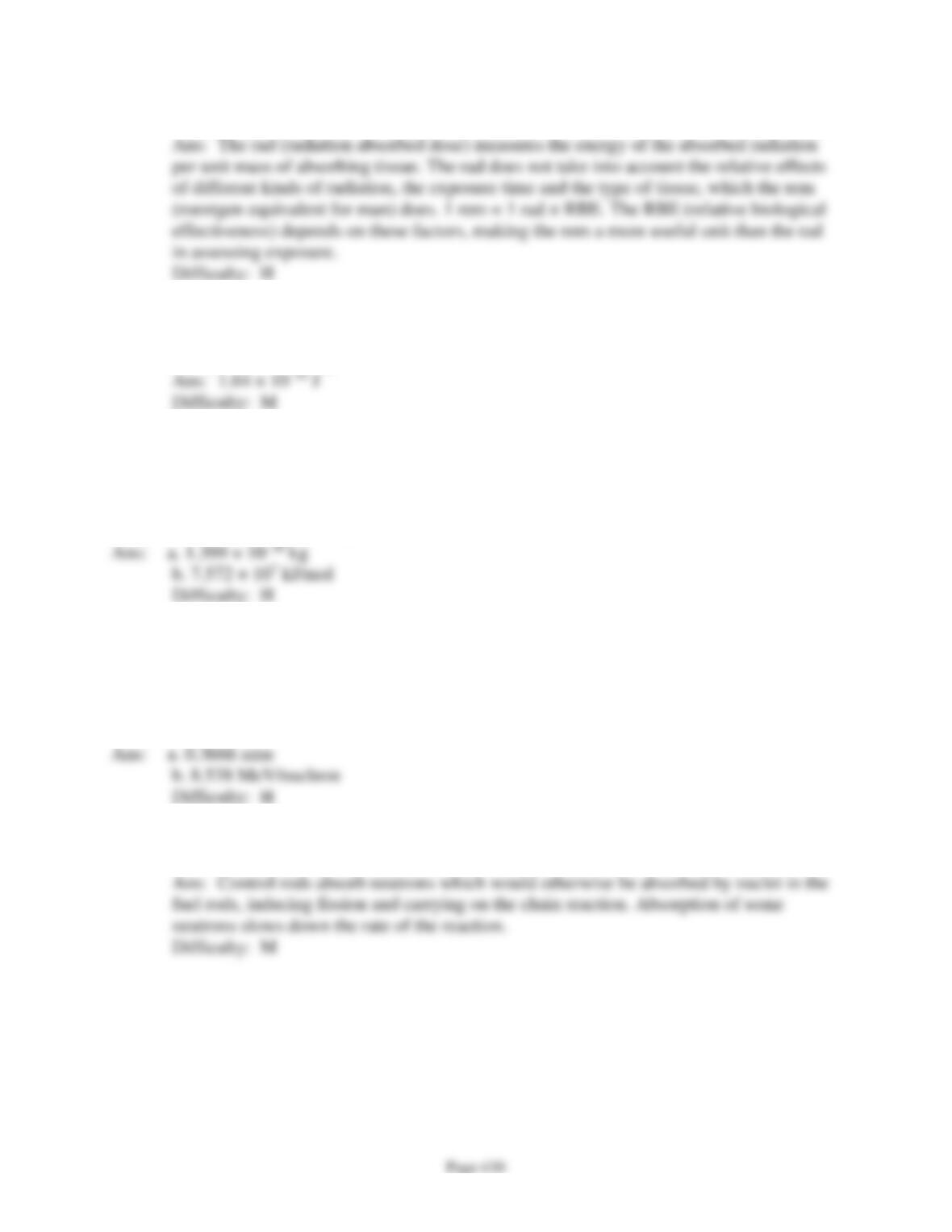
79. Briefly, explain the relationship between the rad and the rem as units of radiation dosage.
80. When an electron and its anti-particle, a positron, collide, they annihilate each other.
Calculate the energy released in this process, in J. (The positron mass is the same as the electron
mass, namely 9.11 × 10⁻³¹ kg.)
81. Calculate to four significant figures
a. the mass defect in kg, and
b. the energy released in kJ/mol, when a neutron decays to produce a proton and an electron.
The neutron, proton, and electron masses are 1.67493 × 10⁻²⁷ kg, 1.67262 × 10⁻²⁷ kg and
9.10939 × 10⁻³¹ kg, respectively.
82. The masses of a potassium-40 atom, a proton, and a neutron are 39.963999 amu,
1.007825 amu, and 1.008665 amu, respectively. Calculate to four significant figures
a. the mass defect in amu, and
b. the energy released in MeV/nucleon, in the formation of
40
19 K
from the appropriate number of
protons and neutrons.
83. What is the mechanism by which control rods slow down the fission rate in a nuclear
reactor?
Chapter 24: Nuclear Reactions and Their Applications
84. Of the naturally-occurring elements on earth today, identify by their chemical symbols
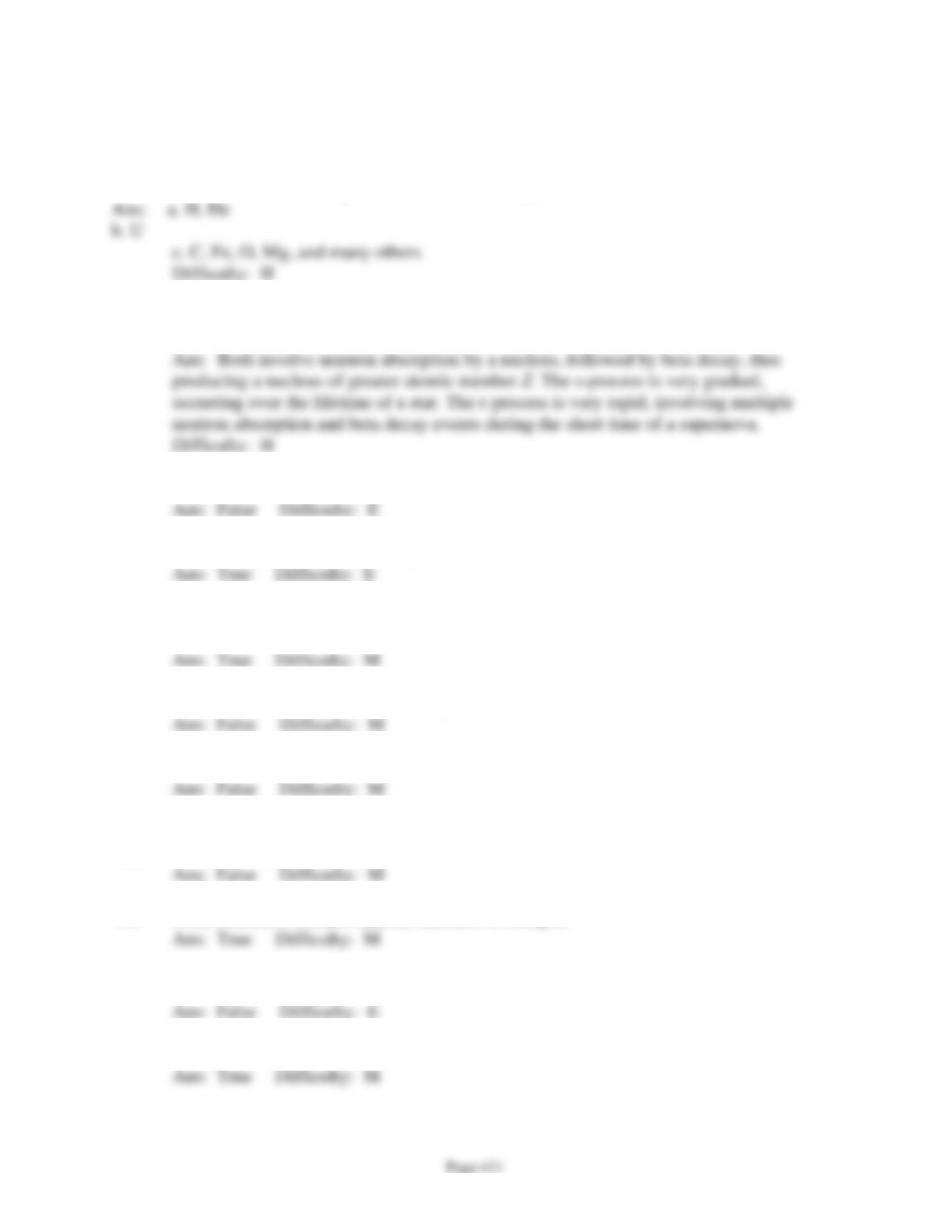
a. two which would have resulted directly from the “big bang”.
b. one which can only be formed in supernova explosions.
c. two which are formed during the normal life of first generation stars.
85. What features do the r- and s-processes for element formation have in common? How do
they differ?
86. Gamma rays are high energy electrons.
87. Gamma rays are not deflected by an electric field.
88. Positron decay and electron capture have the same net effect on the Z and N values of a
nucleus.
89. No alpha decay is observed for isotopes of elements with Z < 83.
90. Radioactive decay follows zero-order kinetics.
91. After 4 half-lives, the fraction of a radioactive isotope which still remains is
approximately one-eighth.
92. Most foodstuffs contain natural, radioactive isotopes.
93. The (negative) binding energy per nucleon reaches a maximum for the isotope
12
6C
.
94. The r-process occurs during supernova explosions.

Chapter 24: Nuclear Reactions and Their Applications
95. The s-process involves a slow succession of neutron absorption and beta decay processes
during the normal life of a star.