Page 403
Chapter 23: The Transition Elements and Their
Coordination Compounds
1. Which of the following elements has the ground state electron configuration,
[Xe]4f145d106s1?
A) Hg B) Ag C) Hf D) Au E) Th
2. Which one of the following has the ground state electron configuration [Ar]3d104s1?
A) In+ B) Cd2+ C) Ag+ D) Ag E) Cu
3. The most common oxidation state for ions of the transition elements is
A) +2. B) +3. C) +4. D) +5. E) +6.
4. The most common oxidation state for ions of the inner transition elements is
A) +2. B) +3. C) +4. D) +5. E) +7.
5. A feature of transition metal chemistry is that these elements exhibit multiple oxidation
states. Which one of the following elements exhibits the smallest number of different oxidation
states?
A) Ti B) Cr C) Mn D) Co E) Zn
6. Which of the following transition elements can have an oxidation number of +7?
A) V B) Cr C) Mn D) Fe E) Co
7. The ground state electronic configuration of Cr2+ is
A) [Ar]4s13d5.
B) [Ar]4s23d4.
C) [Ar]3d4.
D) [Ar]4s13d3.
E) [Ar]4s23d2.
Chapter 23: The Transition Elements and Their Coordination Compounds
8. The ground state electronic configuration of Zn2+ is
A) [Ar]4s23d8.
B) [Ar]4s23d10.
C) [Ar]4s13d9.
D) [Ar]3d10.
E) [Ar]3d8.
9. How many unpaired electrons are there in the Fe3+ ion?
A) 5 B) 4 C) 3 D) 2 E) 1
10. Which of the following atoms has the biggest radius?
A) Ti B) Cr C) Fe D) Ni E) Zn
11. A certain transition element has the stable oxidation states of +2, +3, +4, +5, and +6. In
which state will the element be most likely to form a covalent bond with chlorine?
A) +2 B) +3 C) +4 D) +5 E) +6
12. A certain transition element has the stable oxidation states of +2, +3, +4, +5, and +6. In
which state will the element be most likely to form an ionic bond with chlorine?
A) +2 B) +3 C) +4 D) +5 E) +6
13. Which of the following transition elements can achieve the largest oxidation number?
A) chromium, Cr, Group 6B(6) D) cobalt, Co, Group 8B(9)
B) manganese, Mn, Group 7B(7) E) zinc, Zn, Group 2B(12)
C) iron, Fe, Group 8B(8)
14. If M represents a transition element, which of the following oxides should be the least
basic?
A) MO B) M2O C) M2O3 D) MO2 E) MO3
15. Which of the following ions is most likely to form colored compounds?
A) Sc3+ B) Cu+ C) Zn2+ D) Cr3+ E) Ca2+
16. Which of the following ions is least likely to form colored compounds?
A) Mn2+ B) Cr5+ C) Sc3+ D) Fe3+ E) Co2+
Chapter 23: The Transition Elements and Their Coordination Compounds
17. Which of the following will be diamagnetic?
A) Ni2+ B) Cr2+ C) Mn2+ D) Co3+ E) Ti4+
18. Which of the following will be paramagnetic?
A) V5+ B) Ni2+ C) Mn7+ D) Ti4+ E) Zn
19. What is the highest possible oxidation state for palladium, Pd?
A) +1 B) +2 C) +3 D) +4 E) +6
20. What is the highest possible oxidation state for molybdenum, Mo?
A) +2 B) +4 C) +6 D) +8 E) none of the above
21. Which of the following should be the strongest reducing agent?
A) Fe B) Ru C) Os D) Re E) Cu
22. Which of the following will be the strongest oxidizing agent?
A) Cr B) Cr(II) C) Cr(III) D) Cr(IV) E) Cr(VI)
23. Which of the oxidation states of chromium has the largest valence-state
electronegativity?
A) chromium(0) D) chromium(IV)
B) chromium(II) E) chromium(VI)
C) chromium(III)
24. Chromium and manganese are among the transition elements that form several different
oxides. Which of the following statements characterize these oxides?
A) As the oxidation number on the metal increases, the valence-state electronegativity
increases and the oxides change from acidic to basic.
B) As the oxidation number on the metal increases, the valence-state electronegativity
increases and the oxides change from basic to acidic.
C) As the oxidation number on the metal increases, the valence-state electronegativity
decreases and the oxides change from acidic to basic.
D) As the oxidation number on the metal increases, the valence-state electronegativity
decreases and the oxides change from basic to acidic.
E) None of the above statements is correct.
Chapter 23: The Transition Elements and Their Coordination Compounds
25. Aluminum reacts with oxygen in the air to form a protective oxide coating. Silver also
reacts with compounds in air to form a black coating. What substance is formed?
A) silver oxide D) silver carbonate
B) silver chloride E) silver nitride
C) silver sulfide
26. Which of the following is not a property of silver that is important in black and white
photography?
A) Silver halides are not soluble in water.
B) Silver metal is easily oxidized.
C) Silver halides undergo a redox reaction when exposed to light.
D) Silver ions will form stable, water-soluble complex ions.
E) Silver atoms catalyze the reduction of silver ions.
27. Mercury(II) compounds are assimilated into the food chain because
A) they are ionic substances that are concentrated in cell tissue.
B) they complex with compounds in the blood which carries them to the muscle tissue
of organisms.
C) they are incorporated into bone structure.
D) they are very soluble in water and easily ingested.
E) they are nonpolar substances that are concentrated in fatty tissues as they move up
28. A certain transition metal complex has the formula MX42+. If the metal ion has a d8
electron configuration, what is the shape of the complex?
A) octahedral D) trigonal pyramid
B) square pyramid E) square planar
29. Which of the following coordination numbers applies to octahedral complexes?
A) 4 B) 5 C) 6 D) 8 E) none of the above
30. Which of the following is considered a bidentate ligand?
A) cyanide, CN– D) nitrite, NO2–
B) thiocyanate, SCN– E) hydroxide, OH–
C) oxalate, C2O42–
Chapter 23: The Transition Elements and Their Coordination Compounds
31. Which one of the following normally acts as a bidentate ligand in complexes with
transition metal ions?
A) CN–
B) EDTA4–
C) SCN–
D) ethylene diamine
E) ethylene, C2H4
32. A characteristic of ligands is that
A) they are Lewis acids. D) they are electron pair acceptors.
B) they are Lewis bases. E) they are Brønsted-Lowry acids.
C) they are ions.
33. In the formation of a transition metal complex, the central metal atom or ion acts as
A) an Arrhenius acid. D) a Lewis acid.
B) a Bronsted-Lowry acid. E) a Lewis base.
C) a Bronsted-Lowry base.
34. 10.0 mL of a 0.100 mol/L solution of a metal ion M2+ is mixed with 10.0 mL of a 0.100
mol/L solution of a ligand L. A reaction occurs in which the product is ML32+. Approximately,
what is the maximum concentration of ML32+, in mol/L, which could result from this reaction?
A) 0.100 B) 0.050 C) 0.033 D) 0.025 E) 0.017
35. What is the coordination number of cobalt in the complex ion [Co(en)Cl4]–?
(en = ethylenediamine)
A) 1 B) 2 C) 4 D) 6 E) 8
36. The oxidation and coordination numbers of cobalt in the compound [Co(NH3)5Cl]Cl2
are, respectively:
A) 2 and 6. B) 2 and 8. C) 3 and 6. D) 3 and 8. E) none of the above
37. In the compound K[Co(C2O4)2(H2O)2] (where C2O42– = oxalate) the oxidation number
and coordination number of cobalt are, respectively:
A) –1 and 4. B) –1 and 6. C) 3 and 4. D) 3 and 6. E) 1 and 6.
Chapter 23: The Transition Elements and Their Coordination Compounds
38. In the compound [Ni(en)2(H2O)2]SO4 (where en = ethylenediamine) the oxidation
number and coordination number of nickel are, respectively:
A) 2 and 6. B) 4 and 6. C) 6 and 6. D) 2 and 4. E) 4 and 4.
39. When the ethylenediaminetetraacetate ion (EDTA4–) forms a complex with a transition
metal ion, how many electrons does it normally donate to the metal?
A) 4 B) 6 C) 8 D) 10 E) 12
40. Give the systematic name for [Cu(NH3)4]Cl2.
A) dichlorotetraamminecuprate(II) D) tetraaminocopper(II) chloride
B) tetraamminecopper(II) chloride E) none of the above
C) copper(II) ammonium chloride
41. The compound K3[Fe(CN)6] is used in calico printing and wool dyeing. Give its
systematic name.
A) potassium iron(III) hexacyanate D) potassium hexacyanideferrate
B) tripotassium iron(III) hexacyanate E) none of the above
C) potassium hexacyanoferrate(III)
42. Give the systematic name for Cr(CO)3(NH3)3.
A) chromiumtriaminotricarbonyl D) triamminetricarbonylchromium(0)
B) triamminechromium carbonate E) none of the above
C) triamminetricarbonylchromate(0)
43. Give the systematic name for [CoCl3(H2O)]–.
A) cobalt(II) chloride monohydrate D) aquatrichlorocobaltite(I)
B) aquatrichlorocobalt(II) E) none of the above
C) aquatrichlorocobaltate(II)
44. Write the formula for pentaamminechlorocobalt(III) chloride.
A) [Co(NH3)5Cl]Cl D) [Co(NH3)5Cl]Cl4
B) [Co(NH3)5Cl]Cl2 E) none of the above
C) [Co(NH3)5Cl]Cl3
Chapter 23: The Transition Elements and Their Coordination Compounds
45. Write the formula for diamminedichloroethylenediaminecobalt(III) bromide.
A) [CoCl2(en)(NH3)2]Br D) [CoCl2(en)2(NH3) 2]Br2
B) [CoCl2(en)(NH3) 2]Br2 E) none of the above
C) [CoCl2(en)2(NH3)2]Br
46. Write the formula for sodium tetracyanonickelate(II).
A) Na[Ni(CN)4] D) Na4[Ni(CN)4]
B) Na[Ni(CN)4]2 E) none of the above
C) Na2[Ni(CN)4]
47. Which of the following ligands could participate in linkage isomerism?
A) NH3 B) H2O C) NH4+ D) NO2– E) ethylenediamine
48. Which of the following species could exist as isomers?
A) [Co(H2O)4Cl2]+ D) [Pt(NH3)3Cl]+
B) [Pt(NH3)Br3]– E) none of the above
C) [Pt(en)Cl2]
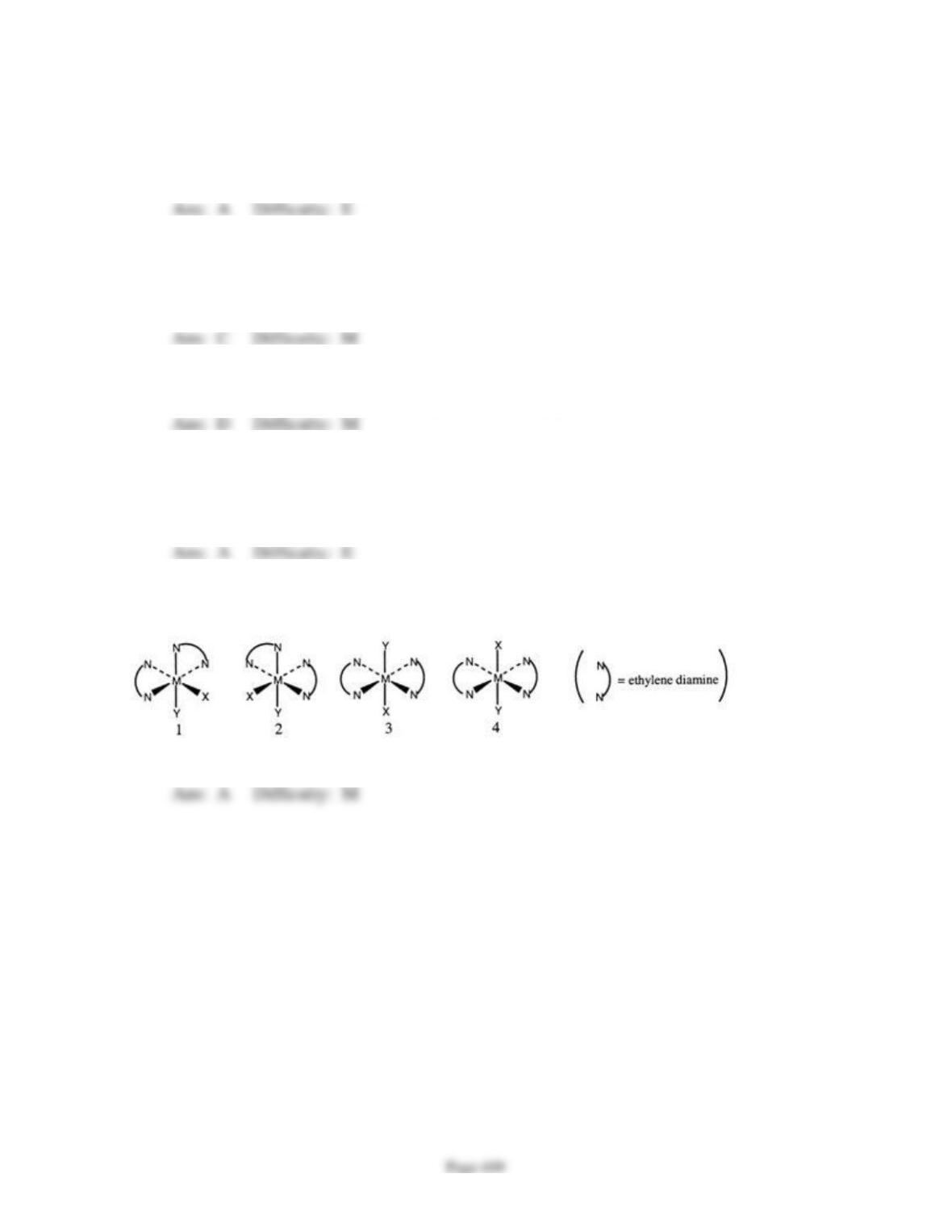
49. Consider the following octahedral complex structures, each involving ethylene diamine
and two different, unidentate ligands X and Y.
Which one, if any, of the following is a pair of optical isomers?
A) 1 and 2 B) 1 and 3 C) 1 and 4 D) 3 and 4 E) none of the above
Chapter 23: The Transition Elements and Their Coordination Compounds
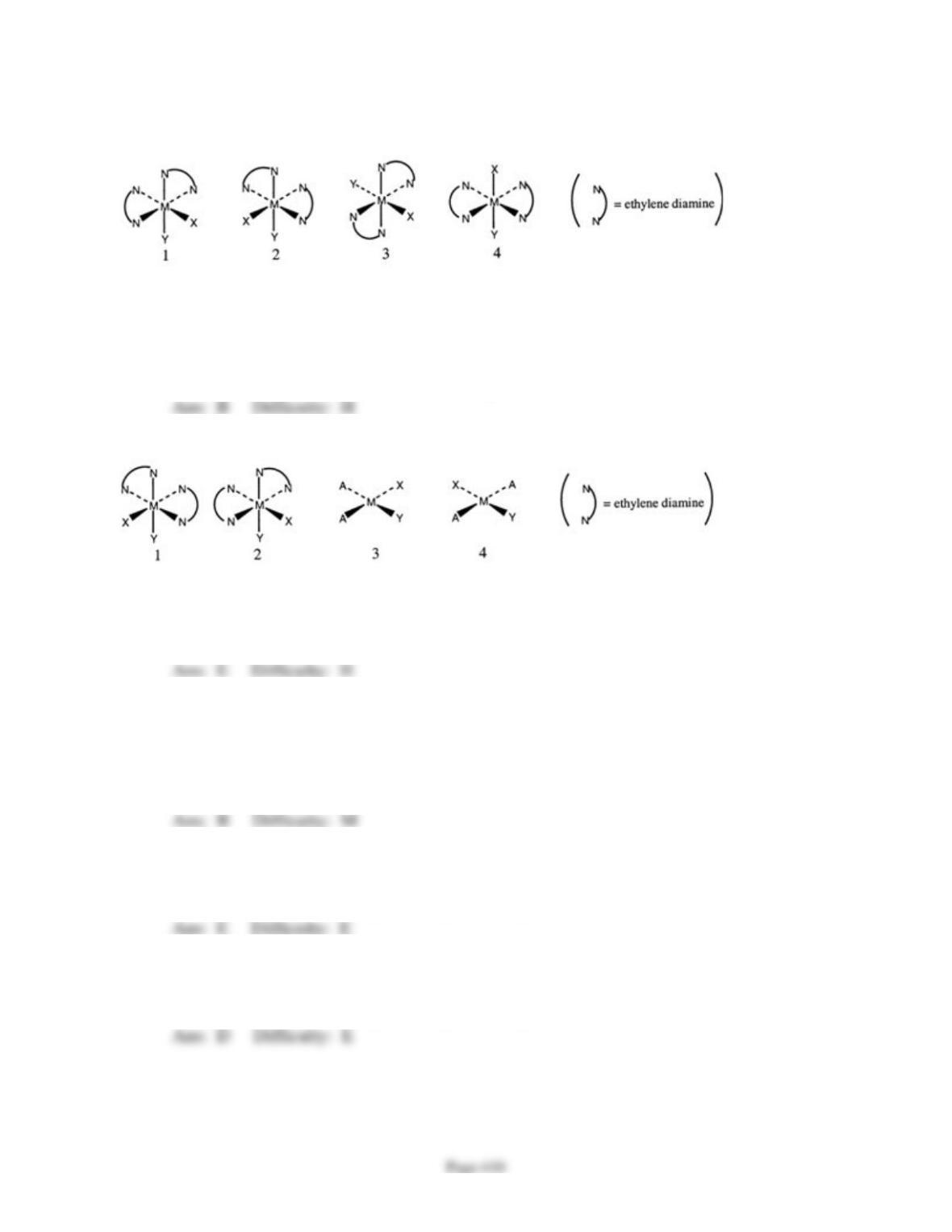
50. Consider the following octahedral complex structures, each involving ethylene diamine
and two different, unidentate ligands X and Y.
Which one of the following statements about these structures is incorrect?
A) Structures 1 and 2 are optical isomers.
B) Structures 1 and 3 are optical isomers.
C) Structures 1 and 3 are different complexes.
D) Structures 1 and 4 are geometrical isomers.
E) Structures 3 and 4 are the same complex.
51. Consider the following structures (1 and 2 are octahedral; 3 and 4 are square planar).
Which one of the following statements about the above structures is correct?
A) 1 and 2 are superimposable. D) 3 and 4 are optical isomers.
B) 1 and 2 are geometric isomers. E) 3 and 4 are geometric isomers.
C) 3 and 4 are structural isomers.
52. In a coordination compound involving a complex ion of square planar geometry, which
of the following types of isomerism is/are never possible?
A) geometric D) coordination
B) optical E) more than one of the above
C) linkage
53. According to valence bond theory, what would be the set of hybrid orbitals used when a
Period 4 transition metal forms a square planar complex?
A) d2sp B) d2p2 C) dsp3 D) sp3 E) dsp2
54. According to valence bond theory, what would be the set of hybrid orbitals used when a
Period 4 transition metal forms a tetrahedral complex?
A) d2sp B) dsp2 C) dsp3 D) sp3 E) d2p2
Chapter 23: The Transition Elements and Their Coordination Compounds
55. According to Valence Bond theory, in the square planar Ni(CN)42– complex ion, the
orbital hybridization pattern is
A) sp3. B) dsp2. C) d2sp. D) d2sp3. E) none of the above.
56. The crystal field splitting energy, ,
A) is larger for tetrahedral complexes than for octahedral complexes.
B) depends on the metal but not on the ligand.
C) determines the color of a complex.
D) is larger for ionic ligands like chloride than for molecular ligands like carbon
monoxide, CO.
E) determines the charge of a complex.
57. In the spectrochemical series, which one of the following ligands has the strongest field?
A) H2O B) CN– C) NH3 D) OH– E) Cl–
58. Which of the following ions could exist in either the high-spin or low-spin state in an
octahedral complex?
A) Sc3+ B) Ni2+ C) Mn2+ D) Ti4+ E) Zn2+
59. Which of the following ions could exist in only the high-spin state in an octahedral
complex?
A) Cr2+ B) Mn4+ C) Fe3+ D) Co3+ E) Ni2+
60. In the presence of a strong octahedral ligand field, the number of unpaired electrons in
Co(III) will be
A) 0. B) 2. C) 4. D) 6. E) none of the above.
61. Which of the following octahedral complexes should have the largest crystal field
splitting energy, ?
A) [Cr(H2O)6]3+ D) [Cr(CN)6]3–
B) [Cr(SCN)6]3– E) [Cr(en)3]3+ (en = ethylenediamine)
C) [Cr(NH3)6]3+
62. Which of the following ligands is most likely to form a low-spin octahedral complex
with iron(III)?
A) Cl– B) H2O C) NH3 D) OH– E) CO
Chapter 23: The Transition Elements and Their Coordination Compounds
63. Which of the following ligands is most likely to form a high spin octahedral complex
with cobalt(II)?
A) CN– B) en (ethylenediamine) C) NO2– D) CO E) I–
64. Iron(III) forms an octahedral complex with the ligand CN–. How many unpaired
electrons are in the d orbitals of iron?
A) 1 B) 3 C) 5 D) 7 E) none of the above
65. How many unpaired electrons will there be in a high-spin octahedral complex of Fe(II)?
A) 0 B) 2 C) 4 D) 6 E) none of the above
66. If a solution absorbs green light, what is its likely color?
67. Why is the +2 oxidation state so common among transition elements?
68. Give one important use of the following metals or their compounds.
a. chromium
b. manganese
c. mercury
d. silver
69. What is the difference between a coordination compound and a complex ion?
Chapter 23: The Transition Elements and Their Coordination Compounds
70. a. How can the formation of a complex ion be described in terms of a theory of acids and
bases?
b. What is the essential requirement for a molecule or ion to act as a ligand?
71. What geometry is particularly common for complexes of d10 metal ions?
72. The compound Rh(CO)(H)(PH3)2 forms cis and trans isomers. Use this information to
predict the geometry of this complex, and draw the geometric isomers.
73. a. State the requirement for two molecules to be optical isomers.
b. A complex ion MABCD2+ (where A, B, C, and D are different unidentate ligands) rotates the
plane of polarized light. Deduce the geometry of the complex and draw the optical isomers of
this ionic formula.
Chapter 23: The Transition Elements and Their Coordination Compounds
74. Apply the valence bond theory to predict the electronic structure and hybridization
pattern of chromium in the complex ion Cr(NH3)63+.
75. The dxy and the dx2–y2 orbitals both lie in the xy plane, yet for a metal ion in an octahedral
complex the energy of the dxy orbital is lower than that of the dx2–y2orbital. Explain this using the
arguments of crystal field theory.
76. a. How many unpaired 3d electrons will there be in (i) high and (ii) low-spin complexes
of Co(II)?
b. How can high and low-spin complexes be recognized and distinguished experimentally?
77. a. Explain how the crystal field theory can use the magnitude of the splitting energy to
provide an explanation of the color and magnetic properties of octahedral complexes.
b. In promoting an electron from the t2g set of orbitals to the eg set, an octahedral complex
absorbs a photon with a wavelength of 523 nm. Calculate the value of in the complex, in
kJ/mol.
78. All atoms of the first transition series of elements have the ground state electronic
configuration [Ar]4s23dx, where x is an integer from 1 to 10.
Chapter 23: The Transition Elements and Their Coordination Compounds
79. The ground state electron configuration of a transition element atom cannot have more
than one incomplete subshell.
80. The M2+ ions of the first transition series of elements all have the general electronic
81. The Cu2+ ion has 1 unpaired electron.
82. Of the 3d transition series of elements, scandium has the greatest atomic radius.
83. Of the 3d transition series of elements, zinc has the greatest atomic radius.
84. The maximum oxidation state of an element in the first transition series never exceeds its
group number.
85. The inner transition series of elements arise from the filling of f orbitals.
86. All the actinide series of transition elements are radioactive.
87. The conversion of the chromate ion (CrO42–) to the dichromate ion (Cr2O72–) is a redox
process.
88. The permanganate ion (MnO4–) is a powerful reducing agent.
89. In complexes of transition metals, the maximum coordination number of the metal is
equal to its number of d electrons.
90. Octahedral complexes can exhibit geometric, optical, and linkage isomerism.
91. Tetrahedral complexes can exhibit both optical and linkage isomerism.

Chapter 23: The Transition Elements and Their Coordination Compounds
92. Square planar complexes can exhibit both geometric and optical isomerism.
93. Valence Bond theory rationalizes octahedral geometry by assuming a d2sp3 hybridization
pattern.