
Chapter 20: Thermodynamics: Entropy, Free Energy, and the Direction of Chemical Reactions
55. “A diamond is forever” is one of the most successful advertising slogans of all time. But
is it true? For the reaction shown below, calculate the standard free energy change at 298K and
determine whether or not a diamond is “forever”.
C(diamond) → C(graphite)
Data: Hf°(diamond) = 1.895 kJ/mol; S°(diamond) = 2.337 J mol-1 K-1;
S°(graphite) = 5.740 J mol-1K-1.
A) G° = 2.19 kJ; forever D) G° = 1.90 kJ; forever
B) G° = –1.90 kJ; not forever E) G° = < –1000 kJ; not forever
C) G° = –2.90 kJ; not forever
56. Hydrogen sulfide decomposes according to the following reaction
2H2S(g) → 2H2(g) + S2(g)
For this reaction at 298K S° = 78.1 J/K, H° = 169.4 kJ, and G° = 146.1 kJ. What is the
value of G° at 900 K?
A) –69881 kJ B) 48.4 kJ C) 99.1 kJ D) 240 kJ E) 441 kJ
57. Nitric oxide reacts with chlorine to form NOCl. The data refer to 298 K.
2NO(g) + Cl2(g) → 2NOCl(g)
Substance: NO(g) Cl2(g) NOCl(g)
H° f (kJ/mol): 90.29 0 51.71
G° f (kJ/mol): 86.60 0 66.07
S°(J/Kmol): 210.65 223.0 261.6
What is the value of G° for this reaction at 550 K?
A) –143.76 kJ B) –78.78 kJ C) –22.24 kJ D) –10.56 kJ E) 66600 kJ
58. Sulfuryl dichloride is formed when sulfur dioxide reacts with chlorine. The data refer to
298 K.
SO2(g) + Cl2(g) → SO2Cl2(g)
Substance: SO2(g) Cl2(g) SO2Cl2(g)
H° f (kJ/mol): –296.8 0 –364.0
G° f (kJ/mol): –300.1 0 –320.0
S°(J/Kmol): 248.2 223.0 311.9
What is the value of G° for this reaction at 600 K?
A) –162.8 kJ B) –40.1 kJ C) –28.4 kJ D) 28.4 kJ E) 162.8 kJ
Chapter 20: Thermodynamics: Entropy, Free Energy, and the Direction of Chemical Reactions
59. The temperature at which the following process reaches equilibrium at 1.0 atm is the
normal boiling point of hydrogen peroxide.
H2O2(l) H2O2(g)
Use the following thermodynamic information at 298 K to determine this temperature.
Substance: H2O2(l) H2O2(g)
H° f (kJ/mol): –187.7 –136.3
G° f (kJ/mol): –120.4 –105.6
S° (J/Kmol): 109.6 232.7
A) 120°C B) 144°C C) 196°C D) 418°C E) 585°C
60. The temperature at which the following process reaches equilibrium at 1.0 atm is the
normal melting point for phosphoric acid.
H3PO4(s) H3PO4(l)
Use the following thermodynamic data at 298 K to determine this temperature.
Substance: H3PO4(s) H3PO4(l)
H° f (kJ/mol): –1284.4 –1271.7
G° f (kJ/mol): –1124.3 –105.6
S° (J/Kmol): 110.5 150.8
A) 286 K B) 305 K C) 315 K D) 347 K E) 3170 K
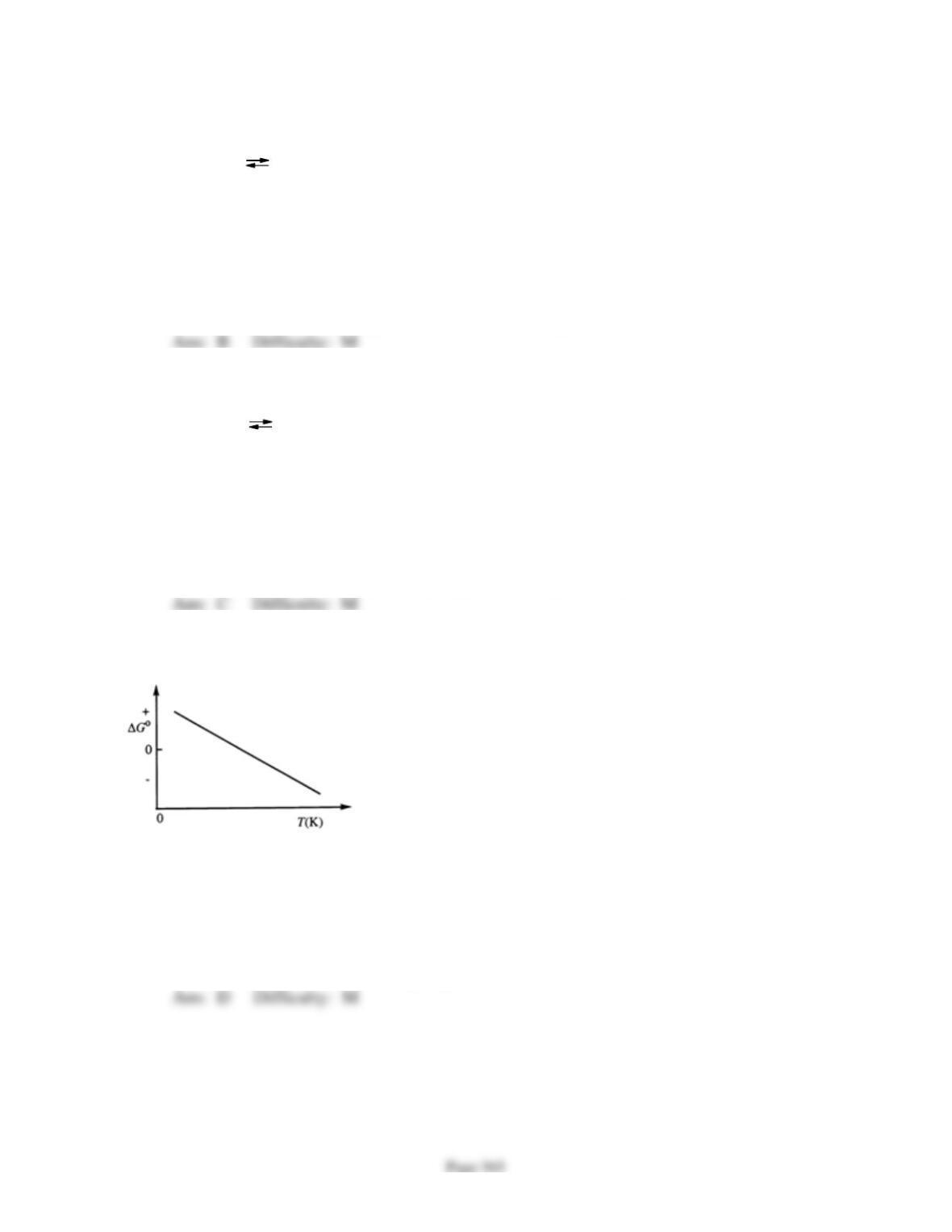
61. Consider the figure which shows G° for a chemical process plotted against absolute
temperature.
Which one of the following is an incorrect conclusion, based on the information in the diagram?
A) H° > 0
B) S° > 0
C) The reaction is spontaneous at high temperatures.
D) S° increases with temperature while H° remains constant.
E) There exists a certain temperature at which H° = TS°.
Chapter 20: Thermodynamics: Entropy, Free Energy, and the Direction of Chemical Reactions
62. Consider the figure which shows G° for a chemical process plotted against absolute
temperature. From this plot, it is reasonable to conclude that:
A) H° > 0, S° > 0 D) H° < 0, S° < 0
B) H° > 0, S° < 0 E) none of the above
C) H° < 0, S° > 0
63. Consider the figure which shows G° for a chemical process plotted against absolute
temperature. From this plot, it is reasonable to conclude that:
A) H° > 0, S° > 0 D) H° < 0, S° < 0
B) H° > 0, S° < 0 E) none of the above
C) H° < 0, S° > 0
64. A reaction is proceeding toward equilibrium. At a certain stage, the concentrations of
reactants and products are such that G = G°. What conclusion can reasonably be drawn about
the reaction at this time?
A) K > Q B) K < Q C) K = Q D) K = 1 E) Q = 1

Chapter 20: Thermodynamics: Entropy, Free Energy, and the Direction of Chemical Reactions
65. Iron(III) oxide can be reduced by carbon monoxide.
Fe2O3(s) + 3CO(g) 2Fe(s) + 3CO2(g)
Use the following thermodynamic data at 298 K to determine the equilibrium constant at this
temperature.
Substance: Fe2O3(s) CO(g) Fe(s) CO2(g)
H° f (kJ/mol): –824.2 –110.5 0 –393.5
G° f (kJ/mol): –742.2 –137.2 0 –394.4
S°(J/Kmol): 87.4 197.7 27.78 213.7
A) 7.0 × 10⁻⁶ B) 1.3 × 10⁻³ C) 2.2 × 10⁴ D) 1.4 × 10⁵ E) > 2.0 × 10⁵
66. Calculate the equilibrium constant at 25°C for the reaction of methane with water to form
carbon dioxide and hydrogen. The data refer to 25°C.
CH4(g) + 2H2O(g) CO2(g) + 4H2(g)
Substance: CH4(g) H2O(g) CO2(g) H2(g)
H° f (kJ/mol): –74.87 –241.8 –393.5 0
G° f (kJ/mol): –50.81 –228.6 –394.4 0
S°(J/Kmol): 186.1 188.8 213.7 130.7
A) 8.2 × 10¹⁹ B) 0.96 C) 0.58 D) 1.2 × 10⁻²⁰ E) 1.4 × 10–46
67. The reaction of methane with water to form carbon dioxide and hydrogen is non-
spontaneous at 298 K. At what temperature will this system make the transition from non-
spontaneous to spontaneous? The data refer to 298 K.
CH4(g) + 2H2O(g) CO2(g) + 4H2(g)
Substance: CH4(g) H2O(g) CO2(g) H2(g)
H° f (kJ/mol): –74.87 –241.8 –393.5 0
G° f (kJ/mol): –50.81 –228.6 –394.4 0
S°(J/Kmol): 186.1 188.8 213.7 130.7
A) 658 K B) 683 K C) 955 K D) 1047 K E) 1229 K
68. Use the thermodynamic data at 298 K below to determine the Ksp for barium carbonate,
BaCO3 at this temperature.
Substance: Ba2+(aq) CO32–(aq) BaCO3(s)
H° f (kJ/mol): –538.36 –676.26 –1219
G° f (kJ/mol): –560.7 –528.1 –1139
S°(J/Kmol): 13 –53.1 112
A) 5.86 B) 6.30 × 10⁸ C) 1.59 × 10⁻⁹ D) 5.47 × 10⁻²¹ E) 2.18 × 10⁻²⁷
Chapter 20: Thermodynamics: Entropy, Free Energy, and the Direction of Chemical Reactions
69. What is the free energy change, G°, for the equilibrium between hydrogen iodide,
hydrogen, and iodine at 453°C? Kc = 0.020
2HI(g) H2(g) + I2(g)
A) 6.4 kJ B) 8.8 kJ C) 15 kJ D) 19 kJ E) 24 kJ
70. The formation constant for the reaction
Ag+(aq) + 2NH3(aq) Ag(NH3)2+(aq)
is Kf = 1.7 × 10⁷ at 25°C. What is G° at this temperature?
A) –1.5 kJ B) –3.5 kJ C) –18 kJ D) –23 kJ E) –41 kJ
71. Consider the reaction
CuI(s) Cu+(aq) + I–(aq)
If the concentrations of the Cu+ and I– ions in equilibrium at 298 K are both equal to 1.03 × 10⁻⁶
M, what is the value of G° for the reaction?
A) –68 kJ B) 68 kJ C) –30. kJ D) 30 kJ E) 34 kJ
72. A reaction has G = 10.0 kJ and G° = 15.0 kJ at a temperature of 50 °C. Calculate the
value of the reaction quotient Q under these conditions.
A) 0.16 B) 9.1 × 10⁻⁵ C) 1.1 × 10⁴ D) 6.4 E) 6.0 × 10⁻⁶
73. a. Explain what is meant by a spontaneous process.
b. Is a spontaneous process necessarily a rapid one? Explain, and provide a real reaction as an
example to illustrate your answer.
Chapter 20: Thermodynamics: Entropy, Free Energy, and the Direction of Chemical Reactions
74. For each of the following pairs, predict which (A or B) will have the greater entropy, and
in one sentence indicate your reasoning.
A B
a. 1 mole of HI(g) 1 mole of HBr(g)
b. 1 mole of HI(g) at 20°C 1 mole of HI(g) at 30°C
c. 3 moles of H2(g) + 1 mole of N2(g) 2 moles of NH3(g)
d. 1 mole of H2(g), pressure = 1 atm 1 mole of H2(g), pressure = 0.1 atm
e. 1 mole of CO2(g) 1 mole of CO2(aq)
f. 1 mole of HCOOH(l) 1 mole of HCOOH(aq)
75. In the expression, S = k ln W, W is called the number of microstates. Explain clearly the
meaning of the word “microstate”, and why a system under a given set of conditions normally
has many microstates.
76. State the second and third laws of thermodynamics.
Chapter 20: Thermodynamics: Entropy, Free Energy, and the Direction of Chemical Reactions
77. In tables of thermodynamic data provided in chemistry books, one finds H°f, G°f, and
S° listed. Briefly, explain why the entropy data are supplied as S°, while the enthalpy and free
energy data are in the form of H°f and G°f, respectively.
78. Given: C2H2(g) → 2C(graphite) + H2(g) G° = –209 kJ
A sample of gaseous C2H2 (acetylene, or ethyne) was stored for one year, yet at the end of this
period the sample remained unchanged and no graphite or hydrogen gas had been formed.
Briefly explain why there is no inconsistency between the sign of G° and the apparent stability
of the sample.
79. The complete combustion of liquid benzene is represented by the equation:
C6H6(l) +
12
7
O2(g) → 6CO2(g) + 3H2O(l)
Using the data below, calculate, for this reaction
a. H° b. S° c. G° at 25°C.
Substance: C6H6(l) O2(g) CO2(g) H2O(l)
H° f (kJ/mol): 49 0 –394 –286
S°(J/molK): 173 205 214 70
80. For the reaction of xenon and fluorine gases to form solid XeF4, H° = –251 kJ and G°
= –121 kJ at 25°C. Calculate S° for the reaction.
Chapter 20: Thermodynamics: Entropy, Free Energy, and the Direction of Chemical Reactions
81. A chemical reaction has G° = 10.0 kJ and S° = 50.0 J/K
a. Calculate H° for this reaction at 25°C.
b. Could this reaction ever be spontaneous? Explain your answer.
82. Photosynthesis can be represented by the equation
6CO2(g) + 6H2O(l) → C6H12O6(s) + 6O2(g)
a. Calculate S° for this process, given the following data:
Substance: CO2(g) H2O(l) C6H12O6(s) O2(g)
S° (J/(molK)): 214 70 212 205
b. Given that H° for the reaction is 2802 kJ, calculate G° at 25°C.
83. A chemical reaction has H° = 42.8 kJ and S° = 92.5 J/K, at 25°C. Calculate the
temperature at which G° = 0. State any approximation involved in your calculation.
84. Compare one mole of ice with one mole of liquid water, both at 1.0 atm and 0°C. The
melting point of ice at 1.0 atm is 0°C. For the process
H2O(s) → H2O(l)
under these conditions predict whether each of the following quantities will be greater than, less
than, or equal to, zero (i.e., > 0, < 0, or = 0). Explain each prediction in one sentence.
a. H° b. S° c. G°
85. For what signs of H and S will a process
a. be spontaneous at high temperatures but not at low temperatures?
b. not be spontaneous at any temperatures?
Chapter 20: Thermodynamics: Entropy, Free Energy, and the Direction of Chemical Reactions
86. A reaction has a positive value of H° and a positive value of S°.
Draw a neat, labeled schematic plot to show how G° (y-axis) will depend on absolute
temperature (x-axis).
87. The water-gas shift reaction plays an important role in the production of clean fuel from
coal.
CO(g) + H2O(g) CO2(g) + H2(g)
Use the following thermodynamic data to determine the equilibrium constant Kp at 700. K.
Substance: CO(g) H2O(g) CO2(g) H2(g)
H° f (kJ/mol): –110.5 –241.8 –393.5 0
S°(J/molK): 197.7 188.8 213.7 130.7
88. Under a given set of conditions, all microstates of a system are equally probable.
89. The term microstate refers to the energy state of a single molecule in a system of many
molecules.
90. The higher the pressure of a gas sample, the greater is its entropy.
91. The entropy of one mole of oxygen gas in a 0.5-L container is less than it would be in a
22.4-L container at the same temperature.
92. In a spontaneous process, the entropy of the system always increases.
Chapter 20: Thermodynamics: Entropy, Free Energy, and the Direction of Chemical Reactions
93. In some spontaneous processes, the entropy of the surroundings decreases.
94. For a reaction at equilibrium, Suniv = 0.
95. The free energy of a perfect crystal at absolute zero, is zero.
96. For a given reaction, a change in the pressure may result in a change in the sign of G.
97. For any reaction, if G° > 0, then K < 1.
98. As a chemical reaction proceeds toward equilibrium, the free energy of the system
decreases.