39) The base SI unit for temperature is:
A) Fahrenheit.
B) Kelvin.
C) Celsius.
D) atmospheres.
E) none of the above
40) Which measurement below represents the heaviest mass?
A) 1 mg
B) 1 kg
C) 1 pg
D) 1 Mg
E) 1 dg
41) Which of the following sets of units is NOT in the order of increasing size?
A) μg < g < kg
B) mL < dL < L
C) ns < ms < s
D) cm < μm < km
E) μmol < mmol < mol
42) An American nickel five cent coin has a mass of approximately 5 grams. Five grams is
equivalent to which term?
A) 5000 kilograms
B) 5000 milligrams
C) 50 centigrams
D) 5000 micrograms
E) none of the above
43) Which of the following would NOT be considered a correct conversion factor?
A) 1 dozen eggs = 12 eggs
B) 12 eggs = 1 dozen eggs
C) 1 pair of shoes = 1 shoe
D) 100 pennies = 1 dollar
E) 5 cents = 1 nickel
44) The common English unit in which the speed of an automobile is expressed is miles/hr. What
is the set of base SI units for speed?
A) mile/s
B) km/hr
C) km/s
D) m/s
E) none of the above
45) The typical problem-solving procedure involves four steps in the order:
A) sort, strategize, solve, check.
B) strategize, solve, sort, check.
C) check, strategize, sort, solve.
D) solve, sort, check, strategize.
46) How many inches are in 25.8 cm?
A) 0.10
B) 28.3
C) 0.0984
D) 10.2
E) none of the above
47) How many inches are in 2.80 ft?
A) 34
B) 33.6
C) 0.233
D) 4.29
E) none of the above
48) How many grams are in 1.48 × 10⁷ μg?
A) 1.48 × 10³
B) 1.48 × 10¹³
C) 1.48
D) 14.8
E) none of the above
49) How many milliliters are in 17.5 L?
A) 175
B) 1.75 × 10⁻²
C) 1.75 × 10³
D) 1.75 × 10⁴
E) none of the above
50) How many microliters are in 41.0 mL?
A) 4.1 × 10³
B) 4.1 × 10¹⁰
C) 0.041
D) 4.10 × 10⁴
E) none of the above
51) How many liters are in 333 mL?
A) 3.33 × 10⁵
B) 0.333
C) 33.3
D) 3.33
E) none of the above
52) How many low dose 81 mg aspirin tablets can be made from 1.21 kg of aspirin?
A) 1.5 × tablets
B) 1.5 × tablets
C) 1.5 × tablets
D) 1.21 × tablets
E) 1.21 × tablets
53) A 12-oz can of soda pop costs eighty-nine cents. A 2.00 L bottle of the same variety of soda
pop costs $2.29. How many times more expensive it is to buy the 12-oz can of pop compared to
buying it in a 2.00 L bottle? (1.00 L = 1.057 quart and 1 quart contains 32 oz)
A) 1.9
B) 2.2
C) 2.6
D) 2.8
E) 4.2
54) How many cm3 are there in 2.5 m3?
A) 2.5 × 10⁶
B) 2.5 × 10⁻²
C) 2.5 × 10²
D) 2.5 × 10⁻⁶
E) none of the above
55) How many cm3 are there in 1.25 ft3?
A) 38.1
B) 5.49 × 10³
C) 246
D) 3.54 × 10⁴
E) none of the above
56) A room has dimensions of 10.0 ft × 20.0 ft × 8.00 ft. Given that there are three feet in a yard,
what is the volume of the room in yd3?
A) 178
B) 59.3
C) 1.60 × 10³
D) 533
E) none of the above
57) What is the volume of a cube with dimensions 11.0 cm × 11.0 cm × 11.0 cm in m3?
A) 1.331 × 10⁻³
B) 1.33 × 10³
C) 1.33 × 10⁻³
D) 1.3 × 10³
E) none of the above
58) Which term below is equivalent to one milliliter?
A) 1 cc
B) 1 mL
C) 1 cm3
D) all of the above
E) none of the above
59) A plastic block has dimensions of 2.2 cm × 3.0 cm × 1.5 cm and a mass of 12.4 grams. Will
the block float in water and why?
A) Yes, because the density of the block is 1.3 g/mL which is less than the density of water.
B) Yes, because the density of the block is 0.80 g/mL which is less than the density of water.
C) No, because the density of the block is 1.3 g/mL which is greater than the density of water.
D) No, because the density of the block is 0.80 g/mL which is greater than the density of water.
E) none of the above
60) Suppose a boat engine leaks 938 milliliters of oil into a lake. The mass of this spilled oil is
The oil will not mix with the lake water. Which statement is true?
A) The oil will sink because its density of 0.877 g/mL is greater than the density of water.
B) The oil will float because its density of 0.877 g/mL is less than the density of water.
C) The oil will sink because its density of 1.14 g/mL is greater than the density of water.
D) The oil will float because its density of 1.14 g/mL is less than the density of water.
E) none of the above
61) A lead ball has a mass of 55.0 grams and a density of 11.4 g/cm3. What is the volume of the
ball?
A) 0.207 mL
B) 0.207 L
C) 4.82 mL
D) 4.82 L
E) none of the above
62) Given the density of Au is 19.3 g/cm3, determine the mass of gold (in grams) in an ingot
with the dimensions of 10.0 in × 4.00 in × 3.00 in.
A) 3.80 × 10⁴
B) 102
C) 2.32 × 10³
D) 0.161
E) none of the above
63) What is the density (g/mL) of an object that has a mass of 14.01 grams and, when placed into
a graduated cylinder, causes the water level to rise from 25.2 mL to 33.6 mL?
A) 0.60
B) 1.7
C) 1.8
D) 2.4
E) none of the above
64) An object weighing 1.840 kg has a volume of 0.0015 m3. What is the density of the object in
g/cm3?
A) 1.2
B) 0.0012
C) 0.82
D) 0.0028
E) none of the above
65) Given the following list of densities, which materials would float in a molten vat of lead
provided that they do not themselves melt? Densities (g/mL): lead = 11.4, glass = 2.6, gold =
19.3, charcoal = 0.57, platinum = 21.4.
A) gold and platinum
B) glass and charcoal
C) gold, platinum, glass and coal
D) gold and charcoal
E) none of the above
66) A popular science demonstration is to take several liquids that will not mix together and
“stack” these liquids in a tall glass cylinder. Suppose the following three liquids were placed in
the same tall, narrow glass cylinder:
SUBSTANCE
DENSITY
g/mL
vinegar
1.01
motor oil
0.87
corn syrup
1.36
These liquids would stack in which order?
A) corn syrup on top, motor oil in the middle, vinegar on the bottom
B) vinegar on top, motor oil in the middle, corn syrup on the bottom
C) motor oil on top, corn syrup in the middle, vinegar on the bottom
D) corn syrup on top, vinegar in the middle, motor oil on the bottom
E) motor oil on top, vinegar in the middle, corn syrup on the bottom
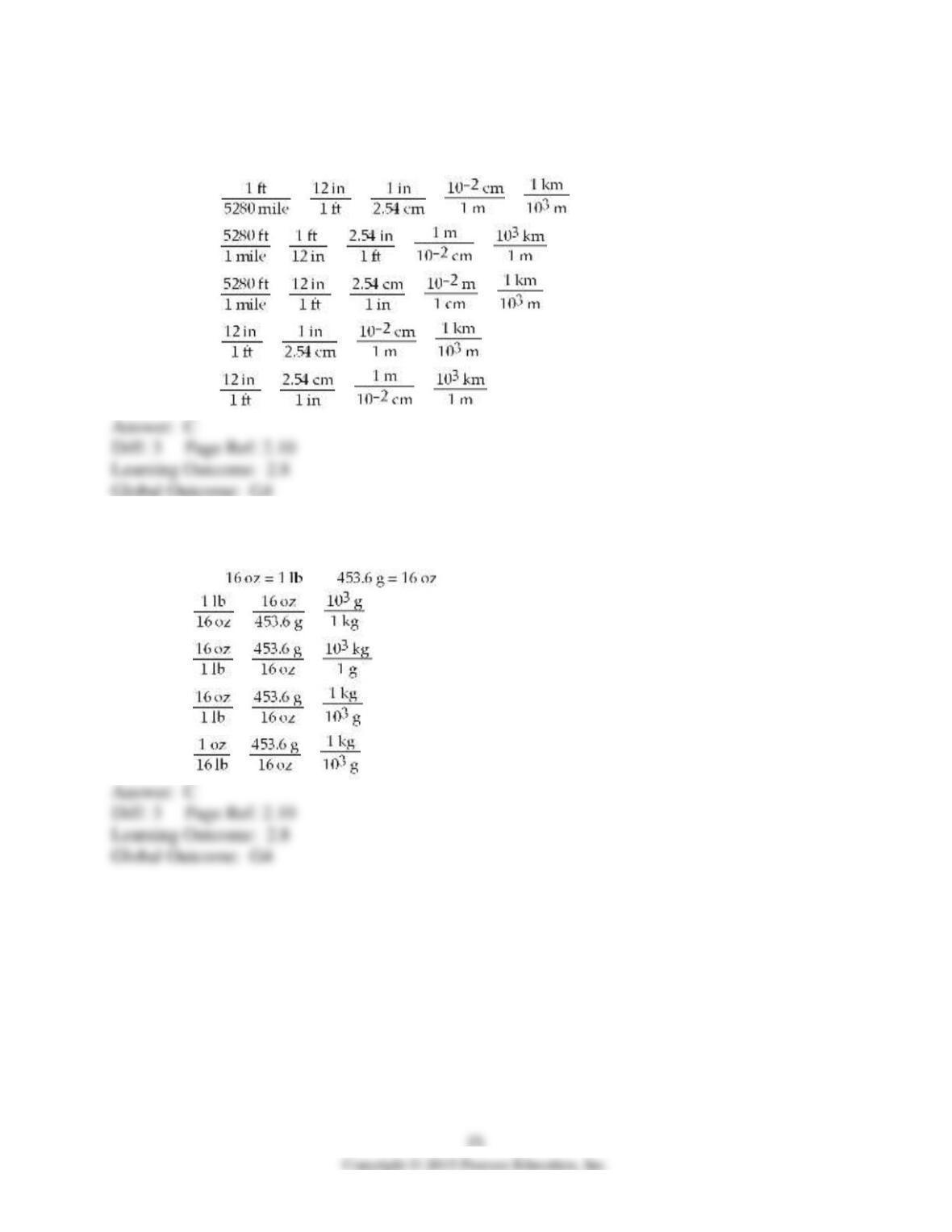
67) The distance from New York City to Washington, DC is approximately 235 miles. Identify
the correct solution map to convert from miles to kilometers using the prefix multipliers and the
given conversion factors: 1 mile = 5280 ft; 1 ft = 12 in; 1 in = 2.54 cm.
A) 235 mile × × × × ×
B) 235 mile × × × × ×
C) 235 mile × × × × ×
D) 235 mile × × × ×
E) 235 mile × × × ×
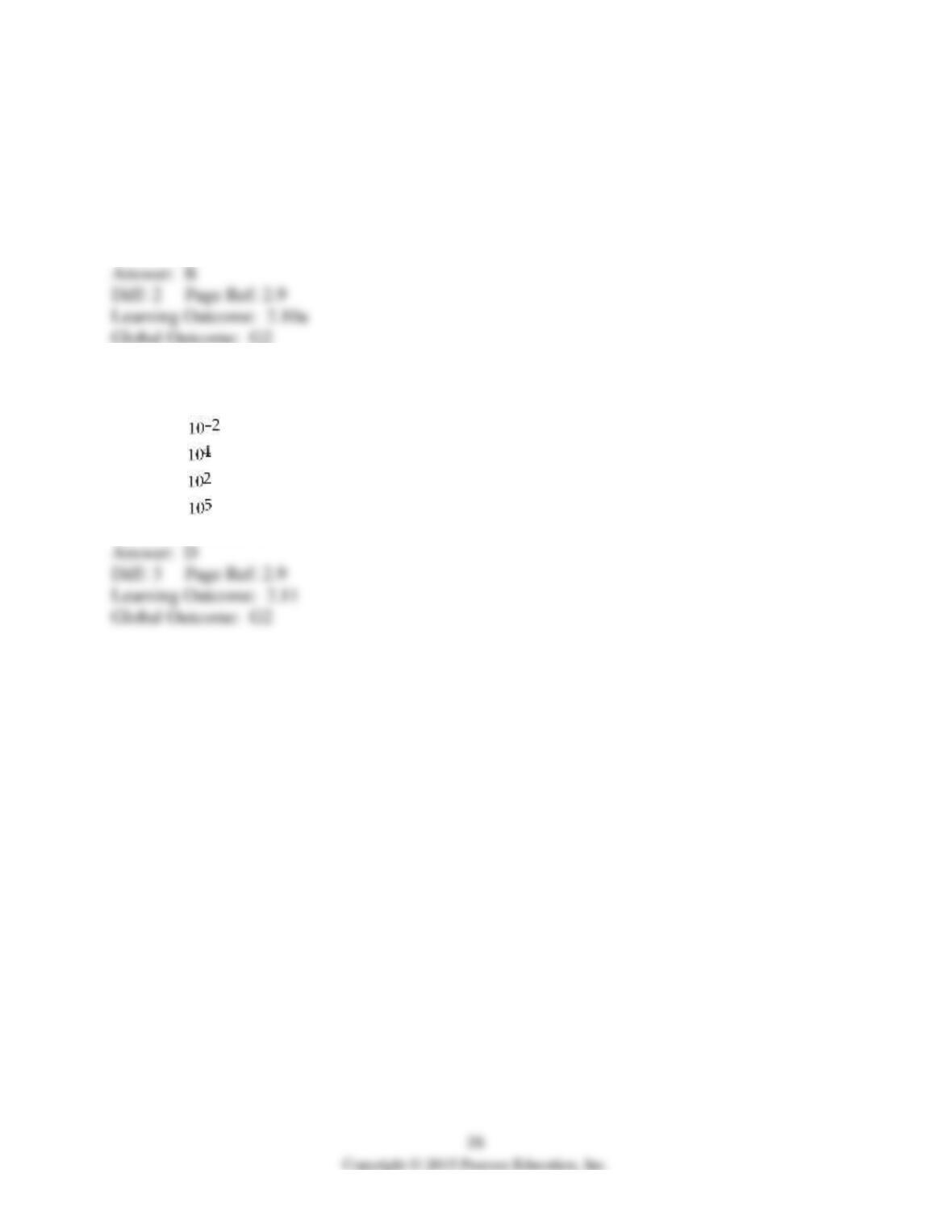
68) The Olympic Games shot put field event uses a 16 pound (lb) shot. Identify the correct
solution map to convert from pounds to kilograms using prefix multipliers and the given
conversions of and .
A) 16 lb × × ×
B) 16 lb × × ×
C) 16 lb × × ×
D) 16 lb × × ×
69) Metals expand to a larger volume when heated. If a piece of metal was heated, which one of
the following statements would be TRUE?
A) The newly calculated density value of the metal would not change from the initial value.
B) The newly calculated density value would decrease.
C) The newly calculated density value would increase.
D) The mass of the metal would also increase.
E) none of the above
70) The jet fuel in an airplane has a mass of 97.5 kg and a density of 0.804 g/cm3. What is the
volume of this jet fuel?
A) 7.84 × cm3
B) 7.84 × cm3
C) 1.21 × cm3
D) 1.21 × cm3
E) none of the above
Algorithmic Questions
1) The exponential is equal to which decimal number?
A) 10,000
B) 1
C) 10
D) 100
E) none of the above
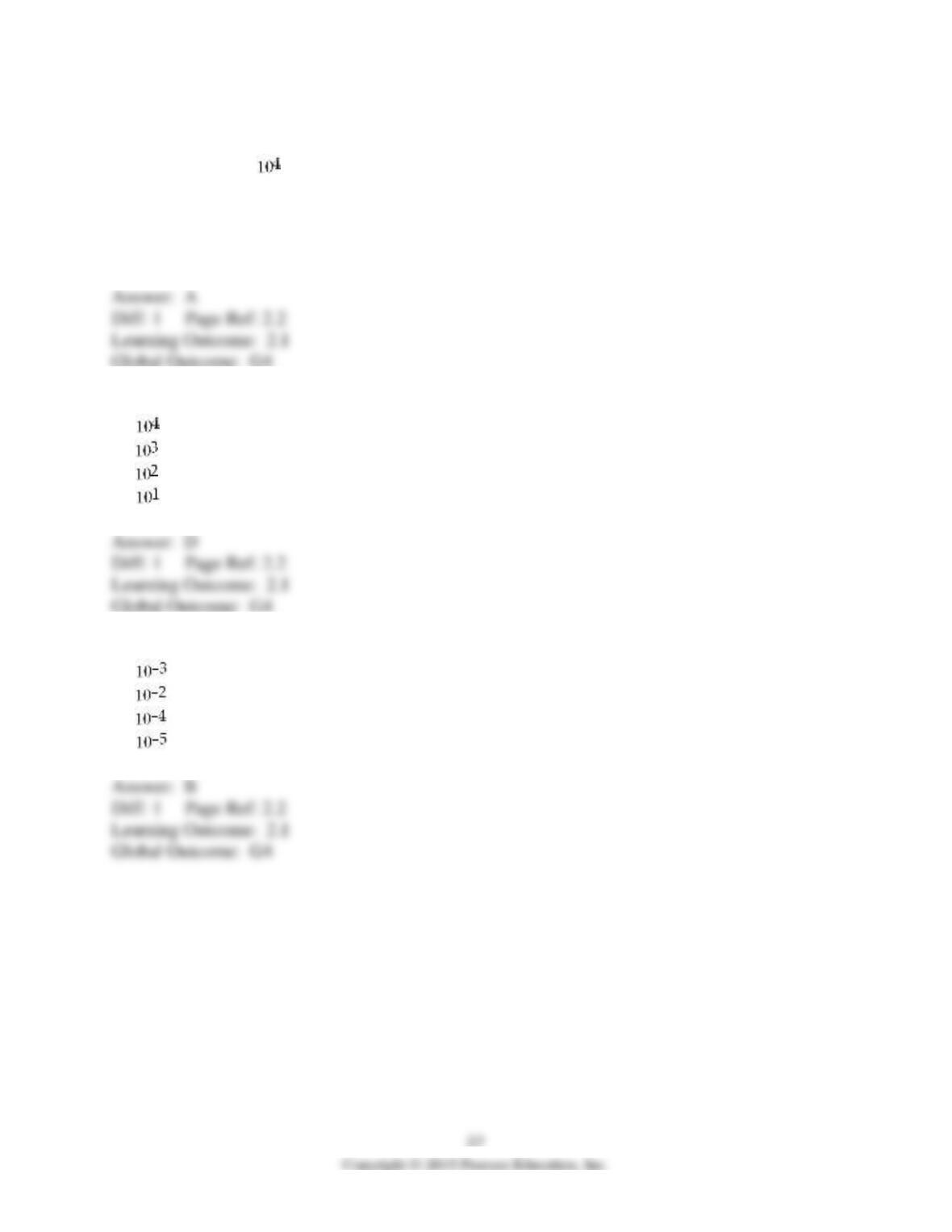
2) The decimal value 10 is equal to which exponential?
A)
B)
C)
D)
E) none of the above
3) The decimal value 0.01 is equal to which exponential?
A)
B)
C)
D)
E) none of the above
4) The exponential is equal to which decimal number?
A) 0.1
B) 0.001
C) -0.00001
D) -0.0001
E) none of the above
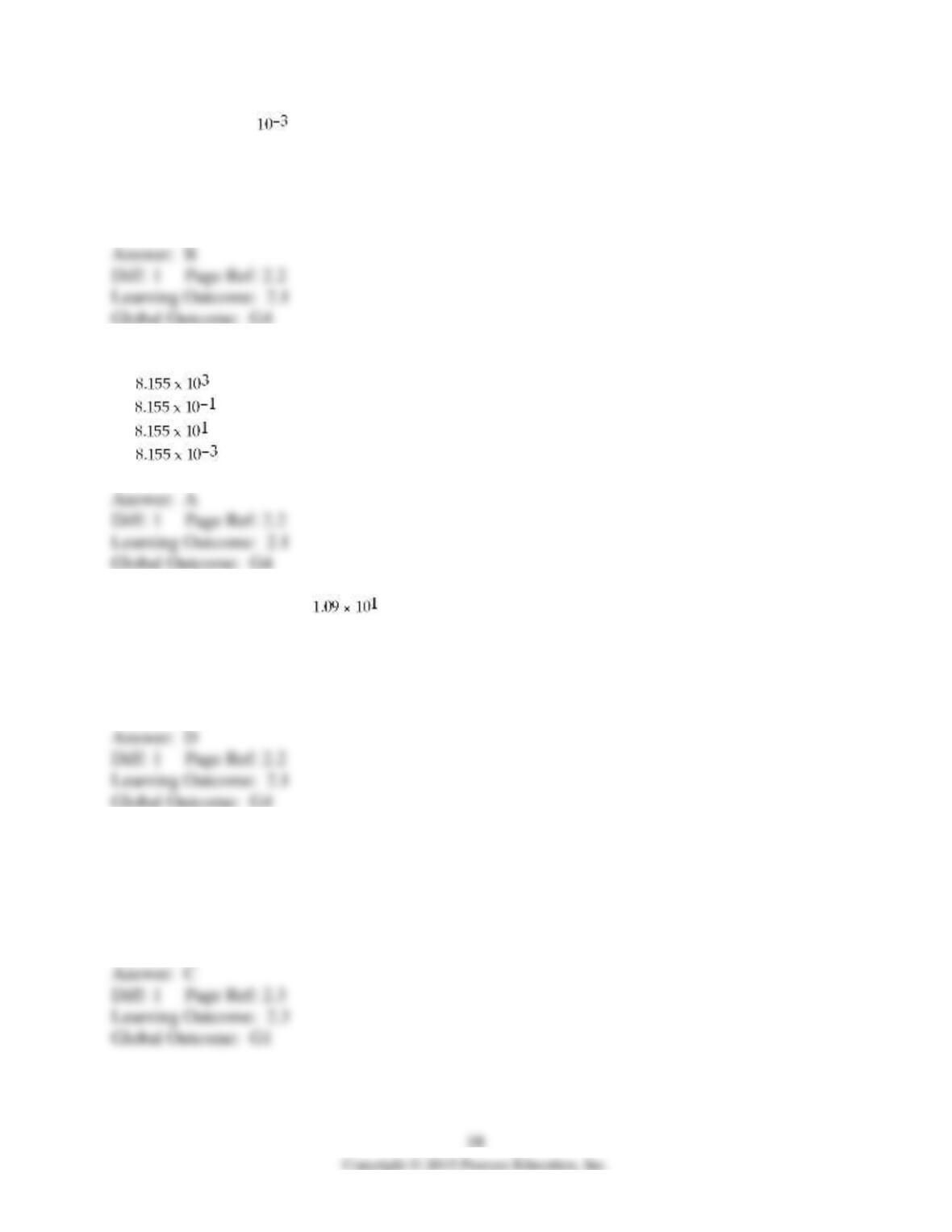
5) How would the number 8,155 be written in scientific notation?
A)
B)
C)
D)
E) none of the above
6) How would the number be expressed in decimal form?
A) 109
B) 0.109
C) 1.09
D) 10.9
E) none of the above
7) How many significant figures are in the number 2903?
A) 2
B) 5
C) 4
D) 3
E) none of the above
8) How many significant figures are represented by the following number that is written in
scientific notation? 2.5 ×
A) 0
B) 1
C) 2
D) 3
E) none of the above
9) When rounding the number 2.348615 to 4 significant figures, what is the correct value?
A) 2.3490
B) 2.340
C) 2.349
D) 2.348
E) none of the above
10) How many significant figures should be reported in the answer to the following calculation?
(1.40) × (17.1) =
A) 0
B) 1
C) 2
D) 3
E) none of the above
11) How many significant figures should be reported in the answer to the following calculation?
(8.50) × (29.0) × (1.0947) =
A) 3
B) 2
C) 4
D) 5
E) none of the above
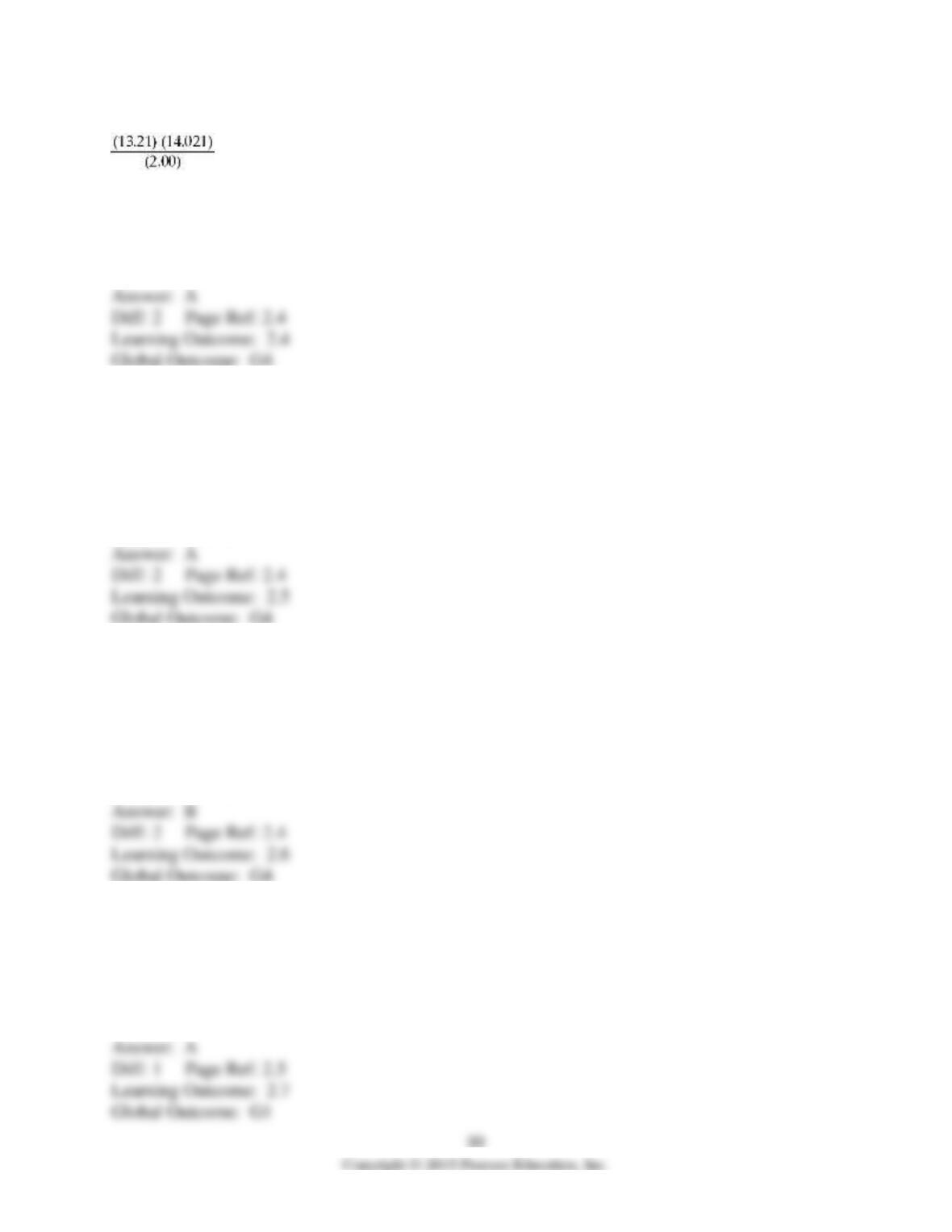
12) How many significant figures should be reported in the answer to the following calculation?
=
A) 3
B) 4
C) 2
D) 5
E) none of the above
13) How many significant figures should be reported in the answer to the following calculation?
(4.921) + (16.2) =
A) 3
B) 2
C) 1
D) 4
E) none of the above
14) How many significant figures should be reported in the answer to the following calculation?
(43.980) × (19.0023 + 25) =
A) 3
B) 2
C) 4
D) 1
E) none of the above
15) The prefix micro represents which multiplier?
A) 0.000001
B) 1,000,000
C) 0.001
D) 1,000
E) none of the above
16) The multiplier 0.01 is represented by which prefix?
A) kilo-
B) deci-
C) centi-
D) milli-
E) none of the above
17) The metric prefix k would be presented as 10 to the power of:
A) -3
B) 3
C) 12
D) -9
18) How many inches are in 6.32 cm?
A) 16.1
B) 2.49
C) 3.78
D) 8.86
E) none of the above
19) How many are in 2.20 ?
A) 36.1
B) 10.6
C) 0.1340
D) 7.45
E) none of the above
20) What is the density of 96 mL of a liquid that has a mass of 90.5 g?
A) 0.94 g/mL
B) 1.1 g/mL
C) 186.5 g/mL
D) 28.4 g/mL
E) none of the above
21) What is the volume of 19.6 g of a liquid that has a density of 0.967 g/mL?
A) 16.9 mL
B) 20.3 mL
C) 14.7 mL
D) 17.9 mL
E) none of the above