Introductory Chemistry, 5e (Tro)
Chapter 2 Measurement and Problem Solving
True/False Questions
1) Numbers are usually written so that the uncertainty is in the last reported digit.
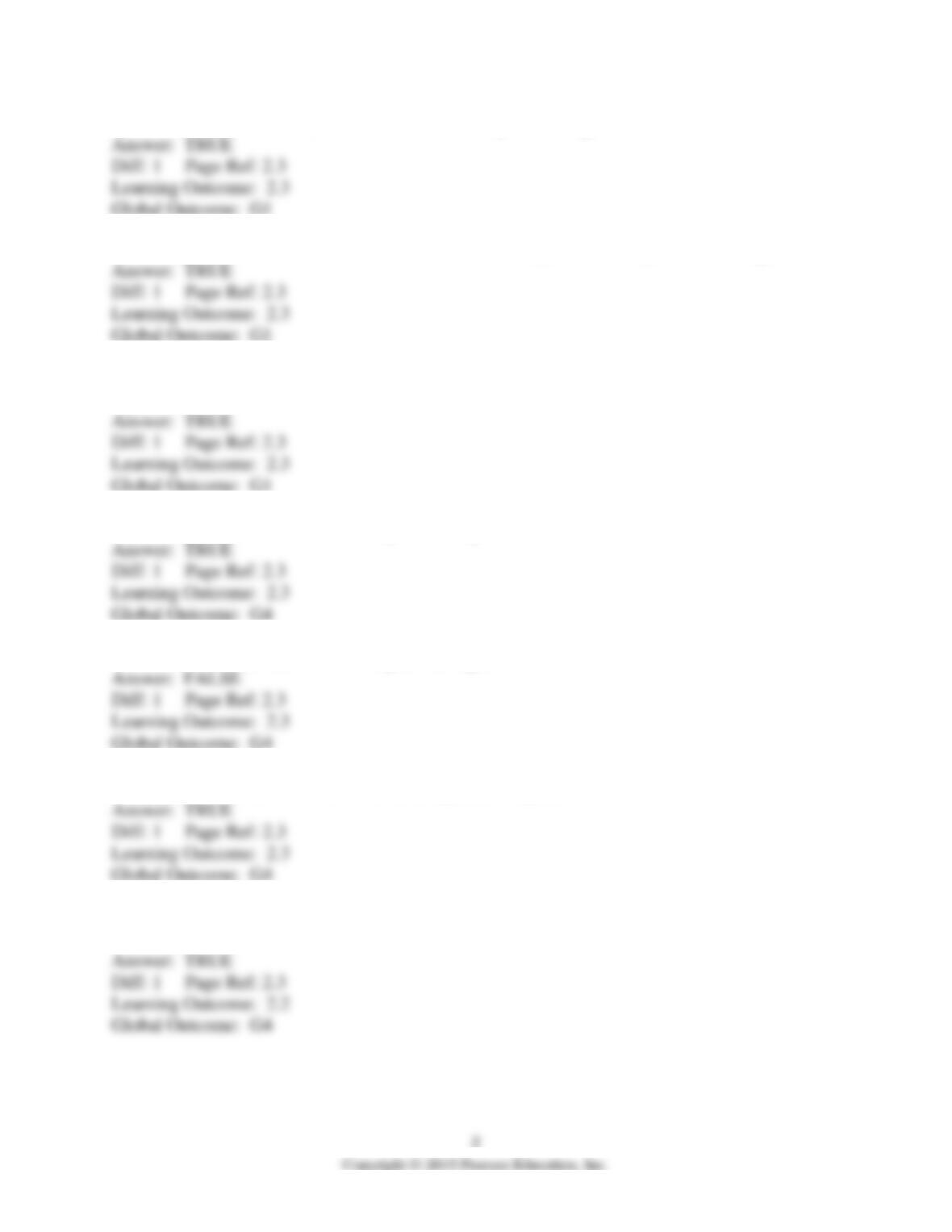
2) The decimal number 0.0000010 expressed in scientific notation is .
3) The decimal number 0.0210 expressed in scientific notation is 2.10 × 10⁻².
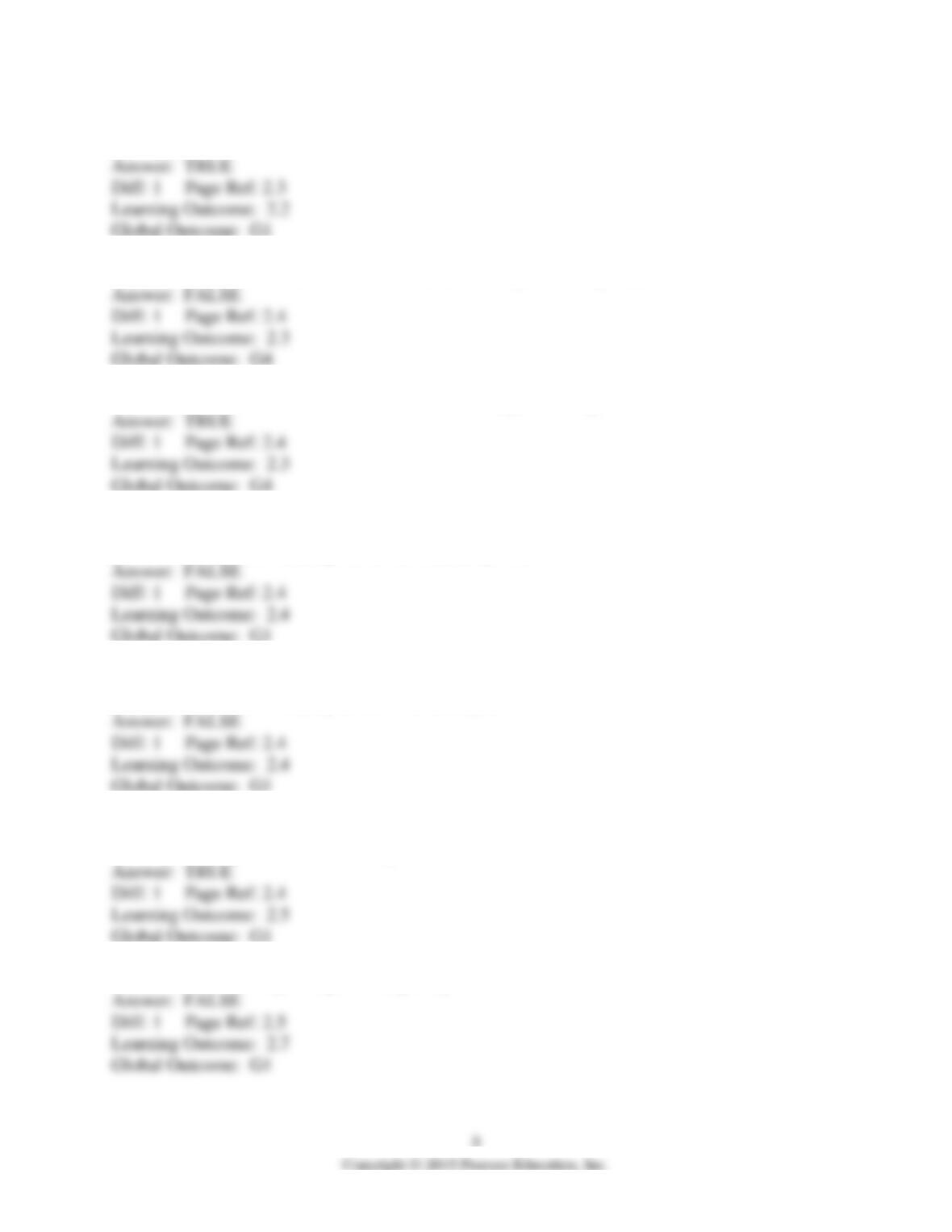
4) The mass of an object, 4.55 × g, expressed in decimal notation is 0.000455 g.
5) If you count 7 pennies, you can only report one significant figure in that measurement.
6) Exact numbers have an unlimited number of significant figures.
7) Zeros located between two numbers are not significant.
8) Zeros located after a number and after a decimal point are significant.
9) Trailing zeros at the end of a number, but before an implied decimal point, are ambiguous.
10) Trailing zeros before a decimal point but after a non-zero number are considered significant
figures.
11) The number 0.010100 has five significant figures.
12) The number 4,450,000.0 has 3 significant figures.
13) The number 7.20 × 10³ contains three significant figures.
14) When the temperature of an object is reported as 23.7°C, the actual temperature can be
assumed to be between 23.6°C and 23.8°C.
15) Scientific numbers are reported so that every digit is certain except the last, which is
estimated.
16) When the number 65.59 is rounded to contain 2 significant figures, it becomes 66.0.
17) When the number 2.35 is rounded to contain 2 significant figures it becomes 2.4.
18) In multiplication and division calculations, the answer will have the same number of decimal
places as the number carrying the fewest decimal places.
19) In multiplication or division calculations, the answer will have the same number of decimal
places as the number carrying the most decimal places.
20) In addition or subtraction, the result carries the same number of decimal places as the
quantity carrying the fewest decimal places.
21) The mass of an object depends on gravity.
22) The base unit of length in the SI system is the cm.
23) The base unit of mass in the SI system is the kg.
24) The prefix nano represents the multiplier 0.000000001.
25) The prefix micro represents the multiplier 0.001.
26) A nine gigagram mass is heavier than a nine nanogram mass.
27) The prefix in the name of a polygon indicates how many sides this geometric figure has, so a
“decagon” would have ten sides.
28) There are 1000 kilometers in one meter.
29) You do not need to write units in calculations as long as you can remember them.
30) Conversion factors are constructed from any two quantities known to be equivalent.
31) A conversion factor is a fraction with one unit on top and a different unit on the bottom.
32) A solution map diagrams the steps required to get from the starting point to the end point of a
calculation problem.
33) A solution map is the section near the back of the textbook that provides the answers to
assigned problems.
34) One mile measures 5,280 feet long, so one square mile is equivalent to 5,280 square feet.
35) Given that 1 inch equals 2.54 centimeters, then 1 cubic inch equals 16.387 cubic centimeters.
36) All solids have the same density.
37) Suppose a symmetrical metal rod of the element lead has a density of 11.4 g/cm3. If this rod
is cut in half, the density of each piece is now 5.7 g/cm3.
38) If you are given the mass and density of an object, you can calculate the volume by using the
equation: V = m/d.
39) If you know the density of a liquid and its volume, the mass of the liquid may be calculated
using the equation: m = V/d.
40) The density of iron is 7.86 g/cm3 while the density of lead is 11.4 g/cm3. If you had one cm3
of each metal, the piece of iron would have a greater mass.
Multiple Choice Questions
1) The correct scientific notation for the number 0.00050210 is:
A) 5.0210 × 10⁴
B) 5.021 × 10⁻⁴
C) 5.021 × 10⁴
D) 5.0210 × 10⁻⁴
E) none of the above
2) The correct scientific notation for the number 500.0 is:
A) 5 × 10²
B) 5.00 × 10²
C) 5.000 × 10²
D) 5 × 10⁻²
E) none of the above
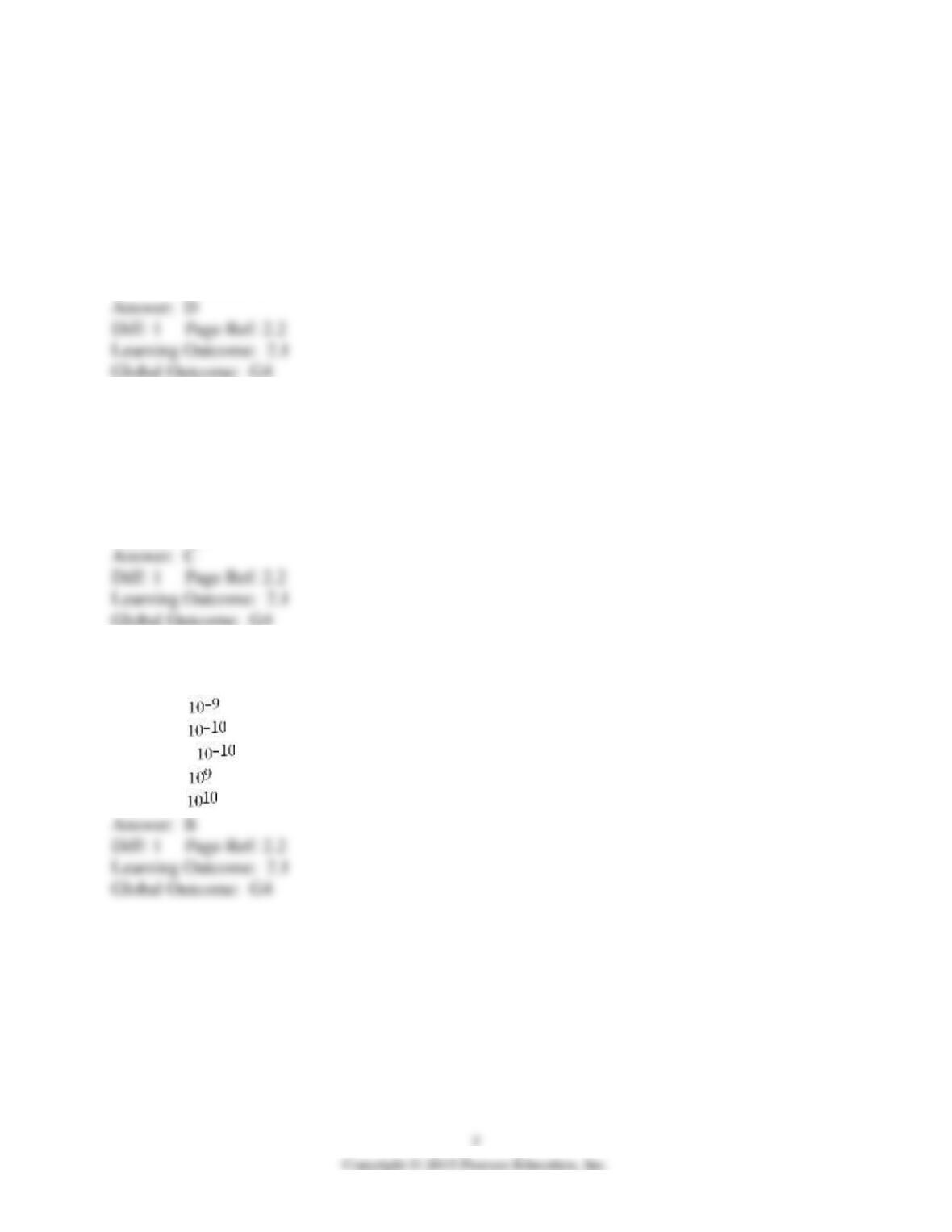
3) The distance between the two hydrogen atoms in a molecule of water is 0.000000000172 m.
Express this distance in scientific notation.
A) 1.72 × m
B) 1.72 × m
C) 0.172 × m
D) 17.2 × m
E) 1.72 × m
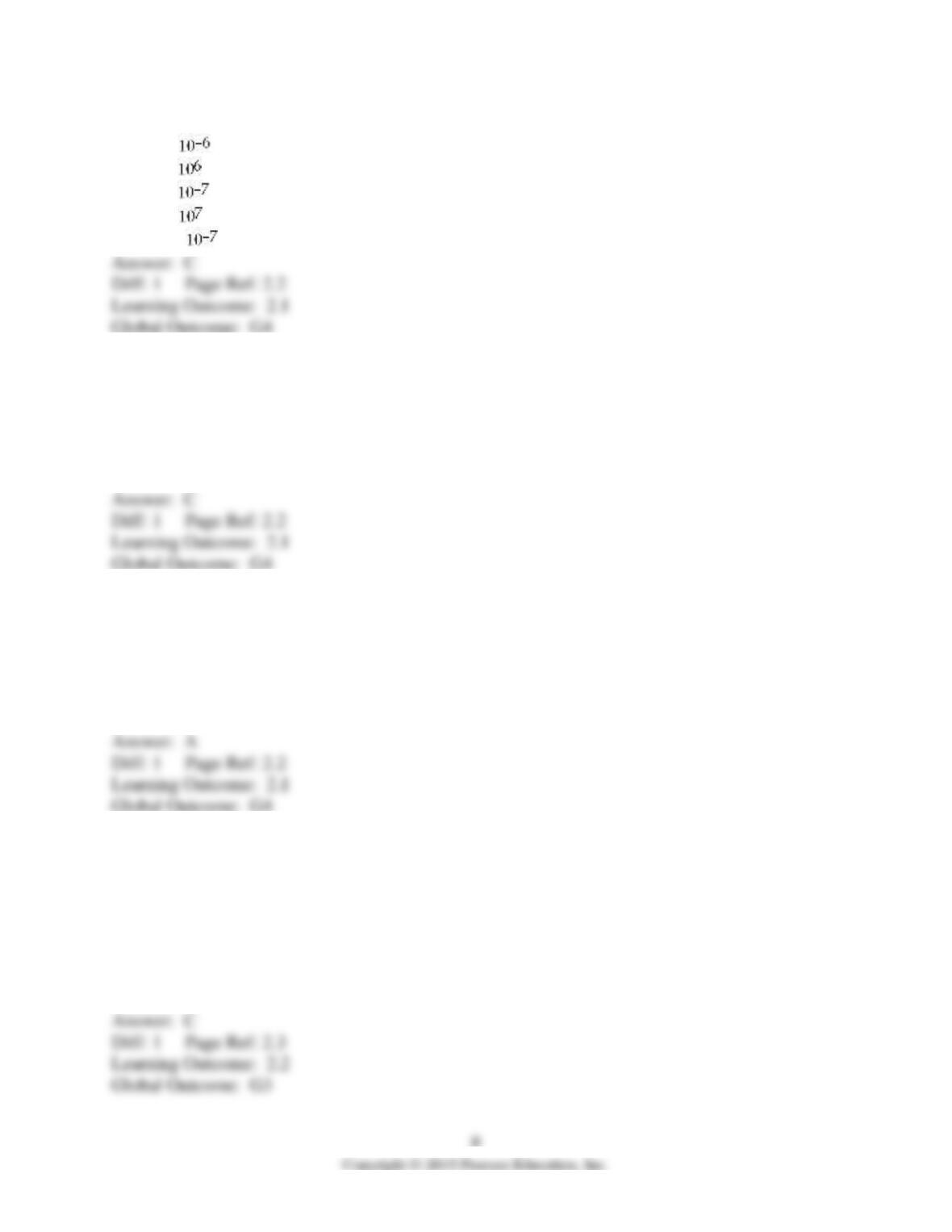
4) The wavelength of blue light is 0.00000045 m. Express this wavelength in scientific notation.
A) 4.5 × m
B) 4.5 × m
C) 4.5 × m
D) 4.5 × m
E) 0.45 × m
5) The correct decimal representation of 1.201 × 10⁻⁷ is:
A) 12010000
B) 0.0001201
C) 0.0000001201
D) 1201.000
E) none of the above
6) The correct decimal representation of 6.453 × 10³ is:
A) 6,453
B) 0.006453
C) 6.5 × 10³
D) 6.453
E) none of the above
7) Suppose a thermometer has marks at every one degree increment and the mercury level on the
thermometer is exactly between the 25 and 26 degree Celsius marks. We should properly report
the temperature measurement as:
A) 25°C
B) 26°C
C) 25.5°C
D) 25.50°C
E) 25.55°C
8) In the number 48.93, which digit is estimated?
A) 4
B) 8
C) 9
D) 3
E) None of the above, all digits are certain.
9) There are exactly 2.54 centimeters in 1 inch. When using this conversion factor, how many
significant figures are you limited to?
A) 1
B) 3
C) ambiguous
D) depends on if you are using it in multiplication/division or addition/subtraction
E) infinite number of significant figures
10) The correct number of significant figures in the number 865,000 is:
A) 3
B) 6
C) 4
D) ambiguous
E) none of the above
11) The correct number of significant figures in the number 1.250100 is:
A) 5
B) 7
C) 4
D) ambiguous
E) none of the above
12) The correct number of significant figures in the number 0.027090 is:
A) 7
B) 6
C) 5
D) ambiguous
E) none of the above
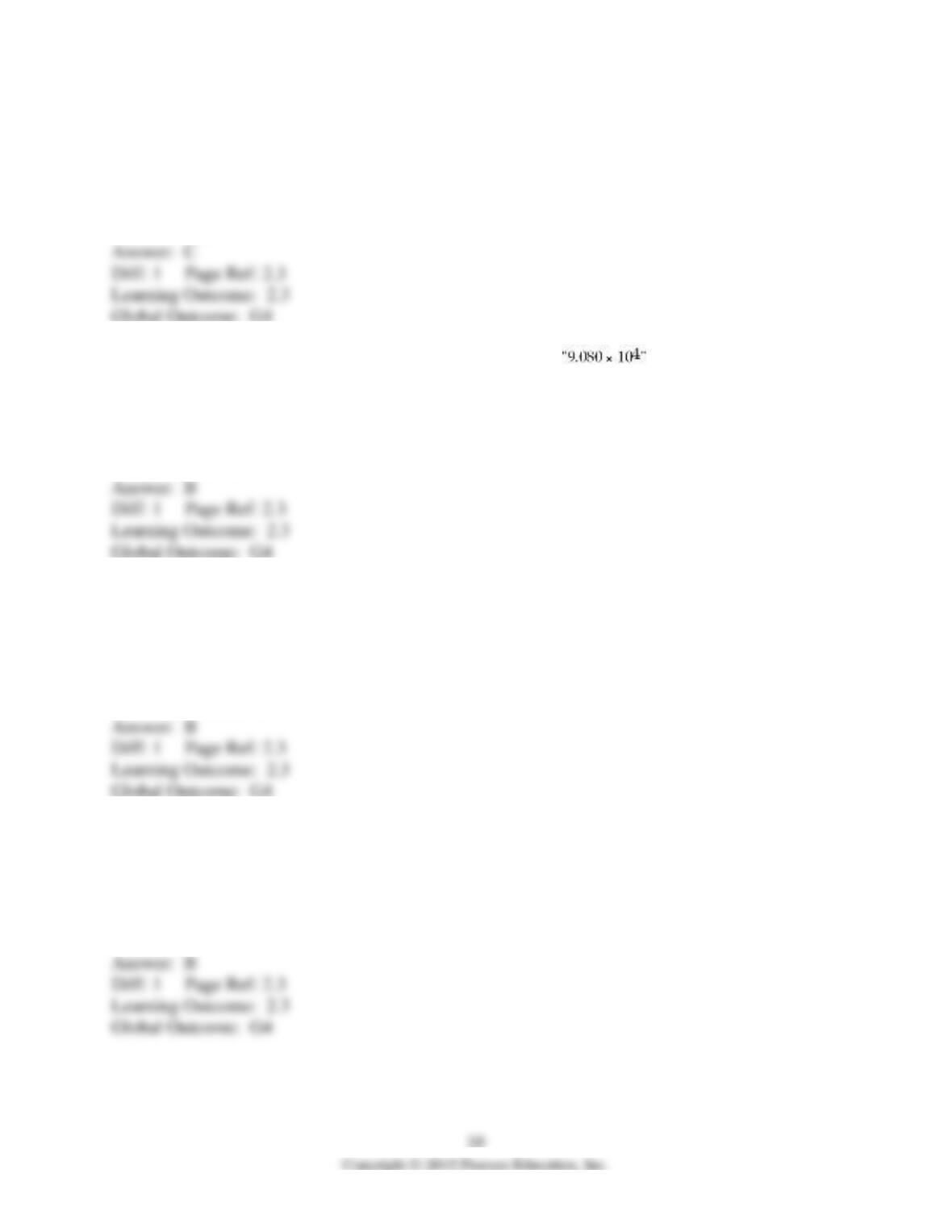
13) The correct number of significant figures in the number is:
A) 3
B) 4
C) 5
D) ambiguous
E) none of the above
14) The correct number of significant figures in the number 4.0 × 10⁻² is:
A) 1
B) 2
C) 3
D) ambiguous.
E) none of the above
15) The correct number of significant figures in the number 0.002320 is:
A) 7
B) 4
C) 3
D) ambiguous
E) none of the above
16) Which of the following statements is NOT part of the rules for determining significant
figures?
A) Non-zero digits at the end of a number are not significant.
B) Zeroes between two numbers are significant.
C) Zeroes to the left of the first non-zero number are not significant.
D) Trailing zeroes at the end of a number, but before an implied decimal point are ambiguous.
E) All of the above statements are part of the rules.
17) When the value 4.449 is rounded to two significant figures, the number should be reported
as:
A) 4.4
B) 4.5
C) 4.44
D) 4.45
E) none of the above
18) How many significant digits should be reported in the answer to the following calculation?
(4.3 – 3.7) × 12.3 =
A) 1
B) 2
C) 3
D) 4
E) none of the above
19) Determine the answer for the equation below with correct number of significant figures:
3.215 × 13.2 ÷ 0.218 = ________
A) 194.669
B) 195
C) 194.7
D) 194.67
E) none of the above
20) Determine the answer for the equation below with correct number of significant figures:
1.2 × 1.79 = ________
A) 2.148
B) 2.15
C) 2.1
D) 2.2
E) none of the above
21) Determine the answer to the following equation with correct number of significant figures:
106 ÷ 9.02 × 1.9 = ________
A) 22.32816
B) 22.328
C) 22.3
D) 22
E) none of the above
22) Determine the answer to the following equation with correct number of significant figures:
2.02 + 8.102 – 0.0297 = ________
A) 10.0923
B) 10.09
C) 10.1
D) 10.092
E) none of the above
23) Determine the answer to the following equation with correct number of significant figures:
13.96 – 4.9102 + 71.5 = ________
A) 80.5498
B) 81
C) 80.5
D) 80.55
E) none of the above
24) Determine the answer to the following equation with correct number of significant figures:
(4.123 × 0.12) + 24.2 = ________
A) 25
B) 24.695
C) 24.70
D) 24.7
E) none of the above
25) Determine the answer to the following equation with correct number of significant figures:
(17.103 + 2.03) × 1.02521 = ________
A) 19.6153
B) 19.62
C) 19.6
D) 20
E) none of the above
26) The correct prefix for the multiplier 1,000,000 is:
A) mega.
B) milli.
C) micro.
D) nano.
E) none of the above
27) The correct prefix for the multiplier 1,000 is:
A) mega.
B) milli.
C) micro.
D) nano.
E) none of the above
28) The correct prefix for the multiplier 0.1 is:
A) tera.
B) deci.
C) femto.
D) pico.
E) none of the above
29) The correct prefix for the multiplier 0.000001 is:
A) mega.
B) milli.
C) micro.
D) nano.
E) none of the above
30) The correct prefix for the multiplier 100 is:
A) mega.
B) hecto.
C) centi.
D) nano.
E) none of the above
31) The correct prefix for the multiplier 10 is:
A) deca.
B) deci.
C) tera.
D) centi.
E) none of the above
32) The correct prefix for the multiplier 1,000,000,000 is:
A) mega.
B) milli.
C) tera.
D) giga.
E) none of the above
33) The correct multiplier for the prefix pico is:
A) 10-3
B) 10-6
C) 10-9
D) 10-12
E) none of the above
34) The correct multiplier for the prefix femto is:
A) 10-15
B) 10-12
C) 1012
D) 109
E) none of the above
35) The correct multiplier for the prefix milli is:
A) 10-3
B) 10-6
C) 10-9
D) 10-12
E) none of the above
36) The correct multiplier for the prefix micro is:
A) 103
B) 10-6
C) 10-9
D) 106
E) none of the above
37) What is the base SI unit for length?
A) mile
B) centimeter
C) foot
D) meter
E) none of the above
38) What is the base SI unit for mass?
A) kilogram
B) gram
C) pound
D) ton
E) none of the above