Chapter 19: Ionic Equilibria in Aqueous Systems
63. A 20.0-mL sample of 0.50 M H2C6H6O6 (ascorbic acid, a diprotic acid) was titrated with
0.50 M NaOH. The following data were gathered during the titration.
mL NaOH added 10.00 20.00 30.00 40.00
pH 4.17 5.21 11.55 12.89
What is Ka2 for ascorbic acid?
A) 6.8 × 10⁻⁵
B) 6.2 × 10⁻⁶
C) 6.2 × 10⁻⁷
D) 6.2 × 10⁻⁸
E) 2.8 × 10⁻¹²
64. What volume of 0.200 M KOH must be added to 17.5 mL of 0.135 M H3PO4 to reach the
third equivalence point?
A) 3.94 mL B) 11.8 mL C) 17.5 mL D) 23.6 mL E) 35.4 mL
65. A sample of a monoprotic acid (HA) weighing 0.384 g is dissolved in water and the
solution is titrated with aqueous NaOH. If 30.0 mL of 0.100 M NaOH is required to reach the
equivalence point, what is the molar mass of HA?
A) 37.0 g/mol
B) 81.0 g/mol
C) 128 g/mol
D) 20.3 g/mol
E) 211 g/mol
66. When 0.300 g of a diprotic acid was titrated with 0.100 M LiOH, 40.0 mL of the LiOH
solution was needed to reach the second equivalence point. Identify the formula of the diprotic
acid.
A) H2S B) H2C2O4 C) H2C4H4O6 D) H2Se E) H2Te
67. What volume of 0.500 M H2SO4 is needed to react completely with 20.0 mL of 0.400 M
LiOH?
A) 4.00 mL B) 8.00 mL C) 12.5 mL D) 16.0 mL E) 32.0 mL

Chapter 19: Ionic Equilibria in Aqueous Systems
68. A change in pH will significantly affect the solubility of which, if any, of the following
compounds?
A) BaF2
B) CuCl
C) CuBr
D) AgI
E) None of the solubilities will be significantly affected.
69. The solubility of aluminum hydroxide in water ______________ when dilute nitric acid
is added to it.
A) increases D) first increases, then decreases
B) decreases E) first decreases, then increases
C) does not change
70. A saturated solution of calcium hydroxide, Ca(OH)2, is in contact with excess solid
Ca(OH)2. Which of the following statements correctly describes what will happen when aqueous
HCl (a strong acid) is added to this mixture, and system returns to equilibrium?
(For Ca(OH)2, Ksp = 6.5 × 10⁻⁶))
A) The solubility of Ca(OH)2 will be unchanged.
B) The OH– concentration will decrease and the Ca2+ concentration will increase.
C) The OH– concentration will increase and the Ca2+ concentration will decrease.
D) The concentrations of both Ca2+ and OH– will increase.
E) The solubility of Ca(OH)2 will decrease.
71. The solubility of silver chloride _______________ when dilute nitric is added to it.
A) increases D) first increases, then decreases
B) decreases E) first decreases, then increases
C) does not change
72. Write the ion product expression for magnesium fluoride, MgF2.
A)
2
[Mg ][F ]
+−
D)
2
1
[Mg ][F ]
+−
B)
22
[Mg ][F ]
+−
E)
22
1
[Mg ][F ]
+−
C)
2
2
2
[Mg ][F ]
[MgF ( )]s
+−

Chapter 19: Ionic Equilibria in Aqueous Systems
73. Write the ion product expression for silver sulfide, Ag2S.
A)
2
[Ag ][S ]
+−
D)
22
1
[Ag ][S ]
+−
B)
22
[Ag ][S ]
+−
E)
22
[Ag ] [S ]
+−
C)
22
2
[Ag ] [S ]
[Ag S( )]s
+−
74. Write the ion product expression for calcium phosphate, Ca3(PO4)2.
A)
23
4
[Ca ][PO ]
+−
B)
2 2 3 3
4
[Ca ] [PO ]
+−
C)
2 3 3 2
4
[Ca ] [PO ]
+−
D)
23
4
3 4 2
[Ca ][PO ]
[Ca (PO ) ]
+−
E) None of the above is the correct ion product expression.
75. The solubility of lead(II) chloride is 0.45 g/100 mL of solution. What is the Ksp of
PbCl2?
A) 4.9 × 10⁻²
B) 1.7 × 10⁻⁵
C) 8.5 × 10⁻⁶
D) 4.2 × 10⁻⁶
E) < 1.0 × 10⁻⁶
76. The solubility of calcium chromate is 1.56 × 10⁻³ g/100 mL of solution. What is the Ksp
for CaCrO4?
A) 2.4 × 10⁻⁴
B) 1.5 × 10⁻⁵
C) 7.6 × 10⁻⁶
D) 1.0 × 10⁻⁸
E) < 1.0 × 10⁻⁸
77. The solubility of silver chromate is 0.0287 g/1.0 L of solution. What is the Ksp for
Ag2CrO4?
A) 9.5 × 10⁻⁵ D) 6.5 × 10⁻¹³
B) 2.4 × 10⁻⁵ E) < 1.0 × 10⁻¹³
C) 2.6 × 10⁻¹²
Chapter 19: Ionic Equilibria in Aqueous Systems
78. The solubility of magnesium phosphate is 2.27 × 10⁻³ g/1.0 L of solution. What is the Ksp
for Mg3(PO4)2?
A) 6.5 × 10⁻¹² D) 4.8 × 10⁻²⁶
B) 6.0 × 10⁻¹⁴ E) 1.0 × 10⁻²⁶
C) 5.2 × 10⁻²⁴
79. Calculate the solubility of barium carbonate, BaCO3, in pure water. Ksp = 2.0 × 10⁻⁹
A) 1.3 × 10⁻³ M D) 4.5 × 10⁻⁵ M
B) 3.2 × 10⁻⁵ M E) 4.0 × 10⁻¹⁸ M
C) 2.2 × 10⁻⁵ M
80. Calculate the solubility of silver oxalate, Ag2C2O4, in pure water. Ksp = 1.0 × 10⁻¹¹
A) 1.4 × 10⁻⁴ M D) 3.2 × 10⁻⁶ M
B) 8.2 × 10⁻⁵ M E) 2.5 × 10⁻¹² M
C) 5.4 × 10⁻⁵ M
81. Calculate the solubility of strontium fluoride, SrF2, in pure water. Ksp = 2.6 × 10⁻⁹
A) 1.4 × 10⁻³ M D) 5.l × 10–5 M
B) 3.4 × 10⁻⁴ M E) < 1.0 × 10⁻⁵ M
C) 8.7 × 10⁻⁴ M
82. Calculate the solubility of silver phosphate, Ag3PO4, in pure water. Ksp = 2.6 × 10⁻¹⁸
A) 4.0 × 10⁻⁵ M D) 1.5 × 10⁻⁶ M
B) 1.8 × 10⁻⁵ M E) < 1.0 × 10⁻⁶ M
C) 4.0 × 10⁻⁶ M
83. Which of the following substances has the greatest solubility in water?
A) MgCO3, Ksp = 3.5 × 10⁻⁸ D) CuBr, Ksp = 5.0 × 10⁻⁹
B) NiCO3, Ksp = 1.3 × 10⁻⁷ E) AgCN, Ksp = 2.2 × 10⁻¹⁶
C) AgIO3, Ksp = 3.1 × 10⁻⁸
84. Which of the following substances has the greatest solubility in water?
A) PbI2, Ksp = 7.9 × 10⁻⁹ D) Zn(IO3)2, Ksp = 3.9 × 10⁻⁶
B) BaF2, Ksp = 1.5 × 10⁻⁶ E) Ag2SO4, Ksp = 1.5 × 10⁻⁵
C) Ca(OH)2, Ksp = 6.5 × 10⁻⁶

Chapter 19: Ionic Equilibria in Aqueous Systems
85. Which of the following substances has the greatest solubility in water?
A) Ba(IO3)2, Ksp = 1.5 × 10⁻⁹ D) CuCl, Ksp = 1.9 × 10⁻⁷
B) PbF2, Ksp = 3.6 × 10⁻⁸ E) CdS, Ksp = 1.0 × 10⁻²⁴
C) SrSO4, Ksp = 3.2 × 10⁻⁷
86. Barium sulfate (BaSO4) is a slightly soluble salt, with Ksp = 1.1 × 10⁻¹⁰. What mass of
Ba2+ ions will be present in 1.0 L of a saturated solution of barium sulfate?
A) < 10-7 g B) 1.0 × 10⁻⁵ g C) 0.0014 g D) 0.0024 g E) > 0.05 g
87. Use the following information to calculate the solubility product constant, Ksp, for PbCl2.
A saturated solution of PbCl2 in water was prepared and filtered. From the filtrate, 1.0 L was
measured out into a beaker and evaporated to dryness. The solid PbCl2 residue recovered in the
beaker amounted to 0.0162 moles.
A) Ksp = 6.9 × 10⁻⁸ D) Ksp = 2.6 × 10⁻⁴
B) Ksp = 4.3 × 10⁻⁶ E) Ksp = 3.2 × 10⁻²
C) Ksp = 1.7 × 10⁻⁵
88. Use the following information to calculate the solubility product constant, Ksp, for CuCl.
A saturated solution of CuCl in water was prepared and filtered. From the filtrate, 1.0 L was
measured out into a beaker and evaporated to dryness. The solid CuCl residue recovered in the
beaker was found to weigh 0.041g.
A) Ksp =1.7 × 10⁻⁹ D) Ksp = 4.3 × 10⁻⁴
B) Ksp = 1.7 × 10⁻⁷ E) Ksp = 2.1 × 10⁻²
C) Ksp = 1.7 × 10⁻⁵
89. Assuming that the total volume does not change after 0.200 g of KCl is added to 1.0 L of
a saturated aqueous solution of AgCl, calculate the number of moles of Ag+ ion in the solution
after equilibrium has been reestablished. For AgCl, Ksp = 1.8 × 10– 10.
A) 1.8 × 10⁻¹⁰ mol Ag+ D) 6.7 × 10⁻⁸ mol Ag+
B) 9.0 × 10⁻¹⁰ mol Ag+ E) 1.3 × 10⁻⁵ mol Ag+
C) 9.0 × 10⁻⁹ mol Ag+
90. What is the maximum mass of KCl that can be added to1.0 L of a 0.010 M lead(II)
chloride solution without causing any precipitation of lead(II) chloride? Assume that addition of
KCl does not affect the solution volume. For lead(II) chloride,
Ksp = 1.6 × 10⁻⁵ .
A) 3.0 g B) 1.5 g C) 0.8 g D) 1.0 g E) 0.2 g

Chapter 19: Ionic Equilibria in Aqueous Systems
91. Calculate the solubility of magnesium sulfate, MgSO4, when placed into a 0.10 M MgCl2
solution. Ksp = 5.9 × 10⁻³
A) 4.2 × 10⁻² M D) 3.5 × 10⁻⁵ M
B) 5.9 × 10⁻² M E) 3.5 × 10⁻⁶ M
C) 7.7 × 10⁻² M
92. Calculate the solubility of silver chromate, Ag2CrO4, in 0.005 M Na2CrO4.
Ksp = 2.6 × 10⁻¹²
A) 1.4 × 10⁻⁴ M D) 1.6 × 10⁻⁶ M
B) 3.4 × 10⁻⁵ M E) < 1.0 × 10⁻⁶ M
C) 1.1 × 10⁻⁵ M
93. Calculate the solubility of lead(II) iodide, PbI2, in 0.025 M KI. Ksp = 7.9 × 10⁻⁹
A) 4.5 × 10⁻² M D) 5.0 × 10⁻⁵ M
B) 2.8 × 10⁻² M E) 1.3 × 10⁻⁵ M
C) 8.9 × 10⁻⁵ M
94. A lab technician adds 0.015 mol of KOH to 1.00 L of 0.0010 M Ca(NO3)2.
Ksp = 6.5 × 10⁻⁶ for Ca(OH)2). Which of the following statements is correct?
A) Calcium hydroxide precipitates until the solution is saturated.
B) The solution is unsaturated and no precipitate forms.
C) The concentration of calcium ions is reduced by the addition of the hydroxide ions.
D) One must know Ksp for calcium nitrate to make meaningful predictions on this
system.
E) The presence of KOH will raise the solubility of Ca(NO3)2.
95. A lab technician adds 0.20 mol of NaF to 1.00 L of 0.35 M cadmium nitrate, Cd(NO3)2.
Which of the following statements is correct? Ksp = 6.44 × 10⁻³ for CdF2.
A) Cadmium fluoride precipitates until the solution is saturated.
B) The solution is unsaturated and no precipitate forms.
C) The solubility of cadmium fluoride is increased by the presence of additional
fluoride ions.
D) One must know Ksp for cadmium nitrate to make meaningful predictions on this
system.
E) The presence of NaF will raise the solubility of Cd(NO3)2.

Chapter 19: Ionic Equilibria in Aqueous Systems
96. What is the maximum amount of sodium sulfate that can be added to 1.00 L of 0.0020 M
Ca(NO3)2 before precipitation of calcium sulfate begins? Ksp = 2.4 × 10⁻⁵ for calcium sulfate.
A) 1.2 × 10⁻² mol D) 1.2 × 10⁻⁵ mol
B) 4.9 × 10⁻³ mol E) 4.8 × 10⁻⁸ mol
C) 3.5 × 10⁻³ mol
97. Consider the dissolution of MnS in water (Ksp = 3.0 × 10⁻¹⁴).
MnS(s) + H2O(l) Mn2+(aq) + HS–(aq) + OH–(aq)
How is the solubility of manganese(II) sulfide affected by the addition of aqueous potassium
hydroxide to the system?
A) The solubility will be unchanged.
B) The solubility will decrease.
C) The solubility will increase.
D) The amount of KOH added must be known before its effect can be predicted.
E) The pKa of H2S is needed before a reliable prediction can be made.
98. The lab technician Anna Lytic adds 2.20 mol KOH to 1.00 L of 0.5 M Al(NO3)3. What is
the concentration of aluminum ions after the aluminum nitrate has reacted with the potassium
hydroxide? Kf = 3.0 × 1033 for Al(OH)4–
A) 1.8 × 10⁻⁷ M D) 3.3 × 10⁻³⁴ M
B) 9.l × 10–18 M E) 7.l × 10–36 M
C) 1.0 × 10⁻³¹ M
99. A solution is prepared by adding 4.50 mol of sodium hydroxide to 1.00 L of 1.00 M
Co(NO3)2. What is the equilibrium concentration of cobalt ions? Kf = 5.0 × 10⁹ for Co(OH)42–
A) 1.1 × 10⁻² M D) 2.0 × 10⁻¹⁰ M
B) 1.4 × 10⁻⁵ M E) 4.9 × 10⁻¹³ M
C) 3.2 × 10⁻⁹ M
100. The concentration of the complex ion in each of following solutions is 1.00 M. In which
of the solutions will the concentration of the uncomplexed metal ion be the greatest?
Hg(CN)42– Kf = 9.3 × 1038
Be(OH)42– Kf = 4.0 × 10¹⁸
Zn(OH)42– Kf = 3.0 × 10¹⁵
Cu(NH3)42+ Kf = 5.6 × 10¹¹
CdI42– Kf = 1.0 × 10⁶
A) Hg2+ B) Be2+ C) Zn2+ D) Cu2+ E) Cd2+
Chapter 19: Ionic Equilibria in Aqueous Systems
Page 347
101. Calculate the solubility of zinc hydroxide, Zn(OH)2, in 1.00 M NaOH.
Ksp = 3.0 × 10⁻¹⁶ for Zn(OH)2, Kf = 3.0 × 10¹⁵ for Zn(OH)42–
A) 0.60 M B) 0.52 M C) 0.37 M D) 0.32 M E) 0.24 M
102. A solution is prepared by mixing 50.0 mL of 0.50 M Cu(NO3)2 with 50.0 mL of 0.50 M
Co(NO3)2. Sodium hydroxide is added to the mixture. Which hydroxide precipitates first and
what concentration of hydroxide ions present in solution will accomplish the separation?
Ksp = 2.2 × 10⁻²⁰ for Cu(OH)2, Ksp = 1.3 × 10⁻¹⁵ for Co(OH)2
A) Co(OH)2; [OH–] = 6.9 × 10⁻⁶ M D) Cu(OH)2; [OH–] = 1.1 × 10⁻⁹ M
B) Co(OH)2; [OH–] = 2.6 × 10⁻⁷ M E) Cu(OH)2; [OH–] = 1.0 × 10⁻¹⁷ M
C) Cu(OH)2; [OH–] = 1.8 × 10⁻⁷ M
103. The salts X(NO3)2 and Y(NO3)2 (where X+ and Y+ are metal ions) are dissolved in water
to give a solution which is 0.1 M in each of them. Using the Ksp values listed below, decide
which aqueous reagent, if any, will definitely precipitate X+ before precipitating Y+ from
solution.
Given Ksp values:
XCl2, 1 × 10⁻⁵ YCl2, 1 × 10⁻¹⁰ X(OH)2, 1 × 10⁻¹⁰ Y(OH)2, 1 × 10⁻⁵
A) 1 M NaCl
B) 1 M HCl
C) 1 M HNO3
D) 1 M NaOH
E) None of the above reagents will accomplish the precipitation.
104. The salts X(NO3)2 and Y(NO3)2 (where X+ and Y+ are metal ions) are dissolved in water
to give a solution which is 0.1 M in each of them. Using the Ksp values listed below, decide
which aqueous reagent, if any, will definitely precipitate X+ before precipitating Y+ from
solution.
Given Ksp values:
XCl2, 1 × 10⁻⁵ YCl2, 1 × 10⁻¹⁰ X(OH)2, 1 × 10⁻¹⁰ Y(OH)2, 1 × 10⁻⁵
A) 1 M NH3
B) 1 M HCl
C) 1 M HNO3
D) 1 M NaCl
E) None of the above reagents will accomplish the precipitation.
Chapter 19: Ionic Equilibria in Aqueous Systems
105. The salts X(NO3)2 and Y(NO3)2 (where X+ and Y+ are metal ions) are dissolved in water
to give a solution which is 0.1 M in each of them. Using the Ksp values listed below, decide
which aqueous reagent, if any, will definitely precipitate X+ before precipitating Y+ from
solution.
Given Ksp values:
XCl2, 1 × 10⁻⁵ YCl2, 1 × 10⁻¹⁰ X(OH)2, 1 × 10⁻¹⁰ Y(OH)2, 1 × 10⁻⁵
A) 1 M NaNO3
B) 1 M HCl
C) 1 M HNO3
D) 1 M NaCl
E) None of the above reagents will accomplish the precipitation.
106. The salts X(NO3)2 and Y(NO3)2 (where X+ and Y+ are metal ions) are dissolved in water
to give a solution which is 0.1 M in each of them. Which of the answers gives the concentration
of chloride ions will precipitate the most YCl2 without precipitating any XCl2?
Given Ksp values: XCl2, 2 × 10⁻⁵ YCl2, 1 × 10⁻¹⁰
A) 1 M Cl–
B) 0.1 M Cl–
C) 0.01 M Cl–
D) 0.001 M Cl–
E) 0.0001 M Cl–
107. What is the pH of 375 mL of solution containing 0.150 mol of propenoic acid (HA) and
0.250 mol of sodium propenoate (NaA)? (Ka for propenoic acid is 5.52 × 10⁻⁵.)
108. Formic acid is a monoprotic acid with a Ka value of 1.8 × 10⁻⁴ at 25°C.
a. Calculate the pH of a 0.200 mol L–1 solution of the acid, making any reasonable
approximations.
b. If 0.0050 mol of NaOH is added to 100. mL of the solution in (a), calculate the pH of the
resultant buffer.
Chapter 19: Ionic Equilibria in Aqueous Systems
109. Hydrofluoric acid (HF) has a Ka value of 7.2 × 10⁻⁴.
a. 0.250 mol of F– ions (in the form of NaF) are added to 1.00 L of 0.100 mol L–1 aqueous HF.
Calculate the resulting pH.
b. To the solution produced in (a) is added 10.0 mL of 5.00 mol L–1 NaOH. Calculate the
resulting pH.
110. Make a clear distinction between buffer range and buffer capacity.
111. Hydrochloric acid (0.100 mol L–1, 25.00 mL aliquot) is being titrated with sodium
hydroxide of the same molarity. Calculate the solution pH after addition of 24.80 mL of the
sodium hydroxide. Make any reasonable approximations.
112. Propanoic acid (CH3CH2COOH) has a Ka of 1.34 × 10⁻⁵. A 25.00 mL sample of 0.1000
mol L–1 propanoic acid (in flask) is titrated with 0.1000 mol L–1 NaOH solution, added from a
buret. Carry out the calculations of the quantities indicated below.
a. The pH after 0.00 mL of NaOH are added.
b. The pH after 15.00 mL of NaOH are added.
c. The hydroxide ion concentration after 26.00 mL of NaOH are added.
Chapter 19: Ionic Equilibria in Aqueous Systems
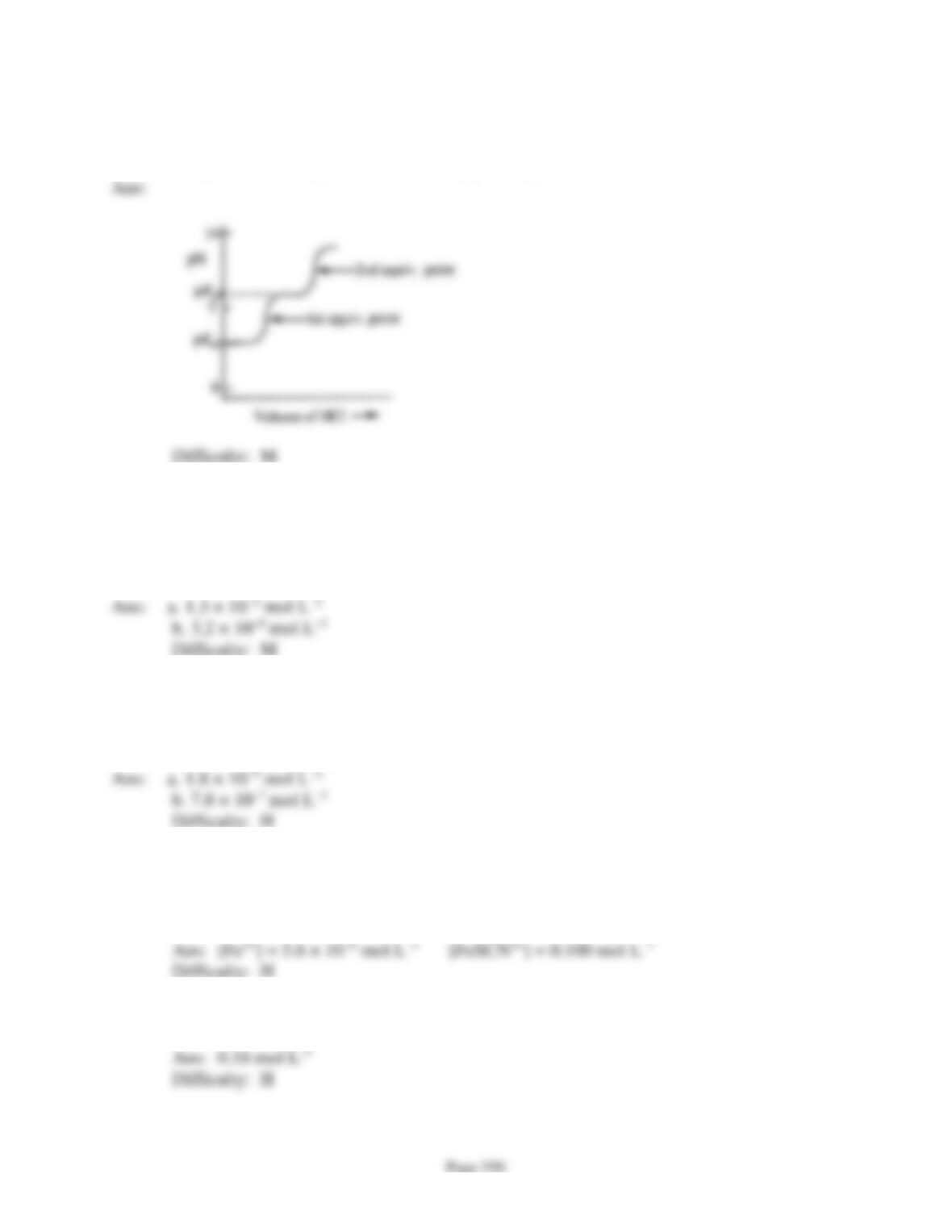
113. Use a carefully drawn and labeled diagram of the titration curve to illustrate the titration
of a weak diprotic acid, in which Ka1 and Ka2 are substantially different, with a strong base (base
is the titrant). Label as many features of the diagram as possible.
114. Lead(II) iodide, PbI2, is an ionic compound with a solubility product constant
Ksp of 7.9 × 10⁻⁹.
Calculate the solubility of this compound in
a. pure water.
b. 0.50 mol L–1 KI solution.
115. Silver phosphate, Ag3PO4, is an ionic compound with a solubility product constant Ksp of
2.6 × 10⁻¹⁸. Calculate the solubility of this compound in
a. pure water.
b. 0.20 mol L–1 Na3PO4 solution.
116. Fe(NO3)3 (0.00100 mol) and KSCN (0.200 mol) are added to water to make exactly 1
liter of solution. The red complex ion FeSCN2+ is produced. Calculate the concentrations of
Fe3+(aq) and FeSCN2+(aq) at equilibrium, if Kf of the FeSCN2+ is
8.9 × 10².
117. Calculate the solubility of copper(II) carbonate, CuCO3, in 1.00 mol L–1 NH3.
Ksp = 3.0 × 10⁻¹² for CuCO3, Kf = 5.6 × 10¹¹ for Cu(NH3)42+
Chapter 19: Ionic Equilibria in Aqueous Systems
118. A CH3COOH/CH3COO– buffer can be produced by adding a strong acid to a solution of
CH3COO– ions.
119. Increasing the concentrations of the components of a buffer solution will increase the
buffer range.
120. Increasing the concentrations of the components of a buffer solution will increase the
buffer capacity.
121. If the pH of a buffer solution is greater than the pKa value of the buffer acid, the buffer
will have more capacity to neutralize added base than added acid.
122. The end point in a titration is defined as the point when the indicator changes color.
123. The equivalence point in a titration is defined as the point when the indicator changes
color.
124. For a diprotic acid H2A, the relationship Ka1 > Ka2 is always true.
125. The solubility of salt MX (solubility product constant Ksp) in water will always be
greater than that of salt MX3 (solubility product constant Ksp) provided that Ksp > Ksp.