Chapter 19: Ionic Equilibria in Aqueous Systems
1. Which of the following aqueous mixtures would be a buffer system?
A) HCl, NaCl D) H2SO4, CH3COOH
B) HNO3, NaNO3 E) NH3, NaOH
C) H3PO4, H2PO4–
2. Which, if any, of the following aqueous mixtures would be a buffer system?
A) CH3COOH, NaH2PO4
B) H2CO3, HCO3–
C) H2PO4–, HCO3–
D) HSO4–, HSO3–
E) None of the above will be a buffer solution.
3. Equal volumes of the following pairs of solutions are mixed. Which pair will produce a
buffer solution?
A) 0.10 mol L–1 HCl and 0.05 mol L–1 NaOH
B) 0.10 mol L–1 HCl and 0.15 mol L–1 NH3
C) 0.10 mol L–1 HCl and 0.05 mol L–1 NH3
D) 0.10 mol L–1 HCl and 0.20 mol L–1 CH3COOH
E) 0.10 mol L–1 HCl and 0.20 mol L–1 NaCl
4. Which one of the following aqueous solutions, when mixed with an equal volume of
0.10 mol L–1 aqueous NH3, will produce a buffer solution?
A) 0.10 mol L–1 HCl D) 0.050 mol L–1 NaOH
B) 0.20 mol L–1 HCl E) 0.20 mol L–1 NH4Cl
C) 0.10 mol L–1 CH3COOH
5. Which one of the following pairs of 0.100 mol L–1 solutions, when mixed, will produce a
buffer solution?
A) 50. mL of aqueous CH3COOH and 25. mL of aqueous HCl
B) 50. mL of aqueous CH3COOH and 100. mL of aqueous NaOH
C) 50. mL of aqueous NaOH and 25. mL of aqueous HCl
D) 50. mL of aqueous CH3COONa and 25. mL of aqueous NaOH
E) 50. mL of aqueous CH3COOH and 25. mL of aqueous CH3COONa
Chapter 19: Ionic Equilibria in Aqueous Systems
6. Which of the following has the highest buffer capacity?
A) 0.10 M H2PO4–/0.10 M HPO42–
B) 0.50 M H2PO4–/0.10 M HPO42–
C) 0.10 M H2PO4–/0.50 M HPO42–
D) 0.50 M H2PO4–/0.50 M HPO42–
E) They all have the same buffer capacity.
7. A popular buffer solution consists of carbonate (CO32–) and hydrogen carbonate (HCO3–)
conjugate acid-base pair. Which, if any, of the following such buffers has the highest buffer
capacity?
A) 0.9 M CO32– and 0.1 M HCO3–
B) 0.1 M CO32– and 0.9 M HCO3–
C) 0.5 M CO32– and 0.5 M HCO3–
D) 0.1 M CO32– and 0.1 M HCO3–
E) They all have the same buffer capacity.
8. A popular buffer solution consists of carbonate (CO32–) and hydrogen carbonate (HCO3–)
conjugate acid-base pair. Which, if any, of the following such buffers can neutralize the greatest
amount of added hydrochloric acid, while remaining within its buffer range?
A) 1 L of 0.9 M CO32– and 0.1 M HCO3–
B) 1 L of 0.1 M CO32– and 0.9 M HCO3–
C) 1 L of 0.5 M CO32– and 0.5 M HCO3–
D) 1 L of 0.1 M CO32– and 0.1 M HCO3–
E) They can all neutralize the same amount of hydrochloric acid.
9. Which of the following acids should be used to prepare a buffer with a pH of 4.5?
A) HOC6H4OCOOH, Ka = 1.0 × 10⁻³ D) C5H5O5COOH, Ka = 4.0 × 10⁻⁶
B) C6H4(COOH)2, Ka = 2.9 × 10⁻⁴ E) HBrO, Ka = 2.3 × 10⁻⁹
C) CH3COOH, Ka = 1.8 × 10⁻⁵
10. Citric acid has an acid dissociation constant of 8.4 × 10⁻⁴. It would be most effective for
preparation of a buffer with a pH of
A) 2. B) 3. C) 4. D) 5. E) 6.
11. A buffer is to be prepared by adding solid sodium acetate to 0.10 M CH3COOH. Which
of the following concentrations of sodium acetate will produce the most effective buffer?
A) 3.0 M CH3COONa D) 1.5 M CH3COONa
B) 2.5 M CH3COONa E) 0.30 M CH3COONa
C) 2.0 M CH3COONa
Chapter 19: Ionic Equilibria in Aqueous Systems
12. An acetate buffer has a pH of 4.40. Which of the following changes will cause the pH to
decrease?
A) dissolving a small amount of solid sodium acetate
B) adding a small amount of dilute hydrochloric acid
C) adding a small amount of dilute sodium hydroxide
D) dissolving a small amount of solid sodium chloride
E) diluting the buffer solution with water
13. A phosphate buffer (H2PO4–/HPO42–) has a pH of 8.3. Which of the following changes
will cause the pH to increase?
A) dissolving a small amount of Na2HPO4
B) dissolving a small amount of NaH2PO4
C) adding a small amount of dilute hydrochloric acid
D) adding a small amount of dilute phosphoric acid
E) making the buffer more concentrated by removing some water
14. What will be the effect of adding 0.5 mL of 0.1 M NaOH to 100 mL of an acetate buffer
in which [CH3COOH] = [CH3COO–] = 0.5 M?
A) The pH will increase slightly.
B) The pH will increase significantly.
C) The pH will decrease slightly.
D) The pH will decrease significantly.
E) Since it is a buffer solution, the pH will not be affected.
15. What will be the effect of adding 0.5 mL of 0.1 M HCl to 100 mL of a phosphate buffer
in which [H2PO4–] = [HPO42–] = 0.35 M?
A) The pH will increase slightly.
B) The pH will increase significantly.
C) The pH will decrease slightly.
D) The pH will decrease significantly.
E) Since it is a buffer solution, the pH will not be affected.
16. Buffer solutions with the component concentrations shown below were prepared. Which
of them should have the lowest pH?
A) [CH3COOH] = 0.25 M, [CH3COO–] = 0.25 M
B) [CH3COOH] = 0.75 M, [CH3COO–] = 0.75 M
C) [CH3COOH] = 0.75 M, [CH3COO–] = 0.25 M
D) [CH3COOH] = 0.25 M, [CH3COO–] = 0.75 M
E) [CH3COOH] = 1.00 M, [CH3COO–] = 1.00 M
Chapter 19: Ionic Equilibria in Aqueous Systems
17. Buffer solutions with the component concentrations shown below were prepared. Which
of them should have the highest pH?
A) [H2PO4–] = 0.50 M, [HPO42–] = 0.50 M
B) [H2PO4–] = 1.0 M, [HPO42–] = 1.0 M
C) [H2PO4–] = 1.0 M, [HPO42–] = 0.50 M
D) [H2PO4–] = 0.50 M, [HPO42–] = 1.0 M
E) [H2PO4–] = 0.75 M, [HPO42–] = 1.0 M
18. A buffer is prepared by adding 0.5 mol of solid sodium hydroxide to 1.0 L of 1.0 M
acetic acid (CH3COOH). What is the pH of the buffer?
A) The pH will be pKa – 0.30, where pKa is that of acetic acid.
B) The pH will be greater than the pKa for acetic acid.
C) The pH will be less than the value in answer a.
D) The pH will be equal to the pKa for acetic acid.
E) More information is needed to solve the problem.
19. A solution is prepared by adding 100 mL of 0.2 M hydrochloric acid to 100 mL of 0.4 M
sodium formate. Is this a buffer solution, and if so, what is its pH?
A) It is a buffer, pH > pKa of formic acid.
B) It is a buffer, pH < pKa of formic acid.
C) It is a buffer, pH = pKa of formic acid.
D) It is a buffer, pH = pKb of sodium formate.
E) Since hydrochloric acid is a strong acid, this is not a buffer.
20. A buffer is prepared by adding 100 mL of 0.50 M sodium hydroxide to 100 mL of 0.75
M propanoic acid. Is this a buffer solution, and if so, what is its pH?
A) It is a buffer, pH > pKa of propanoic acid.
B) It is a buffer, pH < pKa of propanoic acid.
C) It is a buffer, pH = pKa of propanoic acid.
D) It is a buffer, pH = pKb of sodium propanoate.
E) Since sodium hydroxide is a strong base, this is not a buffer.
21. A solution is prepared by adding 500 mL of 0.3 M NaClO to 500 mL of 0.4 M HClO.
What is the pH of this solution?
A) The pH will be greater than the pKa of hypochlorous acid.
B) The pH will be less than the pKa of hypochlorous acid.
C) The pH will be equal to the pKa of hypochlorous acid.
D) The pH will equal the pKb of sodium hypochlorite.
E) The pH will be none of the above.
Chapter 19: Ionic Equilibria in Aqueous Systems
Page 332
22. What is the pH of a buffer that consists of 0.45 M CH3COOH and 0.35 M CH3COONa?
Ka = 1.8 × 10⁻⁵
A) 4.49 B) 4.64 C) 4.85 D) 5.00 E) 5.52
23. What is the pH of a solution that consists of 0.50 M H2C6H6O6 (ascorbic acid) and 0.75
M NaHC6H6O6 (sodium ascorbate)? For ascorbic acid, Ka = 6.8 × 10⁻⁵
A) 3.76 B) 3.99 C) 4.34 D) 4.57 E) 5.66
24. What is the pH of a buffer that consists of 0.20 M NaH2PO4 and 0.40 M Na2HPO4?
For NaH2PO4, Ka = 6.2 × 10⁻⁸
A) 6.51 B) 6.91 C) 7.51 D) 7.90 E) 8.13
25. What is the [H3O+] in a buffer that consists of 0.30 M HCOOH and 0.20 M HCOONa?
For HCOOH, Ka = 1.7 × 10⁻⁴
A) 1.1 × 10⁻⁴ M D) 6.7 × 10⁻⁵ M
B) 2.6 × 10⁻⁴ M E) none of the above
26. What is the [H3O+] in a solution that consists of 1.2 M HClO and 2.3 M NaClO?
Ka = 3.5 × 10⁻⁸
A) 7.8 × 10⁻⁹ M D) 1.6 × 10⁻⁷ M
B) 1.8 × 10⁻⁸ M E) none of the above
C) 6.7 × 10⁻⁸ M
27. What is the [H3O+] in a solution that consists of 0.15 M C2N2H8 (ethylene diamine) and
0.35 C2N2H9Cl? Kb = 4.7 × 10⁻⁴
A) 2.0 × 10⁻³ M D) 2.1 × 10⁻¹⁰ M
B) 1.1 × 10⁻³ M E) 5.0 × 10⁻¹¹ M
C) 6.3 × 10⁻⁹ M
28. What is the [H3O+] in a solution that consists of 1.5 M NH3 and 2.5 NH4Cl? Kb = 1.8 ×
10–5
A) 1.1 × 10⁻⁵ M D) 9.3 × 10⁻¹⁰ M
B) 3.0 × 10⁻⁶ M E) none of the above
C) 3.3 × 10⁻⁹ M
Chapter 19: Ionic Equilibria in Aqueous Systems
29. What is the pKa for the acid HA if a solution of 0.65 M HA and 0.85 M NaA has a pH of
4.75?
A) < 4.00 B) 4.63 C) 4.87 D) 5.02 E) > 5.50
30. A formic acid buffer containing 0.50 M HCOOH and 0.50 M HCOONa has a pH of 3.77.
What will the pH be after 0.010 mol of NaOH has been added to 100.0 mL of the buffer?
A) 3.67 B) 3.78 C) 3.81 D) 3.85 E) 3.95
31. An acetic acid buffer containing 0.50 M CH3COOH and 0.50 M CH3COONa has a pH of
4.74. What will the pH be after 0.0020 mol of HCl has been added to 100.0 mL of the buffer?
A) 4.77 B) 4.71 C) 4.68 D) 4.62 E) none of the above
32. A buffer is prepared by adding 300.0 mL of 2.0 M NaOH to 500.0 mL of 2.0 M
CH3COOH. What is the pH of this buffer? Ka = 1.8 × 10⁻⁵
A) 4.57 B) 4.52 C) 4.87 D) 4.92 E) 4.97
33. A buffer is prepared by adding 1.00 L of 1.0 M HCl to 750 mL of 1.5 M NaHCOO. What
is the pH of this buffer? Ka = 1.7 × 10⁻⁴
A) 2.87 B) 3.72 C) 3.82 D) 3.95 E) 4.66
34. If 10.0 g of NaF and 20.0 g of HF are dissolved in water to make one liter of solution,
what will the pH be? For HF, Ka = 6.8 × 10⁻⁴.
A) 7.13 B) 2.54 C) 1.57 D) 3.17 E) 4.86
35. A solution is prepared by dissolving 20.0 g of K2HPO4 and 25.0 g of KH2PO4 in enough
water to produce 1.0 L of solution. What is the pH of this buffer? For phosphoric acid (H3PO4),
Ka2 = 6.2 × 10⁻⁸.
A) 7.70 B) 7.42 C) 7.21 D) 7.00 E) 6.72
36. You need to use KH2PO4 and K2HPO4 to prepare a buffer with a pH of 7.45. Which of
the following ratios of [base]/[acid] is required? For phosphoric acid, (H3PO4),
Ka2 = 6.2 × 10⁻⁸.
A) [base]/[acid] = 1.75 D) [base]/[acid] = 0.79
B) [base]/[acid] = 1.27 E) [base]/[acid] = 0.57
C) [base]/[acid] = 1.24
Chapter 19: Ionic Equilibria in Aqueous Systems
37. You need to prepare a buffer solution with a pH of 4.00, using NaF and HF. What ratio of
the ratio of [base]/[acid] should be used in making the buffer? For HF,
Ka = 7.2 × 10– 4.
A) [base]/[acid] = 0.14 D) [base]/[acid] = 7.20
B) [base]/[acid] = 0.42 E) None of the above ratios is correct.
C) [base]/[acid] = 2.36
38. The pH of blood is 7.35. It is maintained in part by the buffer system composed of
carbonic acid (H2CO3) and the bicarbonate (hydrogen carbonate, HCO3–) ion. What is the ratio
of [bicarbonate]/[carbonic acid] at this pH? For carbonic acid, Ka1 = 4.2 × 10⁻⁷.
A) [bicarbonate]/[carbonic acid] = 0.11 D) [bicarbonate]/[carbonic acid] = 9.4
B) [bicarbonate]/[carbonic acid] = 0.38 E) None of the above ratios is correct.
C) [bicarbonate]/[carbonic acid] = 2.65
39. What mass of NaF must be added to 50.0 mL of a 0.500 M HF solution to achieve a pH
of 3.25? For HF, Ka = 7.2 × 10⁻⁴.
A) 1.3 g B) 0.69 g C) 6.9 g D) 23 g E) 1.5 g
40. Two buffer solutions are prepared using acetic acid and sodium acetate. Solution A
contains 20.0 g of acetic acid (CH3COOH) and 5.0 g of sodium acetate CH3COONa). Solution B
contains 10.0 g of acetic acid and 25.0 g of sodium acetate. What is the difference between the
pH values of these two solutions? For acetic acid,
Ka = 1.8 × 10⁻⁵.
A) 0.0 B) 1.0 C) 2.0 D) 2.3 E) 4.6
41. A buffer is prepared by adding 150 mL of 1.0 M NaOH to 250 mL of 1.0 M NaH2PO4.
How many moles of HCl must be added to this buffer solution to change the pH by 0.18 units?
If necessary, assume the total volume remains unchanged at 400 mL.
A) 0.025 mol HCl D) 0.50 mol HCl
B) 0.063 mol HCl E) 1.0 mol HCl
C) 0.082 mol HCl
42. At the equivalence point in an acid-base titration
A) the [H3O+] equals the Ka of the acid.
B) the [H3O+] equals the Ka of the indicator.
C) the amounts of acid and base which have been combined are in their stoichiometric
ratio.
D) the pH is 7.0.
E) the pH has reached a maximum.
Chapter 19: Ionic Equilibria in Aqueous Systems
43. When a strong acid is titrated with a strong base, the pH at the equivalence point
A) is greater than 7.0. D) is equal to the pKa of the acid.
B) is equal to 7.0. E) is equal to 3.5.
C) is less than 7.0, but is not 3.5.
44. When a weak acid is titrated with a strong base, the pH at the equivalence point
A) is greater than 7.0.
B) is equal to 7.0.
C) is less than 7.0.
D) is equal to the pKa of the acid.
E) is equal to 14.0 – pKb , where pKb is that of the base.
45. When a strong acid is titrated with a weak base, the pH at the equivalence point
A) is greater than 7.0. D) is equal to the pKa of the acid.
B) is equal to 7.0. E) is equal to the pKb of the base.
C) is less than 7.0.
46. When a weak acid is titrated with a weak base, the pH at the equivalence point
A) is greater than 7.0.
B) is equal to 7.0.
C) is less than 7.0.
D) is determined by the sizes of Ka and Kb.
E) is no longer affected by addition of base.
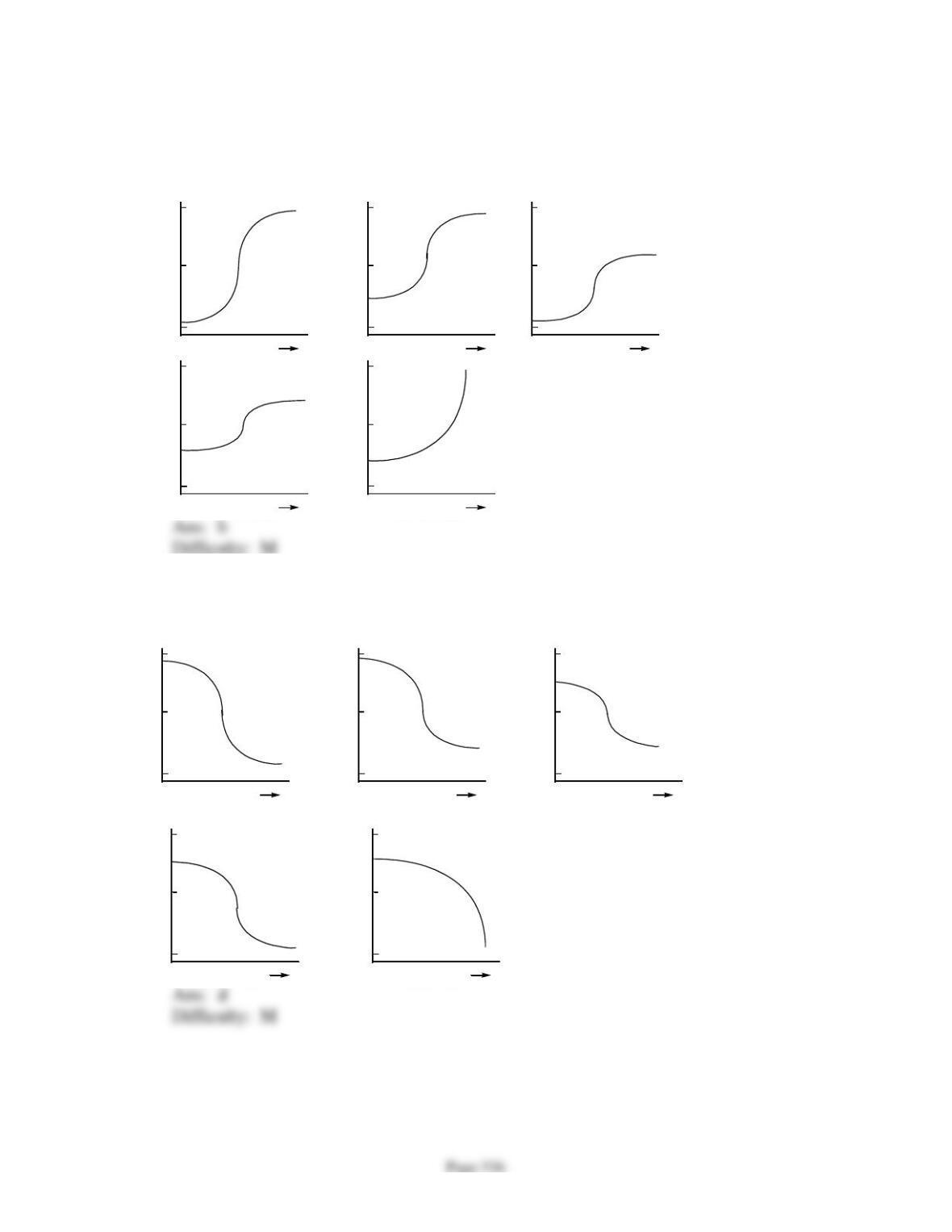
Chapter 19: Ionic Equilibria in Aqueous Systems
47. Which one of the following is the best representation of the titration curve which will be
obtained in the titration of a weak acid (0.10 mol L–1) with a strong base of the same
concentration?
a
pH
14
7
0
Volume of base
b
pH
14
7
0
Volume of base
c
pH
14
7
0
Volume of base
d
pH
14
7
0
Volume of base
e
pH
14
7
0
Volume of base
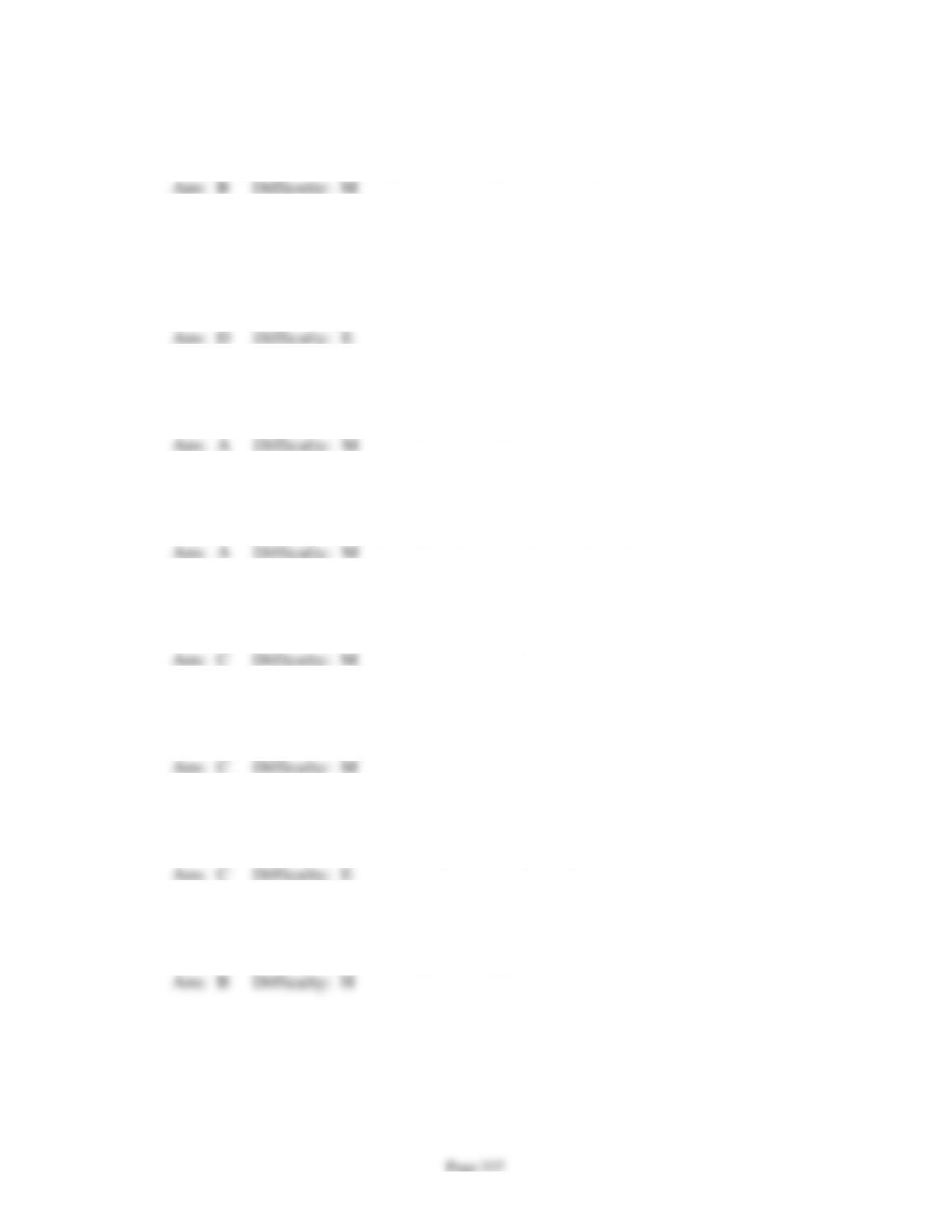
48. Which one of the following is the best representation of the titration curve which will be
obtained in the titration of a weak base (0.10 mol L–1) with HCl of the same concentration?
a
pH
14
7
0
Volume of HCl
b
pH
14
7
0
Volume of HCl
c
pH
14
7
0
Volume of HCl
d
pH
14
7
0
Volume of HCl
e
pH
14
7
0
Volume of HCl
Chapter 19: Ionic Equilibria in Aqueous Systems
49. The indicator propyl red has Ka = 3.3 × 10⁻⁶. What would be the approximate pH range
over which it would change color?
A) 3.5–5.5 B) 4.5–6.5 C) 5.5–7.5 D) 6.5–8.5 E) none of the above
50. Which of the following indicators would be the best to use when 0.050 M benzoic acid
(Ka = 6.6 × 10⁻⁵) is titrated with 0.05 M NaOH?
A) bromphenol blue, pH range: 3.0–4.5 D) phenol red, pH range: 6.9–8.2
B) bromcresol green, pH range: 3.8–5.4 E) phenolphthalein, pH range: 8.0–10.1
C) alizarin, pH range: 5.7–7.2
51. A 50.0-mL sample of 0.50 M HCl is titrated with 0.50 M NaOH. What is the pH of the
solution after 28.0 mL of NaOH have been added to the acid?
A) 0.85 B) 0.75 C) 0.66 D) 0.49 E) 3.8
52. A 20.0-mL sample of 0.25 M HNO3 is titrated with 0.15 M NaOH. What is the pH of the
solution after 30.0 mL of NaOH have been added to the acid?
A) 2.00 B) 1.60 C) 1.05 D) 1.00 E) none of the above
53. A 20.0-mL sample of 0.30 M HBr is titrated with 0.15 M NaOH. What is the pH of the
solution after 40.3 mL of NaOH have been added to the acid?
A) 2.95 B) 3.13 C) 10.87 D) 11.05 E) 13.14
54. A 35.0-mL sample of 0.20 M LiOH is titrated with 0.25 M HCl. What is the pH of the
solution after 23.0 mL of HCl have been added to the base?
A) 1.26 B) 1.67 C) 12.33 D) 12.74 E) 13.03
55. When 20.0 mL of 0.15 M hydrochloric acid is mixed with 20.0 mL of 0.10 M sodium
hydroxide, the pH of the resulting solution is
A) 0.00. B) 12.40. C) 1.60. D) 0.82. E) 7.00.
56. A 25.0-mL sample of 0.35 M HCOOH is titrated with 0.20 M KOH. What is the pH of
the solution after 25.0 mL of KOH has been added to the acid? Ka = 1.77 × 10⁻⁴
A) 4.00 B) 3.88 C) 3.63 D) 3.51 E) 3.47
Chapter 19: Ionic Equilibria in Aqueous Systems
57. A 10.0-mL sample of 0.75 M CH3CH2COOH is titrated with 0.30 M NaOH. What is the
pH of the solution after 22.0 mL of NaOH have been added to the acid? Ka = 1.3 × 10⁻⁵
A) 5.75 B) 4.94 C) 4.83 D) 4.02 E) 3.95
58. A 25.0-mL sample of 0.10 M C2H3NH2 (ethylamine) is titrated with 0.15 M HCl. What is
the pH of the solution after 9.00 mL of acid have been added to the amine?
Kb = 6.5 × 10⁻⁴
A) 11.08 B) 10.88 C) 10.74 D) 10.55 E) 10.49
59. A 25.0-mL sample of 1.00 M NH3 is titrated with 0.15 M HCl. What is the pH of the
solution after 15.00 mL of acid have been added to the ammonia solution?
Kb = 1.8 × 10⁻⁵
A) 10.26 B) 9.30 C) 9.21 D) 8.30 E) 8.21
60. A 20.0-mL sample of 0.30 M HClO was titrated with 0.30 M NaOH. The following data
were collected during the titration.
mL NaOH added 5.00 10.00 1.00 2.00
pH 698 746 7.93 10.31
What is the Ka for HClO?
A) 1.1 × 10⁻⁷ D) 4.9 × 10⁻¹¹
B) 3.5 × 10⁻⁸ E) none of the above
C) 1.2 × 10⁻⁸
Chapter 19: Ionic Equilibria in Aqueous Systems
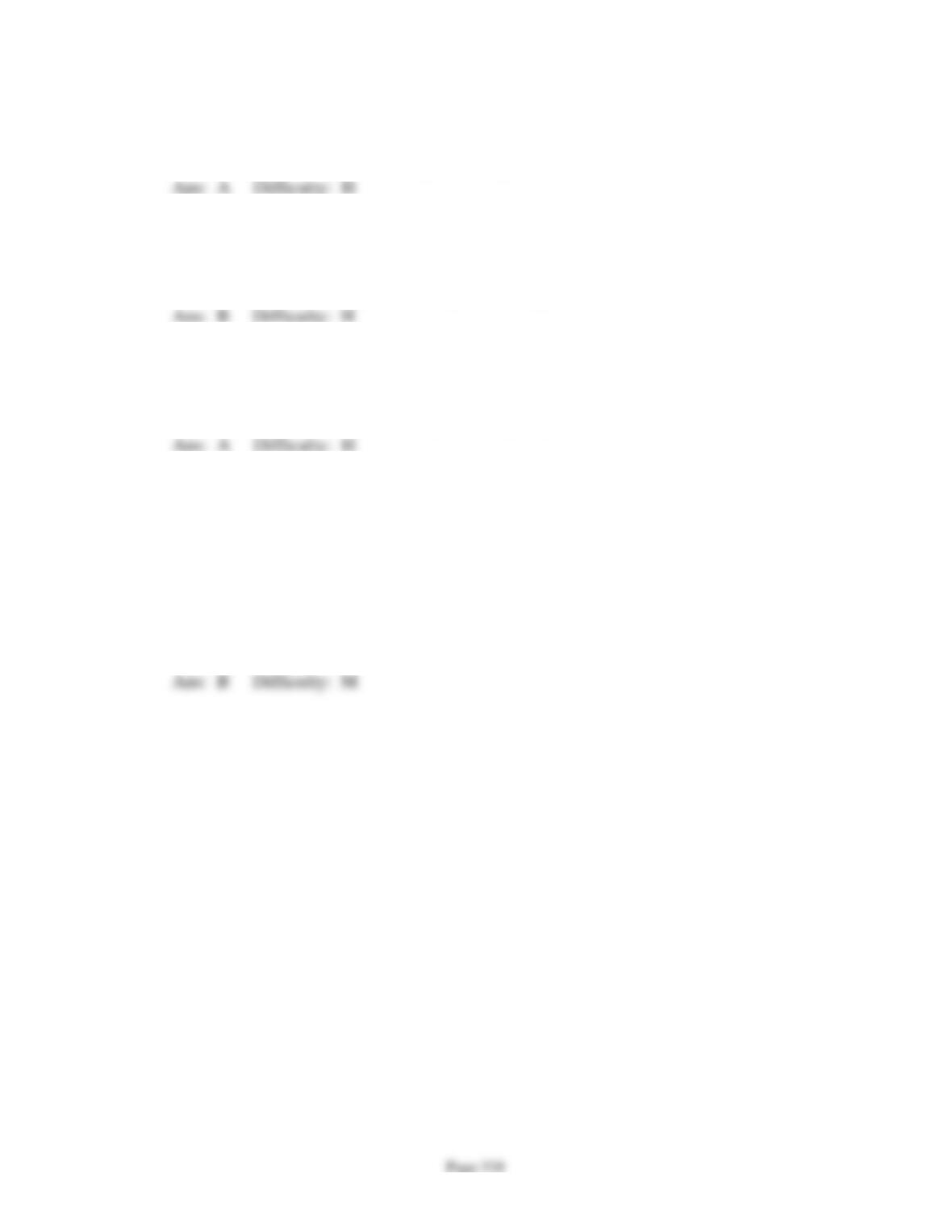
61. Which one of the following is the best representation of the titration curve which will be
obtained in the titration of a weak diprotic acid H2A (0.10 mol L–1) with a strong base of the
same concentration?
a
pH
14
7
0
Volume of base
b
pH
14
7
0
Volume of base
c
pH
14
7
0
Volume of base
d
pH
14
7
0
Volume of base
e
pH
14
7
0
Volume of base
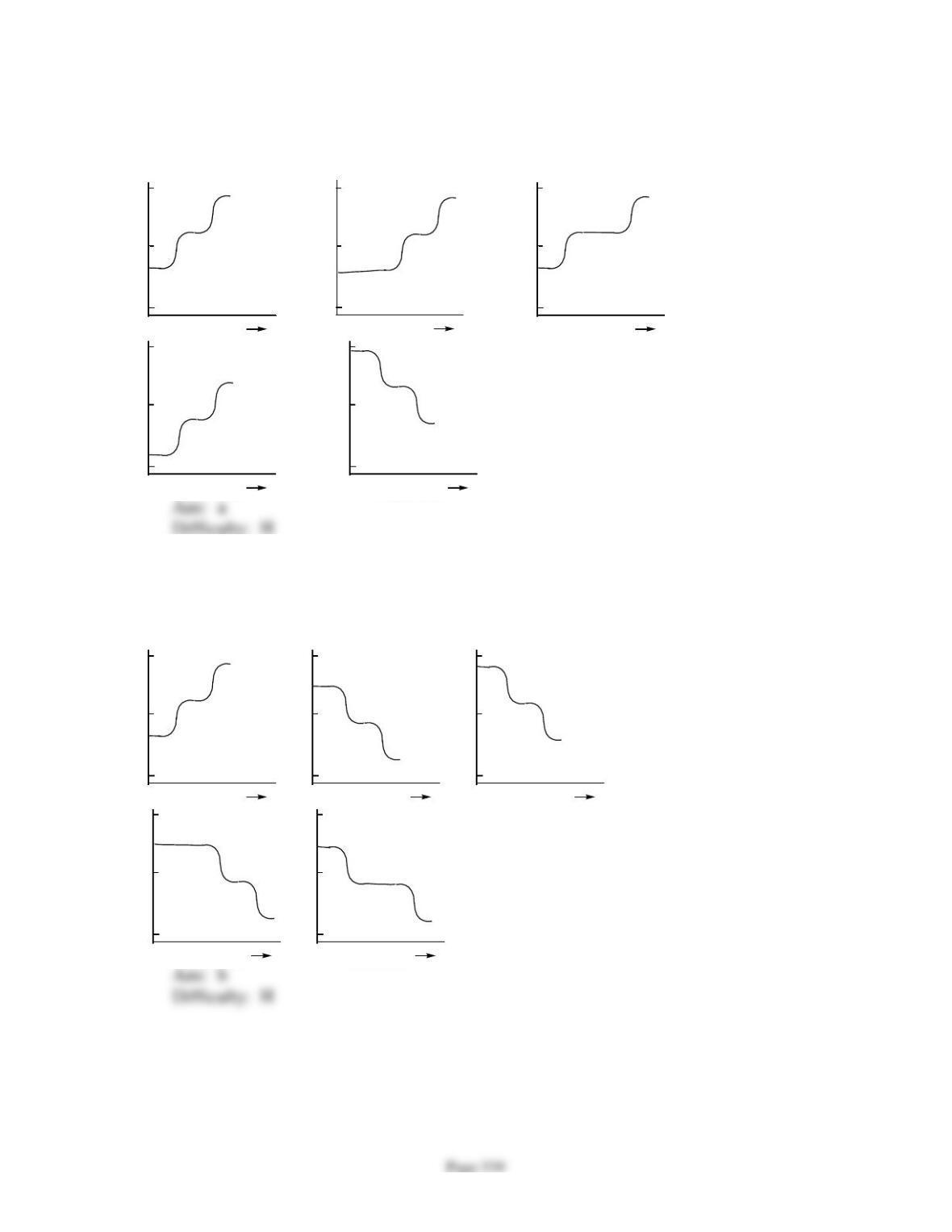
62. A diprotic acid H2A has Ka1 = 1 × 10⁻⁴ and Ka2 = 1 × 10⁻⁸. The corresponding base A2– is
titrated with aqueous HCl, both solutions being 0.1 mol L–1. Which one of the following
diagrams best represents the titration curve which will be seen?
a
pH
14
7
0
Volume of HCl
b
pH
14
7
0
Volume of HCl
c
pH
14
7
0
Volume of HCl
d
pH
14
7
0
Volume of HCl
e
pH
14
7
0
Volume of HCl